What is South African Rainbow Nation 1994?
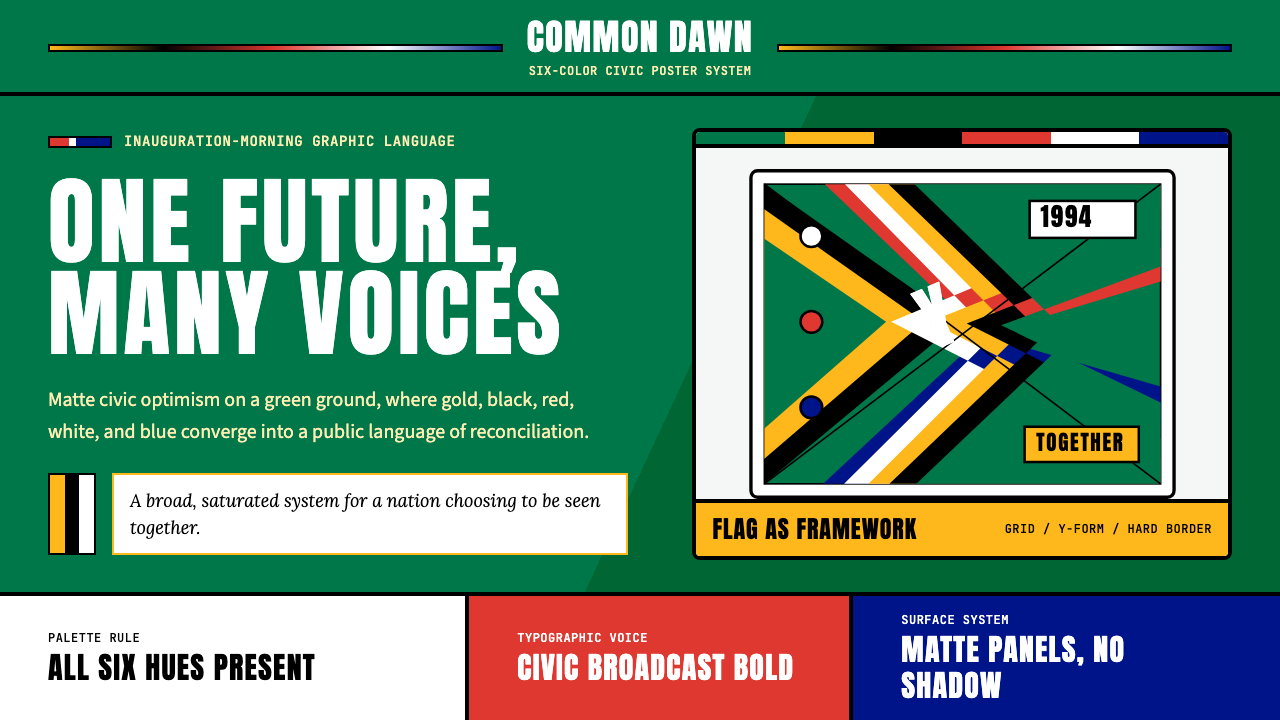
South Africa's Rainbow Nation visual language is the design of hope made concrete — a six-color civic palette born in the inauguration morning light of 1994 and still legible as the most optimistic graphic act of the post-Cold-War world.
South African Rainbow Nation 1994 in brief
South African Rainbow Nation 1994 is a civic design system rooted in one of the most politically charged graphic decisions of the twentieth century: the adoption of a new national flag on 27 April 1994, the day Nelson Mandela was inaugurated as South Africa's first democratically elected president. The flag's six-color Y-form — merging the green, black, and gold of the African National Congress liberation movement with the red, white, and blue of the outgoing Afrikaner-led republic — made visual compromise look not like defeat but like triumph. No color was erased; every strand of the nation's contested history was woven into a single converging form.
The aesthetic system that grows from this flag is matte, saturated, and unapologetically bold. It draws on the visual culture of the transition years: the broadcast graphics of SABC television during the election coverage, the banknote typography of the Mandela era, and the documentary photography of 1994 to 1999, when South Africa was covered by the world's press as a living proof of political possibility. The result is a palette that feels neither colonial nor merely pan-African but specifically South African — inclusive of all the nation's constituent colors, structured around the logic of convergence and forward motion.
The system resists minimalism. Where other contemporary civic identities sought restraint, the Rainbow Nation visual language insists on presence. Color is not used sparingly or symbolically in the way of modernist design traditions; it is used fully, celebratorily, as evidence of abundance rather than scarcity. The Y-form itself encodes this philosophy: multiple streams meeting and merging into one, moving forward together. Applied to interfaces, presentations, or editorial work, the style carries that same directional energy — it points forward, it includes, it does not exclude.
Where does South African Rainbow Nation 1994 come from?
The flag that gave birth to this visual system was designed in remarkable haste. As the 1994 elections approached, South Africa still flew the apartheid-era flag — a design carrying associations with racial oppression that made it politically impossible to retain. A national competition failed to produce an acceptable design. With weeks to spare, State Herald Frederick Brownell created the six-color Y-form flag almost single-handedly, working from a brief requirement: incorporate the ANC's traditional colors alongside those of the existing flag, and find a form that reads as forward motion. He submitted the design as a provisional solution, and it was adopted permanently. The speed of its creation has become part of the flag's mythology — a symbol improvised under pressure that somehow captured everything.
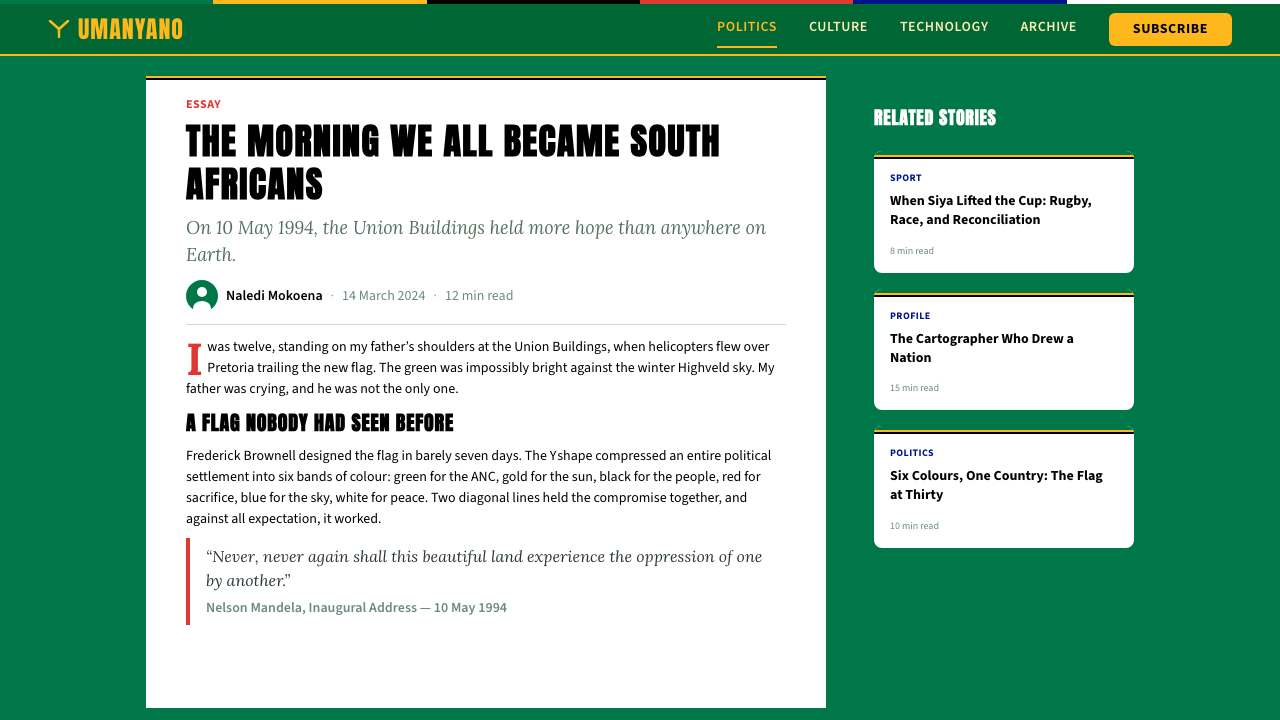
The inauguration on 10 May 1994 at the Union Buildings in Pretoria became the central visual event that anchored this aesthetic. For one morning, the building's sandstone facades, the ceremonial green lawns, and the new flag formed a backdrop against which Mandela's appearance in his green-gold Madiba shirt — a garment that would itself become a design icon — was broadcast to a global audience. The palette of that morning — saturated national greens and golds in strong midday light, with the ceremonial red and the blue sky of a Johannesburg autumn — entered the visual memory of everyone who watched. South African graphic design of the following decade consistently returned to these colors as reference.
The Truth and Reconciliation Commission, chaired by Archbishop Desmond Tutu from 1996 to 1998, extended the visual language of the transition into a sustained national project. The TRC's public hearings produced a distinctive aesthetic of transparency and witness: large public venues, broadcast on live television, with diverse South Africans — Zulu, Xhosa, Afrikaner, English, Coloured, Indian — appearing together in a shared civic frame. The graphic design of the period absorbed this imagery, using the full national palette to signal inclusion rather than neutrality, boldness rather than bureaucratic calm.
By the time of the 2010 FIFA World Cup — hosted in South Africa and accompanied by a graphic identity that drew directly from the Rainbow Nation visual tradition — the style had matured into a global recognizable South African aesthetic. The tournament's official design, the vuvuzela as acoustic symbol, the Bafana Bafana kits, and the urban murals commissioned across Johannesburg and Cape Town all spoke the same saturated, multi-color, civic language first assembled at the Union Buildings in 1994. The style was no longer provisional; it was foundational.
What defines the South African Rainbow Nation 1994 look?
Color Palette
The palette is anchored by the six colors of the national flag — a mid-tone national green, a warm gold, a deep black, a bright white, a vivid red, and a clear blue — used at full saturation rather than muted or tinted. In practice, ANC green dominates as the primary ground color, with gold serving as the principal action color. The red, white, and blue take supporting roles, appearing in accents, typographic elements, and structural dividers. The key characteristic is that all six are present — the system signals inclusion by refusing to let any strand drop out.
The Y-Form as Compositional Logic
The Y-shape of the flag is not merely a flag motif — it is a compositional philosophy. Multiple streams converge toward a single forward-pointing form. Applied to layouts, this translates into diagonal energy, converging lines, and compositions that feel directional rather than static. Color blocks do not sit passively in rectangular fields; they move toward a common vanishing point. This gives Rainbow Nation design a kinetic quality rare in civic identity systems, which typically favor stability and symmetry.
Saturation and Matte Finish
Colors are deployed at full, unmodulated saturation — not reduced, not tinted, not softened by transparency. The surface quality is matte rather than glossy, referencing the flat-ink printing of South African broadcast graphics and banknotes from the Mandela era. This matte, saturated combination gives the style a civic rather than commercial character: it reads as public, as official, as belonging to everyone. The absence of gradients or sheen reinforces the style's material honesty — these colors are what they are, without decoration.
Civic Typography
The typographic anchor of this style is a heavy, condensed sans-serif — the kind of letterform associated with SABC broadcast chyrons, stadium signage, and the bold logotype work of the post-apartheid public institutions. The type is always present at strong weight, set in high contrast against the color grounds. Uppercase dominates in headline settings; when body text appears, it tends toward generous spacing and open tracking, projecting legibility over the kind of tight editorial refinement associated with European print traditions. The goal is to be read across a crowd, not held in the hand.
Inclusive Representation
Unlike design systems that build visual unity by reducing diversity — choosing one ethnic reference, one cultural tradition, one color family — Rainbow Nation design achieves unity by insisting on multiplicity. All six flag colors must be present; all strands of the national story are woven in. In photographic or illustrative choices, the style privileges images that show South African society in its diversity: the Nguni cattle, the Karoo landscape, the Cape Malay architecture, the Joburg skyline, the TRC hearings. Visual unity here is produced not by subtraction but by addition and convergence.
Bold and Unapologetic Scale
Rainbow Nation design operates at a large, public scale. Color blocks are broad, type is set at commanding sizes, and visual hierarchies are generous rather than intricate. This reflects the design culture of street murals, political banners, and broadcast television — formats where communication must work at distance and in a fraction of a second. Refinement at small scale is less important than legibility at large scale. The style is more comfortable on a billboard, a stage backdrop, or a full-bleed web hero than on a business card or a narrow sidebar.
Documentary Photographic Register
When photography is integrated into Rainbow Nation design, it tends toward the documentary register: unposed, daylight-lit, densely peopled images that read as witnesses to history rather than productions of an art director. The 1994 election queues stretching for miles, the Union Buildings inauguration crowd, the faces at TRC hearings — this photographic inheritance means that even staged images in this style carry an obligation of authenticity. Overly styled or obviously retouched photography feels alien; the visual language respects the weight of what it is commemorating.
Who shaped South African Rainbow Nation 1994?
The State Herald who designed South Africa's post-apartheid flag under extraordinary time pressure in early 1994. Brownell's decision to create a Y-form that incorporated all the colors of the competing factions — rather than choosing between them — was the foundational design act of the Rainbow Nation visual system. A trained vexillologist, he understood that a flag must work at a distance and in motion, qualities that gave the new design its bold, saturated, graphic character. His solution, submitted as a provisional measure, became permanent, making the 1994 South African flag one of the few national flags in the world that was designed and adopted within weeks.
As president from 1994 to 1999, Mandela embodied the visual culture of the Rainbow Nation period in his own person. His Madiba shirts — loosely fitted, vibrantly patterned garments in tropical prints — became a studied rejection of Western formal wear as political self-presentation, and their saturated color and bold patterning aligned perfectly with the Rainbow Nation palette. The shirts were not accidental; Mandela worked with designer Desré Bunn to develop a signature style that communicated warmth, cultural pride, and confident informality. His presidency produced an archive of visual images — the inauguration, the World Cup final, the Freedom Day celebrations — that remain the primary visual source material for this design system.
As Chair of the Truth and Reconciliation Commission (1996–1998) and the most visible public figure of the post-apartheid transition beyond Mandela himself, Tutu's presence shaped the visual culture of the period. The TRC hearings, broadcast nationally, created a distinctive civic aesthetic: the public witness, the national colors as backdrop, the deliberate inclusivity of who was seated at the table. Tutu's own deeply affective public presence — weeping openly, laughing expansively, praying in Zulu and English and Afrikaans — modeled the style's emotional range: saturated, warm, unguarded, communal. He coined the term 'Rainbow Nation' itself, crediting Mandela, and in doing so gave the entire visual tradition its name.
A South African visual artist whose satirical, bold, flat-color work has consistently engaged with the visual legacy of the Rainbow Nation project and its contradictions. Murray's most visible work operates in the tradition of political poster-making — high contrast, declarative type, saturated color — while subverting the optimistic iconography of the liberation movement to comment on corruption, inequality, and the betrayal of the transition's promise. His practice demonstrates that the Rainbow Nation visual system is not a closed historical document but a living graphic language that can be deployed critically as well as celebratorily.
The graphic identity developed for South Africa's hosting of the 2010 FIFA World Cup — the first World Cup held on African soil — represents the most internationally visible deployment of the Rainbow Nation visual system. The tournament's identity drew on Ndebele geometric patterns, the flag's six colors, bold sans-serif display type, and a documentary photographic aesthetic to produce a design language understood globally as specifically South African. The identity gave the visual system its international currency and confirmed that it had matured from a political emergency solution into a fully realized, internationally legible design tradition.
How do you use South African Rainbow Nation 1994 today?
Applying the Rainbow Nation visual system requires understanding its core logic before reaching for the palette: this is a style about convergence, inclusion, and forward motion — not simply a six-color South African flag deployed decoratively. A designer who uses only the green and gold, or only two of the six colors, is misreading the system. The entire premise is that all streams are present and meeting. The full palette, used in appropriate proportion, is what communicates the style's meaning rather than simply its appearance.
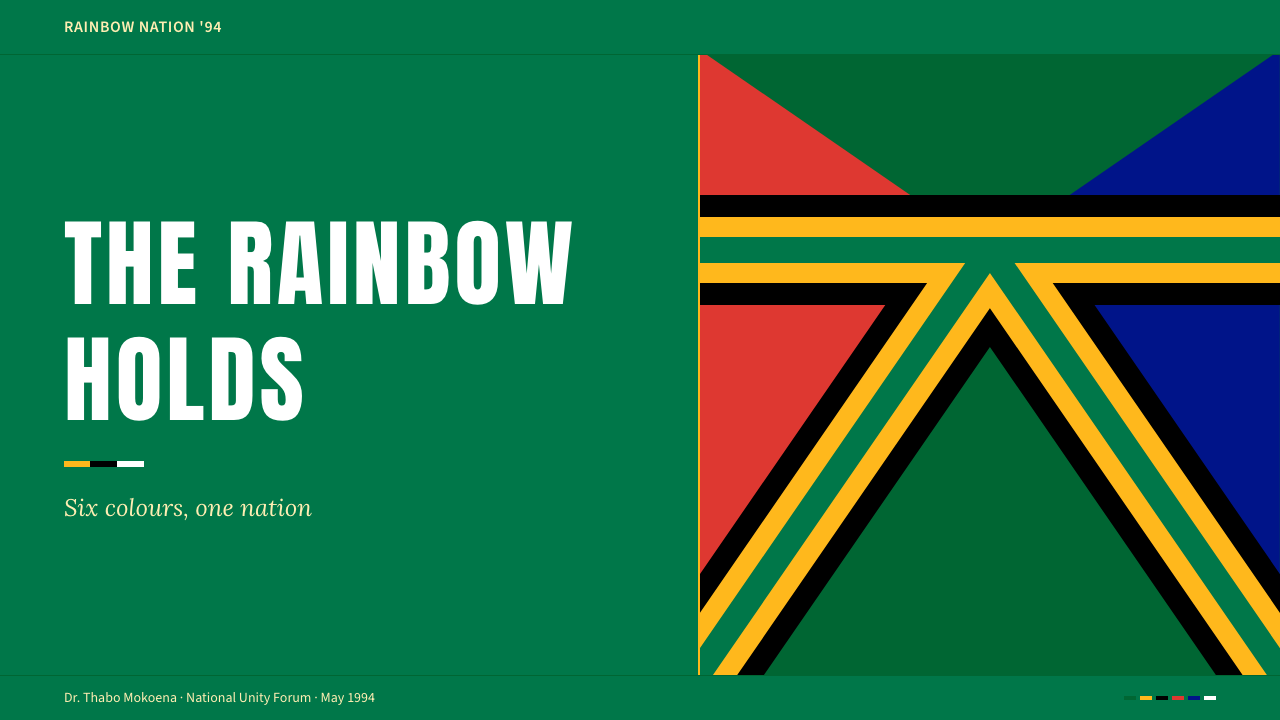
For presentation slides, the style excels at cover pages and section dividers where bold visual statements serve well. A cover built in this system might use national green as the dominant background, gold for the title type, and one of the secondary colors — red or blue — as a geometric accent element or horizontal band. The Y-form composition logic can be adapted into diagonal layouts where two color blocks converge behind a centered title. Content slides should be more restrained: black type on white or cream, with color reserved for data visualization, callout labels, or key-term emphasis. Data slides benefit from the full palette: use distinct flag colors for distinct data series, keeping bars and segments at full saturation to maximize readability.
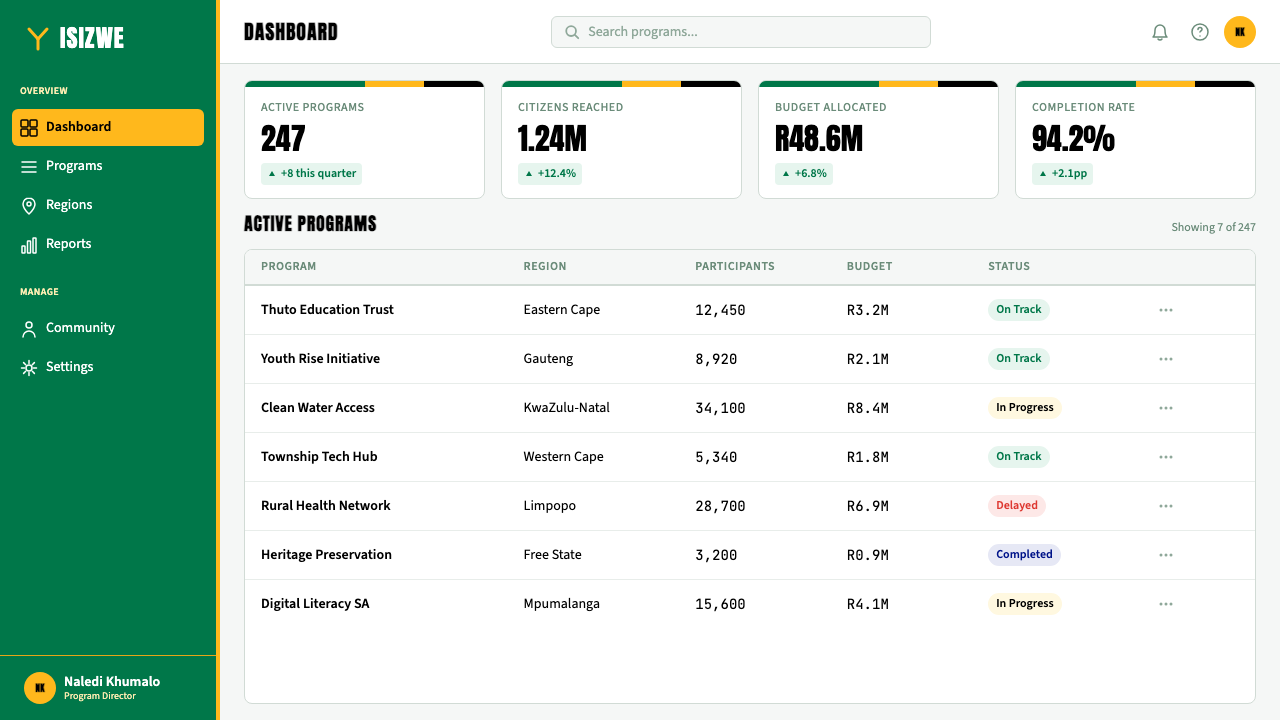
For web and digital interfaces, the style is most at home on civic, educational, or culturally oriented platforms where inclusivity and warmth are core values. Dashboard layouts can use national green as a sidebar color, gold for primary action buttons, and the neutral black-and-white field for data-dense content areas. The palette's high saturation means that color should be used for large, deliberate elements rather than fine-grained detail — a broad hero band, a full-width color block, a large icon fill — not for tiny tags or hairline borders. Card components should use shadow rather than border to define boundaries, allowing color to belong to the content field rather than the framing device.
For editorial and marketing work, the style's poster-like scale and saturation make it effective for campaign materials, cultural event identities, and public-interest communications. Full-width feature blocks alternating between the six flag colors create a powerful sequential reading experience. Typography at a commanding, condensed weight reads as authoritative without being cold — the warmth of the palette prevents the severity that would result from the same approach in a monochrome system. Avoid using the style for luxury or highly exclusive positioning; the system's values are fundamentally egalitarian and democratic, and it reads as incongruous in premium-brand contexts that depend on scarcity signals.
A common mistake when applying this style is treating it as an exercise in maximum saturation — using all six colors at equal weight across every element of a layout, producing visual chaos rather than visual convergence. Authentic Rainbow Nation design has a clear hierarchy even within its palette: green grounds, gold acts, and the remaining colors serve. A second frequent error is using the colors at reduced saturation or in tinted, pastel variants, which produces a palette that looks neither South African nor of any particular tradition — a misremembering of the style's essential boldness. The six colors at full strength, in a composition that builds toward a focal point, is what makes the system work.
South African Rainbow Nation 1994 — FAQ
Is Rainbow Nation design the same as pan-African design?
They overlap but are distinct. Pan-African design typically draws on the red, black, and green of the pan-African flag adopted in 1920, together with Kente cloth patterns, Adinkra symbols, and West African visual traditions. Rainbow Nation design is specifically South African and incorporates colors that would be considered colonial in a pan-African context — notably the red, white, and blue of European national flags — because the South African project was about incorporating and transforming all of the country's histories rather than rejecting one in favor of another. The result is a visual system with more internal tension than pan-African design, and arguably more complexity, because it insists on holding contradictory inheritances together.
How do you prevent the full six-color palette from looking chaotic?
Through strict hierarchy and proportion. In authentic Rainbow Nation design, the six colors are not used at equal weight. National green occupies the largest surface area as the ground. Gold — the action color — occupies the next largest share and draws the eye to the most important elements. The remaining four colors — red, white, blue, and black — appear in progressively smaller proportions, mostly in accents, typographic elements, and geometric detail. This hierarchical structure keeps all six colors present without visual noise. A useful test: if you cover the green ground and the result still reads as South African, the green is not dominant enough. The green should be the unmistakable base from which everything else departs.
Does the style work in a digital dark-mode context?
With care. The original visual system is strongly light-ground: the white band of the flag, the cream-and-daylight quality of the inauguration photographs, and the SABC broadcast aesthetic all point toward light backgrounds. A dark inversion is possible — using deep black as the ground, which allows the gold and green to vibrate against it with great intensity — but it risks losing the civic, inclusive warmth of the original and sliding toward something more dramatic and exclusive. If using a dark ground, the gold should remain the dominant action color rather than white, which can feel too stark. The black-ground variant works well for special events, cultural celebrations, and brand expressions that want richness over openness.
Is this style appropriate for non-South African contexts?
Yes, with awareness of what is being referenced. Rainbow Nation design carries a specific political and historical meaning — it commemorates one of the most celebrated peaceful transitions in modern history and is built from the colors of a specific national flag. Using it outside South Africa requires acknowledging that the style has content, not just appearance. Projects that share the system's values — civic inclusion, the resolution of conflict through dialogue, the possibility of national renewal — can draw on it credibly. Projects that invoke the visual language merely for its colorful boldness without any relationship to its meaning risk a kind of aesthetic appropriation. The most successful non-South African uses of the style tend to be in pan-African, post-conflict, or democracy-celebrating contexts where the values genuinely align.
How does this style differ from other post-colonial national identity systems?
Most post-colonial national identity systems resolve the tension between colonial and indigenous visual traditions by favoring one over the other — either reclaiming pre-colonial iconography and color traditions, or modernizing within an inherited European graphic framework. South Africa's Rainbow Nation system did something structurally different: it refused to resolve the tension at all. The flag and its derived visual language hold both in dynamic coexistence, using the Y-form to represent convergence rather than replacement. This makes the South African system unusual among post-colonial identities for its formal embrace of visual contradiction as a political statement. The result is more complex than most national identities, more visually demanding, and arguably more honest about the actual texture of a post-colonial society.
Related design styles
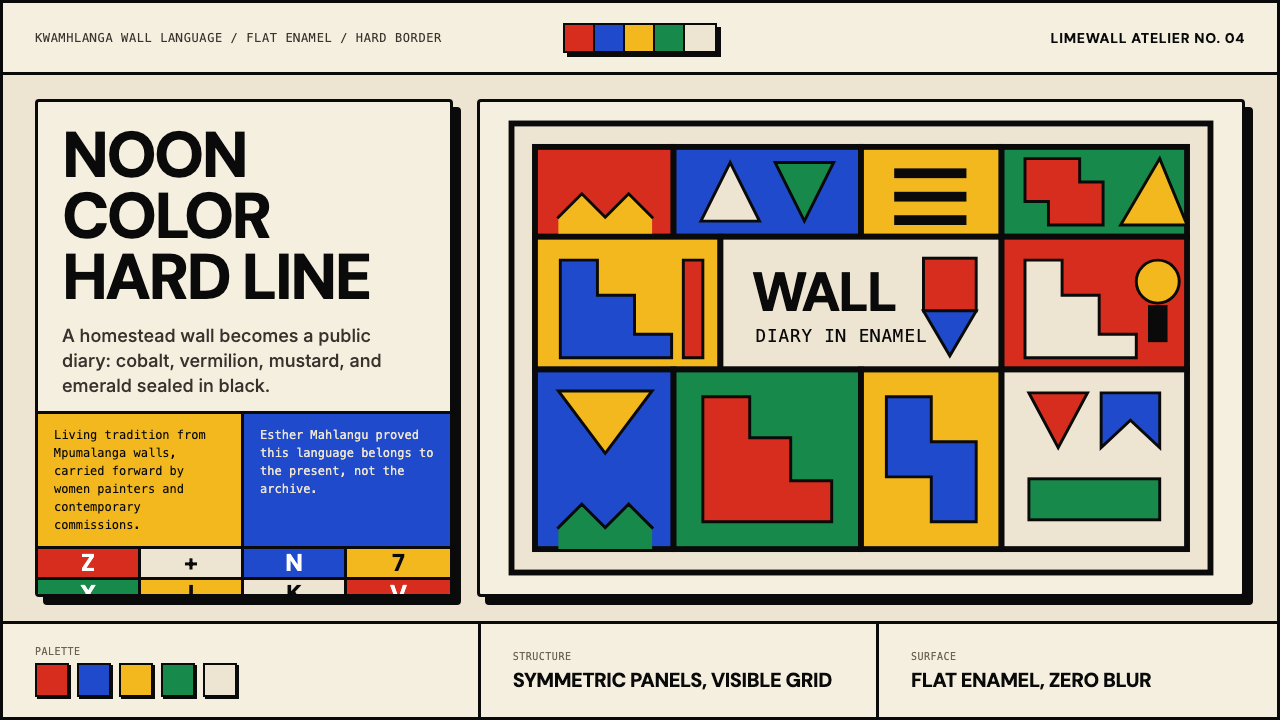 South African Ndebele House PaintNoon color, hard border. Vermilion, cobalt, mustard and emerald lock into a w…
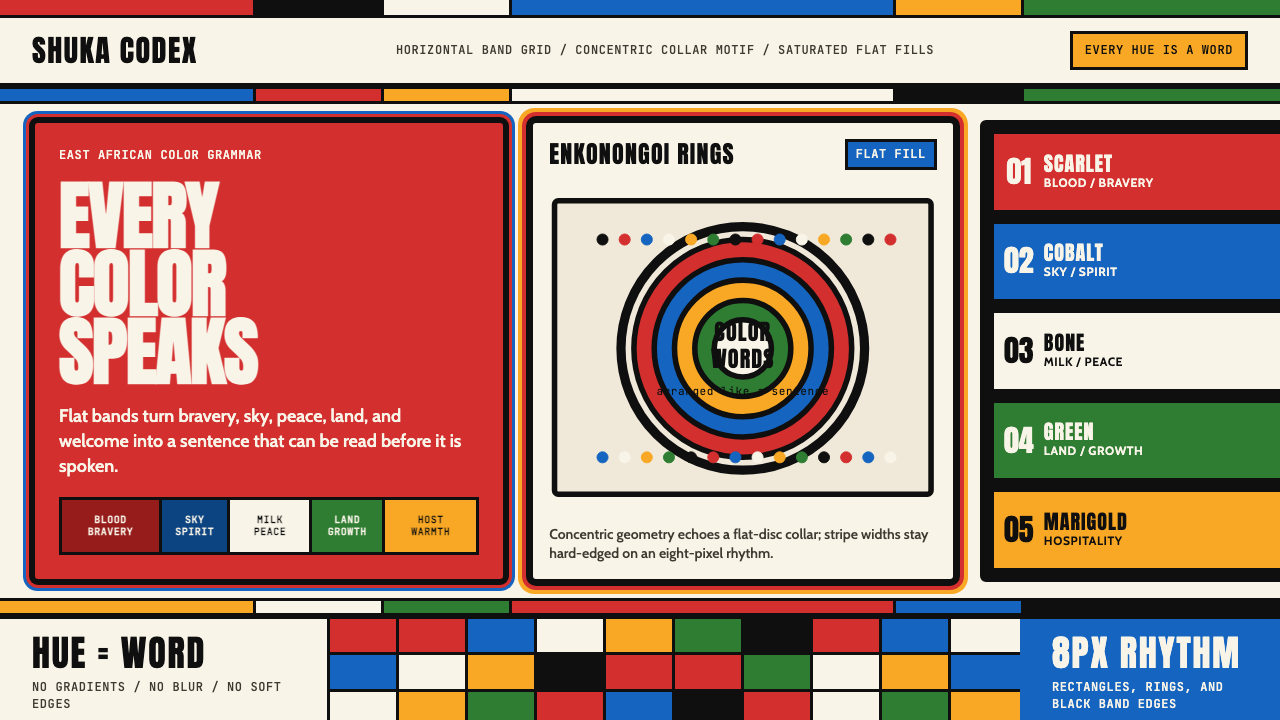 Maasai Shuka & BeadworkColor becomes language. Scarlet bands, cobalt panels, and concentric bead rin…
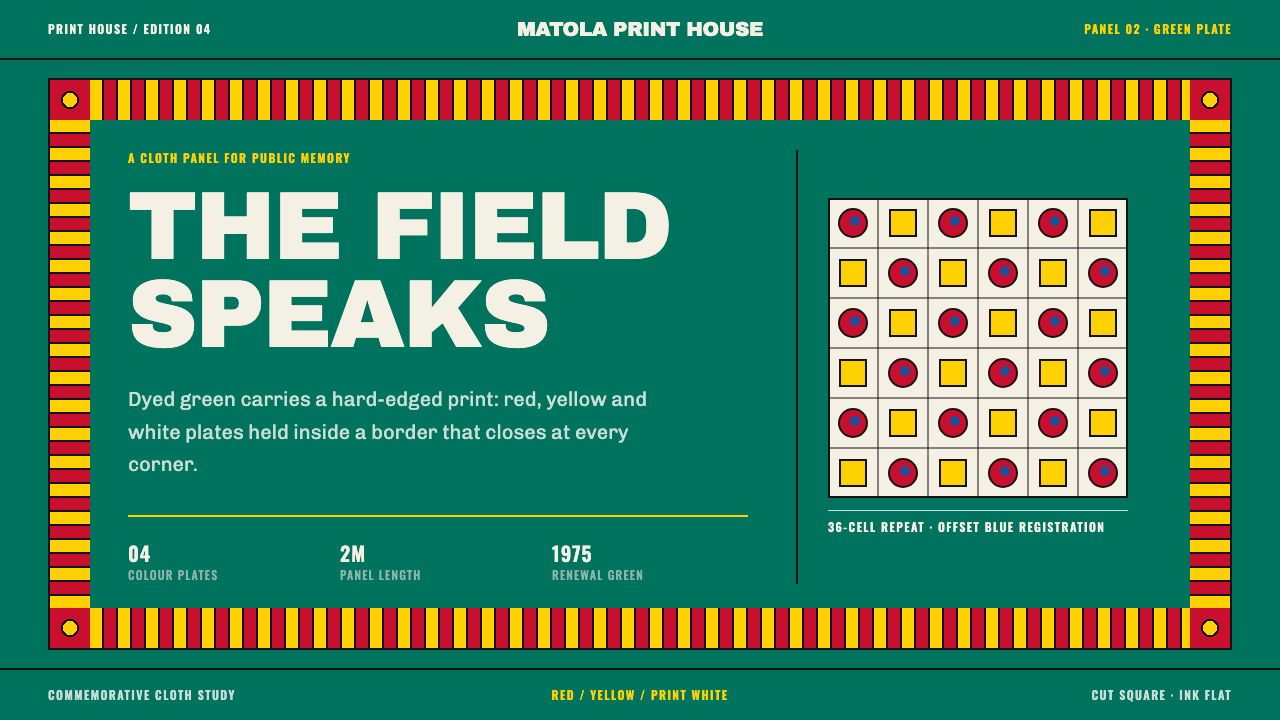 Mozambican CapulanaThe border makes the field speak. Opaque red-yellow plates repeat on renewal…
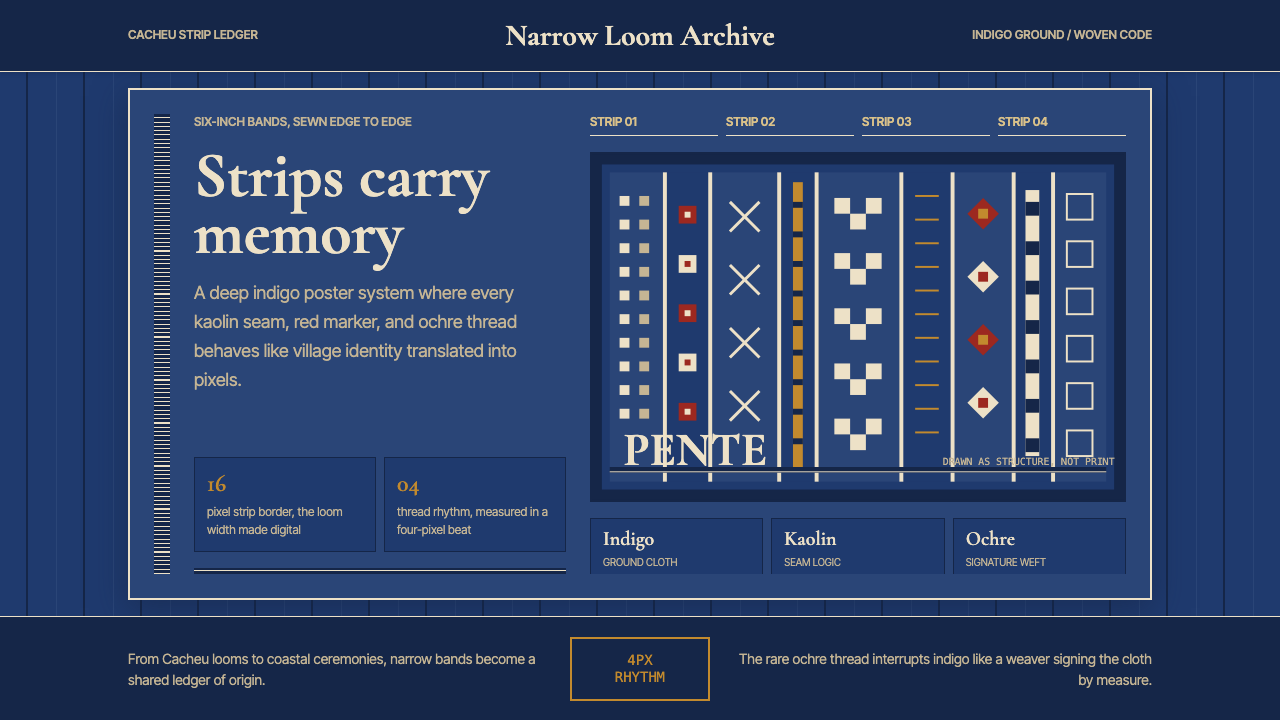 Bissau-Guinean Pano de PenteIndigo remembers. Narrow bands and kaolin seams turn weave grammar into pixel…
 Fon Applique Banner AbomeyRoyal cloth speaks plainly. Flat saffron, green and indigo silhouettes on bla…
 Grenadian Spice & Nutmeg FlagSpice becomes sovereign. Grove green, flag red, brass borders, and serif ledg…