What is Sotho Litema Wall Mural?
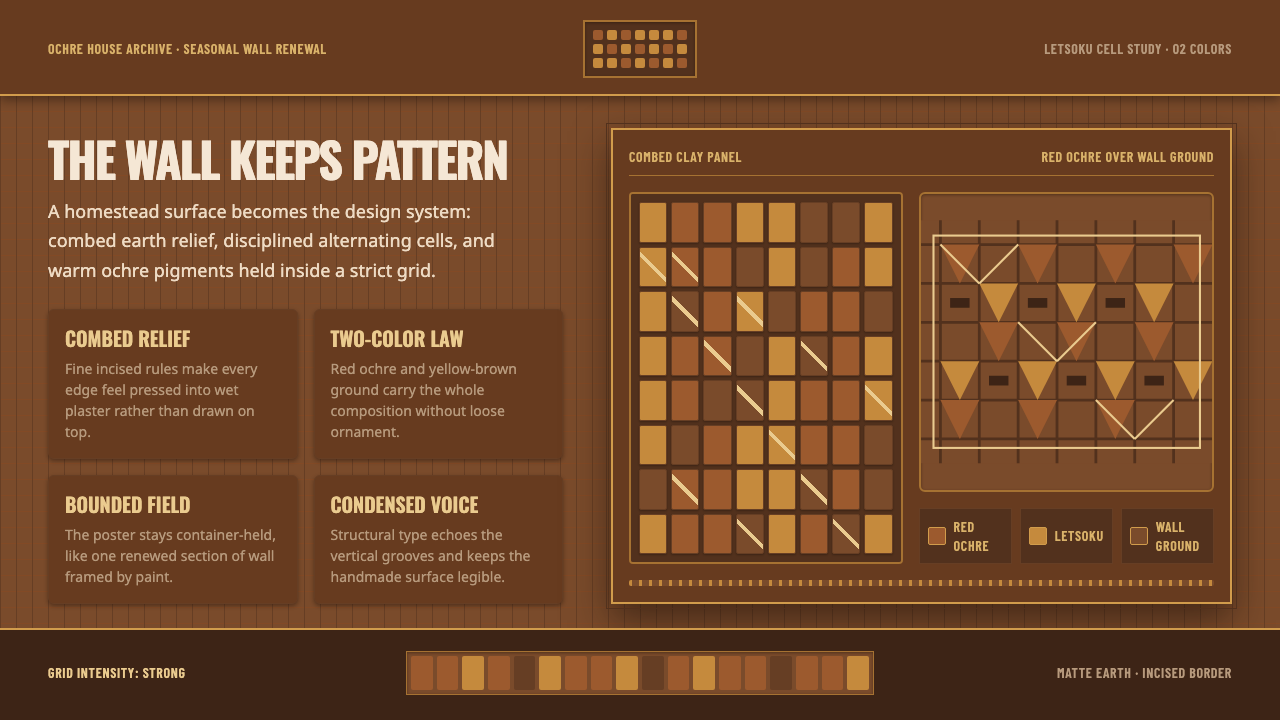
Sotho Litema turns the homestead wall into a living field of earth, rhythm, and remembered touch.
Sotho Litema Wall Mural in brief
Litema are the geometric wall murals made by Basotho people in Lesotho and the Free State of Southern Africa. They are created by women on the exterior walls of homesteads, where wet plaster made from clay and dung becomes both surface and medium. Before the wall dries, its face is combed, scratched, and pressed into dense symmetrical designs. The resulting relief is then picked out with letsoku, an earth-ochre pigment, so that pattern emerges from the very material of the wall rather than sitting on top of it as an independent image.
This is a mural tradition in which the ground is never neutral. The yellow-brown wall, its uneven plaster, and the marks left by fingers are all active parts of the composition. Red ochre commonly answers that earthen ground, creating a restrained contrast that feels excavated rather than applied. A Litema wall does not conceal its making: the damp clay, the combed channels, and the hand-made relief remain visible as evidence of the work.
Visually, Litema is disciplined rather than free-form. Its motifs gather into compact cells, alternating bands, and closely organized symmetrical structures. The effect is dense but not chaotic because repetition gives each form a role. Pattern does not drift across the wall as casual ornament; it holds the wall together, turning a domestic surface into a deliberate field of rhythm, repair, and communal renewal.
Where does Sotho Litema Wall Mural come from?
Litema belongs to a vernacular Basotho mural tradition that predates 1900 and continues today. Its place of origin is not a studio, academy, or named designer's workshop, but the homestead environment of Lesotho and the Free State. That setting matters. The wall is a working domestic surface exposed to weather, repair, and seasonal attention, so decoration, maintenance, and the presentation of home are inseparable activities.
The central makers named by the tradition are Basotho women. Their work begins with wet clay-and-dung plaster, a material whose color, texture, and workable softness determine the visual result. The designs are made through direct contact: combing and scratching create channels and relief before pigment distinguishes the cells. This sequence gives Litema an unusually close relationship between process and appearance. The finished image records not merely a chosen motif, but the physical order in which surface, mark, and color were made.
Letsoku earth ochre provides the tradition's characteristic chromatic emphasis. Rather than covering the wall in a broad painted field, the pigment picks out selected cells against the yellow-brown plaster. The familiar contrast of red ochre and earthen ground lets the pattern remain materially tied to the wall. Color therefore strengthens the geometry without overwhelming the relief or treating the wall as a blank canvas.
The practice continues as a communal, seasonal renewal of the homestead. This continuity is essential to understanding Litema. The mural is not simply a historical pattern archive to be detached from its setting; it is part of recurring care for a lived place. Its enduring visual force comes from that union of repeated geometry, local earth material, hand-made surface, and collective renewal.
What defines the Sotho Litema Wall Mural look?
Earthen Ground
The wall itself is the visual foundation. Yellow-brown clay-and-dung plaster supplies the ground color, the texture, and the irregular bodily presence that a flat painted backdrop would remove. The surface remains visibly material: it reads as earth shaped into architecture, not as a neutral field prepared to disappear behind imagery. Every motif must negotiate with this active ground.
Restrained Ochre
Litema usually works with only two colors, most often red ochre against an ochre-brown wall. This restraint gives the mural its concentration. Red does not arrive as spectacle or decorative abundance; it selects cells, sharpens edges, and makes the relief legible. The limited palette lets material texture and geometric order carry as much visual weight as color.
Combed Relief
The defining mark is not a smooth brushstroke but a combed or scratched channel made while plaster is wet. Relief gives the pattern a tactile dimension before pigment is added. Light, weather, and viewing angle can make these channels register differently, yet the effect remains grounded in direct handwork. The wall appears worked into pattern rather than merely painted with one.
Symmetric Cells
Compositions organize geometric forms into tight, symmetrical cells rather than loose decorative scatter. Repetition creates continuity across a broad wall while alternating arrangements prevent the field from becoming inert. A cell is both a unit of pattern and a unit of structure: it gives the eye a place to land, then directs it toward the next related form.
Dense Rhythm
Density is central to the style, but it is a controlled density. Closely spaced marks and cells build a rhythmic field in which variation happens through sequence, reversal, and adjacency rather than through unrelated motifs. The wall gains energy from accumulation while retaining calm because the system is coherent. Pattern feels woven into the surface's logic.
Visible Making
Litema preserves the evidence of its construction. Finger-combed texture, scratched outlines, wet-plaster relief, and selective earth pigment all remain readable in the finished wall. This visibility makes the mural inseparable from care and renewal. It does not perform industrial smoothness; it values the trace of collective seasonal work as part of the aesthetic result.
Who shaped Sotho Litema Wall Mural?
Basotho women are the named makers of Litema. They form the patterns directly in wet clay-and-dung plaster through combing and scratching, then distinguish selected cells with letsoku earth ochre. Their work establishes the mural's central visual fact: geometry is inseparable from touch, material knowledge, and the wall's condition while it is still workable.
The tradition continues through communal, seasonal renewal of the homestead. In that role, Basotho women do more than apply a pattern to a finished building surface: their mural work participates in renewing the visible life of home. Litema therefore carries the time of repair and return within its appearance, rather than presenting itself as a permanent detached artwork.
Because the practice predates 1900 and remains active today, Basotho women connect its continuing present to its inherited vernacular form. The source of authority is not a single celebrated author but a sustained communal practice in Lesotho and the Free State. This collective authorship helps explain why surface process, repeated geometry, and homestead renewal are all equally central to the tradition.
How do you use Sotho Litema Wall Mural today?
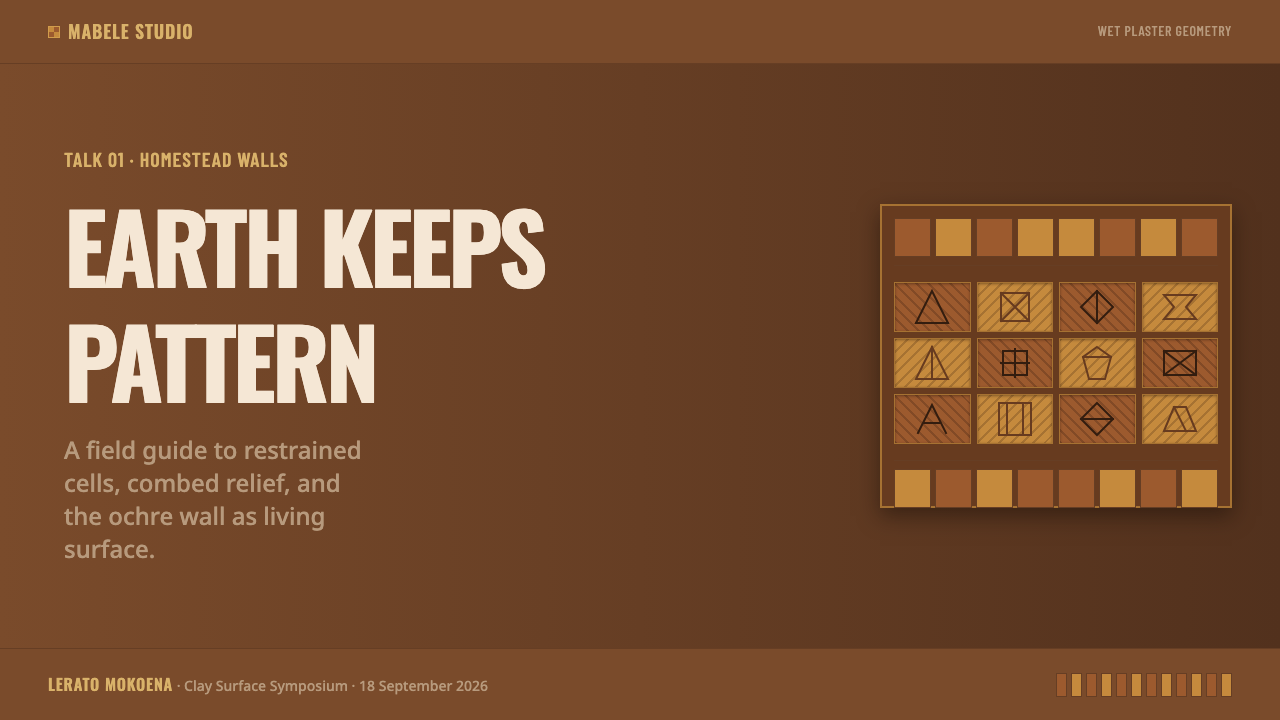
A contemporary design informed by Litema should begin with its material logic, not with a generic geometric overlay. For slide covers, use a deep earthen field that feels like plaster rather than a polished digital background, then introduce a compact band or cluster of symmetrical cells as the visual anchor. Let one ochre accent emerge from the ground instead of scattering color throughout the composition. The title should occupy a calm, protected area so the pattern reads as structure around language rather than as a decorative wallpaper behind it.
For content slides, treat the pattern as a framing system. A combed border, a narrow vertical field, or a sequence of alternating cells can divide sections and establish progression without competing with the main argument. Data slides work best when charts remain simple and their bars, segments, or markers borrow the same relationship between earthen ground and selected ochre emphasis. The aim is not to turn every chart into a mural, but to make hierarchy feel embedded in a coherent visual surface.
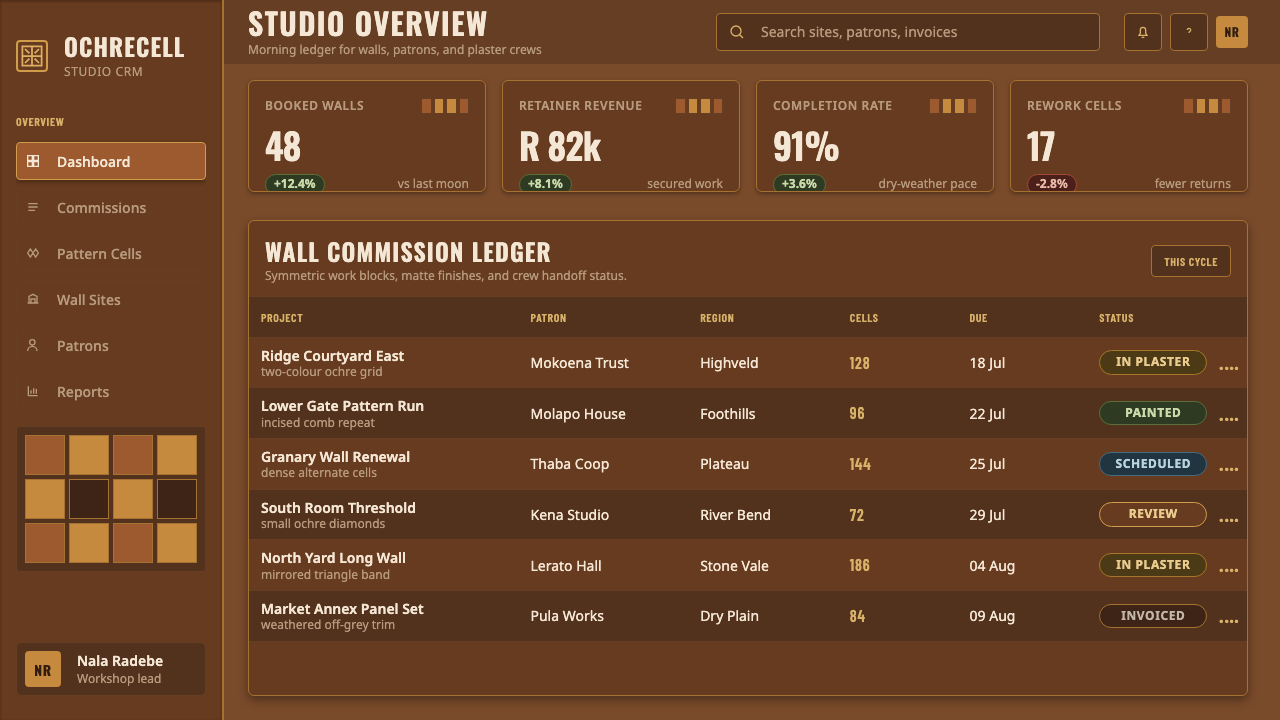
In web interfaces, Litema-derived thinking suits dashboards, status views, and pricing pages when designers need dense information to feel ordered rather than sterile. Use the mural's cell logic to structure repeated cards, categories, or comparison groups, while keeping the primary background materially subdued. Reserve the stronger ochre contrast for important states, selected plans, or active paths. Borders and dividers should feel incised or assembled from repeated units, not like generic decorative lines floating above the interface.
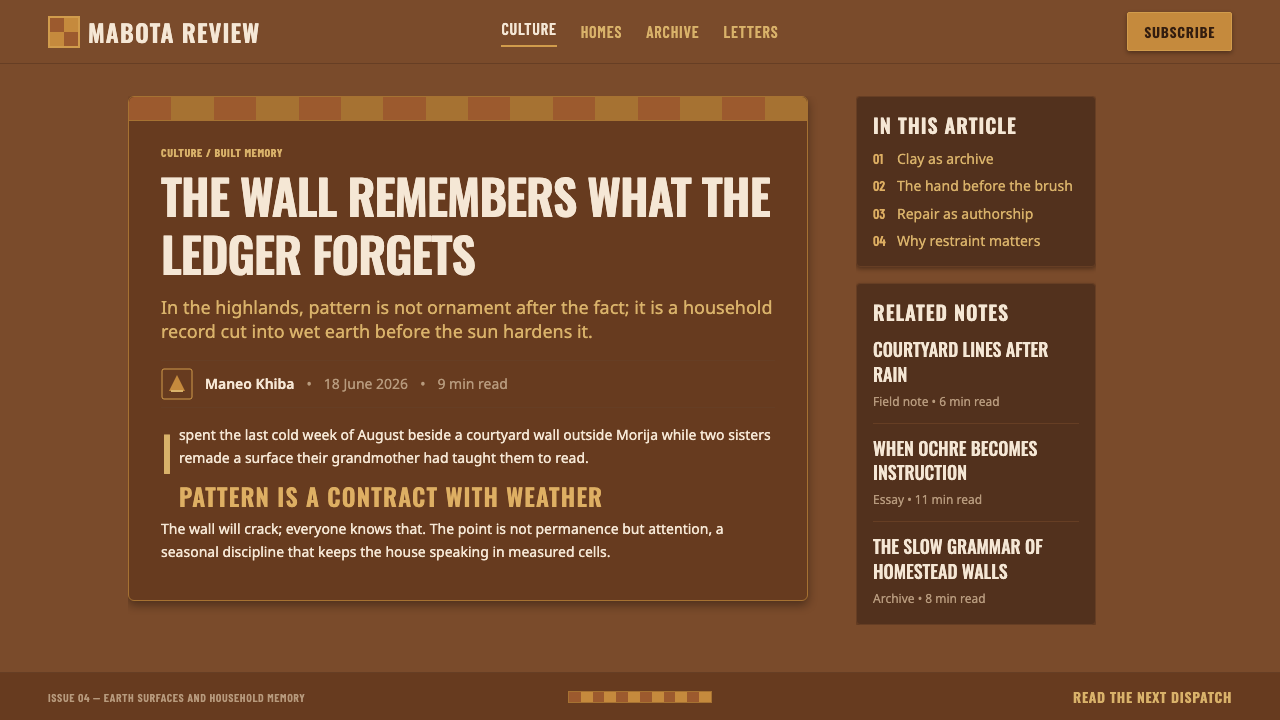
For editorial and marketing work, the style can give a page a strong sense of place and making. A long-form article can open with an earthen image field and then use repeated geometric bands to mark shifts in subject. Campaign or product pages can alternate broad quiet areas with concentrated patterned sections, allowing the eye to move between rest and density. Text should remain comfortably readable and should not be forced into every cell; the mural's power comes from its relationship between compact pattern and open wall.
The common mistake is to treat Litema as a source of anonymous tribal geometry and reproduce only its shapes. That loses the tradition's defining conditions: wet clay-and-dung plaster, finger-combed relief, earth-ochre contrast, symmetry, and seasonal communal renewal of the homestead. A more faithful adaptation keeps the palette restrained, lets surface texture remain visible, and gives repetition a structural task. If the pattern could be swapped for any unrelated geometric decoration without changing the design's meaning, the connection has become superficial.
Sotho Litema Wall Mural — FAQ
Is Litema simply a painted geometric pattern?
No. Painting is only one part of the result. Litema begins with wet clay-and-dung plaster that is combed and scratched into relief before selected cells are picked out with letsoku earth ochre. The wall's earth color, hand-made texture, and shallow channels are integral to the image. Removing that surface process would remove a central part of the tradition's visual language.
Why is the wall ground so important in Litema?
The yellow-brown mud-plaster wall is not a blank background. It supplies the dominant material presence, the underlying color, and the visible relief created by combing. Red ochre works in relation to this ground, picking out cells rather than replacing the wall with a separate painted field. The design depends on seeing earth and pattern as one connected surface.
Does Litema rely on a broad range of colors?
Its compositions are usually restrained to two colors, most often red ochre against the yellow-brown of the wall. This limitation is not a lack of visual richness. It allows relief, symmetry, and alternating cells to remain highly legible while keeping the pattern tied to earth material. The visual interest comes from surface and repetition as much as from color.
Who makes Litema murals?
The tradition identifies Basotho women as its makers. Their work forms part of the communal, seasonal renewal of the homestead in Lesotho and the Free State. This matters because Litema is not described as a detached gallery practice: it is made on lived domestic walls through a process of maintenance, material handling, and patterned renewal.
How can a digital design reference Litema without losing its character?
Start with the relationships that make the murals distinct: an earthen ground, restrained ochre contrast, compact symmetrical cells, visible combed texture, and repetition that organizes a surface. Avoid treating the motifs as interchangeable geometric decoration. A useful digital translation lets texture and structure do real work in the layout, while keeping the pattern connected to the ideas of wall, hand, and renewal.
Related design styles
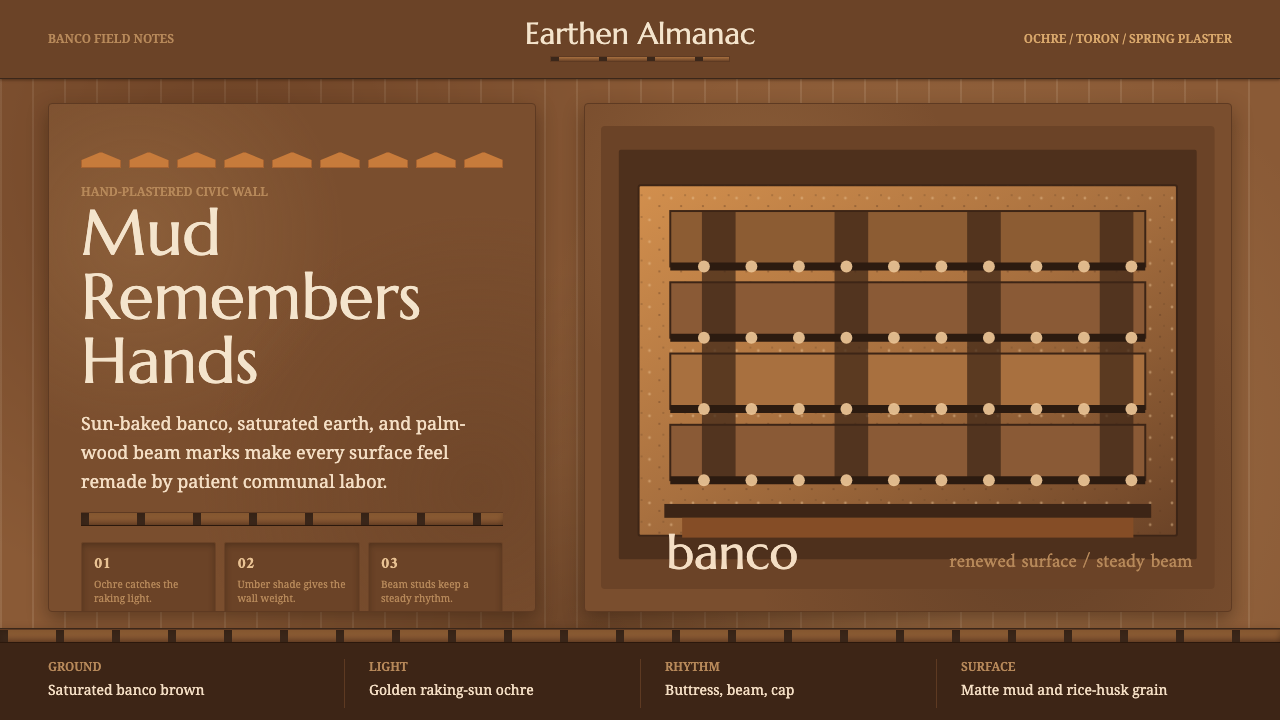 Djenné Mud MosqueBuilt from renewal. Banco brown, ochre caps, and toron grids feel hand-plaste…
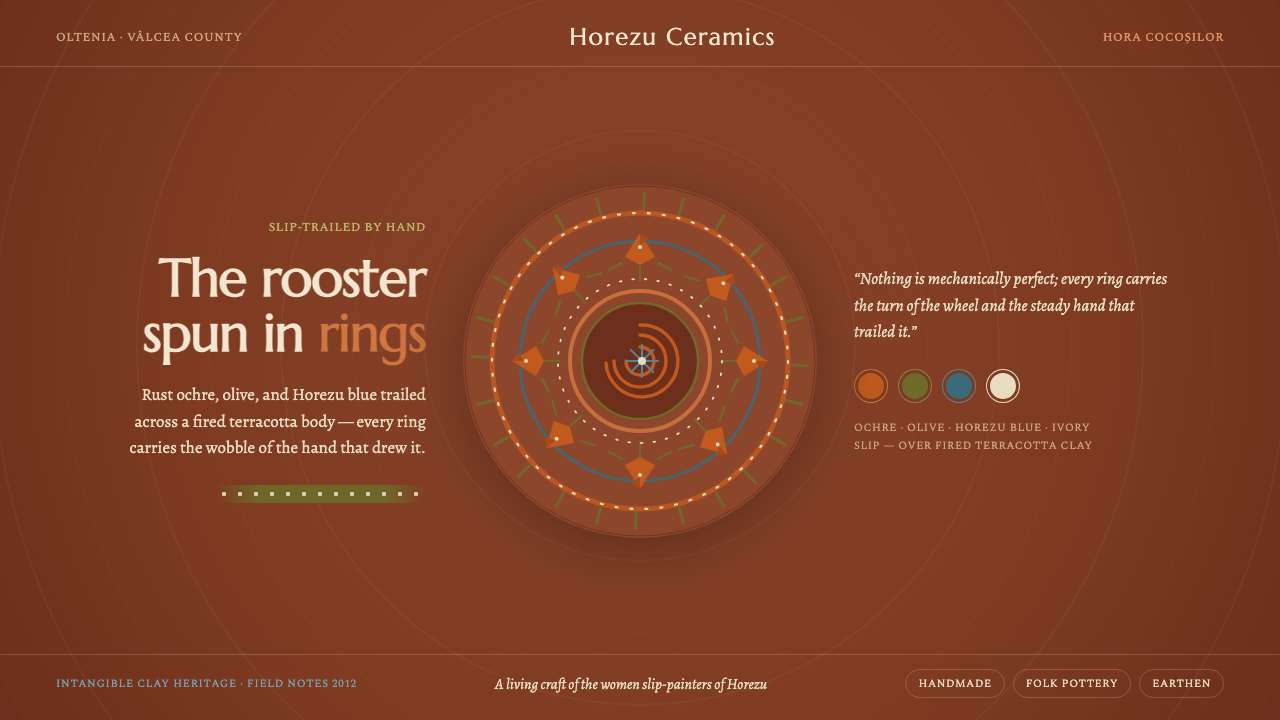 Horezu CeramicsWarm earth, steady hand. The Horezu rooster spun in ochre and olive slip acro…
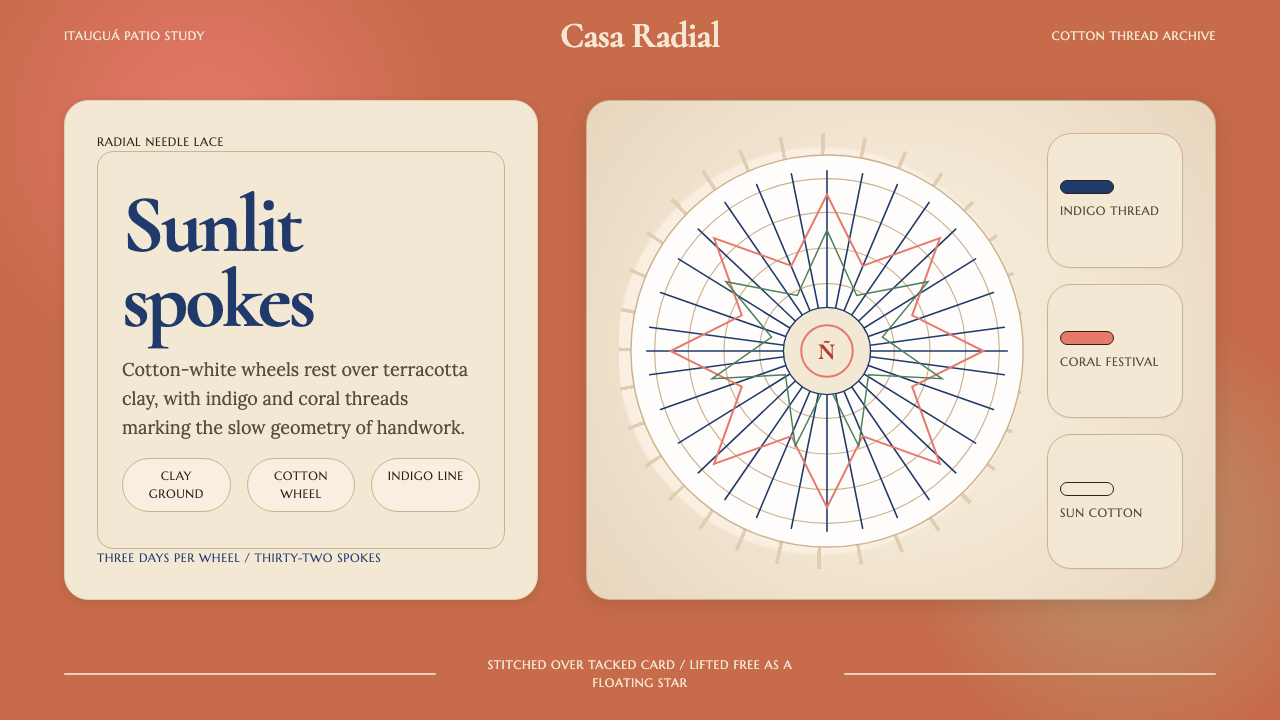 Paraguayan Ñandutí Spider-Web LacePatient lace in sunlight. Terracotta ground, Cormorant serif, indigo radial s…
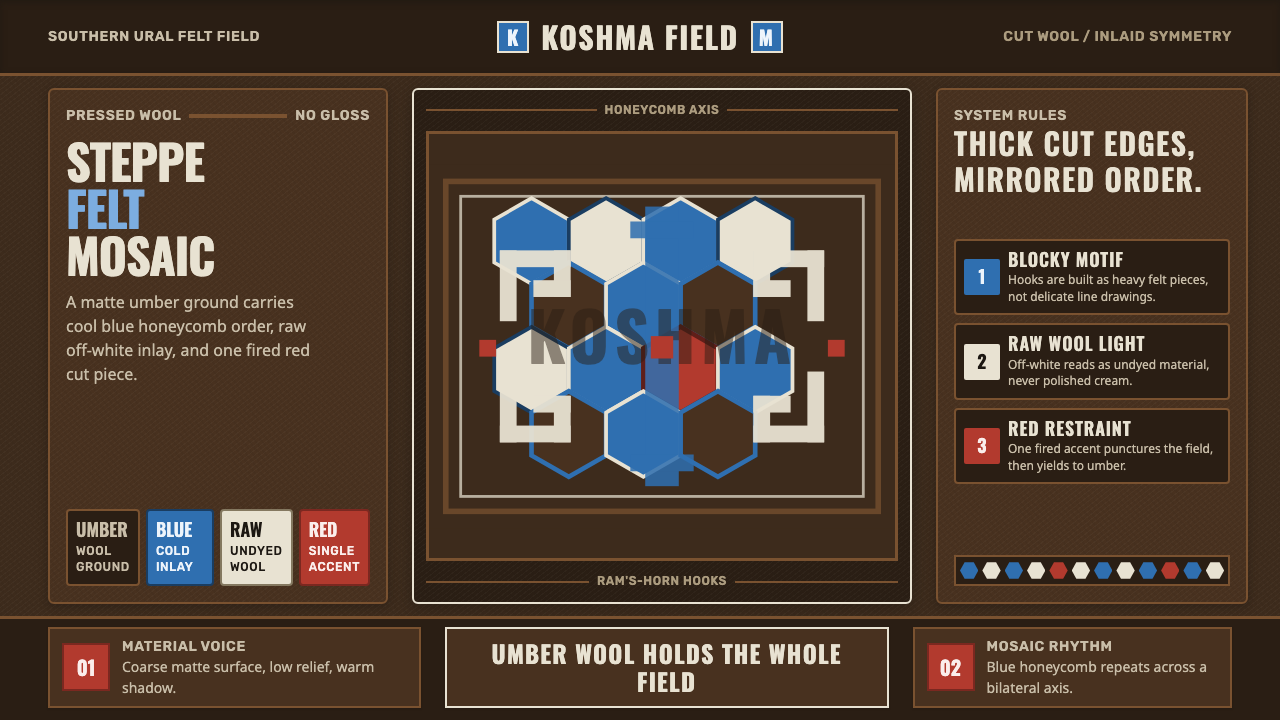 Bashkir Honeycomb Felt OrnamentSteppe craft feels weighty. Umber felt holds blue honeycomb and raw-wool hook…
 Fijian Magimagi LashingStructure becomes ornament. Tan coir diamonds bind mud-black timber in a stri…
 Fijian Masi Tapa StencilGeometry keeps ceremony. Soot-black diamonds repeat on bark beige with rust-r…