What is Sorbian Easter Egg?
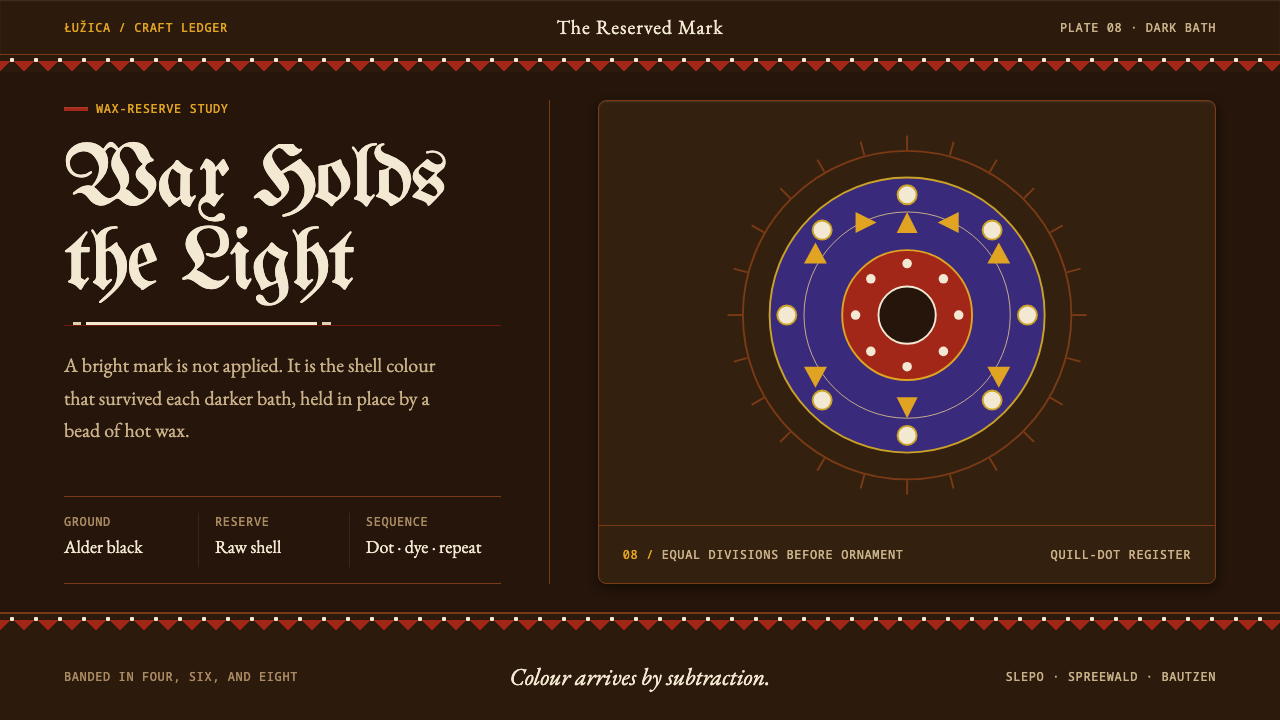
Sorbian Easter Egg is a design made by subtraction: a warm, vegetal-black shell, dots of raw shell colour held back by wax, and ornament that only ever repeats in strict rotation around a circle.
Sorbian Easter Egg in brief
Sorbian Easter Egg is a dark-ground design system drawn from the wax-decorated eggs of the Sorbs, a West Slavic minority in eastern Germany. These eggs are made by subtraction. Hot beeswax is laid on the raw shell dot by dot with a cut goose quill, and the egg is then lowered through dye baths, each darker than the last, until it comes out black. Every dot the wax covered stays the colour it was when the wax touched it.
The design translates that process into a rule about light. The page is a warm, vegetal black, like a shell dyed all the way through. The brightest note is the reserved, undyed shell colour. The ornament is built only from dots, triangles, wheat ears and sun wheels, repeated in strict rotation. Nothing is painted on top. Brightness is not added; it is protected from the dye.
The result is dark without being cold or neon. The black has a brown warmth and an organic feel, and the pale notes are the creamy colour of a raw shell rather than pure white. Pattern is dense and orderly. Each field is divided first, in even steps around the egg, and only then filled, so layouts feel like rosettes and bands with a clear geometry instead of freehand decoration.
Where does Sorbian Easter Egg come from?
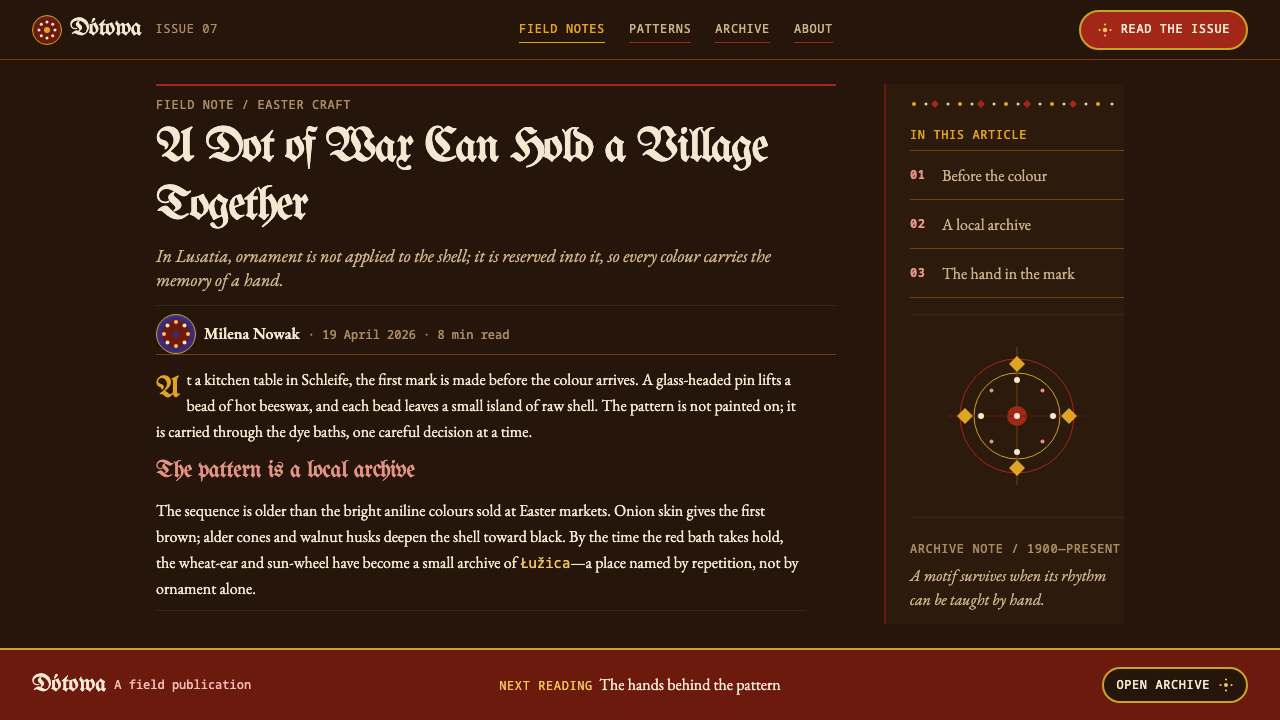
The Sorbs live in Lusatia, in the German states of Saxony and Brandenburg. The region is called Lausitz in German and Łužica in Sorbian, and it is divided into Upper and Lower Lusatia. Their Easter eggs are a seasonal craft practised in village workshops. The source dates the natural-dye practice to before 1900 and says the eggs have been made continuously up to the present day, so this is a living tradition, not a revival.
Before aniline dyes arrived, the palette was three plain words: onion skin, alder cone and brazilwood. Onion skin gave the browns, alder cones and walnut husk gave the dark colours, and brazilwood and cochineal gave the reds. The dye baths run from lighter to darker, which is why the process has to be planned from the lightest colour towards black. The design system keeps this discipline: a strictly limited natural palette, and no sudden synthetic brights.
Four techniques are named in the source, and they show how much of the tradition is a vocabulary of method. Wachsreserviertechnik is wax-resist, where wax protects the shell colour. Bossiertechnik builds ornament from wax that is left on the egg in relief. Ätztechnik etches the finished egg, and Ritztechnik scratches into it. All four turn on the same logic of what you leave and what you remove, and the design system takes the first as its main grammar while remembering the others as the surrounding family.
Every village has its own system of dots, and the rule that holds across them is that the division comes first. The egg is divided into four, six or eight equal parts, and only then are the dots placed. Freehand is not permitted; the order of work is the design. The source names the Domowina, the umbrella body of Sorbian culture, and the village workshops of Schleife (Slepo) and the Spreewald as the living tradition. The deep indigo of the Schleife area appears in the system where dense white triangles are needed, a regional exception that is kept as one.
What defines the Sorbian Easter Egg look?
Vegetal black ground
The page is a warm black, the colour a shell reaches after many baths in plant dye. It is not a pure, cold black and it is not a screen-glow black. It has a brown undertone and a soft, matte depth, as if light were absorbed into a dyed surface. This warmth is what keeps the dark ground feeling organic and handmade.
Reserved shell as the brightest note
The lightest colour on the page is the colour of the raw shell, a creamy, slightly warm off-white. It is never pure white. Because it is the brightest element, it carries all the emphasis, and it appears only where wax protected the shell. In a layout, that means highlights, dots and key figures are cut out of the dark rather than glowing on top of it.
Dots as the basic unit
Each dot is laid with a cut goose quill, one at a time, and the whole ornament grows from that gesture. Dots are small, round and set in careful groups; they form rows, clusters and the centres of rosettes. The effect is rhythmic and tactile, and it gives even a plain surface the feel of a hand-made object.
A small vocabulary of motifs
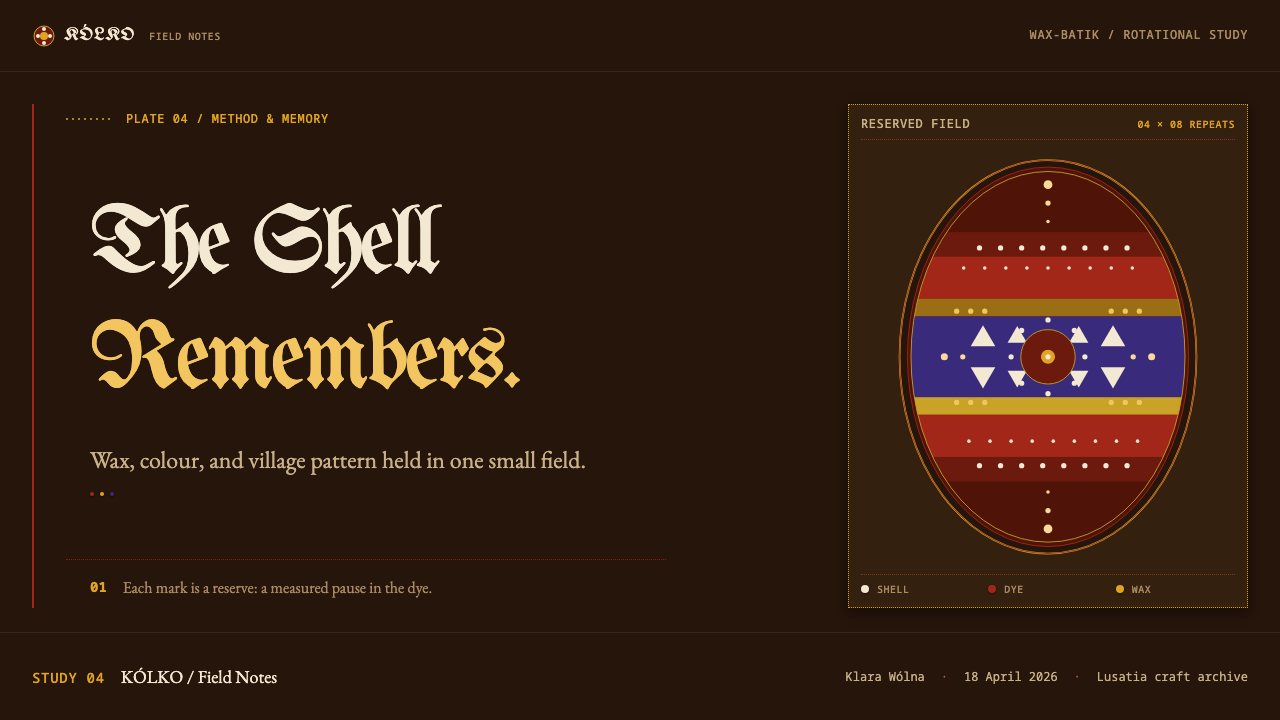
The ornament is built only from dots, triangles, wheat ears and sun wheels. This is a very small set, and the restraint is the point. Triangles form borders and bands, wheat ears add upward direction, and sun wheels become the centres of rosettes. Because the vocabulary is limited, variety comes from the arrangement, not from adding new shapes.
Strict rotational repeat
Patterns repeat around the circle in four, six or eight equal parts, and the division is decided before any dot is placed. The resulting rosettes and bands have radial order and a sense of inevitability. In layout terms this favours centred, circular and evenly spaced compositions, and rules out casual scattering or off-grid placement.
Natural-dye discipline
Before aniline dye the palette was onion skin, alder cone and brazilwood, giving browns, darks and reds. The system keeps to that family: warm, earthy, slightly muted colours, no fluorescent or synthetic accents. Where a colour other than the black and the shell appears, it should feel like something that could have been boiled from a plant.
Regional exception: Schleife indigo
In the Schleife (Slepo) area, a deep indigo-blue is used where dense white triangles are needed. The system keeps this as a regional exception rather than a second ground colour: it is used rarely, for a specific purpose, and with reference to its place. This models how the tradition itself treats variation, as local rules inside a shared method.
Who shaped Sorbian Easter Egg?
The Domowina is the umbrella organisation of Sorbian life, and the source lists it among the key figures for the style. It is an institution rather than a person, and it stands for the continuity of Sorbian language, culture and craft in Lusatia. When the design system is used for work about the Sorbs, it is the first body to look to for context and accuracy.
The workshops around Schleife, called Slepo in Sorbian, are one of the two village traditions the source names. They are the setting for the deep indigo that the system uses where dense white triangles are needed. Their name is a reminder that the style is local as well as regional, with its own habits from village to village.
The Spreewald workshops are the second village tradition the source names. Together with Schleife they show that Sorbian eggs are made by named places and communities and not by a single central style. For designers, the lesson is to cite the place when borrowing from it, and to resist merging every village into one generic folk look.
How do you use Sorbian Easter Egg today?
Sorbian Easter Egg suits work that wants a dark, warm and highly ordered look, where small pale details matter. It is at its best when a design can be built from a limited set of repeating motifs and a strong rule of division. It is less suited to loose, freeform layouts or to subjects that need bright, cheerful colour.
On slides, make the cover a dark warm field with a single rosette or band of dots and triangles, and the title in shell-coloured type. Content slides can use thin repeating borders, with dots standing in for bullets and the shell colour reserved for headings and key figures. Data slides suit dot plots and radial charts, where each point is a reserved dot and everything else recedes into the dark.
In web interfaces, the style works well as a dark mode with character: craft shops, cultural and heritage sites, calendar and seasonal pages, and tools where a calm, focused dark theme is wanted. Dividers can be rows of dots, loading states can build up a rosette step by step, and highlights can be cut out of the dark ground. Keep layouts on an even grid, because the division-first rule applies to interfaces as much as to eggs.
In editorial and marketing work, the style suits spring and Easter campaigns, folk-craft and regional-culture stories, packaging for handmade goods, and any project about patience and process. Photography of eggs should be calm and close. When the subject is the Sorbs themselves, credit the community and the villages, use Sorbian and German terms accurately, and avoid presenting the tradition as generic Slavic folk art.
The most common mistake is to add bright colour or glow. A neon accent or a gradient destroys the natural-dye logic and the sense that light survives only by reserve. A second mistake is to scatter dots at random: the rule that the division comes first is the heart of the style, and an arbitrary arrangement turns it into decoration. A third is to use pure white instead of the creamy shell colour, which makes the page look harsh and modern rather than hand-made.
Sorbian Easter Egg — FAQ
Who are the Sorbs?
The Sorbs are a West Slavic minority living in Lusatia, in eastern Germany, across the states of Saxony and Brandenburg. They have their own language and a living craft tradition, of which the wax-decorated Easter egg is one of the best known. The region is called Lausitz in German and Łužica in Sorbian, and the umbrella body for Sorbian culture is the Domowina.
How are the eggs made?
Hot beeswax is applied to the raw shell dot by dot with a cut goose quill. The egg is then dipped through dye baths, each darker than the last, until it is black. The wax protects the shell colour wherever it was laid, so each dot keeps the colour it had when the wax touched it. Other techniques, including wax relief, etching and scratching, build on the same logic.
Why is the ground black rather than white?
Because the egg is made by subtraction. The process ends in a black shell, and the pale marks are what the wax kept from the dye. The design system makes that into its rule: dark ground, warm and vegetal, with the brightest colour reserved for the places that were protected. A white ground would reverse the logic, turning a style about preserved light into one about added ink.
Why are the patterns so strictly symmetrical?
Because the division comes first. The egg is split into four, six or eight equal parts before a single dot is placed, so every motif repeats in strict rotation. Each village has its own system of dots, but the rule is shared: plan the division, then place the dot. Freehand drawing is not part of the method.
Is the style only for Easter?
No. The eggs are a seasonal craft, but the visual logic is broader: a warm dark ground, a small vocabulary of repeating motifs, light kept by reserve, and a rule of division before decoration. It suits any project about craft, patience, heritage or ordered pattern. Easter and spring are natural uses, not the only ones.
Related design styles
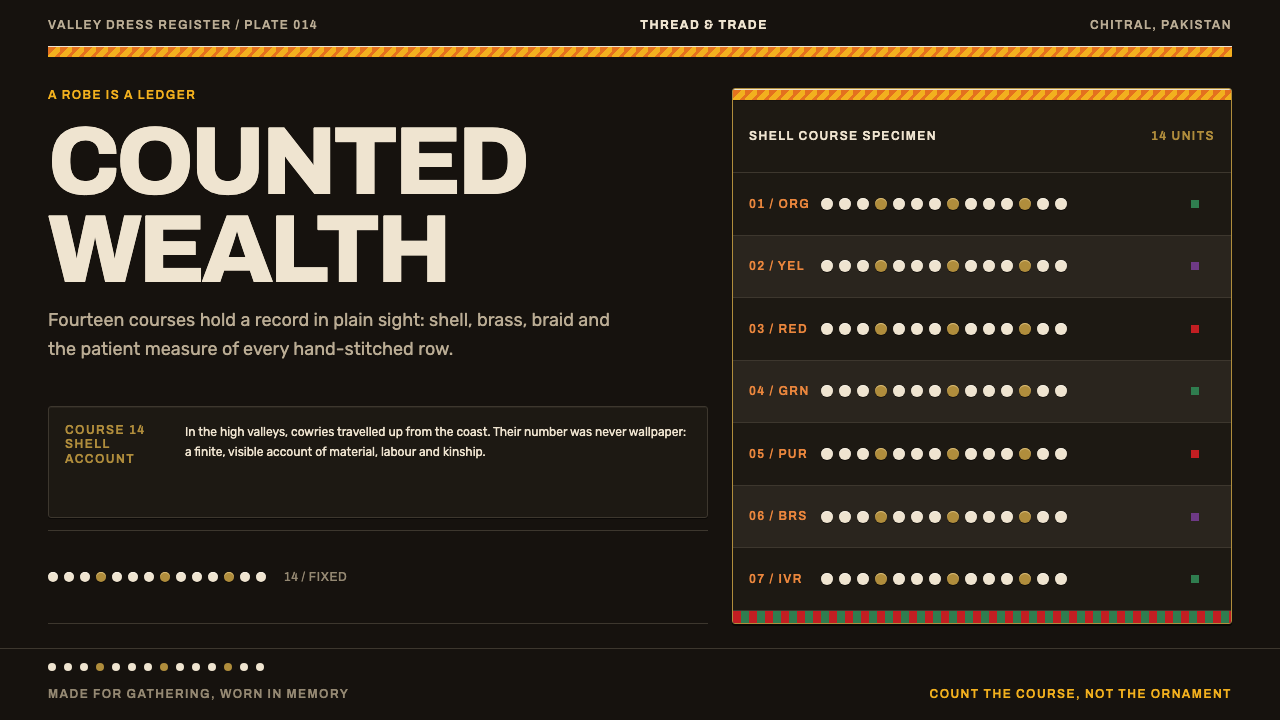 Kalash KupasDensity carries value. Ivory shell courses and orange braid are counted on wa…
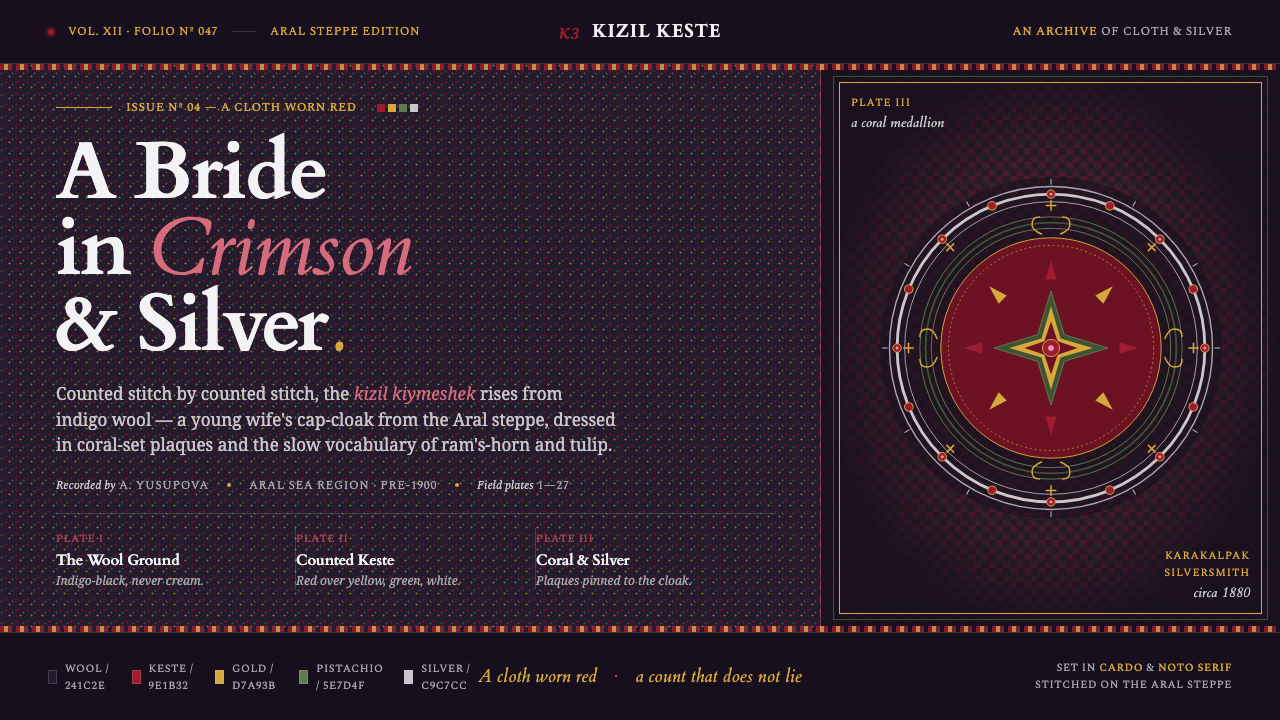 Karakalpak Kimeshek DressA cloth worn red. Crimson keste cross-stitch on indigo wool, set with silver-…
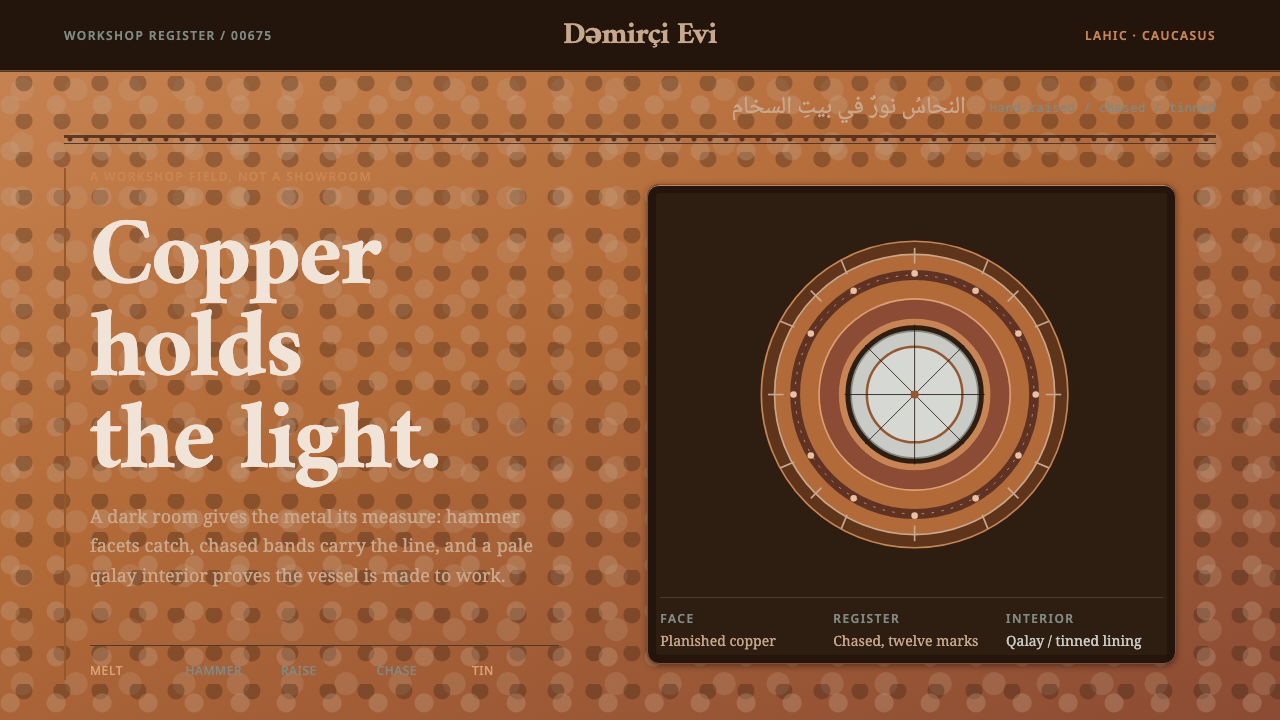 Lahic CoppersmithCopper becomes light. Soot-black bands, Amiri type, hammer facets and tin rev…
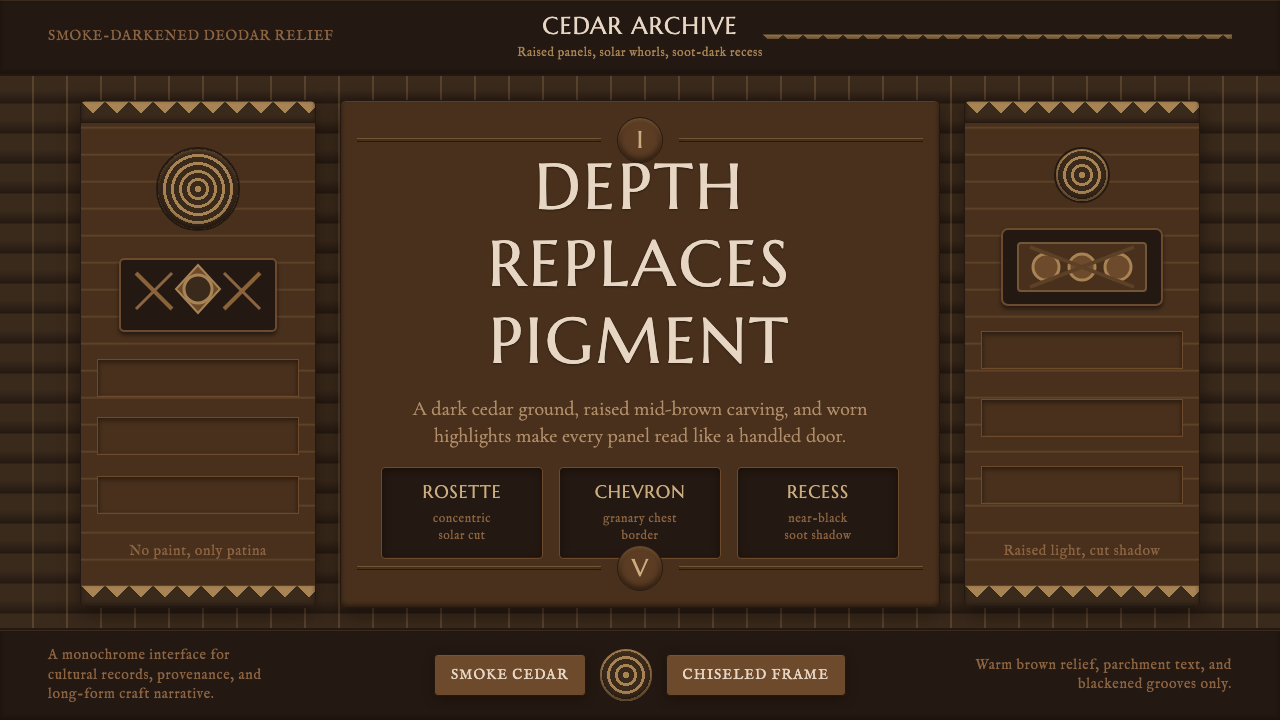 Nuristani Carved CedarDepth replaces pigment. Smoke cedar, chevrons, and rosettes carve light from…
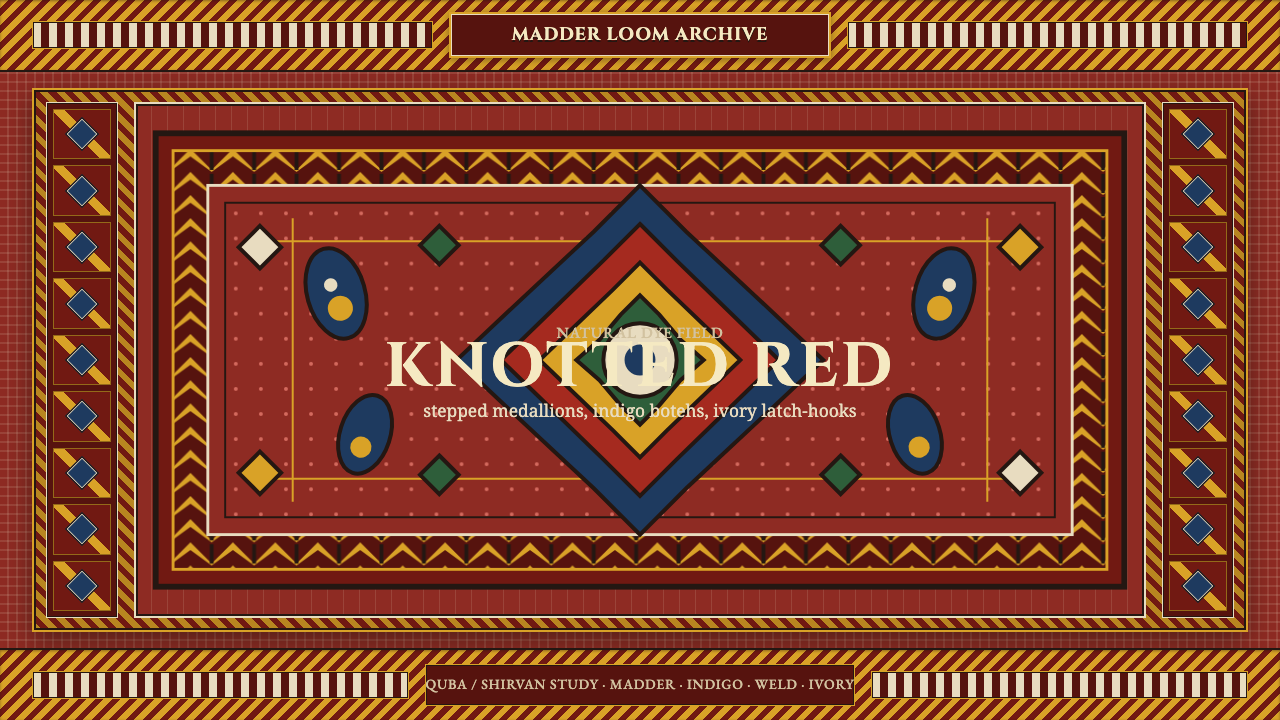 Azerbaijani Quba CarpetRed is the field. Indigo botehs and ivory latch-hooks orbit a stepped medalli…
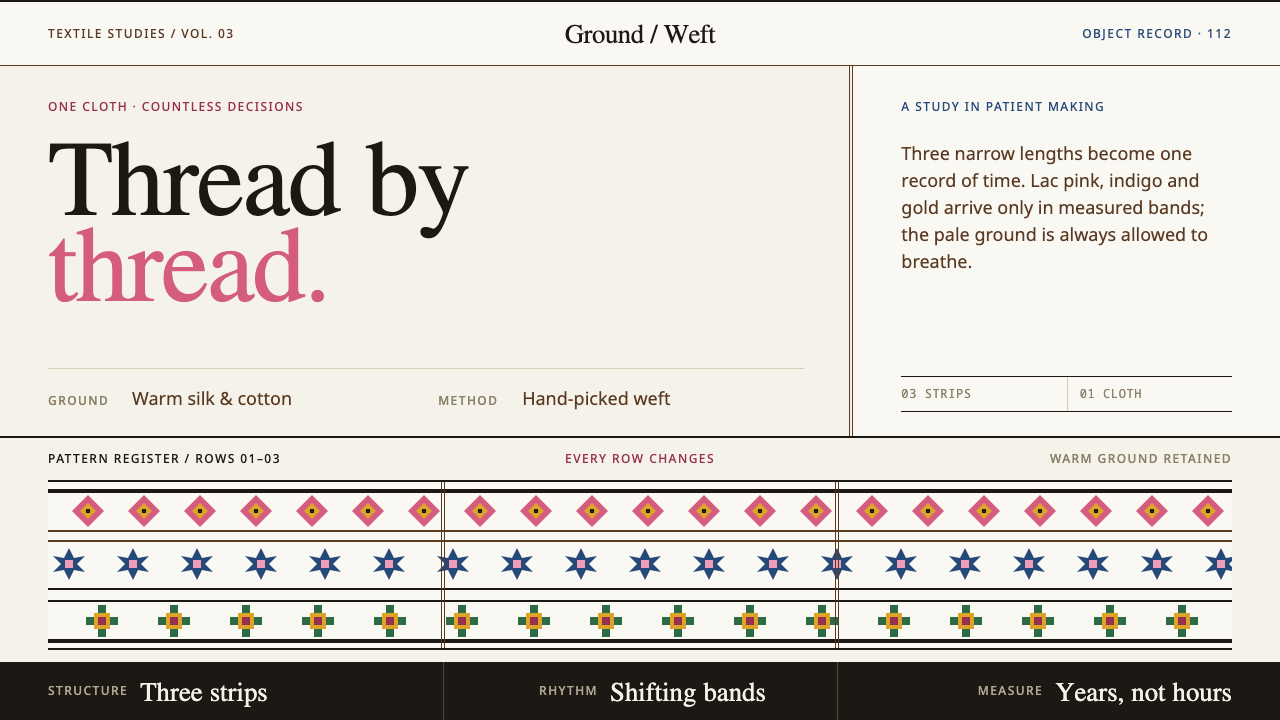 Bhutanese KushutharaPatience made visible. Lac pink and indigo bands shift across a warm silk gro…