What is Solomon Islands Nguzunguzu?
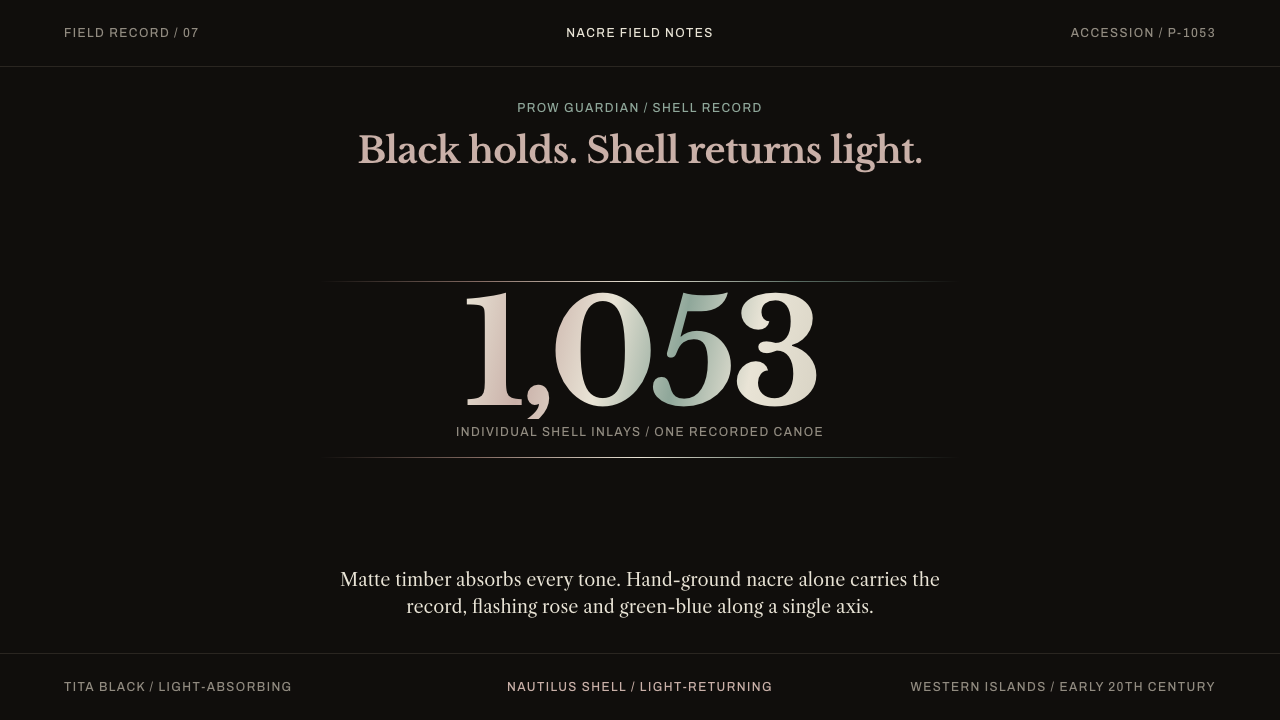
Black swallows every scrap of light in this system, and only nacre gives it back — rose and green-blue flashes surfacing along a strict central axis, exactly where a nguzunguzu once watched over a war canoe's prow.
Solomon Islands Nguzunguzu in brief
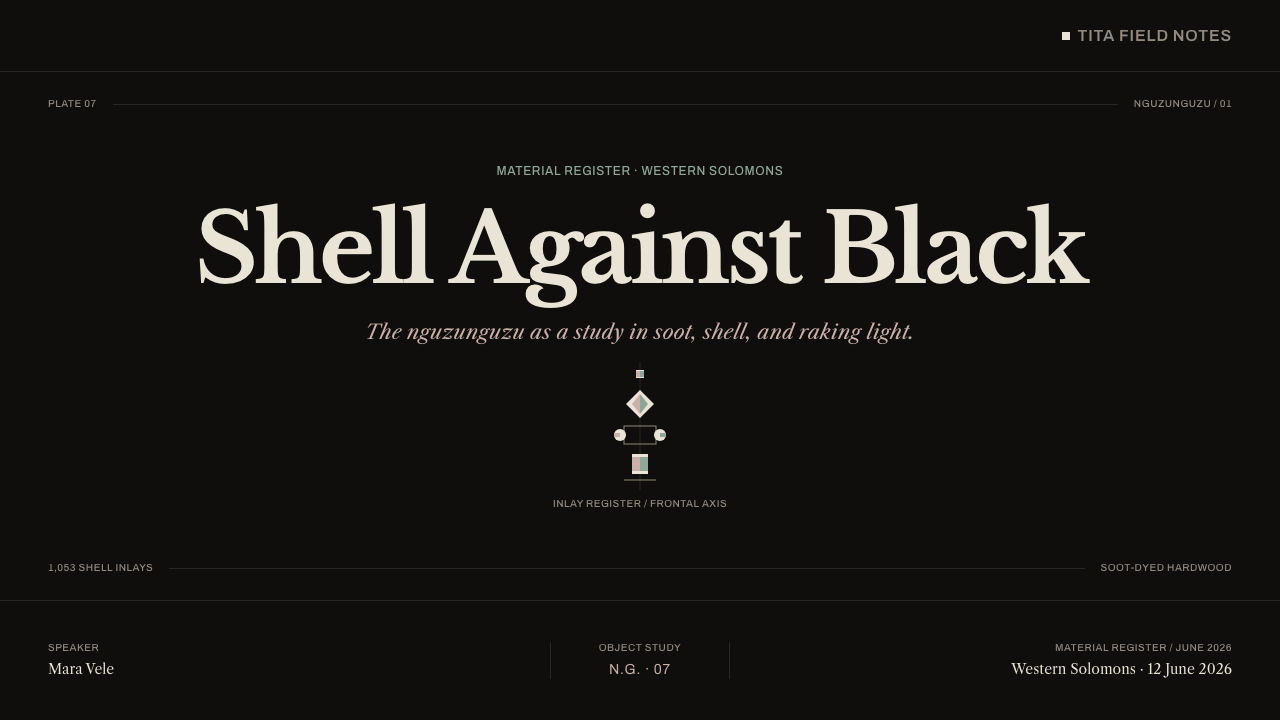
A nguzunguzu is a carved guardian figurehead lashed to the prow of a tomoko, a war canoe used in the western Solomon Islands. Carved from light hardwood, the figure is worked into a specific pose and then stained soot-black using dye made from the tita nut, a process that leaves the wood a deep, matte, light-swallowing black rather than a stained brown or natural wood tone.
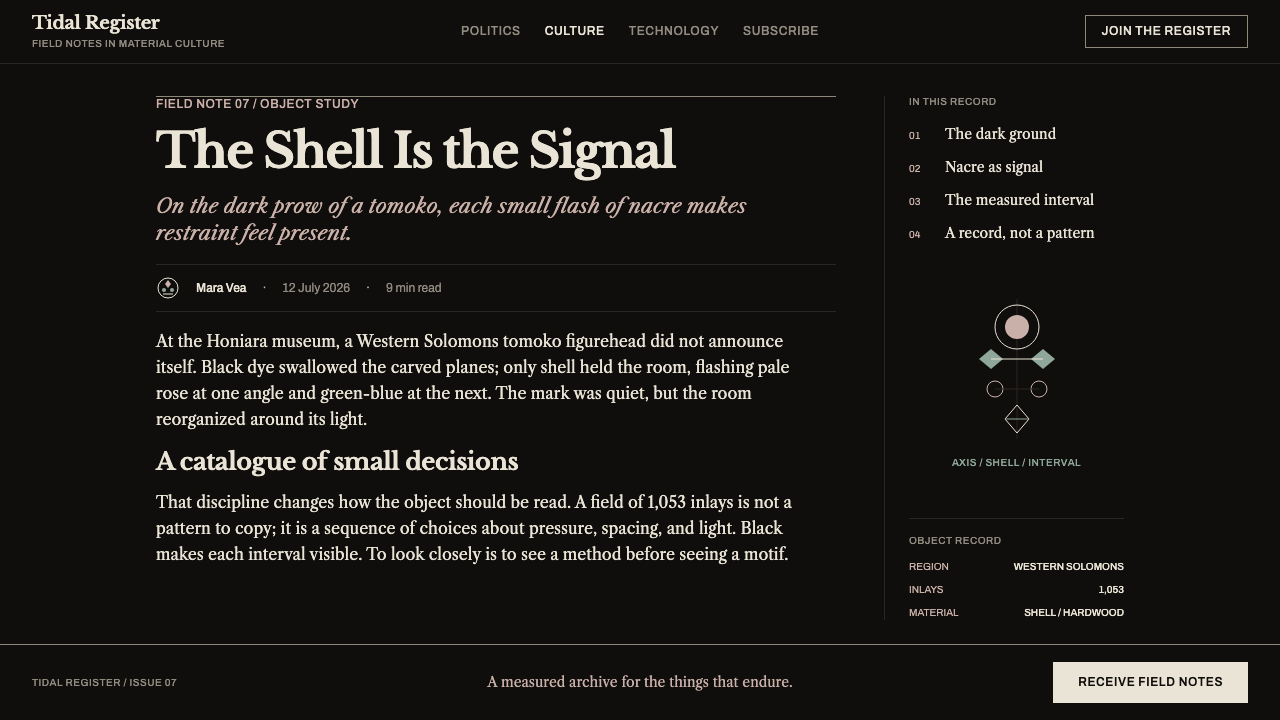
Onto that blackened surface, carvers inlaid shaped pieces of nautilus shell, bedded into a putty made from parinarium nut. This was not a light decorative touch: one recorded canoe, the Niabara, now held by the British Museum, carries 1,053 separate pieces of inlaid shell across its figurehead and hull — a scale of material work that makes clear the nacre was the whole point of the object, not an accent applied afterward.
This system takes those two material facts — dead-black wood and light-catching nautilus nacre — and makes them the entire visual grammar. The page itself is treated as light-absorbing black; nacre is the only element in the system that reflects anything, and it is what carries type, rule lines, and figurative marks. Rose and blue-green flashes, the actual iridescent colors nautilus shell throws off at an angle, are preserved deliberately, because without that flash the shell would flatten into a plain white paint rather than reading as inlaid material. Everything not doing this specific work is left as empty black field, arranged along a strict central axis rather than scattered — the same axis a figurehead itself occupies, lashed dead-center to the canoe's prow rather than offset to either side.
Where does Solomon Islands Nguzunguzu come from?
The nguzunguzu belongs to the western Solomon Islands, spanning New Georgia, Vella Lavella, Choiseul, and Santa Isabel, and its use runs from before 1900 through the early twentieth century. One of the clearest documented reference points for the tradition is the Niabara canoe, held by the British Museum and dated to around 1910 from Vella Lavella, which preserves both the figurehead carving and the extensive shell inlay work in a single, catalogued object.
The figures were carved and attached specifically for the tomoko, the war canoe used in this region during what is named directly in the source material as the headhunting era — a period in which raiding by canoe was tied to ritual practices and to the concept of mana, spiritual power or efficacy believed to inhere in objects, places, and actions. The nguzunguzu's role as a guardian figure at the canoe's prow situates it within that ritual context rather than as an ordinary piece of decorative boat carving, and it is this ritual weight that this system's severity — near-total black, one axis, one reflective material — is ultimately trying to honor rather than merely decorate.
The craft itself follows a fixed material sequence: carve the figure from a light hardwood, stain it black with tita-nut dye, then inlay shaped nautilus shell set into parinarium-nut putty. Each of these three steps uses a specific, named material — not just 'wood', 'dye', and 'shell' in general — which is part of why the resulting object has such a distinct, consistent visual signature across many separately carved canoes. The sequence also matters structurally: the blackening happens before the inlay, so the nacre always sits as a later, distinct layer on top of an already-finished dark ground, rather than the two materials being worked together from the start.
This tradition is credited to the carvers of two specific communities, Roviana and Vella Lavella, both located in the western Solomon Islands. Rather than being attributed to any single named individual, the nguzunguzu figurehead and its shell-inlay technique are named directly in the source material as a shared regional craft — Melanesian canoe carving and the shell-inlay tradition together — practiced and transmitted within these carving communities rather than invented by one documented person.
What defines the Solomon Islands Nguzunguzu look?
Dead-Black Ground
The base field is treated as light-absorbing black, echoing the soot-black finish achieved by staining carved hardwood with tita-nut dye. It should read as matte and swallowing, never glossy.
Nacre as Sole Reflector
Only one material in the system reflects light: nacre. It is reserved specifically for type, rule lines, and any figurative mark — nothing else in the composition is permitted to shine or catch light.
Rose Flash
Nautilus nacre throws a rose-pink iridescence at certain angles, and this system preserves that flash deliberately rather than smoothing it into a flat white, because the flash is what proves the material is shell rather than paint.
Green-Blue Flash
Alongside rose, nautilus nacre also flashes a cool green-blue at other angles. Both flashes should appear together within the nacre elements, never separated into two different solid colors.
Strict Central Axis
Figurative and typographic elements are arranged along a single, strict central axis, echoing the fixed, forward-facing pose of a figurehead lashed to the centerline of a canoe's prow.
Disciplined Empty Field
Any area not carrying nacre, type, or the central figure is left as plain black field rather than filled with secondary pattern or texture. The contrast between black and shell is the entire point, and pattern-filling would dilute it.

Who shaped Solomon Islands Nguzunguzu?
The carvers of Roviana, in the western Solomon Islands, are named among the communities responsible for the nguzunguzu figurehead and its shell-inlay technique. Their work situates the tradition as a shared regional craft passed down within a carving community rather than credited to a single documented individual.
Vella Lavella, also in the western Solomon Islands, is named alongside Roviana as a source community for this carving tradition, and it is the origin point of the Niabara canoe, the documented example that carries 1,053 individual pieces of inlaid nautilus shell.
The Niabara is a specific tomoko war canoe from Vella Lavella, dated to around 1910 and now held by the British Museum. As a single, fully catalogued object carrying 1,053 pieces of inlaid shell, it serves as the clearest documented reference point for how extensive and precise this system's nacre-on-black material logic actually was in practice — a scale that turns an abstract design principle into a countable, verifiable fact about one real, surviving object.
How do you use Solomon Islands Nguzunguzu today?
Solomon Islands Nguzunguzu transfers well anywhere a design needs to feel precise, ceremonial, and materially rich without relying on broad color — but it depends entirely on keeping black as the dominant, near-total field and treating any bright or reflective color as a rare, axis-aligned event rather than a spread palette.
For presentation slides, a cover page should commit to an almost entirely black field, with a single central element carrying the only nacre-like flash of rose and green-blue color, aligned precisely on the vertical center. Content slides should keep data and body text in plain white or pale tones against black, reserving the iridescent accent exclusively for one figure, icon, or key number per slide.
For web interfaces, the palette suits products built around precision, exclusivity, or craft — premium product pages, portfolio sites, or any interface where a single focal element should command total attention. A black base with one central, axis-aligned accent using a rose-to-green-blue iridescent gradient for a logo mark, active state, or hero element produces the same disciplined contrast the source material relies on. Secondary navigation and supporting text should stay in a low-contrast grey rather than white, keeping the iridescent element as the only thing on the page that truly stands out.
For editorial and marketing layouts, the style supports a strong, minimal masthead: an almost entirely black spread, a single centered mark carrying the iridescent flash, and body text kept plain and unadorned. Photography or illustration should favor deep shadow and a single reflective highlight rather than even, flat lighting.
A common mistake is treating the rose and green-blue flash as two separate accent colors to be used independently across a layout. In the source material, both colors appear together within the same reflective material — nacre does not choose one or the other, it shows both depending on the angle of light — so a design that assigns rose to one section and green-blue to another misunderstands the material logic entirely. A second mistake is letting the black field creep toward a dark grey for the sake of legibility; the system depends on true, near-total black, with contrast handled entirely by the rare reflective element rather than by lightening the ground.
Solomon Islands Nguzunguzu — FAQ
Is this the same as a generic iridescent or holographic design trend?
No. Generic iridescent design spreads a rainbow gradient broadly and often across a light background. This system is built on an almost entirely black field, with iridescent color restricted to a single material — nacre — appearing in exactly two hues, rose and green-blue, and placed along one strict central axis rather than spread across the composition.
Why must the black field cover almost the entire composition?
Because in the source material, black is not a background color choice — it is the achieved result of staining carved hardwood with tita-nut dye until it fully absorbs light. The nacre inlay only reads as precious and reflective because almost nothing else in the object shines; reducing the black field's dominance removes the exact contrast that gives the shell its meaning, leaving a design that merely looks dark rather than one that behaves like a light-absorbing material with a single, rare reflective inlay.
How many focal elements should carry the iridescent flash?
Ideally just one per composition, echoing how a single nguzunguzu figurehead, not a repeated pattern of them, was lashed to the prow of a canoe. A design that scatters the iridescent flash across many small elements loses the singular, ceremonial focus that defines the source material.
Does this style require carved or three-dimensional elements to work?
No. The underlying logic — a light-absorbing dark ground, a single reflective material carrying meaning, and a strict central axis — translates directly into flat, two-dimensional design. What matters is preserving the contrast ratio between the black field and the rare reflective element, not reproducing an actual carved surface. A flat digital interface can achieve the same effect purely through color and placement discipline, without any implied depth or texture at all.
What kind of products or contexts does this style not suit?
It struggles in contexts that need to feel bright, casual, or densely informative — data-heavy dashboards, playful consumer apps, or anything requiring many simultaneous focal points. The style's authority depends on near-total darkness broken by exactly one precise, reflective focus; spreading attention across many bright elements contradicts that discipline entirely.
Related design styles
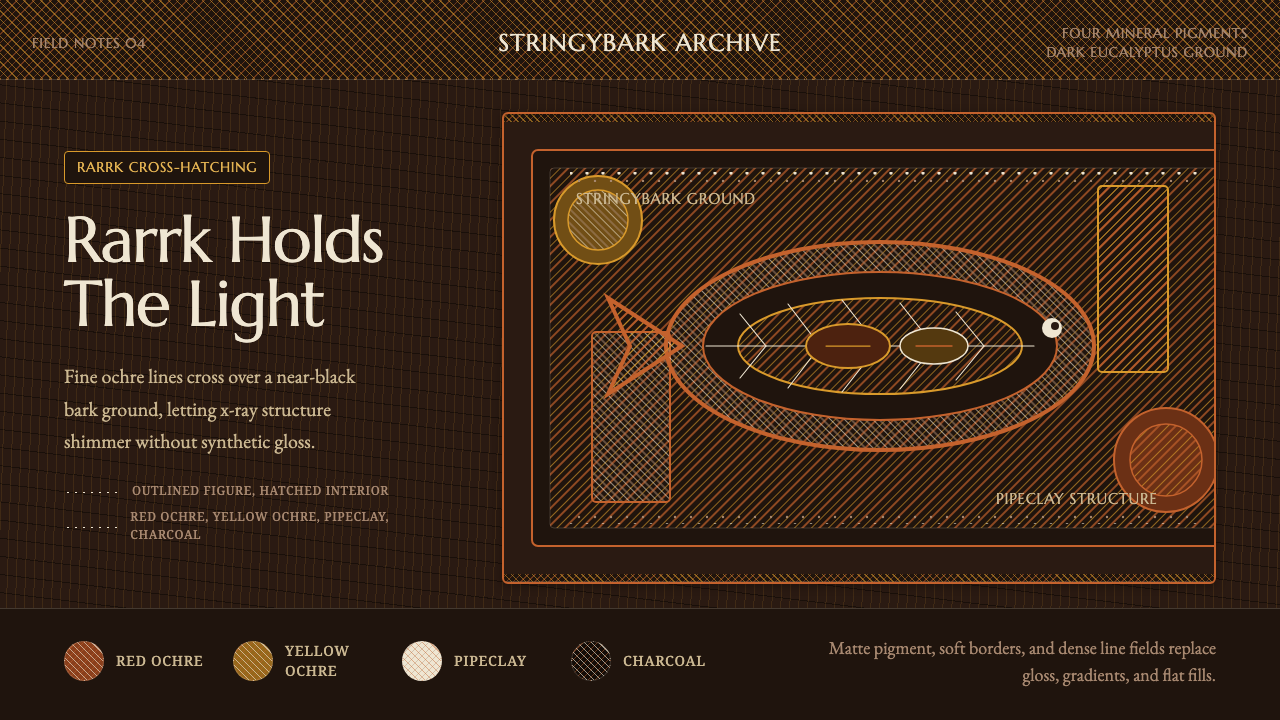 Arnhem X-Ray Bark PaintingShimmers without gloss. Ochre rarrk lines vibrate on dark stringybark.
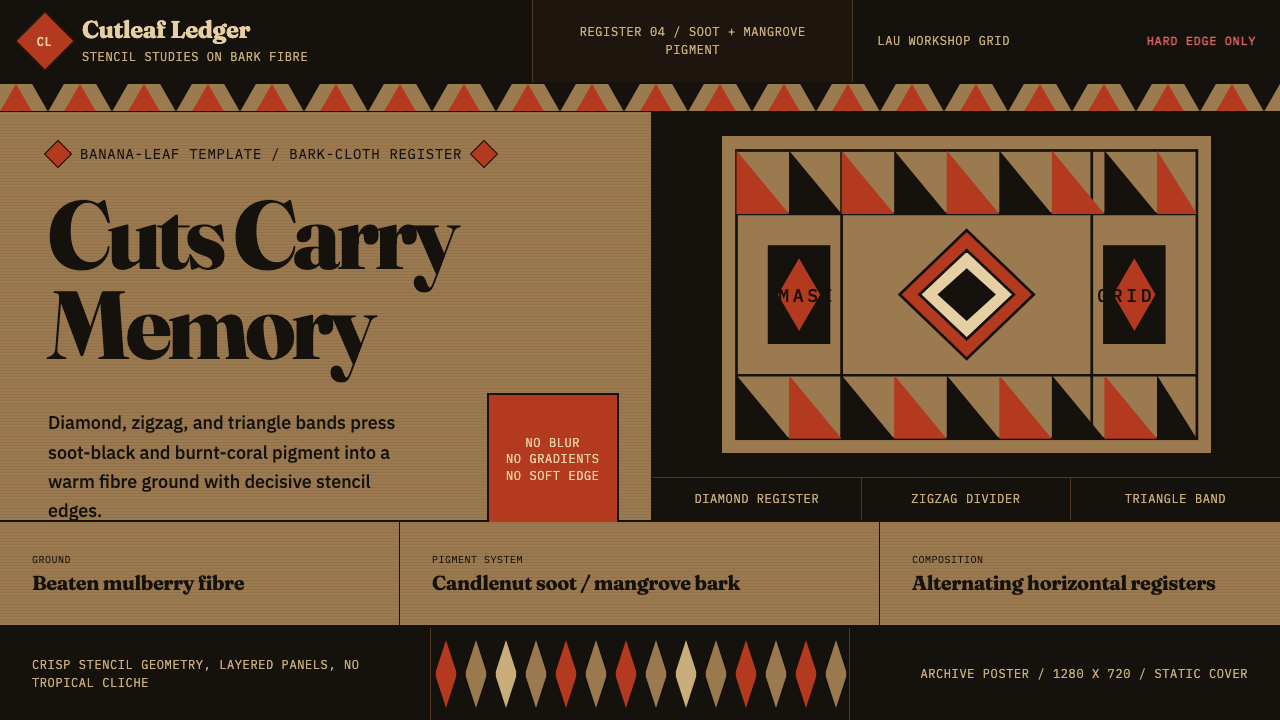 Fijian Masi (Bark Stencil)Stencil memory stays sharp. Soot black and burnt coral strike bark-fibre band…
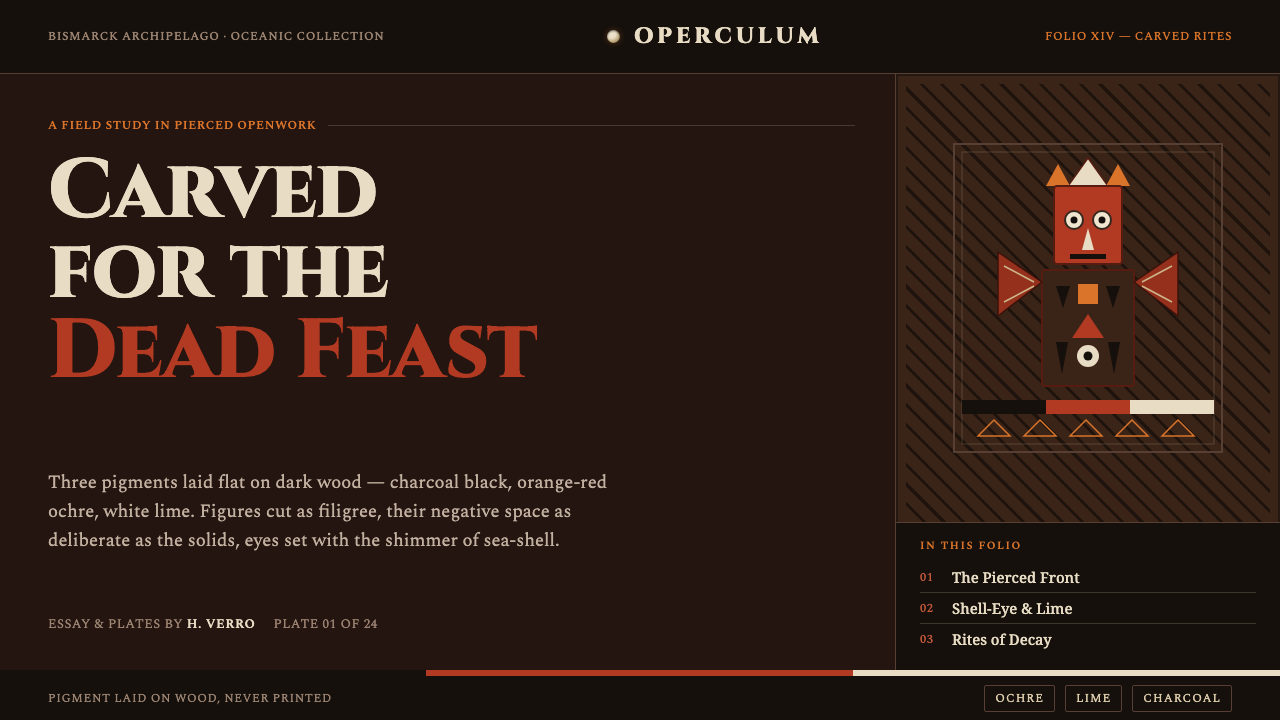 Malagan CarvingCarved for the dead feast. Ochre, lime and charcoal pierced into dark wood, e…
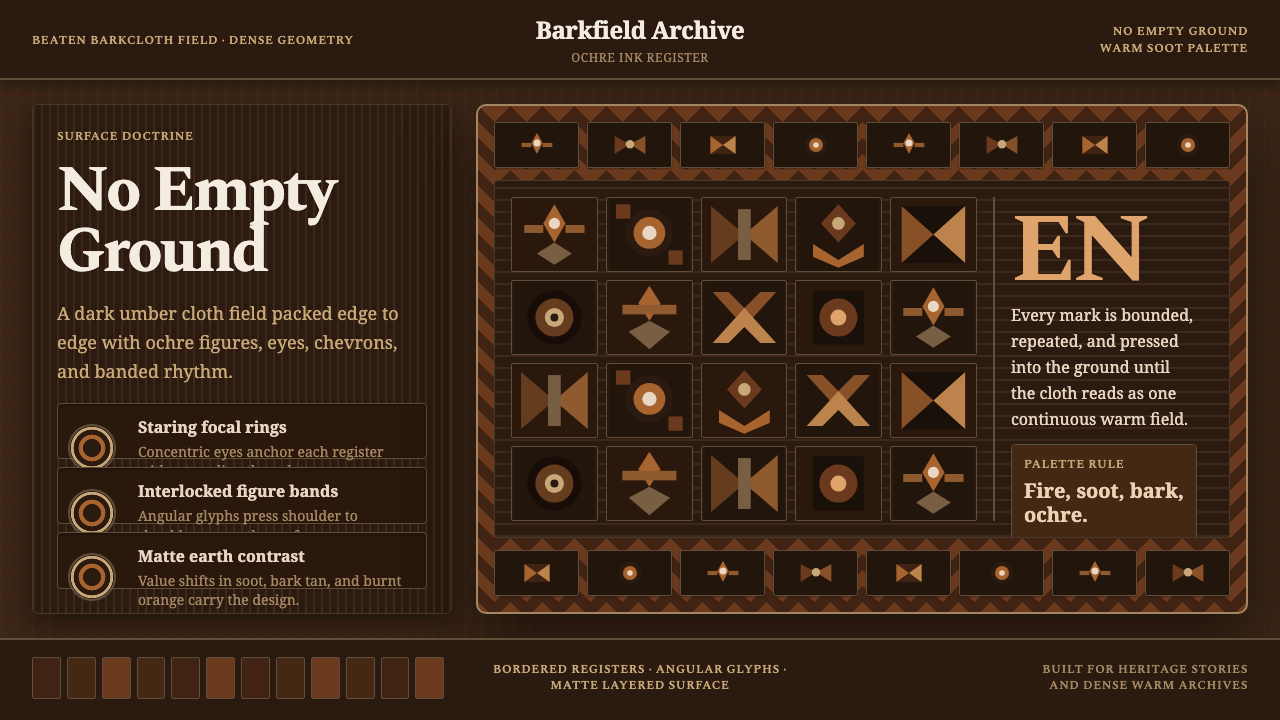 Marquesan Enata Tapa MotifNo empty ground. Ochre enata geometry packs a dark umber barkcloth field.
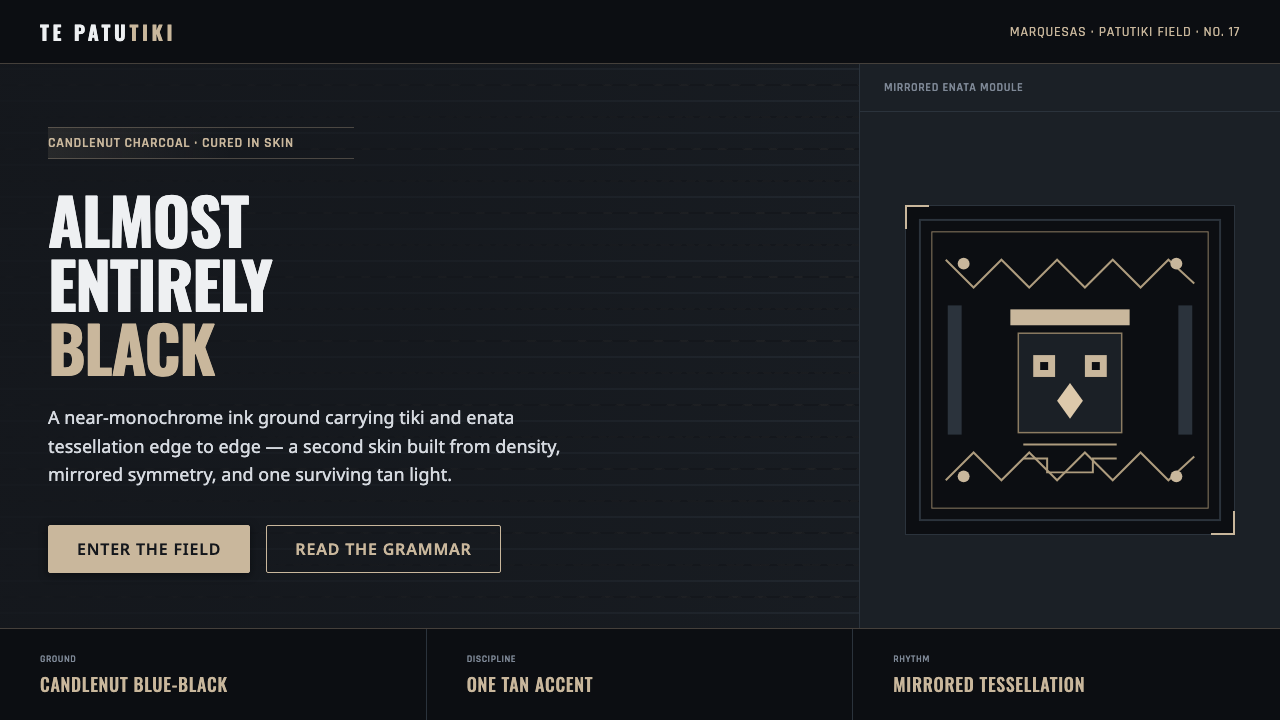 Marquesan Tatu PatternDensity as authority. Tiki and enata tessellation inked into blue-black, lit…
 Rapa Nui Moai PetroglyphMonumental sparseness. Basalt black, scoria red, and pecked-dot borders hold…