What is Palawa Shell Necklace?
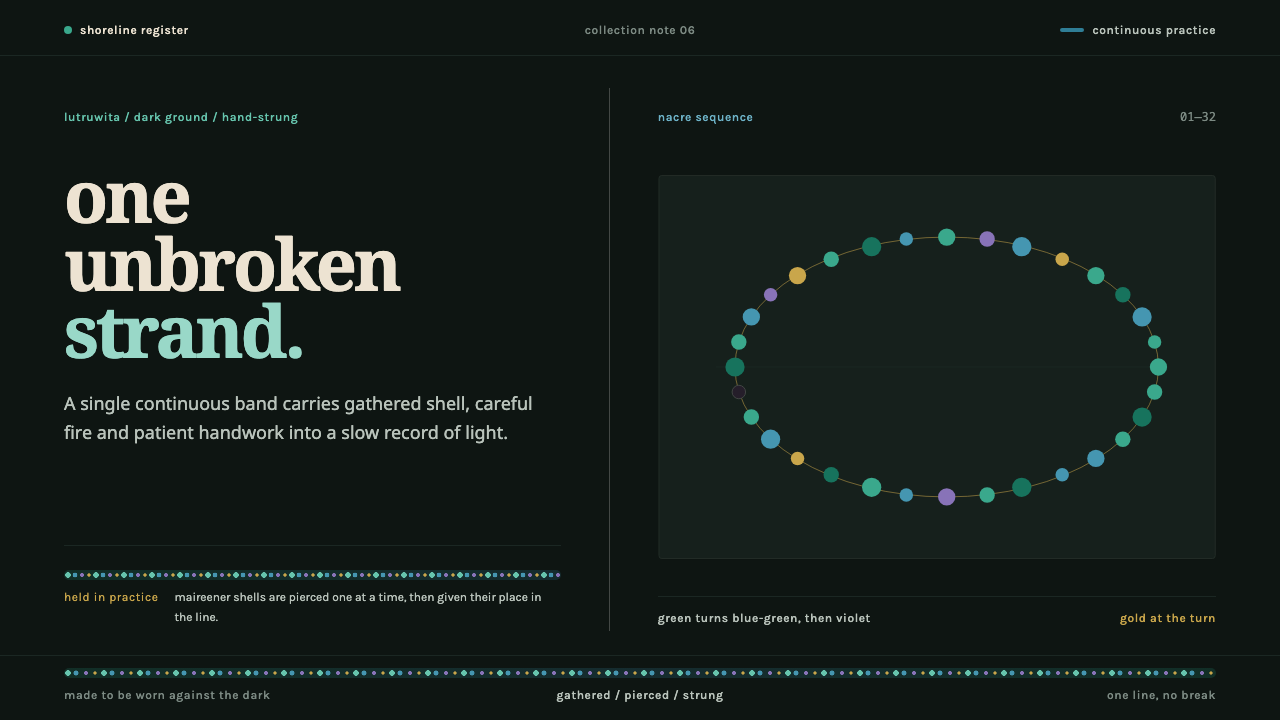
A strand of small nacre shells, threaded one at a time into a single unbroken band, becomes the structure of the page — continuity as form.
Palawa Shell Necklace in brief
Palawa Shell Necklace is a design style drawn from shell stringing, the necklace-making practice of palawa/pakana women in lutruwita, the island also known as Tasmania. Its visual language is a dark ground carrying a single strand of small, pearly beads whose colour shifts from deep green through blue-green to a flash of violet, with a thread of gold along the turn. It is a quiet, low-glare, slow-moving style, and it belongs to the family of heritage-craft systems rather than to any twentieth-century design movement.
What makes the style distinctive is that the necklace is not decoration laid over a layout. The strand is the structure. It divides one section from the next, sets the rhythm of a list, carries navigation from one place to another and, stretched across a screen, shows how far a reader or a process has travelled. The page itself plays the part of the dark ground against which a necklace is worn, and everything else stays quiet so that the line can be read.
Two rules keep the style honest. The first concerns light: nothing glitters hard, and brightness arrives the way it does on nacre, slowly and from within. The second is typographic and comes from the language community rather than from taste: words in palawa kani, the language of Tasmanian Aboriginal people, are set in lowercase by convention, and the system follows that convention. A layout that capitalises them has stopped respecting its source.

Where does Palawa Shell Necklace come from?
Shell stringing is described in the system's own record as the oldest unbroken cultural practice in Tasmania, held by palawa/pakana women for more than 1,800 years. The word that matters in that sentence is 'unbroken'. Through the nineteenth century, Tasmanian Aboriginal people were dispossessed of land, removed from country and subjected to violence, and colonial accounts often announced the end of their culture. The necklaces are among the clearest evidence that no such end occurred: the knowledge passed from women to women, through families and island communities, and the practice is still being carried forward today.
The making itself is slow and physical, and the design system treats that slowness as meaning. Maireener shells are gathered from the coast. They are burnt back over grass and embers until the dark outer skin gives way and the nacre beneath shows through, a deep green that turns blue and then flashes violet as the shell moves in the light. Each shell is pierced one at a time. Then they are strung in their thousands, shell after shell, into a single continuous band. There is no shortcut in the sequence, and nothing in it can be hurried without changing what the object is.
The place matters too. The record locates the style in lutruwita, the palawa kani name for Tasmania, with particular reference to the Bass Strait islands, Cape Barren Island and the Tasmanian coasts. The time frame is given simply as before 1900 and continuous. There is no founding date, no school and no manifesto, because the tradition is not a movement that began at a moment and then spread. It is a practice that was never put down.
Two names stand at the head of the system's lineage: Dulcie Greeno and Lola Greeno. The record also names two movements, palawa/pakana women's shell stringing and Tasmanian Aboriginal cultural continuity, and the pairing is telling. The first describes a craft; the second describes a cultural fact that the craft makes visible. For a designer the lesson is to read the necklace both ways. It is a beautiful object, and it is a statement that a culture persists. The visual choices in the system, the unbroken line, the patient repetition and the refusal of hard sparkle, come from taking both readings seriously.
What defines the Palawa Shell Necklace look?
Dark ground
The page is the dark surface a necklace is worn against. The ground is deep and even, without texture or vignette, so that the small luminous units of the strand have something to be seen against. Nothing else competes for the role of focal point. Empty dark space is part of the composition, much as skin or cloth is part of a worn necklace.
Nacre colour shift
Colour moves the way nacre does: deep green first, then blue-green, then a brief violet flash, with a thin line of gold where the strand turns. The shifts are gradual and ordered along the length of the strand rather than scattered at random. Colour here is a sequence to be followed, not a palette to be chosen from.
The strand as structure
The central device is a continuous band of small round beads. It works as a section divider, as the marker rhythm of a list, as a line of navigation and as a progress indicator. Using it as pure decoration, in a corner or as a header flourish, misses the point. It earns its place only when it is doing structural work.
Soft luminosity
Nothing glitters hard. There are no specular sparkles, no lens flares and no glassy shine. Light seems to come from inside the bead and arrives gently, the way pearly shell catches a window. Contrast is built from the difference between a luminous strand and a dark ground, not from bright highlights.
Small repeated units
The strand is made of thousands of small units that are alike but not identical. The style keeps that quality: beads repeat at a steady interval with a slight natural variation of tone, so the line feels handmade rather than machine-stamped. Scale stays small, and it is the rhythm that the eye follows.
Lowercase palawa kani
Words in palawa kani are set in lowercase by convention, and the system requires typesetters to honour it. That applies in headings, navigation and buttons alike, even where automatic capitalisation would normally take over. Elsewhere, type should stay unobtrusive and let the strand carry the expression.
Unbroken line
The strand is one continuous band, not a collection of separate ornaments. It is not cut by a box or interrupted for effect, and it turns at corners rather than ending. This continuity is the style's meaning made visible. A layout with many short, disconnected strands, or a strand that fades out halfway, has lost the idea.

Who shaped Palawa Shell Necklace?
Dulcie Greeno is named alongside Lola Greeno as one of the two key figures in the system's record of shell stringing. The record ties the practice to the Bass Strait islands and Cape Barren Island, and her name stands for the line of makers through whom the knowledge of gathering, preparing, piercing and stringing was kept alive. For a designer she is a reminder that this is a practice passed hand to hand and house to house rather than a style invented by an individual.
Lola Greeno is the second key name in the record, and one of the best-known contemporary figures associated with Tasmanian Aboriginal shell necklaces. Through makers like her the necklaces are now shown and discussed as art as well as heritage, which is part of why a design system can draw on them at all. Her presence in the lineage is also a reminder that the practice is contemporary and living, not a relic to be quoted in the past tense.
The first movement named in the record is palawa/pakana women's shell stringing, and the women are the real authors of the style. For more than 1,800 years the practice has been held and handed on by them, and the design system is best understood as an attempt to translate their structure into an interface: one strand, made patiently, continuous from end to end. Any use of the style should keep that authorship in view.
How do you use Palawa Shell Necklace today?
Palawa Shell Necklace suits work that has something to carry from one point to another and wants to do it slowly: a story told in sequence, a process with visible steps, a collection to be walked through. Because the strand is a structural device, the style rewards designers who ask what in their content needs dividing, ordering or tracking, and give those jobs to the line. It is a poor fit for work that depends on loud calls to action or bright, high-energy surfaces.
In presentation slides, a cover can be a dark field with a single strand crossing the lower part of the frame and turning at one corner, with the title set quietly above it. Content slides use the strand as the divider between heading and body, and a short length of it can number the sections. Data slides are best when the strand is a measure rather than a flourish: a timeline, a progress line or a row of units in which each bead stands for one thing counted. Keep the ground dark and the type plain.
On the web, the style fits long-form storytelling, onboarding flows, step-by-step guides, museum and heritage sites, craft marketplaces and any product where progress through a sequence is the main idea. The strand can serve as page navigation, a scroll-progress line, a stepper and a list marker. Keep body text strongly legible against the dark ground, keep interactive states understated, and let a single gentle shift of colour mark the current position instead of adding extra icons.
For editorial and marketing work, think of exhibition pages, essays about making and place, product pages for handmade objects and chapter openers in long reports. A short strand between chapters does the work a decorative rule would do elsewhere, and does it with more meaning. Where the work draws on this tradition, name the practice, credit the makers and give the context. Treat the style as a way of telling that story properly, and not as a mood to be borrowed.
The most common mistake is to read the style as a generic iridescent look and scatter glitter, aurora gradients or holographic shine across a layout. That discards the one thing the style insists on, which is that nothing glitters hard. Close behind are capitalising palawa kani words, breaking the strand into disconnected decorative fragments, and applying the style to subject matter that has no real relationship to the culture it comes from. If the use cannot be explained to the people whose practice it is, reconsider it.

Palawa Shell Necklace — FAQ
What is a maireener shell necklace?
It is a necklace made by palawa/pakana women from tiny maireener shells. The shells are gathered on the coast, burnt back over grass and embers until the pearly layer beneath their outer skin shows, pierced individually and strung by the thousands into one continuous band. The practice is described as the oldest unbroken cultural practice in Tasmania, and this design style takes the finished strand as its model.
Why does the style use a dark ground?
Because the page plays the part of the surface a necklace is worn against. A dark, even ground gives the small luminous beads something to be seen against, and it lets nacre colour read as light coming from within the shell rather than as paint on a surface. A pale ground would flatten the green-to-violet movement and turn the strand into a coloured dotted line.
Why are palawa kani words always lowercase?
It is a convention in the way palawa kani, the language of Tasmanian Aboriginal people, is written, and the system adopts it as a typographic rule. In practice that means disabling automatic capitalisation in headings, menus and buttons wherever those words appear. Following the convention is a small, concrete way of showing that the style is borrowing from a living language and not just a look.
Is this the same as an iridescent or holographic gradient style?
No. Iridescent and holographic looks usually rely on bright, shifting highlights across large surfaces. This style does the opposite: colour moves slowly and in order along a single strand, brightness stays soft, and the ground does most of its work by staying dark and still. Think of pearly shell in low light rather than a foil sticker under a lamp.
Can I use it for a project unrelated to Tasmanian Aboriginal culture?
Technically yes, but the question deserves thought. The style is not a neutral mood; it is a translation of a specific living practice. It works best where the content genuinely shares its values of continuity, patience and sequence, and where the practice and its makers are acknowledged. If the project would use the look as a surface effect with no connection to the source, a different style will serve it better.
Related design styles
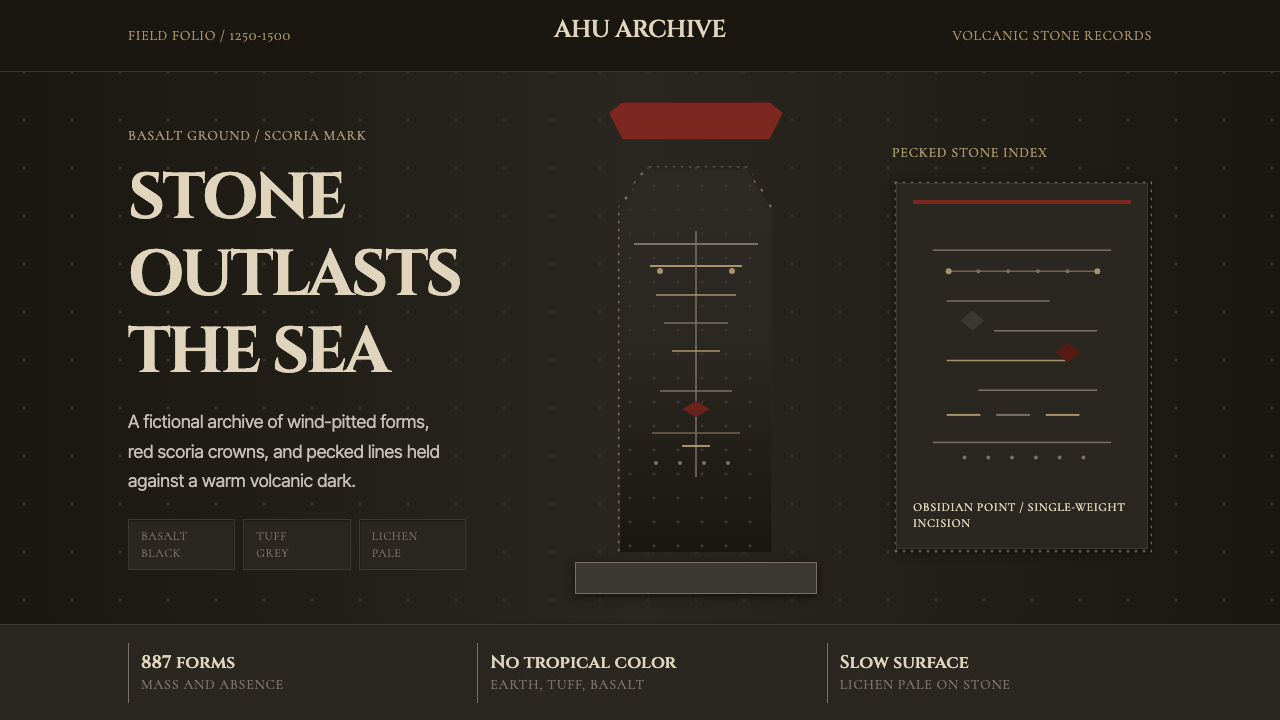 Rapa Nui Moai PetroglyphMonumental sparseness. Basalt black, scoria red, and pecked-dot borders hold…
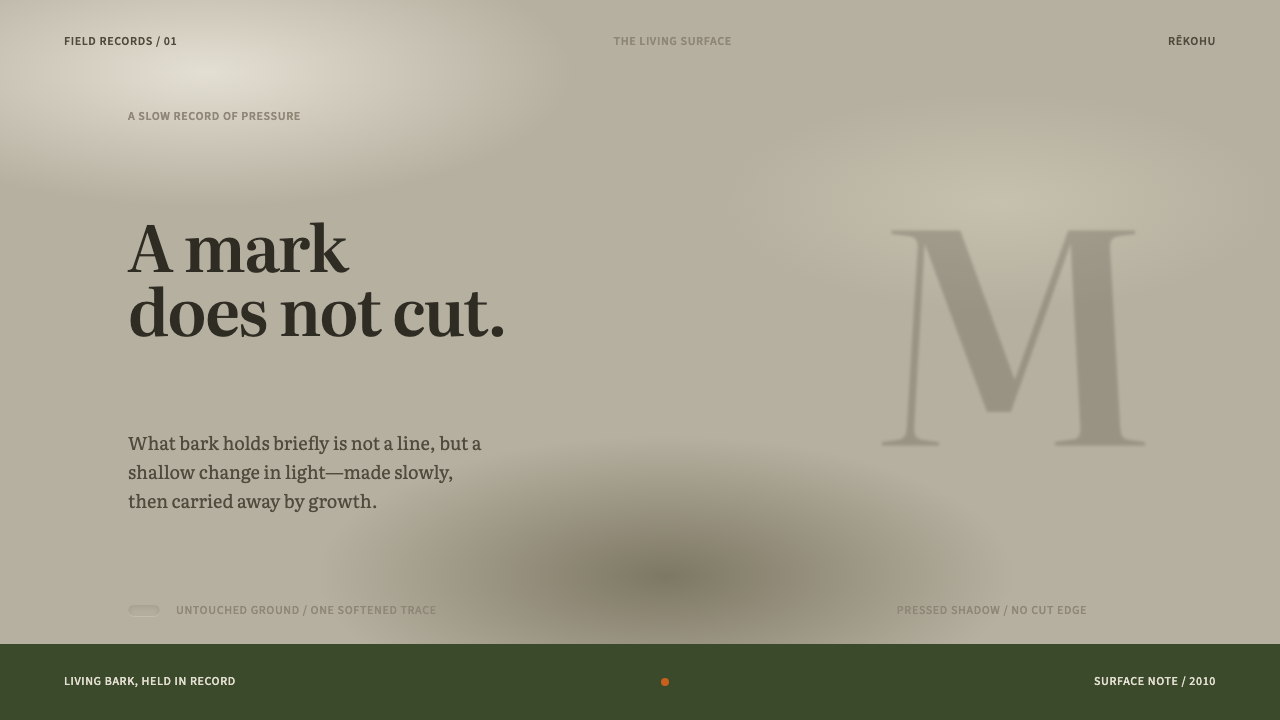 Moriori Rakau MomoriPressure, not incision. Literata shadows sink softly into pale, lichened bark.
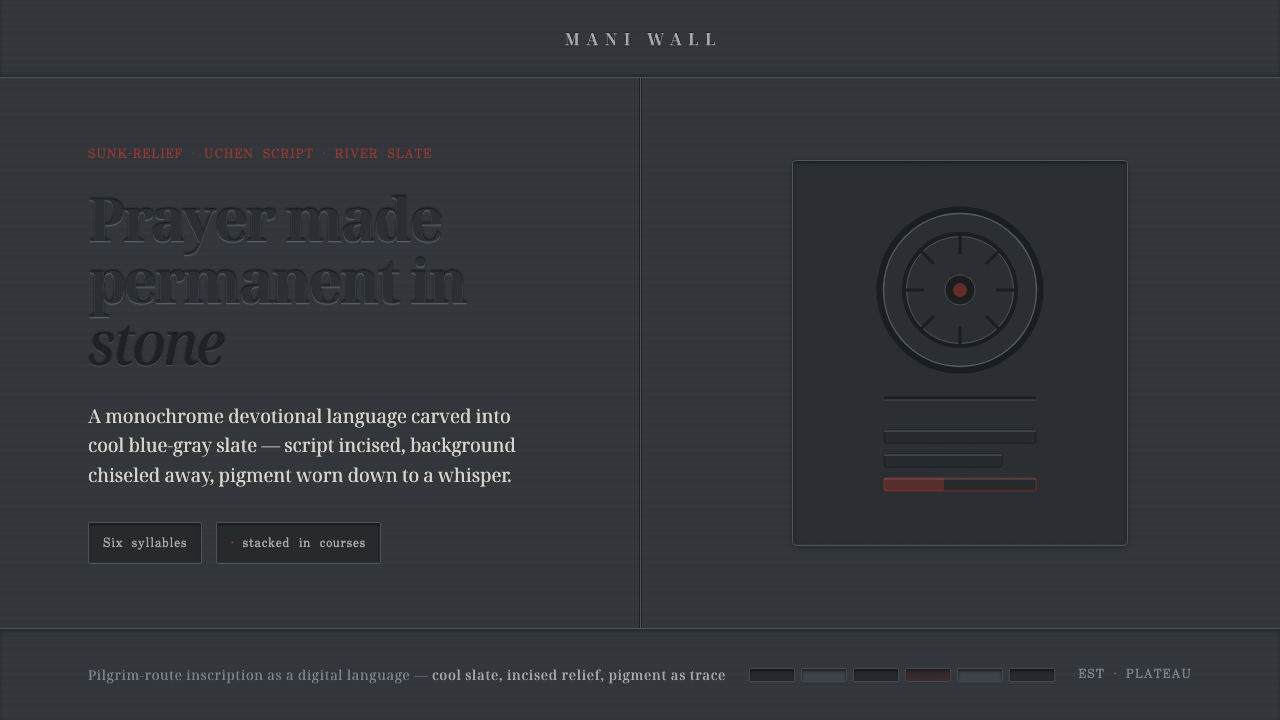 Tibetan Mani StonePrayer made permanent in stone. Sunk-relief glyphs incised into cool slate, p…
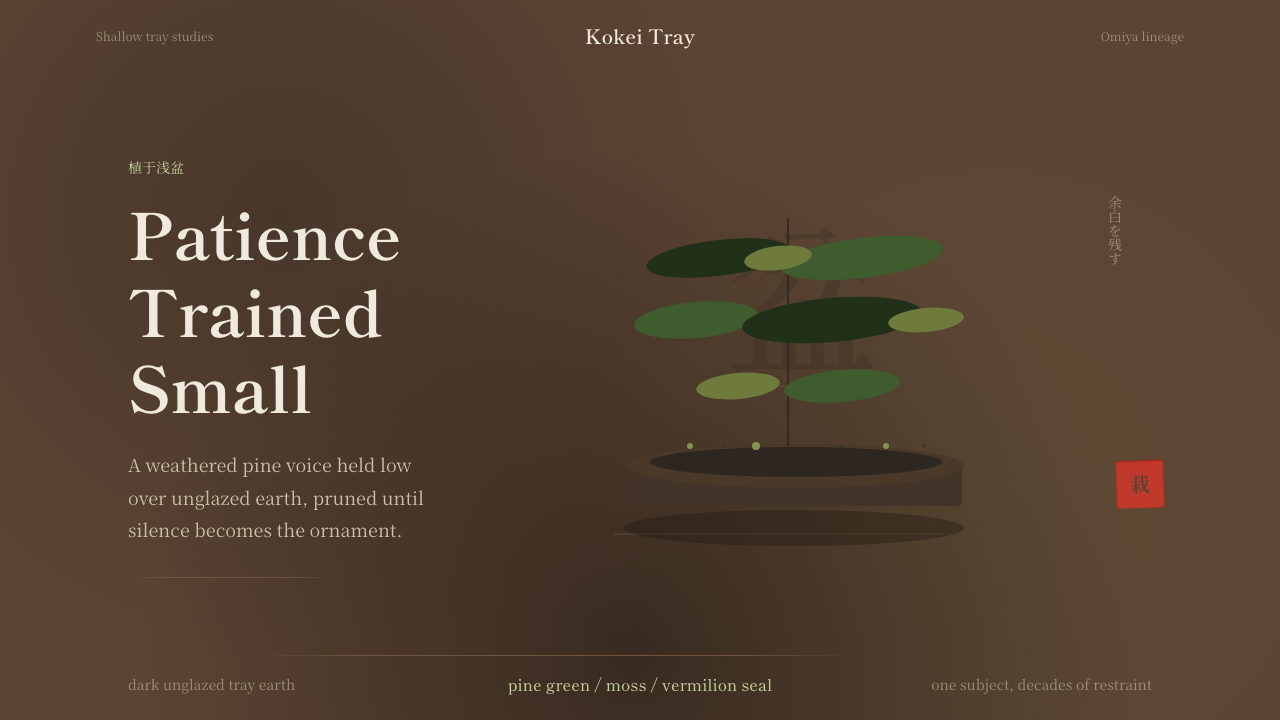 Bonsai CultivationQuiet asymmetry. Pine green rests on dark tray earth, sealed by one vermilion…
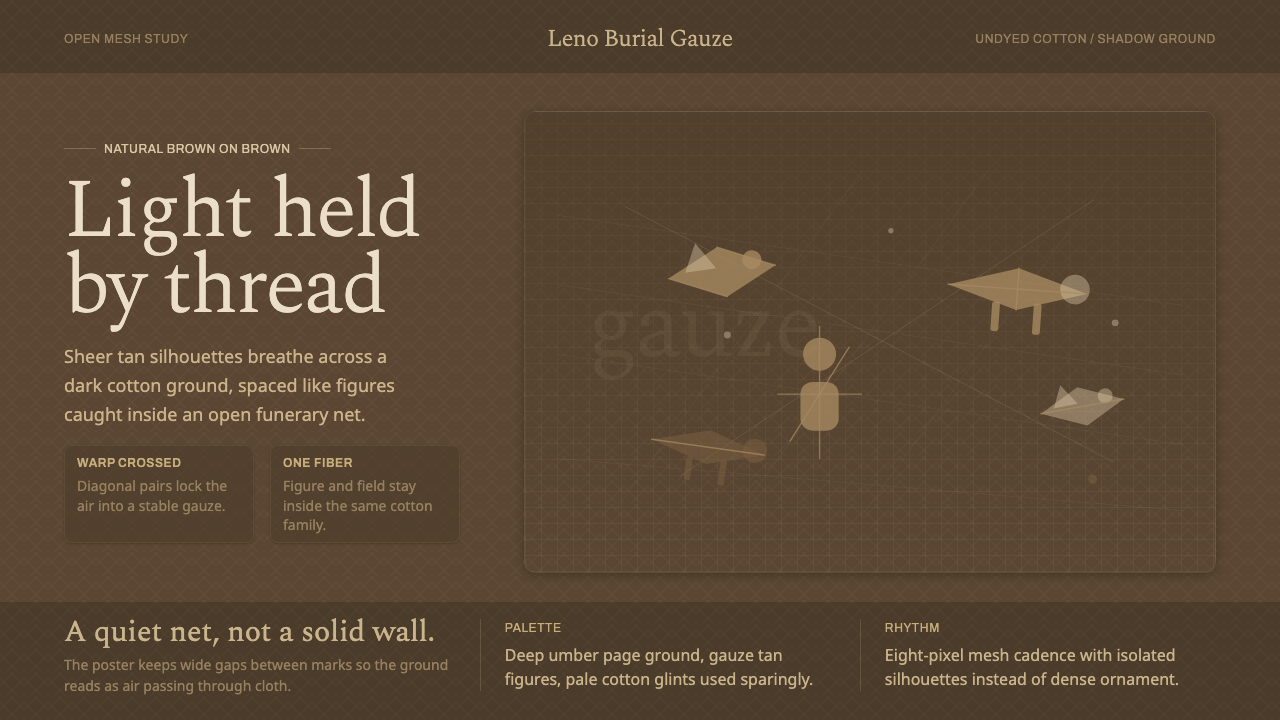 Chancay Gauze TextileQuiet woven dignity. Tan silhouettes float through a dark open cotton mesh.
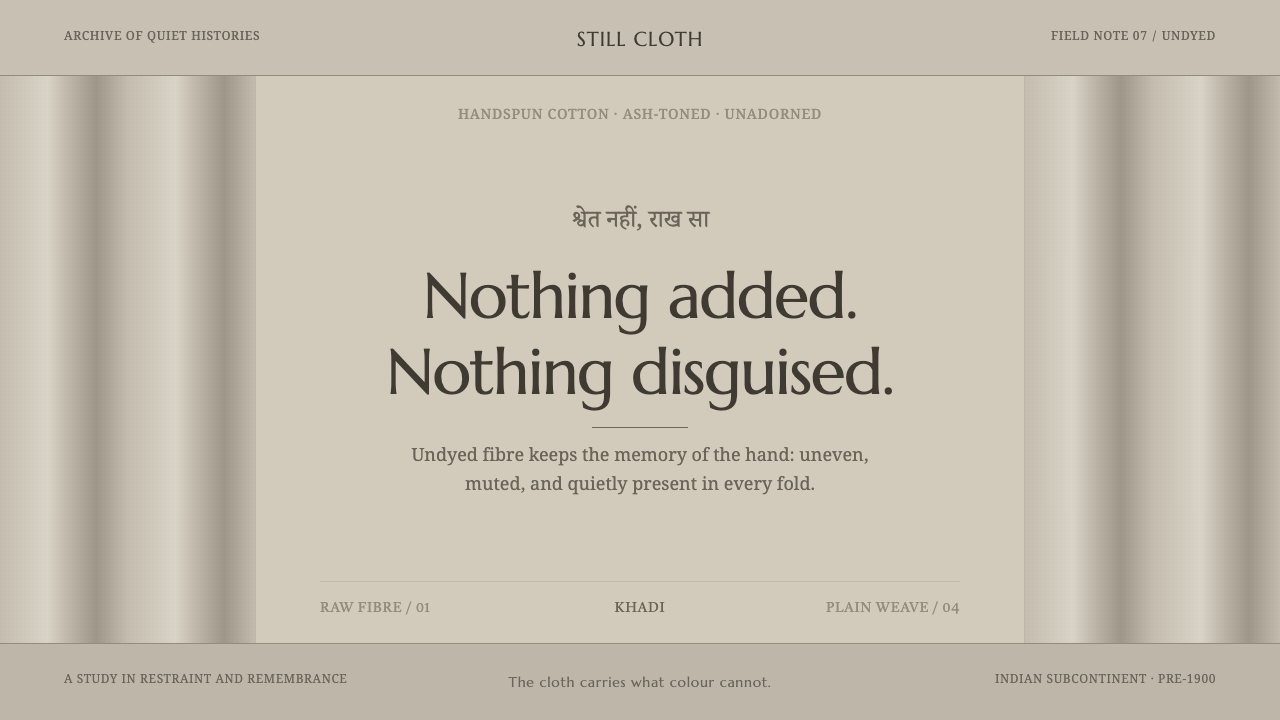 Hindu Widow White SariRestraint carries the weight. Ash-toned khadi, quiet serif type, and vertical…