What is Solarpunk Lagos?
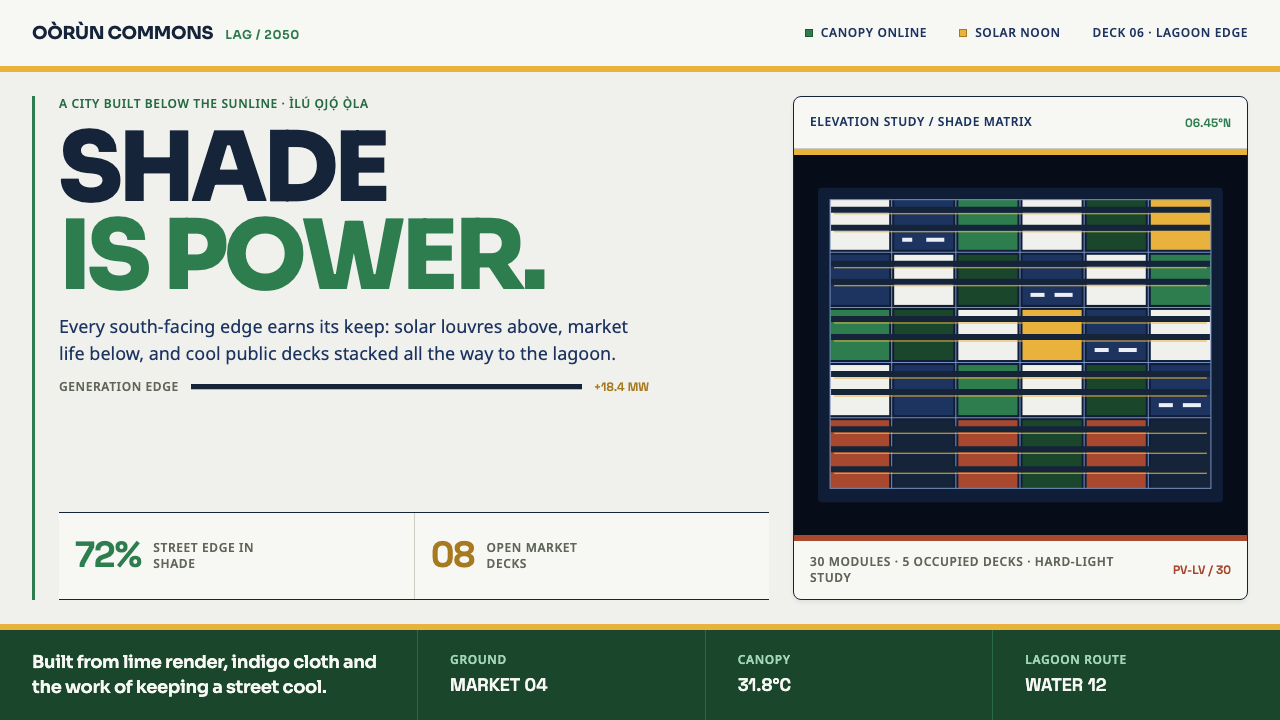
Solarpunk Lagos imagines 2050 from materials the city already has: sun-bleached lime render, indigo grids, solar louvres and a crowded, shaded street.
Solarpunk Lagos in brief
Solarpunk Lagos is a visual language for a speculative Lagos in 2050, built entirely out of what the city already has. Lime-rendered concrete gone bright under equatorial sun. Photovoltaic brise-soleil hung on every south elevation. Indigo adire cloth from Abeokuta. Red laterite dust at the base of the walls. These materials give the style its palette and its textures, and they anchor a future in a real place rather than in a generic sci-fi city.
Its density comes from the work of Olalekan Jeyifous, in particular his Shanty Megastructures and New Lagos, 2081 A.D., the project he made with Walé Oyéjidé: market-level, inhabited and crowded, seen from street height rather than from a clean aerial view. Shade is infrastructure here, so the horizontal louvre line runs across every surface, and green means canopy, not a leaf-shaped badge.
Visually the result is bright and layered. A sun-bleached lime ground carries deep indigo structure, thin gold-edged louvre lines and earthy red at the base, while the scenes stay full of people: markets, rooftop farms, water buses and danfo minibus lines running beneath solar canopies. It is a design language for a future that has not removed the city's crowds, only made them cooler, greener and powered by their own roofs.
Where does Solarpunk Lagos come from?
Solarpunk is a speculative current that imagines renewable-powered, sustainable futures that are inhabited and hopeful rather than bleak. Solarpunk Lagos extrapolates that idea from work made in the 2010s and 2020s towards a 2050 setting, and places it in Lagos, Nigeria, and the Yoruba south-west. The key shift from the usual solarpunk image is location and attitude: the future is built in Lagos with Lagos's materials and Lagos's density, not exported from the empty utopian plaza of a stock image.
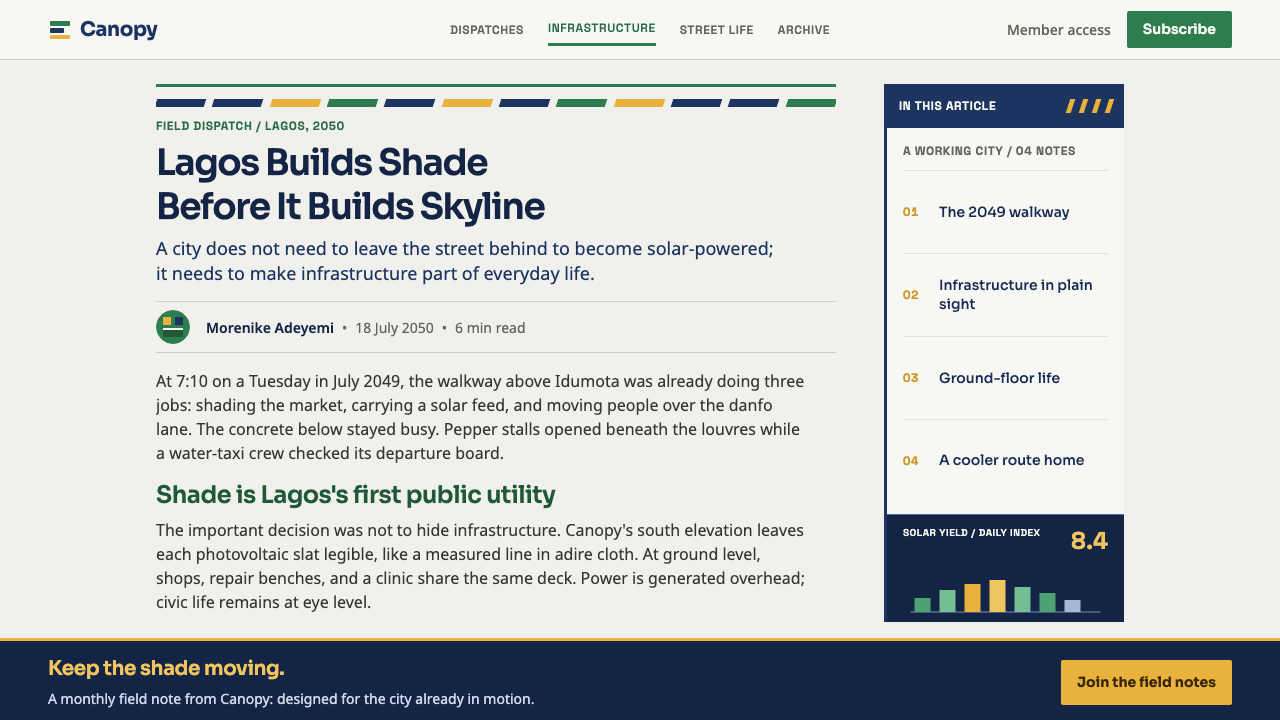
The materials come straight from the street. Lime-rendered concrete turns bright under equatorial sun. Photovoltaic brise-soleil, a fixed sun-shading device, is hung on every south elevation so that the wall shades itself and generates power in the same gesture. Indigo adire, the resist-dyed cloth of Abeokuta, brings a Yoruba grid-and-pattern logic. Red laterite dust sits at the base of walls, a reminder of the ground. Nothing here has to be imported or invented, and each ingredient is something a Lagosian can already point at.
The visual bloodline runs through Olalekan Jeyifous, whose Shanty Megastructures and, with Walé Oyéjidé, New Lagos, 2081 A.D. imagine Lagos grown upward and outward in crowded, inhabited layers. The architect Kunlé Adeyemi is also named among the key figures, as part of the wider current of African climate-adaptive architecture. Alongside Solarpunk itself, the style draws on Afrofuturism, African climate-adaptive architecture and Yoruba indigo resist-dye, which explains why it feels like technology, architecture and textile all at once.
Two principles separate the system from a generic green-tech look. Shade is infrastructure: the louvre line runs across every surface, because shade is what makes a hot city livable and what lets solar panels earn their place. And green means canopy, not a leaf badge: trees, planted terraces and roof farms appear as real mass in the picture, not as an eco icon. These are statements about a city, and they translate into a very particular layout discipline.
What defines the Solarpunk Lagos look?
Lime-Render Ground
The ground is a sun-bleached lime white, warm and slightly chalky, like concrete that has spent years under equatorial light. It is bright without being clinical. Everything else sits on it, so it should dominate the page and stay clean enough for the indigo and gold to read.
Indigo Grid
Deep indigo is the structural colour. It draws gridlines, frames and panel edges, in the spirit of resist-dyed adire cloth, where pattern is built from a repeated grid. It is dark and rich but never black, so it gives the page backbone without making it heavy.
Gold-Edged Solar Louvres
Thin horizontal louvre lines run across surfaces, and their edges catch light as a fine gold. They act as rhythm, dividers and shade at once. The line is the style's signature repeat, and it should be steady and regular, a visible reminder that the surface is working for the city.
Laterite Base
A warm red-brown earth tone sits at the base of walls and panels, like dust splashed up from the street. It grounds a composition and ties it to the soil. It belongs at the foot of a layout and in small touches, not as a large field, so the lime and indigo keep control.
Canopy Green
Green appears as real canopy: dense, layered and tree-like, in planted terraces, roof farms and shaded streets. It is not a leaf badge or a status dot on every control. When green is used, it has mass and context, and it means that something alive is giving shade.
Market-Level Density
The future here is crowded and inhabited, viewed at street height. Layers overlap, stalls and stairs and signs stack up, and there are many small things at once. Density is the point, but it is kept legible by the grid and the louvre rhythm, so the picture is busy without being chaotic.
Shade as Structure
Shade is not a drop shadow added for effect but a structural element: overhangs, canopies and louvres are part of the layout, and areas of cool shadow organise the page. The effect is a composition that looks designed for heat, with covered zones where the eye can rest.
Who shaped Solarpunk Lagos?
A Nigerian-born artist whose Shanty Megastructures give this style its density: a Lagos of crowded, inhabited, market-height layers rather than clean towers. He also made New Lagos, 2081 A.D. with Walé Oyéjidé. Designers borrow his sense of scale, in which the future should be as busy as the present.
Jeyifous's collaborator on New Lagos, 2081 A.D. His place in the lineage is part of why the style feels inhabited and narrative: a future with people and cloth in it as well as buildings, told at the scale of a street rather than a skyline.
An architect named among the key figures and associated with the current of African climate-adaptive architecture. His relevance to the style is its attitude: building with the conditions of Lagos, including heat, rain and water, rather than against them.
How do you use Solarpunk Lagos today?
Solarpunk Lagos works for anything that wants to feel optimistic, dense and practical: energy, climate, urban and mobility products, community platforms, civic tools and cultural projects. It is a poor fit for sparse, luxury minimalism. The style's pitch is abundance and use, not emptiness. A useful test is to look for the three signatures at a glance: a sun-bleached ground, an indigo structure and a repeated louvre line. If any of the three is missing, the page has probably drifted into generic green-tech, however many leaves it carries.
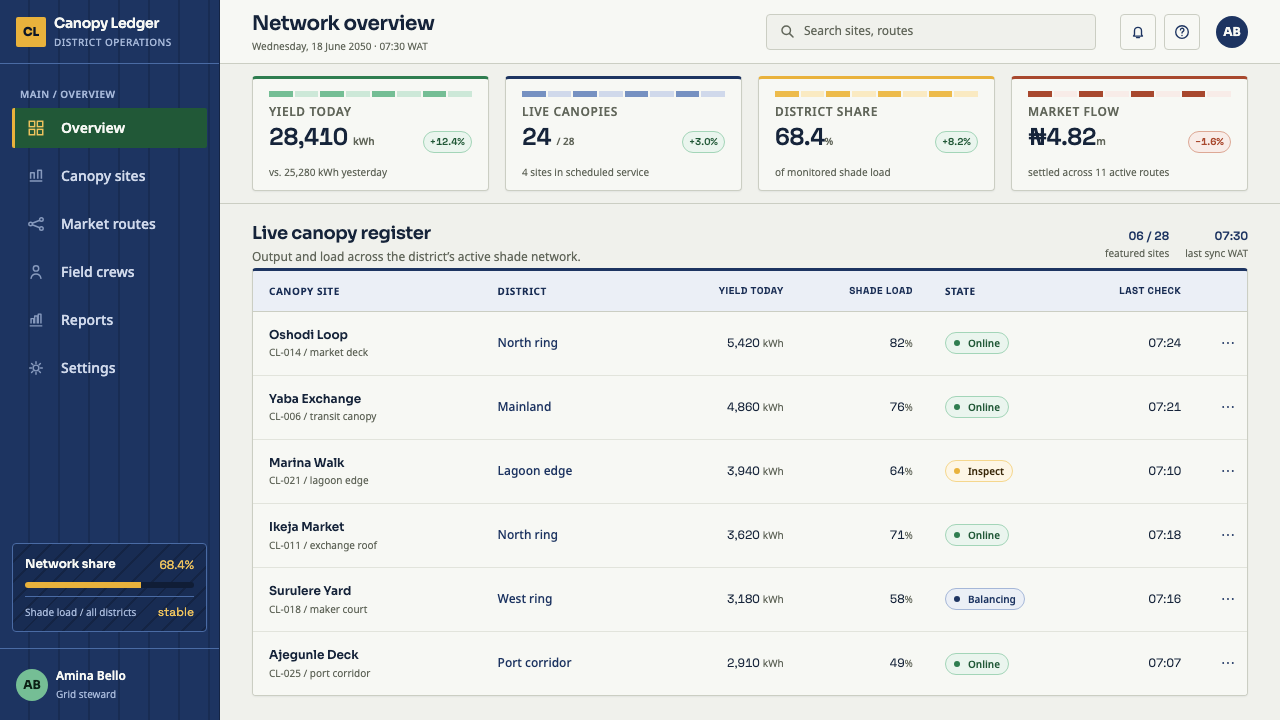
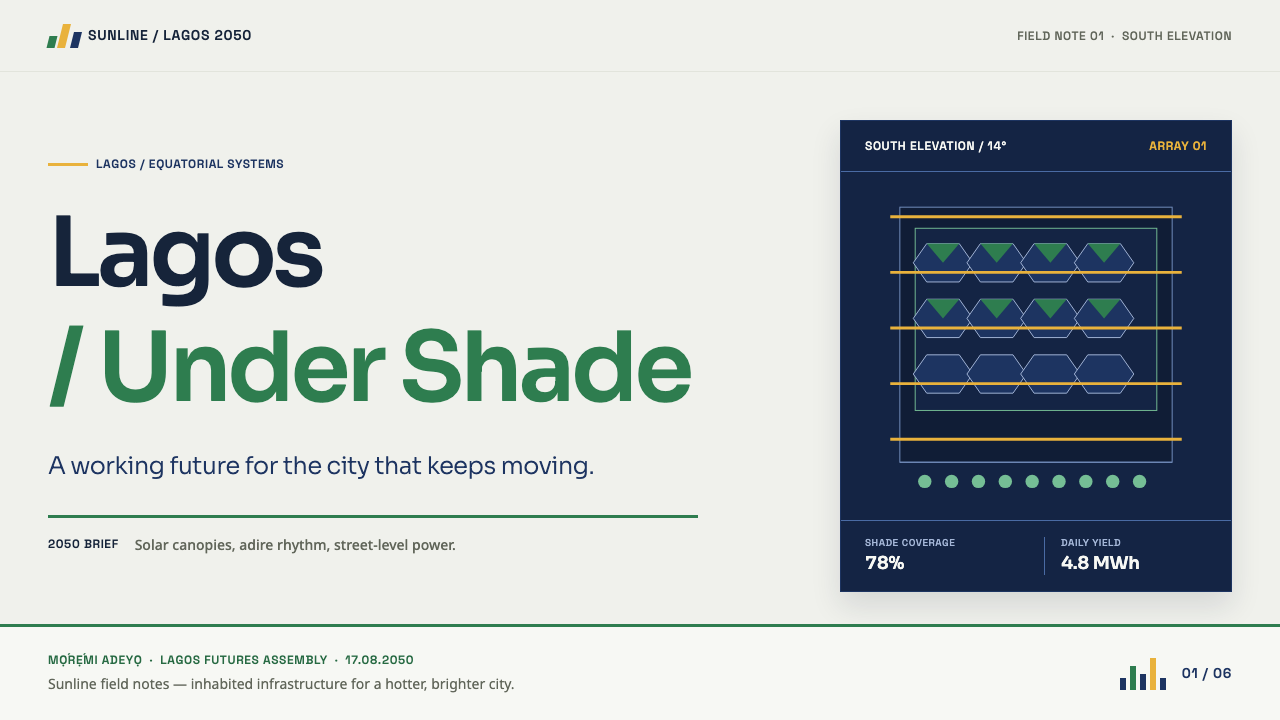
A slide cover can show a sun-bleached lime field with a deep indigo grid across one half, a band of louvre lines along an edge and the title set in a confident, plain face. Content slides can use the louvre line as a recurring horizontal rhythm: thin gold-edged rules that separate sections, each section inside an indigo-gridded panel. Data slides are a natural fit for energy and climate numbers. Charts sit on the lime ground, bars use the indigo, a small amount of gold flags the key figure, and green is reserved for canopy-like areas of meaning.
For dashboards and product interfaces, think dense but shaded. Lime-white surfaces carry panels with indigo gridlines, and the louvre line becomes a recurring divider or progress indicator. Navigation can be compact in the market-street sense, with many small labelled elements rather than a few large ones, provided the hierarchy is clear. A pricing page can pair a lime ground with indigo-grid tier cards and a single gold edge on the recommended plan. Green appears as canopy-like regions or status areas, not as a leaf icon on every button. Empty and loading states are a good place to show the street: a small scene of stalls, louvres and canopy beats a blank panel with a spinner, and it keeps the product feeling inhabited even when there is no data yet.
For editorial and marketing, use street-level photography and illustration: markets, rooftop farms, water buses, minibus lines under solar canopies. Layouts can be layered, with overlapping panels and a visible grid, as long as the ground stays light and the structure stays legible. Textile-derived pattern, in the spirit of adire, works as a border or a backdrop block behind a quote, never as noisy wallpaper behind body text.
The most common mistake is treating the style as generic eco-tech: white space, thin type, a green leaf icon and a floating solar panel. That erases Lagos and the density. The second is a glossy sci-fi finish, with neon, chrome and glowing dark mode, which belongs to a different future; this one is built from lime, indigo and laterite. The third is emptiness. A Solarpunk Lagos screen should feel inhabited, so leave out the vast empty plazas.
Solarpunk Lagos — FAQ
Is Solarpunk Lagos the same as Afrofuturism?
They are related but not the same. Afrofuturism is a broad cultural current, and this style draws on it alongside solarpunk, African climate-adaptive architecture and Yoruba indigo resist-dye. Solarpunk Lagos is a specific design system for a Lagos in 2050, with a defined set of materials, colours and layout rules.
Why is shade treated as infrastructure?
In an equatorial city, shade is what makes outdoor life possible, and solar louvres shade a wall and generate power at the same time. In design terms, that means the louvre line appears across surfaces and layouts include covered zones, so the page looks as though it were built for heat.
What does green mean in this style?
Green means canopy, meaning real trees, planted terraces and roof farms, rather than a leaf-shaped badge. Use it with mass and context, in regions of the layout, not as an eco icon on every control. If green is not showing something alive giving shade, it probably does not belong.
Does the style work in dark mode?
It is built on a sun-bleached lime ground, so light is its natural state. A night version is possible: let indigo carry the ground, use the gold-edged louvre lines as lamplight and keep the grid visible. Treat it as a departure, and avoid neon or chrome, which would pull it into a different kind of future.
How do I get density without clutter?
Lean on structure. A visible indigo grid, a steady louvre rhythm, flat colour fields and a light ground let many small elements coexist legibly. Keep one clear hierarchy, group things into panels, and reserve gold and green for a few meaningful places, so the crowd reads as a city rather than as noise.
Related design styles
 Solarpunk (2035)Climate optimism feels handmade. Moss ground, solar gold, and Art Nouveau bor…
 Solarpunk Utopia Poster (2014)Optimism has infrastructure. Emerald ground, saffron sunburst, humanist serif…
 Yukon Northern LightsPhysics as interface. Electric oxygen-green curtains glow over blue-black nig…
 Africanfuturism VibraniumCeremony goes electric. Violet glow and gold inlay thread a volcanic textile…
 Avatar — Pandora Bioluminescence (2009)The forest knows you are there. Cyan light blooms across a deep-teal living f…
 Bio-Organic GenerativeInterfaces feel cultured. Void black, Voronoi membranes, and neon chlorophyll…