What is Solarpunk (2035)?
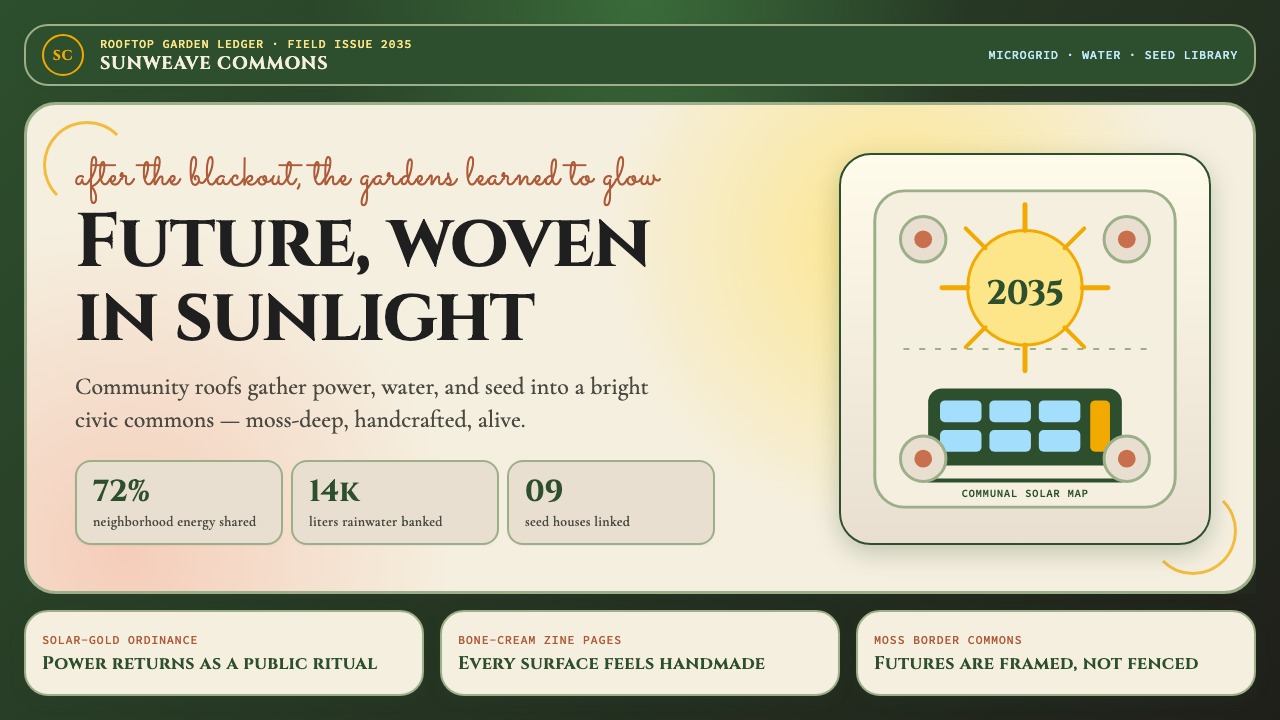
Solarpunk imagines the future as green, communal, and handmade — where solar-gold light spills over moss-covered rooftops and Art Nouveau curves reclaim the city.
Solarpunk (2035) in brief
Solarpunk is a speculative aesthetic and political movement that pictures a near-future in which the climate crisis has been met with creativity and communal solidarity rather than corporate collapse or military dystopia. Its visual language is warm and verdant: deep moss-green grounds, sun-gold accents, bone-cream surfaces, and organic silhouettes that echo vine tendrils, solar panel grids, and the curvilinear ornament of Art Nouveau revival architecture. Where cyberpunk offered neon-lit ruin, Solarpunk offers flowering abundance.
The aesthetic draws from several traditions simultaneously. Alphonse Mucha's decorative borders and flowing botanical motifs supply the ornamental vocabulary. Hayao Miyazaki's films — in particular Nausicaä of the Valley of the Wind and Castle in the Sky — provide a template for worlds where advanced technology and lush ecology coexist without contradiction. The natural pigments of terracotta, unbleached linen, amber resin, and sun-baked clay ground the palette in materials that feel grown rather than manufactured.
Crucially, Solarpunk is not nostalgic. It does not mourn a pre-industrial past; it designs a post-carbon future. Solar panels nest inside Gothic arches. Wind turbines rise from community gardens. Handmade ceramics share shelf space with open-source electronics. The aesthetic insists that high technology and deep ecology are not opposites, and that beauty — particularly the ornate, nature-derived beauty of Art Nouveau — is itself a form of political argument against the grey utilitarian logic of extraction capitalism.

Where does Solarpunk (2035) come from?
Solarpunk's intellectual roots reach back to 2008, when the term first appeared in an online essay arguing that science fiction had exhausted its capacity for productive pessimism. The post-apocalyptic and corporate-dystopian modes had normalized catastrophe as inevitable; what was needed, the argument ran, was a speculative mode that treated ecological flourishing as a plausible outcome worth designing toward. The name fused the solar-energy optimism of the environmental movement with the 'punk' suffix that signals a counterculture operating outside mainstream institutional channels.
The movement's visual canon crystallized around 2012 to 2014, largely through the image-sharing culture of Tumblr and later Pinterest. Users began tagging and collecting images — Mucha lithographs, Ghibli concept art, photographs of Singapore's Gardens by the Bay, renders of vertical farms, pictures of community solar installations in rural cooperatives — under the emerging Solarpunk label. The act of collecting and captioning these images was itself a form of manifesto-writing: it defined a visual territory by accumulation rather than by formal declaration. By 2014, the first dedicated Solarpunk anthologies of speculative fiction were in preparation, and the aesthetic had a recognizable iconography.
Key intellectual architects of the movement include Adam Flynn, whose 2014 essay 'Solarpunk: Notes toward a manifesto' remains the most cited theoretical text; Andrew Dana Hudson, a fiction writer and essayist who developed the movement's political-economic dimensions; and Olivia Louise, whose visual curation work on Tumblr helped define the canonical image set. Justine Norton-Kertson has been influential in connecting Solarpunk to existing anarchist and degrowth traditions, arguing that the aesthetic must be inseparable from its political commitments or it becomes mere decoration.
The movement matured significantly through the 2020s as climate change moved from speculative concern to lived reality in much of the world. Architectural firms began producing buildings explicitly described as Solarpunk, incorporating living walls, integrated photovoltaic surfaces, communal food-growing spaces, and ornamental botanical motifs in facade design. By the early 2030s, the aesthetic had entered mainstream institutional culture — appearing in municipal planning documents, government green-transition communications, and the visual identity of renewable-energy cooperatives. The 2035 version of the design system reflects this maturation: it retains the movement's warmth and hand-crafted sensibility while codifying it into a deployable design language legible to contemporary digital interfaces.
What defines the Solarpunk (2035) look?
Color Palette
The Solarpunk palette is grounded in the natural world rather than the digital one. The dominant tone is a deep, saturated moss-green — the color of a living wall or a fern in dappled light — which serves as both background and atmospheric anchor. Against this, solar gold appears as a warm, generous accent: the color of mid-afternoon sun through amber glass rather than a harsh primary yellow. Bone cream and unbleached linen tones provide content surfaces that feel hand-pressed rather than screen-rendered. Earthy terracotta, amber, and warm ochre fill supporting roles. The overall effect is a palette that reads simultaneously as historical (recalling the natural dyes of Art Nouveau posters) and futuristic (invoking the warm glow of renewable energy abundance).
Organic Line and Botanical Ornament
Where Bauhaus reduced form to geometry and Swiss Style to the grid, Solarpunk restores the curve. Borders are not ruled lines but vine stems; dividers are not horizontal bars but stylized leaf arrangements; frame elements grow from corners as if rooted there. This vocabulary is drawn directly from the Art Nouveau tradition — particularly the sinuous, nature-derived ornamental language of Mucha, Guimard, and Klimt — but it is deployed in contemporary digital contexts: as SVG illustrations, as decorative layer elements, as the curves that define card shapes and icon silhouettes. The ornament is never merely cosmetic; it is structural, providing rhythm and orientation within a layout.
Texture and Handcraft Warmth
Solarpunk actively reintroduces the imperfection and tactility that modernist design traditions worked hard to eliminate. Paper grain, linen weave, watercolor wash, and ink-on-wood-block print textures appear as background treatments and overlay effects, softening what might otherwise be stark digital compositions. This is not a retreat from the digital medium; it is a deliberate cultural argument embedded in form — the assertion that the future should feel made by human hands, not extruded by machines. In practice, textures are applied subtly, working with the moss-green and bone-cream grounds rather than obscuring them.
Typography with a Living Quality
Solarpunk typography resists the cold neutrality of purely geometric sans-serif faces. Preferred typeforms have slight humanist warmth — letterforms that retain traces of the hand, of calligraphic origin, of letters carved into stone rather than plotted by algorithm. Display type is often used at generous scales, allowing the organic quality of letterforms to read as texture in itself. Headlines may incorporate decorative botanical initial caps, in the tradition of illuminated manuscripts reinterpreted through Art Nouveau revival. Body text favors comfortable line spacing and generous measure, reinforcing the aesthetic's commitment to reading as a slow, pleasurable act rather than a rapid scan.
Solar and Radial Motifs
The sun — as an actual celestial body and as a symbol of renewable energy abundance — is the movement's central icon, and its visual grammar pervades the design system. Sunburst patterns, radial gradients in solar-gold tones, circular compositions that echo the disc of the sun, and starburst dividers drawn in Art Nouveau line work all reinforce this solar orientation. In a layout, the radial motif provides an alternative organizational logic to the straight grid: things can radiate outward from a center, can be arranged in arcs, can speak the language of growth and expansion rather than of filing and containment.
Community and Multiplicity
Unlike design systems derived from corporate modernism — which tend toward singular, authoritative voices — Solarpunk is compositionally generous. Multiple voices can coexist on a single page. Illustration styles can mix: a botanical engraving alongside a flat icon alongside a loose watercolor sketch. Pattern borders can frame diverse content without enforcing homogeneity. This visual democracy is not accidental; it mirrors the movement's political commitments to decentralization, cooperative governance, and the dignity of different cultural traditions. In practice, this means Solarpunk layouts feel curated and handpicked rather than manufactured to spec.
Dark Ground, Light Bloom
The canonical Solarpunk color mode places warm content on a dark ground — bone-cream text and solar-gold accents against deep moss-green — inverting the bright-screen defaults of most digital interfaces. This dark-ground approach is not merely aesthetic; it carries meaning. The moss ground suggests soil, forest shade, the earth from which things grow. The light elements are what emerges from that ground: solar gold as sunlight breaking through leaves, cream as warm lamplight in a community workshop. The system can also function in a lighter mode, but the dark-ground mode is where the aesthetic is most itself.

Who shaped Solarpunk (2035)?
Flynn's 2014 essay 'Solarpunk: Notes toward a manifesto,' published in the anthology Sunvault and widely circulated online, is the foundational theoretical document of the movement. He argued that Solarpunk should be understood not as a genre but as a design and political orientation: a commitment to imagining futures that are both technologically sophisticated and ecologically embedded, governed by cooperative rather than extractive logics. His articulation of Solarpunk as a practice of 'infrastructure as culture' — the idea that the design of shared systems is itself a form of political expression — has been influential across architecture, urban planning, and speculative fiction.
Louise's curatorial work on Tumblr in the 2012–2015 period was instrumental in defining the movement's visual canon before any formal design system existed. By assembling and annotating image collections — mixing Mucha prints, Ghibli stills, community garden photographs, and architectural renders — she established the visual grammar that later formal articulations of the style would codify. Her contribution represents a broader pattern in Solarpunk's development: the aesthetic emerged through distributed collaborative curation rather than through the authorial declaration of a single designer or manifesto.
Though Mucha (1860–1939) predates the Solarpunk movement by a century, his visual vocabulary is so thoroughly embedded in the aesthetic that he functions as a founding ancestor. His characteristic devices — botanical border panels, circular aureole frames, flowing hair merged with plant forms, organic letterforms emerging from root and branch structures, the warm golden-and-green palette of his later Slavic Epic — are all directly legible in Solarpunk design. Solarpunk designers invoke Mucha not as pastiche but as evidence of a longer tradition: the insistence that beauty derived from nature is a legitimate, politically resonant design choice.
Miyazaki's animated films, produced through Studio Ghibli from the 1980s onward, provide the most widely recognized visual template for a Solarpunk world before the movement had that name. Nausicaä of the Valley of the Wind (1984) imagines an ecology that is dangerous but generative, where humans survive by learning the logic of a non-human world. Castle in the Sky (1986) and Howl's Moving Castle (2004) place advanced technology inside organic and pastoral settings without irony. The Ghibli visual sensibility — soft afternoon light, hand-painted backgrounds with visible brushwork, human-scale architecture overgrown with plants — became a touchstone for Solarpunk visual culture precisely because it embodied the aesthetic before the political framework existed to articulate it.
Norton-Kertson has been one of the movement's most persistent voices arguing that Solarpunk aesthetics must remain inseparable from Solarpunk politics — that a visual style stripped of its commitment to degrowth, mutual aid, and indigenous ecological knowledge becomes merely another commodified design trend. As editor of the journal Solarpunk Magazine and contributor to numerous anthologies, Norton-Kertson has worked to ensure that the growing institutional adoption of Solarpunk imagery is accompanied by substantive engagement with the movement's political-economic critiques. This tension between aesthetic adoption and political integrity remains one of the movement's live debates.
How do you use Solarpunk (2035) today?
Solarpunk is one of the few contemporary design systems that is explicitly political in its aesthetic commitments, and applying it well requires understanding that its visual choices are not arbitrary — each one is a small argument about what the future should feel like. The practical implication is that Solarpunk works best for products and organizations whose values align with the movement's orientation: sustainability, community, craft, and optimism about collective human capability. Used cynically — as a green-washing visual veneer over extractive or surveillance-driven products — it reads as incoherent to audiences familiar with the aesthetic's cultural context.
For presentation slides, Solarpunk offers a strong alternative to the sterile corporate defaults that dominate most professional decks. A cover slide built in this system typically anchors a large botanical border motif in the bottom-left and top-right corners, with the title set in a humanist display face at generous scale on a moss-green ground. Solar-gold is used for the headline or a single key phrase, never for multiple elements simultaneously. Content slides use bone-cream grounds with deep-moss-green type for body text, reserving solar-gold for data callouts or section labels. Data visualization slides adopt a warm, palette-consistent approach: charts and graphs use the moss-green and solar-gold as the primary data colors, with bone-cream as the neutral, and botanical dividers between sections replace ruled horizontal lines.
For web interfaces, Solarpunk is particularly well-suited to environmental, cooperative, community, and educational platforms where the visual language should communicate warmth and approachability alongside competence. Dashboard interfaces in this system organize information within organic card shapes with softly curved borders rather than hard rectangular containers, use solar-gold accents for interactive states and key metrics, and incorporate subtle botanical pattern overlays in sidebar or header areas. Pricing pages benefit from the aesthetic's natural tier differentiation: a community tier, a cooperative tier, and an enterprise tier translate well into the three earthy accent tones of terracotta, moss-green, and solar-gold. Navigation uses generous line spacing and is typographically clear rather than icon-heavy.
For editorial and marketing materials, Solarpunk supports both long-form reading experiences and high-impact visual communications. Article layouts in this system favor a moderate column width for body text, generous leading, and botanical drop-cap initials for section openings. Pull quotes are framed within thin Art Nouveau line borders rather than heavy blockquote bars. Marketing pages use the full-width botanical border system: decorative vine frames set the boundaries of feature sections, alternating between deep-moss-green and bone-cream grounds to create rhythm. Photography, where used, is treated warmly — desaturated toward the palette's earthy tones, never cold-processed or high-contrast in the cyberpunk manner.
The most common mistake when applying Solarpunk is conflating it with generic 'eco' aesthetics: stock photographs of leaves, flat green icons, and corporate sustainability reports. Solarpunk is not about being green in a metaphorical sense; it is about the specific visual vocabulary of Art Nouveau ornament, natural pigment warmth, handcraft texture, and solar motifs. A second common error is over-saturating the palette — pushing the moss-green so dark it becomes oppressive, or using solar-gold at such high intensity it loses its warmth and begins to read as warning-signal yellow. The system works through restraint and balance: deep grounds with light-toned content, warm accents used sparingly, organic decoration that breathes rather than crowds.

Solarpunk (2035) — FAQ
Is Solarpunk just Art Nouveau with solar panels?
Art Nouveau is the most visible ancestor, but Solarpunk is a synthesis of several distinct traditions. From Art Nouveau it inherits the organic line, botanical ornament, and the conviction that everyday objects deserve beautiful design. From Studio Ghibli it borrows the template of a world where technology and ecology coexist without irony. From the degrowth and commons movements it takes its political-economic commitments. From craft traditions worldwide it derives its insistence on handmade texture and material honesty. The solar-panel element is not simply added on — it is the aesthetic's political core, the insistence that energy infrastructure can be generous and luminous rather than industrial and extractive. Solarpunk would not exist without Art Nouveau, but Art Nouveau would not recognize itself in Solarpunk.
How does Solarpunk differ from Cottagecore?
Cottagecore and Solarpunk share some visual territory — both embrace organic forms, handcraft aesthetics, and a rejection of industrial modernity — but their underlying politics and futures are different. Cottagecore is primarily nostalgic and escapist: it imagines a retreat from contemporary society into an idealized pre-industrial rural past. Solarpunk is explicitly future-oriented and politically engaged: it imagines not a retreat but a transformation, where the aesthetic of organic abundance is achieved through solar-powered cooperatives and community governance rather than through withdrawal. Practically, Solarpunk compositions are denser, more technologically explicit, and more politically legible than Cottagecore's soft, dreamy pastoral register.
Can Solarpunk work for a dark-themed interface, like a night-mode dashboard?
The canonical Solarpunk palette is already a dark-ground system — the deep moss-green is a dark background, and the aesthetic reads most naturally in this mode. What changes in a 'night mode' interpretation is the ground tone, which might shift from moss-green toward a deeper forest-dark or near-black while retaining the solar-gold and bone-cream as foreground elements. This is coherent with the aesthetic: it evokes a forest at night, lit from within by warm light. What should be avoided is a cold, blue-black night mode that imports the visual logic of a cyberpunk or corporate dark interface — that would undermine the warmth that the palette depends on. Botanical motifs and organic line work in a paler, moonlit tone can preserve the Solarpunk atmosphere even on a very dark ground.
What kinds of products is Solarpunk not well suited for?
Solarpunk struggles in contexts that demand urgency, authority, or sharp rational structure as primary values. Financial trading platforms, emergency response tools, and highly technical developer tooling benefit from visual systems that communicate precision and control — qualities that Solarpunk's organic warmth actively works against. The aesthetic also sits uneasily with luxury brands that rely on cold minimalism, scarcity signaling, and materials like polished metal and glass for their associations. And because Solarpunk is politically legible — it signals specific commitments to ecology, community, and anti-extraction — it can create cognitive dissonance when applied to products whose business models contradict those values. The most important diagnostic question is whether the organization's actual behavior aligns with what the aesthetic says about it.
How should imagery and photography be handled in a Solarpunk design?
Photography in a Solarpunk system is treated warmly and organically. Color grading should pull toward the palette's earthy warmth — boosting amber and green channels, cooling down blue channels — so that images feel consistent with the moss-and-gold ground rather than imported from a different visual register. Subject matter naturally gravitates toward community, cultivation, and the co-existence of built and natural environments: rooftop gardens, cooperative workshops, solar installations nestled in greenery, people working together on shared projects. Cold-processed, desaturated, or high-contrast photography in the editorial fashion or corporate stock style should be avoided entirely. Illustration — whether botanical engravings, watercolor sketches, or folk-art-influenced flat imagery — is an equal partner to photography in this system, not a fallback for when photos aren't available.
Related design styles
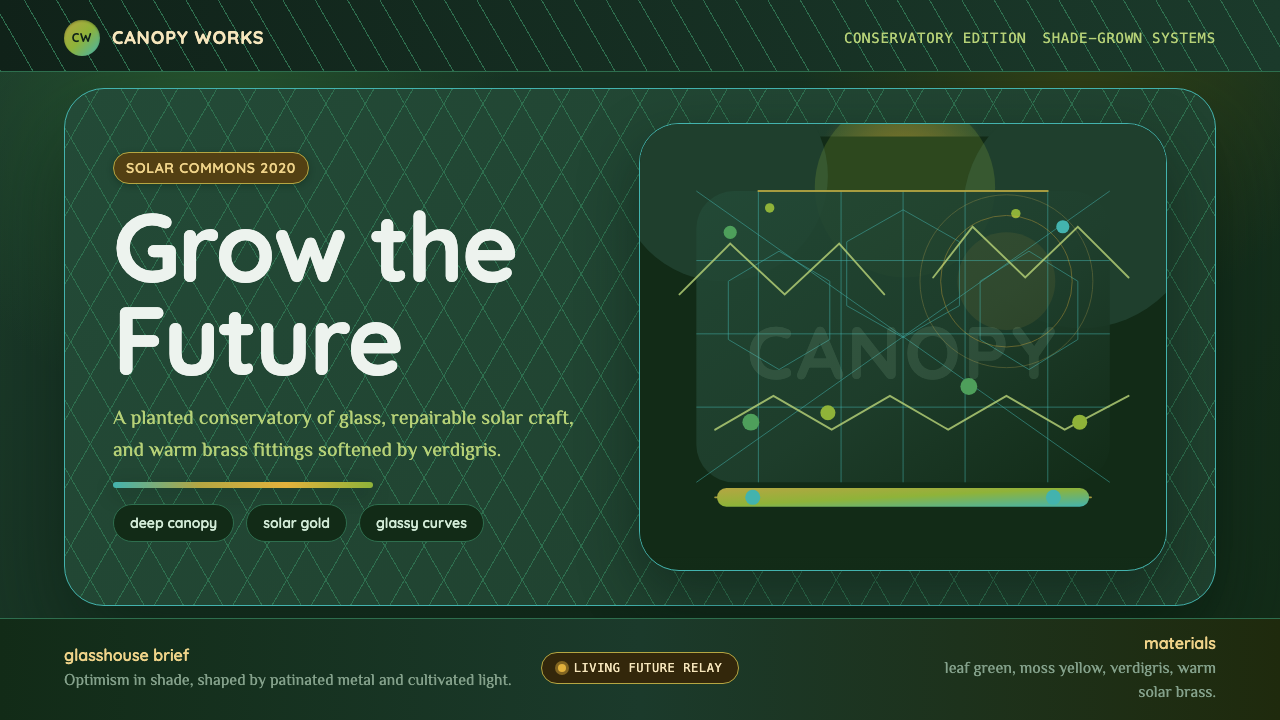 Solarpunk GreenhouseA grown future, not a sterile one. Deep canopy green, solar gold, and glassy…
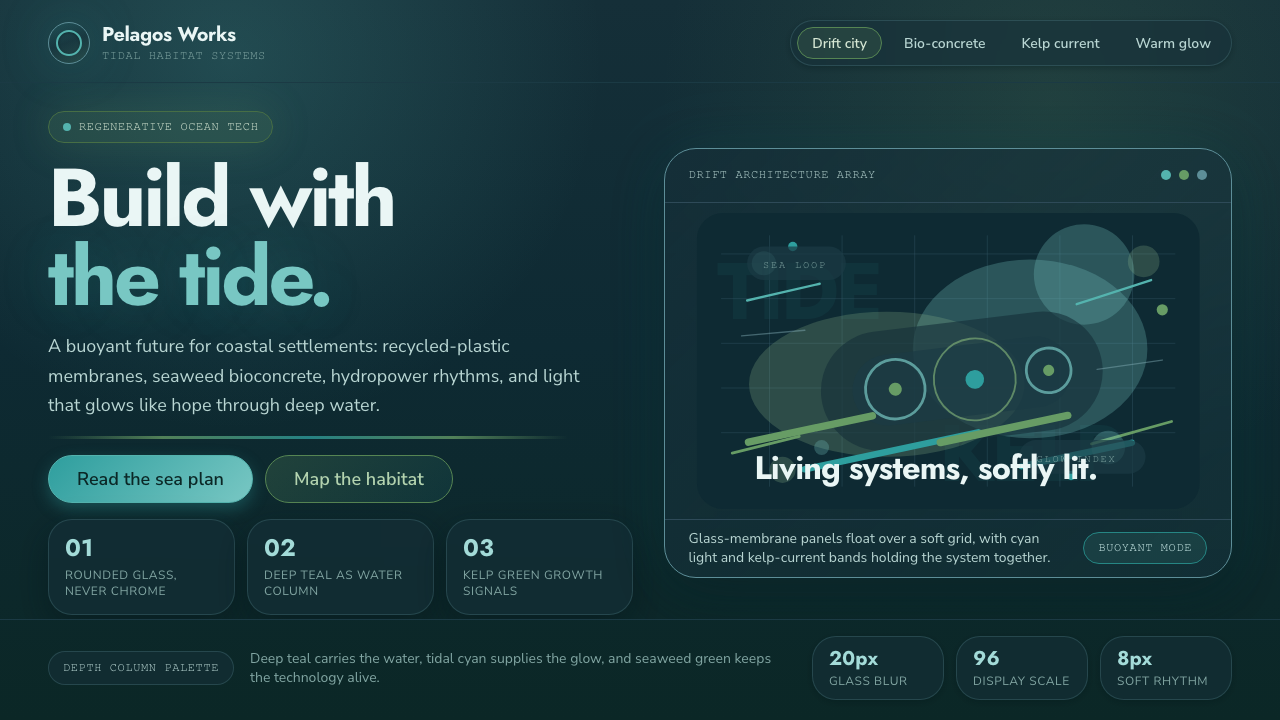 TidalpunkHope glows underwater. Deep teal glass, tidal cyan light, and kelp-green curr…
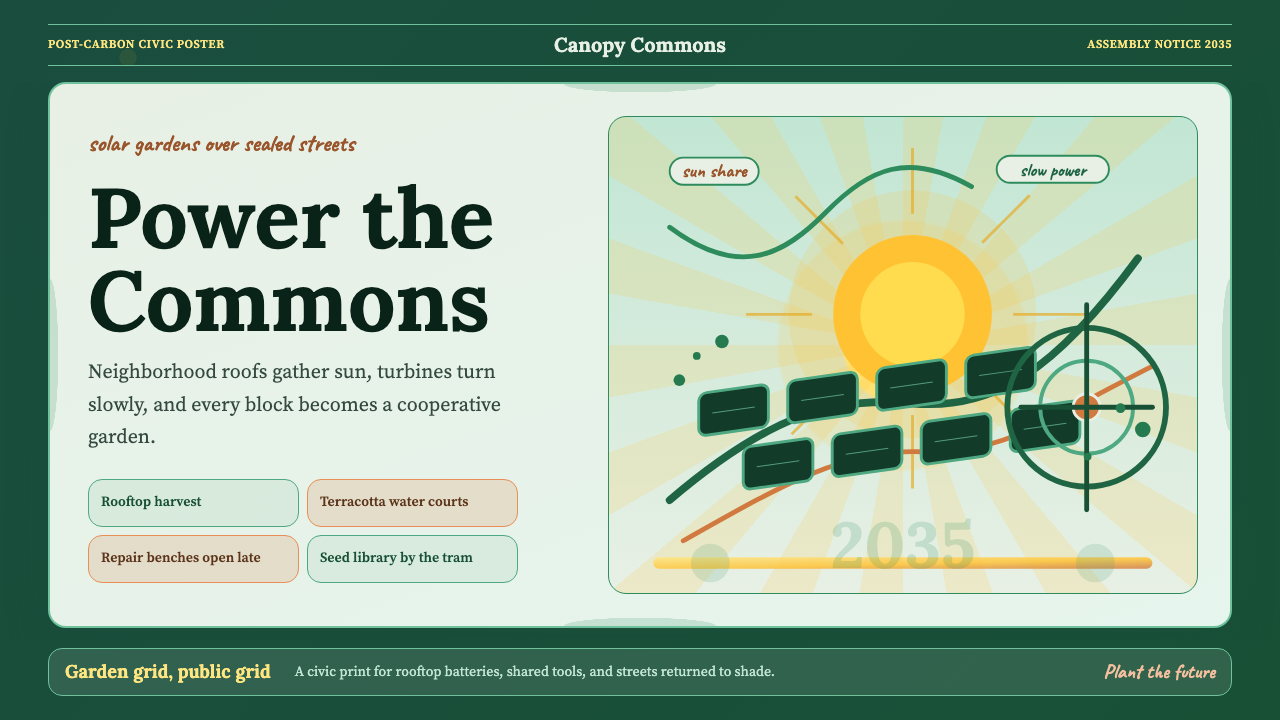 Solarpunk Utopia Poster (2014)Optimism has infrastructure. Emerald ground, saffron sunburst, humanist serif…
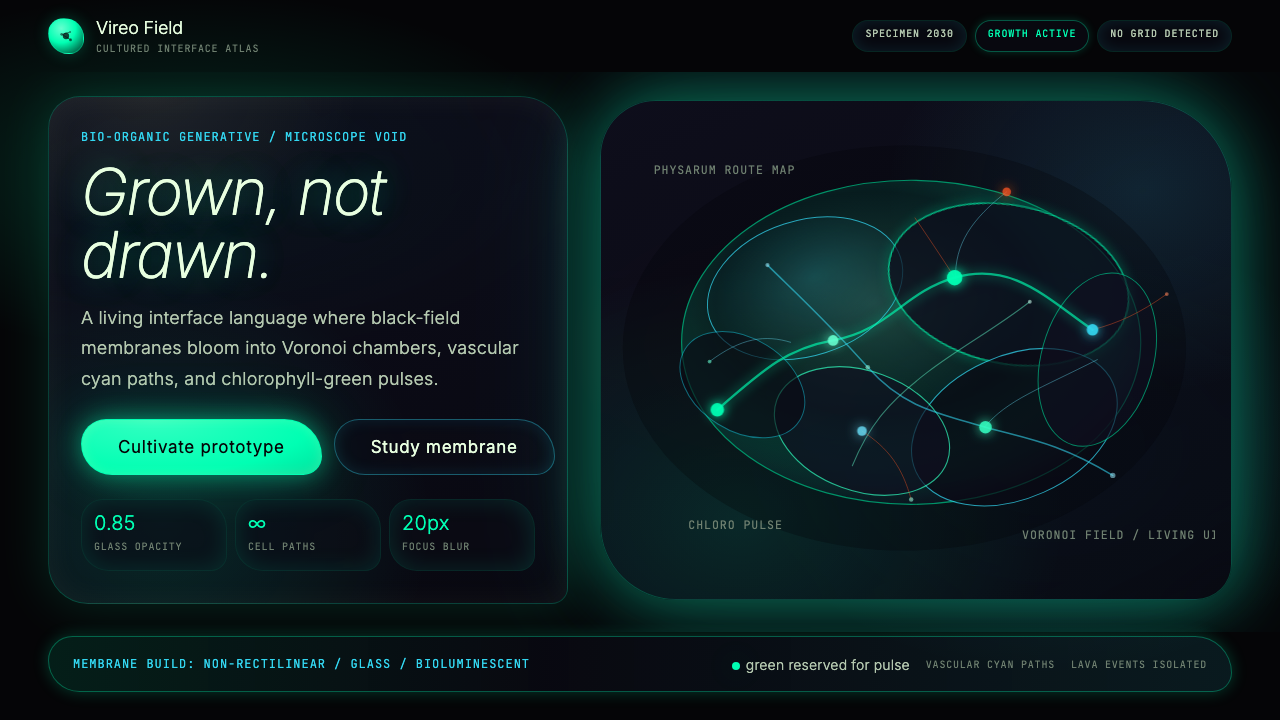 Bio-Organic GenerativeInterfaces feel cultured. Void black, Voronoi membranes, and neon chlorophyll…
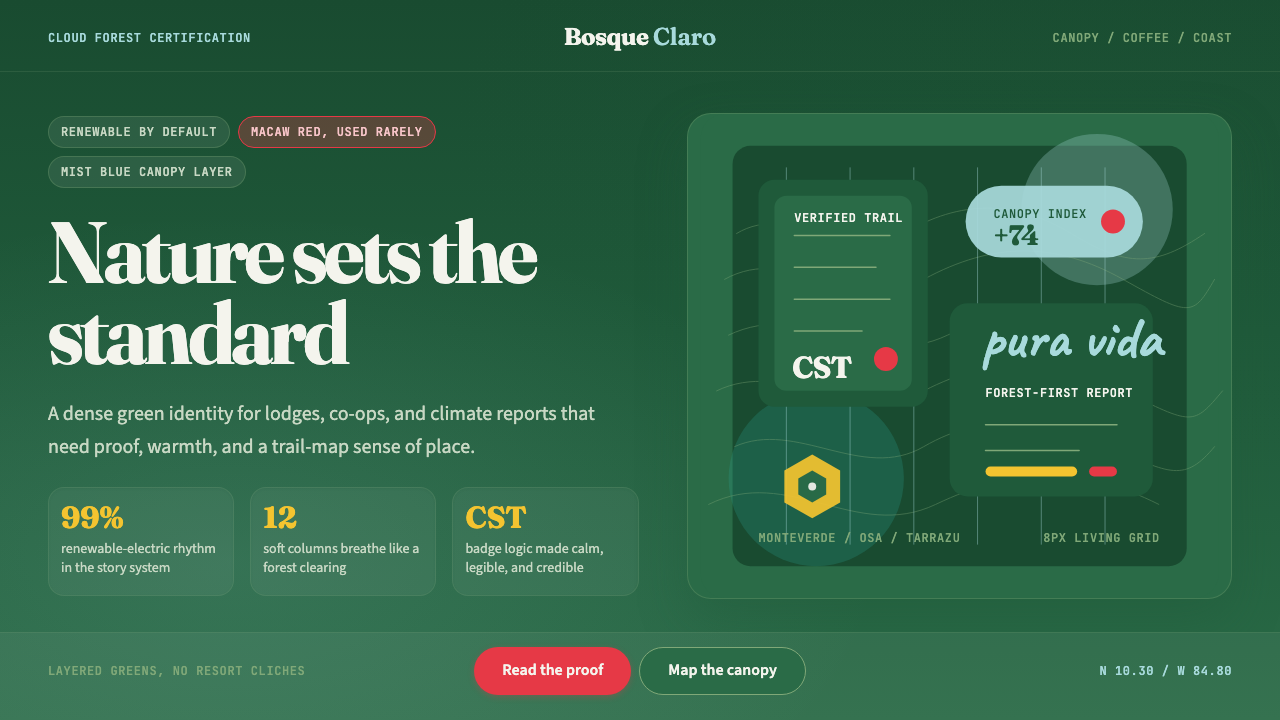 Costa Rica Pura Vida EcoAlive without greenwash. Cloud-forest green, Fraunces serif, and scarlet acce…
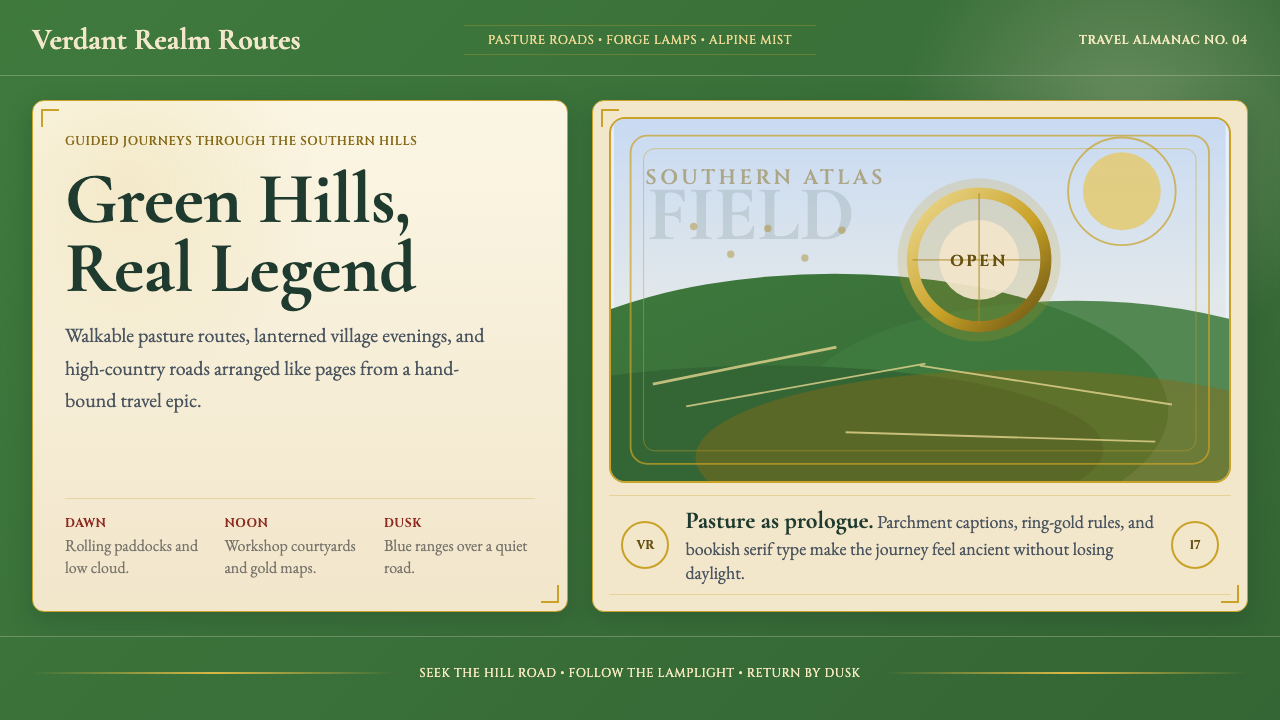 NZ Lord of the Rings TourismEpic feels approachable. Pasture green, ring-gold, and Garamond book frames.