What is Solar Eclipse Corona?
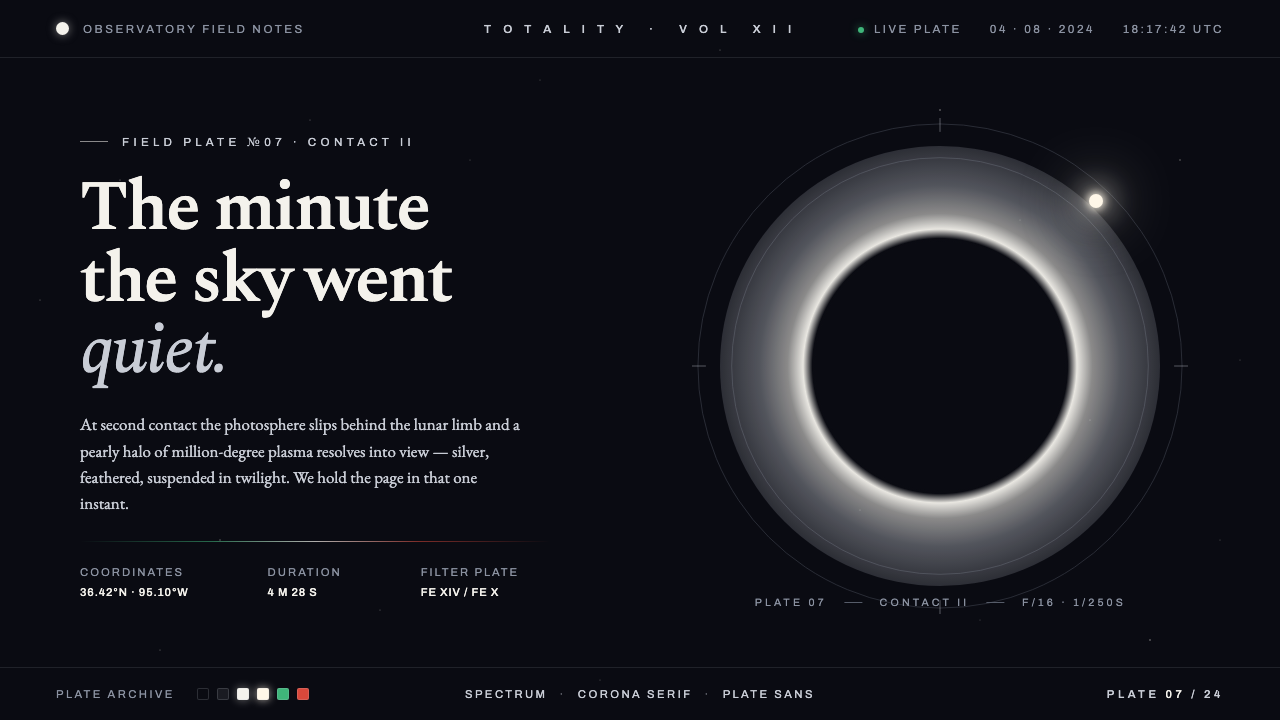
Solar Eclipse Corona turns totality into a design language: pearly silver light suspended in near-black silence, with one warm diamond-ring spark to mark the instant.
Solar Eclipse Corona in brief
Solar Eclipse Corona captures the most luminous instant in astronomy: totality, when the Moon’s black disc is encircled by the pearly-white solar corona against a deep slate-twilight sky. It is not a general space aesthetic and not a celebration of spectacle. Its subject is a precise atmospheric condition in which darkness makes scattered light visible.
The visual system is built on extreme restraint. Cool silver-white corona light is the dominant presence; the surrounding field recedes into twilight black; a warm-white diamond-ring spark marks contact; and faint green and red coronal lines introduce the physics without competing with the central image. Everything is quiet, centered, and intentional.
The style belongs to eclipse-photography minimalism, where a single astronomical event carries the composition. It favors one focal ring over a field of stars, one luminous edge over multiple effects, and the suggestion of scientific observation over decorative fantasy. Its beauty comes from contrast, suspension, and the feeling that the viewer has arrived at exactly the right second.
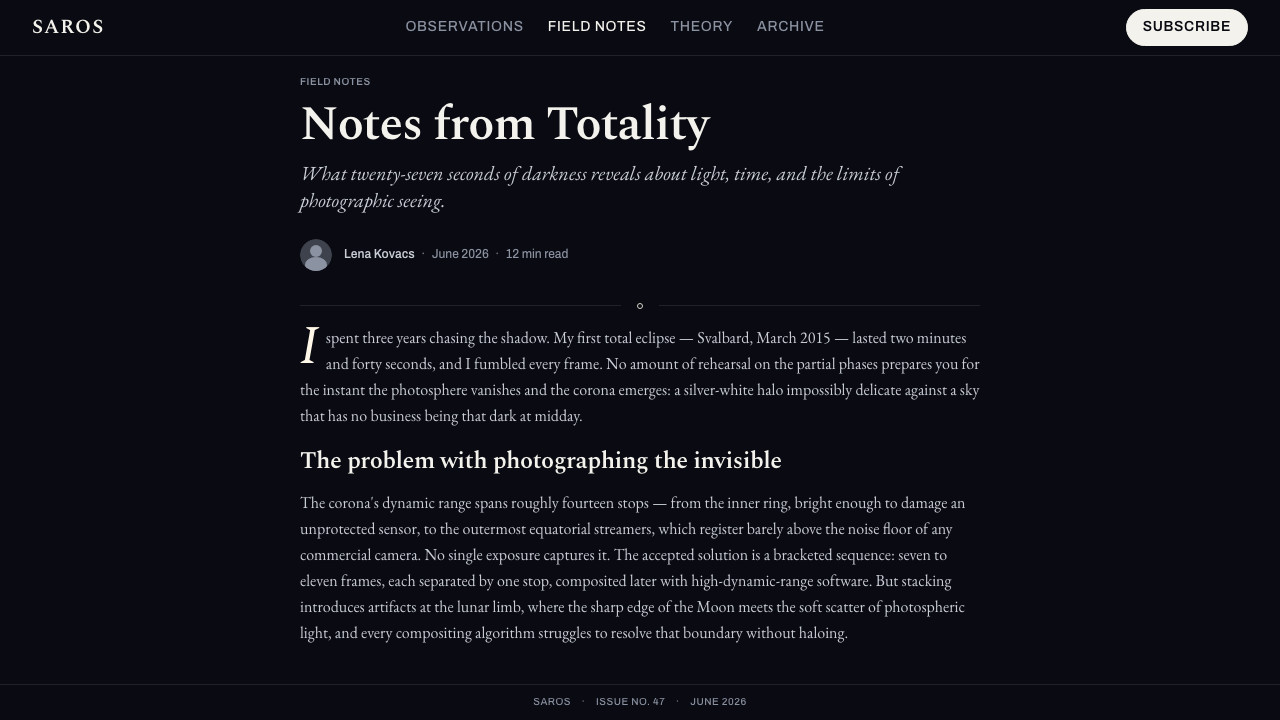
Where does Solar Eclipse Corona come from?
Solar Eclipse Corona belongs to the modern total-eclipse astrophotography era from 2010 to now. Its region is global and internet-based: eclipse-chaser photographs, observatory imagery, and public astronomy references circulate across the same visual field. The style is therefore less a school with a manifesto than a contemporary design vocabulary distilled from widely shared records of totality.
Its foundation is astrophotography. The camera does not treat the eclipse as a conventional landscape, because the essential subject is neither horizon nor weather but the relationship between a black lunar disc and the luminous atmosphere around it. The resulting image is almost diagrammatic: a dark centre, a pale ring, and a surrounding field whose emptiness gives the light its authority.
A second source is sky-event documentation. The image must feel like evidence of a rare celestial alignment, not an invented portal or cinematic nebula. NASA eclipse science and the observational culture associated with Sky & Telescope provide the reference frame: precise, publicly legible, and grounded in the event itself. The style’s quietness comes from treating the photograph as a record before treating it as a mood.
The final layer is scientific minimalism. The corona remains cool and silvery, while faint green and red traces evoke coronal emission lines associated with the physics of highly ionized iron. These accents are not decorative color notes; they are restrained signals that the luminous ring is an observed physical phenomenon. The style joins wonder and explanation without allowing either one to overwhelm the other.
What defines the Solar Eclipse Corona look?
Corona Light
The defining light is pearly silver-white: cool, scattered, and atmospheric rather than glossy or metallic. It should appear to breathe outward from the lunar edge, with enough delicacy to suggest real observation. Cream, ivory, and golden white weaken the identity because the corona is meant to feel cold, rare, and suspended.
Twilight Darkness
The surrounding field is deep slate-twilight, approaching black without becoming a flat graphic void. This darkness is functional: it creates the optical conditions in which the corona can carry the entire composition. A busy star field or visible landscape introduces competing subjects and breaks the hush.
Centered Focus
Composition is quiet and centered. The black lunar disc establishes a stable centre, while the corona forms a surrounding boundary rather than a decorative halo. Peripheral elements should remain subordinate, allowing the viewer to experience the eclipse as a singular event instead of scanning across a collage.
Diamond-Ring Spark
The diamond-ring moment is a warm-white spark at the edge of the cool corona. Its value lies in rarity and timing, so it should remain a precise accent rather than become a second light source. When enlarged, repeated, or scattered across a composition, it loses the sense of contact and transition that gives it meaning.
Scientific Traces
Faint green and red lines may appear as restrained references to coronal physics. They should read as evidence embedded in the image, not as neon decoration. Their role is to add a barely perceptible layer of specificity: the ring is luminous because it records matter and energy, not because an effect has been applied.
Photographic Restraint
The style avoids ornamental depth, fantasy atmospherics, and competing celestial motifs. Its surfaces should feel observed, not manufactured. The strongest result usually has very few visual decisions: one dark disc, one corona, one contact spark, and enough surrounding silence for each element to remain legible.

Who shaped Solar Eclipse Corona?
NASA eclipse science represents the observational and explanatory foundation behind the style. It anchors the image in totality as a real astronomical event, where the Moon’s disc, the corona, and the changing contact light are treated as subjects of study as well as sources of wonder.
Sky & Telescope stands for the public-facing culture of eclipse observation and sky-event documentation. Its place in the reference system keeps the style legible to enthusiasts and viewers, balancing scientific precision with the immediacy of a shared celestial experience.
Coronal physics supplies the style’s faint green and red scientific accents. The emission-line references keep the corona from becoming a generic white ring: they imply that the image contains physical information beneath its apparent simplicity.
How do you use Solar Eclipse Corona today?
For presentation slides, Solar Eclipse Corona is strongest on a cover that commits to a single centred eclipse image, a deep slate-twilight field, and a quiet title hierarchy. Content slides should preserve that calm: use broad dark space, cool light for the primary subject, and restrained green or red only when distinguishing scientific notes. Data slides can treat the corona as a visual anchor, but charts must remain subordinate to the subject rather than compete with it.
For web interfaces, the style suits astronomy dashboards, observatory portals, eclipse trackers, and analytical products that need authority without visual noise. Dark surfaces should carry the interface, while silver-white marks the active or observed state. A warm diamond-ring accent can identify a key moment or featured event; faint green and red can separate scientific categories. Cards, controls, and navigation should be quiet enough that the central event remains the interface’s emotional centre.
For editorial and marketing work, the style supports covers, feature stories, event announcements, and campaign pages built around anticipation. A single corona can occupy the dominant image field, with the headline placed in the surrounding darkness rather than printed over the brightest light. Supporting copy should feel measured and observational. Marketing can use the diamond-ring spark as a recurring sign of arrival, but the rest of the page should resist multiplying celestial motifs.
The common mistake is turning Solar Eclipse Corona into generic futuristic space design. Stars, nebulae, glowing grids, lens flares, coloured planets, and several competing light sources all dilute the original idea. Another failure is making the scientific accents bright and decorative. The style works when darkness creates attention, the corona remains cool and central, and every secondary mark feels like evidence of the same rare instant.
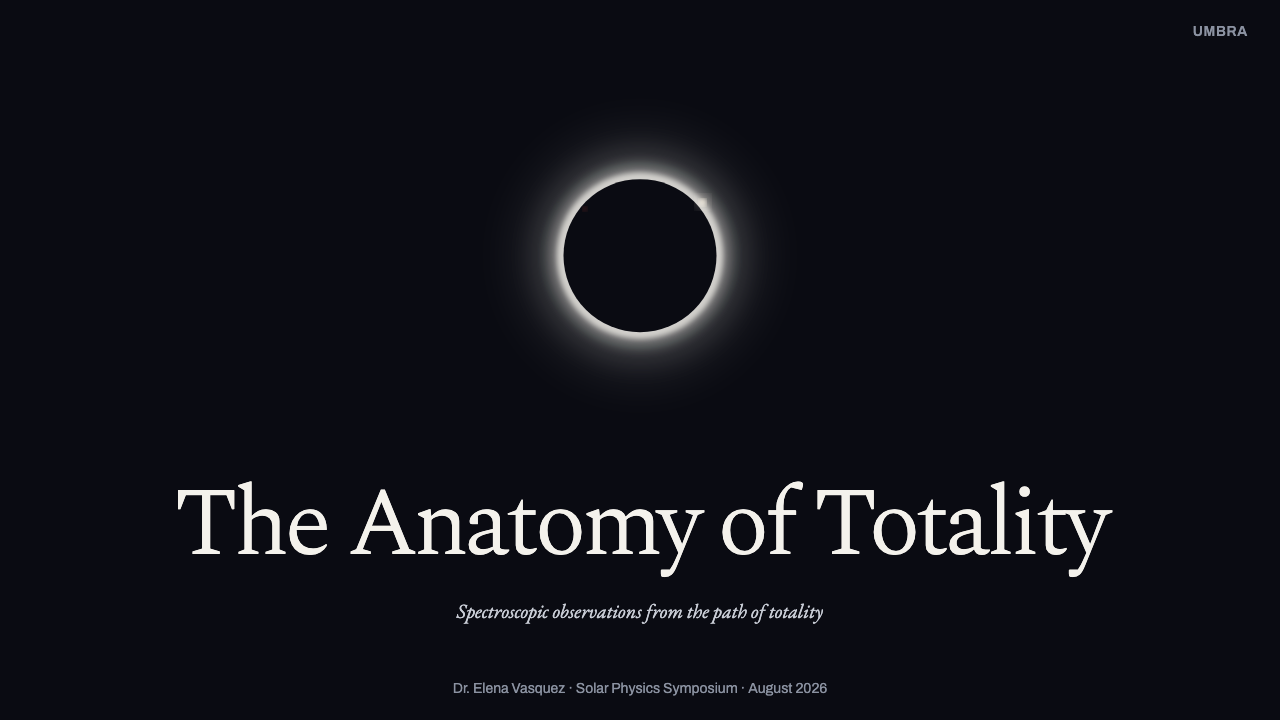
Solar Eclipse Corona — FAQ
Is Solar Eclipse Corona a general space style?
No. Its subject is specifically totality: the Moon’s black disc, the pearly corona, and the contact light that marks a fleeting stage of the eclipse. Generic stars, nebulae, planets, or futuristic cosmic effects move the design into another category. The style depends on the discipline of keeping one astronomical event unmistakably central.
Can the style use a light background?
A light background is possible for a supporting surface, but it weakens the core visual logic. The canonical field is deep slate-twilight, close to black, because the corona needs surrounding darkness to feel luminous and rare. If a light variant is necessary, it should preserve the cool silver corona, centred composition, and exceptional status of the diamond-ring spark.
How bright should the green and red accents be?
They should remain faint. Their purpose is to suggest coronal emission-line physics, not to decorate the image or establish a second palette. If viewers notice the green and red before they notice the black lunar disc and silver corona, the accents have become too assertive. Treat them as information at the edge of perception.
What makes the diamond-ring spark different from an ordinary glow?
The diamond-ring spark has narrative and observational meaning: it marks the moment of contact between eclipse phases. It is warm-white against a cool corona and should appear as a rare edge event, not as a reusable glow applied everywhere. Its power comes from timing, contrast, and singularity.
Related design styles
 Arrival LogogramFirst contact turns quiet. Fog gray, serif notes, and smoke-black rings decod…
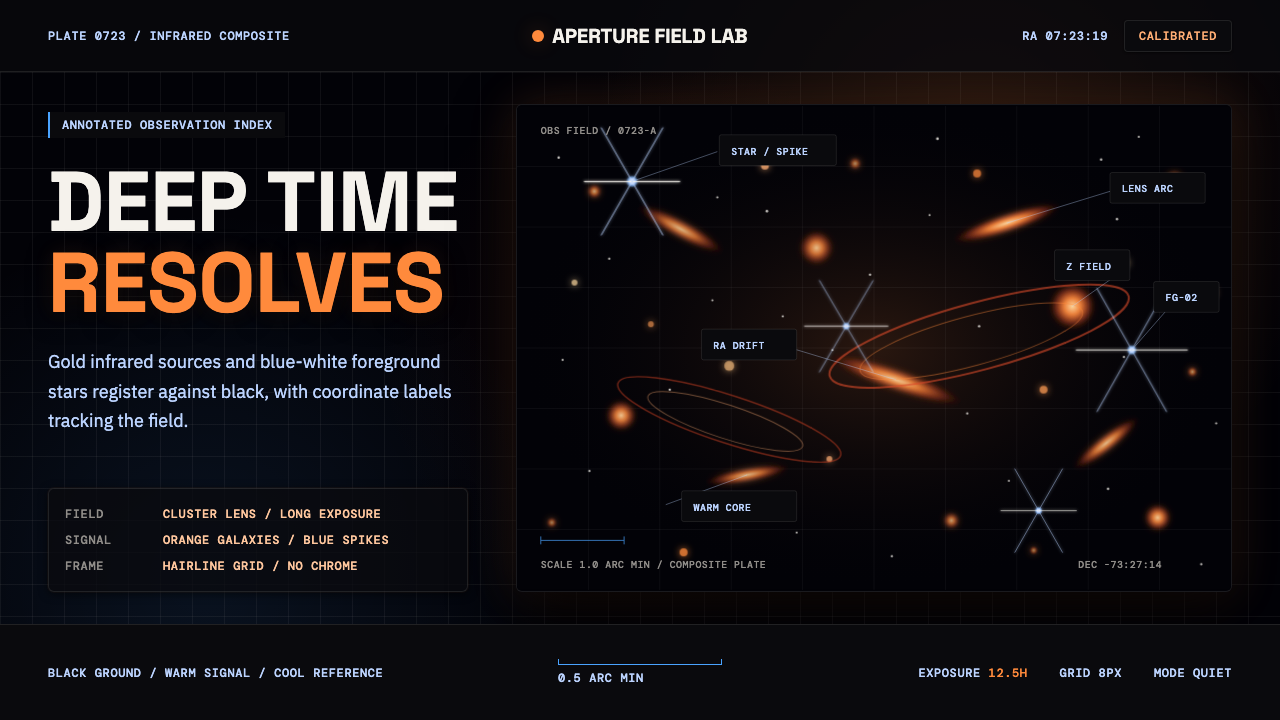 JWST Deep FieldPrecision in deep black. Orange galaxies, blue spikes, and DM Mono callouts m…
 IndieWeb / Personal SiteOwn your URL, own your paragraph. Narrow Lora column, near-black on cool whit…
 Micronesian Etak Star CompassNavigation as memory. White star points and sand ribs map a 32-point ocean-ni…
 X-Ray CrystallographyQuiet evidence glows. Near-black film, Spectral serifs, and an X-cross spot l…
 Arctic Tundra LichenPatience made visible. Sage speckles drift over cold stone with narrow, quiet…