What is Shipibo Kené Pattern?
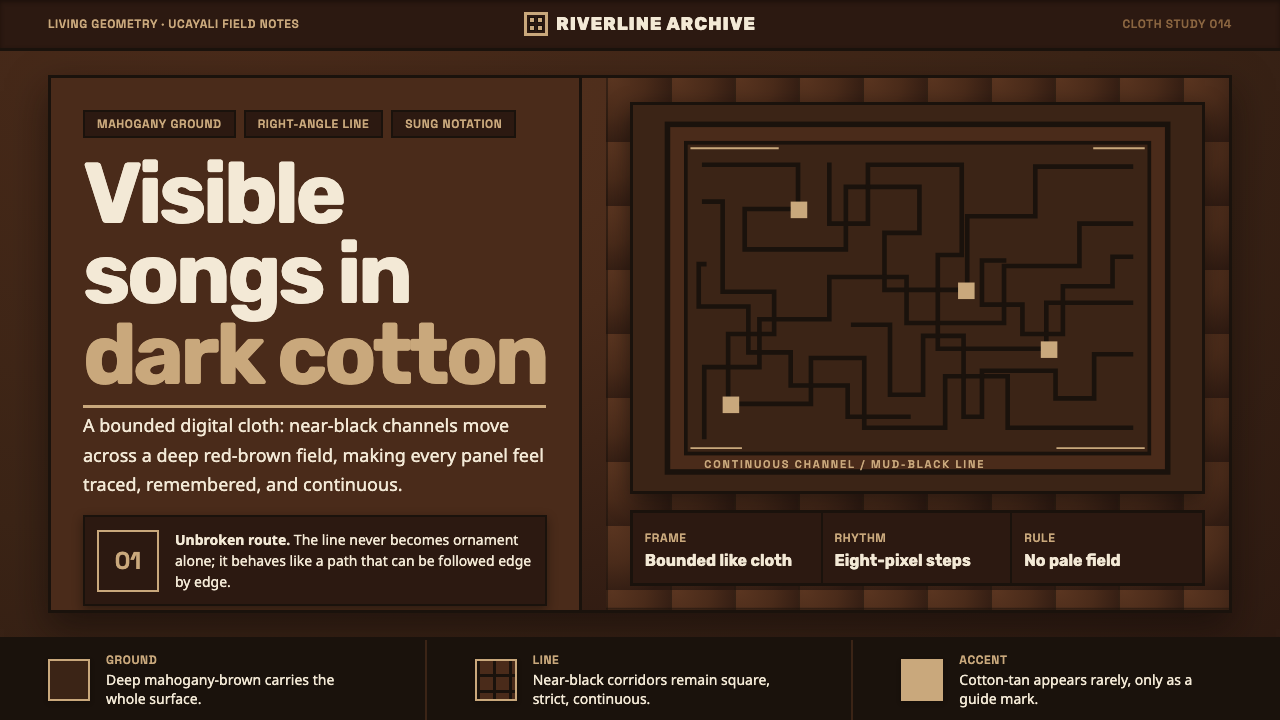
Shipibo Kené turns sacred geometry into song: continuous near-black paths moving across a deep earthen field, where every turn belongs to an unbroken visual chant.
Shipibo Kené Pattern in brief
Kené is the sacred geometric design language of the Shipibo-Conibo people of the Peruvian Amazon. It is a living cultural tradition, carried through matrilineal lines of women artists and sustained through textile, ceramic, and shamanic practice. Its visual character is immediately distinctive: dense linear paths travel across a dark red-brown field, turning at sharp corners, separating, rejoining, and maintaining an impression of continuous motion.
The pattern is not simply surface decoration. Within the tradition, a continuous channel can be understood as a visible song. Shamanic keepers trace and sing along its unbroken route, connecting line, voice, memory, and spiritual practice. This gives Kené a different design logic from ordinary ornament: the line is not an embellishment placed on top of a surface, but the structure through which the surface speaks.
In its textile form, handspun cotton is dyed with mahogany-bark tannin until it becomes a deep earthy ground. Near-black pathways are then painted with fermented mud and huito fruit pigment. For contemporary digital interpretation, the essential lesson is not to imitate a textile mechanically, but to preserve the relationship between dark ground, continuous angular line-work, visual rhythm, and disciplined density.
Where does Shipibo Kené Pattern come from?
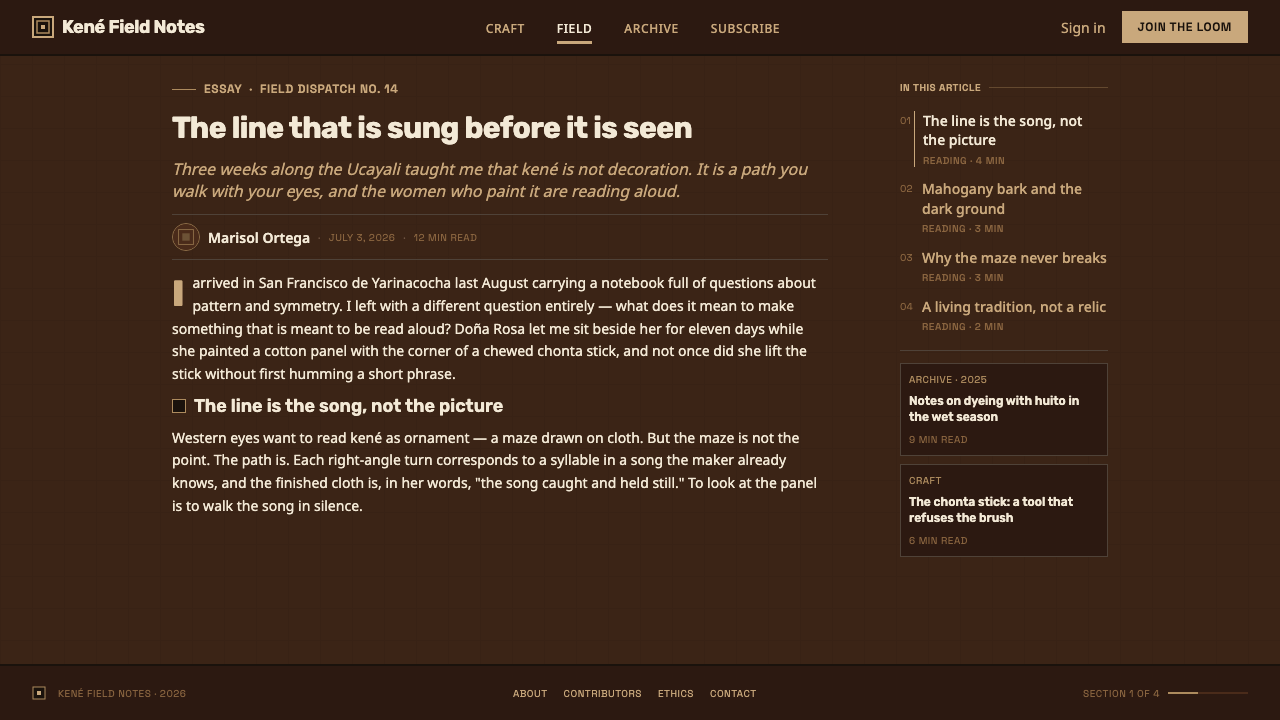
Kené belongs to the Shipibo-Conibo people of the Ucayali River basin in the Peruvian Amazon. Its roots reach back to the pre-Columbian past, while its practice remains continuous in the present. That combination matters: Kené should not be treated as a closed historical style available for casual extraction, but as a contemporary cultural language whose meaning is maintained by the people who practice it.
The tradition is passed matrilineally through generations of women painters. This mode of transmission gives the pattern a lived, relational character. Knowledge is not merely a set of motifs to copy; it is sustained through making, observation, instruction, and repetition across generations. The visual system therefore carries cultural continuity as well as formal complexity.
Textile practice provides the material foundation for the familiar Kené image. Handspun cotton receives a deep red-brown dye from mahogany-bark tannin, producing a ground with the gravity of earth and bark rather than the neutrality of paper. Fermented mud and huito fruit pigment create the near-black line-work above it. The materials establish a strong value contrast while keeping the entire composition rooted in organic, Amazonian matter.
Kené is also tied to icaro, the song-as-pattern logic described through shamanic practice. A shamanic keeper can trace and sing an unbroken route through the labyrinth. This relationship explains why continuity is so central to the visual language. The path carries meaning through its progression, not through isolated symbols; interruption changes the character of the whole.
What defines the Shipibo Kené Pattern look?
Earthen Darkness
Kené begins with a deep red-brown ground associated with mahogany-bark dye. The field should feel dense, warm, and materially grounded rather than neutral or airy. Pale surfaces and pastel atmospheres work against this logic because they weaken the contrast and gravity that make the pathways legible.
Continuous Path
The essential motif is an unbroken route, not a collection of disconnected marks. Lines should appear to travel, return, and continue beyond the viewer’s immediate grasp. Their continuity gives the composition its chant-like quality and distinguishes a coherent Kené-inspired system from a generic maze graphic.
Right-Angle Rhythm
Turns are sharp and deliberate. The pattern relies on angular movement rather than soft curves, creating an architectural cadence across the field. Repeated corners establish tempo, but the visual result should remain alive and intricate rather than mechanically uniform.
Near-Black Linework
The pathways read as near-black against the red-brown ground, recalling the contrast produced by fermented mud and huito pigment. The line should feel assertive enough to hold dense complexity, yet embedded in the field rather than floating as a polished technical overlay.
Labyrinthine Density
Kené creates richness through closely related pathways, intervals, and turns. Density is not visual clutter when the route remains intelligible; it is a way of creating immersion and sustained attention. Empty space should function as breathing room inside the pattern, not as a separate minimalist backdrop.
Song and Trace
Because the line can be traced and sung by a shamanic keeper, motion through the pattern matters as much as the pattern seen at once. A successful application invites the eye to follow a route patiently. It should feel less like a decorative repeat and more like a visual score unfolding across a surface.
Who shaped Shipibo Kené Pattern?
Shipibo-Conibo women artists are the primary matrilineal carriers of Kené practice. Their role makes clear that the design language is not anonymous pattern stock: it is maintained through living artistic knowledge, transmitted across generations through the people who paint, make, and teach it.
Shamanic keepers connect Kené to the logic of icaro, in which an unbroken visual route can be traced and sung. Their practice places the pattern within a system of voice, movement, and spiritual meaning, rather than reducing it to a purely visual arrangement.
The matrilineal lineages through which Kené is passed are themselves central cultural actors. They preserve continuity between earlier practice and contemporary making, ensuring that the language remains rooted in relationships, material knowledge, and sustained community transmission.
How do you use Shipibo Kené Pattern today?
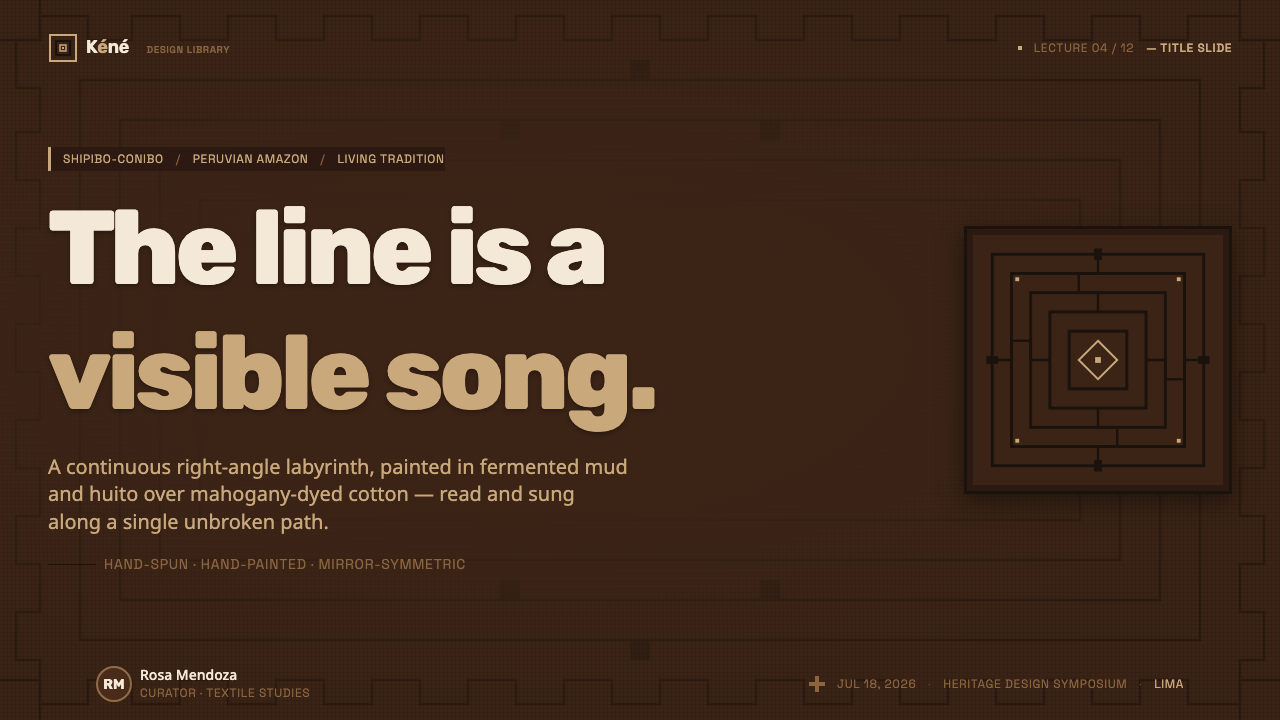
For presentation covers, Kené-inspired work is strongest when a deep earthen field carries one deliberate expanse of continuous near-black pathwork. Let the title occupy a calm clearing rather than competing with the line system. Content slides should use smaller fragments as framing structures, keeping the primary reading area clear while allowing the pattern to guide the eye through the page.
For data and explanatory slides, use the pattern as a navigational border, sectional band, or diagrammatic route rather than as a fill behind dense information. The continuous path can connect stages, categories, or ideas, but it should not falsely suggest a literal cultural diagram. Preserve strong contrast and make charts, labels, and values easy to separate from the ornamental field.
For web interfaces, the language is best suited to immersive landing pages, cultural storytelling surfaces, and dark dashboards with a limited amount of information visible at one time. A continuous line motif can organize navigation, transitions between sections, or background panels. On pricing and transactional pages, reduce the pattern substantially so that comparison, action, and accessibility remain more important than atmosphere.
For editorial and marketing work, Kené can give long-form pages a powerful sense of ritual progression. Use the line-work to mark chapters, introduce quotations, or carry a viewer between image and text. Marketing should frame the tradition accurately and respectfully, naming Shipibo-Conibo cultural origin rather than presenting the pattern as a placeless tropical texture.
The most common mistake is treating Kené as a generic geometric wallpaper. Random broken lines, pale backgrounds, soft ornamental curves, and decorative repetition lose the core relationship between continuity, dark earth, angular rhythm, and song-like tracing. Another mistake is implying authorship or sacred meaning without context; a respectful application should acknowledge its living cultural source and avoid pretending that a digital motif replaces the tradition itself.
Shipibo Kené Pattern — FAQ
Is Kené simply a maze pattern?
No. Its maze-like appearance is important, but Kené is a sacred geometric language within Shipibo-Conibo cultural practice. The continuous route is understood in relation to song, tracing, and shamanic keeping. Calling it only a maze describes its surface appearance while missing the living cultural and spiritual logic behind it.
Why are pale and pastel backgrounds unsuitable for this style?
The source logic of Kené depends on the relationship between a deep mahogany-toned ground and near-black line-work. This contrast gives the route its weight, visibility, and earthbound character. Pale or pastel fields shift the mood toward lightness and decoration, weakening the visual conditions that make the path feel continuous and consequential.
Can Kené-inspired patterns be used as a repeating background?
A repeated background can quickly flatten the tradition into generic decoration. If repetition is necessary, preserve the sense that each route belongs to a continuous field rather than a sealed tile. Use it with restraint, leave room for reading, and provide cultural attribution instead of presenting the result as an anonymous geometric asset.
What makes a digital interpretation respectful?
Respect begins with naming the Shipibo-Conibo origin and recognizing Kené as a living tradition practiced by women artists and shamanic keepers. Visually, retain the principles of continuity, angular pathwork, dark earthen grounding, and restraint. Conceptually, avoid claiming sacred authority, inventing meanings, or treating the pattern as interchangeable exotic decoration.
Related design styles
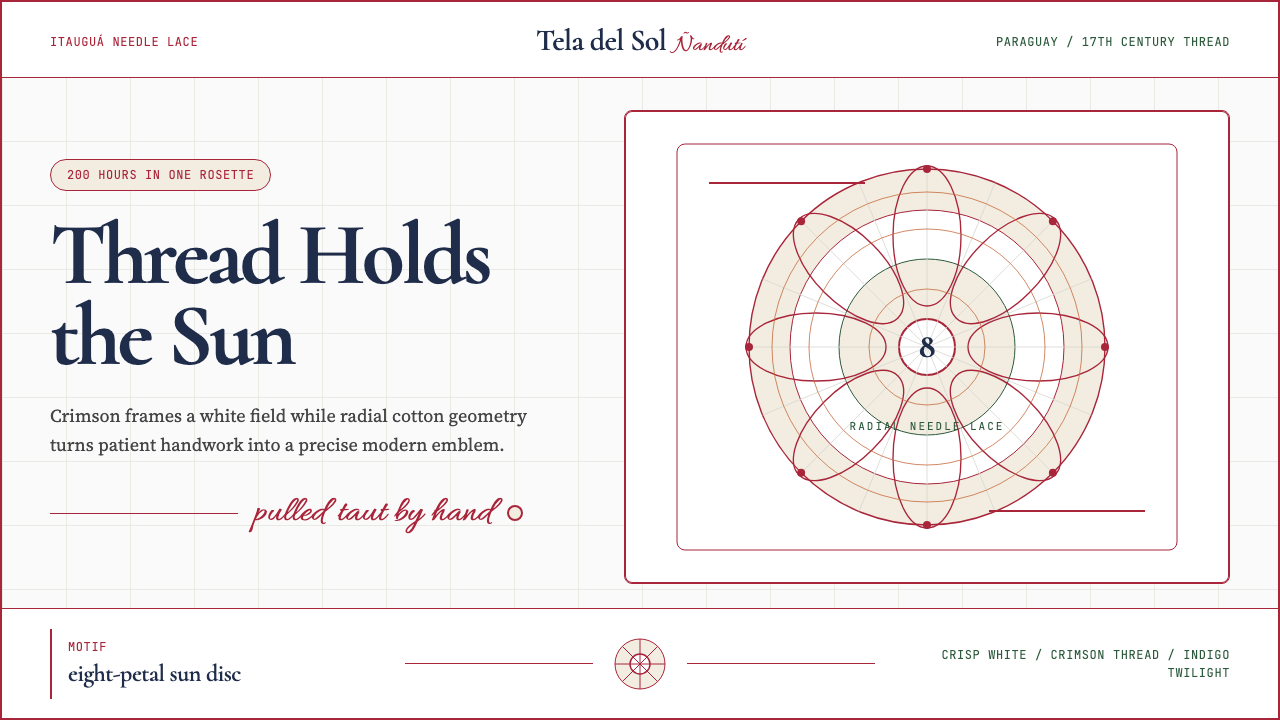 Paraguayan Ñandutí LacePatient craft, modern frame. Crimson lines pin radial lace on crisp white.
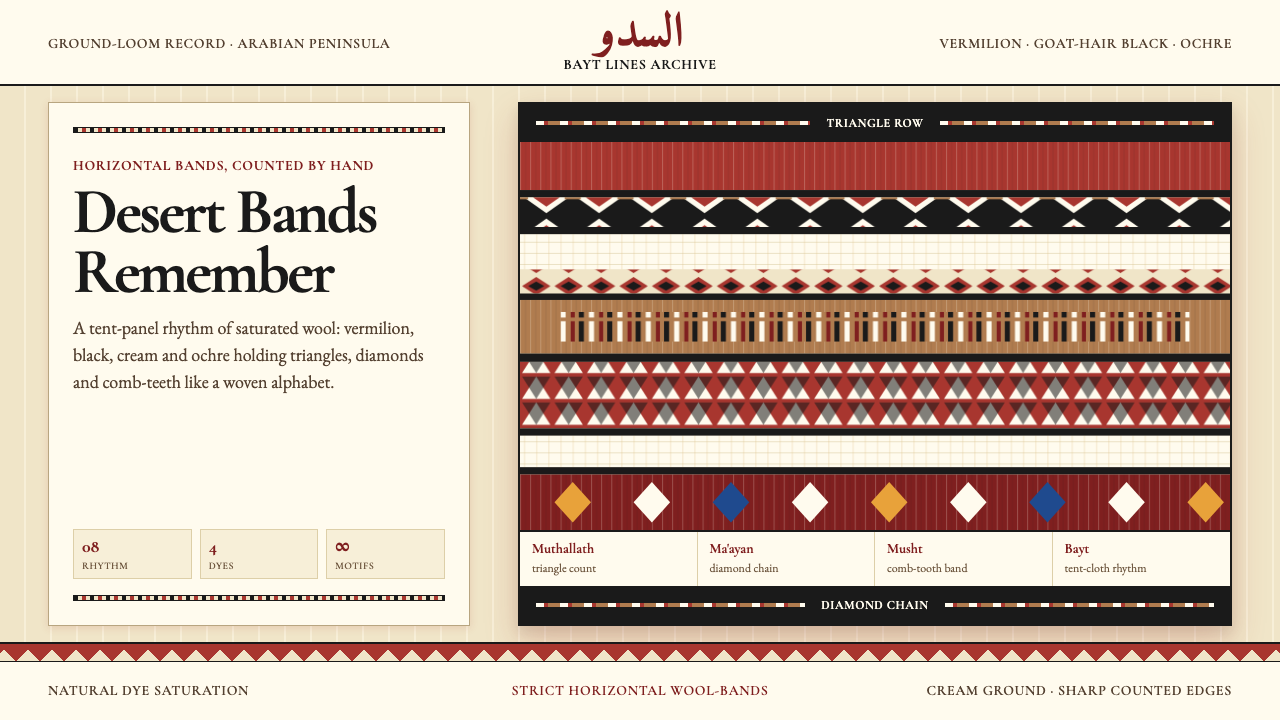 Bedouin Desert Textile (Sadu)Woven memory, not ornament. Vermilion-black bands count triangles and diamond…
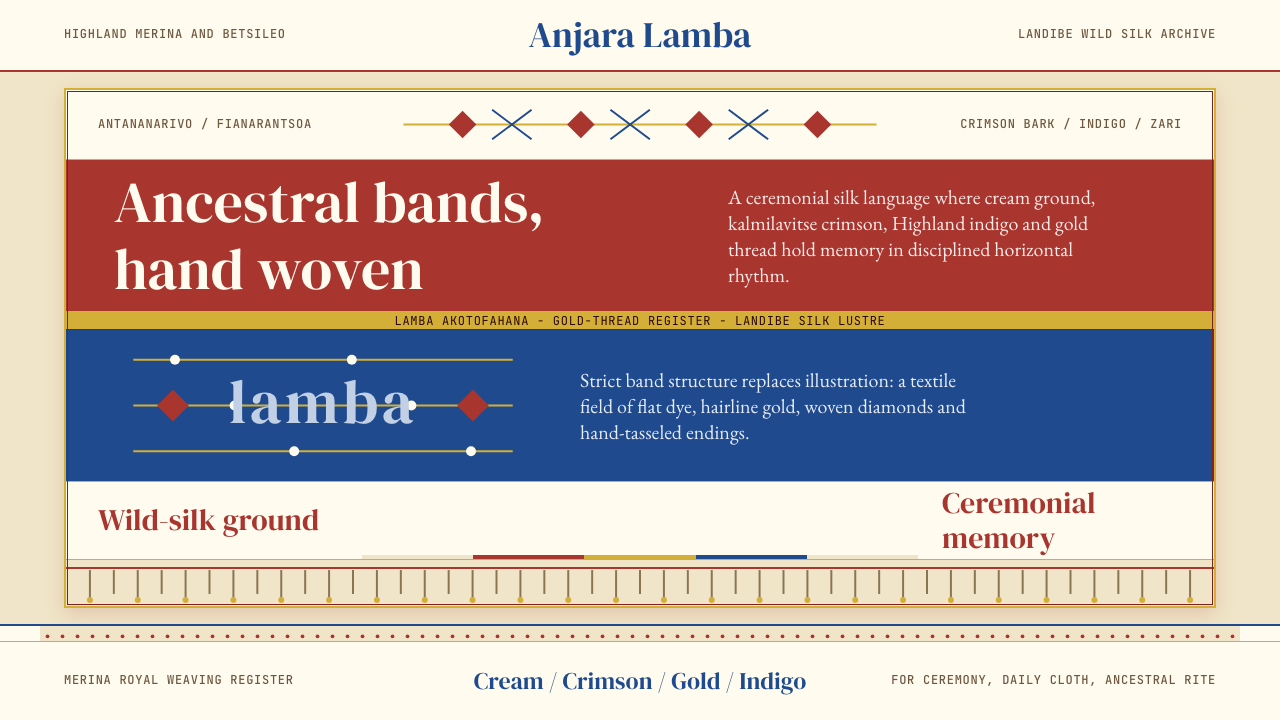 Madagascan Lamba SilkAncestry is woven flat. Crimson, indigo, cream and gold run in strict silk ba…
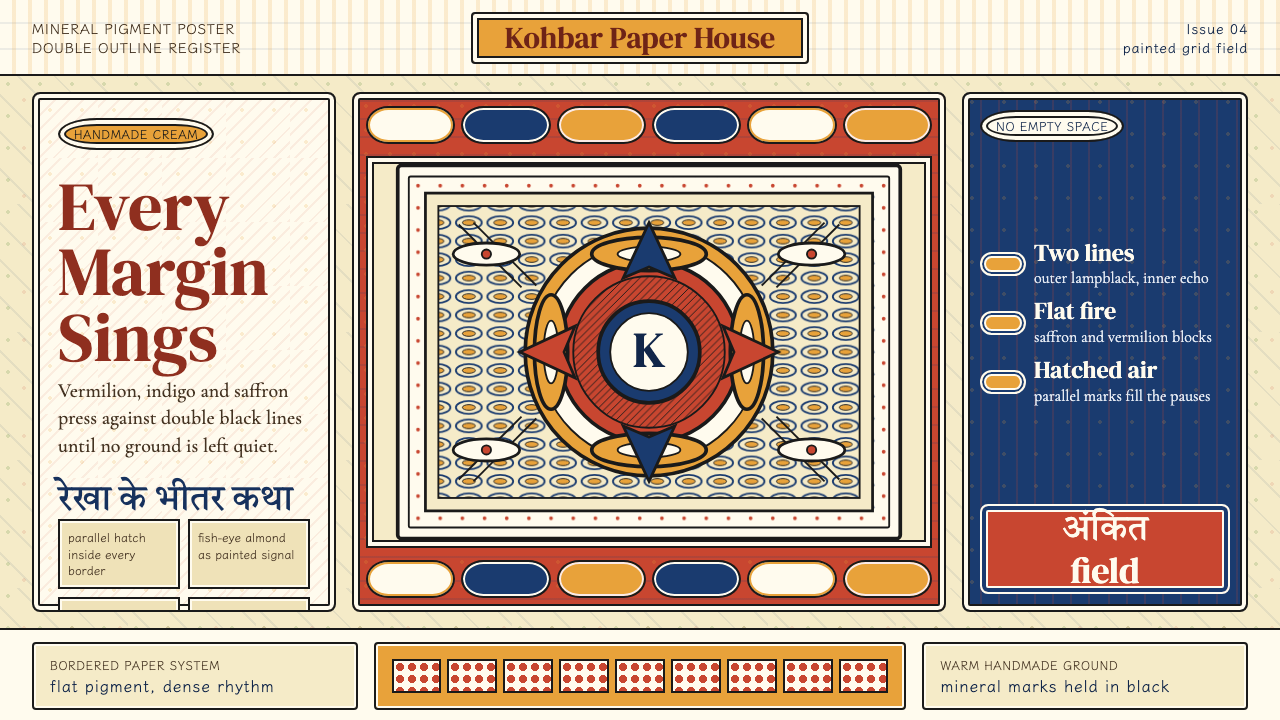 Madhubani (Mithila Folk Painting)No empty ground. Vermilion, indigo and saffron pack double-outlined panels wi…
 Okinawan Bingata Resist DyeOrnate without clutter. Persimmon ground, vermilion type, emerald-cobalt sten…
 Yoruba Gelede MaskRitual weight, not spectacle. Terracotta, kaolin, and indigo frame a carved-m…