What is Saudi Vision 2030?
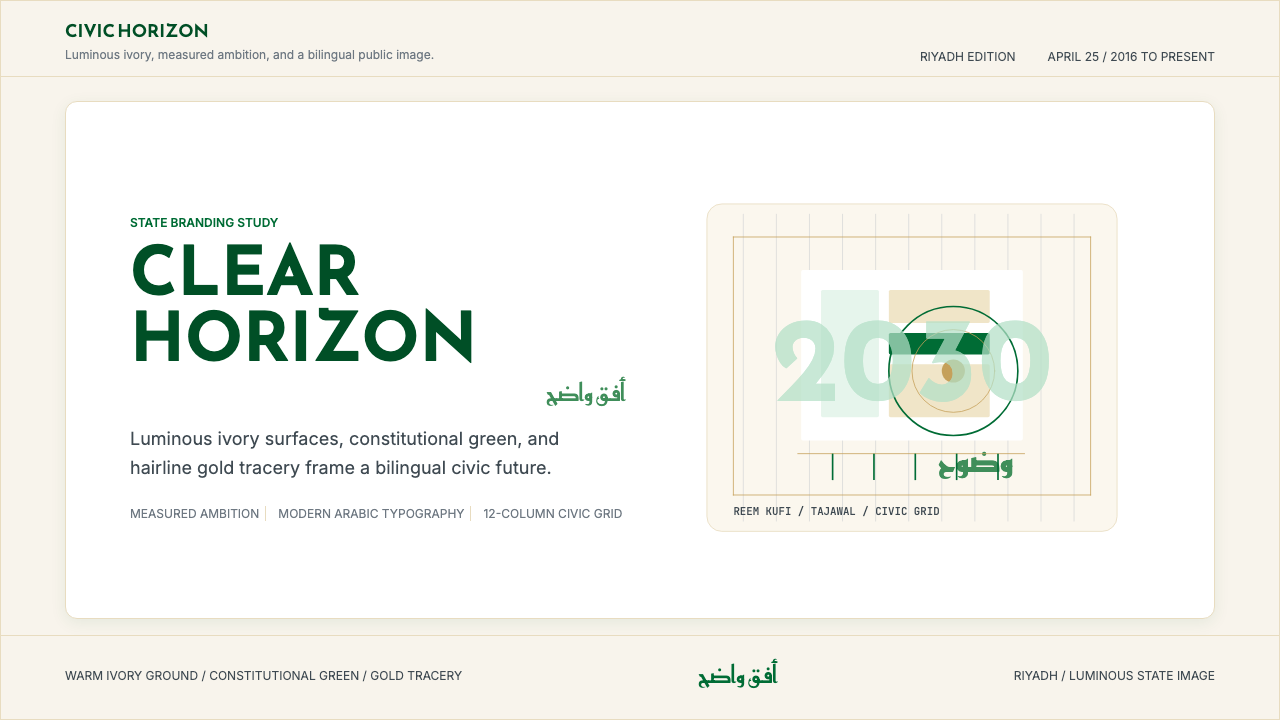
Saudi Vision 2030 is the visual grammar of a nation rewriting its identity on the world stage — luminous ivory surfaces, sage-evolved greens, and hairline gold tracery composing a civic aesthetic as measured and deliberate as the ambition behind it.
Saudi Vision 2030 in brief
Saudi Vision 2030 names both a national reform program and the distinctive visual identity that has accompanied it since the official launch in April 2016. As a design system, it is the most ambitious act of nation-branding in the contemporary Gulf — a comprehensive visual language deployed across government ministries, giga-project developments, tourism campaigns, cultural institutions, and international diplomacy, all united by a palette and typographic sensibility that deliberately departs from the heavy state imagery of earlier Saudi official design.
The system's visual character rests on restraint and luminosity rather than grandeur. Where previous Saudi official design leaned on the deep ceremonial green of the national flag and traditional gilded ornament, Vision 2030 evolved these signals: ivory or near-white surfaces replace saturated grounds, a sage-to-emerald green family takes the place of the single national green, and gold is deployed as hairline tracery rather than flood fill. The effect is a palette that reads as modern and internationally legible while remaining unmistakably rooted in Arabian cultural identity.
What separates this system from generic Gulf modernism is its integration of Arabic typographic tradition into a contemporary civic grid. Headlines rendered in Reem Kufi or similar modern Naskh-derived letterforms are not decorative flourishes added after the fact — they are structural. The calligraphic curve and the geometric module coexist on the same layout plane, each earning its place through legibility and cultural resonance rather than spectacle. This balance is the system's central design argument: that modernity and heritage are not opposites, that a nation can be both ancient and forward-looking without contradiction.
Where does Saudi Vision 2030 come from?
The Vision 2030 program was announced publicly on April 25, 2016, by Crown Prince Mohammed bin Salman, then Deputy Crown Prince and Minister of Defence. The initiative was framed as a comprehensive roadmap to reduce Saudi Arabia's economic dependence on oil revenues by diversifying into tourism, entertainment, culture, and technology. The visual identity — developed in coordination with the Vision Realization Office and the Public Investment Fund — was conceived from the outset not as governmental livery but as a public-facing brand capable of speaking to international investors, Saudi youth, and regional neighbours simultaneously.
The design language drew on several overlapping sources. The first was the tradition of modern Arabic typography that had been gaining momentum across the Arab world since the 1990s, as type designers and foundries developed Naskh and Kufi letterforms capable of combining classical calligraphic authority with the technical demands of screen rendering and grid-based layout. Typefaces such as those produced by Boutros Fonts — including Tajawal, which became associated with digital-first Saudi government interfaces — brought structured legibility to Arabic headlines without sacrificing the organic rhythm of the script tradition.
The second source was the aesthetic language of the giga-projects that Vision 2030 spawned: NEOM, the Red Sea Project, Diriyah Gate, Qiddiya. These developments produced vast quantities of architectural renderings and promotional material, and their visual vocabulary — sun-bleached warm neutrals, crisp angular photography, geometric abstraction of Arabian landscape forms — fed back into the broader Vision 2030 identity. The desert light of the Hejaz and the Najd, the white limestone of old Diriyah, the blues of the Red Sea coast: these regional color associations were absorbed and systematized rather than replaced.
The third influence was the broader shift in Gulf nation-branding that accelerated after the 2010s. Dubai Expo 2020 preparations, Abu Dhabi's cultural district development, and Qatar's FIFA World Cup 2022 identity work all demonstrated that the Gulf could produce world-class design systems that referenced Islamic geometric traditions and Arabic calligraphy while meeting the legibility and scalability standards expected of a contemporary global brand. Vision 2030 entered this conversation as Saudi Arabia's most ambitious contribution — larger in scale, broader in institutional reach, and explicitly tied to a social transformation agenda that had no precedent in the region's brand history.
What defines the Saudi Vision 2030 look?
Palette — Luminous Restraint
The core palette evolves the Saudi national green rather than replacing it. The dominant ground is ivory or warm near-white, evoking the high-desert light of the Arabian Peninsula. A family of greens — ranging from a desaturated sage through a mid-emerald to a deeper forest tone — provides institutional authority without the ceremonial heaviness of the traditional flag green. Gold appears as a hairline accent or thin geometric tracery, never as a fill color, allowing it to function as a signal of quality and heritage without tipping into opulence. The palette is warm overall, Mediterranean and Gulf in its associations rather than Nordic or East Asian.
Arabic Typography as Structure
Modern Naskh-derived typefaces serve as the headline voice of the system. These letterforms carry the organic curves of classical calligraphy while meeting the grid alignment and legibility demands of contemporary screen and print contexts. The key distinction from decorative Arabic typography is structural intention: the headline is not ornamented Arabic text superimposed on a Western layout — it is the primary grid anchor, sized and placed with the same logic as a geometric block. Bilingual settings (Arabic and English) are handled through careful optical sizing rather than mechanical scaling, maintaining reading comfort across both scripts.
Geometric Tracery and Pattern
Islamic geometric pattern — the centuries-old tradition of interlocking star polygons, arabesque latticework, and muqarnas-derived tessellations — enters the Vision 2030 system in abstracted, reduced form. Pattern is not applied as wallpaper or border decoration; it appears as a single geometric motif at large scale, as a subtle texture on a light ground, or as the organizing logic of a layout grid. This restraint is deliberate: the full complexity of traditional geometric pattern would overwhelm the legibility requirements of a civic communications system. What remains is the structural logic of the tradition, distilled to its essential geometry.
Warmth Through Material Reference
The system consistently references the material and tonal world of the Arabian Peninsula — not through literal texture or skeuomorphic surface, but through color temperature, photographic palette, and spatial proportion. Images favor the warm overexposed look of midday desert light; architectural renderings use the bleached limestone and terracotta palette of Najdi architecture; promotional photography favors golden-hour warmth over blue-hour cool. This material groundedness gives the system a geographic specificity that distinguishes it from generic international design — it is legible as Saudi and as Gulf in a way that pure geometric abstraction would not be.
Civic Scale and Grid Discipline
Vision 2030 communications are consistently designed at what might be called civic scale: generous margins, large headline type, and clear hierarchy that reads from a distance on a billboard as readily as at close range on a phone screen. The underlying grid is disciplined but not rigid — it accommodates both the right-to-left reading direction of Arabic and the left-to-right of English in bilingual documents, using centered compositions or carefully mirrored structures where necessary. The system's grid logic is architectural in ambition: it is designed to coordinate not just posters and presentations but wayfinding systems, exhibition halls, and the facades of entire ministerial campuses.
Confident Bilingualism
Unlike earlier Gulf design systems where Arabic text was often a secondary decorative element subordinated to English, Vision 2030 materials treat Arabic and English as co-equal. Arabic headlines are not smaller or softer than their English counterparts; both languages share the same weight and spatial authority. This bilingual confidence is itself a designed message: the system visually argues that Saudi Arabia can speak Arabic to its own people and English to the world without either voice being diminished. The practical discipline this requires — managing optical weight across two scripts with very different visual densities — is one of the system's most sophisticated technical achievements.
Aspirational Photography
Photography within the system is consistently aspirational rather than documentary. Images favor sweeping aerial perspectives of architectural developments, portraits of young Saudis in professional or creative settings, and landscape photography that emphasizes the dramatic scale of the Peninsula's geography. Color grading trends warm and high-contrast, consistent with the palette's ivory and gold orientation. Photography does not depict the present state of things so much as the projected ideal — a visual representation of the transformation the program promises. This is not unusual for nation-branding at scale, but the Vision 2030 system deploys it with unusual consistency and technical quality.
Who shaped Saudi Vision 2030?
As Crown Prince and the primary architect of the Vision 2030 program, Mohammed bin Salman is the political and institutional force that gave the design system its mandate and scale. His 2016 announcement of the program — broadcast across Saudi and international media — was itself a designed communications event, establishing the visual register that the system has maintained since. His patronage of giga-projects including NEOM, the Red Sea Project, and Diriyah Gate created the primary arenas where the Vision 2030 aesthetic has been most extensively developed and tested.
The Vision Realization Office (VRO) functions as the institutional guardian of the Vision 2030 design system — coordinating brand standards across hundreds of government entities, supervising the rollout of sub-brand identities for individual programs and giga-projects, and ensuring that the visual language of the initiative remains coherent as it scales across media, languages, and geographies. The VRO's role is analogous to a large corporate brand team: setting standards, reviewing executions, and mediating between the demands of individual program identities and the requirements of the master brand.
The Public Investment Fund is the sovereign wealth vehicle through which most Vision 2030 giga-projects are financed and developed. Its visual identity work — spanning NEOM, the Red Sea Project, Diriyah Gate Authority, and Qiddiya — constitutes a substantial portion of the broader Vision 2030 design ecosystem. Each PIF-backed project maintains a distinct sub-brand while remaining visually affiliated with the parent system, creating a family of identities that collectively demonstrate the range of the palette and typographic system across very different program types: futuristic urban development, coastal tourism, historical heritage, and entertainment.
The Boutros type foundry, and specifically the Tajawal typeface it developed, became closely associated with the digital and screen-facing dimensions of Vision 2030's government interface design. Tajawal represents the generation of Arabic typefaces that emerged to serve the UI needs of digital government services — combining classical Naskh structure with the open apertures and consistent stroke modulation required for rendering at small sizes on screens. Its adoption across Saudi digital government portals gave the Vision 2030 typographic voice a specific, recognizable character in screen contexts, demonstrating how Arabic typography could achieve the same systematic consistency as the best Latin typefaces in interface design.
The design and architecture teams behind NEOM — the most visually ambitious of the Vision 2030 giga-projects — have produced a body of imagery and spatial identity work that has significantly shaped the broader aesthetic conversation around the program. NEOM's promotional materials, architectural renderings, and brand communications push the Vision 2030 visual language toward its most speculative and forward-looking register: deep space blues, mirror-finish surfaces, and extreme geometric abstraction sit alongside the broader system's warm neutrals and Islamic pattern references. NEOM's design language functions as the future-forward edge of the Vision 2030 aesthetic family.
How do you use Saudi Vision 2030 today?
Saudi Vision 2030 is one of the most transferable contemporary civic design systems for contexts requiring a blend of institutional authority, cultural specificity, and modern legibility. Applying it well requires understanding its underlying logic: the palette communicates warmth and measured confidence, the typography carries cultural weight without sacrificing readability, and the geometric elements reference a specific tradition rather than generic global modernism. These are intentional signals, not decorative choices, and they work best when the content they frame shares similar ambitions.
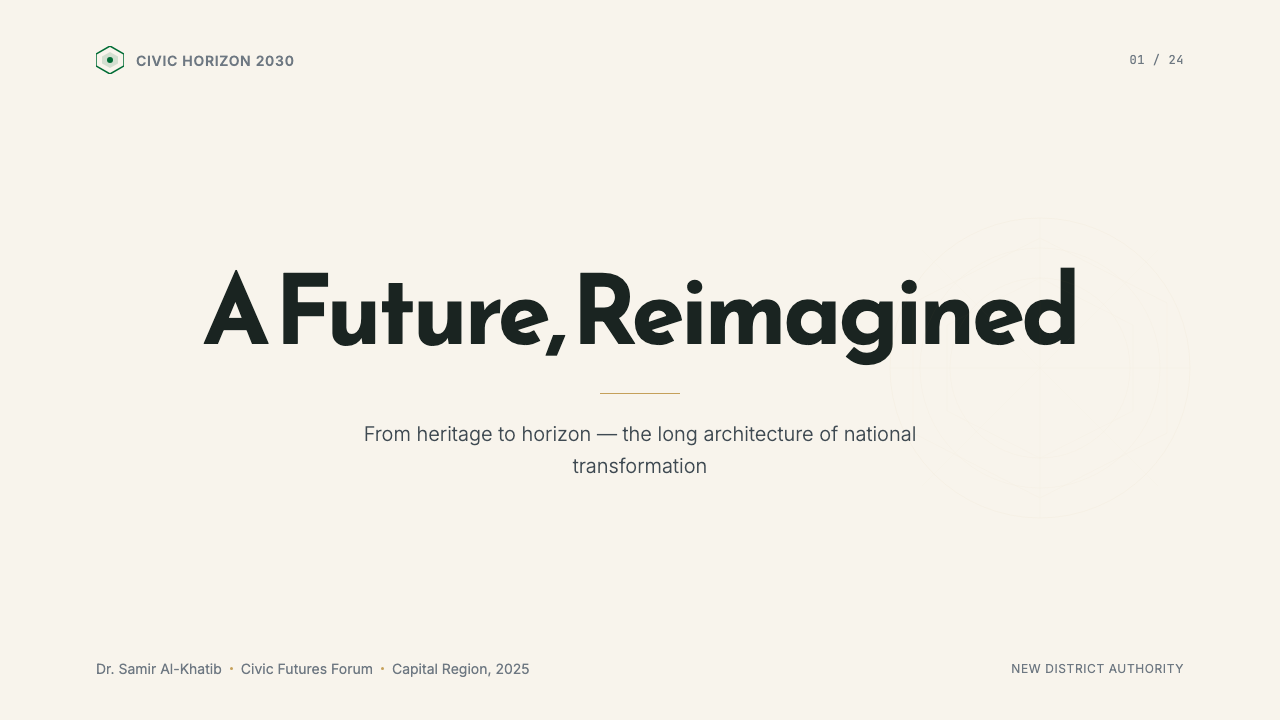
For presentation slides, the system translates naturally to both cover and content contexts. A cover slide benefits from the generous scale and confident typography of the civic aesthetic: a large, warm-ground field with a primary headline in a Naskh-influenced letterform, a thin gold rule or geometric accent, and a secondary English line set in a clean contemporary sans. Content slides should be treated as structured layouts with clear typographic hierarchy — two or three type sizes, generous white space, and restrained use of the green family to mark section headers or key data points. Avoid crowding: the system's civic scale implies breathing room, not density.
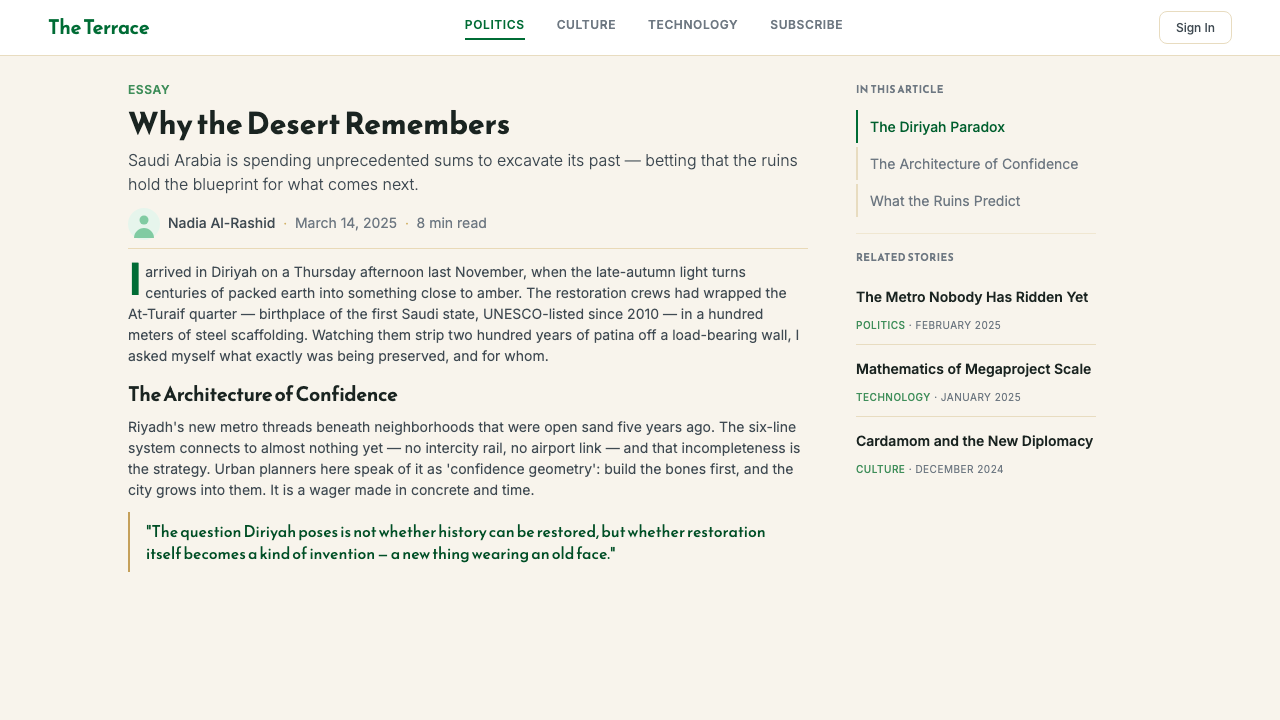
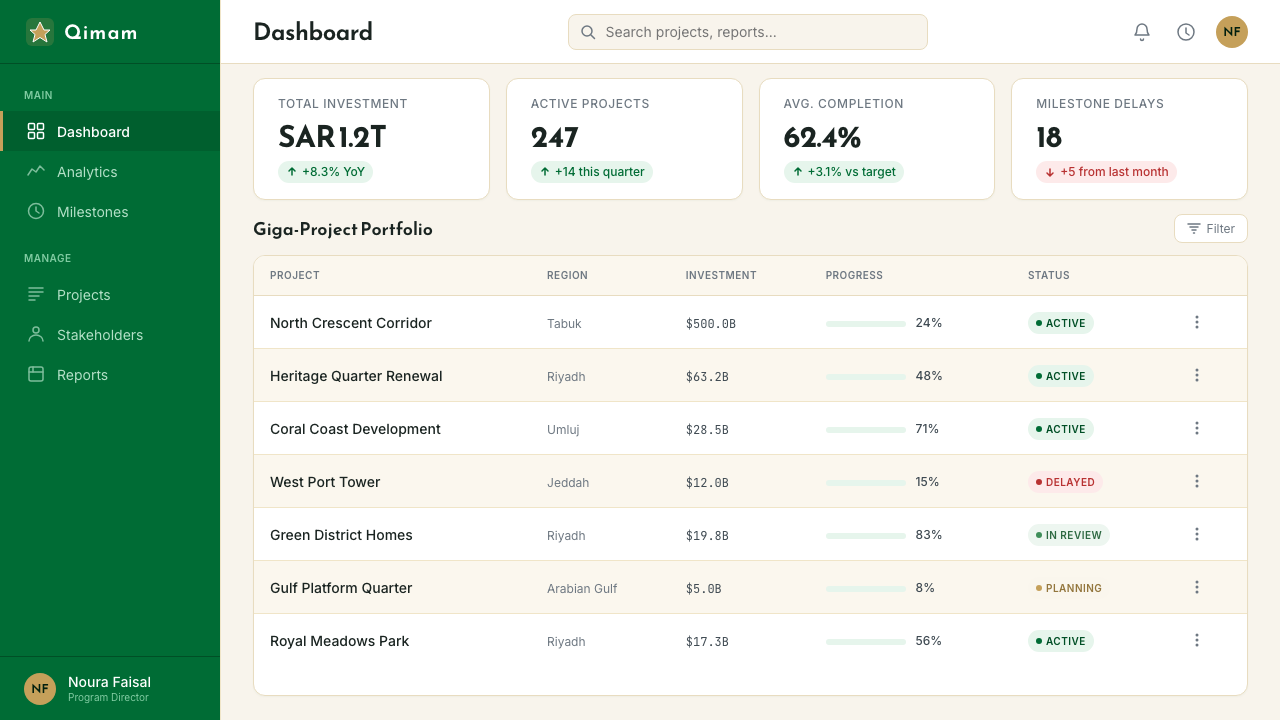
For web interfaces and dashboards, the system works well in contexts where institutional credibility and navigational clarity are the primary goals — government portals, civic service platforms, organizational reporting dashboards. The approach: ivory or warm white background, a dominant typographic hierarchy with a modern Arabic-compatible or visually harmonious Latin typeface, green as the primary interactive color, and gold as a sparse accent on premium or highlighted states only. Geometric pattern, if used, should appear as a single motif at reduced opacity in backgrounds or section dividers rather than as a repeating field.
For editorial and marketing communications, the Vision 2030 system supports strong visual hierarchy combined with cultural specificity. Feature spreads benefit from full-bleed aerial photography with the warm, high-contrast grading characteristic of the system, anchored by large headline type. Campaign materials can use the geometric tracery as a primary visual element — a single star polygon or lattice fragment at large scale on an ivory ground creates immediate cultural recognition without resorting to illustration. The mistake to avoid here is over-saturation: using the full green family simultaneously, or stacking pattern on top of warm photography, will quickly collapse into visual noise.
A common error when adopting this aesthetic is conflating it with generic Gulf or Middle Eastern design conventions — adding crescents, domes, and decorative Arabic calligraphy as ornamental overlays. The Vision 2030 system is distinguished precisely by its restraint: Arabic typography is structural, not decorative; geometric pattern is abstracted and reduced, not elaborated. Designers applying the system should ask, with each element they add: does this carry communicative weight, or is it there for cultural signaling alone? If the latter, it likely does not belong.
Saudi Vision 2030 — FAQ
How does Vision 2030 design differ from traditional Islamic decorative art?
Traditional Islamic decorative art — the Arabesque, the muqarnas, the Iznik tile, the illuminated manuscript border — is characterized by surface elaboration: complexity is the virtue, and the eye is invited to follow interlocking patterns indefinitely. Vision 2030 design inverts this value. It takes the structural logic of Islamic geometric pattern — the mathematical relationships between forms, the principle of infinite extension, the balance between figure and field — and reduces it to its simplest readable unit. A single star polygon replaces a tiled field; a hairline geometry replaces a gilded border. The goal is recognition and cultural resonance achieved through suggestion rather than elaboration.
Can the Vision 2030 aesthetic work in contexts outside Saudi Arabia or the Gulf?
The system's core elements — its warm neutral palette, its typographic confidence, its geometric abstraction — are culturally specific but not culturally exclusive. Organizations working in international contexts related to the Gulf region, the wider Arab world, or the Islamic cultural sphere can draw on the system's design logic with clear relevance. For genuinely unrelated contexts, the Arabic typographic elements should be used only if the content genuinely involves Arabic language; without that grounding, the use risks reading as appropriation rather than reference. The palette and geometric elements are more portable — warm neutrals and abstracted geometric pattern are a broadly applicable design vocabulary when deployed without the specifically Arabic typographic dimension.
Is this design system suitable for commercial brands, or is it inherently governmental?
The Vision 2030 system was purpose-built for civic and governmental communication, but many of its characteristics translate well to commercial contexts: hospitality brands, luxury retail, cultural institutions, professional services, and organizations positioned around heritage and modernity simultaneously. The civic scale and bilingual confidence read well in any context that values legibility and institutional weight. The system is less suited to fast-moving consumer categories — food, youth entertainment, fast fashion — where the measured, aspirational register can feel too formal. The test is whether the brand's own values include the qualities the system communicates: measured confidence, cultural rootedness, and forward ambition without urgency.
How should the green and gold elements be balanced to avoid looking ornate?
The fundamental rule is that gold is an accent, never a dominant. In the Vision 2030 system at its best, gold appears at hairline weight — as a single rule, a thin geometric frame, or a tracery element — and covers no more than a small fraction of any given layout surface. When gold is expanded beyond accent into area, the result reads as gilded rather than refined. Similarly, the green family works best when a single green from the range is selected for a given document or context, rather than multiple greens used simultaneously. The ivory ground is what makes both gold and green land cleanly: without generous warm neutral space around them, the accents lose their legibility and their sense of measured confidence.
How does Vision 2030 design handle the tension between Arabic and English in bilingual layouts?
The system resolves the bilingual tension by treating both languages as structurally equivalent rather than by subordinating one to the other. In practice this means: Arabic and English headlines appear at comparable optical sizes adjusted for the visual weight differences between the two scripts; neither language is set significantly smaller or softer than the other; and layout structures are designed to accommodate bidirectional reading rather than assuming a single dominant reading direction. The challenge is that Arabic and English letterforms have very different visual densities at the same point size — Arabic text tends to appear more compact and visually active, English more open. Skilled bilingual layout in this system adjusts for this optically rather than mechanically, producing parity of presence rather than parity of measurement.
Related design styles
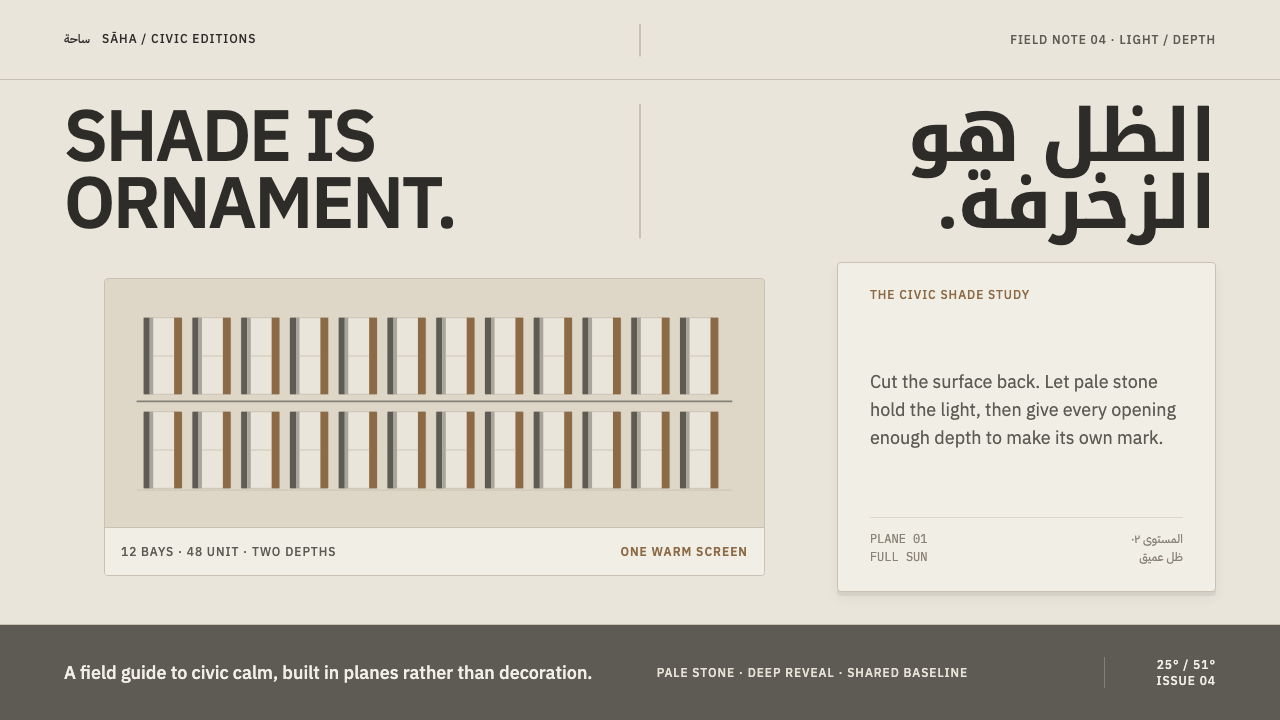 Msheireb DohaCalm is cut into stone. Warm limestone, equal-weight bilingual type, and hard…
 Kenya Hara «White»Emptiness is the subject. Warm washi white holds one pale sumi-gray mark.
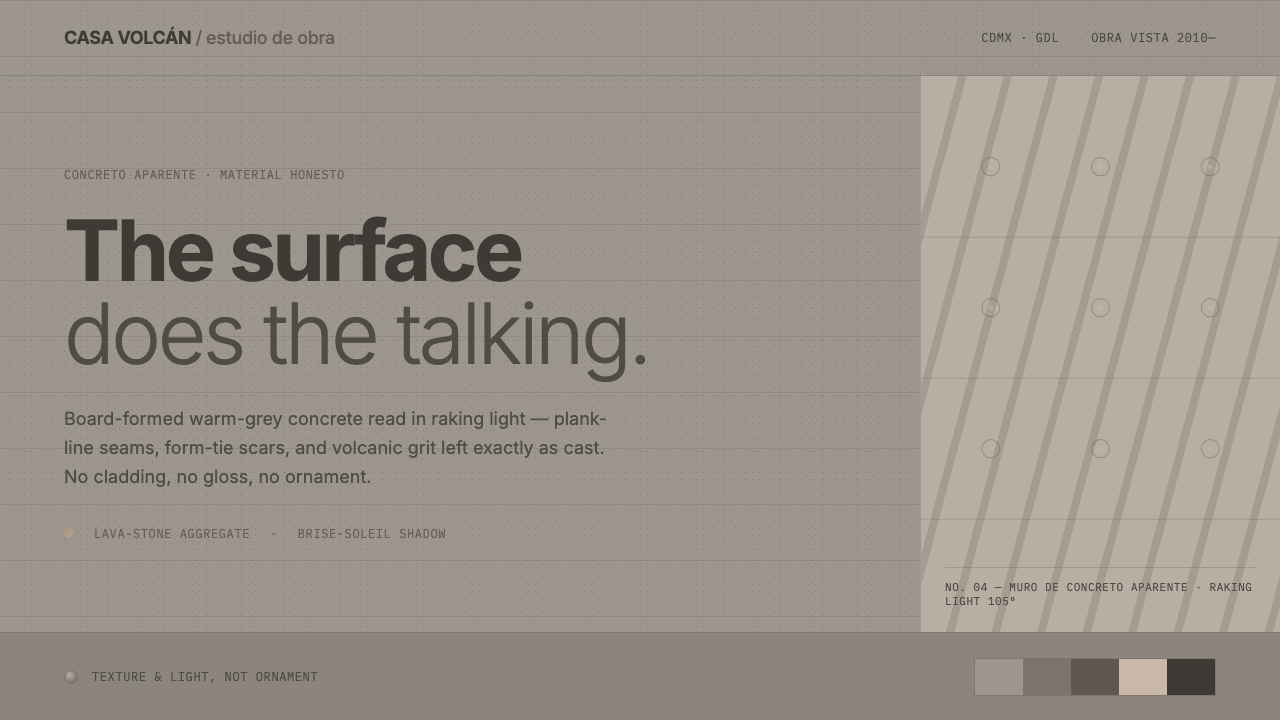 Mexican Concrete BrutalismThe surface does the talking. Board-formed warm-grey concrete, plank seams an…
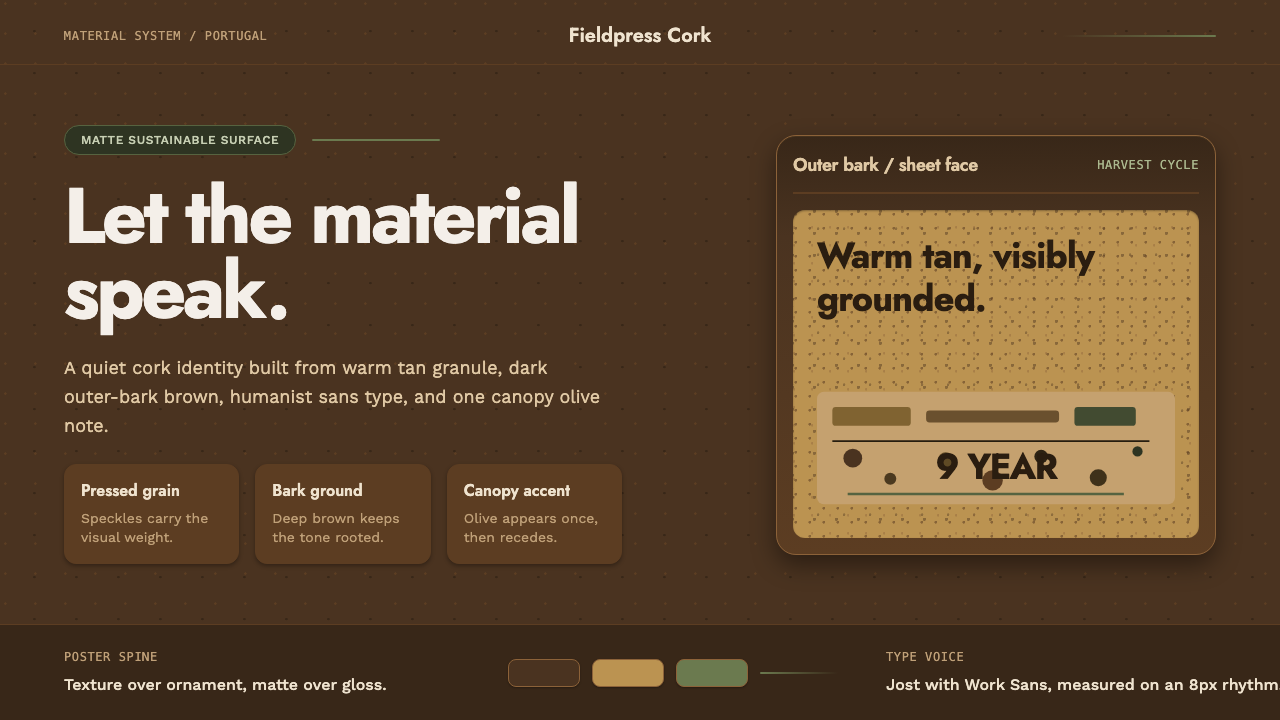 Portuguese CorkGrounded by texture. Cork tan speckles on bark brown, with one olive rule.
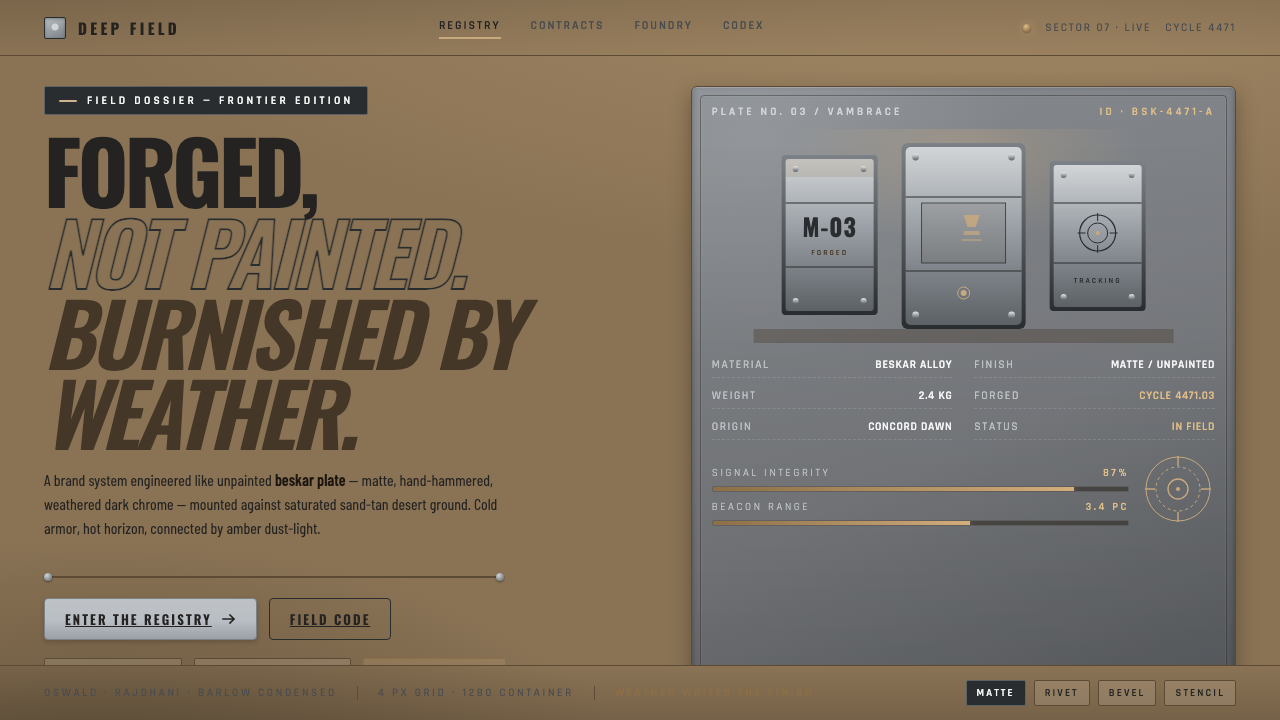 The Mandalorian BeskarForged, not painted. Weathered matte beskar chrome on sand-tan desert, stenci…
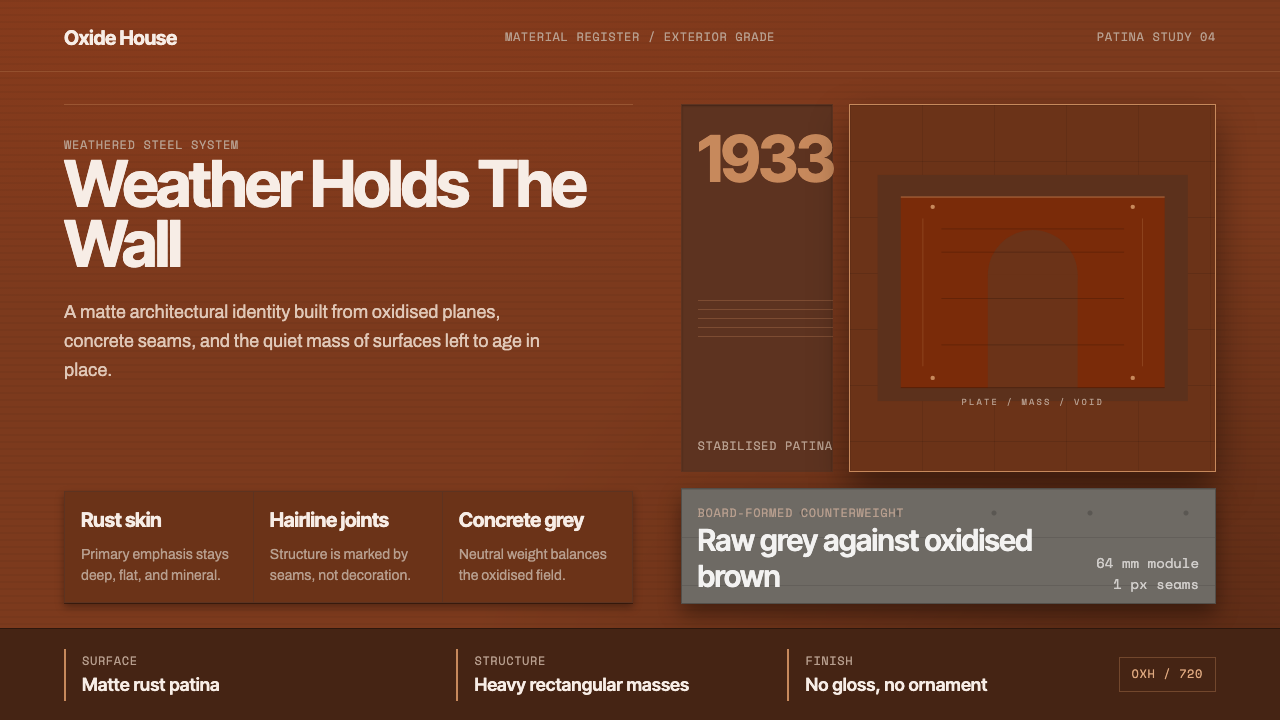 Corten Weathering SteelWeight over ornament. Rust-brown planes and concrete-grey seams make mass vis…