What is Obsidian Knowledge Graph?
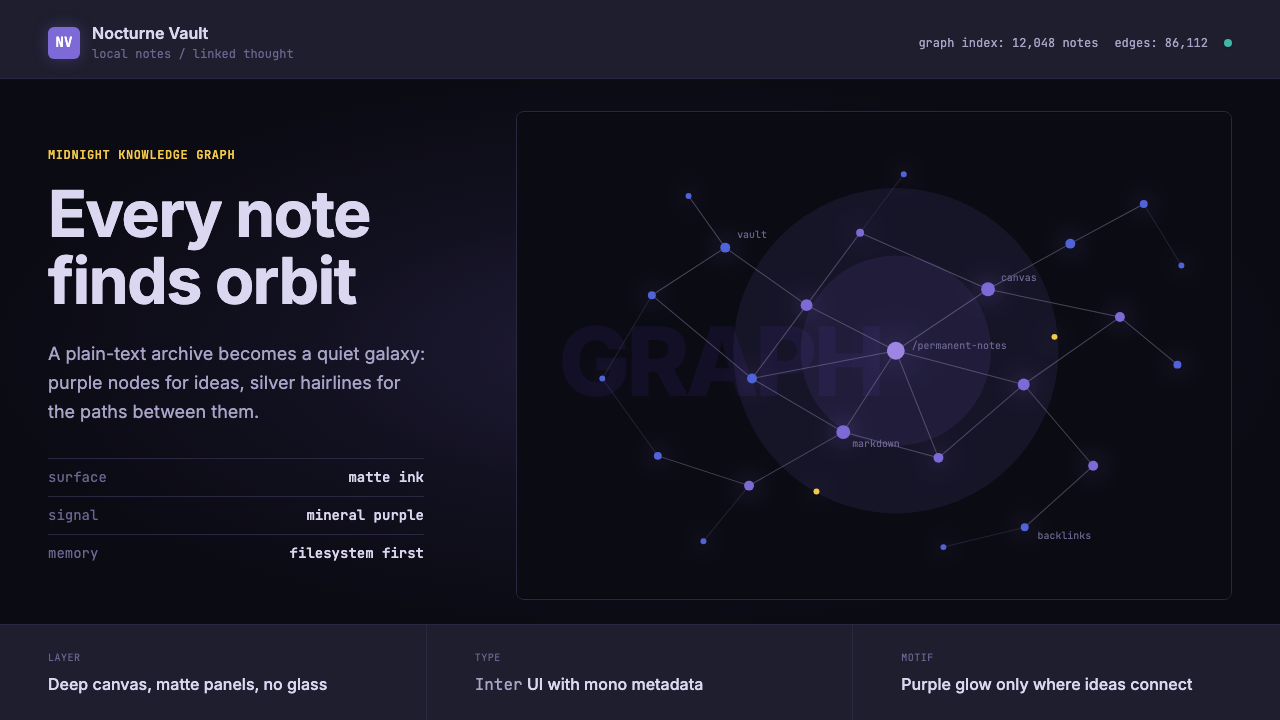
Obsidian's knowledge graph turned a tool for thinking into a visual philosophy — deep matte black, pulsing purple nodes, and the quiet conviction that ideas should be seen as constellations, not lists.
Obsidian Knowledge Graph in brief
Obsidian Knowledge Graph is the visual and interaction language developed by and around the Obsidian note-taking application, released in 2020. Its most iconic element is the interactive graph view: a dark canvas scattered with colored nodes representing individual notes, connected by hairline edges that represent links between them. Together, these form a living map of a user's accumulated thought — a galaxy of ideas rendered in software.
The design system extends far beyond the graph itself. It encompasses a matte dark interface, a dominant purple accent, a disciplined typographic hierarchy, and a strong ethic of restraint. Nothing decorates for decoration's sake. Every visual element serves the goal of helping a user move through dense textual and conceptual material with as little friction as possible. The aesthetic carries the values of its community: local-first, privacy-minded, deeply literate, and slightly monastic.
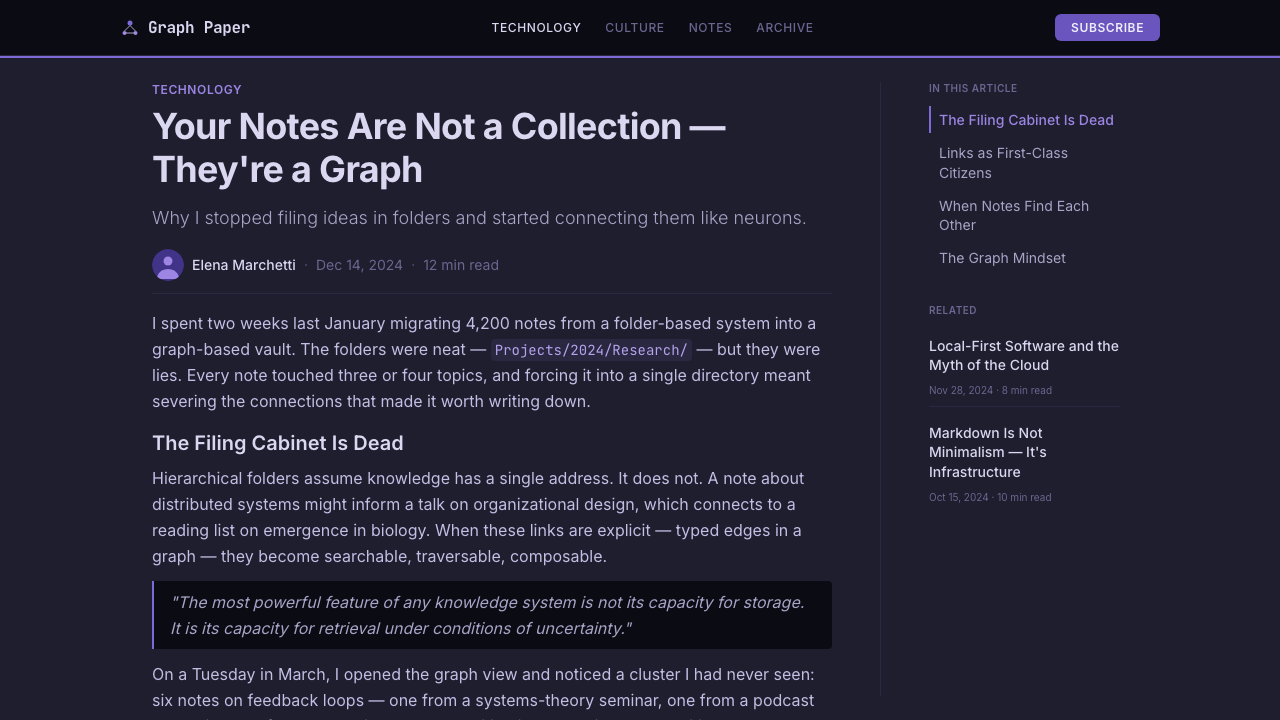
Because Obsidian is infinitely customizable through its CSS snippet system and a rich ecosystem of community themes, the Obsidian aesthetic exists in many variations. But the canonical visual identity — dark background, purple nodes, silver edges, monospaced code blocks, and sparse chrome — has become recognizable enough to stand as a design language in its own right, shorthand for the broader world of networked personal knowledge management.
Where does Obsidian Knowledge Graph come from?
Obsidian was created by Shida Li and Erica Xu, a two-person team distributed between Toronto and the Netherlands. It launched in public beta in May 2020 — when the personal knowledge management space was electrified by the Zettelkasten concept, a note-linking method developed by German sociologist Niklas Luhmann and rediscovered by a generation of productivity writers. Roam Research had just demonstrated that networked, bidirectionally linked notes could feel like a different way of thinking. Obsidian arrived as the local-first, privacy-respecting alternative: your notes live in plain Markdown files on your own device, not on someone else's server.
The visual identity was never the result of a formal brand exercise. It emerged from the values baked into the product. The dark interface made long reading and writing sessions easier on the eyes. Purple — long associated in computing culture with mystery, creativity, and focused nocturnal work — became the accent almost inevitably. The name reinforced the palette: obsidian is a volcanic glass, deep black with slight iridescence, sometimes showing a purple or green sheen in certain light. The mineral gave the tool its character before any design decision was consciously made.
The knowledge graph view, which visualizes note connections as a node-edge diagram rendered with WebGL, was not a late feature — it was a founding metaphor. The graph made visible what Luhmann's physical slip-box had only implied: that knowledge is not hierarchical but associative, not a tree but a web. Seeing your notes as a constellation gave users a genuinely new experience of intellectual ownership. The graph became the tool's most-shared screenshot and the visual anchor of its entire identity.
As Obsidian's community grew to hundreds of thousands of daily users by its 1.0 release in 2022, a rich ecosystem of designers built custom themes. Kepano (Steph Ango), who joined as CEO that year, had developed Minimal — one of the most influential community themes — pushing the aesthetic toward a cleaner, more editorial sensibility while retaining dark-mode discipline. Eleanor Konik, a prominent community writer and educator, helped articulate the intellectual culture — the practices, vocabulary, and ethos — that gave the aesthetic its meaning. When Canvas launched in 2023, the design language was mature enough to absorb new affordances without losing its coherence.
What defines the Obsidian Knowledge Graph look?
The Dark Ground
The Obsidian interface is built on a deep, nearly-black matte surface that reads more as the absence of light than as a color — not a cool slate or neutral charcoal but something with a very slight warmth, as if the darkness has absorbed years of thought. This ground is not a stylistic choice grafted onto the tool; it is the environment in which the entire visual system breathes. Text, nodes, and interface elements float on it like objects in space, given luminosity by contrast alone.
Purple Nodes and Silver Edges
The knowledge graph's visual vocabulary is spare and precise. Notes appear as circular nodes, glowing softly in the dominant purple against the dark field. Links between notes become hairline silver edges — near-invisible except where they cluster, forming visible constellations around densely connected ideas. Color within the graph carries structural meaning: the default purple signals ordinary notes, while orphan notes, tags, and attachment types may appear in differentiated tints. The overall impression is astronomical — a star map of one mind.
Typographic Restraint
The interface text lives at the quiet end of the typographic spectrum — rendered in a clean, humanist sans-serif for prose and a monospaced face for code and technical content. The two voices are distinct but harmonious: prose flows softly against the dark ground, while code blocks step forward with the structured clarity of a terminal. There are no expressive display typefaces, no decorative lettering, no headline fonts performing drama. Hierarchy is built from weight, size, and color alone, with muted tones for interface chrome and full-brightness reserved for actual content.
Structural Minimalism
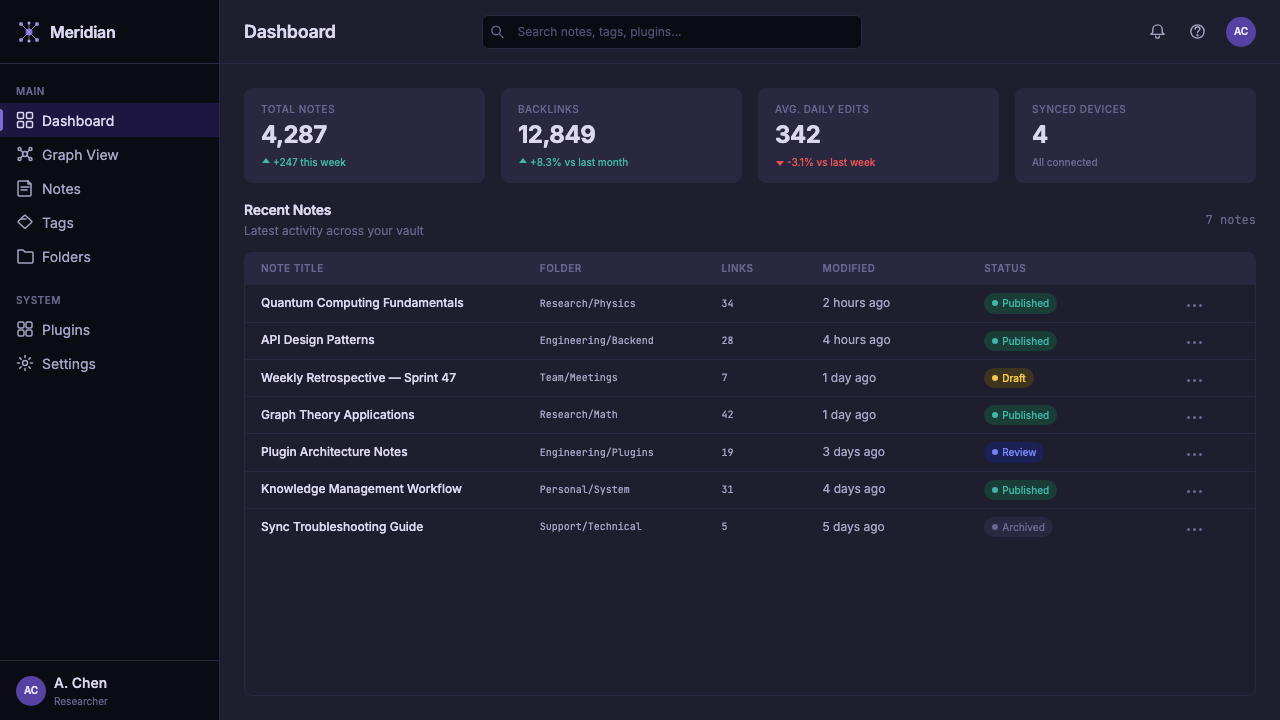
Obsidian's chrome is reduced to the absolute minimum needed to orient a user within the system. Sidebars collapse. Toolbars disappear in focus mode. The writing surface expands to fill available space. What remains visible is not decoration but navigation infrastructure — file trees, tab bars, status indicators — each rendered at low visual weight so that the content itself commands attention. This is not the performed minimalism of a marketing page; it is the functional minimalism of a working environment where the tool should be nearly invisible.
Depth Through Luminosity
Rather than simulating physical depth through shadows and gradients, Obsidian creates a sense of space through luminous contrast alone. The graph nodes appear to glow because they are rendered at full color saturation against a near-black ground — the contrast itself implies depth. Hover states add a subtle brightening; active elements pulse. The experience is less like using a flat interface and more like peering into illuminated circuitry — depth implied by light, not by geometry.
Markdown Proximity
The visual language of Obsidian is never far from the raw material it processes: Markdown text. Even in rendered reading view, the formatting decisions feel close to the source — heading scales are clear but not theatrical, horizontal rules are plain dividers, blockquotes are simply indented with a vertical bar. The aesthetic refuses to paper over the text structure with elaborate visual chrome. This proximity to the plain-text substrate is both a philosophical statement and a practical advantage: notes look like notes, not like designed documents.
Community Theme Vocabulary
Because Obsidian exposes its entire visual layer to CSS customization, a shared aesthetic vocabulary has emerged across hundreds of community themes. Even themes that depart from the default dark purple — shifting to warm sepia or bright academic whites — tend to retain certain commitments: minimal chrome, typographic hierarchy over decoration, code blocks as distinct objects, and a graph view legible as a spatial representation. The diversity of themes exists within a recognizable family of design values.
Who shaped Obsidian Knowledge Graph?
Shida Li co-founded Obsidian and serves as its primary developer, responsible for the core architecture — the WebGL graph renderer, the plugin API, and the live preview editor — that makes the design system technically possible. His engineering decisions have direct design consequences: building the graph with WebGL rather than SVG allows thousands of nodes to render fluidly, which is why the graph view feels like a living organism rather than a static diagram. Li has maintained Obsidian's independence and local-first commitment throughout the application's growth.
Erica Xu co-founded Obsidian alongside Shida Li, contributing to product direction and the community culture that grew around the tool. The two-person founding structure — lean, independent, profitable without venture capital — has itself become part of the tool's identity and has shaped the aesthetic ethos: a product built to last by people who use it, for people who use it, without the scaling pressure that would compromise its disciplined restraint.
Steph Ango, known as kepano, developed the Minimal theme — one of the most widely installed community themes — before joining Obsidian as CEO in 2022. Minimal demonstrated that the dark-matte-purple visual system could be refined toward a lighter, more editorial sensibility without losing structural integrity. As CEO, Ango writes publicly about local-first principles, file-over-app philosophy, and software longevity. His influence has pushed Obsidian's aesthetic toward greater clarity and reduced visual noise.
Eleanor Konik is a historian and educator who became one of Obsidian's most influential community voices, writing about note-taking practice, Zettelkasten methodology, and the intellectual culture around the tool. Her work established a scholarly register for the community — a tone that values depth and genuine curiosity over productivity performance. This culture has shaped the tool's aesthetic: an interface that respects the weight of serious thought rather than gamifying or trivializing it.
Though Luhmann died in 1998, decades before Obsidian existed, his intellectual legacy is inseparable from the tool's visual identity. Luhmann was a German sociologist who produced an extraordinary body of work with the help of a physical card-index — the Zettelkasten — containing over ninety thousand handwritten notes linked by reference numbers. Its networked, non-hierarchical structure is the direct intellectual ancestor of Obsidian's graph. Without Luhmann, there is no graph metaphor; without the graph metaphor, there is no Obsidian visual identity.
How do you use Obsidian Knowledge Graph today?
The Obsidian aesthetic is transferable to any context where the user is engaged in serious, sustained intellectual or technical work — and where the interface should communicate that seriousness without becoming oppressive. It is a style for the long session, the deep dive, the working environment designed to disappear. Applied correctly, it tells the user: this is a place where real thinking happens.
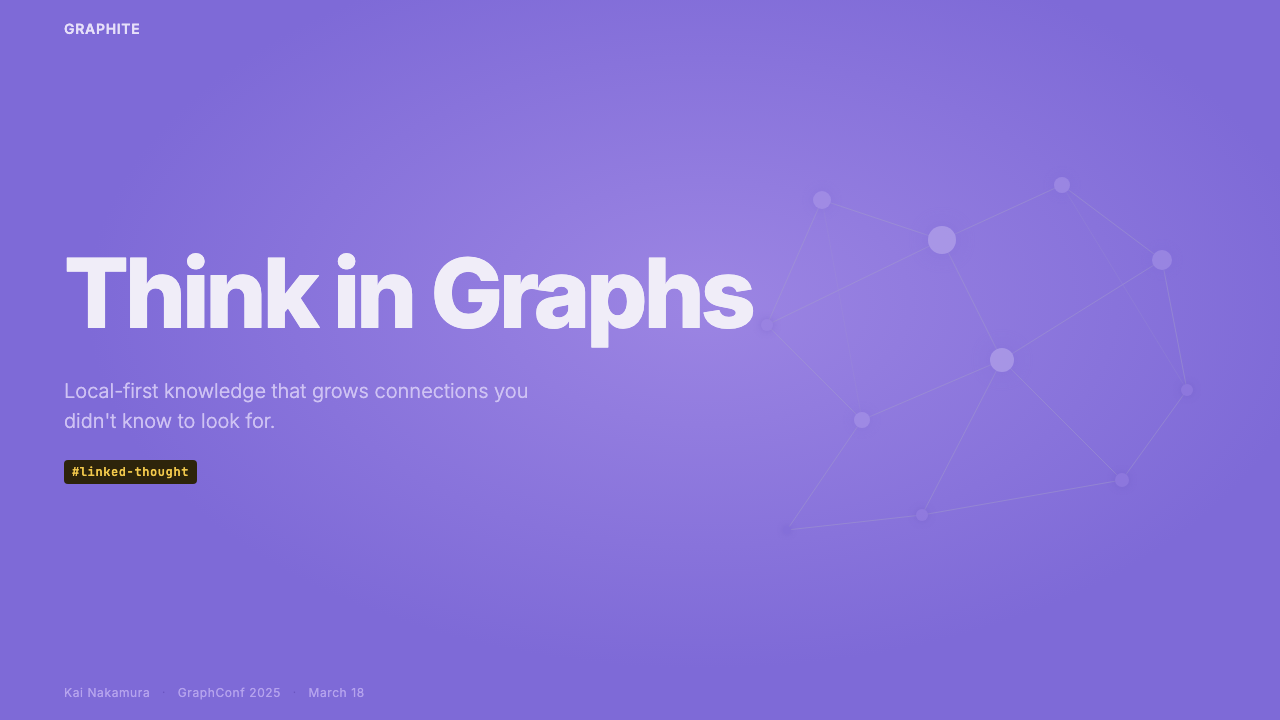
For presentation slides, the style works well for technical talks and developer-facing content. A cover slide benefits from the deep dark ground with a single luminous element — a graph visualization, a glowing title in the signature purple, or a sparse node diagram — centered against near-darkness. Content slides should minimize chrome: no decorative borders, no background gradients. Text hierarchies are built through scale and the contrast between the accent and neutral tones. Code blocks step forward as distinct, monospaced objects. Data slides can lean into the graph metaphor — network diagrams and relational visualizations feel native rather than imported.
For web interfaces, the style is best suited to developer tools, documentation sites, knowledge bases, and productivity dashboards. The approach: deep background, a restrained purple accent for interactive elements and active states, monospaced text wherever code appears, and a typographic system that prioritizes reading clarity. Sidebar navigation should feel like a file tree — hierarchical but unadorned. Cards differentiate by luminosity rather than by border or color variety.
For editorial and marketing contexts, a technical blog or documentation page benefits from the dark-ground approach when targeting developer audiences who associate it with seriousness. The purple accent, used sparingly, signals intellectual identity rather than consumer branding. Long-form layouts should prioritize reading comfort: generous line spacing and a typographic rhythm that rewards slow reading. Visuals, when they appear, are functional — diagrams, graphs, screenshots — never decorative.
A common mistake is confusing darkness with density. Authentic Obsidian-derived interfaces are generous with empty space — the dark ground needs room to breathe the way night sky needs horizon. Equally common is over-extending the purple accent, treating it as a brand color to be broadly applied rather than a luminous signal reserved for what genuinely demands attention. The purple earns its authority by being rare: one or two elements per composition — the active link, the key data point, the anchoring heading. Everything else recedes into the dark ground.
Obsidian Knowledge Graph — FAQ
Is the Obsidian aesthetic only suitable for dark-mode interfaces?
The canonical Obsidian aesthetic is dark-mode-first — the knowledge graph depends on its near-black ground, since nodes can only glow against darkness. But the underlying principles translate to light mode more readily than the surface suggests. A light-mode Obsidian-derived interface retains the same typographic restraint, the same minimal chrome, the same structural use of the purple accent. What changes is the direction of contrast: where the dark version glows outward from a dark field, the light version recedes toward a quiet white or off-white ground. Both work; dark communicates focus and intensity, light communicates openness and accessibility.
How does Obsidian's purple differ from other purple-accented design systems?
Obsidian's purple sits at the intersection of violet and indigo — a hue associated with the mineral the app is named for and with a long history of purple signaling intellectual depth, mystery, and prestige in both Western and East Asian visual traditions. Crucially, it functions as a single luminous signal, not a brand color varied across surfaces. It appears where things glow — active nodes in the graph, active links in the editor, interactive highlights. Other purple-accented systems — analytics tools, creative suites, social platforms — use purple more broadly as a marker of modernity. Obsidian's purple is more restrained, more nocturnal, specifically tied to the experience of thought made visible.
Why does the knowledge graph work as a navigational metaphor rather than just a visual feature?
The graph view works as a navigational metaphor because it maps spatial intuition onto conceptual structure. Human memory is partially spatial — we remember ideas in terms of where we encountered them and what was nearby. The knowledge graph externalizes this quality, giving users a view of their notes that reflects how memory actually works rather than how filing systems are organized. Navigating by proximity and density — moving toward clusters of densely connected nodes — is cognitively natural. The visual design reinforces this: scattered luminous nodes against the dark ground are explicitly astronomical, activating spatial and navigational associations of looking at a night sky.
What kinds of products should avoid the Obsidian aesthetic?
The aesthetic does not suit contexts where warmth, playfulness, or sensory richness are primary values. Consumer products in food, children's education, wellness, and social networking rely on organic textures, friendly illustration, and warm palettes that invite rather than concentrate. The restraint that reads as depth in a knowledge tool reads as coldness in an onboarding flow welcoming first-time users. The dark-ground system also requires careful implementation for accessibility — pure dark backgrounds can cause halation for some users. Brands needing to communicate openness, joy, or broad approachability will find the nocturnal intensity of this palette working against them.
How does the Obsidian aesthetic relate to the history of dark-mode interfaces?
Early CRT terminals displayed phosphorescent text on dark screens out of technical necessity, not aesthetic intent. Hacker culture and science fiction later romanticized this into a cultural association: dark interfaces meant technical mastery. As mainstream software shifted to light backgrounds, dark mode became a marker of professional tools — code editors, mixing software, video suites — where extended screen time made low-luminance environments preferable. Obsidian inherits this tradition but gives it new meaning: the darkness is not about terminal nostalgia but about creating an environment where ideas, rendered as glowing nodes against a dark field, feel genuinely weighted and present. The aesthetic arrives at darkness through meaning rather than habit.
Related design styles
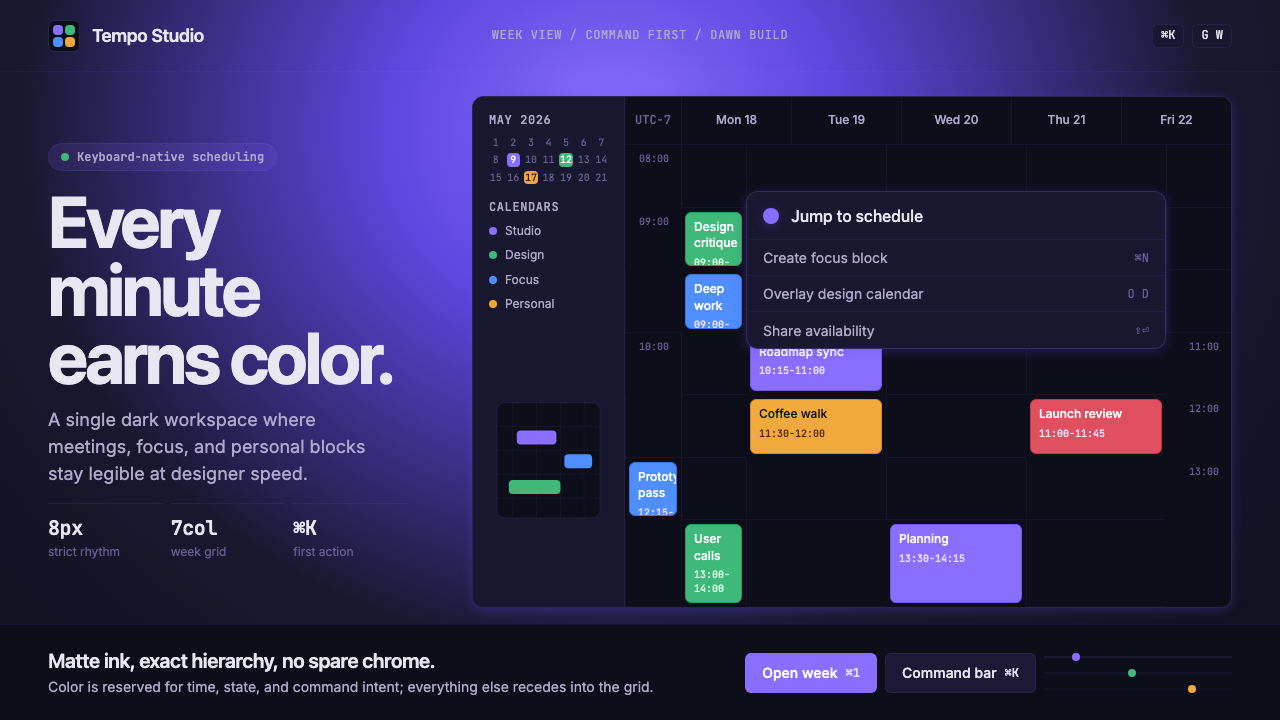 Cron CalendarDesigner-tech restraint. Purple wash, ink grid, mono shortcuts, surgical even…
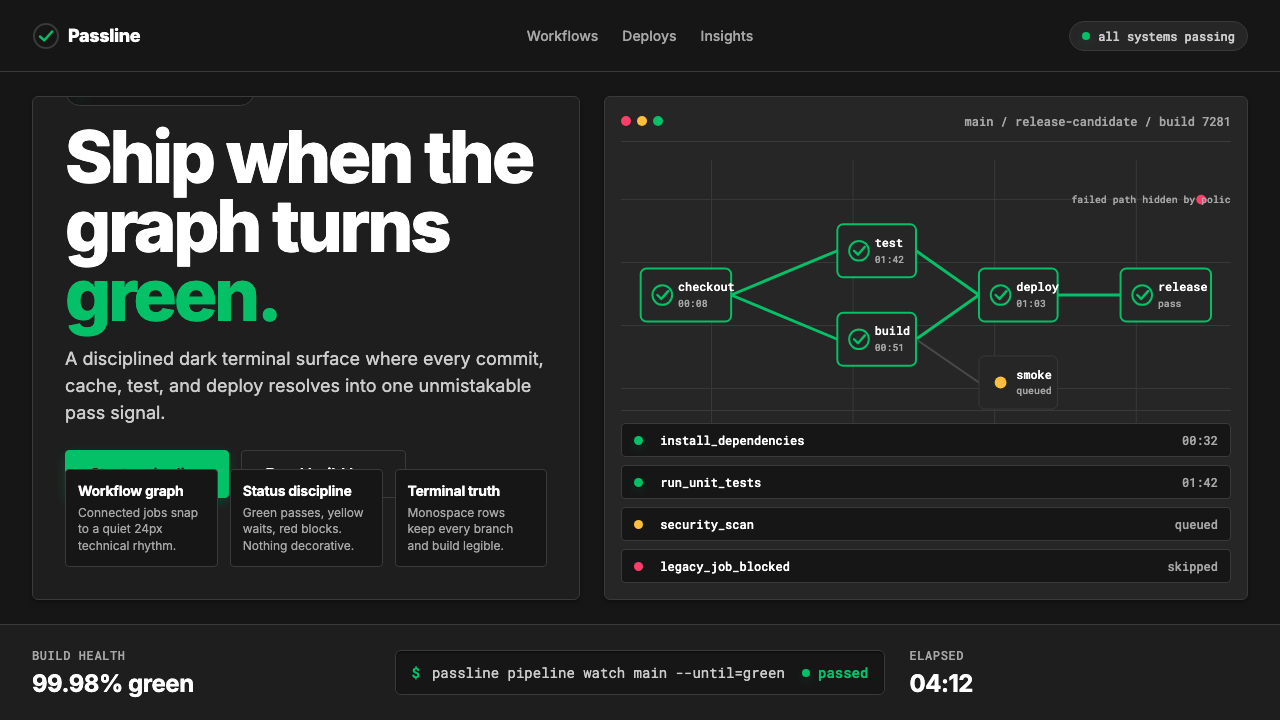 CircleCI Pipeline-GreenConfidence goes green. Emerald status lines cut through terminal-black pipeli…
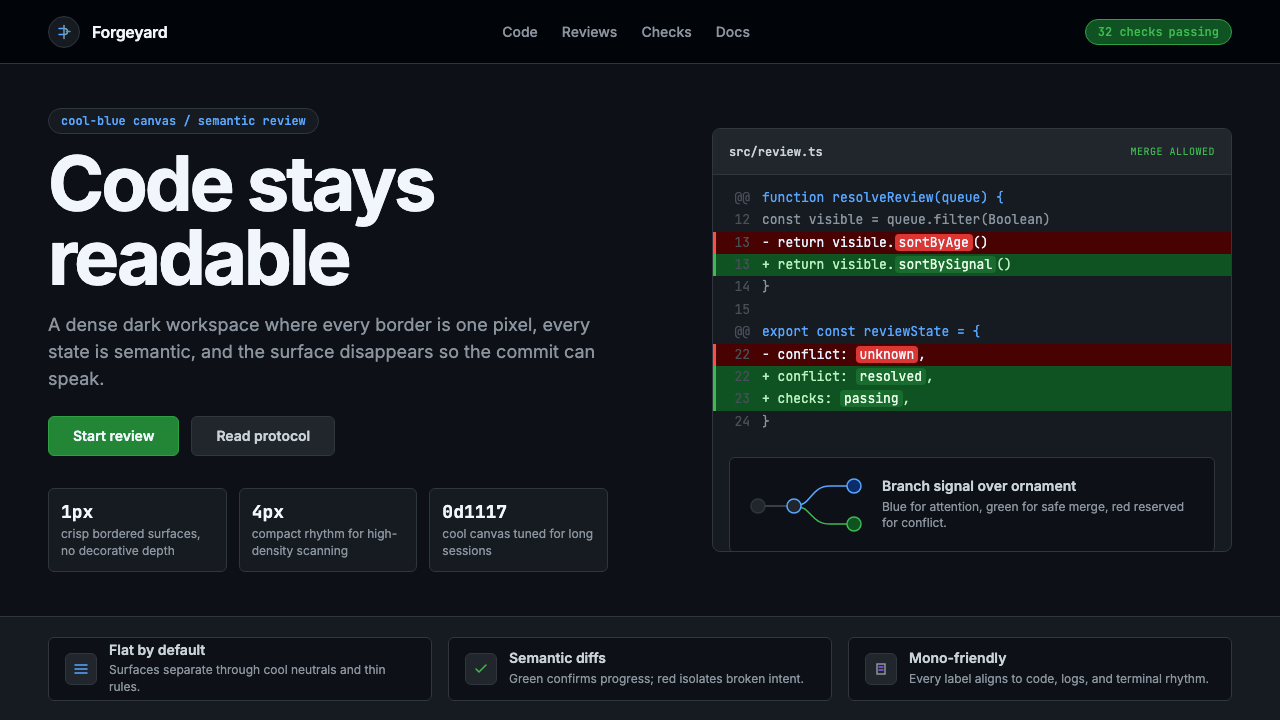 GitHub DarkCode-first darkness. Cool-blue canvas, 1px borders, green/red diff lines.
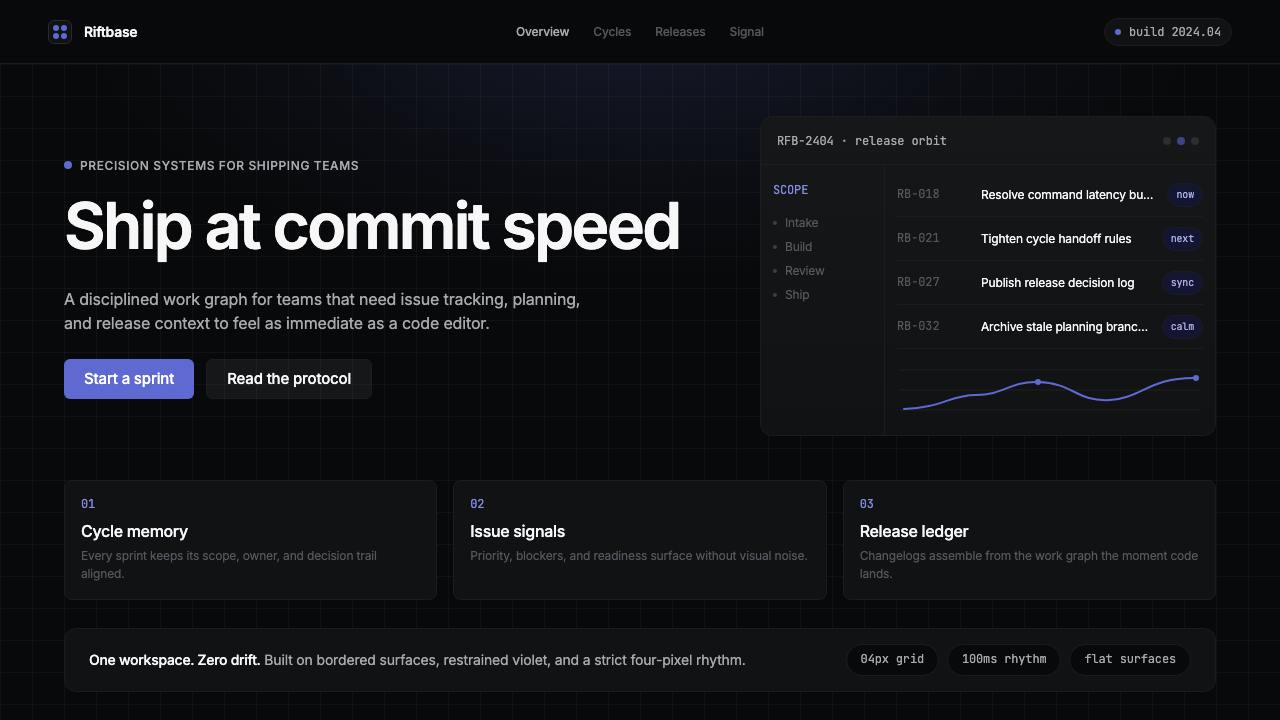 Linear 2024Precision down to the millisecond. Near-black, indigo-violet accents, Inter D…
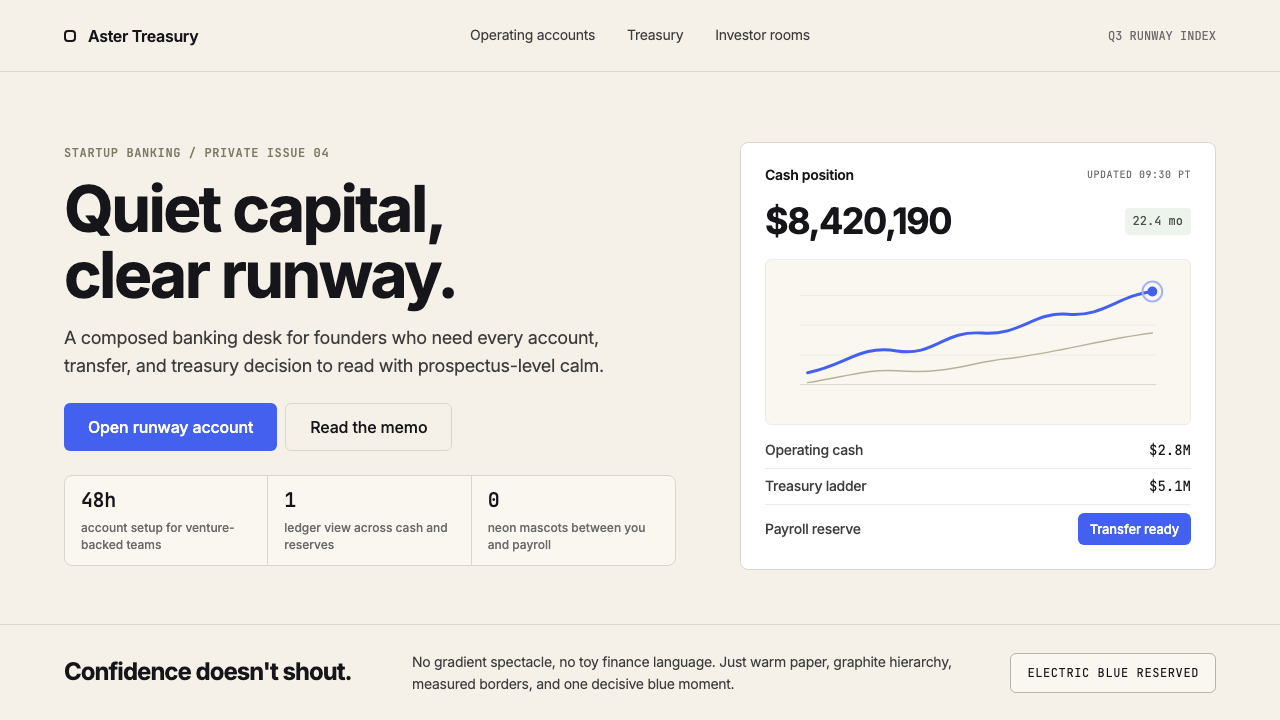 Mercury BankQuiet precision wins. Cream paper, charcoal Inter, and one electric-blue spar…
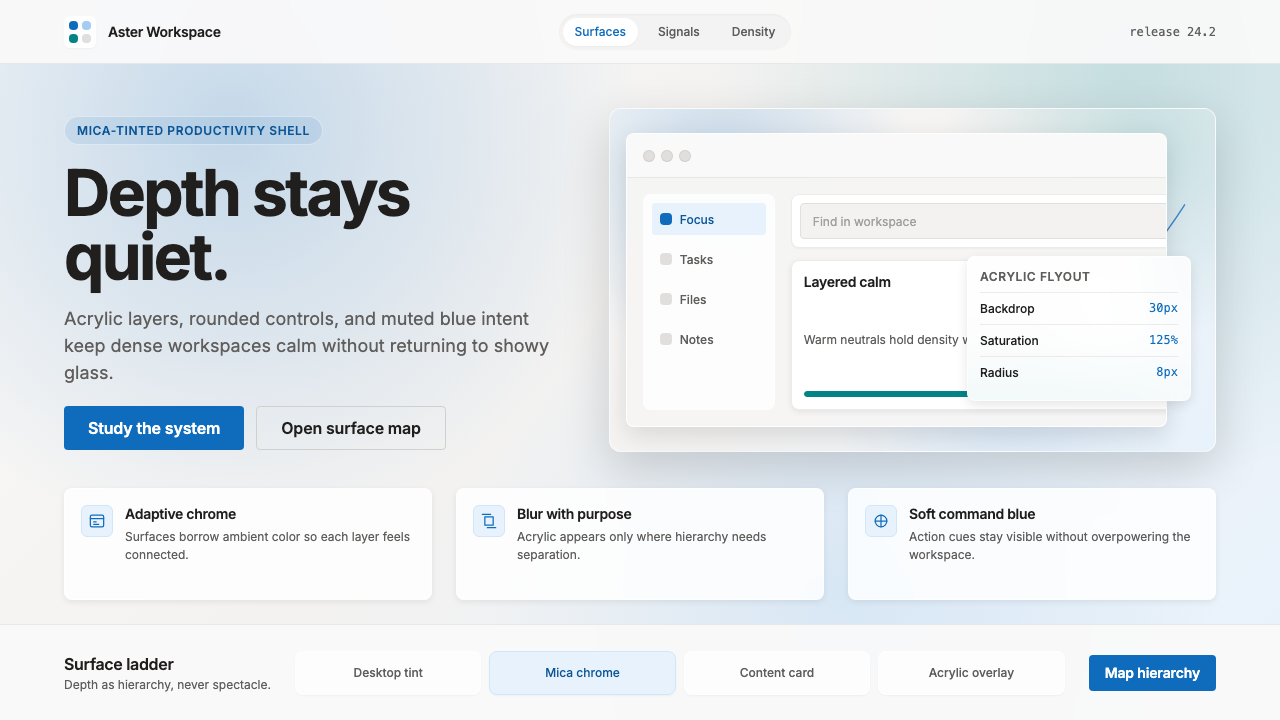 Microsoft Fluent 2Disciplined translucency. Warm Mica neutrals, acrylic blur, and muted blue cr…