What is Santeria Altar Bembe?
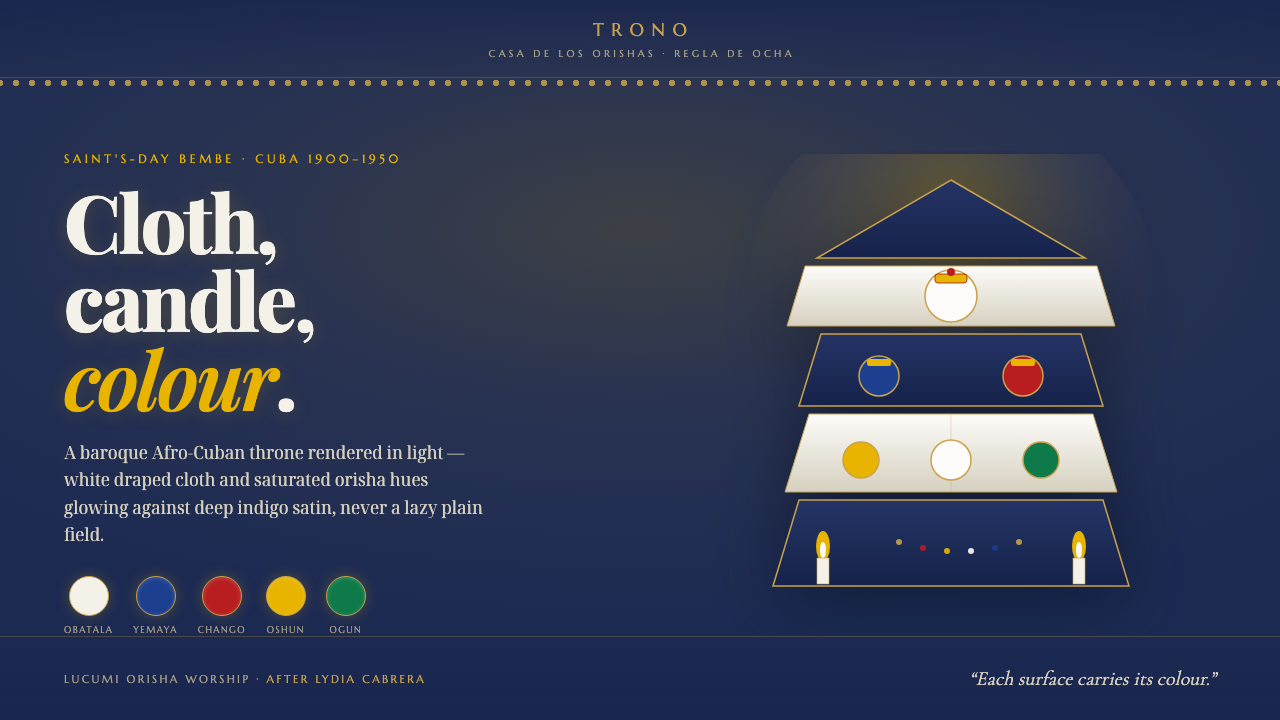
Santeria Altar Bembe turns devotion into a throne of saturated color, white ceremonial cloth, indigo satin, and candlelit abundance.
Santeria Altar Bembe in brief
Santeria Altar Bembe refers to the visual language of the bembe, or trono throne, built to honour the orishas within Santeria, also known as Regla de Ocha. Its foundation is a syncretic Afro-Cuban devotional setting: tiered white cloth draped over a royal-blue satin canopy, with porcelain soperas, beaded collares, and cowrie shells gathered into a ceremonial crown. The result is not a quiet shrine but a concentrated field of colour, textile, reflection, and ritual presence.
The digital system distills that baroque devotion without reducing it to generic luxury or tropical decoration. A deep indigo throne drape replaces the empty white interface field; white cloth supplies luminous structure; saturated orisha colours create hierarchy and identity; warm candle glow gives the composition its living centre. Satin sheen and shadow are essential because they make the surface feel gathered, layered, and ceremonial rather than flat.
Its emotional character comes from controlled abundance. The design should feel rich, reverent, and intimate at once: royal-blue depth behind bright white fabric, saturated accents appearing like offerings, and small details suggesting beads, porcelain, or shells. The system is dark, but not gloomy. Candle warmth keeps the indigo field human, while white cloth prevents the saturated colours from becoming visually heavy.
Where does Santeria Altar Bembe come from?
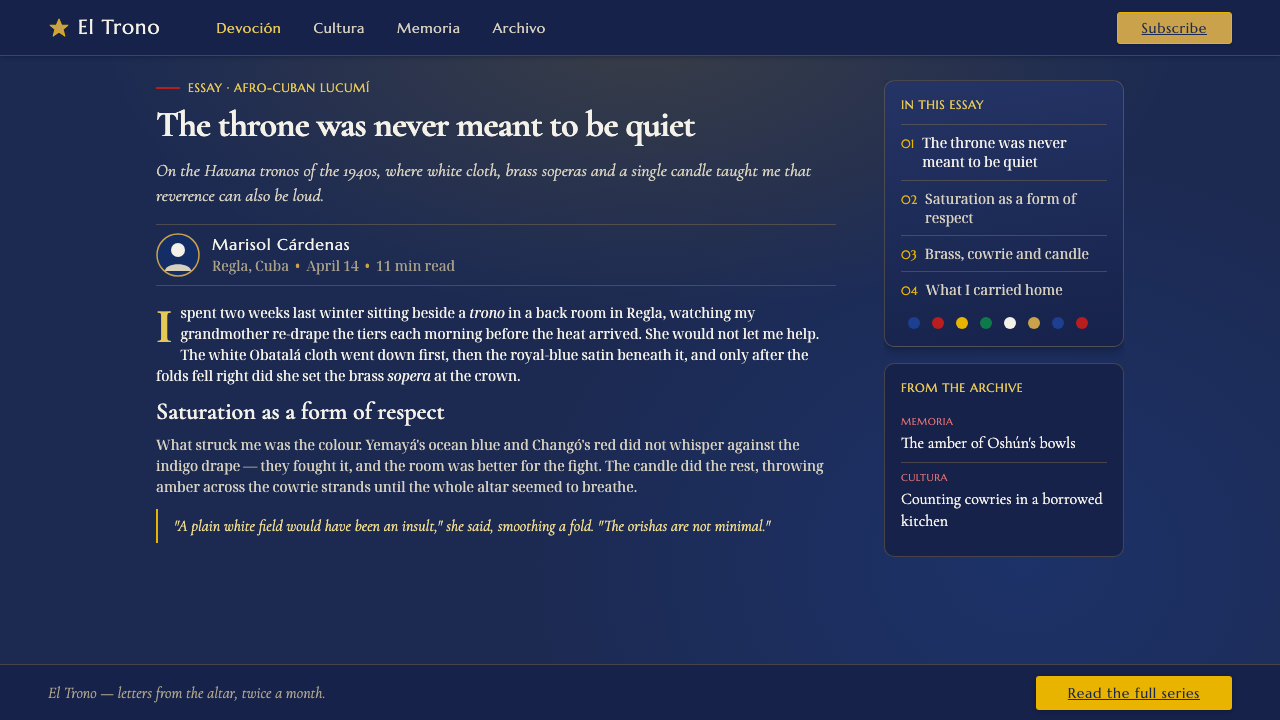
The source material places the consolidation of Lucumi and Regla de Ocha in Cuba between 1900 and 1950, within the Afro-Cuban Yoruba diaspora of Latin America. Santeria Altar Bembe belongs to that setting of cultural continuity and religious synthesis. Its identity is therefore not based on a single decorative vocabulary. It emerges from the meeting of Lucumi orisha worship and Catholic-Yoruba syncretism, expressed through a throne assembled for honour rather than display alone.
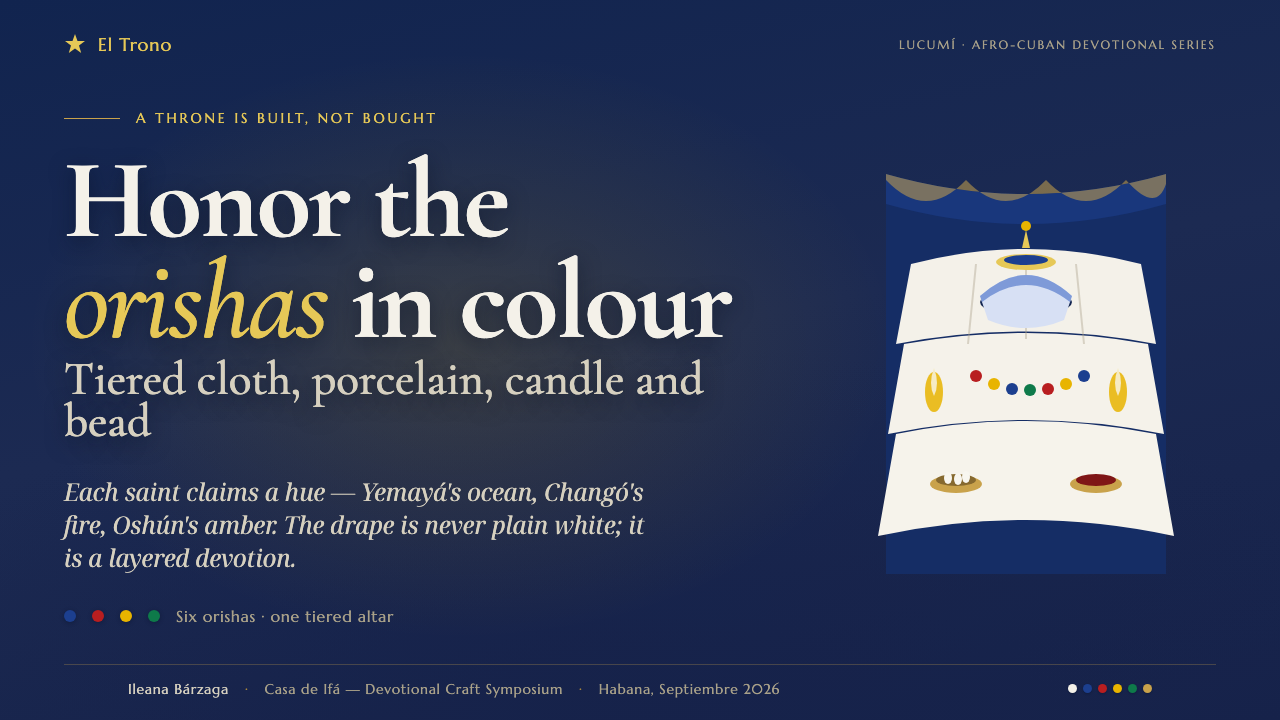
The bembe is described as a trono throne: a devotional structure whose vertical layering creates a sense of elevation. White cloth is draped in tiers over a royal-blue satin canopy, then crowned with porcelain soperas, beaded collares, and cowrie shells. Each material contributes a different kind of presence. Cloth brings softness and ceremonial purity; satin brings depth and reflected light; porcelain suggests contained sacred objects; beads and shells bring rhythm, texture, and concentrated detail.
Colour is inseparable from the orishas honoured by the throne. Pure-white Obatala cloth signals purity. Yemaya brings the blue of the ocean, Shango brings red, and Oshun brings amber yellow. In the digital adaptation, these colours should remain distinct and saturated, but their use should feel intentional. They are not a decorative rainbow. They are a way of giving each accent a devotional charge while the indigo throne and white cloth hold the composition together.
The named figures and makers associated with this cultural field are santeros y santeras, babalawos, igbodu throne builders, and Lydia Cabrera. The source material does not reduce the tradition to one author or one canonical designer. That matters for the style: the altar is understood as a living act of assembly, where knowledge, craft, devotion, and material arrangement meet. A faithful digital interpretation should preserve that sense of collective making and avoid presenting the visual system as an invented brand ornament detached from its Afro-Cuban Yoruba context.
What defines the Santeria Altar Bembe look?
Indigo Throne
The foundation is a deep indigo field that behaves like a throne drape rather than a neutral background. It should feel dense, satin-like, and slightly mysterious, with enough tonal movement to suggest fabric gathered in shadow. Indigo gives the brighter elements somewhere to stand: white cloth becomes luminous, saturated orisha colours become ceremonial accents, and candle warmth can register as a living interruption in the darkness.
Draped White Cloth
White is not an empty surface in this system. It is layered, folded, and draped, giving the interface a ceremonial architecture. The cloth should create soft vertical falls, overlapping bands, and irregular edges that remain visibly deliberate. Pure white is tied to Obatala and signals purity, so it carries both visual brightness and symbolic responsibility. Use it to organize content, not merely to fill space.
Saturated Orisha Colour
Colour arrives with identity. Yemaya is represented through ocean blue, Shango through red, and Oshun through amber yellow. These hues should appear saturated and confident, placed as concentrated fields, marks, or accents against indigo and white. Their strength comes from restraint around them: when every element competes at full intensity, the symbolic hierarchy disappears. Let the throne remain dark and let the colour announce what matters.
Candlelit Warmth
Warm candle glow is the system's emotional light source. It should soften the severity of indigo without turning the page bright, and it should make white cloth feel illuminated from within. The glow works best as a local presence around focal content, porcelain-like details, or selected accents. It is not a universal haze. Its purpose is to imply intimacy, flicker, and attentive ritual focus.
Ceremonial Objects
Porcelain soperas, beaded collares, and cowrie shells provide the system's object language. Their digital counterparts should feel gathered and displayed, with small repeating details set against broad textile masses. Beads can establish rhythm, shells can punctuate an edge, and porcelain can introduce a quiet reflective note. These motifs are strongest when they remain selective and tactile rather than becoming a repeated ornamental border.
Baroque Layering
The composition gains richness through accumulation: throne drape behind cloth, cloth behind objects, objects within candlelight. Layers should overlap enough to create depth and hierarchy, while each layer remains legible. The style is baroque because it welcomes richness, not because it accepts visual noise. Repetition, drape, sheen, and shadow should all serve the sense of a carefully prepared sacred setting.

Who shaped Santeria Altar Bembe?
Santeros y santeras are named in the source material among the people associated with the Santeria and Regla de Ocha field. In the design interpretation, they represent the devotional practitioners whose presence keeps the altar language connected to lived Afro-Cuban religious practice rather than detached spectacle.
Babalawos are included in the source material as key figures within this cultural setting. Their inclusion reinforces that the visual system belongs to a wider field of knowledge, devotion, and ritual authority, not to an isolated decorative style.
Igbodu throne builders are named as makers associated with the altar tradition. They embody the material intelligence of the bembe: the ability to arrange draped cloth, canopy, porcelain, beads, shells, and colour into a throne that feels assembled for honour and presence.
Lydia Cabrera is named in the source material among the figures connected to the Lucumi and Afro-Cuban Yoruba cultural field. Her presence in the reference set signals the importance of cultural documentation and interpretation alongside the living work of practitioners and throne builders.
How do you use Santeria Altar Bembe today?
Santeria Altar Bembe is especially effective for presentation covers that need atmosphere, reverence, and immediate visual identity. Build the cover around a deep indigo throne field, then let a draped white form establish the main vertical movement. Use one saturated orisha colour as the first accent and reserve candle warmth for the focal title or a small ceremonial detail. Content slides should preserve the altar's hierarchy: broad dark fields, clear white cloth-like sections, and concentrated colour marks. Data slides can treat charts as offerings arranged within the throne, using colour to distinguish meaning while keeping the surrounding field quiet and candlelit.
For web interfaces, the system suits dashboards, ritual calendars, cultural archives, collection tools, and other products that need a sense of depth and ceremonial focus. A dashboard can use indigo as the persistent environment, white draped panels as content surfaces, and saturated orisha colours for status, categories, or selected states. Pricing pages can give each tier a distinct colour association, but the structure should remain legible through spacing, grouping, and contrast rather than through a carnival of competing accents. Warm highlights should gather around actions and focal summaries, not wash across every component.
Editorial work benefits from the contrast between dense indigo atmosphere and luminous white reading surfaces. A feature article can open with a throne-like masthead, followed by narrow, calm text fields that feel like folded cloth placed within a larger ceremonial setting. Pull quotes, captions, and metadata can borrow the rhythm of beads or shells through small repeated marks, while photography or illustration should be framed as an object within the altar rather than as an unrelated full-bleed image. Marketing pages can use saturated colour as a declaration of purpose, with the indigo ground providing continuity across sections.
The style is useful when a product needs to communicate richness without relying on generic gold, marble, or luxury language. Its authority comes from assembly: fabric, colour, object, glow, and shadow working together. That makes it suitable for cultural storytelling, hospitality, music, beauty, and selected community-facing experiences, provided the visual references are handled with respect. The system should acknowledge its Afro-Cuban Yoruba context through its material logic and naming, rather than borrowing sacred motifs as empty exotic decoration.
The common mistake is turning the altar into a dark luxury theme with random jewel tones. Saturation alone does not create Santeria Altar Bembe. The composition needs white cloth as a structural and symbolic counterweight, indigo as a throne-like environment, warm candle glow as a local source of intimacy, and orisha colours used with intention. Another failure is flattening every layer into a uniform pattern. The style depends on gathered depth: what is behind, what is draped, what is crowned, and what is illuminated must remain distinguishable.
Santeria Altar Bembe — FAQ
Is Santeria Altar Bembe simply a dark luxury style?
No. Its darkness comes from the indigo throne drape and candlelit setting, but the system is defined by a specific relationship between indigo, white cloth, saturated orisha colours, ceremonial objects, and warm light. Remove the draped white structure or the devotional sense of gathered materials and the result becomes generic luxury. The style depends on cultural and material logic, not darkness alone.
Why is white so important in the palette?
White is the luminous structural counterweight to the indigo throne. In the source tradition, pure-white Obatala cloth signals purity, so white carries symbolic meaning as well as visual brightness. It should appear as draped, folded, or layered cloth rather than as a blank interface field. This preserves both its ceremonial role and its ability to organize content.
How should the orisha colours be used in a digital interface?
Use them as concentrated, meaningful accents rather than as a complete decorative rainbow. Yemaya's ocean blue, Shango's red, and Oshun's amber yellow can distinguish categories, actions, or focal content, while indigo and white maintain the throne's overall structure. The colours should feel saturated and intentional, but surrounding restraint is necessary so that their identity remains legible.
What role does candle glow play?
Candle glow is a local emotional light, not a universal atmospheric filter. It warms the indigo field, makes white cloth feel alive, and directs attention toward selected objects or content. If spread evenly across the whole composition, it loses its sense of flicker and ritual focus. Treat it as an intimate illumination that gathers around what deserves attention.
How can the style be used respectfully?
Keep the Afro-Cuban Yoruba context visible in the design rationale. The bembe is a trono throne built to honour the orishas within Santeria, Regla de Ocha, Lucumi worship, and Catholic-Yoruba syncretism. Avoid stripping the system down to shells, beads, saturated colour, or exotic atmosphere as disconnected decoration. Respect comes from understanding the relationship between material arrangement, devotion, identity, and cultural setting.
Related design styles
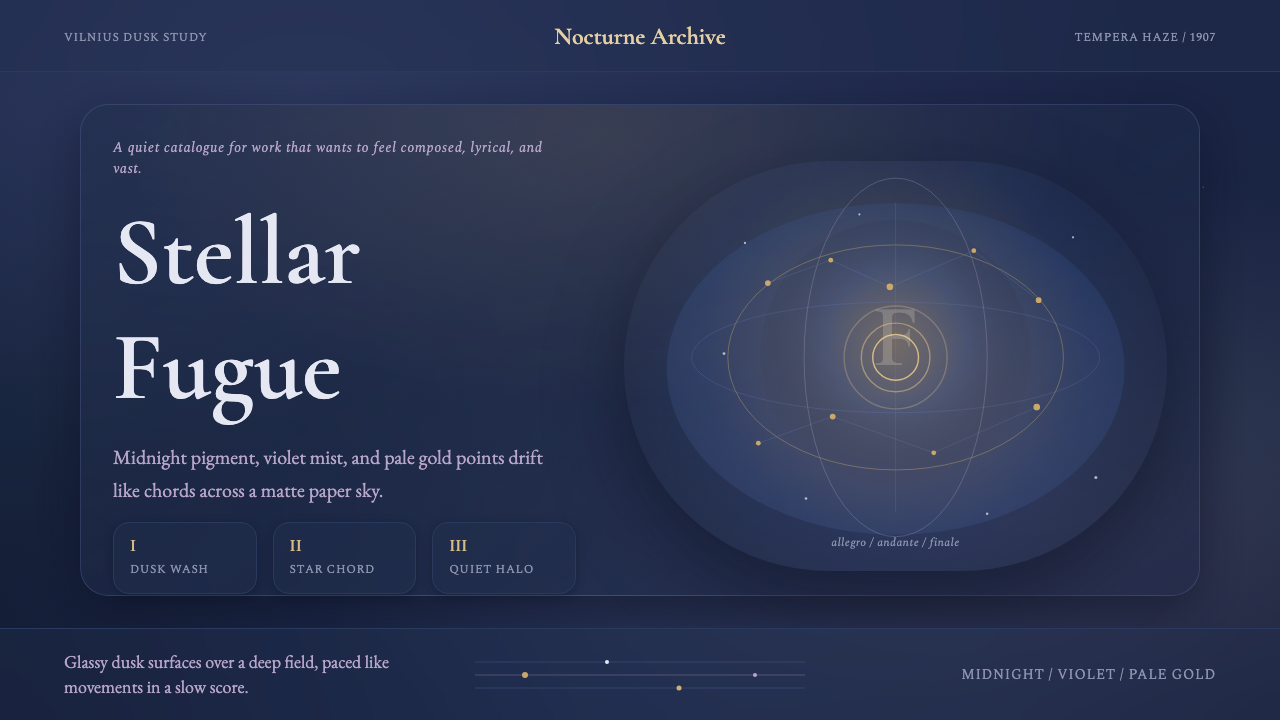 Čiurlionis SymbolismCosmos becomes music. Midnight blue-violet washes and pale gold stars drift i…
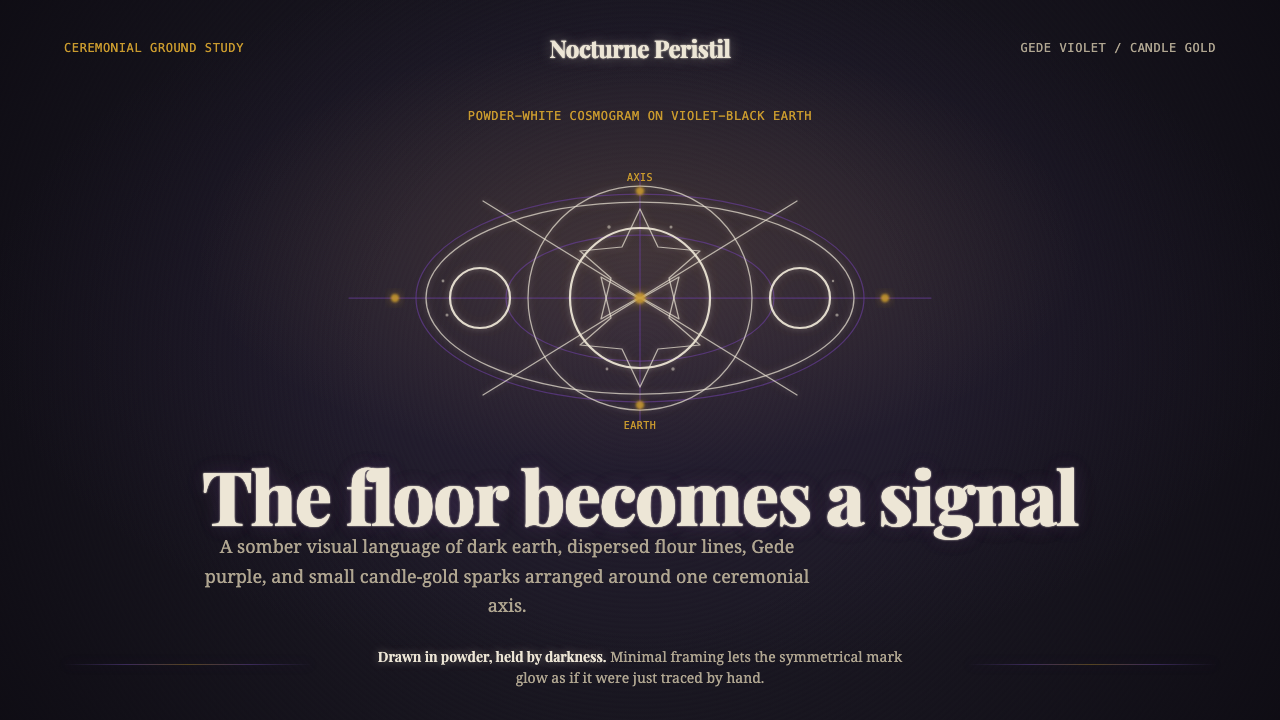 Haitian Vodou VèvèSomber ritual glow. Powder-white lines on violet-black earth, touched by cand…
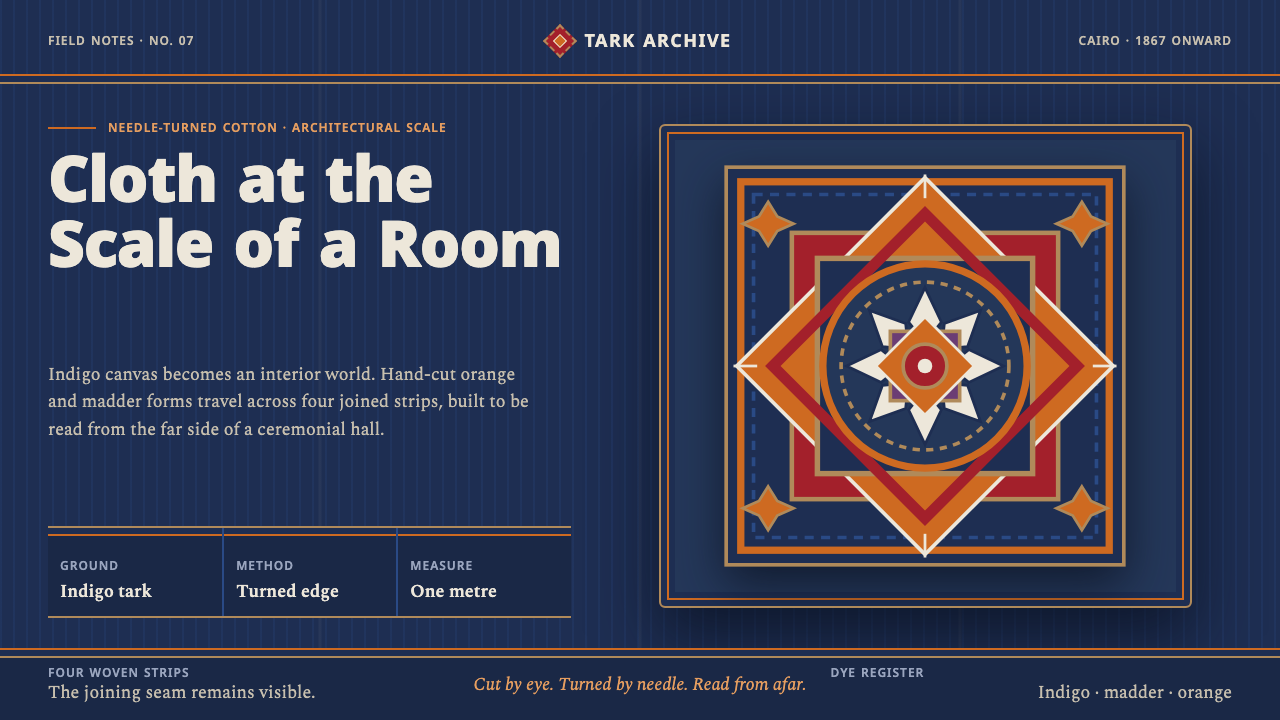 Khayamiya Tentmaker AppliquéCloth becomes architecture. Indigo canvas holds monumental orange and madder…
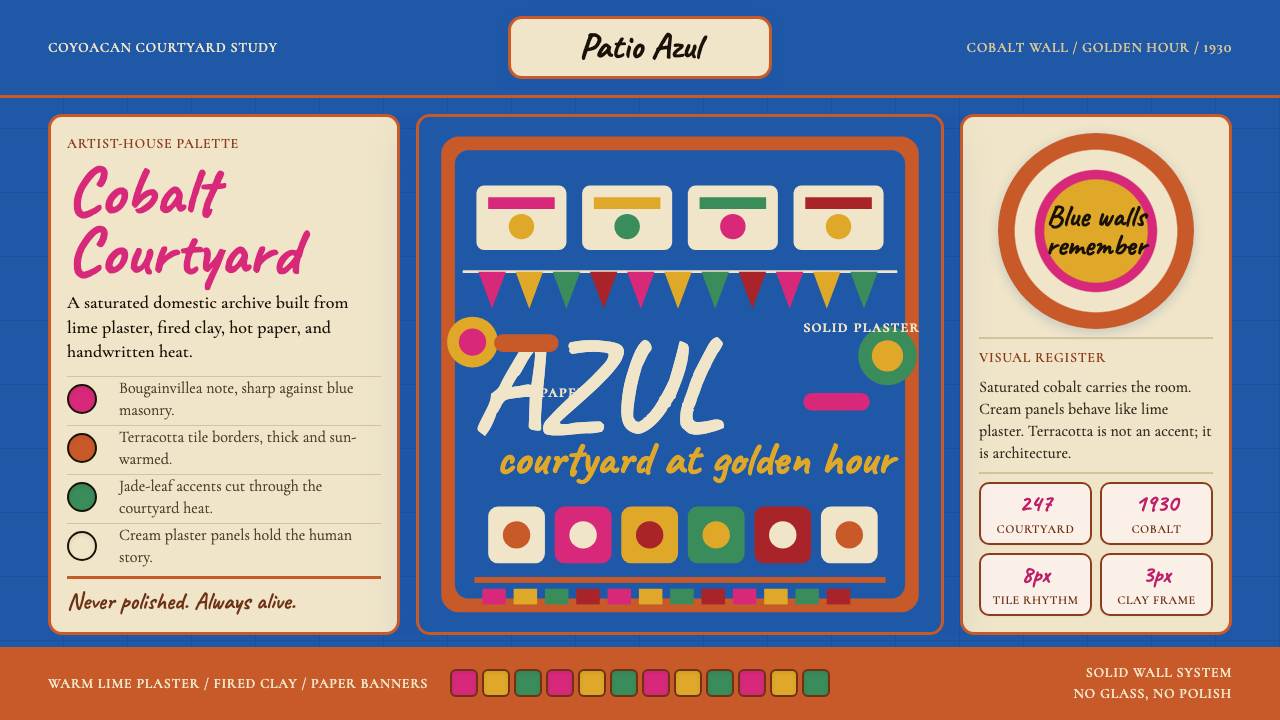 Mexican Frida Blue House (Coyoacán 1930)Maximum color, intimate walls. Cobalt, cream panels, terracotta grid, cut-pap…
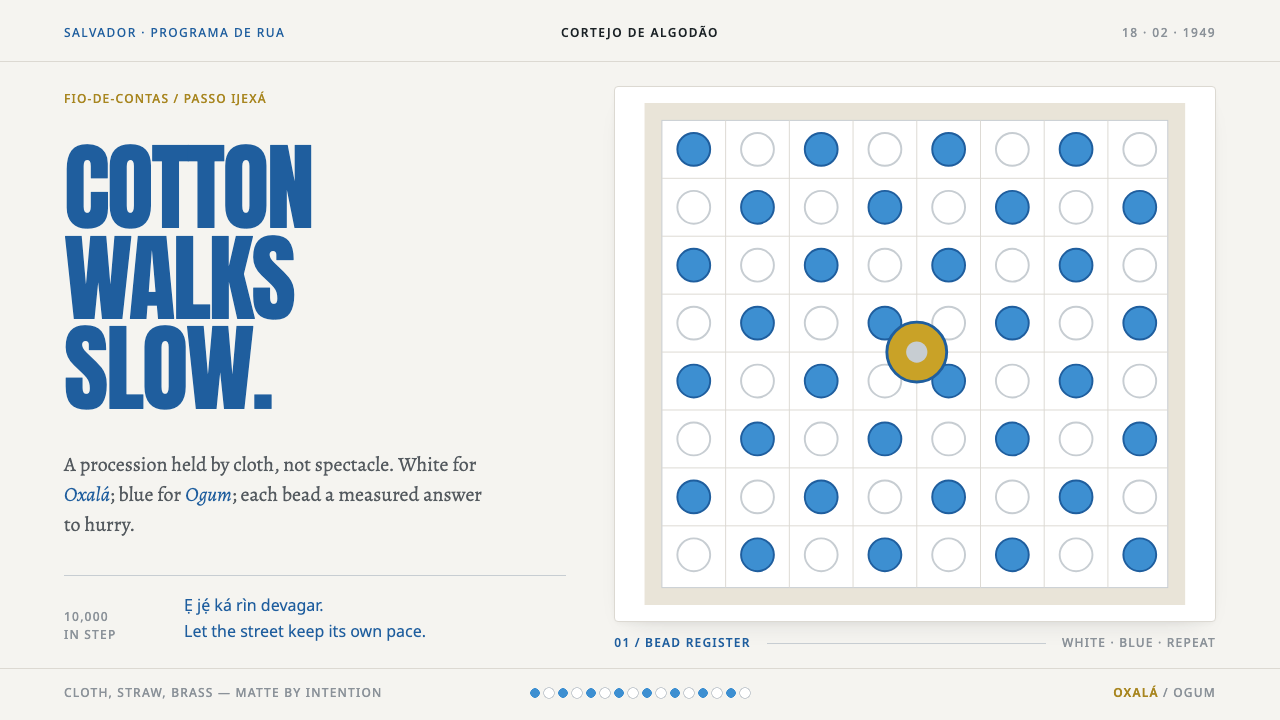 Afoxé Filhos de GandhyA procession that refuses to hurry. Cotton white and bead blue repeat in a me…
 Gaucho LeatherHand-worked horseman craft. Dark recado leather, harness tan, coin-silver ras…