What is Afoxé Filhos de Gandhy?
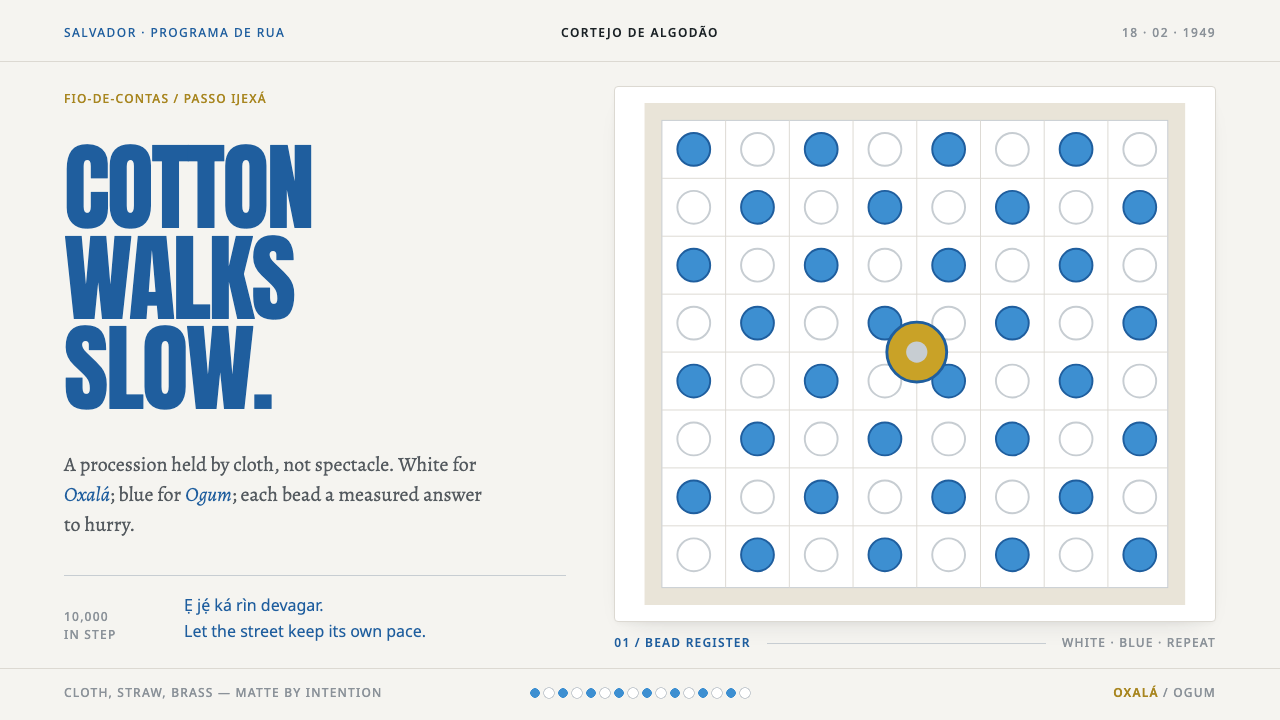
Filhos de Gandhy is a procession that refuses to hurry: cotton white and bead blue alternating like a strand of ritual beads, with brass and straw at the edges and nothing shiny anywhere.
Afoxé Filhos de Gandhy in brief
Filhos de Gandhy, 'Sons of Gandhi', is the largest afoxé of the Salvador carnival in Bahia, Brazil. An afoxé is a carnival procession rooted in Candomblé, and this one gathers around ten thousand men, each wrapped in a cotton bedsheet sewn down the sides and a towel wound into a turban. They move at the pace of the ijexá drum rather than the pace of a parade.
The palette is not decoration. In the Candomblé reading the group keeps, white belongs to Oxalá and blue to Ogum, and the alternating white-and-blue strand is the fio-de-contas, the bead necklace, of Oxaguiã: white for his father Oxalufã, blue for Ogum, from whom he is inseparable. What looks like a simple two-colour scheme is therefore a piece of theology worn on the body.
This design system keeps that reading. The ground is washed cotton white, the main colour is bead blue, and brass and straw appear only at the edges as dry, warm notes. Nothing is shiny: no sequins, no satin, no glow. The procession is slow and peaceful, and the visual language is meant to be slow as well, with generous spacing, an even rhythm and a calm that is not the same as emptiness.
Where does Afoxé Filhos de Gandhy come from?
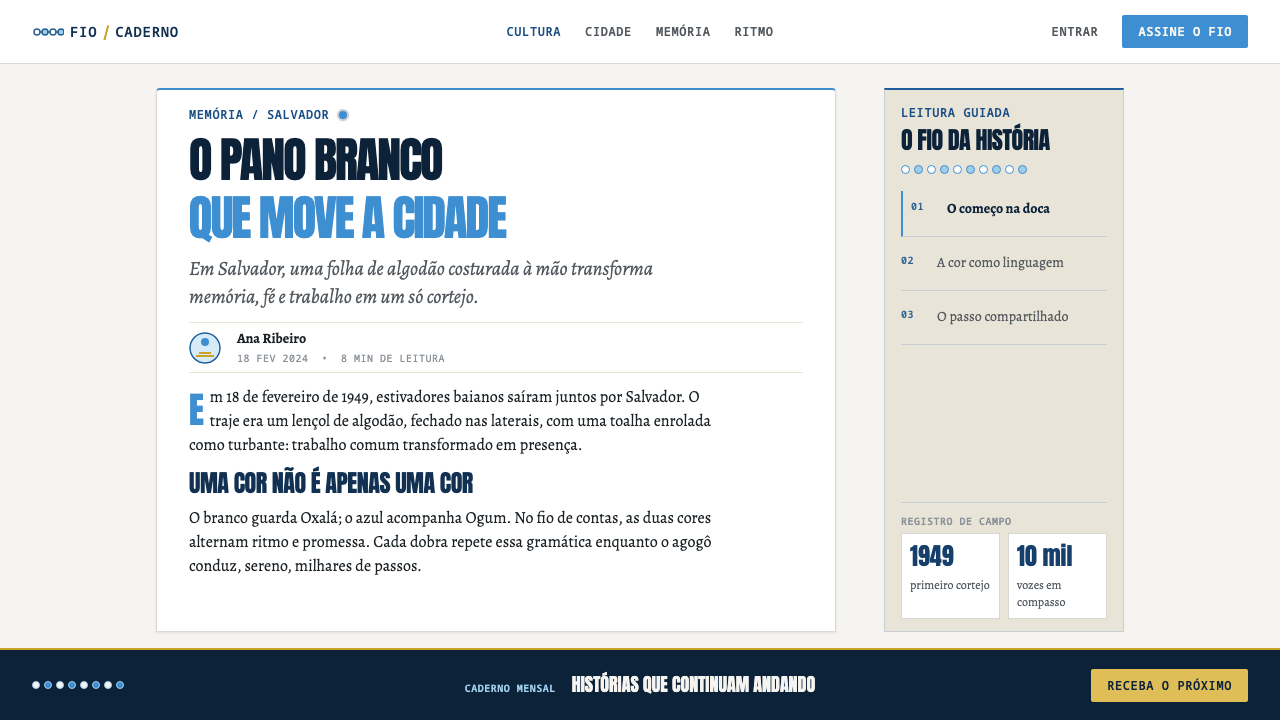
The afoxé was founded in Salvador on 18 February 1949 by dockworkers of Bahia. That origin explains a great deal about its look. These were working men, and the costume they chose was made from ordinary household cloth: a bedsheet, a towel, white sandals with blue socks. Its plainness is a statement of dignity rather than a trace of scarcity.
The name and the emblems look toward India. 'Gandhy' recalls Mahatma Gandhi, and the silver-blue brooch worn on the chest is borrowed from the imagery of Indian princes. The theology, though, points to the Candomblé of Bahia, where white and blue name the orixás Oxalá and Ogum. The result is a deliberate layering of references: a name that speaks of peace laid over an Afro-Brazilian religious code, worn on cotton.
The afoxé belongs to the Afro-Brazilian carnival of Bahia, the strand of Salvador's carnival rooted in Candomblé and set to the tempo of the ijexá rhythm. Its territory is the carnival circuits of Salvador and the old town of Pelourinho. The decades from 1950 to 1990 are the ones that define its carnival image: the years in which the sight of a vast, quiet river of white and blue moving through the streets became a fixture of the city's carnival.
Several names recur in the story of its beginnings: Durval Marques da Silva, Antônio Rodrigues da Silva and Aristides Mascarenhas are counted among its key figures. What matters for design is less any single biography than the image that generation established: simple cloth, a sparing palette, a measured pace, and an insistence that nothing in the procession should be shiny or hurried.
What defines the Afoxé Filhos de Gandhy look?
Washed cotton ground
The ground is the white of laundered cotton, a little warm and never dazzling, closer to a bedsheet dried in the sun than to a sheet of printer paper. It carries the idea that this is cloth, worn and washed rather than new and glossy. White also carries meaning here, since it belongs to Oxalá, so it is treated as a respected colour and not as empty space.
Bead blue
Blue is the lead colour, the blue of glass beads and of Ogum. It appears in measured quantities: a band, a rule, a block of type, a repeated dot. Because blue and white do sacred work together here, the blue should look dyed and settled rather than electric, and it is never allowed to glow.
The alternating strand
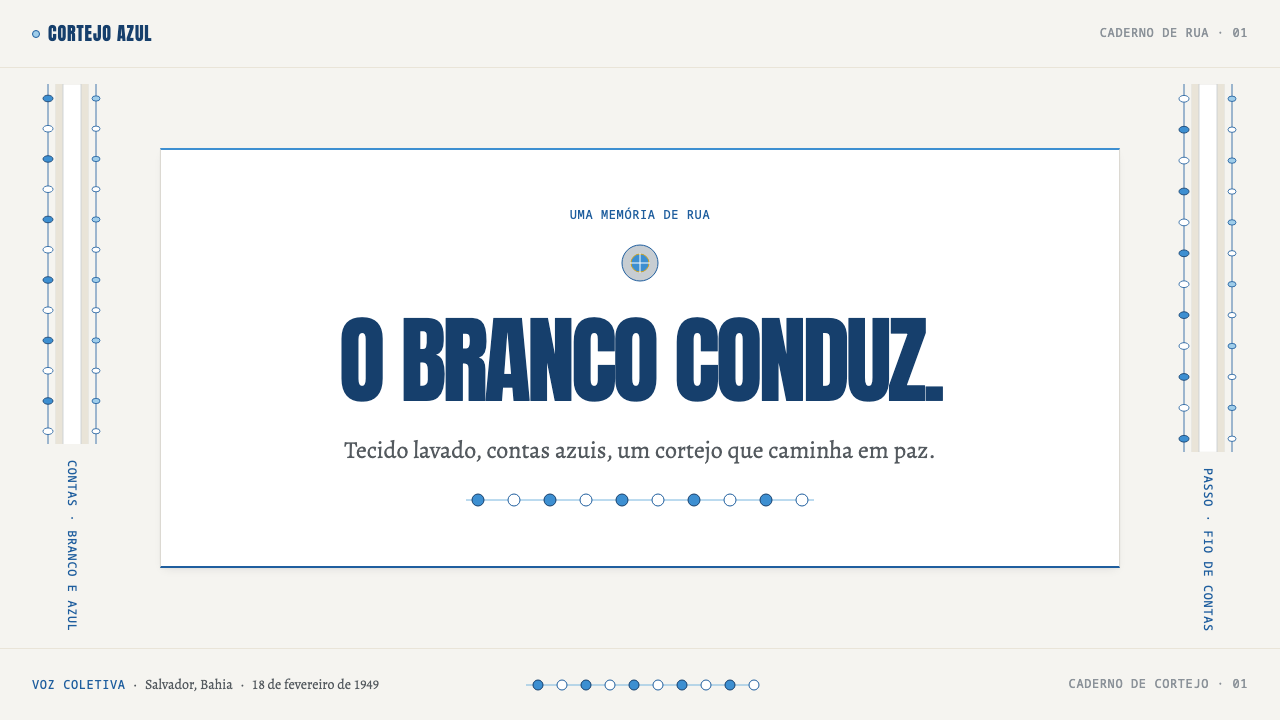
The signature structure is the white-and-blue alternation of the fio-de-contas. In layout it becomes a repeating rhythm: dividers, borders, list markers and timelines that alternate white and blue at an even interval, like beads on a string. The repetition is slow and regular, and the eye can rest on it. It turns a layout into a procession, with elements following one another in single file.
Brass and straw edges
Brass and a dry, straw-like tone sit at the edges: small details, rules, clasps and accents. They are warm and dull rather than gleaming, the brass of an old fitting rather than a polished trophy, and the straw of the coast rather than gold leaf. Keep them rare, so that they read as trim on a garment.
Nothing shiny
No sequins, no satin, no gloss, no glow. Surfaces are matte and fibrous, and light behaves as it does on cloth: soft, even and without highlights. This restraint is the opposite of the glitter that carnival imagery often invites, and it is the clearest way to tell this style from a generic festival palette.
A measured pace
Pacing is part of the visual language. Spacing is generous and consistent, transitions are unhurried, and nothing is staged to rush the reader. The model is a procession moving at the speed of a drum, so layouts favour long horizontal runs and a steady vertical rhythm over bursts of density. Calm here means composed attention, not emptiness.
Cloth construction
The costume is made from simple rectangles: a bedsheet sewn down the sides, a towel wound into a turban. The design translates this into plain rectangles and straight seams, with edges treated like stitched hems and folds implied rather than rendered. Garment-like construction gives the style its honesty, because you can see how it is made.
Who shaped Afoxé Filhos de Gandhy?
One of three names counted among the key figures of the afoxé's origins and of its defining carnival decades. Whatever the details of individual roles, he belongs to the founding-era generation of a group that is now the largest afoxé in Salvador, and whose plain white costume still defines its image.
Listed among the key figures alongside Durval Marques da Silva. His place in the story is a reminder that the afoxé is a collective authorship, one in which a bedsheet, a towel and a bead-coloured palette were agreed by a community and not styled by an agency.
The third of the key figures. He stands in this account for the continuity between the founding of 1949 and the carnival decades that followed, the years in which the group's slow, peaceful image settled into the form this system takes as its model.
The founders as a group: dockworkers who started the afoxé on 18 February 1949. Their working-class origin is built into the look, from household cloth to the refusal of glitter, and it is the best guide for anyone adapting the style: dignity achieved through plainness, not through ornament.
How do you use Afoxé Filhos de Gandhy today?
Filhos de Gandhy is a style of calm, ritual dignity. It works wherever a design needs to feel communal, unhurried and rooted, and it is poorly served by anything that tries to sparkle. It borrows the logic of a procession: elements follow one another in order, at an even pace, in a small palette that means something.
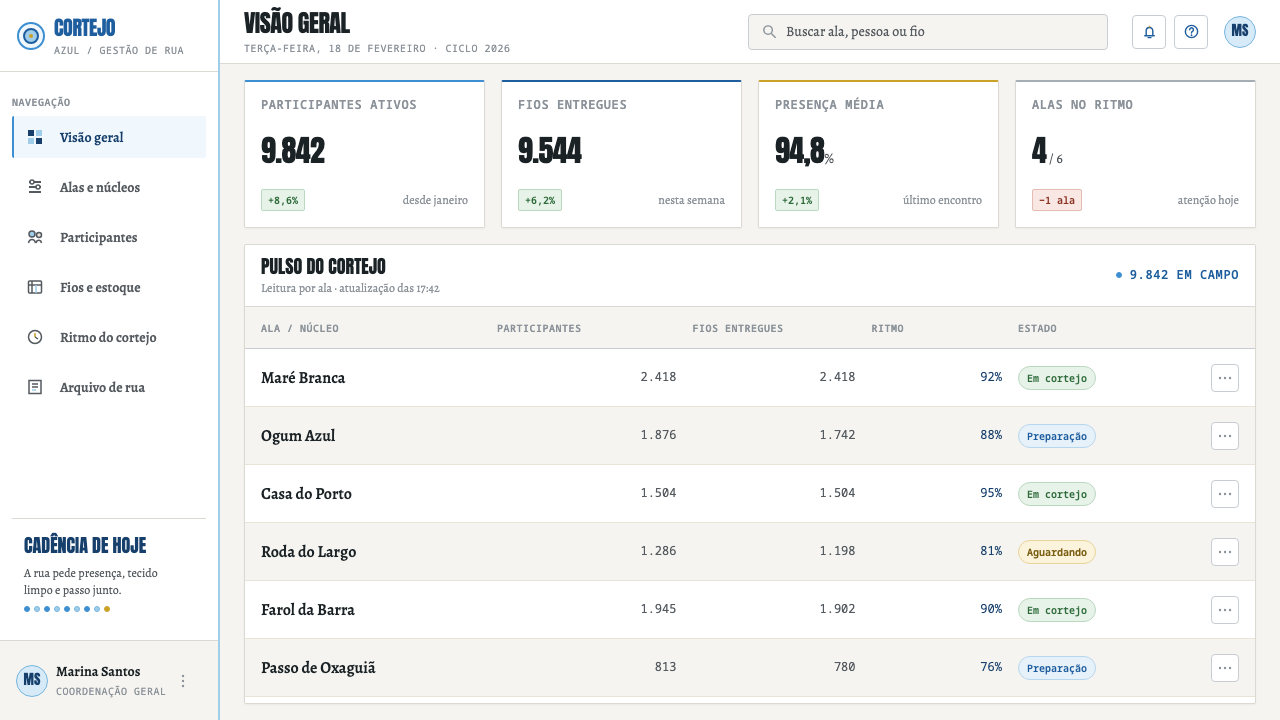
For presentation slides, a cover can be a field of washed cotton white with a single band of alternating white and blue beads and a calm title, with brass or straw used only for a thin edge. Content slides keep an even, generous rhythm, one idea at a time, with the white-and-blue strand as the divider between sections. Data slides use blue as the main series and brass as the single highlight, with the strand motif for axes or timelines, so that a chart reads like a measured procession rather than a spike.
For web interfaces, the style suits community platforms, cultural and heritage organisations, education, non-profits, wellness-adjacent products and any service that wants to feel patient and trustworthy. Use a cotton-white page, blue as the interactive colour, strand dividers, matte buttons without gloss and unhurried transitions. Pricing and onboarding flows work well as sequences of beads, one step at a time. Avoid glossy gradients, neon accents and sparkle.
For editorial and marketing work, it fits stories about communities, traditions, music, faith and memory, anniversary and commemoration pieces, and campaigns that want to speak about peace or patience. Photography should feel documentary and warm, and layouts should give long horizontal runs of white and blue the way a procession fills a street. The tone of the copy matches the visuals: measured, plain, never shouting.
The common mistake is to hear 'Brazilian carnival' and reach for glitter, saturated rainbow colour and fast, busy layouts. This system is the opposite: restrained, matte and slow. The second mistake is to treat white and blue as a mere colour scheme. These colours carry meaning in Candomblé, so they should be handled with respect and never turned into novelty decoration or a party theme. The third is adding shine to the brass and straw; once they gleam, the dry, worn dignity of the whole system is lost.
Afoxé Filhos de Gandhy — FAQ
What is an afoxé?
An afoxé is a carnival procession rooted in Candomblé, moving to the ijexá rhythm and belonging to the Afro-Brazilian carnival of Bahia. Filhos de Gandhy is the largest afoxé of the Salvador carnival. Unlike a parade built on speed and spectacle, it is slow, peaceful and symbolically coded, and that character is what this design system translates: a measured pace, a meaningful palette and no shine.
Why only white and blue?
Because the two colours are a code, not a taste. White belongs to Oxalá and blue to Ogum, and the alternating strand is the bead necklace of Oxaguiã, white for his father Oxalufã and blue for Ogum. Brass and straw are kept to the edges as dry, warm trim, so the white-and-blue pairing stays at the centre. Adding more hues would dilute exactly the thing the palette is there to say.
How do I use the style without turning it into a costume?
Borrow its structure and tone, not its religious or carnival imagery. The washed cotton ground, the alternating strand rhythm, the matte surfaces and the slow pacing can all be applied to ordinary interfaces and documents without any literal reference to a procession. Treat the colour meanings with respect, avoid party or novelty treatments, and let the restraint do the work.
Does the style work on a dark background?
The system is built on a washed cotton ground, so its logic is light. A dark version is possible if you keep the cloth logic: use a deep, matte bead blue as the ground, let cotton white act as the other half of the strand, and keep brass and straw dry and dull. What must not happen is a glossy, glowing dark theme, because the absence of shine is the style's whole point.
Where does the style struggle?
It struggles where urgency, speed or energy is the message: nightlife, gaming, flash sales, high-frequency trading dashboards and anything that must feel loud. It also gives little help with very dense data screens, because its pacing depends on generous space. Use it where patience, community and quiet confidence are what the product wants to communicate.
Related design styles
 Puerto Rican Bomba & PlenaNight festival dignity. Drum-red stripes and cream Playfair type on deep trop…
 Uruguayan Candombe LlamadasCandombe after dark. Indigo ground, ochre drum circles, crimson banner type.
 Belizean Garifuna PuntaNight rhythm burns. Indigo fields, flame-orange serif type, and flag stripes…
 Brazilian Favela Rocinha 1970sHand-built warmth. Pink, saffron and green stripes climb cinderblock in rotul…
 Dim Sum CartWarm clutter sings. Vermilion seals, bamboo weave, and brush type stack like…
 Guyanese Tassa DrumCeremony carries the beat. Indigo banners, Playfair type, and marigold rows g…