What is Khayamiya Tentmaker Appliqué?
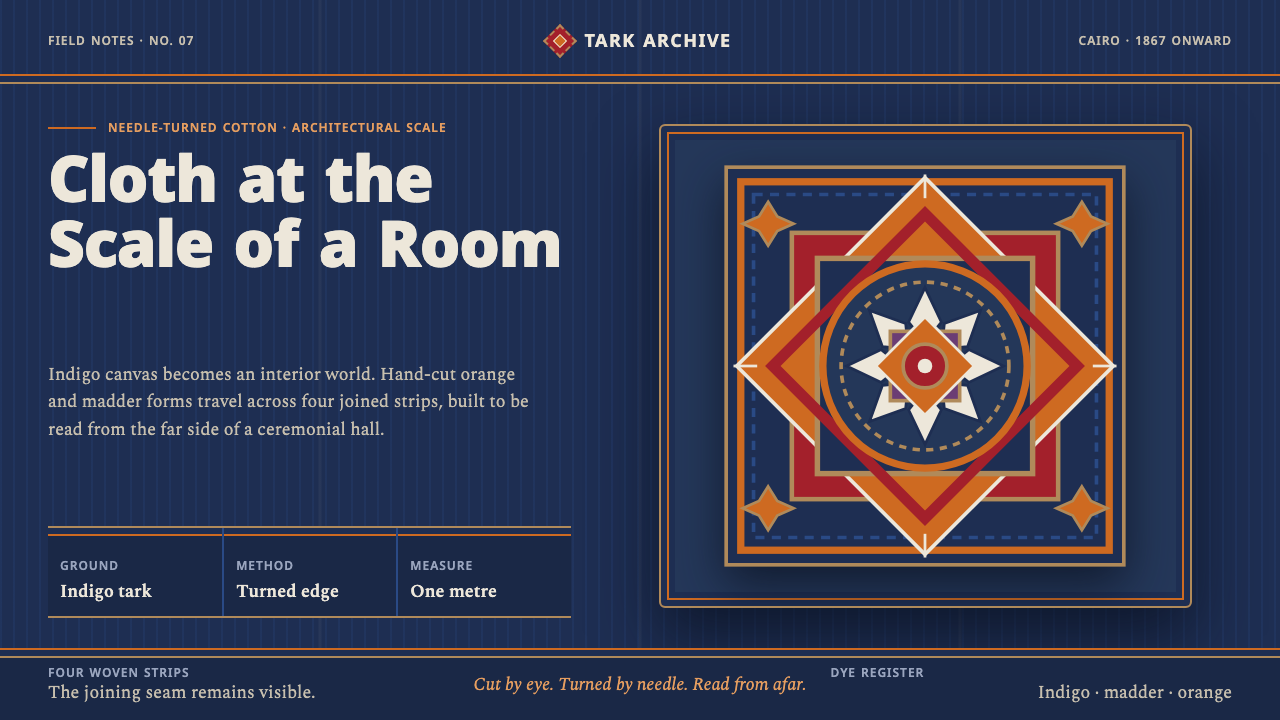
Khayamiya turns cloth into architecture — indigo canvas holds appliqué patterns scaled to be read from across a tent, not a page.
Khayamiya Tentmaker Appliqué in brief
Khayamiya is the appliqué craft of Cairo's tentmakers — the name comes from khayma, the Arabic word for tent. Working in the Souk al-Khayamiyya, a covered market street inside the Qasaba of Radwan Bey near the historic Bab Zuweila gate, tentmakers cut cotton fabric into geometric and floral shapes, turn the raw edges under with a needle so no fray shows, and stitch each shape by hand onto tark, a coarse base canvas of linen or hemp. Tark itself is a construction: four strips of hand-loomed cloth, roughly matched in width, sewn edge to edge so a visible seam runs down the center of every panel — a structural fact, not a flaw to hide.
The scale of the work follows its purpose. Khayamiya panels are not framed pictures; they are the internal lining of the suradeq, the large ceremonial tent erected in a street or courtyard for weddings, funerals, religious festivals, or state occasions. A panel has to hold its own against the noise and crowd of an entire gathering, so central medallions run close to a meter across, and border patterns are long enough that a person could walk the length of one without reaching its end. Pattern therefore behaves architecturally: a medallion functions like a dome, a border like a cornice, repeating at the scale of a room rather than a desk.
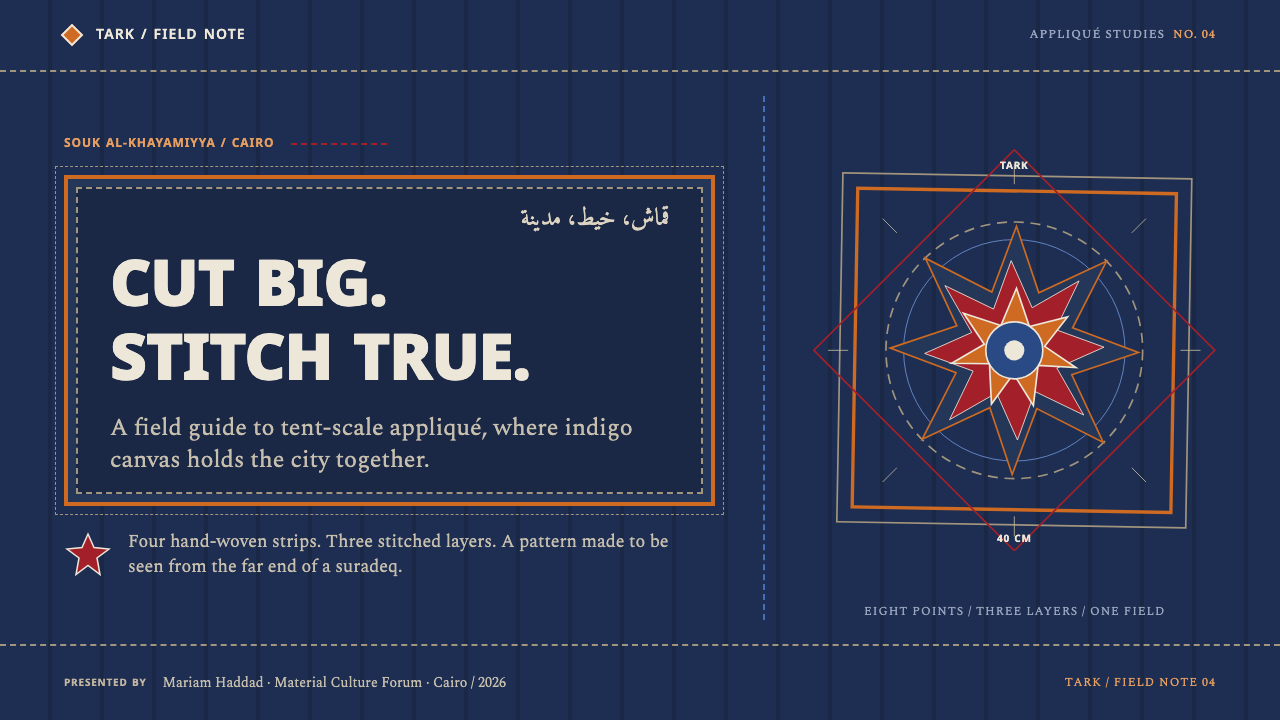
The pattern vocabulary draws on several overlapping traditions that met in Cairo: Islamic geometric ornament and arabesque vine-work supply the eight-pointed stars, interlocking polygons, and scrolling foliage that dominate most panels; a Pharaonic-revival strand surfaces in some later work, referencing ancient Egyptian motifs for a national audience; and a folkloric-illustration tradition contributes narrative panels — boats, camels, scenes of everyday life — stitched with the same appliqué technique but read more like a picture than a pattern. All three sit on the same hand-cut, hand-sewn foundation, which is what actually unifies the tradition, more than any single motif does.
Where does Khayamiya Tentmaker Appliqué come from?
The craft is anchored to one street: Souk al-Khayamiyya, inside the Qasaba of Radwan Bey, just inside Cairo's Bab Zuweila gate. The qasaba — a covered commercial corridor — takes its name from Radwan Bey, the Cairo official associated with the street's development as a market thoroughfare; tentmakers have worked under its arcades for generations, and it remains one of the few streets in the old city still organized around a single traditional trade rather than tourism or general retail.
The recorded era for the tradition spans the Khedival period (1867–1914) through to the present day. Under the Khedives — the Ottoman viceroys who governed Egypt with growing autonomy through the nineteenth and early twentieth centuries — Cairo's guild-based craft economy, including tentmaking, continued to serve both everyday ceremonial life and the state occasions of the ruling household. Tents lined with khayamiya panels were part of the visual apparatus of public celebration, and the craft's organization around the souk persisted through the political transformations that followed the Khedival era.
Color history gives the tradition its own internal chronology. Before the 1920s, tentmakers worked with a genuinely narrow set of dyes: white cotton, indigo blue, and madder red were the available colors, and panels from this period read as combinations of those three. In the 1920s, orange, purple, and tan entered the available palette. This is not a stylistic choice made by any one artist — it is a material fact about what dye a workshop could obtain in a given decade, which means a panel's color range can be read almost like a date stamp.
In the twentieth and twenty-first centuries, the tradition has been carried forward by working masters in the souk alongside a growing body of outside documentation. Contemporary tentmakers such as Hany Abd El Kader and Ahmed Naguib continue to design and stitch panels for ceremonial and commercial use, while scholarship — notably the research of Sam Bowker — has brought the craft's history, technique, and commercial life to audiences well beyond Cairo, helping khayamiya travel from tent lining to gallery wall and museum collection without leaving its origins as a street trade behind.
What defines the Khayamiya Tentmaker Appliqué look?
Color
The palette is genuinely historical rather than decorative. Pre-1920s work is built from just three colors — saturated indigo, madder red, and undyed white cotton — while orange, purple, and tan appear only from the 1920s onward. A system built on this tradition leads with a deep, saturated indigo ground, uses that 1920s orange as the primary accent, and reserves undyed, unbleached cotton tones for the cut appliqué shapes themselves — never as a background field.
Scale and Composition
Every pattern is scaled for a room, not a page. Central medallions run close to a meter across, and borders are conceived as lengths you could walk beside — a person moving alongside a suradeq wall reads the pattern the way they would read a building's cornice. Designing with khayamiya in mind means resisting the impulse to shrink the central motif; the drama depends on its size relative to a human body.
Construction and Technique
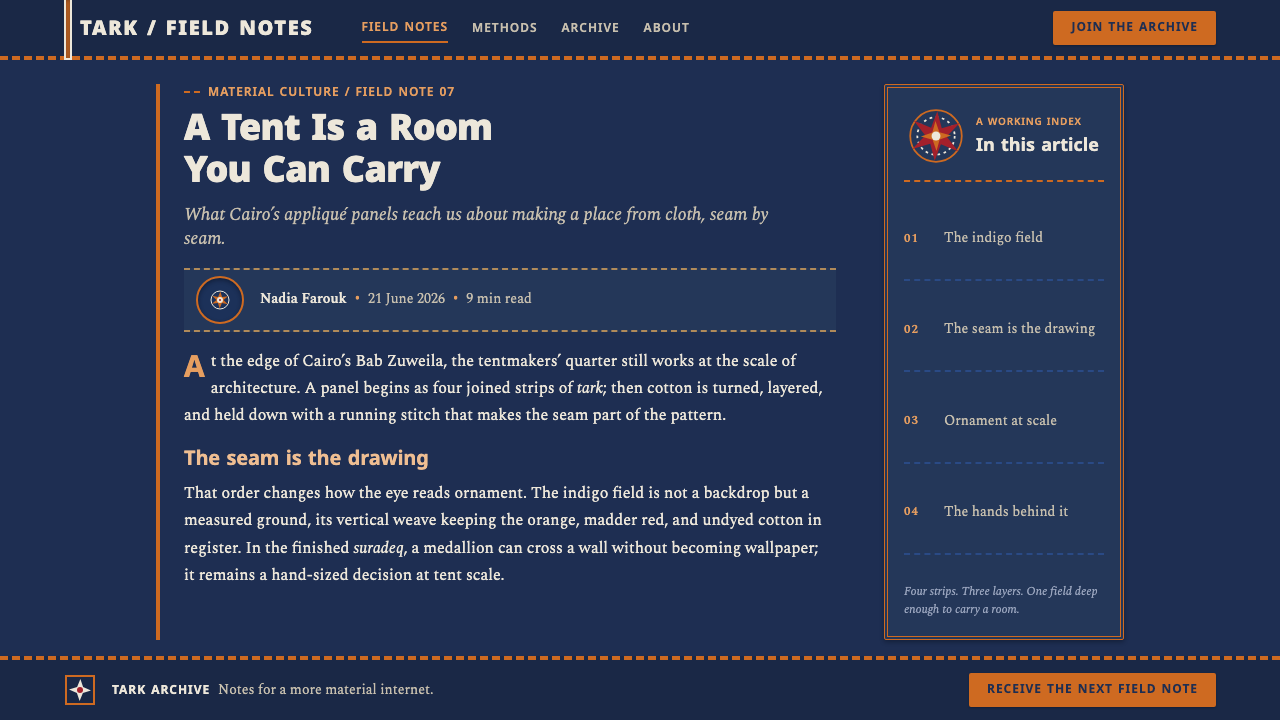
The base cloth, tark, is itself a visible construction: four hand-woven strips of linen or hemp joined edge to edge, leaving a seam down the center of every panel. Appliqué shapes are needle-turned — their raw edges tucked under before stitching — so every outline is a slightly irregular hand-drawn curve rather than a mechanically clean one. Authentic work keeps this irregularity; smoothing it into a perfect vector line erases the evidence of the hand that made it.
Motif Vocabulary
Three overlapping vocabularies supply the motifs: Islamic geometric ornament and arabesque vine-work (eight-pointed stars, interlocking polygons, scrolling foliage), a Pharaonic-revival strand drawing on ancient Egyptian imagery, and a folkloric-illustration tradition that renders narrative scenes — boats, camels, everyday life — with the same appliqué technique. A given panel usually commits to one register rather than mixing all three at once.
Border and Framing
Composition is organized as medallion plus concentric border, echoing the logic of a carpet or a dome rather than a poster. Borders repeat a single motif at length, framing the central field the way an architectural cornice frames a room, and multiple border bands often stack around one medallion — an outer geometric band, an inner floral one — before the eye reaches the central form.
Material Honesty
Nothing in authentic khayamiya pretends to be something it is not: cotton reads as cut cotton, the center seam of the tark stays visible, and stitching lines are not disguised. This is a craft built from what a cutting table and a needle can actually do, and a design system drawn from it should keep that same directness — flat cut shapes, no gradient shading, no simulated fabric texture standing in for the real irregularity of hand work.
Who shaped Khayamiya Tentmaker Appliqué?
Radwan Bey is the historical figure whose name attaches to the Qasaba of Radwan Bey, the covered market corridor near Bab Zuweila that has housed Cairo's tentmakers for generations. The street's identity as a dedicated commercial thoroughfare — rather than a general market — is bound up with his name, and it is this qasaba, not any single workshop, that gave the khayamiya trade its lasting physical home in the old city.
Sam Bowker is among the researchers whose work has documented khayamiya for audiences outside Cairo, tracing its materials, technique, and the commercial life of the souk itself. That documentation matters for a craft that survives through oral, hand-to-hand transmission in a working market rather than through pattern books, and it has helped khayamiya register internationally as a distinct tradition rather than a generic 'Middle Eastern textile'.
Hany Abd El Kader is one of the working tentmakers continuing the khayamiya trade in the souk today, designing and hand-stitching panels within the same medallion-and-border grammar that has organized the craft since the Khedival period. His work represents the tradition's living, commercial present rather than its historical record — panels still made to be hung, still made to order, still made for use.
Ahmed Naguib works within the same souk trade as a contemporary tentmaker, part of the generation keeping khayamiya a living commercial craft rather than a museum-only survival. His presence in the tradition's record underlines that khayamiya is not a closed historical style but an active practice, still capable of producing new panels within its established grammar of medallion, border, and dated palette.
How do you use Khayamiya Tentmaker Appliqué today?
Khayamiya translates most naturally into work that needs to feel ceremonial, generous, and hand-made rather than corporate or minimal — cultural programming, hospitality branding, or any product that wants to signal craft heritage rather than technological efficiency. What matters in transferring the style is understanding that its power comes from scale and construction, not merely from an indigo-and-orange color swap.
For presentation slides, a cover works best when it borrows the medallion-and-border logic directly: a single large geometric form — an eight-pointed star or a scalloped medallion outline — anchored in the field, with a wide border-like frame running along one or two edges. Content slides should avoid crowding; khayamiya panels rarely fill every inch with pattern, they let large fields of solid indigo breathe around the motif, so a slide with one strong geometric anchor and generous plain ground will read more authentically than one packed with ornament.
In web interfaces, the style suits hospitality, cultural, and heritage-brand contexts — event pages, festival microsites, or premium hospitality dashboards — where a deep indigo ground, orange accent buttons, and border-like dividers between sections can stand in for the suradeq's concentric framing. Cards and panels should use flat, hard-edged shapes rather than soft shadows, and any decorative border treatment should run as a repeating strip rather than a single ornamental flourish, echoing the walkable border logic of the source craft.
For editorial and marketing use, the style rewards generous scale: a single feature image or headline treated as a 'medallion' — centered, bordered, given room — communicates the tradition's logic better than scattering small motifs across a page. Marketing materials for cultural events, travel, or craft-focused products can use the indigo field as a dominant background with orange reserved strictly for a call to action or a single accent element, keeping the historical restraint of the three-color-then-four-color palette intact.
A common mistake is treating khayamiya as a generic 'Middle Eastern' pattern fill — dropping arabesque-looking shapes onto any warm palette without respecting the indigo-ground, dated-accent-color logic, or the medallion-plus-border composition. Equally common is over-cleaning the linework: sanding hand-cut, needle-turned edges into perfectly smooth vector curves removes the exact quality — visible handwork — that makes the source material distinctive.
Khayamiya Tentmaker Appliqué — FAQ
Is khayamiya the same as other Islamic geometric textile traditions?
It overlaps with them but is defined by a specific construction, not just a motif set. Khayamiya's identity comes from appliqué — cut cotton shapes needle-turned and hand-stitched onto a four-strip tark canvas — built at a scale meant to line a ceremonial tent. Other Islamic textile traditions may use similar geometric vocabulary through weaving, embroidery, or printing, but khayamiya is specifically a cut-and-sew craft tied to one street and one purpose: the suradeq.
Why does color range indicate a panel's age?
Because the palette was constrained by what dyes were actually available, not by taste. Before the 1920s, tentmakers worked only with white cotton, indigo, and madder red — a technical limitation, not a stylistic one. Orange, purple, and tan became available afterward. A panel that uses only the earlier three colors is consistent with pre-1920s material conditions, while orange signals the later palette, which is why color range functions almost like a date stamp for the tradition.
What is a suradeq, and why does it matter for the design?
A suradeq is the large ceremonial tent erected for weddings, funerals, religious festivals, or state occasions, and khayamiya panels are its interior lining. Because the panels have to hold visual authority inside a crowded, temporary structure rather than a quiet gallery wall, everything about the design — the size of the central medallion, the length of the borders — is scaled for a room full of people, not a framed picture. Any application of the style should preserve that logic of scale rather than shrinking motifs to poster or icon size.
Does khayamiya always use narrative imagery, like boats or camels?
No — narrative folkloric scenes are one strand among several, not the default. Most khayamiya work is purely geometric or arabesque: medallions, stars, and vine-work with no figurative content at all. Folkloric-illustration panels, depicting boats, camels, or everyday scenes, form a separate register within the tradition, usually kept distinct from the geometric panels rather than mixed into the same field.
Is this style limited to Middle Eastern or Islamic-heritage products?
It travels well beyond that context as long as the underlying logic — dated, restrained color; monumental medallion-and-border scale; visible hand construction — is respected rather than reduced to a surface color swap. It works particularly well for anything positioning itself around craft, heritage, hospitality, or ceremony, regardless of geographic branding, but it will read as costume rather than craft if applied only as an indigo-and-orange skin over an otherwise generic layout.
Related design styles
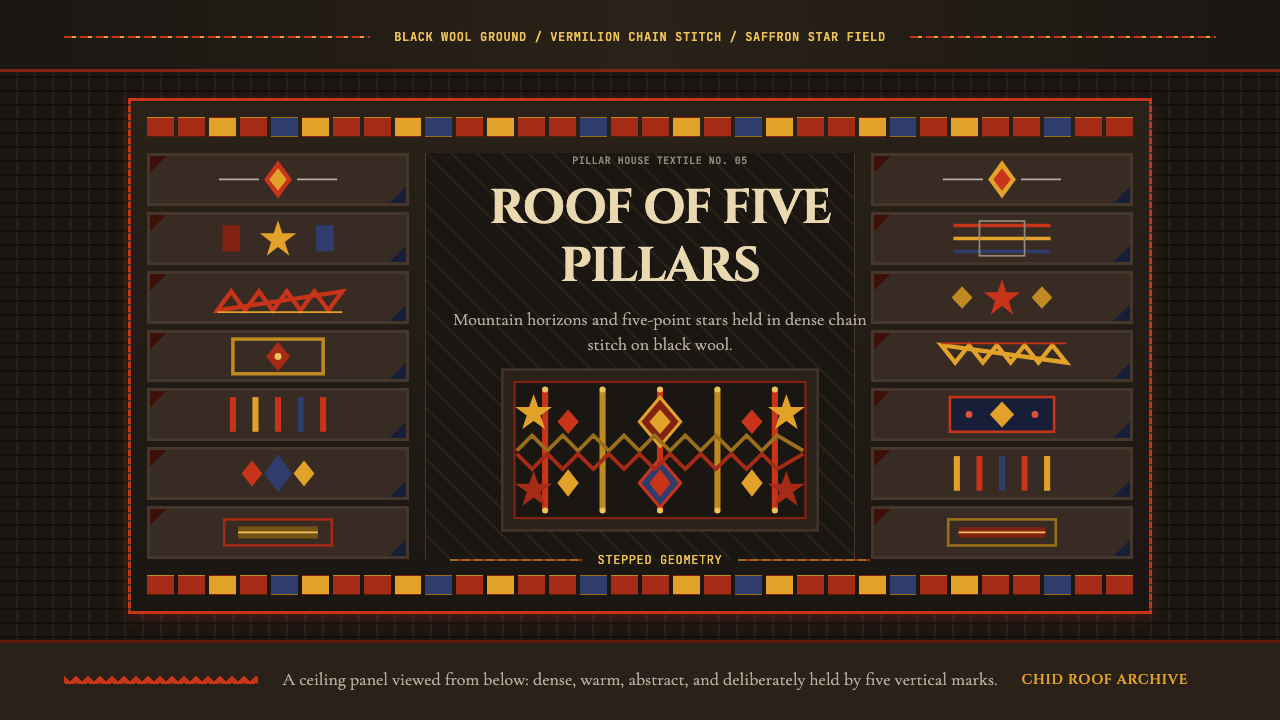 Tajik Pamir Needlework (Chid Roof)Cosmos stitched into wool. Vermilion diamonds and saffron stars hold a five-p…
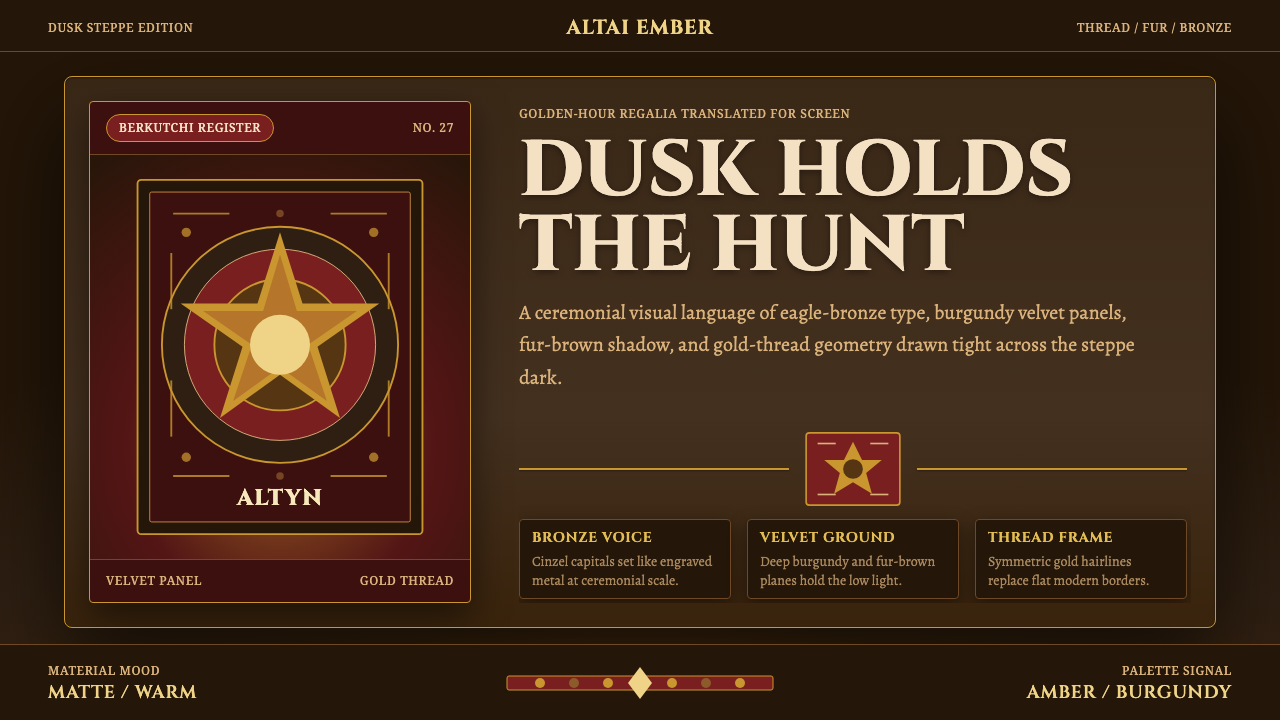 Kazakh Eagle HunterGolden hour feels handmade. Burgundy velvet, bronze type, and gold-thread bor…
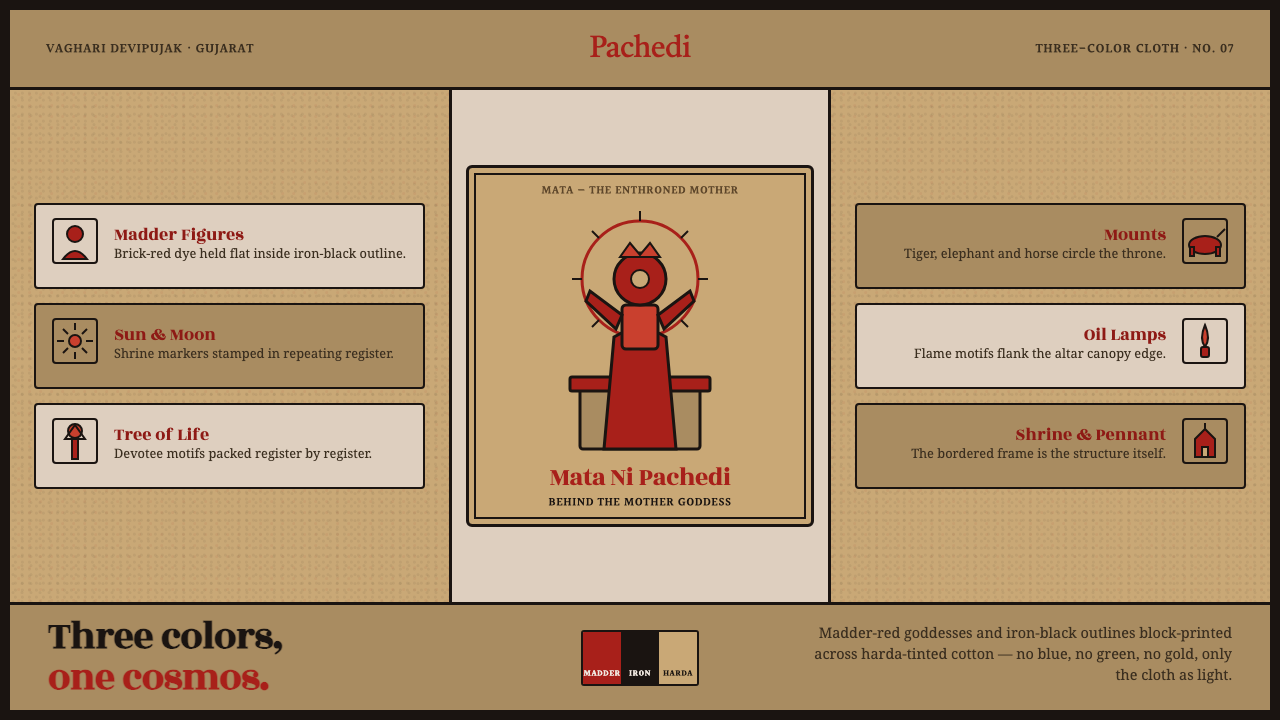 Mata Ni Pachedi Temple ClothThree colors, one cosmos. Madder-red goddesses, iron-black outlines, harda-ti…
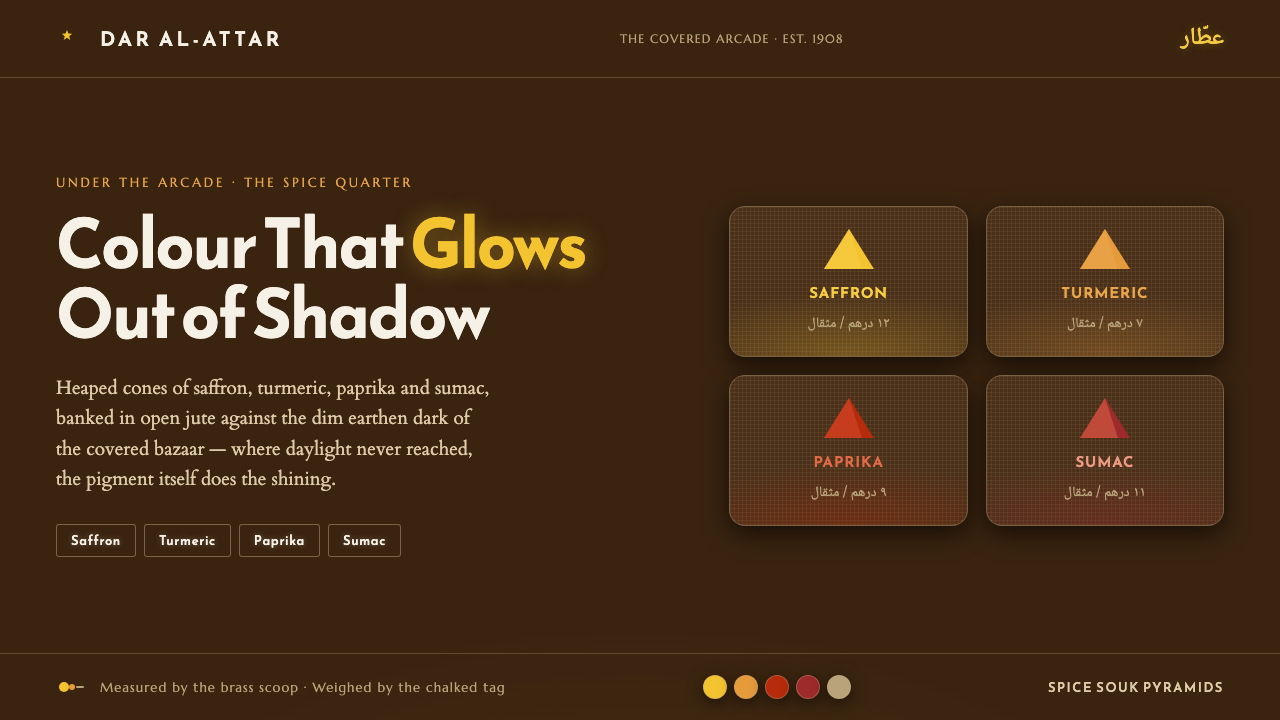 Spice Souk Market PyramidsColour glows out of shadow. Saffron-paprika-sumac heaps on dim earthen brown,…
 Thai Teak Canal HouseAged oiled teak, never fresh-sawn. Deep umber planks raised over the klong, l…
 Gaucho LeatherHand-worked horseman craft. Dark recado leather, harness tan, coin-silver ras…