What is Sanjhi Paper-Stencil Mathura?
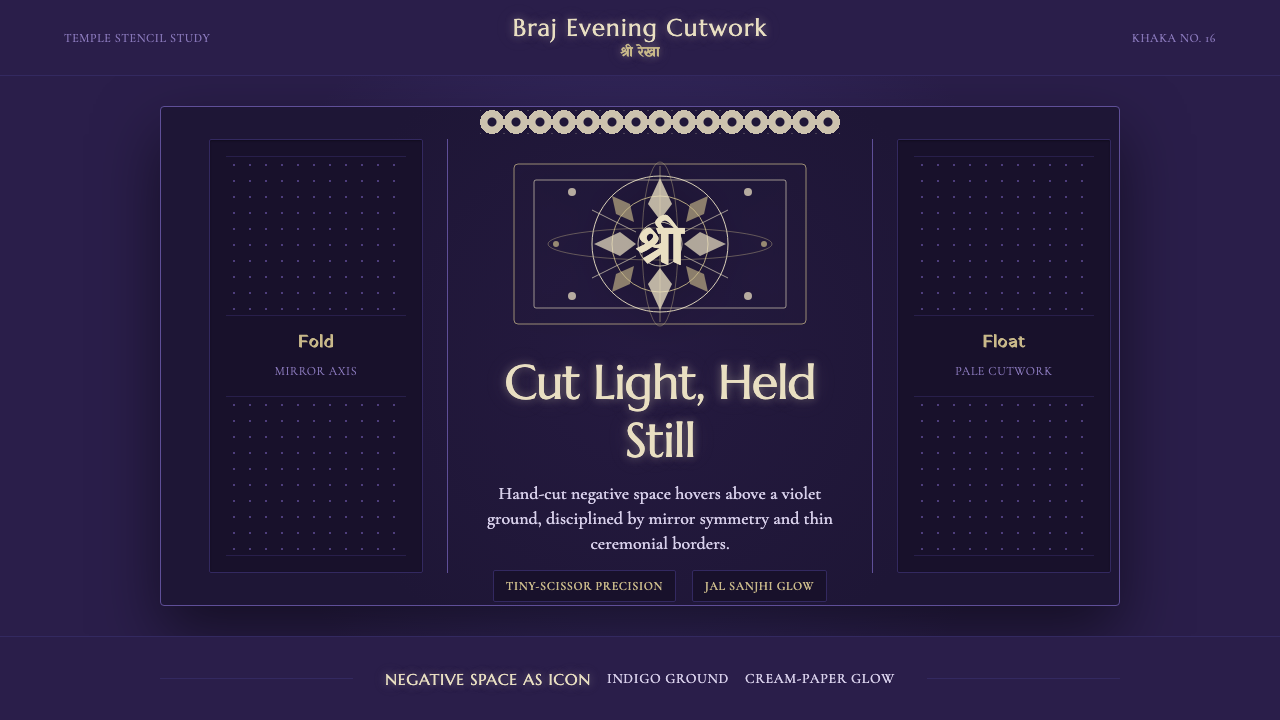
Sanjhi turns paper into an act of devotion: pale, cut-through filigree held in luminous tension against an enveloping indigo-violet dark.
Sanjhi Paper-Stencil Mathura in brief
Sanjhi is the ritual paper-cutting tradition of Braj, devoted to Krishna and associated especially with the Vaishnava temples of Mathura and Vrindavan. Its defining object is the khaka: an exceptionally fine stencil cut freehand with tiny custom scissors. Krishna, lotus blooms, peacocks, cows, and scenes from the Raas Leela recur not as decorative inventory but as a devotional visual language.
The finished work is built through absence. The paper that has been removed becomes the image, leaving a lace-like field of openings, bridges, petals, bodies, and ornament. This negative-space construction gives Sanjhi its unusual visual force: the stencil reads as both a fragile sheet of paper and a complete image held together by extraordinary control.
Placed over water or mounted against a dark ground, pale cutwork seems to detach from its support and glow. The contrast is reverent rather than theatrical. Deep indigo-violet creates a quiet, recessive field; the khaka appears as a suspended offering, where symmetry, restraint, and patient handwork transform an ordinary material into a devotional icon.
Where does Sanjhi Paper-Stencil Mathura come from?
Sanjhi reached its height in the Vaishnava temples of Mathura and Vrindavan during the 15th and 16th centuries, within the Krishna devotional culture of Braj. Its visual world is inseparable from bhakti: image-making is directed toward reverence, remembrance, and ritual encounter rather than toward autonomous display.
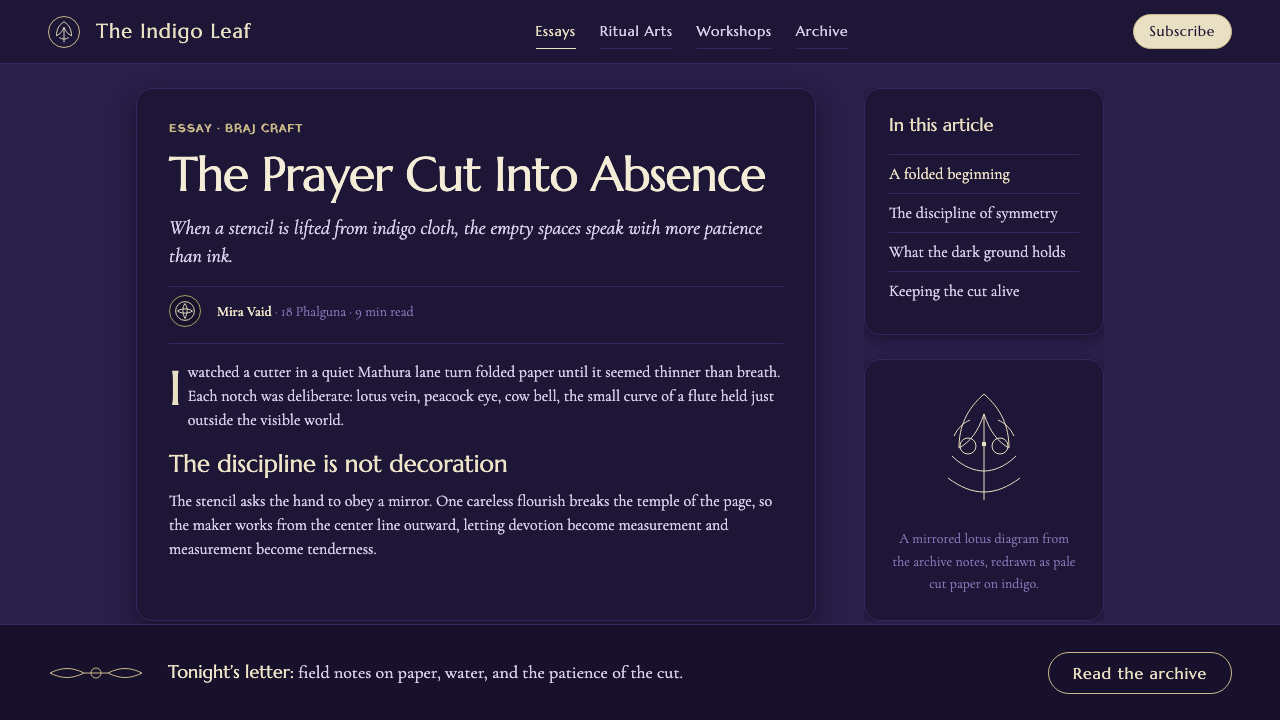
The tradition is rooted in khaka cutting. Master cutters use tiny custom scissors to draw with removal, shaping a continuous paper structure by hand instead of assembling separate motifs afterward. Bilateral symmetry is central to this discipline. It gives the image ceremonial order while making every cut dependent on the survival of its neighboring bridges.
Jal Sanjhi, the water-floating tradition, reveals why negative space matters so much to the form. When the stencil meets water, its apertures and pale edges become the active image. The work is not merely viewed as a flat illustration; it is experienced through delicacy, reflection, and the shifting distinction between surface and void.
Sanjhi remains a living, GI-tagged craft practiced continuously into the present. Its continuity does not depend on abandoning ritual specificity. Mathura temple artisans, Vrindavan master cutters, and Vaishnava khaka craftsmen sustain a tradition whose authority comes from repeated hand practice, inherited devotional subjects, and the exacting demands of paper itself.
What defines the Sanjhi Paper-Stencil Mathura look?
Dark Ground and Pale Filigree
A deep indigo-violet ground creates the visual silence around the work. Pale khaka cutwork rises from it with a restrained glow, so contrast feels devotional and atmospheric rather than graphic or aggressive.
Negative Space
The removed paper is not background loss but the primary image. Openings describe lotus petals, animal forms, figures, and narrative scenes, while the remaining paper acts as the delicate structure that allows the image to exist.
Bilateral Symmetry
Sanjhi relies on highly controlled bilateral symmetry. Mirrored movement gives flowers, creatures, and devotional scenes a centered calm, while tiny variations in cutting keep the result visibly handmade rather than mechanically repeated.
Fine Connected Structure
The visual density comes from narrow bridges that connect every opening to the larger sheet. These links are structural necessities, yet they also create the lace-like rhythm that makes the paper appear improbably light and intricate.
Devotional Motifs
Krishna, lotus blooms, peacocks, cows, and Raas Leela scenes organize the imagery. Their role is not ornamental variety; each motif locates the work inside Krishna bhakti visual culture and gives the composition ritual purpose.
Water and Suspension
In Jal Sanjhi, the water-floating setting heightens the sense that the stencil is an offering rather than an object. In contemporary dark-ground applications, that same quality can be suggested through generous emptiness and the impression that pale cutwork has barely settled.

Who shaped Sanjhi Paper-Stencil Mathura?
Vrindavan master cutters represent the hand discipline at the center of Sanjhi. Their practice joins freehand cutting, bilateral symmetry, and Krishna devotional imagery, demonstrating that technical precision in this tradition is inseparable from ritual attention.
Mathura temple artisans locate Sanjhi within a living temple setting rather than a detached decorative category. Their work preserves the relationship between the paper stencil, Krishna devotion, and the visual customs of Braj.
Vaishnava khaka craftsmen sustain the stencil as both an image and a demanding material construction. Their craft depends on knowing how much paper can be removed, which bridges must remain, and how devotional motifs can survive as coherent filigree.
How do you use Sanjhi Paper-Stencil Mathura today?
For presentation covers, Sanjhi works best when the page feels like a dark shrine for a single pale cut-paper form. Let a lotus, peacock, or symmetrical khaka occupy a quiet field, and keep the title secondary to the impression of suspended devotion. Content slides should preserve this hierarchy with calm text areas and restrained framing rather than filling every surface with pattern.
Data slides can borrow Sanjhi's distinction between void and structure. Treat information as pale, clearly separated marks on a dark field, and let supporting lines behave like the bridges in a stencil: necessary, fine, and never more prominent than the information they hold. Avoid turning charts into literal decorative cutouts when legibility needs to lead.
For web interfaces, the style suits immersive cultural pages, collection views, and carefully paced dashboards. A dark interface can use pale filigree as a framing device around key content, while navigation and controls remain quiet and direct. In pricing or comparison contexts, reserve the most elaborate imagery for a featured state or threshold, so the ritual atmosphere does not obscure decisions.
Editorial and marketing work benefits from Sanjhi's sense of revelation. Begin sections with a cropped stencil edge, a reflective dark field, or a motif that gradually gives way to reading space. Campaign pages can use Krishna-related imagery only where it remains faithful to the supplied cultural context; the style is strongest when it communicates reverence rather than treating sacred symbols as generic luxury decoration.
The common mistake is to imitate Sanjhi with ornamental lace patterns while ignoring the logic of cutting. Authentic-looking work depends on visible negative space, connected paper bridges, bilateral order, and restraint. Overloading a dark surface with unrelated flourishes, glowing effects, or broken fragments loses the fragile structural calm that gives the tradition its force.
Sanjhi Paper-Stencil Mathura — FAQ
What is a khaka in Sanjhi?
A khaka is the finely cut paper stencil at the center of Sanjhi practice. It is made freehand with tiny custom scissors and relies on connected areas of remaining paper to hold a complex image together. Its openings form the visible motif, so the stencil functions through negative space as much as through the paper that remains.
Why is bilateral symmetry so important to Sanjhi?
Bilateral symmetry gives Sanjhi its ceremonial calm and technical discipline. It organizes intricate devotional subjects into a balanced whole while demanding that the cutter maintain fragile structural connections on both sides. The result feels ordered without becoming impersonal, because it is still cut freehand.
What is Jal Sanjhi?
Jal Sanjhi is the water-floating tradition within Sanjhi. Setting the cut stencil over water intensifies its negative-space character, allowing pale edges and openings to appear especially light, reflective, and temporary. The water setting reinforces the work's ritual quality and its sense of humble material transformed through devotion.
Can Sanjhi be used as a general decorative pattern?
It can inform visual composition, but it should not be reduced to generic ornament. Sanjhi belongs to a Krishna devotional tradition and derives its character from ritual imagery, negative-space cutting, symmetry, and structural restraint. A respectful contemporary use preserves those relationships instead of borrowing only a lace-like surface appearance.
Related design styles
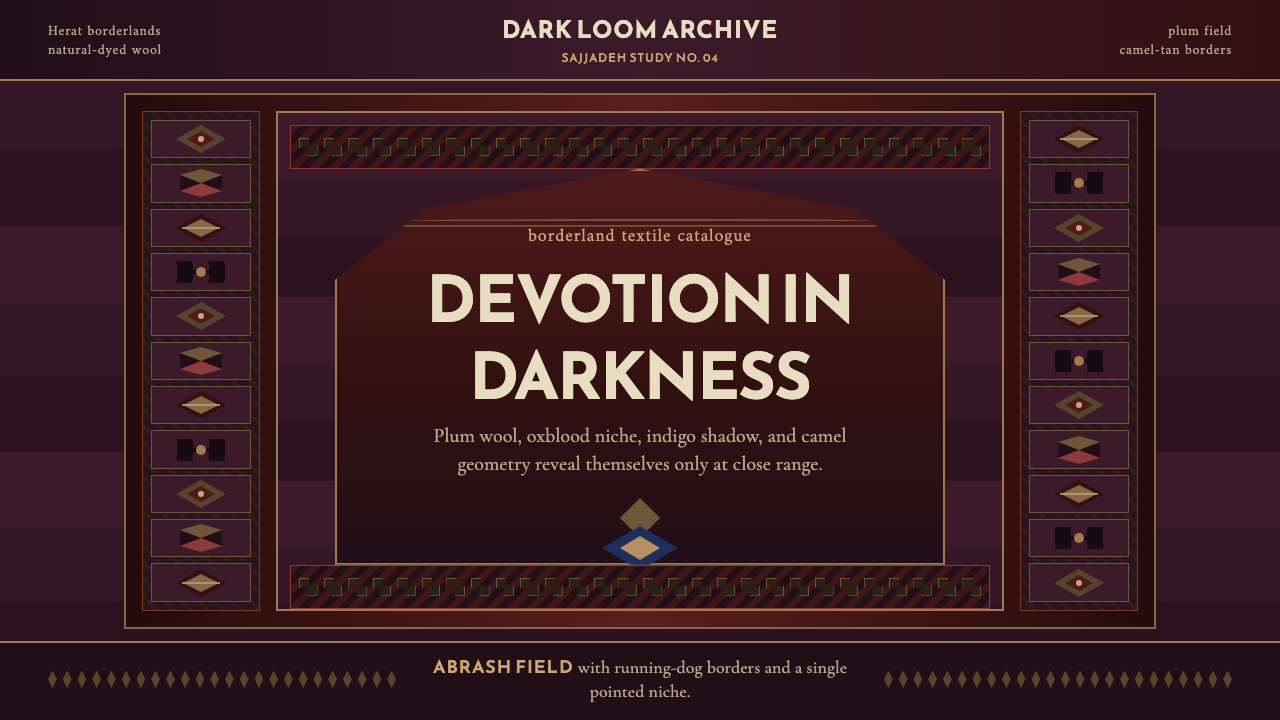 Afghan Baluchi Prayer RugDevotional darkness glows. Plum field, oxblood mihrab, and camel borders surf…
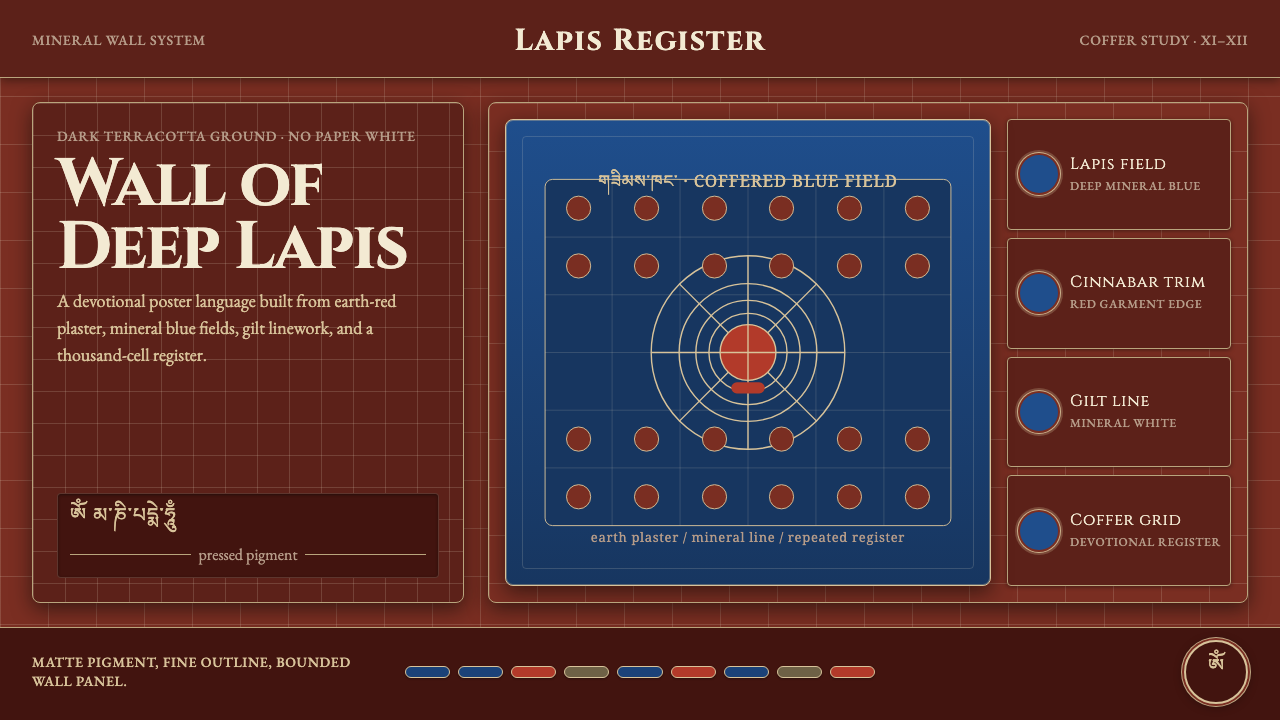 Alchi Monastery MuralDevotional depth. Lapis fields and coffered grids glow on terracotta plaster.
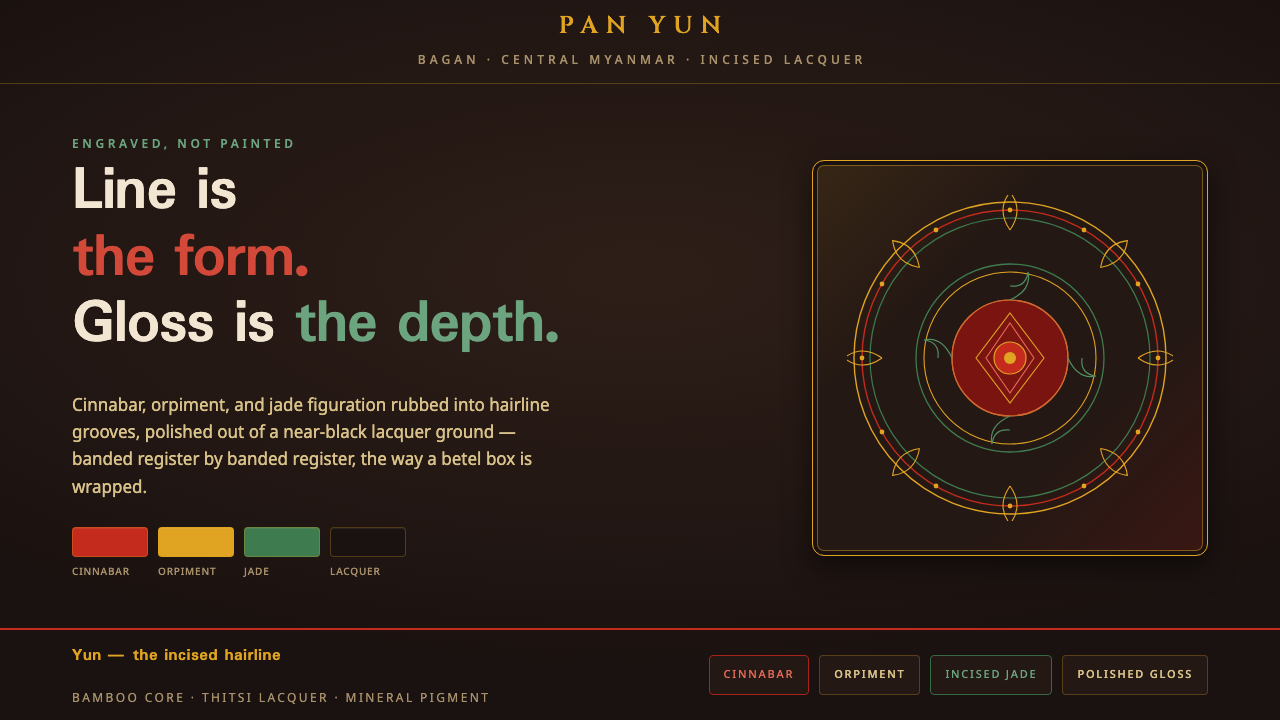 Bagan Yun LacquerwareEngraved, not painted. Cinnabar, orpiment and jade hairlines polished from ne…
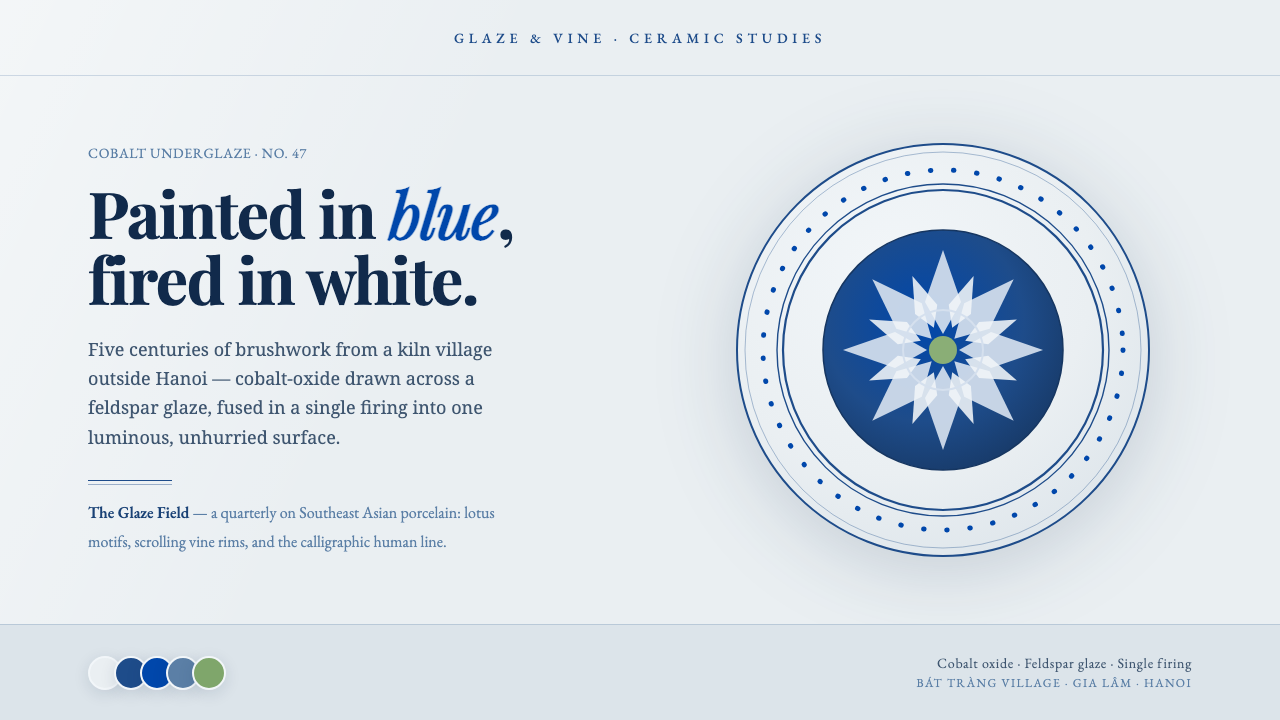 Bát Tràng Ceramic BlueCobalt brushed on glaze white. Muted underglaze blue, double-line plate rims,…
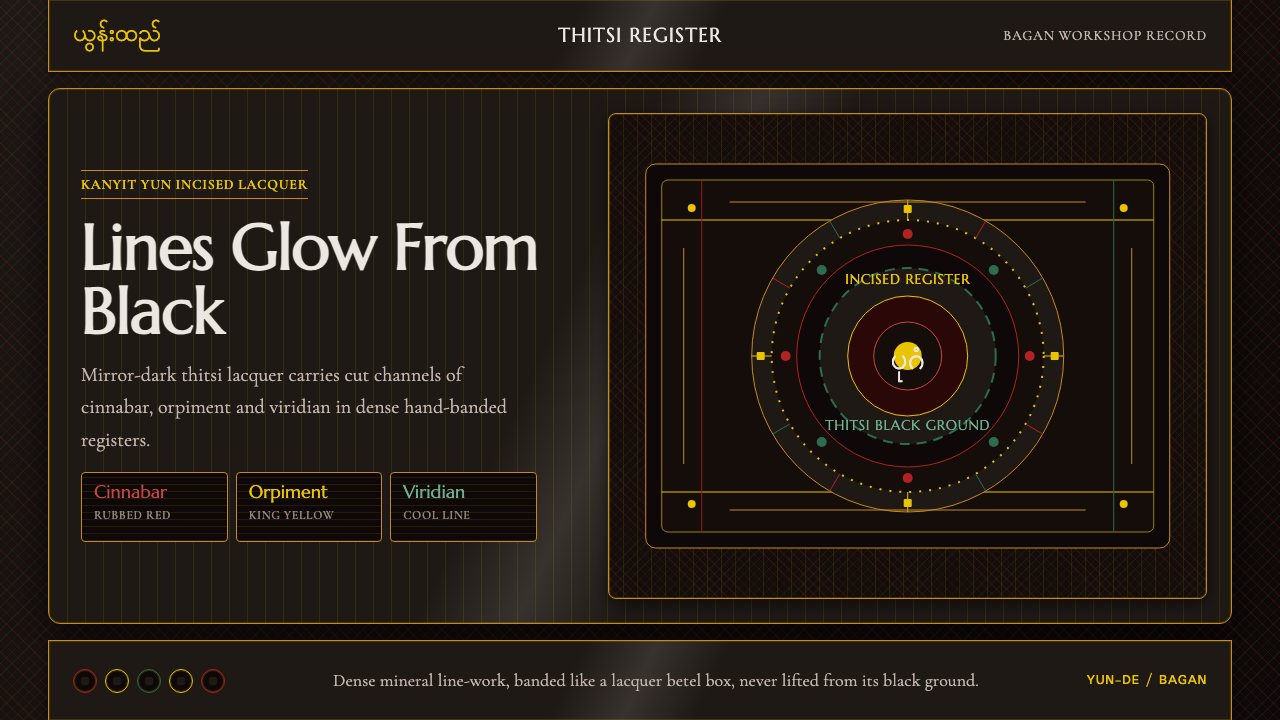 Burmese Yun LacquerwareLacquer glows in cut lines. Cinnabar, orpiment and viridian band a mirror-bla…
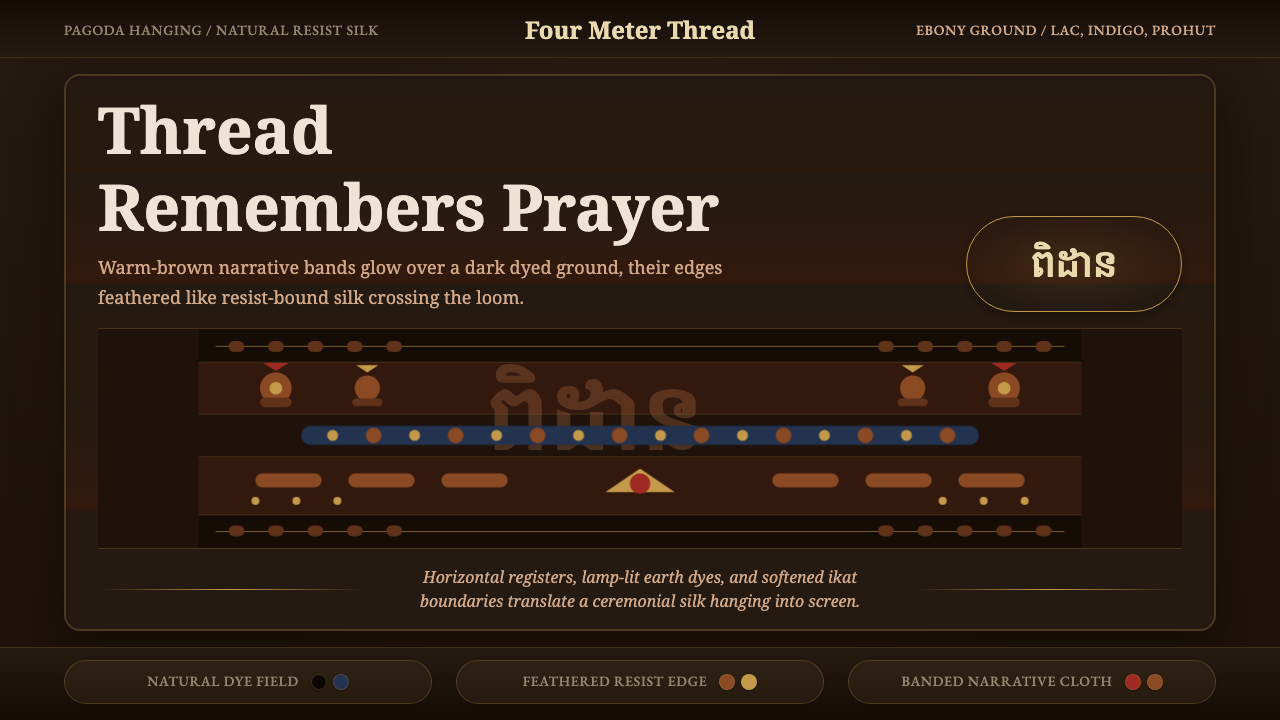 Cambodian Pidan IkatSacred cloth glows. Ebony-indigo bands carry warm-brown ikat figures with fea…