What is Samoan ʻIe Tōga Fine Mat?
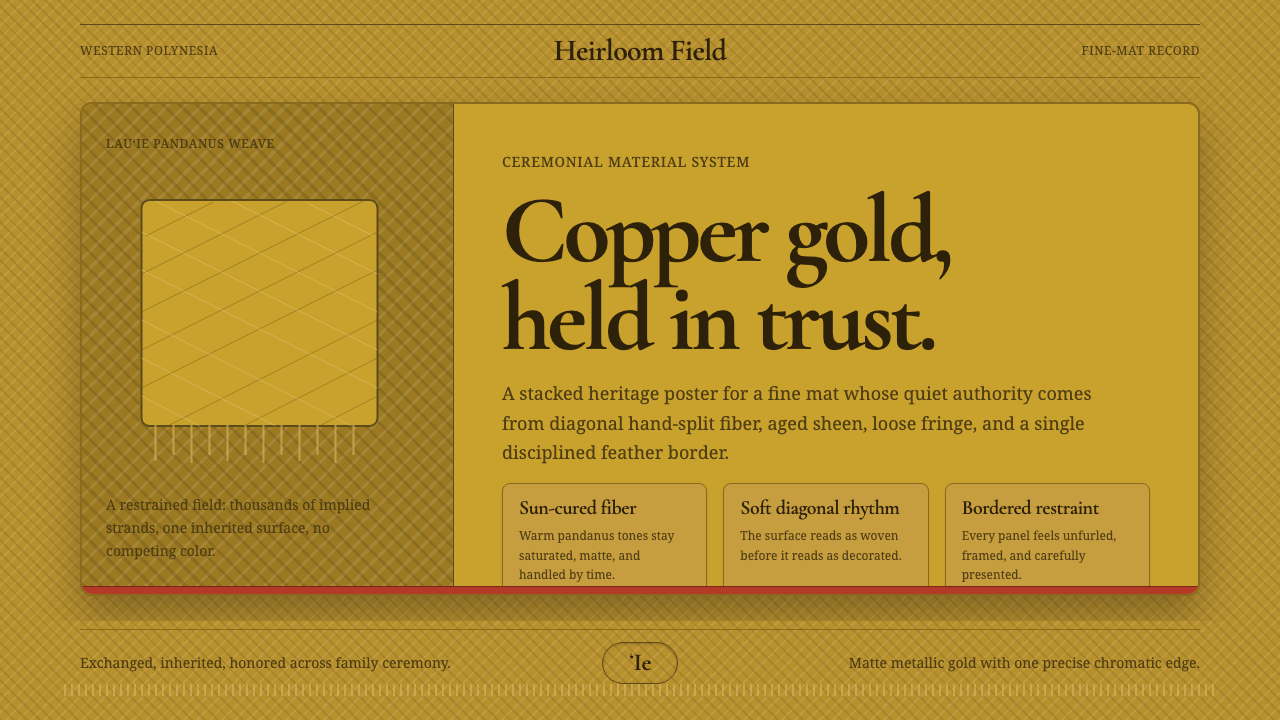
Samoan ʻie tōga turns ceremony into surface: copper-gold weave, loose fringe, and one red feather line carrying the weight of inheritance.
Samoan ʻIe Tōga Fine Mat in brief
The ʻie tōga is Samoa’s supreme ceremonial treasure: a finely woven mat made from exceptionally delicate lauʻie pandanus fiber. The leaves are stripped, boiled, sun-cured, and split into strands finer than raffia before weaving begins. Its value is inseparable from handling and history. As a mat is carefully kept, exchanged, inherited, and honored through generations, its naturally bleached fiber develops a deeper shiny copper-golden character.
Rather than treating the surface as a place for illustration, the ʻie tōga derives its visual power from construction. Thousands of hand-split strands form a disciplined diagonal over-under weave. The repeated rhythm is dense but not busy: it reads as one continuous field, where labor, material, and pattern cannot be separated from one another.
Its visual language is restrained with unusual precision. A broad field of matte metallic gold is bordered by an unwoven fringe, then interrupted by a single strip of red Collared-Lory, or sega, feathers. The feather line is not an all-over decoration. It acts as punctuation: one concentrated note of color that gives the surrounding woven field greater quietness and ceremonial presence.
Where does Samoan ʻIe Tōga Fine Mat come from?
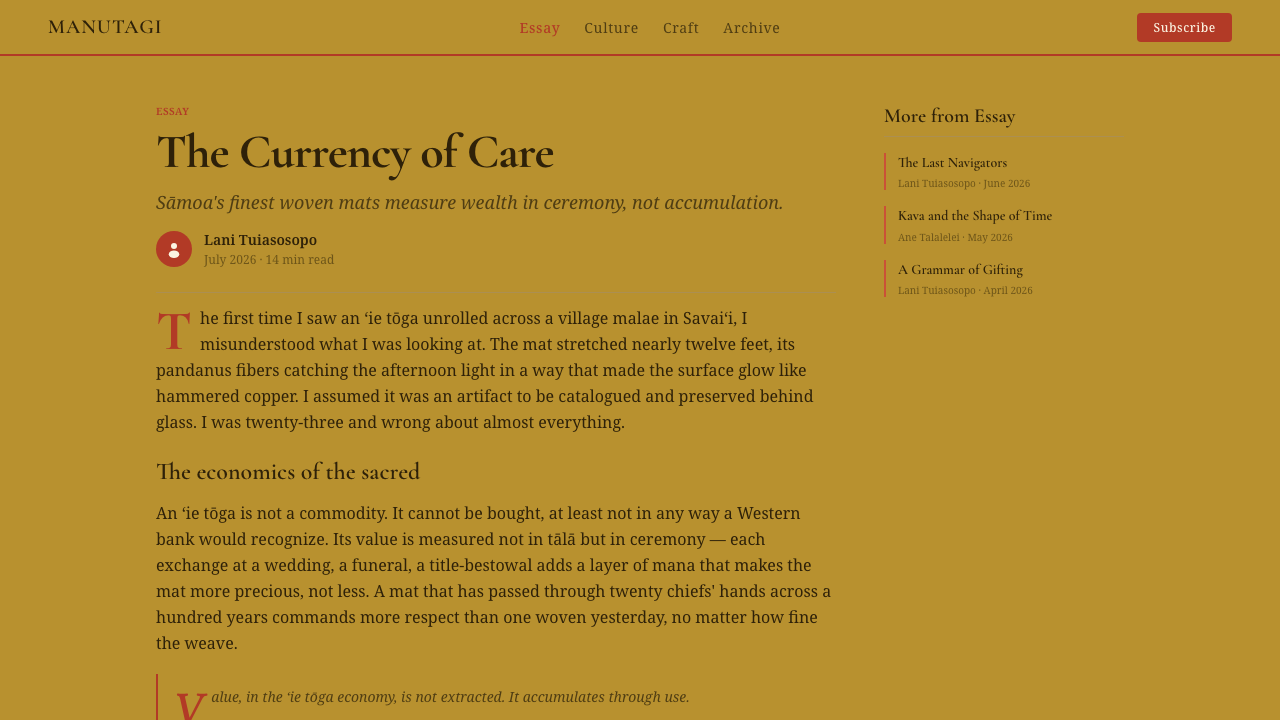
The ʻie tōga belongs to Samoa in western Polynesia, within Oceania, and its documented design context spans 1900 to 1950 while remaining a living tradition with older heirloom roots. It should therefore be understood not as a closed historical style, but as a ceremonial practice whose visual authority comes from continuity, care, and exchange.
Its making begins with lauʻie pandanus. The material is stripped, boiled, dried in the sun, and divided into extremely fine strands. This preparation determines the finished surface: the weave has the close, disciplined character of a structure assembled from countless narrow lines rather than from broad decorative bands.
Master ʻie tōga weavers and tuʻufaʻatasi lineage keepers sustain the weaving knowledge. Their role is not merely to produce an attractive object. They carry forward the material process, the refined weave, and the careful treatment required for a mat to retain its value and develop its coppery-golden sheen through time.
The mat’s ceremonial life is tied to faʻafalavelave, the family events at which fine mats are commissioned and exchanged. Family matai, or chiefly title holders, participate in this social economy through commissioning and exchange. The red feather strip, fringe, and fine woven field therefore belong to an object whose appearance is inseparable from kinship, honor, and the movement of treasured goods between generations.
What defines the Samoan ʻIe Tōga Fine Mat look?
Copper-Gold Field
The dominant impression is a naturally bleached, coppery-golden surface with a subdued metallic sheen. It should feel warm, aged, and materially honest rather than glossy or polished. The field is visually broad and uninterrupted, allowing the weave itself to carry the composition.
Diagonal Weave
The core geometry is a diagonal over-under weave made from thousands of fine hand-split strands. The pattern is repetitive but never mechanical in feeling. Its density suggests patience and accumulated handwork, while its diagonal direction gives the surface quiet movement.
Loose Fringe
The unwoven fringe creates a deliberate transition between finished structure and free fiber. It softens the perimeter without becoming decorative excess. Against the exactness of the woven center, the fringe introduces breath, tactility, and evidence of the material’s original strand-like nature.
Single Red Accent
A strip of red sega feathers is the mat’s sole chromatic punctuation. Its force depends on rarity: red is concentrated into one narrow ceremonial signal against the copper-gold ground. Introducing many competing accents would erase the restraint that makes the feather line meaningful.
Matte Sheen
The material may catch light, but it should do so with depth rather than sparkle. The desired effect is the sheen of carefully handled natural fiber, not a synthetic metallic finish. Variation comes from weave direction, age, and fiber surface rather than from artificial tonal effects.
Ceremonial Restraint
Every visible element has a clear role: the woven field establishes continuity, the fringe marks the edge, and the feather line provides emphasis. The style does not seek abundance through accumulation. Its richness comes from fine material, disciplined repetition, and the cultural weight of an object made to be exchanged and inherited.
Who shaped Samoan ʻIe Tōga Fine Mat?
Master ʻie tōga weavers are responsible for the demanding craft of transforming prepared lauʻie fiber into a fine ceremonial mat. Their work brings together the hand-split strands, the diagonal weave, the fringe, and the carefully controlled overall surface.
Tuʻufaʻatasi lineage keepers preserve the continuity of fine-mat weaving knowledge. Their importance lies in sustaining a practice whose value depends not only on appearance, but also on careful handling, inherited knowledge, and ceremonial recognition across generations.
Family matai, the holders of chiefly titles, commission and exchange mats within ceremonial life. Their participation connects the ʻie tōga to faʻafalavelave, where the mat functions as a treasured object of family obligation, honor, and intergenerational exchange.
How do you use Samoan ʻIe Tōga Fine Mat today?
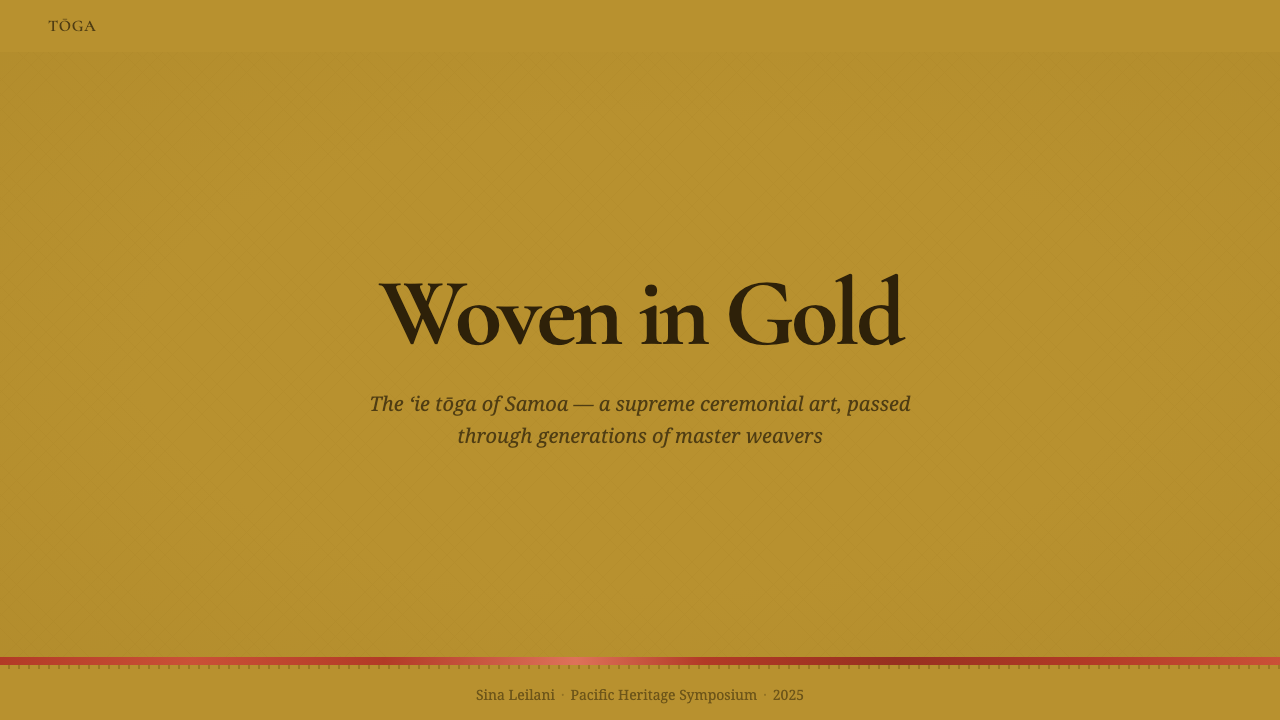
For presentation covers, borrow the composition rather than reproducing the object literally. Build a broad warm woven field, leave one edge visibly less resolved, and reserve a single red linear accent for the title area or a key divider. The cover should feel ceremonial through stillness and material rhythm, with text allowed ample open space.
For content and data slides, treat the diagonal weave as an organizing rhythm rather than as a busy background. Use subtle directional structure to group information, keep charts quiet and legible, and let one red marker identify the most important data point or section. The fringe idea can become a soft boundary between content groups without turning into a repeated ornament.
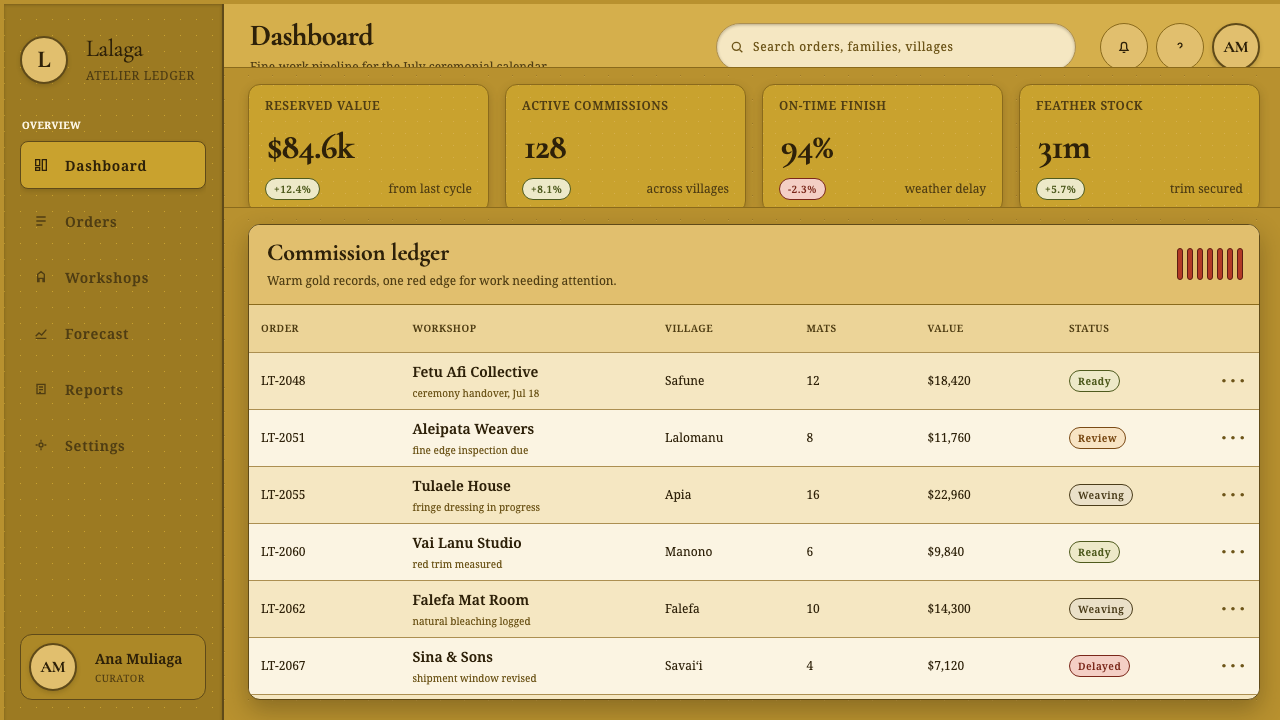
For web interfaces, this language is most useful where trust, provenance, and careful stewardship matter. A dashboard can use warm fiber-like surfaces for grouping, restrained diagonal detail for navigation or status regions, and one concentrated accent for a primary state. Pricing and membership pages can use the same hierarchy, allowing the main offer to receive the single strongest visual emphasis.
For editorial and marketing work, the style supports stories about craft, inheritance, ceremony, and material knowledge. Long-form layouts should preserve broad calm fields around the text, use close woven detail as a supporting texture, and make any red intervention rare enough to feel consequential. Photography or product imagery should remain secondary to the sense of material continuity.
The common mistake is treating the red feather line as a generic decorative stripe or treating the weave as a busy luxury pattern. The ʻie tōga’s character depends on imbalance held in restraint: one color interruption, one disciplined field, and an edge that reveals fiber rather than hiding it. If every section receives a bright accent, fringe effect, and patterned surface, the ceremonial calm disappears.
Samoan ʻIe Tōga Fine Mat — FAQ
What makes an ʻie tōga different from an ordinary woven mat?
The ʻie tōga is identified in the source material as Samoa’s supreme ceremonial treasure. Its exceptionally fine lauʻie fiber, dense hand-split weave, red sega feather strip, and role in inheritance and ceremonial exchange distinguish it from a utilitarian woven surface. Its value also deepens through careful handling and time.
Why is the red feather line used so sparingly?
The red sega feather strip is described as the mat’s only chromatic punctuation. Its visual authority comes from contrast with the otherwise continuous copper-golden field. Keeping the accent singular allows it to register as a deliberate ceremonial mark rather than as surface decoration.
Does the copper-golden color come from added pigment?
No added pigment is described in the provided material. The coppery-golden sheen develops from the natural bleaching of lauʻie fiber, deepening through age and careful handling. It is therefore a material quality connected to the mat’s life over generations, not simply a color treatment.
Can this visual language be used without copying ceremonial objects?
Yes, when the application focuses on structural lessons rather than imitation: a continuous woven rhythm, restrained material warmth, a revealed edge, and one carefully reserved accent. The important boundary is to avoid reducing the ʻie tōga to a generic pattern, because its appearance is bound to Samoan weaving, ceremonial exchange, and inheritance.
Related design styles
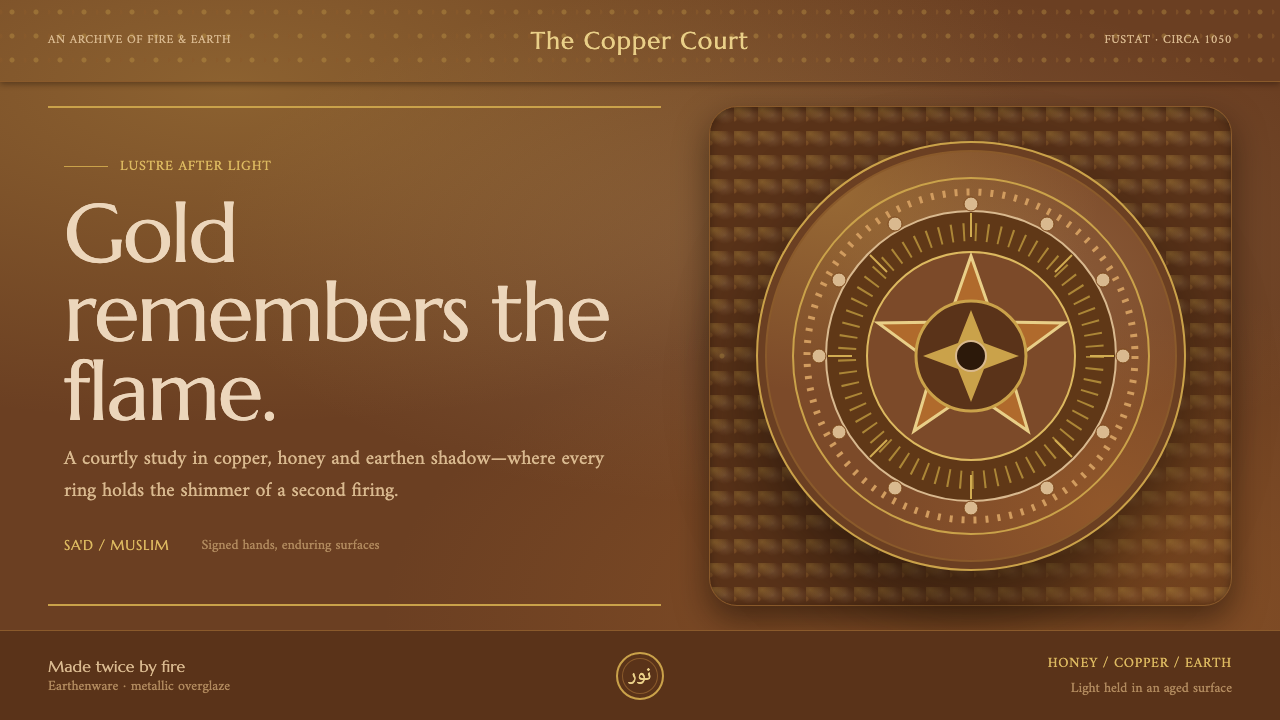 Fatimid LustrewareOpulence fired into earth. Copper-gold lustre glows through dense medallions…
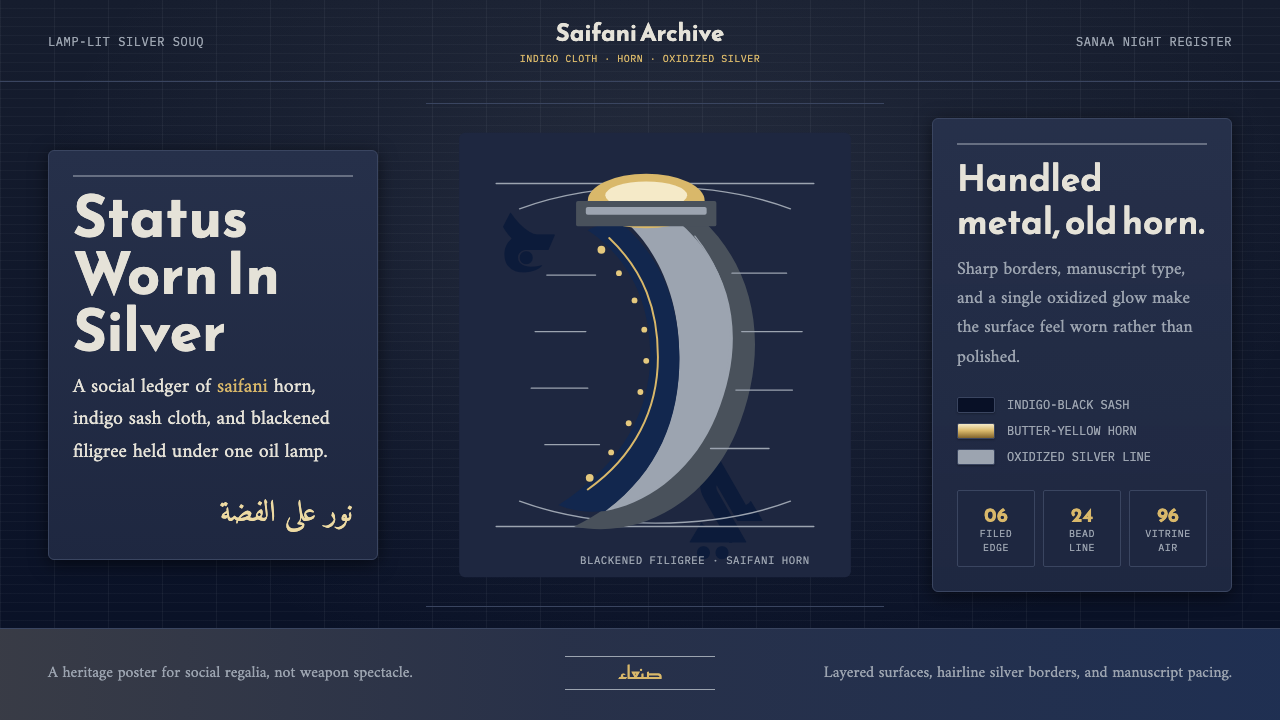 Yemeni Jambiya Curved DaggerLamp-lit status. Indigo-black fields, butter-yellow horn, and silver filigree…
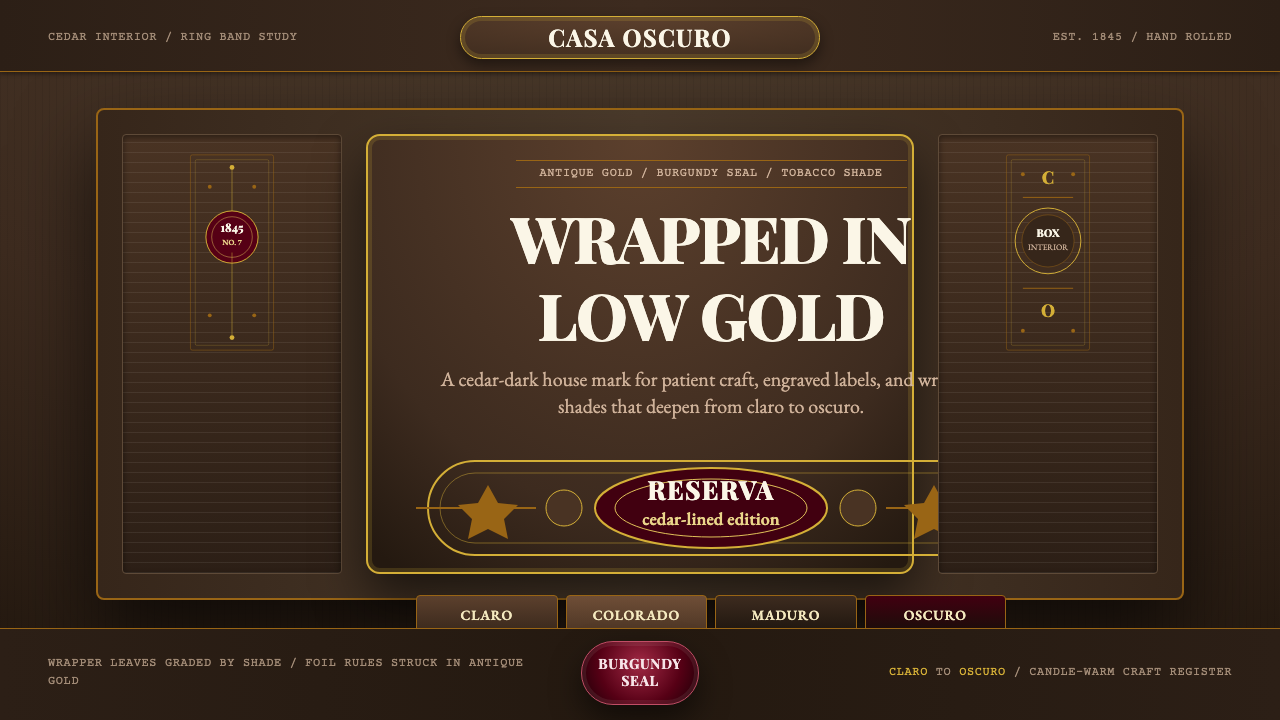 Cuban Habano CigarLuxury sleeps in shadow. Tobacco brown, antique gold rules, and burgundy seal…
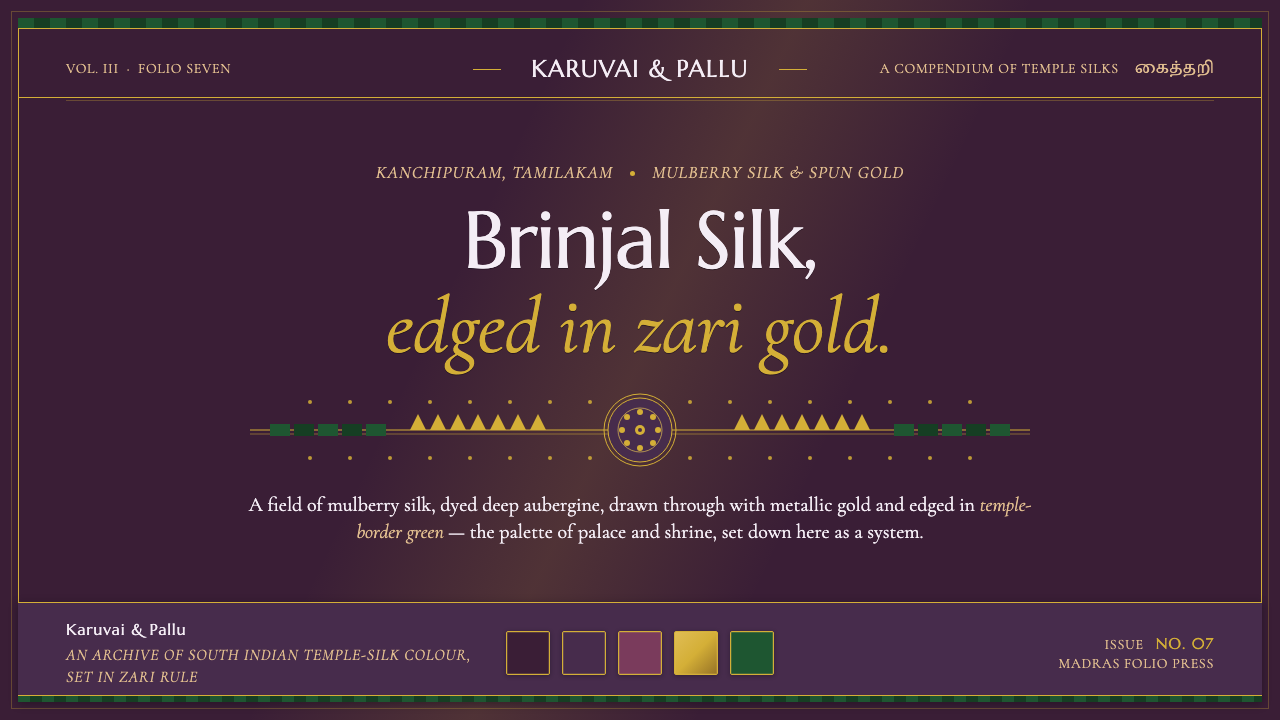 Indian Brinjal Temple TextilePalace silk, systematised. Brinjal violet ground edged in zari gold, korvai g…
 Lao Sinh Silk WeaveCeremonial Lao silk on screen. Dark aubergine ground threaded with gold mat-m…
 Māori Hei-Tiki PounamuQuiet mana in dark stone. Moss-green pounamu glows at the edge, red wax held…