What is Russian Cosmism?
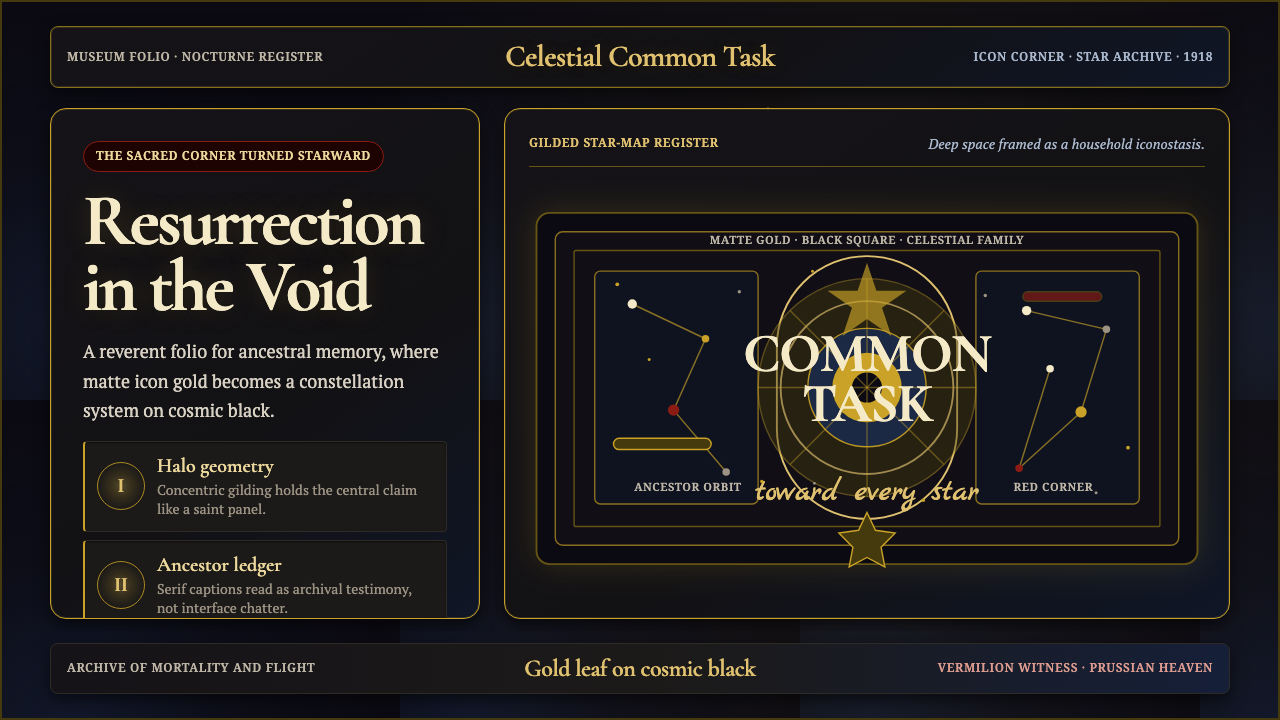
Russian Cosmism turns the screen into a sacred observatory: icon gold, star maps, and a black field that feels less empty than infinite.
Russian Cosmism in brief
Russian Cosmism is a visual interpretation of a philosophical horizon formed in Russia and Eastern Europe during the late nineteenth and early twentieth centuries. Its central emotional premise is immense: humanity must overcome death, restore its ancestors, and extend human life outward into the stars. Design derived from this idea does not present space as a neutral scientific backdrop. Space is a destination of duty, memory, and spiritual consequence.
The style joins that cosmic ambition to Eastern Orthodox iconography. Gold recalls the luminous surfaces of icons placed in the sacred corner of the home; halos, radiating discs, and concentrated points of light carry the feeling of revelation rather than ordinary decoration. A dark field gives those marks gravity. It is not merely a night-sky background, but a visual void against which light can read as sacred presence.
Suprematist black supplies the other half of the language. Associated here with Kazimir Malevich’s conception of cosmic space, it creates a severe, almost absolute ground for floating forms. Gold should lead; restrained icon red and deep cosmic blue may punctuate it. The resulting atmosphere is dense, reverent, and interstellar: an interface that behaves like an icon corner turned toward deep space.
Where does Russian Cosmism come from?
Russian Cosmism begins with Nikolai Fedorov’s late nineteenth-century conviction that humanity’s ultimate work was collective and cosmic. Death was not treated as an immutable boundary but as a challenge to be overcome; the human family was imagined as restored across generations and dispersed through the universe. This is the source of the style’s unusual emotional scale. Its stars do not signify escape, novelty, or technological spectacle alone. They signify obligation to the dead and responsibility for a future beyond Earth.
That philosophical horizon encountered the visual discipline of Eastern Orthodox iconography. Icons organize spiritual attention through luminous gold, concentrated faces or emblems, enclosing halos, and an atmosphere in which light stands for more than illumination. The sacred corner of the home is important to the theme because it gives the visual language an intimate setting: the infinite is approached through a framed, devotional object rather than through a distant scientific instrument.
Cosmism also meets Suprematism through Kazimir Malevich and the association of black with cosmic space. The black plane has a different task from conventional darkness. It removes ordinary setting, depth cues, and worldly clutter, allowing signs, circles, lines, and radiance to appear suspended beyond familiar scale. This makes abstraction feel contemplative rather than merely formal.
The named figures around this horizon—Fedorov, Konstantin Tsiolkovsky, Alexander Bogdanov, and Malevich—indicate that Cosmism belongs to a broad field where philosophy, futurity, collective human destiny, and radical visual abstraction can coexist. The style should preserve that tension. It is neither historical icon painting nor a generic space aesthetic; it is a collision between devotional light and a future-facing cosmos.
What defines the Russian Cosmism look?
Sacred Gold
Gold is the governing light. It should read as leaf, halo, constellation, or illuminated inscription against darkness, never as generic luxury trim. Its power comes from concentration: a few radiant marks can make the whole composition feel consecrated.
Cosmic Black
The dark ground is expansive and nearly absolute, drawing on the Suprematist association of black with cosmic space. It must remain calm enough for gold and text to breathe; texture, noise, and decorative darkness weaken its contemplative force.
Constellation Structure
Points, arcs, radial paths, and sparse connecting lines organize information like a star map. These marks should imply orientation and relation, not simulate a busy astronomical chart. The pattern is devotional geometry: a way to place ideas within a larger cosmos.
Iconic Radiance
Halos and radiant discs frame focal content with the visual grammar of an icon. Their role is hierarchical and contemplative: they identify what deserves attention without turning every component into a glowing effect.
Restrained Accents
Icon red and deep cosmic blue are supporting voices beside gold. Red can signal urgency, sacrifice, or a marked threshold; blue can suggest remoteness and depth. Used too broadly, either color makes the composition theatrical rather than reverent.
Dense Stillness
The style holds visual density and stillness together. A field may contain stars, rings, lines, and inscriptions, yet its rhythm should remain slow and ceremonial. Empty black is as active as ornamented gold because both shape the sense of cosmic distance.
Who shaped Russian Cosmism?
Fedorov supplies the foundational philosophical ambition of Russian Cosmism: humanity should conquer death, resurrect every ancestor, and carry the human family into the stars. In visual terms, this makes the theme ethical and eschatological rather than merely futuristic.
Tsiolkovsky is named among the central figures of the Cosmism horizon. His presence helps locate the movement at the meeting point of spaceward imagination and a larger account of humanity’s future destiny.
Bogdanov belongs to the key figure constellation associated with Russian Cosmism. Within this theme, that constellation matters because it keeps the visual language tied to collective human questions rather than reducing it to private mysticism.
Malevich provides the Suprematist visual inheritance: black understood as a symbol of cosmic space. His role is essential to the theme’s severe dark field, where abstraction permits gold, geometry, and radiance to hover beyond ordinary setting.
How do you use Russian Cosmism today?
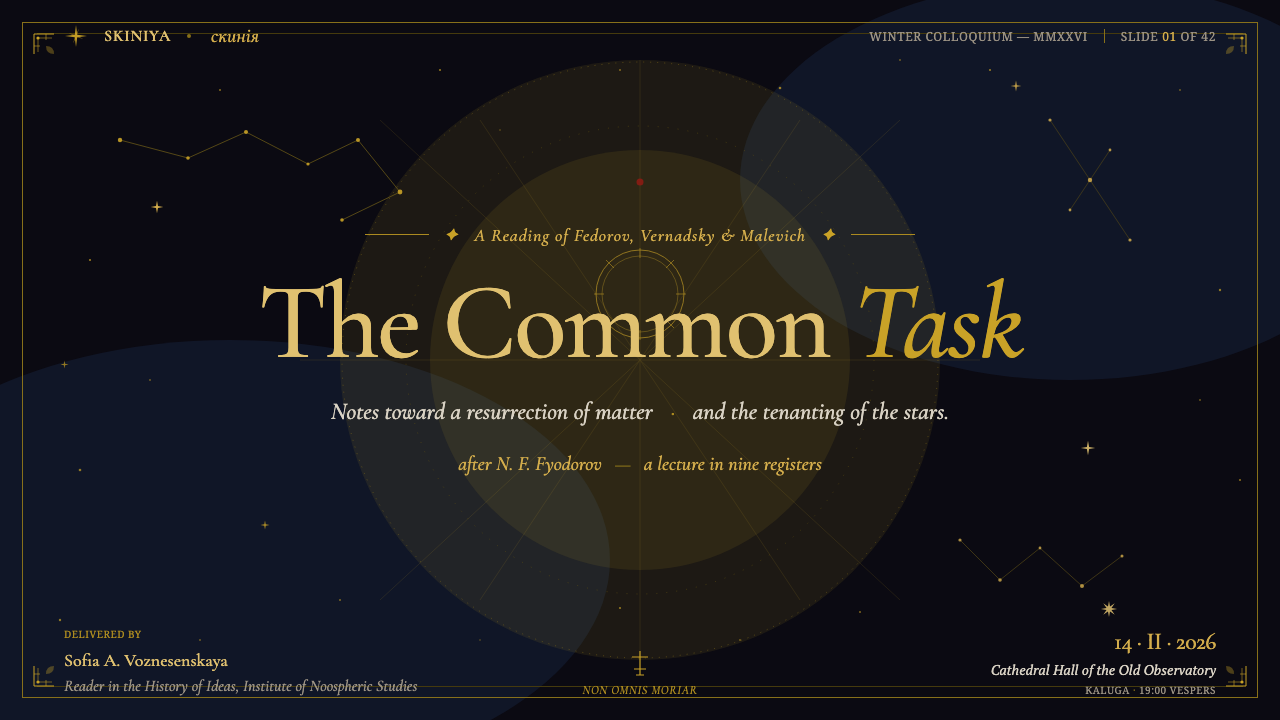
For presentation covers, treat the slide as a single devotional field. Let a black expanse carry one concentrated gold constellation, halo, or celestial disc, with the title set as an inscription rather than a marketing slogan. Content slides should introduce structure slowly: a dark reading field, clear text hierarchy, and a restrained radial or linear device that carries the eye between ideas. Data slides benefit when charts are made to feel like celestial relations, with a gold focal series and sparse accent colors used only to distinguish meaningful contrast.
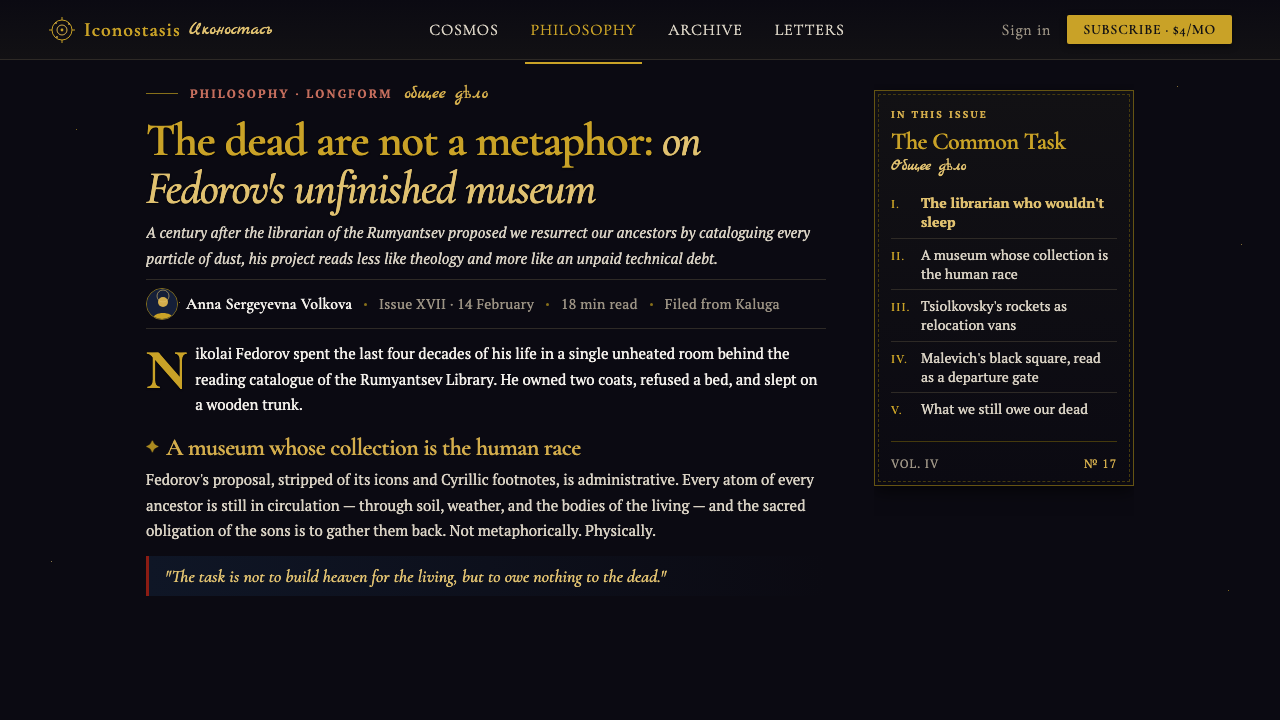
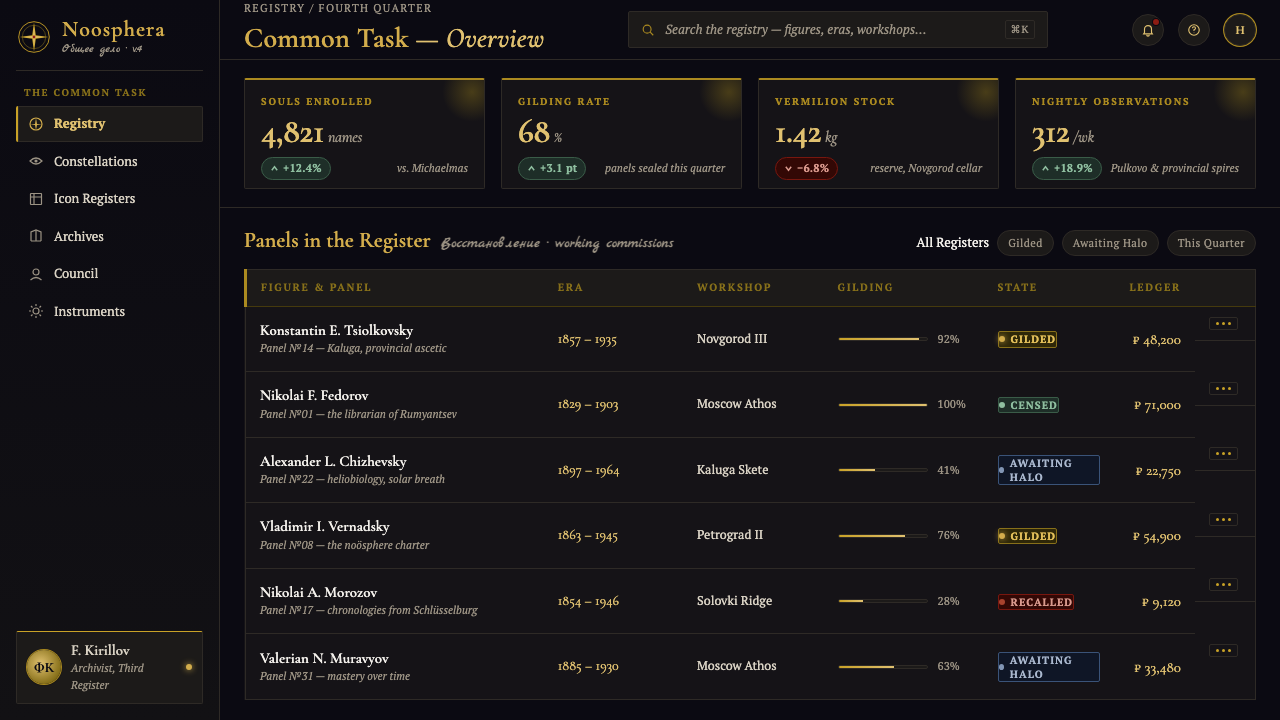
For web interfaces, Russian Cosmism suits dashboards, research environments, member spaces, and premium editorial tools whose content benefits from gravity and sustained attention. Use the dark ground to establish a stable environment, then let gold markers identify navigation, selected states, or important information. Panels should feel like quiet frames within a larger void, not like stacks of glossy cards. The interface gains authority when interaction remains measured and the star-map language clarifies relationships rather than adding spectacle.
For editorial and marketing work, the style is strongest when a story concerns memory, long horizons, discovery, cultural inheritance, or collective ambition. An article can use gold rules, halo-like section emblems, and constellation diagrams to establish a ceremonial reading rhythm. A campaign page can frame one proposition as an illuminated inscription amid black space. The essential contrast is between intimate devotional detail and overwhelming cosmic scale; preserving both prevents the work from becoming generic science fiction.
The common mistake is to treat Russian Cosmism as a license for abundant stars, metallic effects, and dramatic space imagery. That approach loses the philosophical and iconographic discipline that makes the style distinctive. Lead with a sacred focal light, leave substantial darkness intact, and use red or blue as rare signals. If every surface glows, every panel has a nebula, or every line imitates a star chart, nothing retains the gravity of an icon turned toward the cosmos.
Russian Cosmism — FAQ
Is Russian Cosmism simply a dark space-theme aesthetic?
No. Space is essential, but the style is defined by the collision of cosmic aspiration with sacred visual inheritance. Gold, halos, and icon-like concentration make the dark field devotional; without them, the result is closer to conventional science fiction or astronomy branding.
Why is gold so important in this style?
Gold carries the glow of Eastern Orthodox iconography and gives light a spiritual role. It should function as revelation, orientation, or sacred emphasis against black, rather than as a general sign of wealth or premium status.
Can the style work for ordinary information-heavy interfaces?
Yes, if its symbolic elements are subordinated to legibility. A dashboard can use the cosmic field for atmosphere while keeping text, selection, grouping, and data relationships unmistakably clear. The sacred tone should intensify attention, never obscure operational information.
How should red and blue be used beside gold?
Use them as rare secondary signals. Icon red can mark a threshold or urgent emphasis, while deep cosmic blue can introduce distance and depth. Gold remains the primary light; allowing all accents to compete equally dissolves the hierarchy that gives the style its reverence.
Related design styles
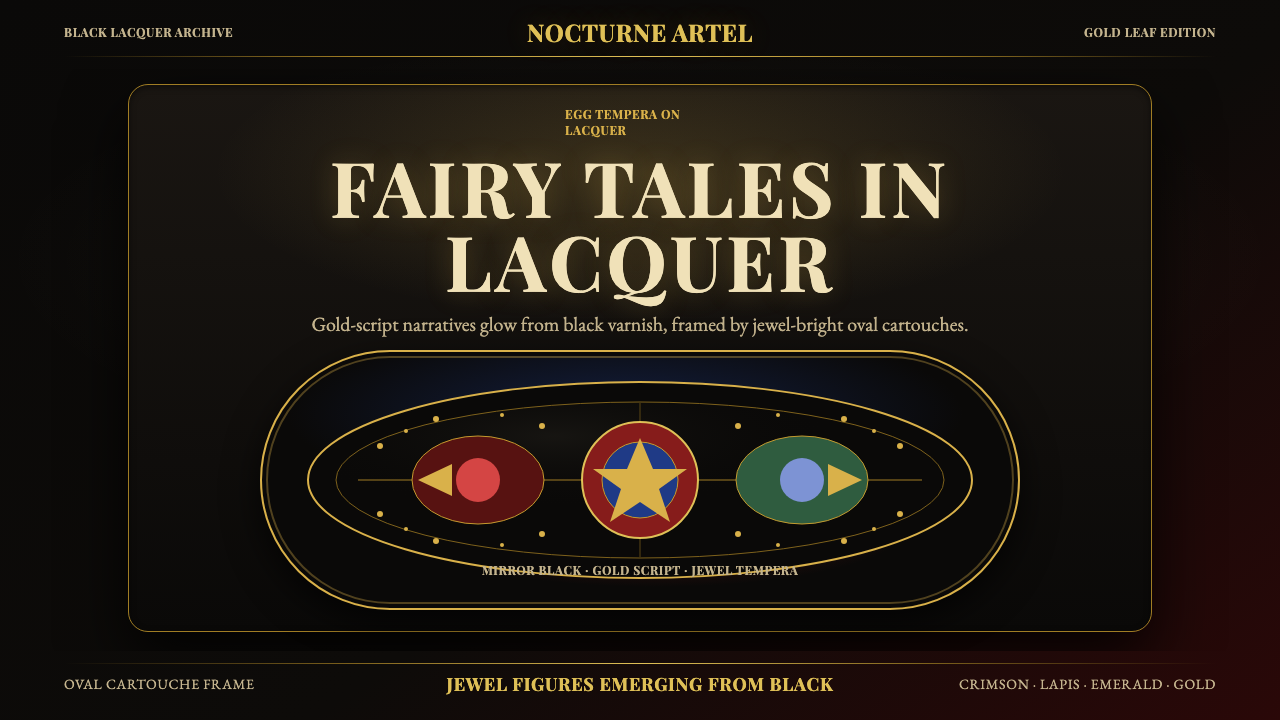 Russian Palekh Lacquer MiniatureBlack lacquer turns mythic. Gold ovals hold crimson, lapis, and emerald tempe…
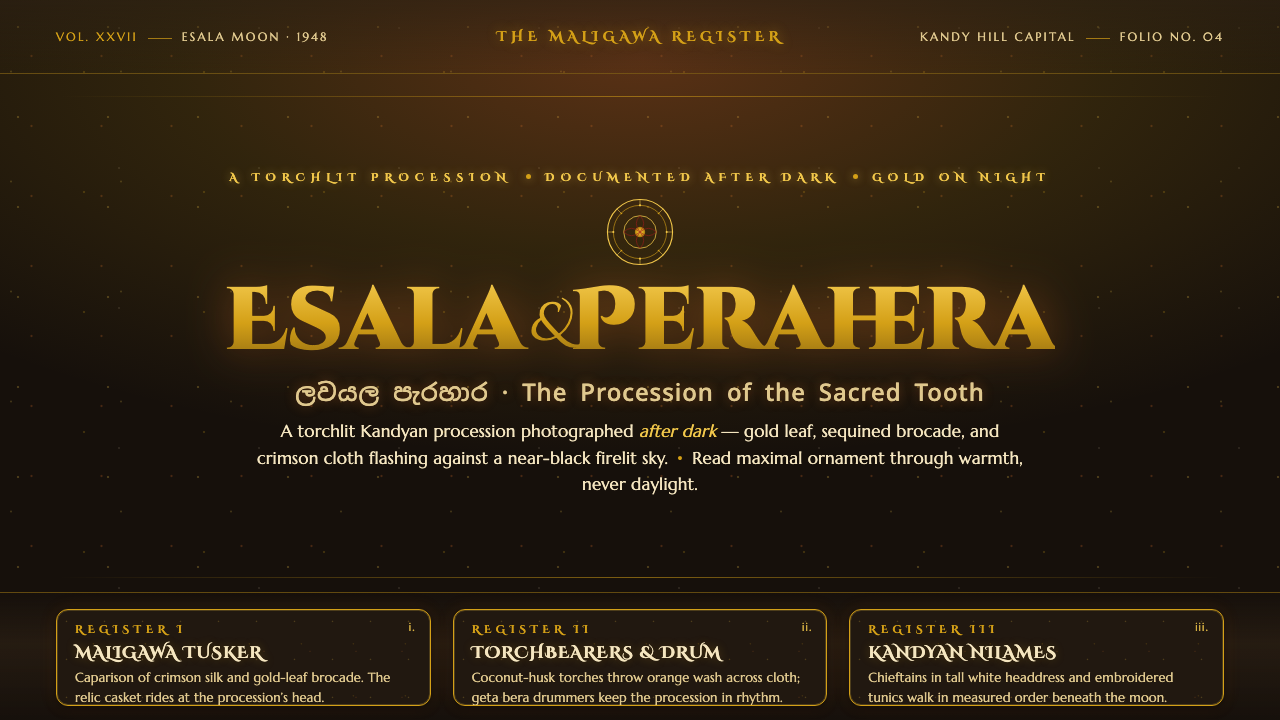 Kandy Esala PeraheraA torchlit night procession, not a poster. Gold flecks and crimson brocade fl…
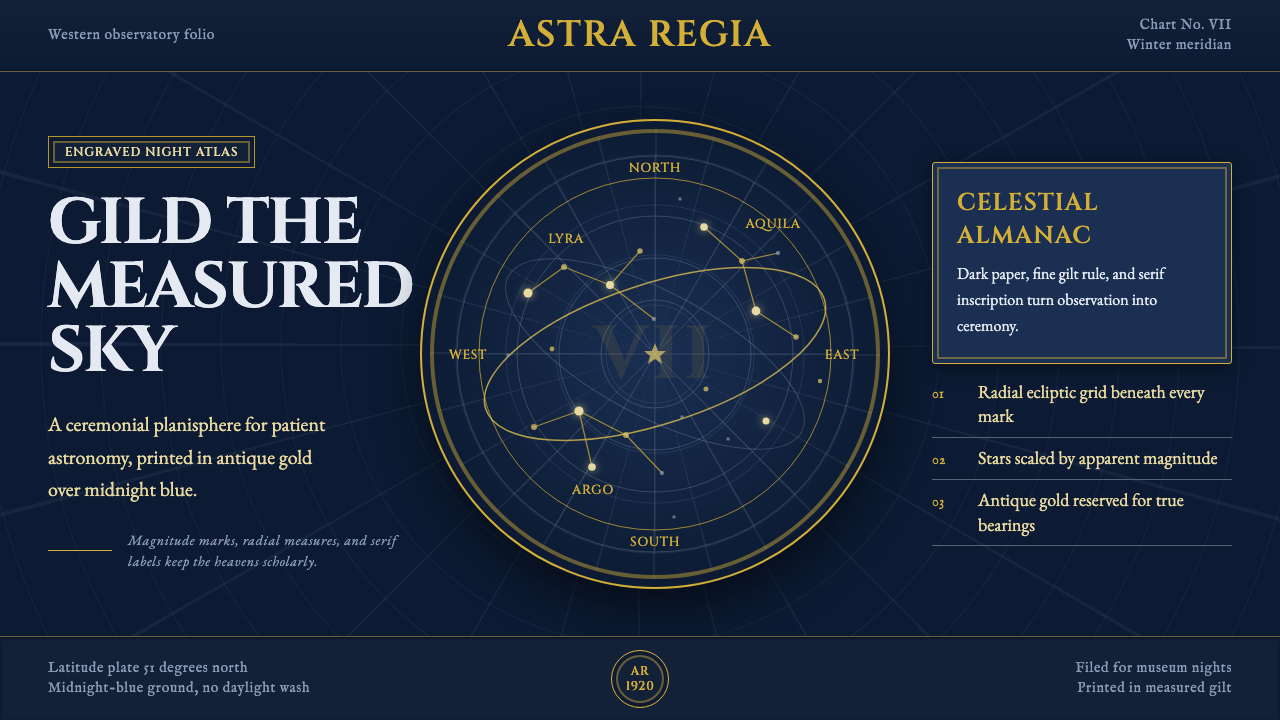 Vintage Star ChartScholarly night, gilded. Cinzel caps orbit gold grids and magnitude stars.
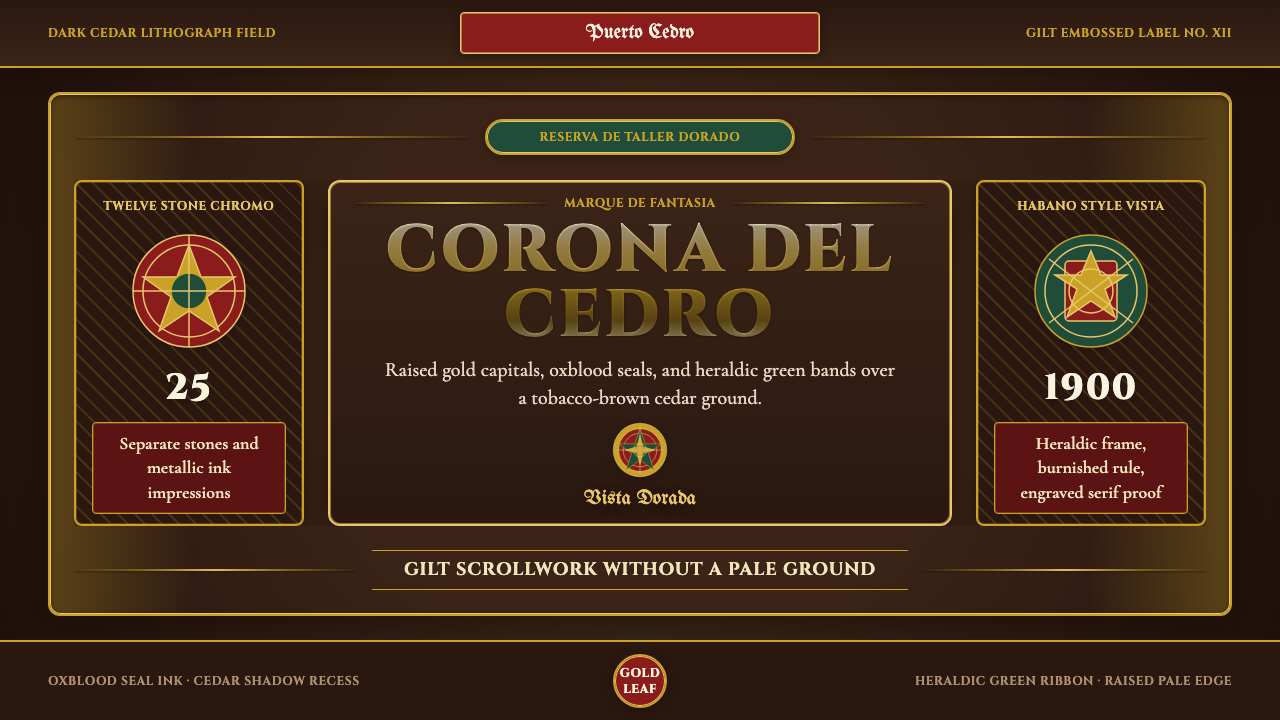 Cigar Box LabelGilt maximalism glows. Gold Cinzel capitals lock into a tobacco-brown framed…
 Fountain Pen & InkInk holds the room. Blue-black wash, Pinyon script, and 14k gilt rules do the…
 German Expressionist CinemaDread is painted, not cast. Amber type, steel-blue flats, and oblique shadows…