What is Redis Cache Red?
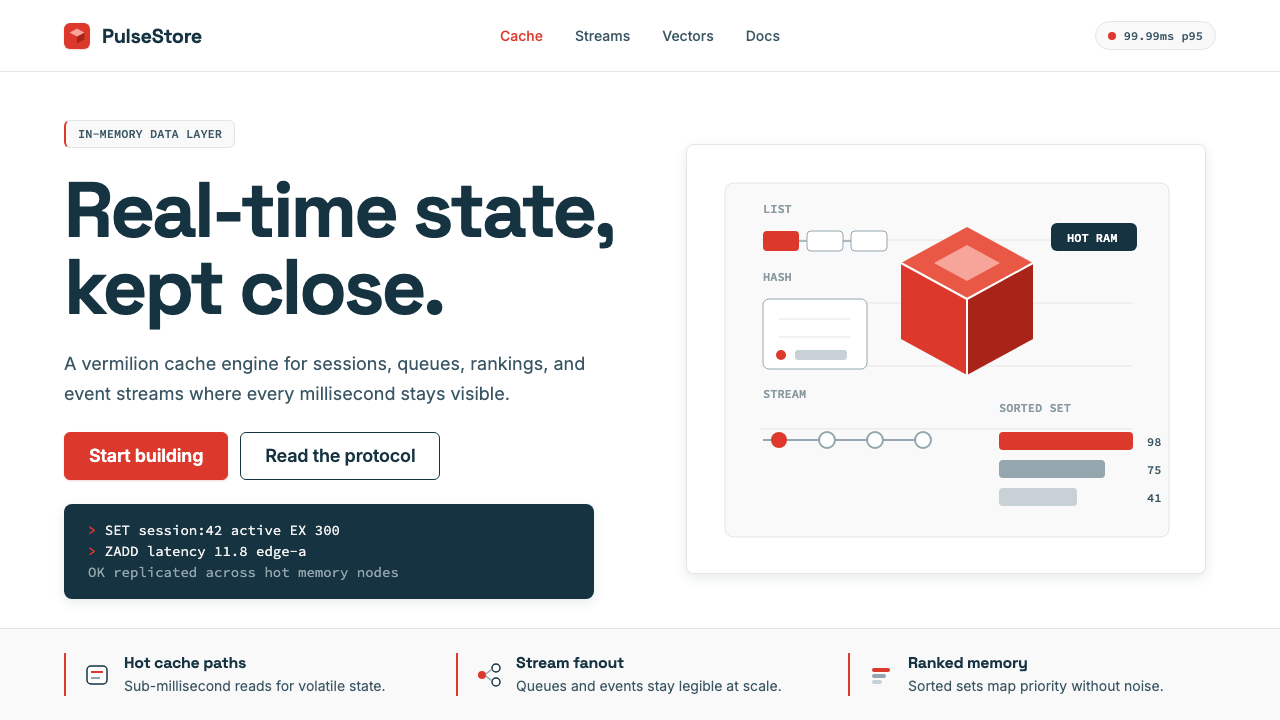
Redis Cache Red translates the world's fastest in-memory database into a visual identity — vermilion precision, slate discipline, and white-space generosity that make raw throughput feel designed.
Redis Cache Red in brief
Redis Cache Red is the visual design system that emerged from the redis.io brand: a tightly constrained palette anchored by a single saturated vermilion-red, balanced against deep slate-navy and generous expanses of pure white. The system is defined less by what it includes than by what it refuses — gradient fills, decorative illustration, competing accent colors, and any typographic flourish that cannot be justified by information hierarchy.
The aesthetic owes its character to the software it represents. Redis — Remote Dictionary Server — is an in-memory key-value store celebrated for sub-millisecond response times. Every visual decision in the Redis identity reflects this engineering culture: geometric sans-serif type conveys precision without warmth; the three-dimensional cube logo motif signals data structure and spatial reasoning; technical diagrams of lists, hashes, sorted sets, and streams replace representational imagery entirely. The design communicates that the product has been engineered, not merely built.
What sets Redis Cache Red apart from other developer-brand systems is its balance of warmth and rigor. The anchor red is not the cold red of a warning system or the corporate red of a financial institution — it is vermilion, a hue that carries historical associations with craft, urgency, and human attention. Paired with deep slate and open white space, it reads as both technically authoritative and approachable, a visual embodiment of open-source software that also runs enterprise infrastructure.

Where does Redis Cache Red come from?
Redis was created in 2009 by Salvatore Sanfilippo, known online as antirez, a Sicilian programmer who initially built it to solve a performance problem with his own startup's real-time web log analysis tool. The original codebase, written in C, was published as open source almost immediately. Within months it had attracted contributors from across the internet, drawn by its elegant design: a small, fast, reliable store for data structures that other systems could not serve at comparable speeds.
The project's visual identity in its early years was minimal to the point of near-absence — a functional website, documentation, and a simple logo that communicated little beyond the name. The cube motif that would later anchor the brand appeared gradually as the community grew and Redis began to be used in production at major internet companies including Twitter, GitHub, and Stack Overflow. By 2011, when Yiftach Shoolman and Ofer Bengal founded Redis Labs (later renamed Redis Inc.) to build a commercial layer on top of the open-source project, the need for a more deliberate visual identity became apparent.
The brand that is now recognizable as Redis Cache Red took its mature form through a series of refinements across the 2010s, crystallizing with a significant visual refresh in the early 2020s. The decisions made in that refresh — committing to vermilion as the sole chromatic anchor, establishing the white-ground grid as the primary surface, adopting geometric sans-serif type for all interfaces — reflected both the design sensibilities of the era and the company's ambition to position Redis as infrastructure-grade software alongside products from major cloud vendors.
The movement that Redis Cache Red belongs to is broader than any single company: it is the visual language of the commercial open-source business, a category that includes Elastic, HashiCorp, Grafana, and MongoDB. These brands share a set of instincts — technical illustration over photography, monospace type for code, a bold single-color anchor, restrained secondary palettes — that signal authenticity to developer audiences. Redis Cache Red is a particularly pure example of this language, distinguished by the warmth of its anchor hue and the three-dimensional geometric confidence of its logo mark.
What defines the Redis Cache Red look?
Vermilion Anchor
The entire Redis palette orbits a single saturated red that reads as warm rather than aggressive — closer to the red of a wax seal or a craftsman's tool handle than to a warning indicator. This hue appears in the logo, primary call-to-action elements, and key navigation highlights; everywhere else, the palette is deliberately neutral. The discipline of a single chromatic anchor gives every appearance of that red tremendous visual weight, making it impossible to overlook while remaining coherent across dark and light contexts.
Geometric Cube Motif
The three-dimensional cube that anchors the Redis logo is not decorative — it is a direct reference to the data structures that Redis stores and retrieves. In the wider design system, this geometric confidence extends to technical illustrations: data structures are rendered as clean isometric or axonometric diagrams, lists appear as stacked rectangles, streams as flowing sequences of blocks. The cube functions as a visual metaphor that bridges brand identity and product explanation.
White-Ground Grid
Pure white is the dominant surface across all Redis visual output — marketing pages, documentation, developer console, and presentation materials alike. This white-ground approach is not minimalism for its own sake but a functional choice: white maximizes the contrast of code snippets in monospace type, gives technical diagrams the breathing room they need to be readable, and ensures that the vermilion anchor color retains its full impact whenever it appears. The grid underlying this white space is strict, creating alignment so consistent that the layout itself becomes a signal of engineering discipline.
Technical Illustration over Photography
Photographic imagery is largely absent from the Redis visual system. In its place, clean technical diagrams explain how data flows through the system: keys and values rendered as labeled blocks, replication topology shown as connected nodes, cluster architecture laid out as a spatial map. These illustrations are rendered in a flat or lightly dimensional style, using the brand palette with black type and restrained use of the anchor red for emphasis. The choice signals authenticity to developer audiences who are trained to read diagrams and are skeptical of stock photography.
Monospace Code as Visual Element
Code snippets in a monospace typeface are not merely functional inclusions in Redis design — they are treated as visual elements in their own right. Command syntax, output examples, and configuration snippets appear in lightly tinted code blocks that break the visual rhythm of prose, creating a distinctive alternation between explanation and demonstration. The monospace type signals technical seriousness, while the careful framing of code blocks within the wider white-space grid ensures they read as designed rather than dropped in.
Slate Navy Secondary Palette
Supporting the vermilion anchor is a deep slate-navy that appears in secondary navigation, footer regions, code block backgrounds in dark-mode contexts, and tier or category differentiation. This secondary color is dark enough to carry white type at full legibility and cool enough in tone to counterbalance the warmth of the red without competing for dominance. The relationship between the warm anchor and the cool secondary creates a quiet tension that keeps pages visually active without requiring additional hues.
Geometric Sans-Serif Type Hierarchy
Typography in the Redis system is built on geometric sans-serif faces that echo the cube motif's rationalism. Headlines are set large and with deliberate weight contrast against body text; section labels and metadata are stepped down in scale but not in family, maintaining visual coherence across a page. The type hierarchy communicates through size and weight alone — no italic flourishes, no decorative capitals, no ornamental separators. This typographic restraint ensures that the vermilion anchor and the technical diagrams carry the expressive burden of the design, while type itself remains infrastructure.

Who shaped Redis Cache Red?
The Sicilian programmer who created Redis in 2009 while solving a real-time performance problem for his own startup. Sanfilippo's instinct to build a small, elegant, purpose-specific tool rather than a general-purpose database shaped Redis's entire engineering philosophy — and, by extension, the visual identity that would eventually represent it. His decision to open-source the project immediately meant that the aesthetic of Redis grew alongside a global community rather than inside a single design department.
Co-founder and former CTO of Redis Inc., Shoolman was instrumental in translating the open-source project into a commercial product with enterprise-grade visual presentation. The transition from community project to funded company required a more deliberate brand system — one that could speak to both developers downloading a free tool and enterprises negotiating multi-year contracts. The maturation of the Redis visual identity under the company's growth reflects decisions made at this organizational level.
Co-founder and CEO of Redis Inc., Bengal's leadership shaped the commercial positioning of Redis at the intersection of open-source community and enterprise infrastructure. His direction informed the brand's ambition to present Redis as a credible infrastructure-grade product alongside offerings from major cloud providers — an aspiration that required a visual identity disciplined and confident enough to stand in that company. The warmth-plus-rigor tension in the brand personality reflects the dual audience Bengal's company needed to serve.
As CEO who guided Redis Inc. through a significant period of growth and brand evolution, Trollope's tenure oversaw the visual refresh that consolidated the Redis Cache Red identity into its most recognizable form. Enterprise software brands that seek developer trust while also closing large sales cycles must manage a delicate balance in tone — technical enough to be credible, accessible enough to be bought. The coherent, mature visual system that Redis presents today reflects organizational commitment made at the executive level.
How do you use Redis Cache Red today?
Redis Cache Red is a design system built around a single bold chromatic decision, which makes it both highly legible to apply and easy to misuse. The core principle is anchor discipline: the vermilion red is the only saturated hue in the palette, and it should appear sparingly — in logos, primary action elements, and navigational anchors — while the rest of the surface is white or near-white, with deep slate used only for secondary structure or dark-mode surfaces.
For presentation slides, Redis Cache Red performs best when the cover slide commits fully to the bold register of the brand: the cube motif at large scale, the title in a geometric sans-serif at generous weight, and the red used as a single accent against a pure white or deep slate ground. Content slides should be treated as documentation pages — white background, black body type, monospace blocks for any technical content, and the red reserved exclusively for the most important concept per slide. Data slides work especially well in this system: charts and diagrams rendered as clean geometric objects with bars and segments in the brand's neutral palette, with red used only to highlight the key data point the slide is making.
For web interfaces, the system is particularly well suited to developer dashboards, API reference pages, and pricing pages. The approach is grid-first: establish a clean multi-column structure, keep background surfaces white, and let the typographic hierarchy do the organizational work. Card components should have subtle borders rather than soft shadows; interactive states should use the red sparingly and consistently. Navigation should be primarily typographic — the brand name or product wordmark carrying the identity without requiring icon-heavy decoration. Avoid the temptation to introduce additional accent colors for different product tiers; use the slate-navy and varying levels of opacity within the neutral palette to create differentiation instead.
For editorial and marketing work, the style supports a poster-like boldness that works well for feature announcements, conference materials, and social cards. A Redis Cache Red editorial layout uses generous white margins, one or two levels of typographic hierarchy defined purely by scale and weight, and the red as a single emphatic element — an underline on a key phrase, a background block behind a quoted statement, a border on a featured diagram. Marketing pages benefit from alternating full-width sections between white-ground and slate-ground treatments, with the red appearing at the intersection as a transitional accent.
The most common mistake when applying this system is treating the vermilion red as a general-purpose color available throughout the layout. When the anchor color appears too frequently, it loses its weight and the system collapses into visual noise. A second common error is introducing soft shadows, gradient overlays, or organic shapes that soften the geometric precision the system depends on. Redis Cache Red is at its most convincing when it looks like it was designed by engineers who respect design — rational, precise, undecorated — not when it tries to appear warmer or more consumer-friendly than its engineering audience actually requires.

Redis Cache Red — FAQ
Can Redis Cache Red work for non-technical products?
The system can be applied beyond its origin context, but it carries strong associations that are difficult to suppress: precision, engineering rigor, developer culture, and infrastructure-grade reliability. Products that benefit from these associations — analytics tools, developer platforms, data-intensive enterprise applications, technical documentation systems — will feel authentic in this style. Products that need to lead with warmth, sensory richness, or emotional storytelling will find the style working against them. The vermilion anchor is warm for a developer-brand red, but it is still a red, and when combined with geometric type and white-ground grids it reads as technical before it reads as inviting.
How does Redis Cache Red differ from other developer-brand systems like Elastic or MongoDB?
All three belong to the same broader visual family — commercial open-source brands that use bold single-color anchors, technical illustration, monospace code blocks, and restrained secondary palettes. The distinctions are in the specific character of each anchor hue and the spatial personality of the layout system. Redis Cache Red's anchor is a warm vermilion with artisanal associations; Elastic's yellow is energetic and alert; MongoDB's green is ecological and growth-oriented. Redis's three-dimensional cube motif also gives it a more explicitly spatial, structural quality compared to the flatter mark-making of some peers. The warmth-plus-rigor combination in Redis is the system's most distinctive quality — it feels like a craftsman's tool rather than a corporate product.
How should the cube motif be used in layouts beyond the logo?
The cube motif is most powerful when used sparingly and scaled deliberately. As a background element at very large scale — partially cropped, positioned at an edge or corner — it creates spatial depth without competing with foreground content. As a small repeated element in a pattern or texture context, it risks becoming decorative wallpaper that undermines the system's discipline. The most coherent extension of the motif is through the technical illustration system: data structure diagrams that use the same geometric, slightly three-dimensional language as the logo mark create a visual echo without literalizing the cube in ways that feel heavy-handed.
Does the system support a dark mode, and how does it change the character of the design?
A dark-mode variant is both possible and in use across Redis developer tooling. The primary inversion swaps the white ground for a deep slate or near-black surface, promotes the slate-navy to a mid-tone structural layer, and allows white type to carry full legibility. The vermilion anchor in a dark context reads as brighter and more urgent than it does against white — the warm red on a cool dark ground creates stronger contrast and a more alert visual register. The character shifts from open and documentary to focused and immersive, which is appropriate for terminal-adjacent interfaces like command-line documentation or interactive API explorers. Code blocks become dominant rather than accented, which is well-suited to developer workflow contexts.
What is the biggest risk when presenting Redis Cache Red to a non-developer audience?
The system is calibrated for an audience that reads technical diagrams fluently, is skeptical of visual marketing, and interprets restraint as quality rather than poverty. For business decision-makers without a technical background, the same visual cues that signal credibility to engineers — the monospace code blocks, the absence of lifestyle imagery, the diagrammatic illustration — can read as incomplete, unfinished, or lacking in warmth. The mitigation is not to soften the system but to lead with the elements that bridge both audiences: the bold vermilion anchor is universally legible as a confident, distinctive brand color; the cube motif is visually interesting independent of its technical meaning; the generous white space reads as premium. Build the non-technical narrative on these elements and let the technical depth remain available without being foregrounded.
Related design styles
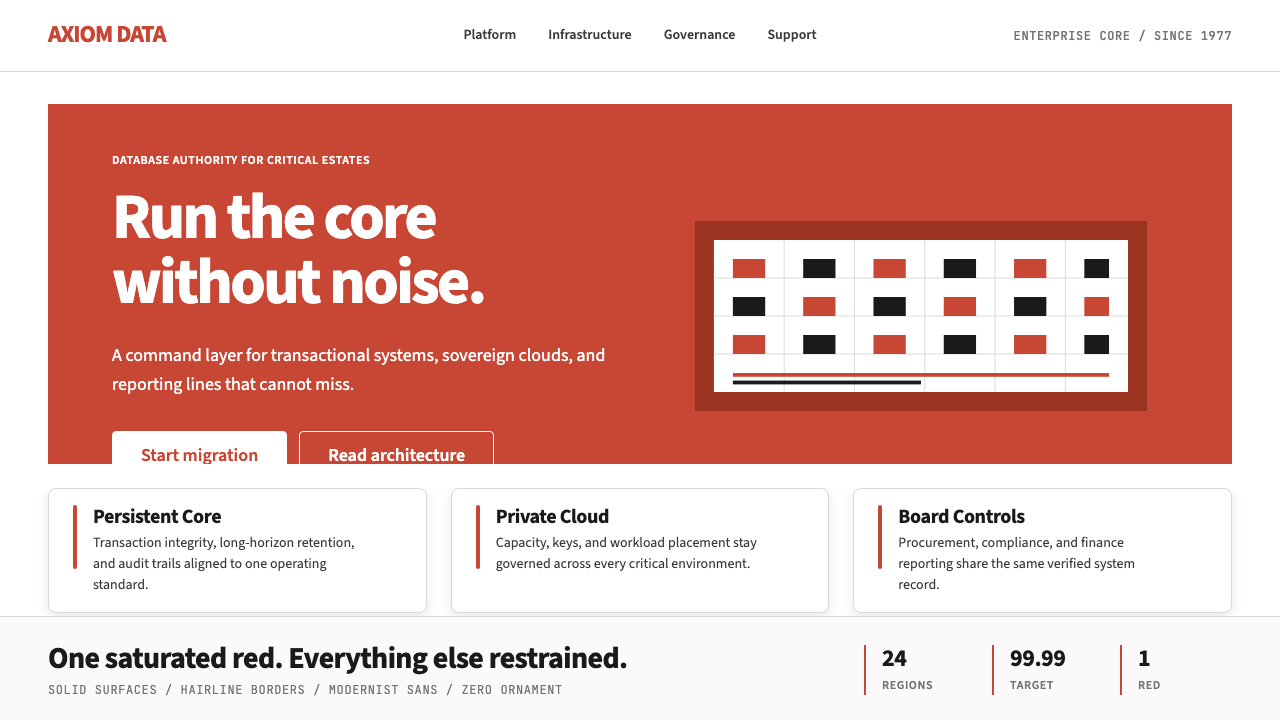 Oracle Corporate RedEnterprise certainty. Saturated red, tight sans, and white space do all the w…
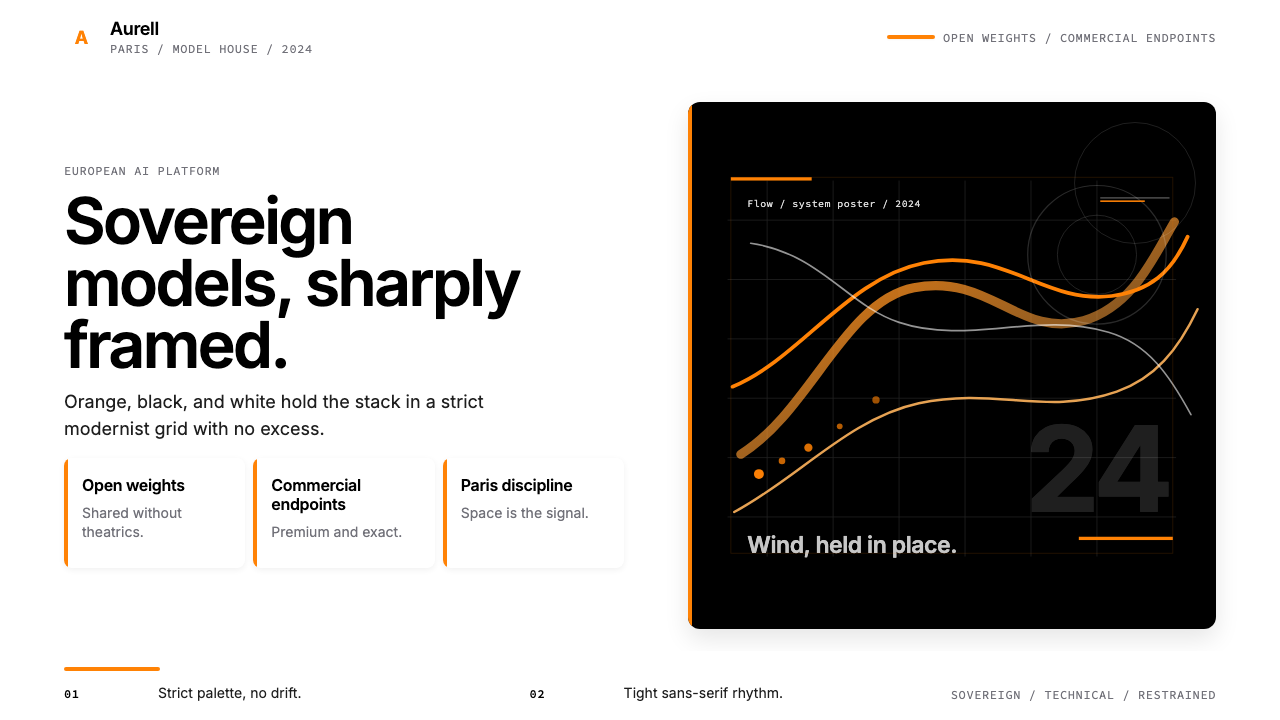 Mistral AI OrangeSovereign AI with restraint. Orange, black, and white lock the grid.
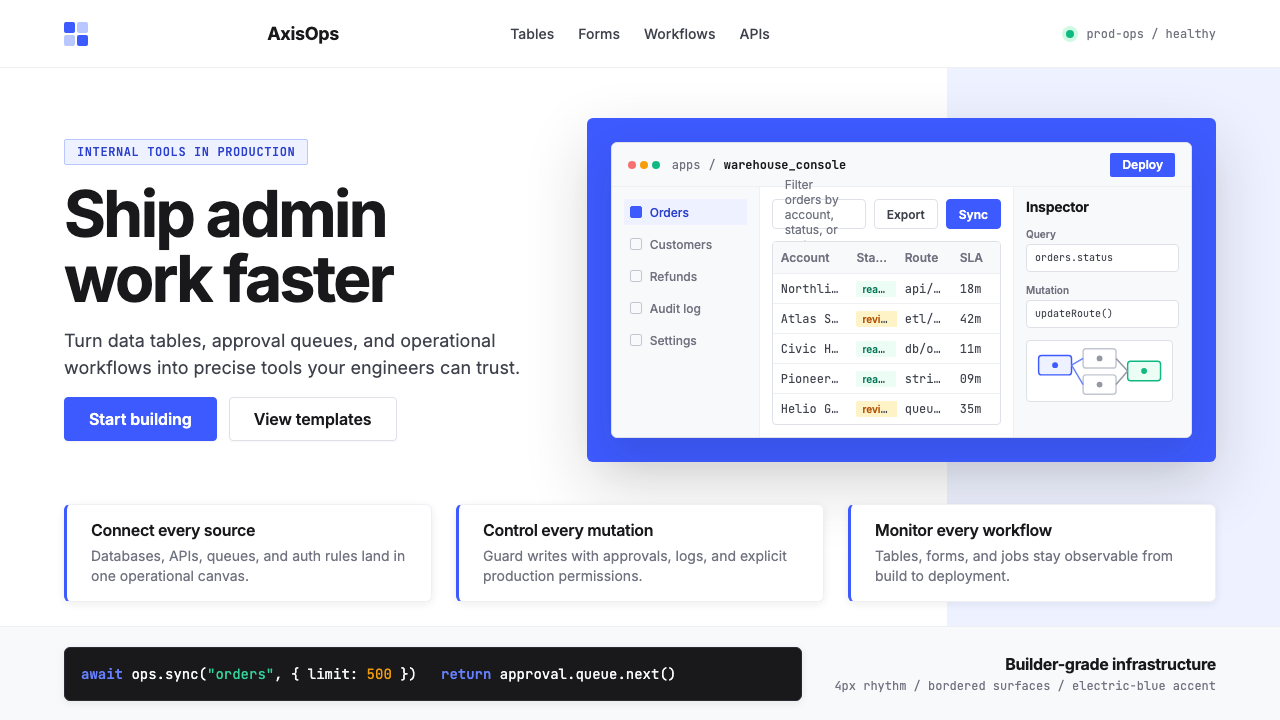 Retool Internal-Tools RedPrecision ships fast. Electric blue panels, Inter type, and bordered UI mocku…
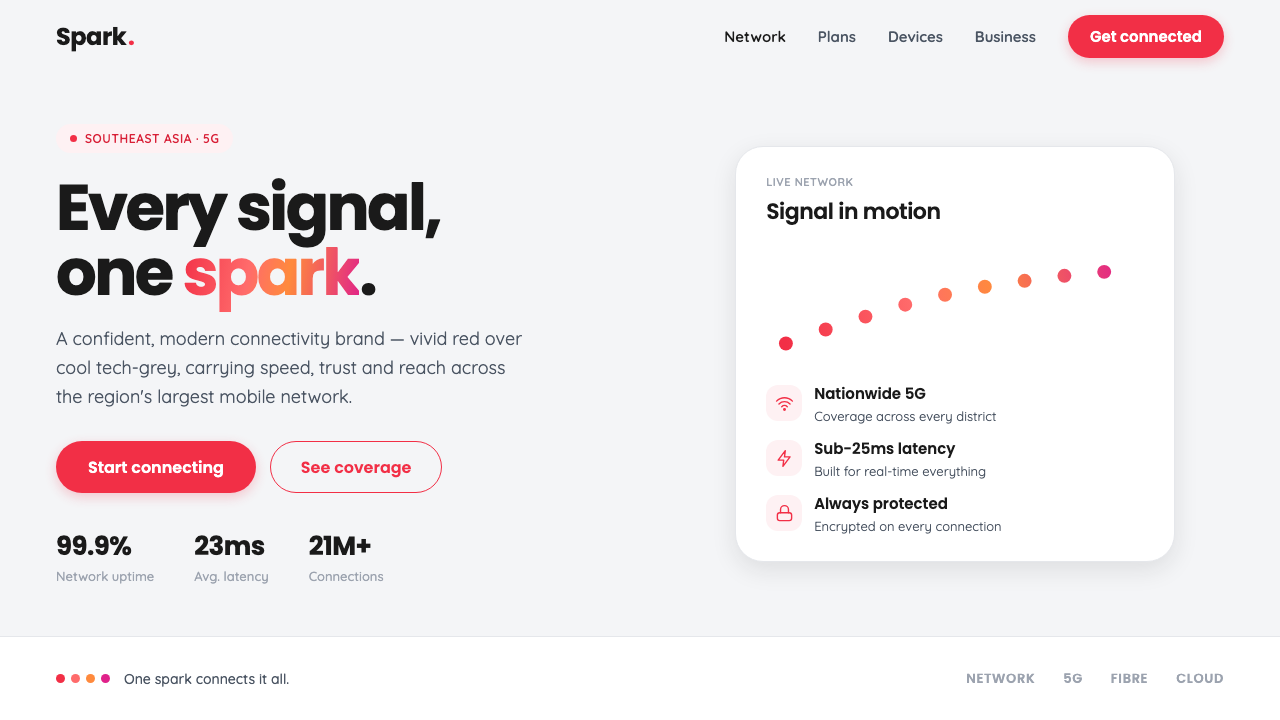 Singtel Modern BrandKeeps the red loudest on screen. Vivid Singtel red on cool tech-grey, with a…
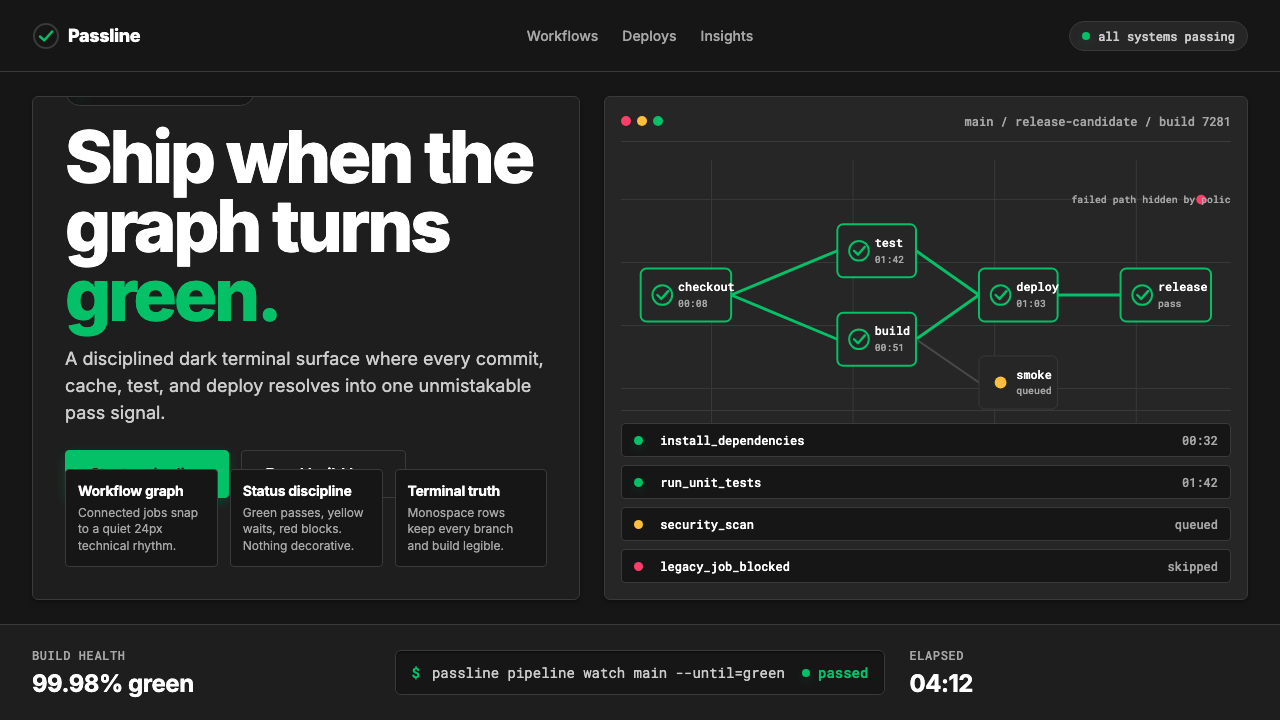 CircleCI Pipeline-GreenConfidence goes green. Emerald status lines cut through terminal-black pipeli…
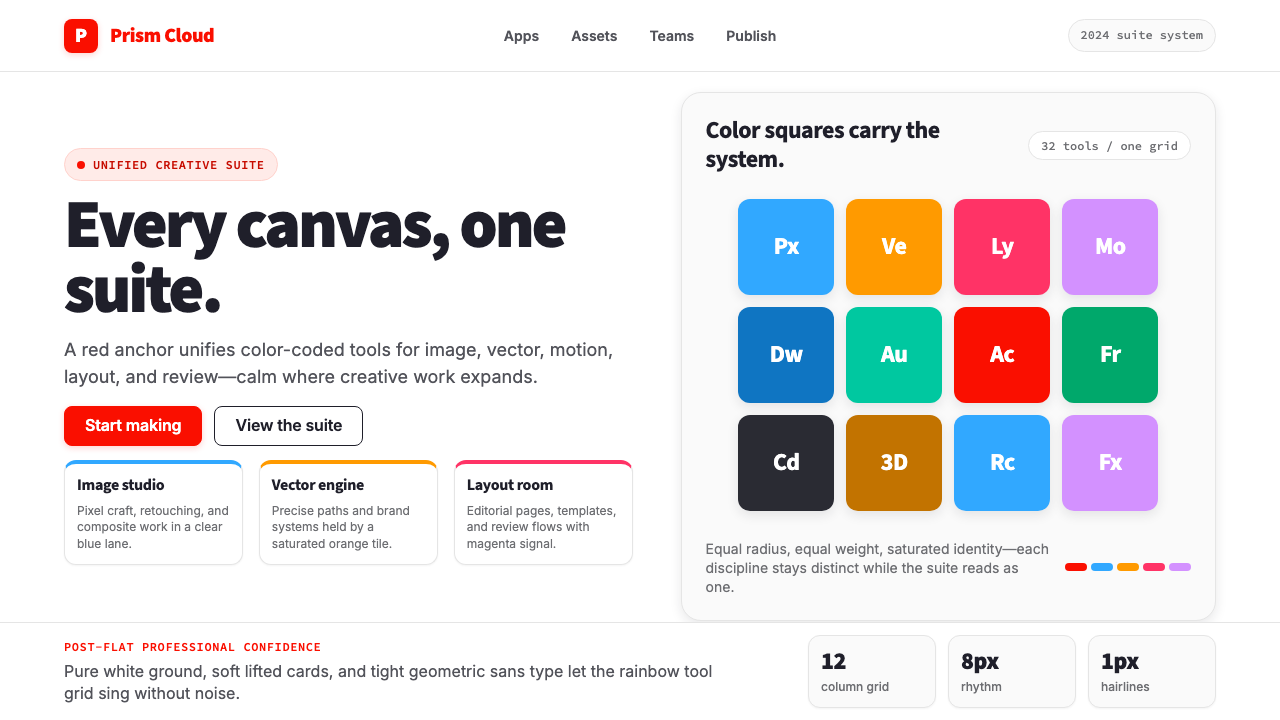 Adobe Creative CloudUnified, not uniform. Red anchor, white space, and saturated app tiles organi…