What is Mewar Rajput Miniature?
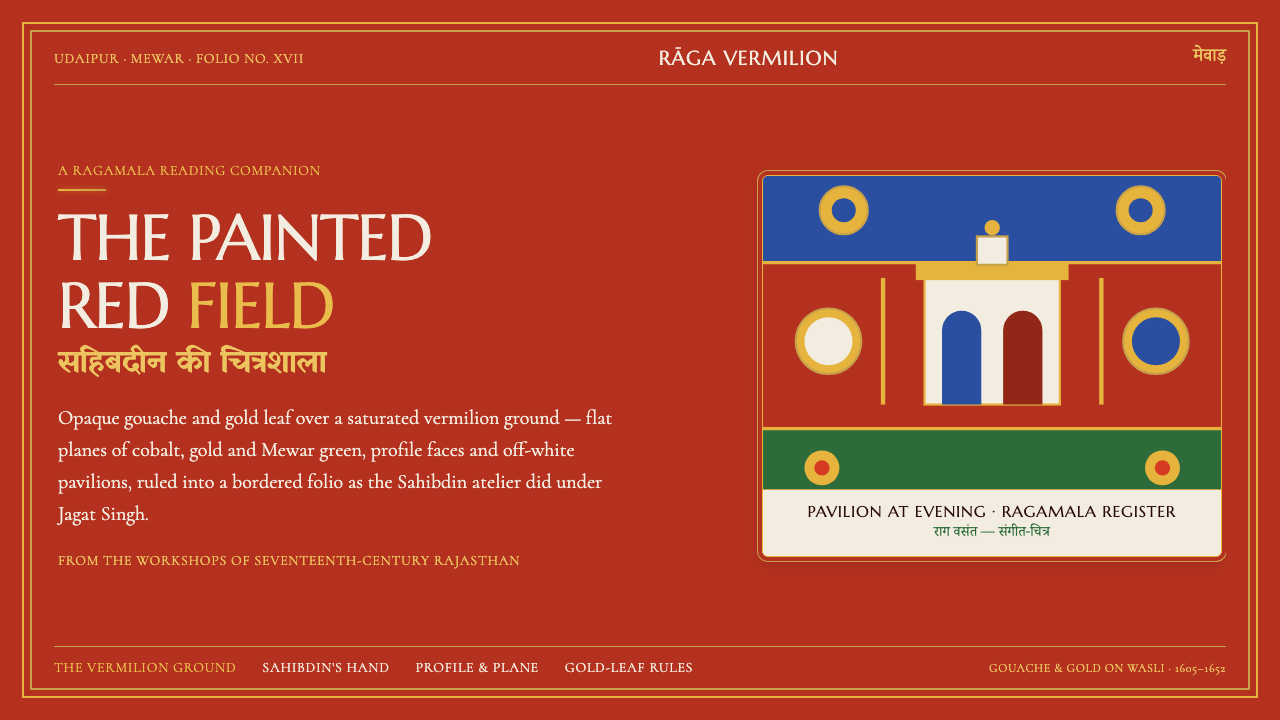
Mewar Rajput miniature makes the ground part of the image: vermilion fields, cobalt planes, gold-leaf glints, and profile figures held inside the discipline of a folio.
Mewar Rajput Miniature in brief
Mewar Rajput miniature is a courtly painting tradition associated with Mewar and Udaipur in Rajasthan, India. Its images are made with opaque gouache and gold on burnished wasli paper, using a visual language of flat, saturated color rather than atmospheric recession. Vermilion is not a background added after the subject; it is an active painted field that gives the entire folio its heat, pressure, and visual identity.
The documented Mewar vocabulary is concise but emphatic: vermilion and cobalt set out broad planes, gold-yellow and Mewar green appear as equally flat accents, profile faces establish a clear human presence, and off-white architecture interrupts the field with crisp structural mass. Gold leaf is used as a small, precious event. It catches the eye without dissolving the composition into general luxury.
The result is a miniature style with an unusually direct relationship between color and structure. The page reads as a bounded image rather than a window onto a naturalistic scene. A figure, building, or ornamental detail is placed against the color ground with conviction; each element remains legible because the surrounding field is so unequivocal.
Where does Mewar Rajput Miniature come from?
The tradition belongs to South Asia’s Rajput court miniature painting and to the ragamala folio tradition. Its setting is Mewar, centered on Udaipur in Rajasthan, where the painted page was understood as a complete, contained surface. The folio format matters: its border, ground, figure, architecture, and gold detail are not independent decorations but parts of one deliberately bounded composition.
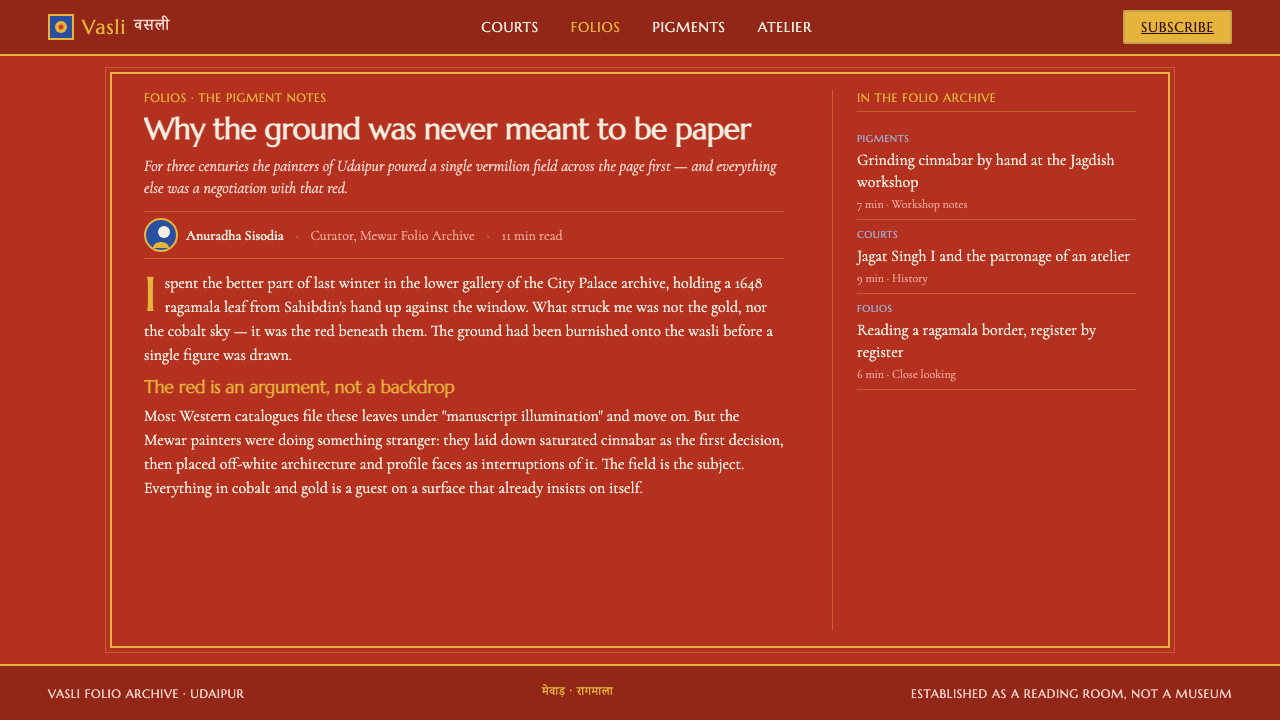
A documented early point is the Chawand ragamala of 1605. These folios establish the importance of the saturated vermilion ground device associated with Mewar painting. The red field makes a decisive break from the expectation that paper should remain a neutral support. Here the support is visually transformed into the principal atmosphere of the image.
The school reached a major seventeenth-century flowering in Sahibdin’s atelier under Maharana Jagat Singh I, whose reign is associated with the period from about 1628 to 1652. The source material identifies this moment through its combination of flat vermilion and cobalt planes, profile faces, off-white architecture, and gold leaf. Those elements are best understood as a coordinated system: color establishes the field, drawing fixes the figure, architecture gives rhythm, and gold provides a sparing point of ceremonial emphasis.
What defines the Mewar Rajput Miniature look?
Painted Ground
Vermilion is the signature ground device. It should occupy the page as a full, saturated field, never retreating into a faded paper substitute. The ground is not empty space behind content; it is a positive visual force against which figures, architecture, and gold become sharper.
Flat Saturation
Vermilion, cobalt, gold-yellow, and Mewar green are treated as flat, confident planes. Their role is graphic and compositional, not atmospheric. Avoid turning them into soft washes, muted earth tones, or naturalistic lighting effects; their force comes from their unbroken presence.
Profile Presence
Profile faces are a defining human motif. The side view makes the figure read with immediacy and restraint, preserving a clear silhouette against the field. It is less concerned with rounded portrait realism than with a poised, recognizable presence inside the folio.
Off-White Architecture
Off-white architecture provides a cool structural counterpoint to the heated ground. It should read as a flat, cleanly bounded form rather than as a deeply rendered building. Against vermilion or cobalt, its pale surfaces create separation, rhythm, and a sense of framed order.
Gold as Accent
Gold leaf belongs at points of attention, not across every surface. Its value lies in contrast with opaque gouache and saturated color: a small glint can define a border, catch a motif, or dignify an architectural or figural detail. Generalized gilding weakens the folio’s discipline.
Folio Boundary
Every composition should feel held inside a bordered folio. The edge is not an afterthought; it is the device that turns broad color into a composed image. Framing gives the flat field ceremonial containment and prevents the palette from becoming merely decorative.
Who shaped Mewar Rajput Miniature?
Sahibdin is the key named artist associated with the school’s major seventeenth-century flowering. The source material places his atelier under Maharana Jagat Singh I and identifies it with the visual coordination of vermilion and cobalt fields, profile faces, off-white architecture, and gold leaf. His name anchors the style in a specific courtly workshop rather than an anonymous decorative category.
Maharana Jagat Singh I is the ruler under whom Sahibdin’s atelier is identified as reaching its peak, during the period associated with about 1628 to 1652. His importance here is institutional: the style’s most fully articulated phase is tied to a Mewar court context in which folio painting, saturated grounds, and gold-accented finish could operate as one coherent visual culture.
The painters of the Chawand ragamala are identified through the 1605 folios that provide an early documented reference for the Mewar vermilion ground. As a collective designation, they matter because the style is carried by a folio tradition as much as by an individual hand: the page-wide field, bounded composition, and painted elements must work together.
How do you use Mewar Rajput Miniature today?
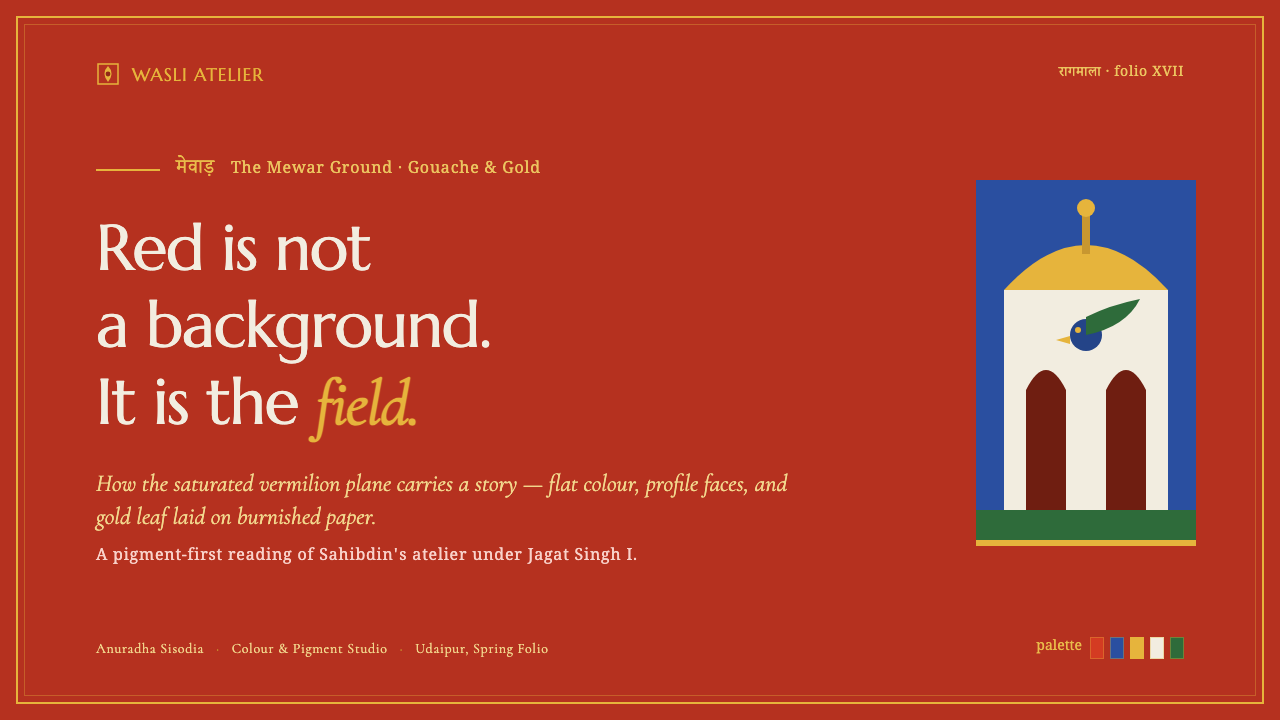
For presentation covers, use the vermilion ground as the main image rather than a neutral backdrop. Place a single profile figure, an off-white architectural mass, or a cobalt plane within a folio-like frame, then let the title occupy a calm, clearly bounded area. The cover should feel like one painted page, not like a modern layout decorated with miniature motifs.
For content and data slides, retain the logic of broad flat fields and explicit containment. Separate content into framed panels, use off-white shapes to hold dense information, and reserve cobalt or Mewar green for a secondary area of attention. Data should be simplified into flat marks and grouped forms; gold is best used to signal a key distinction, not to coat an entire chart.
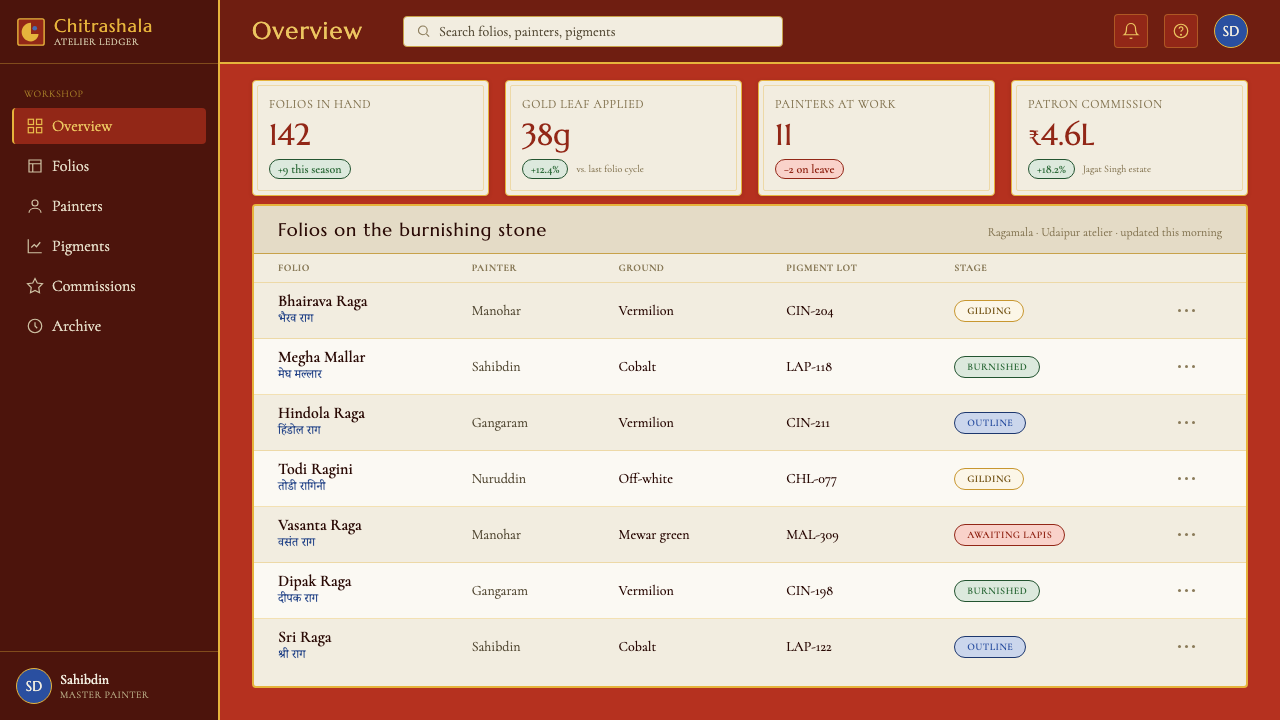
For web interfaces, this style is strongest in dashboards, collections, cultural archives, and pricing pages that benefit from emphatic hierarchy. Treat the screen as a sequence of folios: a vermilion field can establish a major section, while off-white surfaces create clear reading zones and cobalt distinguishes navigation or selected states. Profile imagery and architectural silhouettes work better as deliberate focal elements than as repeated decoration.
For editorial and marketing work, use the bordered-folio principle to make campaigns, article headers, and feature blocks feel collected rather than scattered. A flat vermilion or cobalt field can carry a concise statement; off-white architecture-like shapes can organize supporting copy; a small gold-leaf accent can direct the eye to a name, a rule, or a meaningful detail. Let large color areas do the expressive work.
The common mistake is reducing Mewar Rajput miniature to a generic warm, ornate look. Diluting vermilion into terracotta pastels, covering every surface in gold, adding soft depth, or treating the palette as interchangeable misses the system’s central discipline. Keep the ground saturated, the color planes flat, the gold sparing, and the frame present.
Mewar Rajput Miniature — FAQ
Is the vermilion background optional in Mewar Rajput miniature?
It can vary across a broader design application, but the saturated vermilion field is the signature ground device identified for Mewar ragamala folios. If the goal is to evoke this particular system faithfully, vermilion should be treated as an active painted ground. Replacing it with paper-cream changes the balance between field, figure, architecture, and gold.
How should gold be used in this style?
Use gold as gold leaf: concentrated, reflective, and selective. It is most effective at borders, small motifs, or details that deserve ceremonial attention. The contrast between a small gold accent and opaque gouache is more faithful to the documented system than a surface covered in generalized metallic richness.
Can the style use a pale paper-like background?
Off-white has an important place, but primarily as architecture and framing contrast rather than as the governing ground. The design system explicitly distinguishes the painted vermilion field from paper-cream. A pale surface can support reading areas or architectural forms, but it should not erase the force of the saturated ground.
What makes a digital interpretation feel like a folio rather than a color-themed interface?
The key is containment. Build every major composition around a bounded field, then give the profile figure, off-white architecture, cobalt plane, and gold detail distinct roles within it. When the frame, ground, and accents work as one image, the screen inherits the folio logic. When motifs float independently, the result becomes decorative rather than structural.
Related design styles
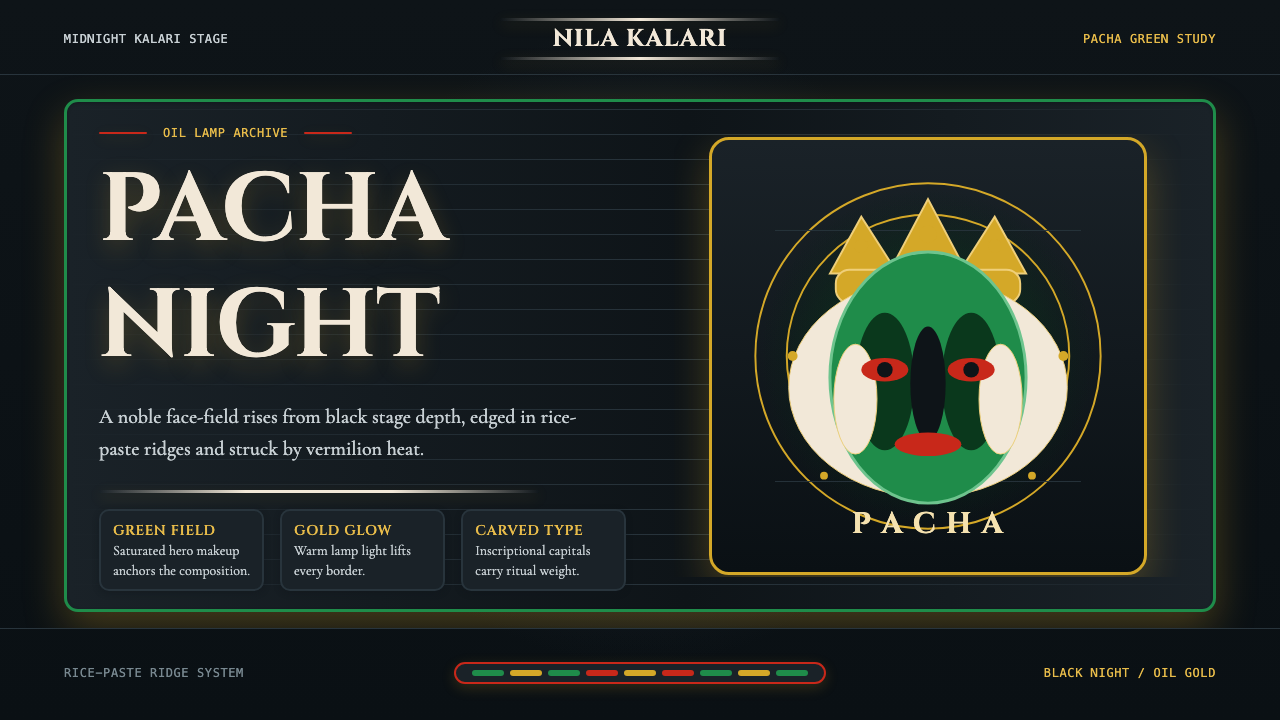 Kerala Kathakali (Pacha Green Makeup)Fierce ceremonial night. Pacha green, vermilion, and oil-gold frame monumenta…
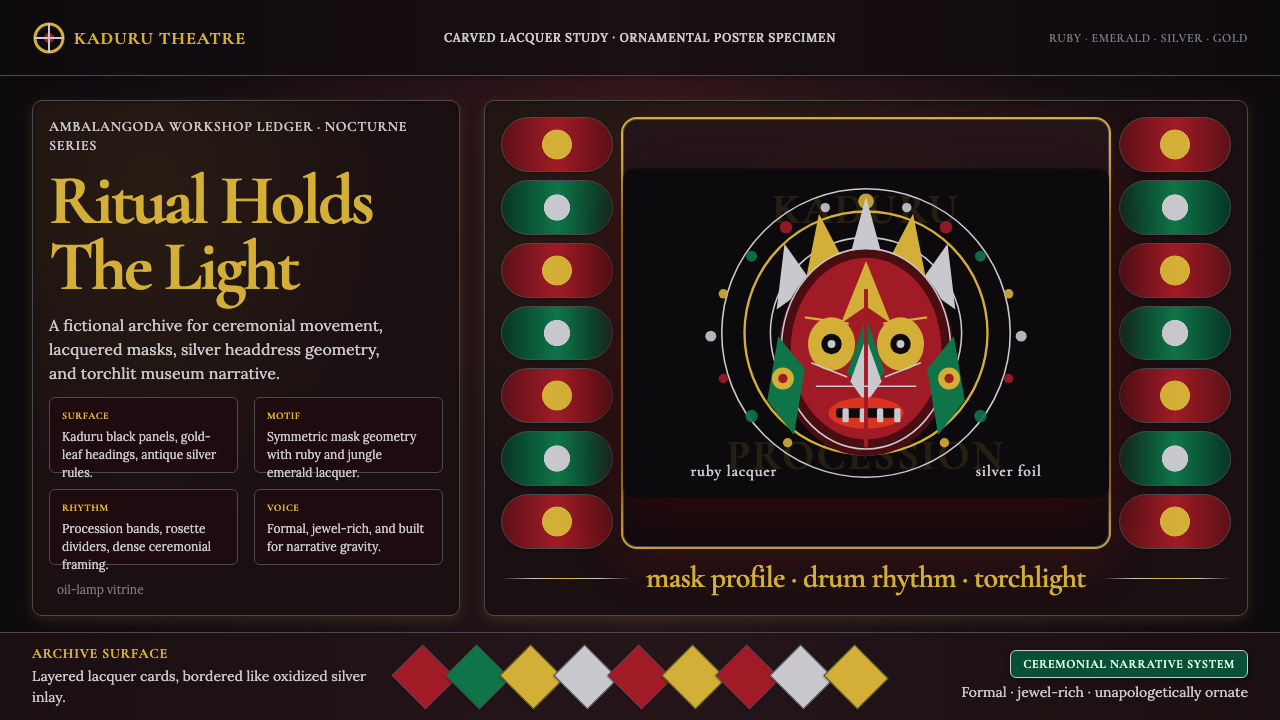 Sri Lankan Kandyan Mask & DanceRitual carries weight. Gold serif type and ruby-emerald filigree burn on blac…
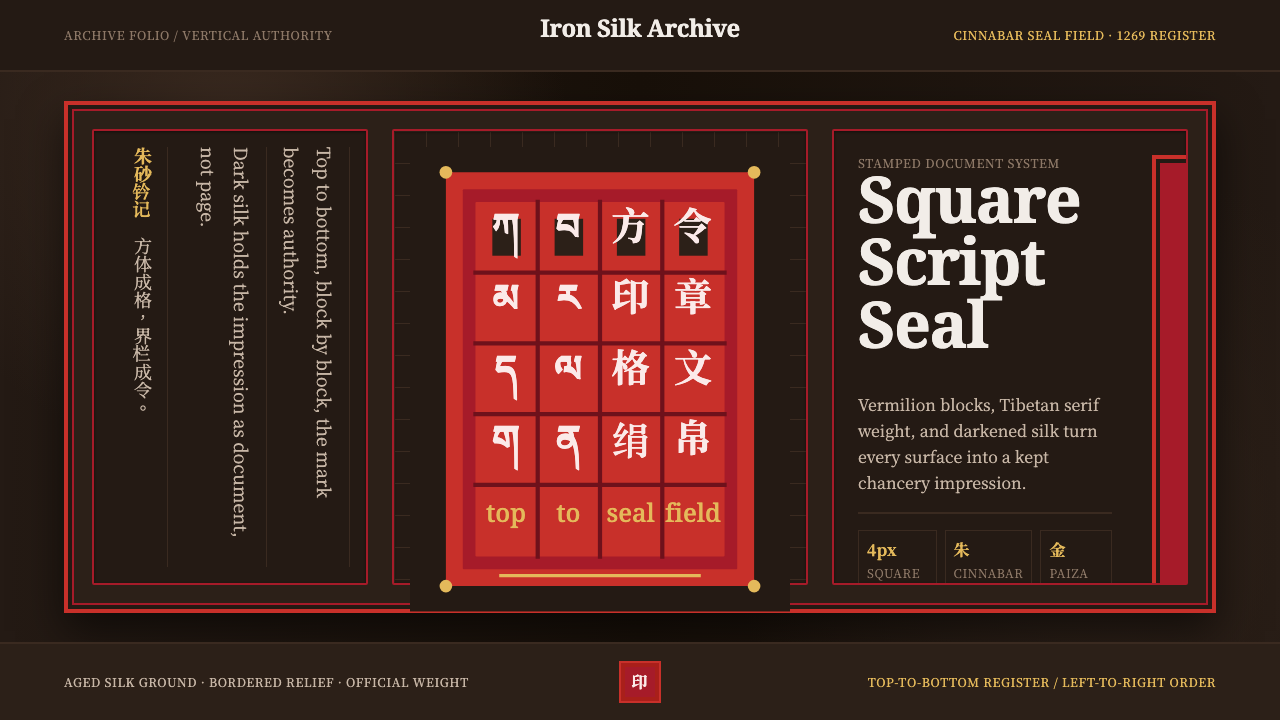 Phags-pa Seal ScriptAuthority, stamped vertical. Cinnabar borders press Tibetan serif blocks into…
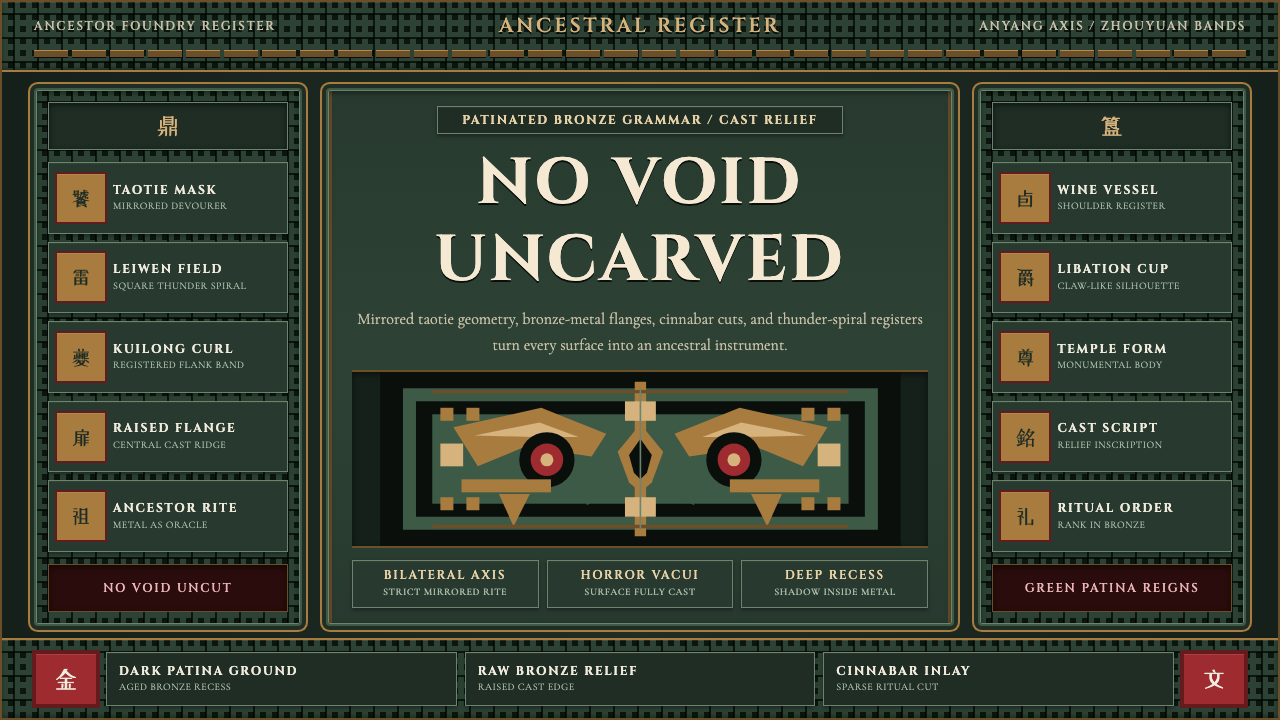 Shang-Zhou Ritual BronzeAncient terror fills every surface. Patina green, bronze relief, mirrored tao…
 Apothecary Poison LabelDanger made ornate. Cobalt ribs, aged paper, and red POISON rules make fear t…
 Balinese Barong Mask (1920)Protection glows after dark. Cinzel capitals frame gold, ruby, and emerald ge…