What is Quebec Clarence Gagnon Folk Naïf?
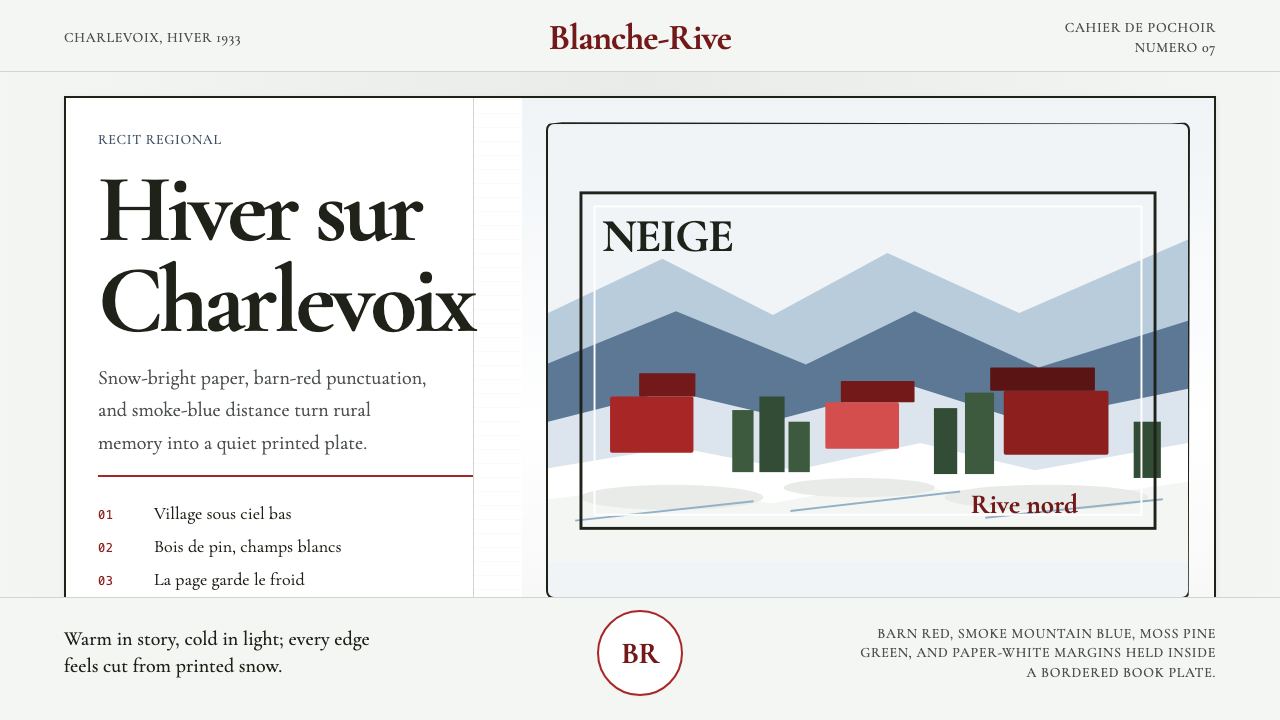
Flat stencil-cut snowfields, barn-red homesteads, and smoke-blue mountain shadows — Clarence Gagnon's pochoir illustrations for the 1933 deluxe Maria Chapdelaine set the visual grammar of Québécois folk naïf.
Quebec Clarence Gagnon Folk Naïf in brief
Quebec Clarence Gagnon Folk Naïf is a design aesthetic rooted in the pochoir illustration tradition that Clarence Gagnon brought to its highest expression in the 1933 luxury edition of Louis Hémon's novel Maria Chapdelaine. Pochoir — a French stencil-printing method that builds images through layered hand-cut masks — produces color fields of remarkable flatness and saturation, with clean edges between tones that feel simultaneously hand-made and architecturally precise. The style translates this technique into a visual system of flat stencil-cut color panels, picture-book compositions, and the quietly dramatic palette of a Charlevoix winter.
The aesthetic belongs to the broader tradition of Québécois folk narrative painting: images that tell communal stories, frame everyday rural life with gentle heroism, and treat the landscape not as backdrop but as protagonist. Snow is never merely white — it reads as the coolly luminous ground from which every warm accent (the red of a barn, the orange of a lantern, the olive of a frozen cedar) is made visible. Components in this visual language feel like illustrated story-page panels: self-contained, warm in spirit, and structured around the clarity of a single scene rather than the complexity of layered information.
What distinguishes the style from general folk illustration is its particular balance of naïve directness and craft precision. Gagnon was academically trained and had spent years in Paris absorbing post-Impressionist colorism before returning to paint the Charlevoix region. His folk naïf sensibility is therefore knowing rather than untutored — it borrows the flat plane, the frontal animal, the simplified horizon of traditional folk art while applying the careful color relationships of a trained painter. The result is a visual register that feels simultaneously ancient and considered: warm without being sentimental, simple without being crude.
Where does Quebec Clarence Gagnon Folk Naïf come from?
Clarence Gagnon was born in Montréal in 1881 and showed an early aptitude for painting the Québec countryside. After training at the Art Association of Montreal, he spent extended periods in Paris between 1904 and 1936, studying at the Académie Julian and absorbing the colorism of the Post-Impressionist and Symbolist circles that surrounded him. But unlike many Canadian artists who assimilated entirely into European modernism, Gagnon returned again and again to the Charlevoix region — particularly Baie-Saint-Paul and the villages of the lower Laurentides — where he developed a distinctive regionalist vision centered on winter landscapes, rural habitant life, and the particular quality of snow light under an overcast Quebec sky.
The Charlevoix region had become, by the early twentieth century, an informal artists' colony. Marc-Aurèle Fortin, Horatio Walker, and eventually Jean Paul Lemieux all painted there, drawn by the same qualities that Gagnon celebrated: the dramatic landforms of the St. Lawrence Escarpment, the insular village culture preserved since New France, and a light that flattened forms and clarified silhouettes in ways that suited painterly simplification. The Charlevoix art colony was neither a formal school nor a declared movement — it was a shared geography that produced a recognizable family of visual sensibilities.
The commission that crystallized Gagnon's folk naïf aesthetic came in the late 1920s, when the Paris publisher Mornay invited him to illustrate a luxury edition of Louis Hémon's Maria Chapdelaine — a novel first published in 1913 that had become the defining literary portrait of traditional Québécois rural life. Gagnon worked on the illustrations for several years, producing fifty-four pochoir plates that were hand-stenciled in Paris by specialist craftspeople under his supervision. The pochoir process suited his sensibility perfectly: its flat, bounded color fields echoed folk-art traditions while its layered precision allowed the subtle chromatic relationships — the way blue shadow falls across snow, the difference between a birch-white sky and a snow-white field — that distinguished his work from cruder folk illustration.
When the deluxe Maria Chapdelaine appeared in 1933, it was received as both an artistic achievement and a cultural monument — a refined embodiment of the Québécois folk imagination by a painter who had the technical training to formalize it without draining it of warmth. The book's visual language became enormously influential in Québec graphic culture, shaping poster art, book design, and eventually the broader visual vocabulary through which Québécois identity was represented throughout the twentieth century. Figures such as Jean Paul Lemieux extended the regionalist project in painting after the Second World War, while designers and illustrators continued to draw on the flattened palette, simplified composition, and narrative clarity that Gagnon had codified.
What defines the Quebec Clarence Gagnon Folk Naïf look?
Palette
The color range is anchored by three defining chromatic relationships: barn red against snow white, smoke-blue mountain shadow against the paleness of frozen sky, and moss-green pine silhouette against both. These hues are not bright primaries — they are the muted, mineral tones of a winter landscape seen under overcast light. Warmth comes in small doses (a lit window, a red sash, a chestnut horse) against expanses of cool neutrality. Secondary accents — the ochre of bare birch bark, the blue-gray of frozen water — are drawn from the same natural source, so the palette feels coherent even when extended across many elements.
Flat Color Fields
Color in this style is applied as flat, bounded areas rather than blended gradients. The pochoir technique from which the aesthetic derives produces clean stencil edges between color zones — sky meets hilltop in a crisp line, a horse's flank is a single unmodulated tone, a barn sits as a solid silhouette. This flatness is not crudeness; it is a deliberate formal choice that gives every composition clarity and graphic weight. Layered stencils produce occasional subtle overlaps where tones interact, but the overall impression is one of careful, bounded zones rather than continuous tonal gradation.
Pictorial Composition
Compositions are organized like picture-book panels: a strong horizon line divides sky from ground, figures and structures are placed with frontal clarity rather than perspectival depth, and the eye is guided by the rhythm of repeating shapes — a row of fence posts, a line of spruce trees, the curve of a road disappearing into the middle distance. This narrative clarity means every scene reads as complete in itself, with foreground elements framed against simplified backgrounds. The viewpoint is typically at eye level or slightly elevated, giving the spectator a position of gentle overview rather than dramatic immersion.
Snow as Ground and Light Source
Snow functions simultaneously as compositional ground, light source, and chromatic anchor. Under overcast winter sky, snow in the Charlevoix landscape does not reflect direct sunlight — it emits a diffuse, cool luminosity that is both bright and tonally restrained. In this style, the white or near-white of snow creates the lightest value in most compositions, making every other element — however muted — appear to glow against it. Blue shadow cast by trees or buildings across the snowfield is one of the style's most characteristic marks: a cold, clean blue-gray that reads more as atmospheric phenomenon than as cast darkness.
Hand-Set Serif Typography
Text in this tradition draws from the hand-set typefaces of early-twentieth-century Quebec book and poster printing: sturdy, optically balanced serifs with a slight irregularity of stroke that suggests craft process rather than mechanical precision. Type is treated as integral to the composition — title lettering may be sized to balance a large pictorial field, captions sit close to their images in a manner that recalls hand-annotation. The overall typographic register is warm and artisanal without being archaic or precious; it reads as the printed equivalent of the narrative clarity that governs the images.
Narrative Human and Animal Figures
Human figures and working animals are a constant presence: habitants bundled in winter coats, habitant women in bright sashes, horse-drawn sleighs, cattle in barn doorways, sled dogs. These figures are never idealized — they are sturdy, front-facing or in simple profile, rendered in a few flat tones with clear silhouettes. Their scale relative to the landscape conveys the folk narrative theme: people are of the land, neither dominating it nor dwarfed by it. Figures give each composition a human heartbeat without becoming sentimental portraits.
Quiet Drama of Season
The aesthetic carries the emotional register of a Charlevoix winter: silence, endurance, and a kind of beauty that asks to be noticed slowly. There is no bombast — compositions do not strain for grandeur. Instead, they accumulate quiet drama through the contrast of warmth against cold, shelter against open exposure, the human mark against the indifferent white field. This emotional restraint is part of the style's character; it reads as dignity rather than distance, as observation rather than sentiment.

Who shaped Quebec Clarence Gagnon Folk Naïf?
Gagnon is the central figure through whom the folk naïf aesthetic was formalized. Born in Montréal, he spent formative years at the Académie Julian in Paris while maintaining a deep attachment to the Charlevoix region. His fifty-four pochoir illustrations for the 1933 Maria Chapdelaine are the canonical expression of the style: flattened color, pictorial clarity, and a winter palette that became the visual language of Québécois regional identity. He was also a respected printmaker and plein-air landscape painter, but the Maria Chapdelaine commission remains his most culturally resonant achievement.
The French-born writer whose novel Maria Chapdelaine provided the literary substrate that Gagnon illustrated. Hémon spent only fourteen months in the Lac-Saint-Jean region of Québec before his death, but his careful observation of habitant life — the seasonal rhythms, the religious faith, the relationship between family and land — produced a portrait so accurate and sympathetic that it became a foundational text of Québécois cultural identity. The novel's subject matter — its frost, its isolation, its quiet heroism — is inseparable from the visual world that Gagnon built around it.
A major Québécois painter who shared Gagnon's attachment to the rural and working-class landscape of Québec, though his palette and technique diverged significantly. Fortin worked often with watercolor and developed a distinctive vision of the elms of Sainte-Rose and the Montreal waterfront, using flat color and strong outline in ways that parallel the folk naïf sensibility. His work extends the regionalist tradition into a more expressively colored and emotionally direct register, and he stands alongside Gagnon as one of the defining figures of the Charlevoix and greater Québec visual tradition.
The painter most associated with carrying the Québécois regionalist tradition into the second half of the twentieth century. Lemieux's mature work shares the folk naïf aesthetic's love of simplified horizon lines, solitary figures in vast winter landscapes, and muted seasonal palettes — but extends these toward a metaphysical quietude that goes beyond illustration. His figures are often isolated against near-empty snowfields, giving the folk naïf visual vocabulary an existential weight that influenced later Québécois visual art and graphic design.
How do you use Quebec Clarence Gagnon Folk Naïf today?
Quebec Clarence Gagnon Folk Naïf is well suited to contexts where warmth, cultural specificity, and narrative authenticity are primary values — the opposite of contexts that call for technological coolness or corporate abstraction. The style's strengths are its ability to make a viewer feel located in a particular place and time, to make data or content feel curated and hand-considered, and to carry emotional warmth without tipping into saccharine sentimentality. Applied well, it creates the sense that a human hand was involved in every decision.
For presentation slides, the style works best on covers and section dividers that carry an atmospheric, story-opening quality. A cover page might use a large flat-color composition — a simplified snowfield, a silhouetted structure — as the full bleed background, with title text in a robust serif placed in a white or cream panel that floats over the image like a book title. Content slides should maintain the palette's restraint: use the barn red or smoke blue sparingly for emphasis, keep backgrounds in the near-white or cream range, and let the composition breathe. Data slides can take on the style's pictorial clarity by treating charts as flat geometric fields — bar charts in the muted warm tones, background gridlines in the lightest possible grey.
For web interfaces and digital products, the style suits editorial platforms, cultural organizations, food and heritage brands, and any product where craft narrative and regional authenticity are part of the value proposition. The approach: use a generous off-white or snow-white background as the dominant ground, apply barn red or smoke blue as the single primary interactive accent, and structure content in clear panel-like blocks that echo the pictorial composition of the source illustrations. Navigation should be typographic and clean; icon use should be minimal and when icons appear, they should feel drawn rather than constructed — simple closed silhouettes rather than multi-weight line icons.
For editorial and marketing design, the style supports a storytelling-forward approach that reads as both warm and considered. A heritage brand's marketing page might alternate full-width image panels (flat color illustrations or photography treated in the style's palette) with text panels in an off-white field and a sturdy serif. Pull quotes sit in the margin in a smaller weight of the same typeface. Marketing materials for cultural events, winter tourism, or food-and-craft brands are natural homes for the aesthetic. The palette's coherence means it remains effective at smaller scales — postcards, social media tiles, and in-store signage all carry the same visual register.
A common mistake when applying this style is overloading it with decorative folk motifs — quilt patterns, botanical borders, folk-art flourishes — that conflict with its essential flatness and pictorial restraint. The Gagnon folk naïf aesthetic is not a folk-art sampler; it is a refined, trained eye's interpretation of folk visual culture. Ornament that is not structural or narrative should be removed. A second frequent error is allowing the palette to become too warm overall: the snow white and cool blue shadow are as essential to the style as the barn red. Removing the cool anchor allows the warm tones to tip into a generic rustic aesthetic that loses the style's defining quality — the cool bite of a Charlevoix winter.
Quebec Clarence Gagnon Folk Naïf — FAQ
What makes this style different from general folk illustration or rustic design?
The distinction lies in the trained eye behind the naïve surface. Gagnon spent years absorbing Post-Impressionist colorism in Paris before applying it to Charlevoix folk subjects, which means his color relationships are carefully calibrated even when they appear simple. The style differs from generic rustic design in its cool chromatic anchor — the snow white and blue shadow that prevent warmth from becoming cloying — and in its compositional control, which is picture-book clear rather than decoratively complex. Genuine rustic or country folk aesthetics tend toward more pattern, more layering, and a warmer overall register. This style is quieter, cooler, and more formally disciplined.
Can this style work effectively in digital interfaces, or is it inherently print-oriented?
The style translates well to digital interfaces precisely because its foundational properties — flat color, clean edges, high tonal contrast between elements — are native to screen rendering rather than in tension with it. The pochoir technique produced flat bounded fields long before screens existed; those same properties that make screen colors vivid also suit this visual language. The main adaptation required is handling the snow-white ground carefully on bright screens, where pure white can feel harsh. An off-white or very slightly warm white preserves the style's luminous quality without the clinical brightness of full-white digital backgrounds.
How should this style handle photography or photographic imagery?
The style's relationship with photography requires deliberate curation. Full-color naturalistic photography imported directly tends to disrupt the palette's coherence and the compositional flatness that the aesthetic depends on. Photography works best when treated as a tonal field — converted to a limited palette duotone using the style's smoke-blue and near-white, or cropped to foreground silhouettes that echo the flat pictorial clarity of the pochoir illustrations. Winter landscape photography with overcast skies and snow-covered ground requires the least adaptation, since its inherent palette already aligns with the style. For editorial use, treating photography as a texture within a larger flat color composition — rather than as the hero element — preserves the style's visual coherence.
Is this style appropriate only for Canadian or Québécois cultural contexts, or can it be applied more broadly?
The style's cultural specificity is real but does not confine it to strictly regional applications. The underlying visual properties — flat color fields, pictorial composition, a cool luminous ground with warm accent tones, narrative human scale — are transferable design qualities that resonate wherever craft warmth, winter aesthetics, or thoughtful regionalism are valued. The style finds natural applications in winter tourism, heritage food and beverage brands, publishing design for narrative non-fiction, and cultural institutions across many geographies. What transfers is the aesthetic sensibility; what does not transfer automatically is cultural appropriation — using the specific symbols of Québécois rural life (habitant dress, snowshoe trapping culture, French-Canadian folk religious imagery) outside that cultural context requires care and intentionality.
How does this style differ from other winter or Scandinavian folk aesthetics it might be confused with?
The most important distinguishing feature is the cool luminosity of the snow ground versus the warmer, candlelit intimacy of Nordic folk aesthetics. Scandinavian folk traditions — the Swedish Dalarna style, Norwegian rosemaling, Finnish folk textiles — tend toward denser pattern-work, symmetrical motifs, and a warmer amber or red-dominant palette that evokes indoor firelight and textile craft. The Gagnon folk naïf aesthetic is outdoor and landscape-centered: its warmth is accent rather than dominant, and the overarching impression is of cool, open, snowy space rather than warm enclosure. Its compositions are simpler and less pattern-based, with a narrative pictorial scene as the organizing unit rather than a decorative repeating motif.
Related design styles
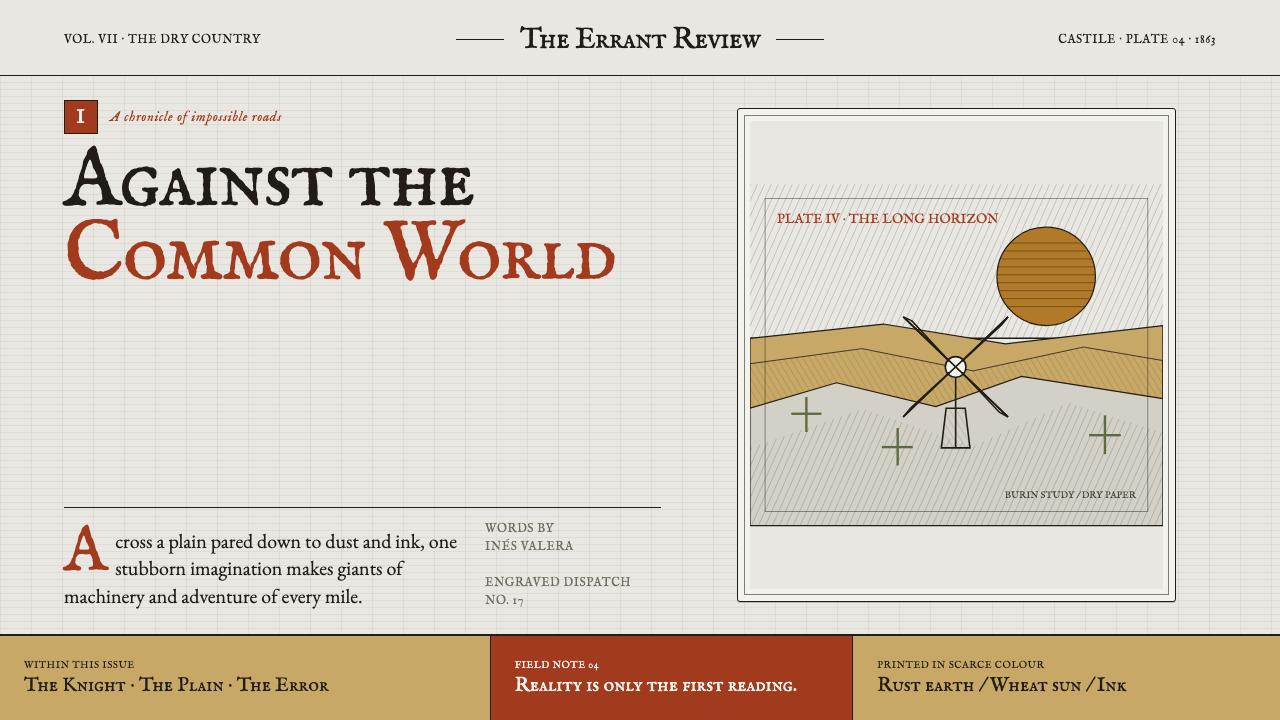 Don Quixote (1605)Imagination defies the plain. Rust capitals and cross-hatched ink score a dry…
 Winnie-the-Pooh (1926)Wonder lives in the white space. Loose sepia lines meet one small spot of hon…
 Fado SaudadeSaudade in shadow. Mourning black holds wine red, honey wood, and one gold li…
 Kashmiri Crocus PurpleAbundance of one hue, scarcity of its complement. Crocus violet under mist, o…
 Mawson's Hut ExpeditionAn archive that stays at work. Buff survey paper, slab type and frost-thin ru…
 Moby-Dick (1851)White space becomes open sea. Ink-navy rules and oxblood bearings pull across…