What is Post-it Canary Yellow (1980)?
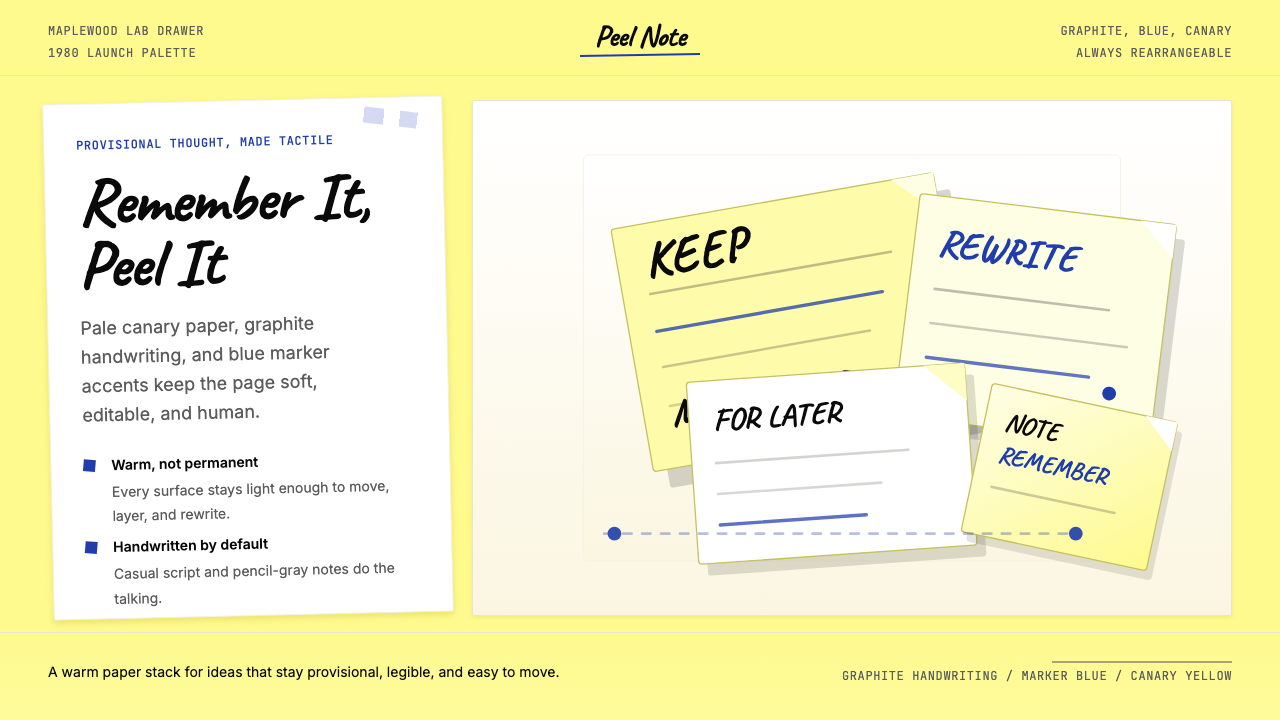
The most recognizable shade of yellow in the modern office was never designed — it was an accident of scrap paper, a failed adhesive, and six years of patient waiting.
Post-it Canary Yellow (1980) in brief
Post-it Canary Yellow is a design system rooted in the visual vernacular of the sticky note: a pale, slightly warm yellow ground, graphite-toned handwriting, occasional blue marker accents, and the slightly imprecise, tilted geometry of a paper square peeled from a pad and pressed onto a surface. It is a system that makes the provisional feel intentional — the aesthetic of a thought in progress.
Where many historical design languages emerge from artistic manifestos or institutional programs, Post-it Canary Yellow emerged from corporate accident: a 3M lab, a low-tack adhesive that failed to bond permanently, and the particular yellow of whatever scrap paper happened to be nearby. That origin — humble, unplanned, warmly functional — is inseparable from what the style communicates. It says: this is human, handwritten, not yet final, and that is perfectly fine.
Visually, the system is distinguished by its warmth and approachability. The dominant ground is a soft, slightly creamy yellow — not a saturated primary, but a muted, paper-like tone that reads as inviting rather than urgent. Letterforms lean toward the handwritten and informal. Accents in cool marker-blue or graphite-grey punctuate the yellow field, echoing the way a real sticky note accumulates layers of ink. Slight tilts, soft drop shadows, and paper-edge effects reinforce the tactile quality of physical notes without tipping into skeuomorphic excess.

Where does Post-it Canary Yellow (1980) come from?
The story begins in 1968, when Spencer Silver, a chemist at 3M's central research laboratory in Maplewood, Minnesota, was attempting to develop a strong, permanent adhesive. What he synthesized instead was a microsphere-based compound that bonded lightly and — crucially — could be removed and repositioned without leaving residue. Within 3M, Silver spent years presenting his discovery at internal seminars, convinced it had potential, but unable to identify a commercial application. The adhesive was too weak to hold things firmly; that was, everyone assumed, its fatal flaw.
The application arrived through another 3M employee, Arthur Fry, who attended one of Silver's seminars in 1974. Fry sang in his church choir and was frustrated that his paper bookmarks kept falling from his hymnal. Silver's adhesive, he realized, was precisely what he needed: a way to mark pages that would hold gently but peel away cleanly. He coated strips of paper with Silver's compound and found they worked exactly as he had imagined. But neither Fry nor Silver initially considered what color that paper should be. The yellow — the specific canary yellow that became the note's defining visual identity — came from the scrap paper available in the lab next door. It was an arbitrary starting point that became permanent.
3M test-marketed the product as Press 'n Peel in 1977, with limited success. The reformulated product, renamed Post-it Notes, launched nationally in the United States in 1980. Geoff Nicholson, the product's development manager, and his team drove the commercialization strategy that transformed a laboratory curiosity into a universal office staple. The canary yellow was retained not from any aesthetic research but from manufacturing consistency: changing the color would have meant changing the supply chain. By 1981, Post-it Notes were named one of the best new products of the year by major business publications, and the yellow was already becoming inseparable from the concept of the sticky note itself.
The cultural resonance of Post-it Yellow deepened through the 1980s and 1990s as knowledge work — strategy sessions, brainstorming workshops, design sprints — adopted the physical act of writing on yellow squares as a primary thinking tool. The color took on meaning beyond its material origin: it became shorthand for provisional thought, for the moment before a decision is made, for collaborative intelligence that has not yet been formalized. By the time digital interfaces began simulating sticky notes as interface widgets in the early 2000s, the canary yellow was so deeply coded as a cognitive aid that any digital equivalent needed to inherit it, or risk being unrecognizable.
What defines the Post-it Canary Yellow (1980) look?
Ground Color
The defining element of this system is its ground: a warm, muted yellow that evokes paper rather than paint. It sits closer to a cream-yellow than to a saturated primary, carrying the tactile suggestion of a physical substrate. This softness is what separates the aesthetic from the aggressive yellows of warning labels or taxi livery — it invites rather than alerts. The warmth comes from a slight orange undertone that prevents the yellow from reading as cold or acidic.
Handwriting and Informal Type
Typography in this system leans toward the informal and the handmade. Where other design languages pursue mechanical perfection in letterforms, Post-it Canary Yellow privileges the slight irregularity of the written gesture — letterforms that carry the suggestion of a pen or pencil moving across paper. This does not mean illegibility; it means a warmth and personality that rigid geometric type cannot provide. The contrast between an informal written headline and a quieter, more neutral secondary text reinforces the note-like quality of the composition.
Tilt and Imprecision
Real sticky notes are never perfectly aligned. They are pressed on at a slight angle, catch a corner of air, or overlap each other with casual disregard for the grid. This system embraces that imprecision as a design principle. Cards, panels, and image frames are set at slight rotations. Stacking and layering are used to suggest accumulation rather than order. The effect communicates spontaneity and human decision-making — things were put here because they mattered, not because a template required it.
Graphite and Marker Accents
Against the warm yellow ground, two accent registers appear: the cooler, darker tone of graphite — evocative of pencil marks, ballpoint scrawls, and the neutral grey of printed text — and the brighter, more deliberate blue of a marker pen. Graphite handles body text and secondary information, staying subordinate to the yellow. Marker blue punctuates: underlines, circles, arrows, the marks someone makes when reviewing a note rather than writing it. Together these accents preserve the system's specificity without departing from the immediate world of the physical sticky note.
Paper-Edge Physicality
The physical sticky note has an edge — a slight shadow, a curl, the gummed top strip that suggests it came from a pad. This system references those material details with restraint: a faint drop shadow cast at a consistent angle, a slightly rough or uneven border, the visual cue that what you are seeing was placed here rather than always belonging. These physical references stop short of full skeuomorphism; they provide depth and presence without pretending to be something other than a screen.
Warmth Over Perfection
Perhaps the most fundamental quality of this system is its willingness to be imperfect. Unlike design languages that aspire to mechanical precision or minimalist purity, Post-it Canary Yellow treats slight irregularity as a feature. The system's visual warmth comes from its association with human gesture — the hand that wrote on the note, the finger that pressed it to the wall. Designs in this style should feel touched rather than generated, chosen rather than optimized.
Layering as Information
In the sticky-note workspace — a whiteboard covered in overlapping notes, a wall of clustered ideas — layering is itself a form of communication. Notes in front matter more, or came later; notes at the periphery are tangential; notes that overlap share a connection. This system translates that spatial logic into digital and print contexts through deliberate overlapping of cards, slight z-ordering of panels, and grouped clustering of related elements. Hierarchy is spatial as much as typographic.

Who shaped Post-it Canary Yellow (1980)?
Silver joined 3M's central research laboratory in 1966 and in 1968 synthesized the pressure-sensitive microsphere adhesive that would eventually become the functional foundation of Post-it Notes. For six years, he actively promoted the adhesive within 3M through internal seminars, convinced of its potential despite the absence of an obvious application. His persistence in championing a solution in search of a problem is a canonical story in innovation history — and a reminder that the most enduring inventions are sometimes the ones that take the longest to find their purpose.
Fry was a 3M product development researcher who, in 1974, connected Silver's adhesive to a practical problem he experienced personally: choir bookmarks that would not stay in place. His insight was not technical — Silver had already solved the chemistry — but conceptual: he recognized that a weakness (impermanent bonding) was actually a feature (repositionability). Fry's prototype, made at his home with strips of paper coated in Silver's compound, demonstrated the core interaction that has remained unchanged since 1980.
Nicholson served as the commercial development manager who drove Post-it Notes from an internal 3M prototype to a nationally distributed product. The path was not straightforward: the initial test marketing under the Press 'n Peel name in 1977 underperformed, and only after a direct sampling campaign — giving the product away to users in Boise, Idaho in what became known as the Boise Blitz — did its viral adoption demonstrate market potential. Nicholson's team understood that Post-it Notes had to be experienced to be understood; this insight shaped both the marketing strategy and the product's eventual ubiquity.
The institutional context for Post-it Notes — 3M's culture of allowing researchers to spend a portion of their time on independent projects, known informally as bootlegging — is as important as any individual inventor. Silver's adhesive would likely have been discarded at a company with stricter project-termination criteria. The laboratory culture that permitted Silver to pursue a solution without a problem, and that kept his discovery alive through internal seminars for six years, is itself a design for innovation: one of the few documented cases where institutional patience produced a product used by billions.
How do you use Post-it Canary Yellow (1980) today?
Post-it Canary Yellow is a style built around human impermanence and collaborative thought, which makes it well-suited for contexts where participation, creativity, and iteration are the primary values. Before applying it, designers should ask whether the product or communication benefits from appearing provisional and inviting — because that is what this aesthetic communicates. It is the wrong choice for contexts requiring authority, formality, or technical precision; it is the right choice when the goal is to feel approachable, generative, and open.
For presentation slides, the system works at two distinct registers: cover slides and ideation or workshop slides. A cover built in this style might feature a large tilted yellow card dominating the frame, with the title in a slightly informal letterform and a single graphite or blue accent mark. The composition should feel slightly off-center — as if the card was placed by a hand rather than positioned by a template. Content slides in brainstorm or planning presentations benefit from the clustered sticky-note layout: groups of yellow cards at slight angles, each containing one idea, organized into loose spatial clusters that communicate relationship without imposing rigid hierarchy. Data slides are more challenging in this style; when used, charts should be simplified to their most essential geometry, embedded in a yellow card, and annotated in handwriting-like type rather than presented as polished infographics.
For web and digital product interfaces, the style is most at home in tools centered on note-taking, planning, project management, and creative collaboration — Kanban boards, mind-mapping tools, digital whiteboards, brainstorming features. Dashboard applications can use the aesthetic to distinguish a notes or comments panel from more formal data displays, creating a visual language where the yellow zone signals human input and the neutral zone signals system data. Pricing pages and onboarding flows can use yellow card components to highlight key information in a way that feels friendly rather than promotional — the note quality implies the team put this here specifically for you to see, rather than that it was placed by a marketing algorithm.
For editorial and marketing work, the style supports content that aims to feel personal, direct, and slightly urgent without the hard-edged urgency of red-and-black alert aesthetics. A campaign built around this palette might use yellow card compositions as a recurring motif — the brand is leaving you a note, literally. Social media cards benefit from the style's informal quality: a tilted yellow frame, a handwritten-style message, a graphite or blue accent. Print collateral in this style works well for creative industries, educational institutions, and technology companies that want to communicate approachability and collaborative culture. The style should never be pushed toward high gloss or extreme production values — perfection undermines the handmade quality that gives it its warmth.
A common mistake when applying Post-it Canary Yellow is using a fully saturated, aggressive yellow rather than the softer, slightly muted canary tone that defines the original product. The system's warmth depends on that specific quality of yellow — one that reads as paper rather than as signal. A second frequent error is over-tilting and over-layering: a composition where every element is rotated and stacked reads as chaotic rather than spontaneous. Reserve the tilt and layering for one or two focal elements and let the rest of the composition settle into quieter alignment. Finally, the handwriting quality of type should complement the yellow, not compete with it — if the letterforms are too ornate or too childlike, the result feels playful rather than thoughtful.

Post-it Canary Yellow (1980) — FAQ
Is Post-it Canary Yellow the same as any warm yellow, or is the specific tone important?
The specific tone is essential to the system's meaning. The original canary yellow reads as paper — warm, slightly muted, with a softness that prevents it from signaling urgency or danger. A fully saturated primary yellow tilts toward signal and warning; a cooler, greener yellow loses the warmth that gives the system its human quality. Designers applying this style should resist the temptation to use a 'more vibrant' yellow on the grounds that it will be more visible. The quieter tone is part of the communication: this is a note, not a headline.
Can this style work in a dark or night-mode interface?
Dark mode is possible but requires significant adaptation. The yellow-on-dark combination is inherently high-contrast and risks reading as warning or alert rather than as the warm, provisional quality the style depends on. A dark variant works best when the yellow is used sparingly — as a card accent or a highlight rather than as the primary ground — and when the dark background is warm-toned rather than pure black. A deep warm grey or dark brown ground allows the yellow to retain its paper-like quality rather than appearing to glow electrically.
How do you maintain hierarchy and readability when the dominant surface is yellow?
Hierarchy in this system is established primarily through the contrast between the yellow ground and the darker tones placed on it — graphite for body text and secondary information, near-black for primary headings, marker blue for emphasis. The yellow ground should carry minimal direct text; it functions as a field, not a page. When more text-heavy content must sit on yellow, reduce the saturation of the yellow slightly and use a deeper, weightier typeface to ensure sufficient contrast. For complex information, allow white or light-grey panels to appear within the yellow field — the yellow frames them, rather than serving as the primary reading surface.
What kinds of products and industries is this style least suited for?
Post-it Canary Yellow struggles wherever precision, authority, or formality are essential signals. Financial services products requiring trust and stability, legal or medical platforms where clinical clarity is expected, luxury goods where the handmade quality would undermine perceived value, and security or emergency systems where yellow carries warning connotations — all of these are poor fits. The style also underperforms in contexts requiring rich imagery or photography as a primary communication mode, because the yellow ground competes with photographic color rather than supporting it. The honest framing: this aesthetic says 'quick, handmade, provisional.' If your product needs to say the opposite, choose a different system.
How is Post-it Canary Yellow different from broader 'playful' or 'friendly' design systems?
The distinction lies in specificity. Many 'playful' design systems rely on rounded corners, bright multicolor palettes, mascot illustrations, and oversized type to signal approachability. Post-it Canary Yellow is narrower and more precise: its friendliness comes from a specific historical object — the physical sticky note — and from the cognitive associations that object carries: temporary thought, collaborative work, ideas in process. The style is approachable without being childlike, informal without being careless. Its warmth comes from the suggestion of human gesture rather than from visual sweetness. This specificity is its strength and its constraint: the style communicates a particular kind of human context, not friendliness in the abstract.
Related design styles
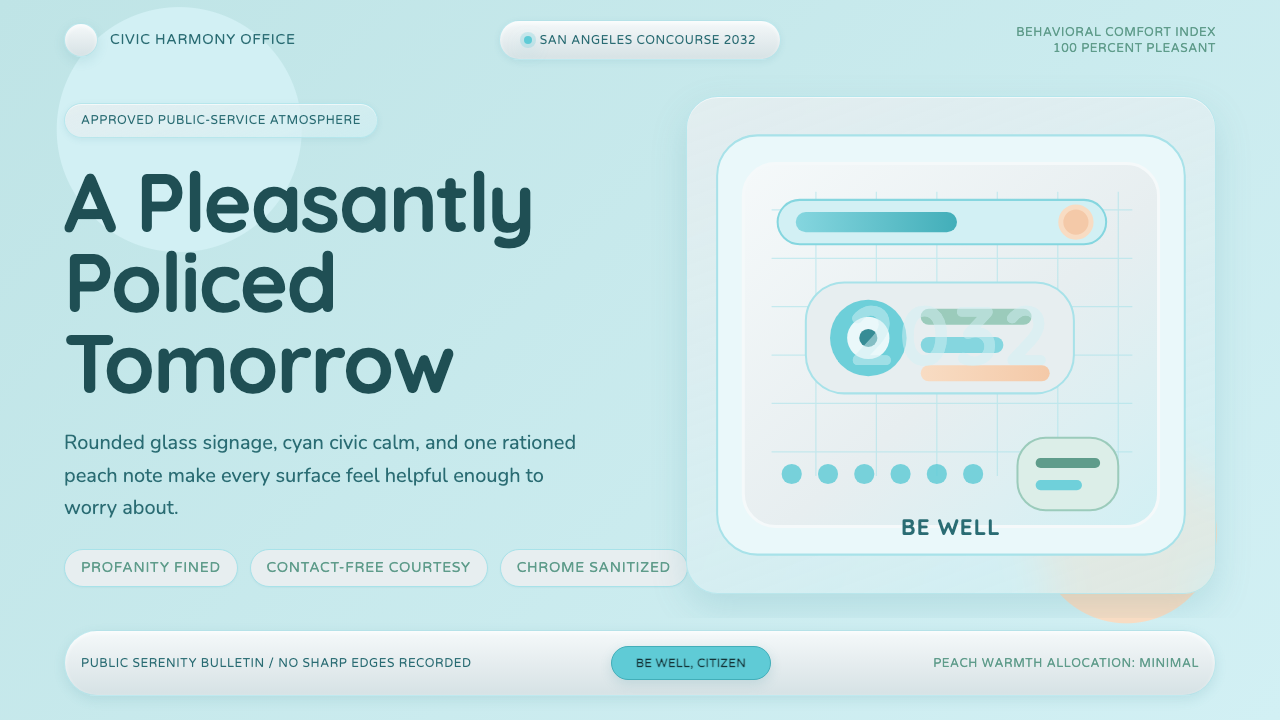 Demolition ManToo clean to trust. Pastel cyan glass, rounded civic signage, one peach warni…
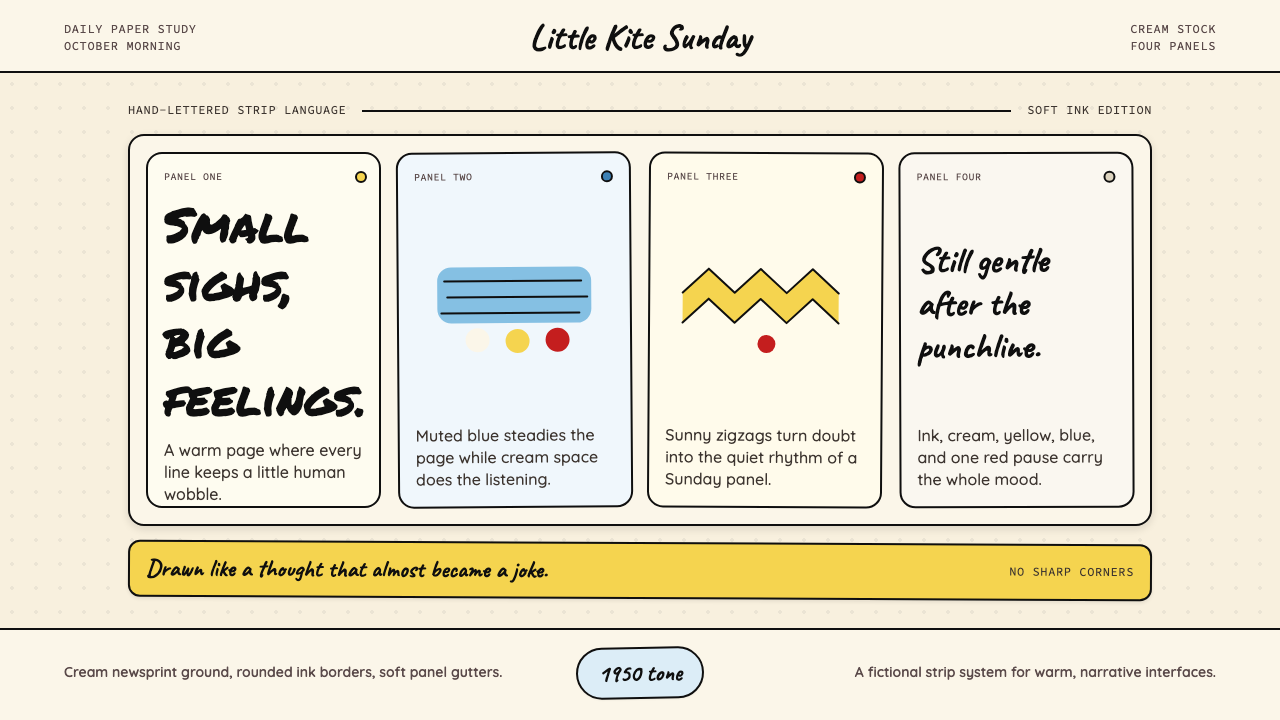 Peanuts Comic Schulz (1950)Gentle melancholy on newsprint. Caveat lettering, cream panels, yellow and bl…
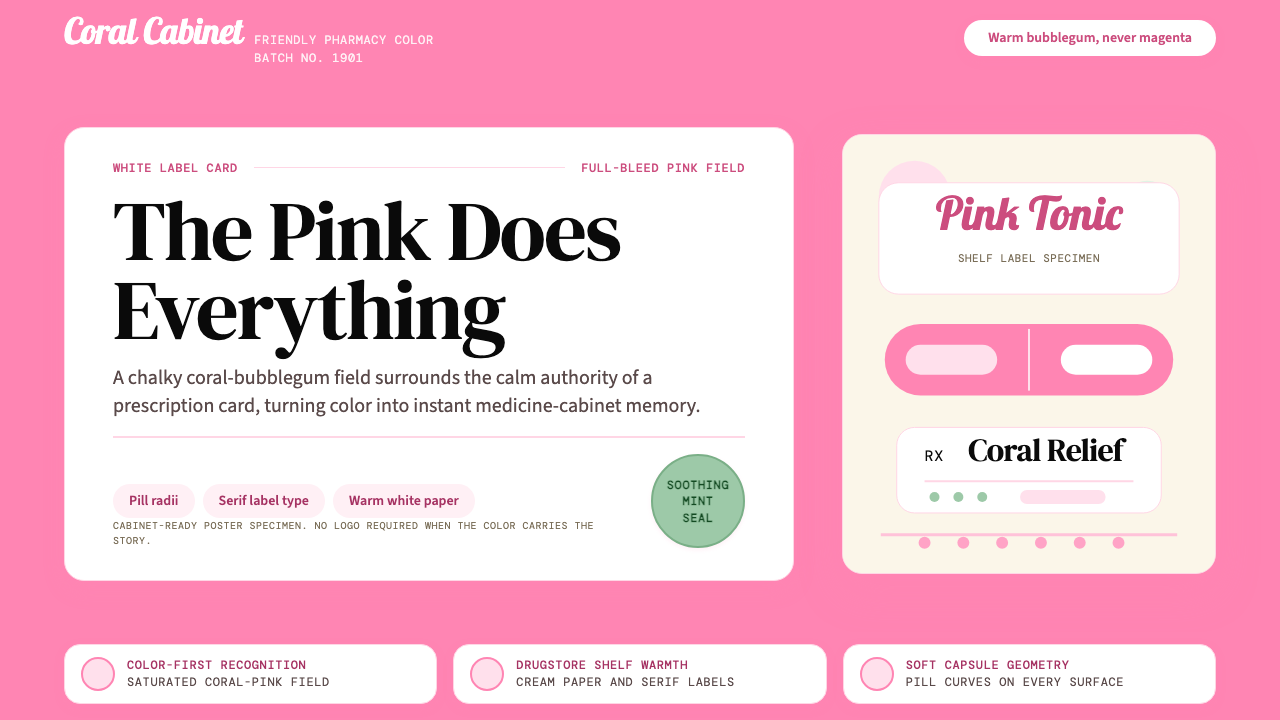 Pepto-Bismol Pink (1901)Color is the cure. Bubblegum pink floods the field; white label cards and pil…
 Friends Central Perk (1994)Sitcom warmth, turned TV-bright. Grape walls, couch orange, and bouncing colo…
 HeinekenEmerald owns the field. White label, red star, gold line, and condensed type…
 Nickelodeon Orange Splat (1984)Kids own the screen. Orange fields, slime-green pops, and wobble borders do t…