What is Plains Ledger Drawing?
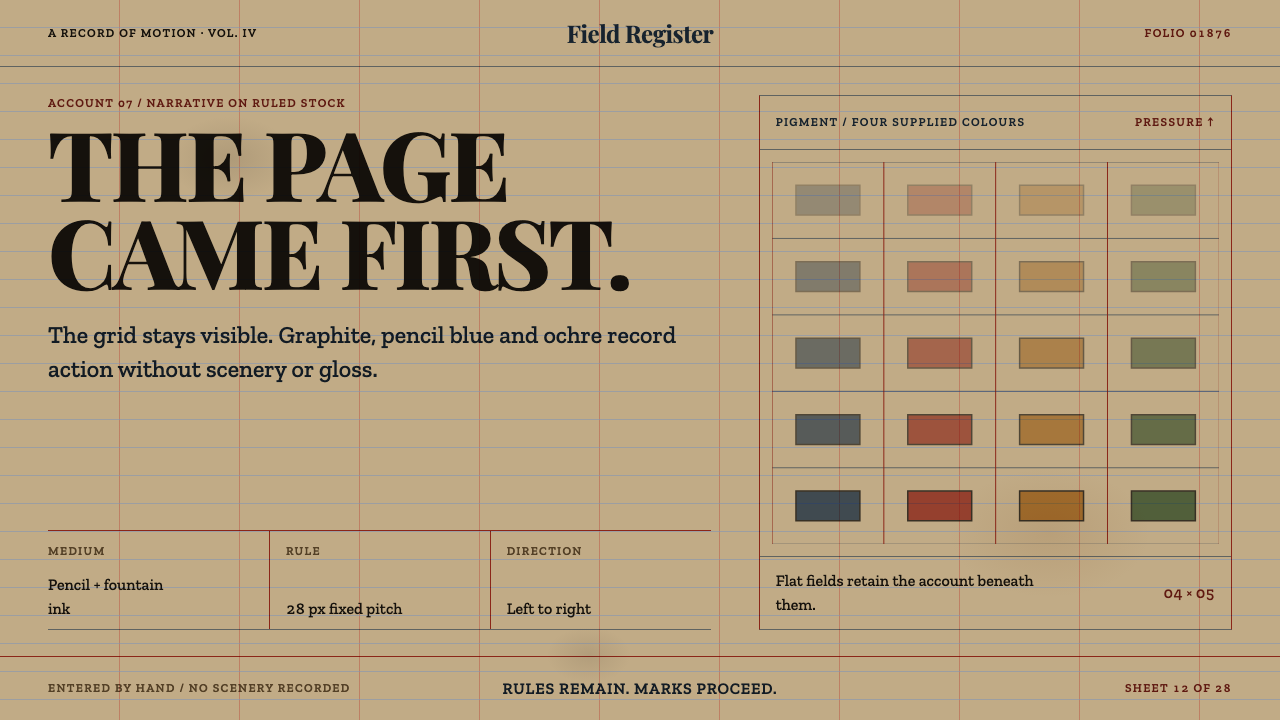
Plains ledger art never painted over the trader's blue and red account rules — it drew straight across them, letting a stranger's grid witness a narrative tradition that had lived on buffalo hide for generations.
Plains Ledger Drawing in brief
Ledger art exists because two unrelated things happened to be available in the same place at the same time: traders, government agents, and army officers carried surplus account-book paper, and Plains artists carried a narrative drawing tradition that had run for generations on buffalo hide. When hide became scarce, artists moved that same visual language onto whatever paper was at hand, and the ledger book's pages — already printed with the ruled lines of someone else's bookkeeping — became the surface. Nothing about the underlying financial grid was altered to accommodate the new use; it simply stayed where it was, printed, while an entirely different kind of record was drawn directly on top of it. The surface was never chosen for its own visual qualities; it was chosen because it was there, and the style is inseparable from that circumstance.
The compositional convention that resulted is immediately recognisable: horizontal processions of mounted men, moving in profile across the page in a single direction, rendered in hard outline and filled with flat, even colour. There is no background, no landscape, no incidental detail — only the figures and their action, arranged in a line the way a written sentence runs left to right. The economy is total: everything not essential to identifying who is depicted and what they are doing is left out. A reader unfamiliar with the specific event depicted can still follow the sequence of action simply by reading the procession from one side of the page to the other.
What makes the style distinct, though, is what is deliberately left visible underneath. The ledger's own printed blue horizontal rules and red vertical column rules are never painted over or worked around — they run straight through the bodies of horses and riders exactly as printed, and the drawing is composed against them rather than in spite of them. A financial record and a war narrative occupy the same surface at once, each fully legible, neither erasing the other.
Where does Plains Ledger Drawing come from?
The tradition developed roughly between 1870 and 1920, a period in which Plains nations across North America were experiencing depleted buffalo herds, increasing contact with settlers and the military, and confinement to reservations — all of which reduced access to the hide that had previously carried the same narrative drawing tradition, while simultaneously increasing contact with traders and officials who had discarded account paper to spare.
The specific materials available shaped the palette as directly as the paper shaped the composition. Artists worked with pencil, crayon, pen-and-ink, and occasionally watercolour — whatever traders and missionaries happened to supply — and the resulting colour never exceeds the saturation those materials are capable of. This is not a stylistic restraint chosen for its own sake; it is the visible trace of exactly what was in the box at the time, muted rather than paint-bright by material necessity.
Between 1875 and 1878, a group of Southern Plains artists, including Howling Wolf, were held as prisoners at Fort Marion in St. Augustine, Florida. Confined and separated from their communities, this group produced a significant body of ledger art during imprisonment, using the drawings both to record memory and, in some cases, to sell to visitors — turning the same visual tradition into both testimony and a means of survival under confinement. That the same horizontal-procession convention could serve both purposes at once, private memory and a transaction with a curious outsider, says something about how durable the underlying visual grammar was.
The tradition continued into the reservation era through artists such as Black Hawk, Silver Horn, and Amos Bad Heart Bull, who carried the horizontal-procession convention forward to document specific historical events, war exploits, and communal life. At a time when many other forms of cultural and political expression were being actively suppressed, ledger art remained a way to record tribal history in a visual language that could still be practised.
What defines the Plains Ledger Drawing look?
Visible Underlying Grid
The ledger paper's own printed blue horizontal rules and red column rules remain fully visible beneath and through every figure, never painted over or avoided.
Hard Outline, Flat Fill
Figures are drawn with a firm, unbroken outline and filled with flat, even colour — no shading, no gradient, no modelling of form through light and shadow.
Horizontal Procession
Mounted figures move in profile in a single direction across the page, arranged as a linear sequence rather than a centred or symmetrical scene.
Muted, Material-Bound Palette
Colour never exceeds pencil- or crayon-level saturation, since those were the actual materials available — the palette is a direct trace of what artists had on hand, not a chosen aesthetic restraint.
Scene Economy
No background, landscape, or incidental detail is included — only the figures and their action, with the ground plane implied entirely by the procession line itself.
Documentary Purpose
Each drawing typically records a specific event — a war deed, a ceremony, an episode of daily life — so the style carries a narrative and historical function embedded directly in its form.
Who shaped Plains Ledger Drawing?
Howling Wolf was among the Southern Plains artists held as prisoners at Fort Marion between 1875 and 1878, producing ledger drawings during imprisonment that documented memory and experience under confinement using the same horizontal-procession convention.
Black Hawk carried the ledger art tradition into the reservation era, using the same hard-outline, flat-fill procession style to document historical events and communal life at a time when many other forms of expression were being suppressed.
Silver Horn continued the ledger drawing tradition through the reservation period, applying its documentary conventions to record specific events in a visual language that remained legible and practisable under changed circumstances.
Amos Bad Heart Bull produced ledger art documenting tribal history and events, extending the tradition's function as a form of visual record-keeping well into the reservation era.
How do you use Plains Ledger Drawing today?
For presentation slides, this style translates well into content pages that use a faint, printed ruled-line background — thin horizontal and vertical rules suggesting an account grid — with bold, flat-colour icons or figures arranged in a single horizontal row across the page, exactly echoing the procession convention. The grid should stay visible under the figures rather than being hidden behind them.
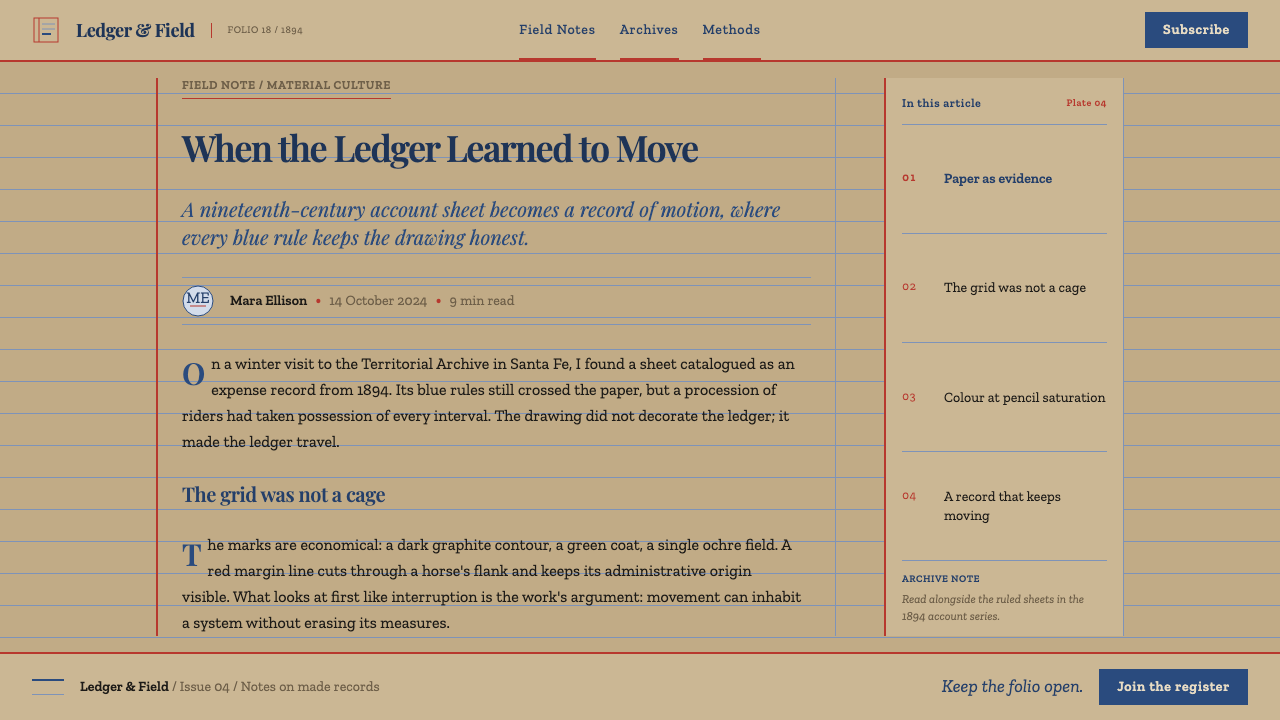
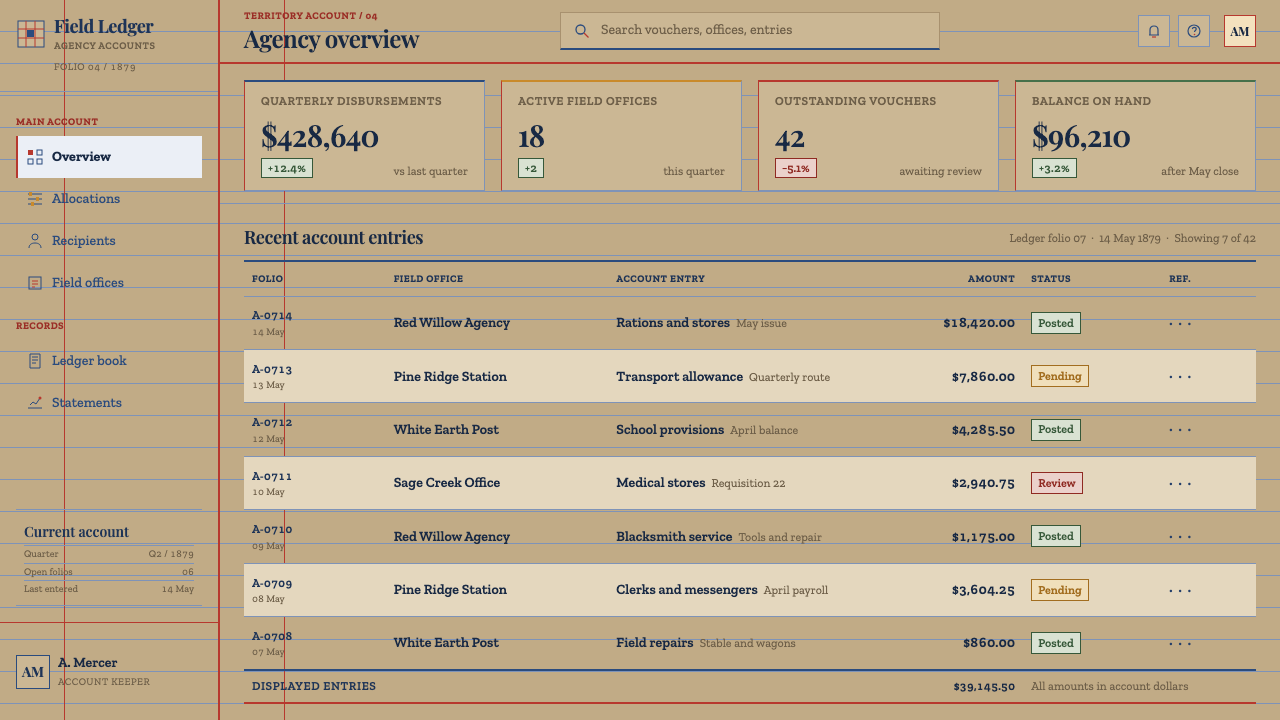
In web interfaces, the visible-grid device works surprisingly well for tables and data displays: literal ruled lines as a background texture, with data points or status icons rendered as flat, hard-outlined silhouettes rather than photographic or gradient-shaded elements. This gives a dashboard a documentary, ledger-like credibility that a plain flat design lacks.
For editorial and historical storytelling content, a row of flat-colour, hard-outline figures marching left to right makes an effective timeline device — each figure representing one event in sequence, composed against a faint rule-grid background rather than a plain white field.
Marketing or brand applications that want to evoke authenticity, documentation, or historical record can use the grid-plus-procession device as a recurring section motif, but should keep colour firmly at pencil or crayon saturation rather than jumping to bright, print-level colour, since that saturation level is central to the style's credibility.
The most common mistake is removing or hiding the underlying grid to "clean up" the design — this defeats the entire concept, since the tension between the printed financial grid and the drawn narrative on top of it is the style's defining feature. A second common mistake is oversaturating the colour palette beyond what pencil or crayon could produce, which erodes the material honesty the style depends on. A third is adding background or environmental detail behind the procession of figures — the style's economy depends on the figures and their action standing alone against the grid, with nothing else competing for the viewer's attention.
Plains Ledger Drawing — FAQ
Why is the ledger's printed grid left visible instead of painted over?
The visible grid is central to the style's meaning: a financial record made by traders or officials and a narrative tradition carried by Plains artists occupy the same surface at once, each fully legible. Painting over the grid would erase that juxtaposition entirely.
Why does the colour in ledger art always look muted rather than vivid?
The materials available — pencil, crayon, pen-and-ink, occasional watercolour, supplied by traders and missionaries — never reach the saturation of printed ink or paint. The muted palette is therefore a direct material trace, not a chosen aesthetic.
What was the Fort Marion group?
Between 1875 and 1878, a group of Southern Plains artists, including Howling Wolf, were held as prisoners at Fort Marion in St. Augustine, Florida, where they produced a significant body of ledger art documenting memory and experience under confinement.
Is ledger art purely decorative, or does it record specific content?
It is documentary. Each drawing typically records a specific event — a war deed, a ceremony, an episode of daily life — so the horizontal-procession style is inseparable from its function as a form of historical record-keeping.
Why do the figures always move in one direction across the page?
The single-direction procession reads like a line of writing, moving the viewer's eye through a sequence of action the way text moves through a sentence — a convention that carried over directly from the same narrative tradition's earlier use on buffalo hide.
Related design styles
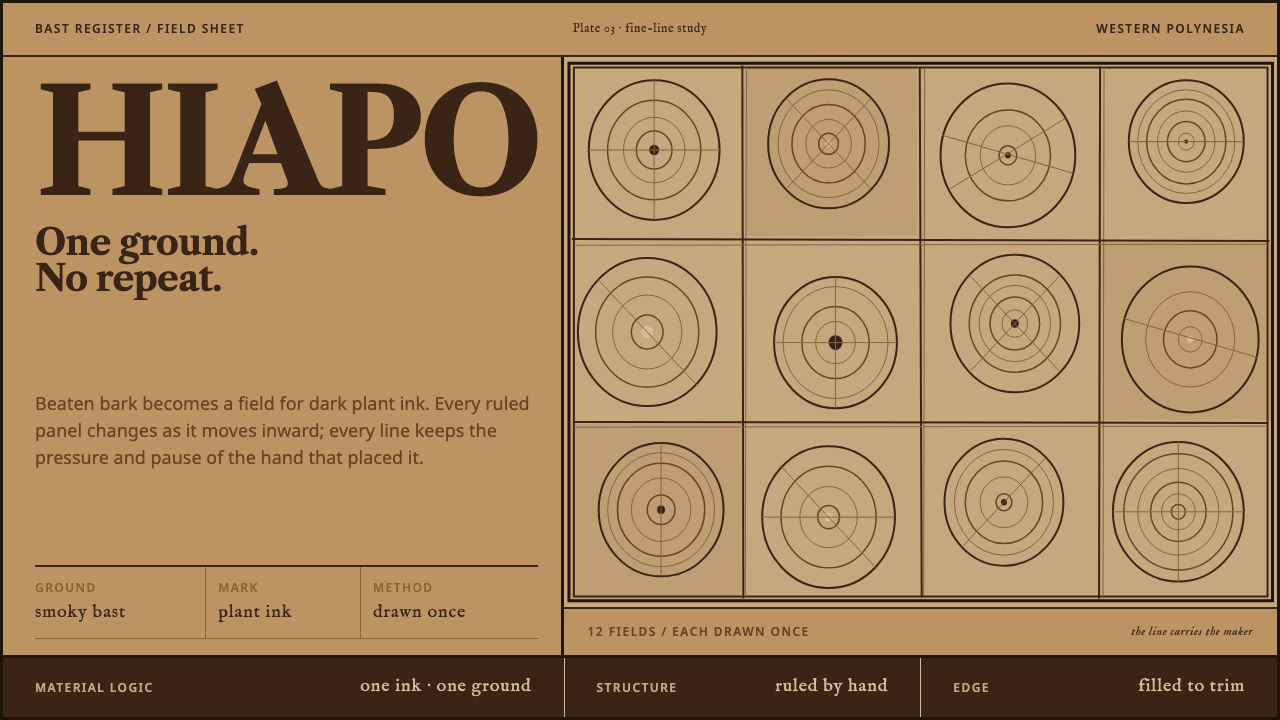 Niuean HiapoEvery line keeps its maker. Dark plant ink fills smoky barkcloth in hand-rule…
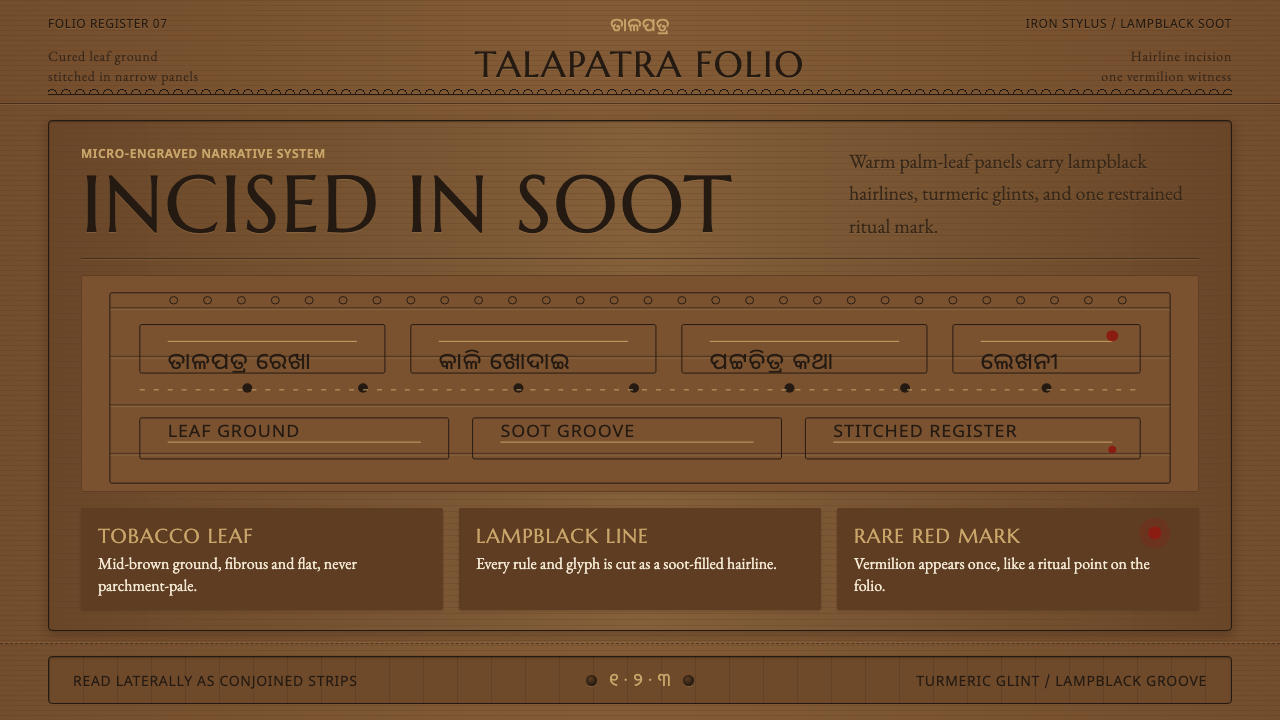 Odisha Palm-Leaf EtchingSacred narrative goes microscopic. Lampblack hairlines cut tobacco-brown leaf…
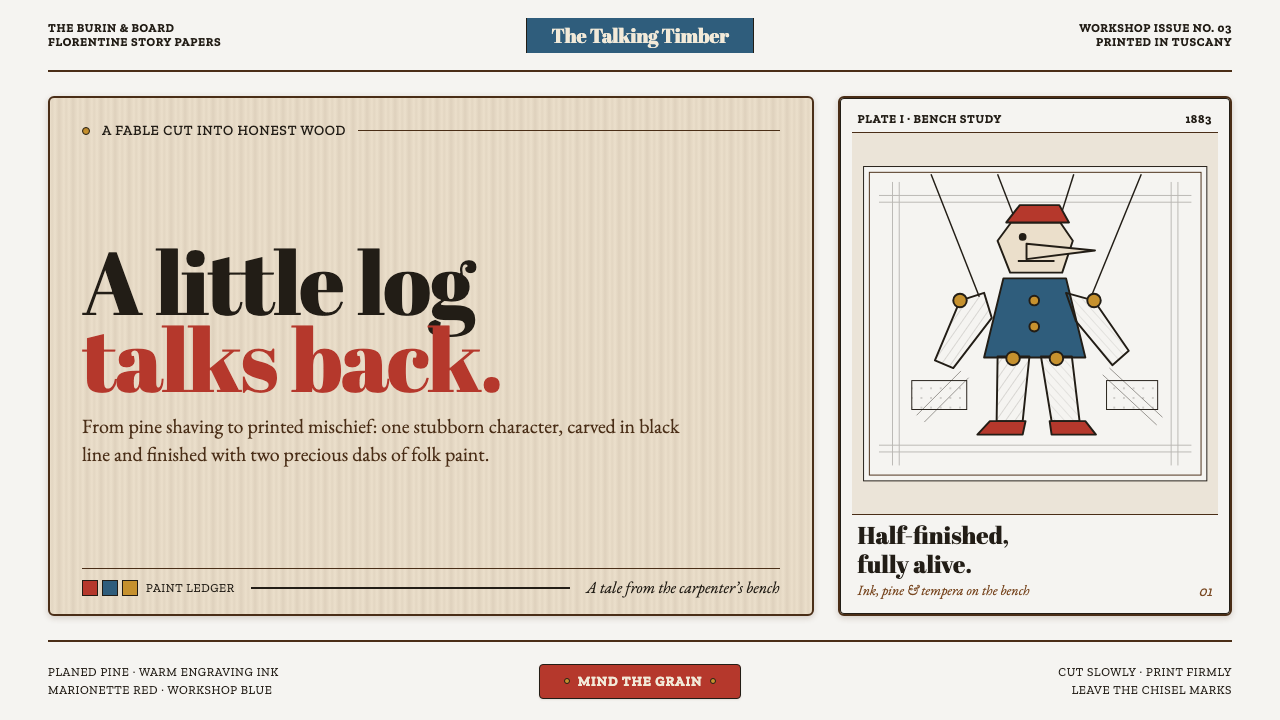 Pinocchio (1883 Marionette Workshop)Carved from honest timber. Red, blue and ochre punctuate crisp engraved lines.
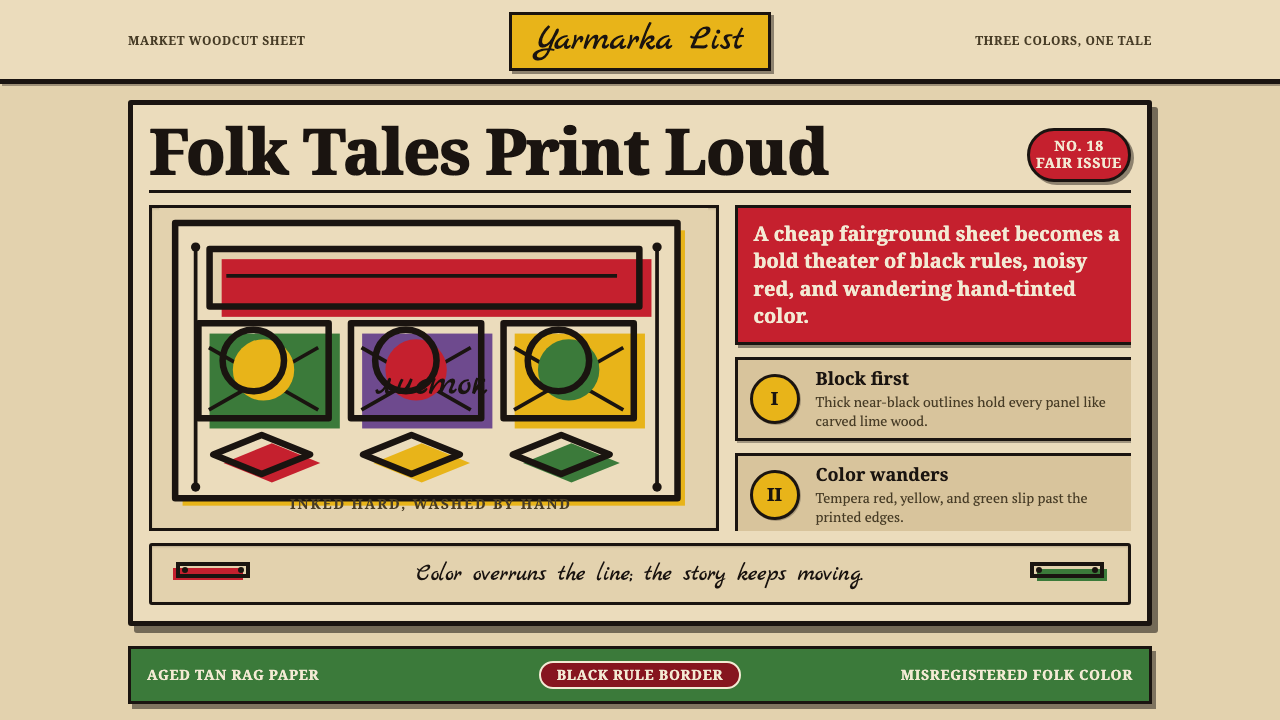 Russian LubokFolk print sings. Tan rag paper, black woodcut rules, red and green fills mis…
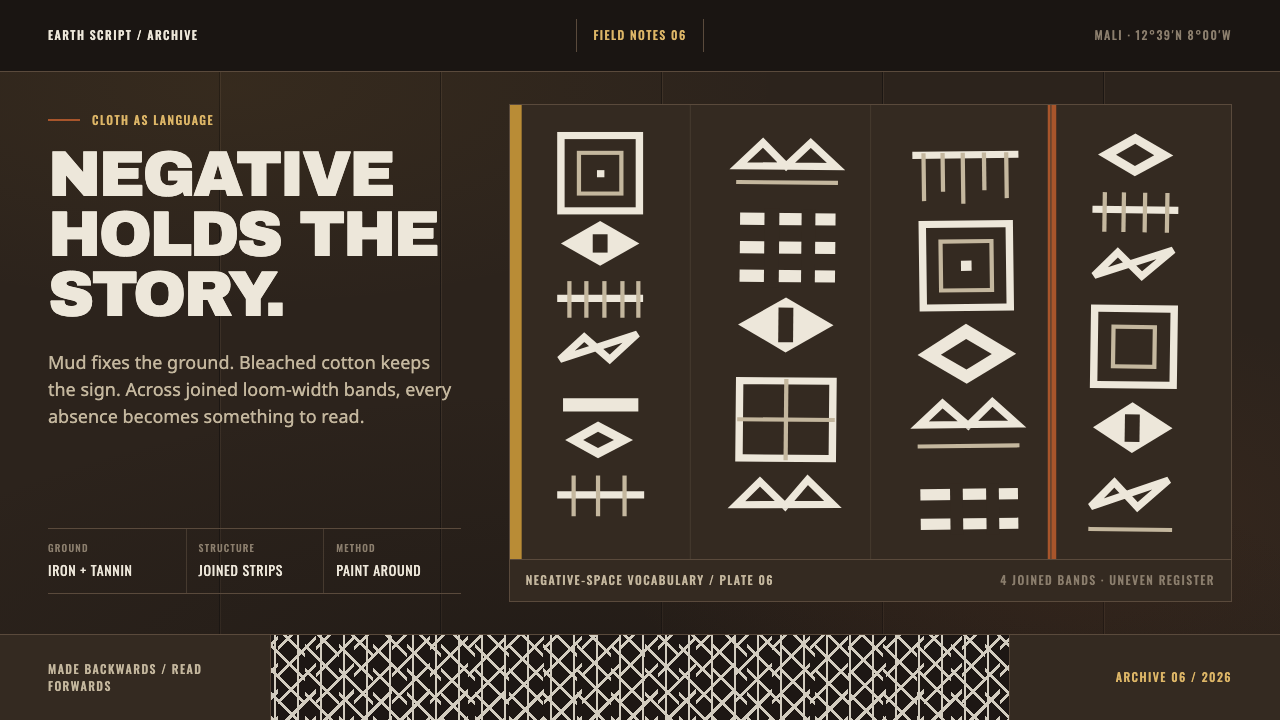 Bogolanfini MudclothAbsence becomes language. Warm iron-black bands hold uneven bleached-cotton s…
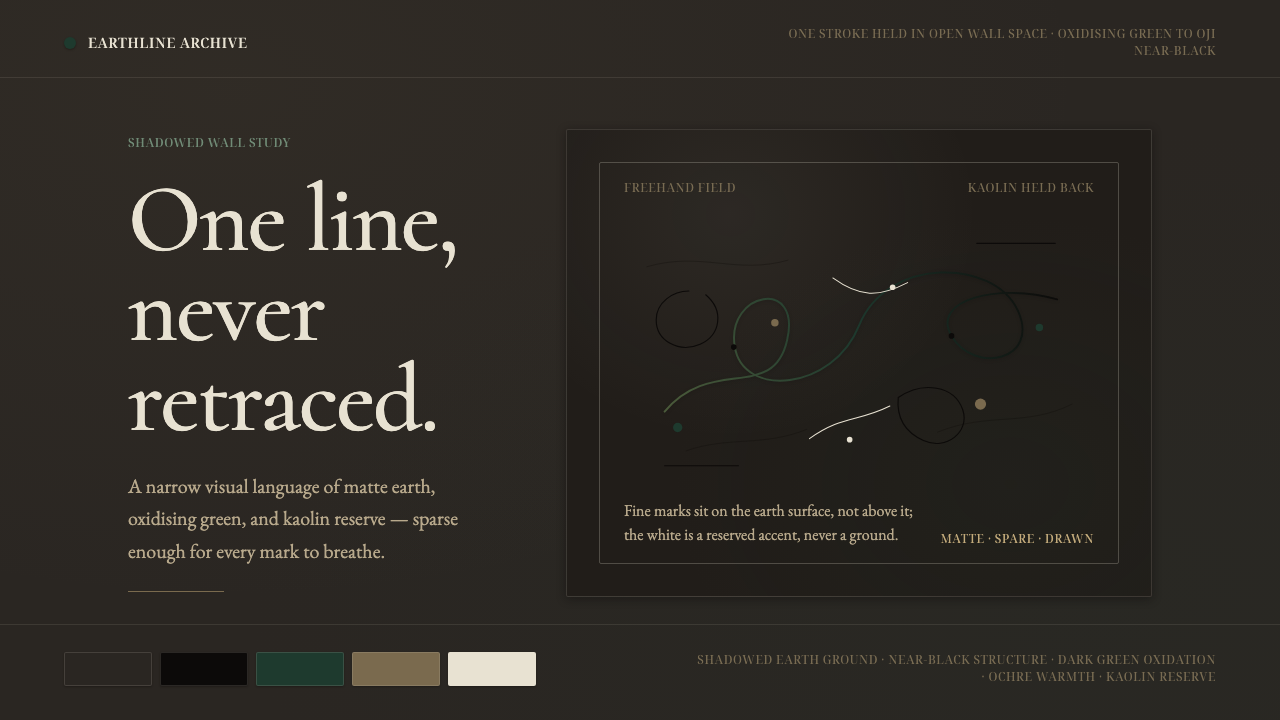 Igbo Uli Painting NigeriaSpare line carries the wall. Near-black curves breathe on dark earth with kao…