What is Plaid 2023?
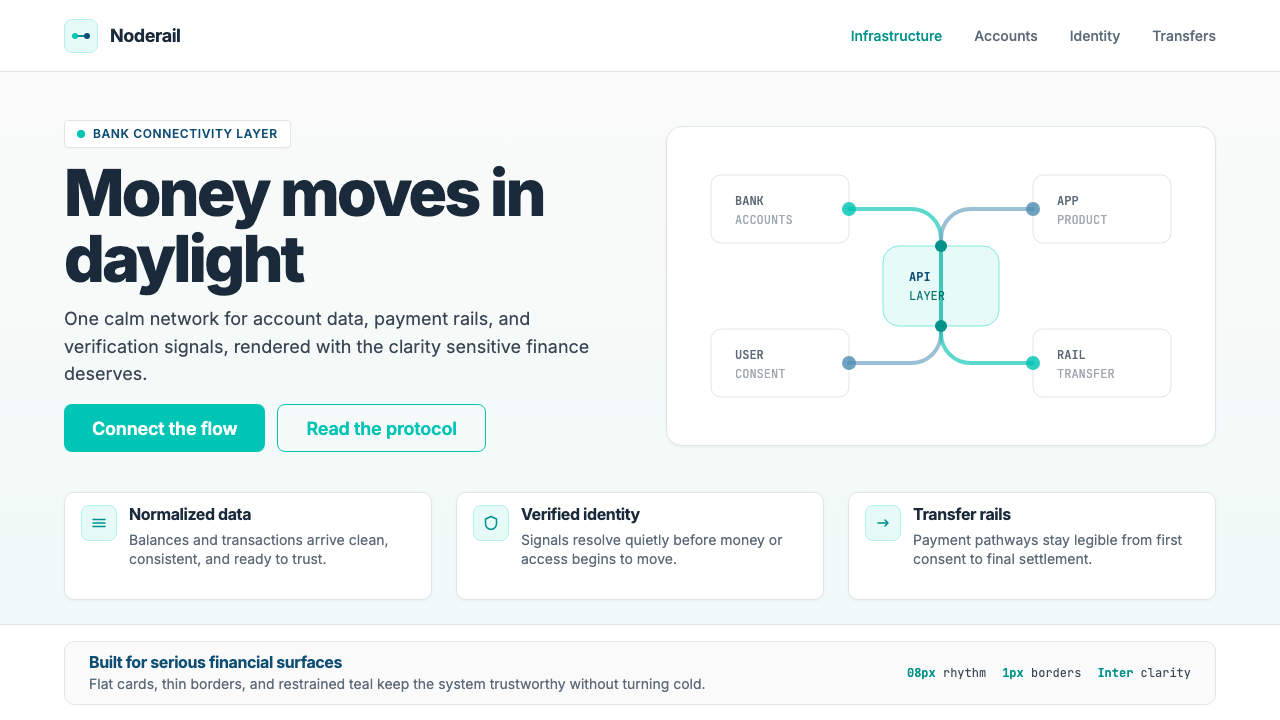
Plaid's 2023 brand turns invisible financial infrastructure into something you can almost see — calm teal nodes on daylit white, making the pipes that move money feel trustworthy and tangible.
Plaid 2023 in brief
Plaid 2023 is the visual design language developed by Plaid, the San Francisco-based financial data infrastructure company, to represent its API platform in a way that is simultaneously technical and reassuring. The aesthetic centers on a signature teal deployed against near-white grounds, a pipe-and-node illustration vocabulary that renders abstract data flows as tangible diagrams, and a geometric sans-serif typeface chosen for its clarity across every scale from mobile-screen labels to billboard headlines.
The system sits firmly in the lineage of modern fintech design — clean, grid-anchored, generous with whitespace — but it distinguishes itself through its infrastructure metaphor. Where many financial brands reach for authority through deep navy and gold, Plaid reaches for it through legibility and openness. The teal reads as calm precision rather than aggression. The near-white ground reads as daylight rather than sterility. The pipe illustrations read as systems you can understand rather than black boxes you must trust blindly.
As a design language, Plaid 2023 belongs to a moment when financial infrastructure companies began marketing directly to developers and enterprise buyers simultaneously. The system must speak to a developer who wants proof of technical rigor and to a CFO who wants proof of reliability — and it accomplishes both by making the underlying plumbing visible and comprehensible, not by hiding it behind consumer-facing gloss.

Where does Plaid 2023 come from?
Plaid was founded in San Francisco in 2013 by Zach Perret and William Hockey, initially as a consumer budgeting app before the founders recognized that the harder and more valuable problem was the infrastructure layer beneath such apps — the connective tissue between consumer bank accounts and the applications that needed to read or move that data. The company pivoted to become a pure API provider, and by the early 2020s it was processing transactions for thousands of fintech products including Venmo, Robinhood, and Coinbase, largely invisibly.
The brand that emerged in the years around 2022 to 2024 reflects that infrastructure identity with unusual directness. Rather than softening or concealing the technical nature of the product — as many fintech companies do by leading with consumer-facing photography of smiling people or aspirational lifestyle imagery — Plaid chose to foreground the infrastructure metaphor itself. Pipe-and-node diagrams, which in another context might feel cold or engineering-only, become the brand's primary expressive vehicle. The result is a rare case of B2B technical branding that communicates at the level of the product's actual function.
The teal color that anchors the palette has precedent in financial and healthcare technology branding, where it has long been used to signal precision, trustworthiness, and modernity without the heaviness of navy or the aggressiveness of bright blue. Plaid's version sits in a range that reads as decisively digital — not the teal of a physical material but the teal of a screen rendering a data state — while remaining warm enough to avoid clinical coldness.
The broader context for Plaid 2023 is the open banking movement, which gathered regulatory momentum in the European Union through PSD2 and in the United Kingdom through the Open Banking Standard, and which Plaid was actively shaping in the United States through its API ecosystem. A brand language that makes financial data flows legible is also, implicitly, an argument for the open banking model: that infrastructure should be transparent, that data flows should be visible, and that the plumbing of finance should be something consumers and businesses can inspect and understand rather than something that happens in the dark.
What defines the Plaid 2023 look?
Signature Teal on Near-White
The defining color relationship in Plaid 2023 is a single distinctive teal — positioned in the family of blue-greens associated with precision and calm technology — set against backgrounds that read as very light rather than pure white, giving the overall palette a slight warmth that prevents clinical coldness. This teal functions as the brand's primary identification color: it appears on interactive elements, illustration nodes, and section anchors, while the background does most of the breathing. Secondary neutral tones — soft grays and off-whites — provide supporting structure without competing with the teal for attention.
Pipe-and-Node Illustration System
The most distinctive visual element in the Plaid 2023 system is its diagrammatic illustration vocabulary. Abstract data flows are rendered as networks of pipes and circular nodes — the visual language of engineering schematics, adapted into a clean, friendly register. Pipes are drawn with consistent weight and rounded corners, implying both the robustness and the smoothness of the underlying infrastructure. Nodes appear at connection points, often rendered in the signature teal, functioning simultaneously as data waypoints in the narrative and as visual focal points in the composition. These illustrations replace the lifestyle photography common in consumer fintech with something that speaks directly to the technical product.
Geometric Sans-Serif Clarity
Plaid's typographic choice — a neutral, highly legible geometric sans-serif — reflects the brand's core value proposition: clarity above all. The typeface performs identically at the small scale of API documentation labels and at the large scale of campaign headlines, which is a practical requirement for a company whose brand surfaces range from developer console interfaces to outdoor advertising. Letter-spacing is kept open at display sizes and standard at text sizes, avoiding the tightly-tracked letterforms that can feel fashionable but reduce legibility in technical contexts. Hierarchy is established through size and weight contrast alone, without reliance on decorative devices.
Generous Whitespace as Trust Signal
Throughout the Plaid 2023 system, negative space is used at a scale that communicates confidence rather than economy. Sections breathe. Elements are not crowded against their neighbors. This generosity with space is not accidental — in financial contexts, density and clutter are associated with confusion and hidden complexity, while open space is associated with transparency and control. The layout discipline reinforces the brand's message that Plaid is infrastructure you can understand, not a black box. Padding within cards, margins between sections, and spacing between typographic elements all err on the side of openness.
Restrained Color Application
Despite having a distinctive and memorable brand color, the Plaid 2023 system uses that teal with noticeable restraint. It does not flood surfaces. It does not appear on every interactive element. It is reserved for moments where it can do real communicative work — marking a key node in a diagram, highlighting a primary call to action, anchoring a section transition. This restraint amplifies the color's impact: when the teal appears, it means something. The rest of the palette is intentionally recessive, consisting of carefully chosen neutrals that ensure the teal always reads as signal, never as noise.
Subtle Shadow and Depth
The Plaid 2023 system uses depth selectively and softly. Cards and UI components carry gentle, low-spread shadows that lift them slightly from the page without introducing the skeuomorphic heaviness that defined earlier generations of fintech interfaces. This approach to shadow is explicitly modern — it acknowledges that layering and depth are useful organizational tools while refusing to overstate them. The shadows are present enough to communicate hierarchy and interactivity but absent enough to keep the overall feel clean and flat-adjacent. They function as spatial metadata rather than stylistic statement.
Infrastructure-as-Hero Messaging Frame
Underlying all the visual decisions in Plaid 2023 is a coherent messaging strategy: infrastructure should not be apologized for or hidden, it should be celebrated and made legible. This framing shows up in how diagrams are treated as heroes rather than supporting elements, in how the brand leads with the complexity of financial connectivity rather than simplifying it away, and in how technical vocabulary — APIs, connections, data flows — appears in marketing contexts without being translated into consumer-friendly euphemisms. The visual language and the verbal language are in alignment: both say that the pipes matter and that understanding them is a feature, not a burden.

Who shaped Plaid 2023?
Perret co-founded Plaid in 2013 with William Hockey, initially as a consumer product before recognizing the infrastructure opportunity. As CEO, he has consistently articulated the vision of open banking infrastructure as a public good — a framing that directly informs the brand's emphasis on transparency and legibility. His public communications have helped position Plaid not just as a vendor but as a participant in shaping the architecture of financial access, which the 2023 brand language reflects in its infrastructure-forward aesthetic.
Hockey co-founded Plaid and served as its CTO during the company's foundational years, overseeing the technical architecture that the brand's pipe-and-node visual vocabulary was eventually designed to represent. The engineering culture he helped establish — precise, systematic, concerned with reliability over flash — is legible in the design system's restraint and its preference for diagrammatic clarity over decorative ambition.
The in-house brand and design team responsible for the 2022–2024 visual identity is the direct author of the system described here. Their central contribution was the decision to make the infrastructure metaphor the brand's primary visual register rather than softening it for a consumer audience. This required confidence that the core buyers — developers and enterprise decision-makers — would respond to technical directness rather than require the aspirational lifestyle imagery common in consumer fintech. The team's choice to build a coherent illustration system around pipe-and-node forms rather than relying on stock photography or generic iconography gives the brand a distinctive and ownable visual voice.
Not a person but an essential shaping force: the global push for open banking — accelerated by regulatory frameworks like PSD2 in Europe and the Open Banking Standard in the United Kingdom — created the market context in which Plaid's infrastructure brand became legible and necessary. Open banking posits that financial data belongs to the consumer and should flow freely between institutions and applications via standardized APIs. A brand that visualizes those data flows as transparent, comprehensible networks is also, implicitly, an argument for this model. The Plaid 2023 aesthetic cannot be fully understood without this regulatory and ideological backdrop.
How do you use Plaid 2023 today?
Plaid 2023 is a well-defined system with a clear value proposition — infrastructure made legible — and it transfers well to any context where technical precision, transparency, and calm authority are the desired signals. Understanding the system well enough to apply it correctly means internalizing its core logic: teal is used sparingly so it means something when it appears, whitespace is used generously so complexity reads as organized rather than overwhelming, and illustration does the work that lifestyle photography does in consumer brands.
For presentation slides, the Plaid 2023 aesthetic works exceptionally well for both cover slides and technical content slides. A cover benefits from a bold pairing of the near-white ground with a large teal illustration element — a pipe diagram, a node network — positioned as the hero, with the title in clean geometric sans-serif at generous scale. Content slides should maintain the system's disciplined spacing: one primary idea per slide, supported by a diagram or a small number of data points, with generous margins on all sides. Data slides can take on a diagrammatic quality directly influenced by the brand's own illustration system — network graphs, flow charts, and process diagrams feel native rather than borrowed. Avoid dense bullet lists, which undercut the brand's core promise of clarity.
For web UI including dashboards and pricing pages, the Plaid 2023 language translates directly. Dashboards benefit from the system's card-based hierarchy: lift components with a subtle shadow, use the teal exclusively for active states and primary data indicators, and build a strict column grid that ensures every element has a clear positional relationship to its neighbors. Pricing tiers work well with the system's restrained color approach — use the teal to mark the recommended or featured tier, leave the others in neutral ground, and rely on typographic size contrast to differentiate features. Navigation should be typographic, with minimal icon use and clear label hierarchy.
For editorial design and marketing materials, the infrastructure-as-hero framing opens compositional possibilities that distinguish Plaid-influenced work from generic fintech aesthetics. Feature sections can lead with a large pipe-and-node diagram as the primary visual, with supporting text positioned to read as annotation rather than caption. Marketing pages work well with a rhythm of full-width sections that alternate between near-white grounds with teal illustration elements and dark grounds with near-white type — the contrast creates forward momentum without requiring photographic content. Print materials such as conference handouts or one-pagers follow the same spacing logic: wide margins, single-column or two-column body text, and teal used only for the most important navigational or structural element on the page.
A common mistake when applying the Plaid 2023 aesthetic is treating the teal as a fill color rather than an accent color — flooding backgrounds, buttons, and illustrations with it until it loses the signal value that makes it effective. The system works because the teal is outnumbered by neutral space; as soon as it dominates, the careful balance collapses and the design reads as a generic brand color rather than a precision instrument. A related mistake is over-populating illustrations: pipe-and-node diagrams should feel like they are revealing just enough of the underlying system to be illuminating, not like complete architectural blueprints. Edit the diagrams to the fewest nodes that still communicate the intended flow.

Plaid 2023 — FAQ
How does Plaid 2023 differ from generic fintech design?
Most fintech brands resolve the tension between technical complexity and consumer reassurance by hiding the technology — leading with smiling people, aspirational photography, and warm lifestyle imagery while keeping the underlying infrastructure out of sight. Plaid 2023 takes the opposite position: it leads with the infrastructure, makes the pipes and nodes the visual hero, and treats technical directness as a feature rather than a liability. This makes it unusual in the fintech space and well-suited to an audience of developers and enterprise buyers who are more interested in how things work than in how they feel.
Can the Plaid 2023 style work for consumer-facing products?
With significant adaptation, yes — but the system was not designed for that context and its strengths become weaknesses in consumer-facing emotional territory. The infrastructure metaphor, the diagrammatic illustration style, and the restrained teal-on-white palette convey precision and trustworthiness very effectively to developers and enterprise buyers. For general consumers, the same elements can read as cold, technical, or inaccessible. Consumer applications that need to evoke warmth, joy, or personal connection will find the Plaid 2023 aesthetic insufficient on its own and will need to supplement it with photography, softer color relationships, and a warmer typographic voice.
How should the teal be used when building with this aesthetic?
Treat the teal as a signal, not a surface. Its correct uses are: marking the most important interactive element on a given view (a primary button, a key call to action), indicating an active or selected state in navigation or controls, anchoring the primary node or connection point in a diagram, and providing a color accent at section transitions to orient the reader. Its incorrect uses are: filling large background areas, appearing on every button or interactive element regardless of hierarchy, or being applied to illustration elements so broadly that the diagrams lose tonal variety. The teal should appear less often than you might initially think is necessary — that restraint is what gives it power.
Is Plaid 2023 suitable for dark-mode interfaces?
The canonical Plaid 2023 palette is light-ground — near-white backgrounds are central to the system's openness and legibility. A dark mode adaptation is possible and can be effective, but it requires deliberate choices rather than a simple inversion. On a dark ground, the teal may need to be slightly adjusted in brightness to maintain its contrast ratio and prevent it from either disappearing into the background or becoming electrically intense. The pipe-and-node illustration system adapts well to dark grounds because the line-based forms maintain legibility across tonal ranges. The deeper risk in a dark adaptation is that the open, transparent quality that defines the light version becomes harder to maintain — dark grounds can read as more opaque and technical, which may work for developer documentation but less well for enterprise marketing contexts.
What kinds of projects benefit most from this aesthetic?
The Plaid 2023 aesthetic performs best for B2B technology products, developer tools, and enterprise software where the audience values precision, transparency, and competence over warmth and aspiration. It is particularly well-suited to: API documentation and developer portals, where the technical vocabulary of diagrams and code feels native; enterprise SaaS dashboards, where clarity and information density need to coexist; fintech or data infrastructure products positioning themselves as trustworthy and serious; and conference presentations or technical marketing materials where the audience already understands the problem being solved and simply needs to evaluate the solution. It is less suited to consumer e-commerce, children's products, food and beverage, or any context where emotional warmth is a primary purchase driver.
Related design styles
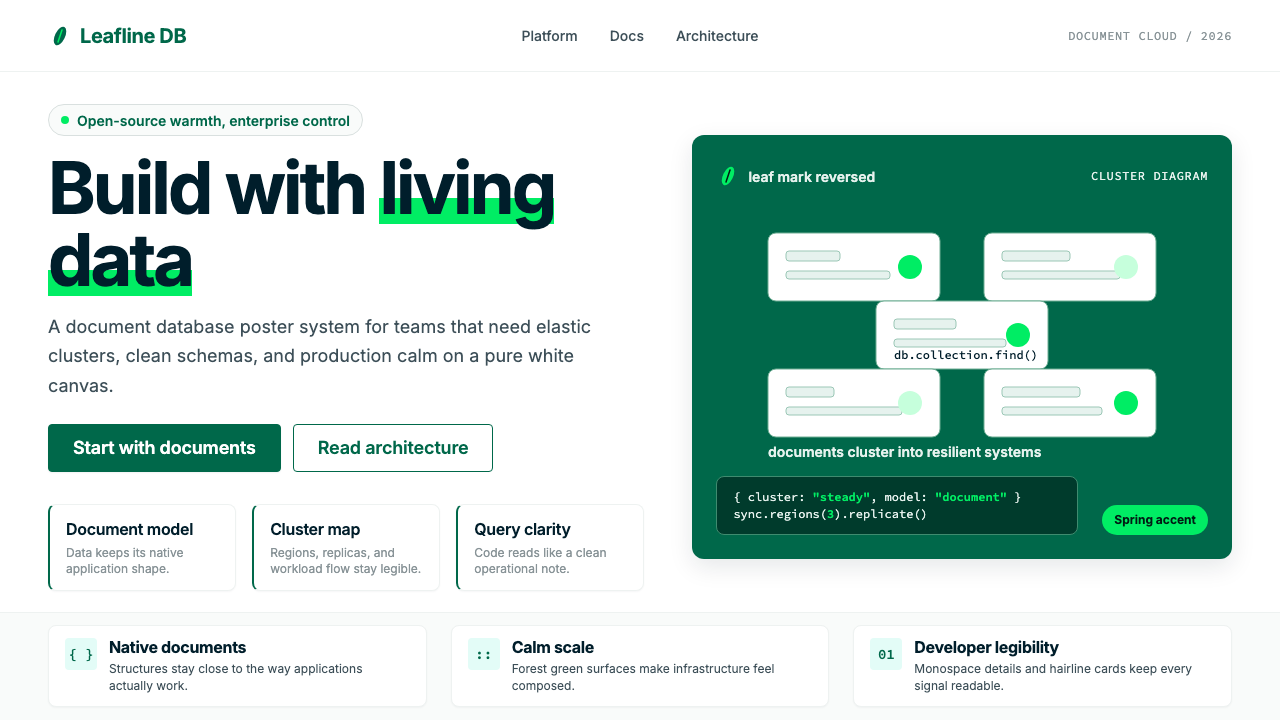 MongoDB Leaf GreenDisciplined green, open warmth. Forest leaf forms and Spring accents breathe…
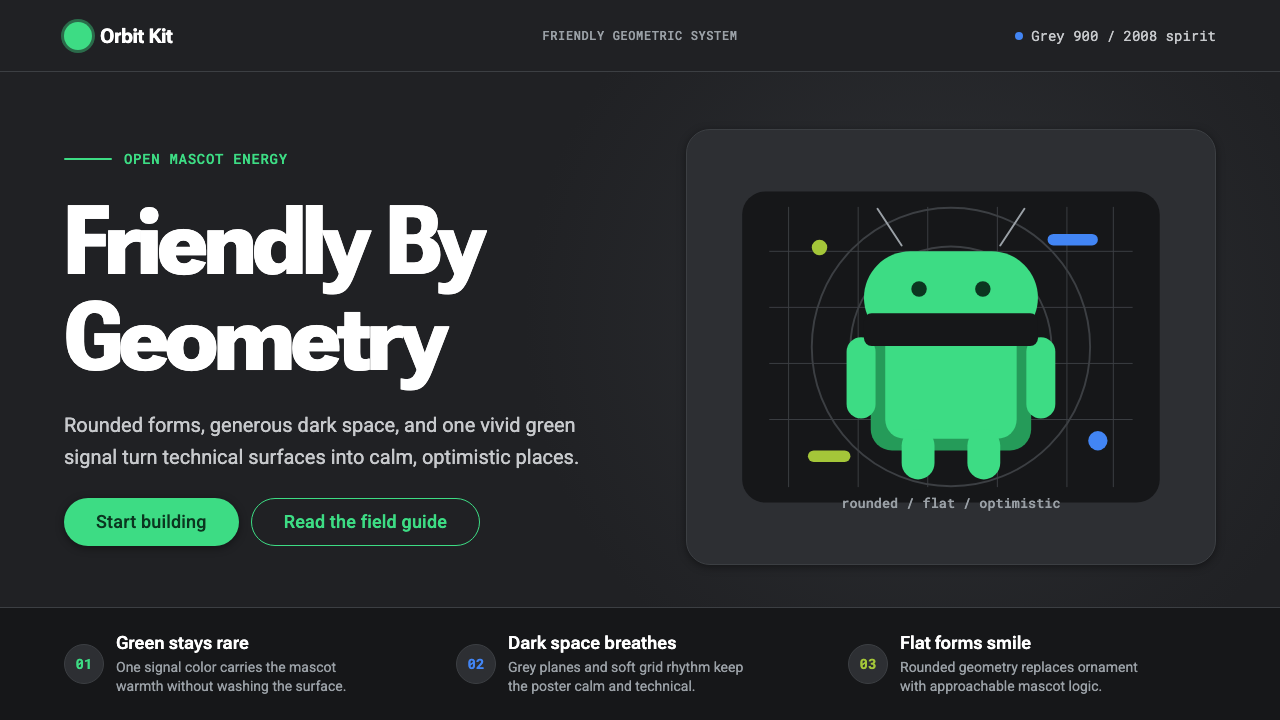 Android Bugdroid GreenFriendly tech, reduced to geometry. Vivid green pops from Grey 900 and rounde…
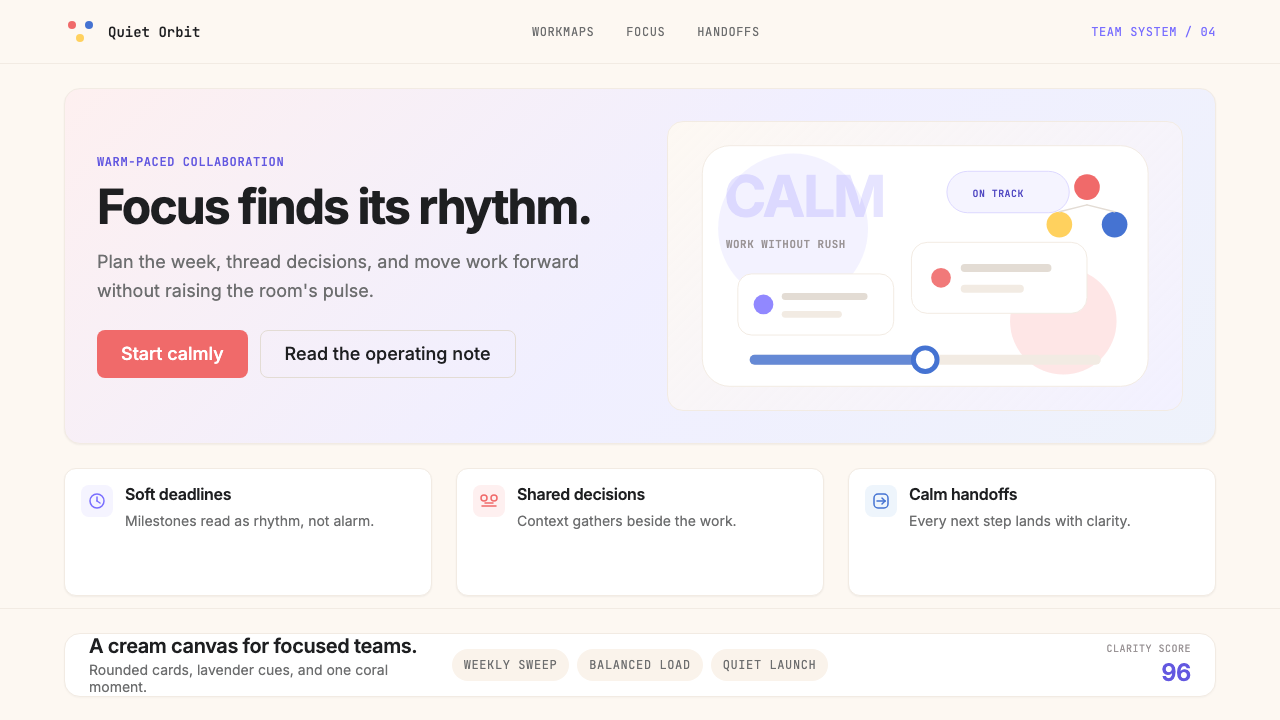 AsanaCalm productivity breathes. Cream canvas, lavender panels, coral-blue-yellow…
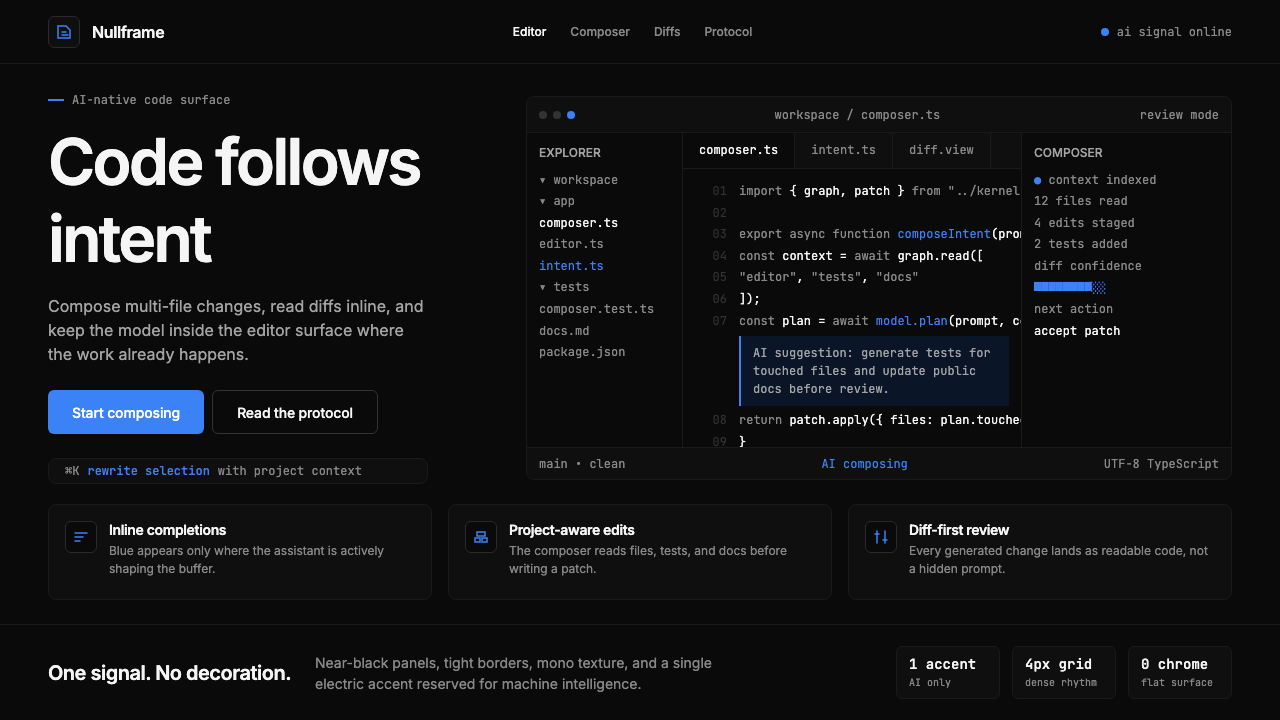 Cursor IDEAI-first code editor. Pure dark surfaces, off-white text, electric blue reser…
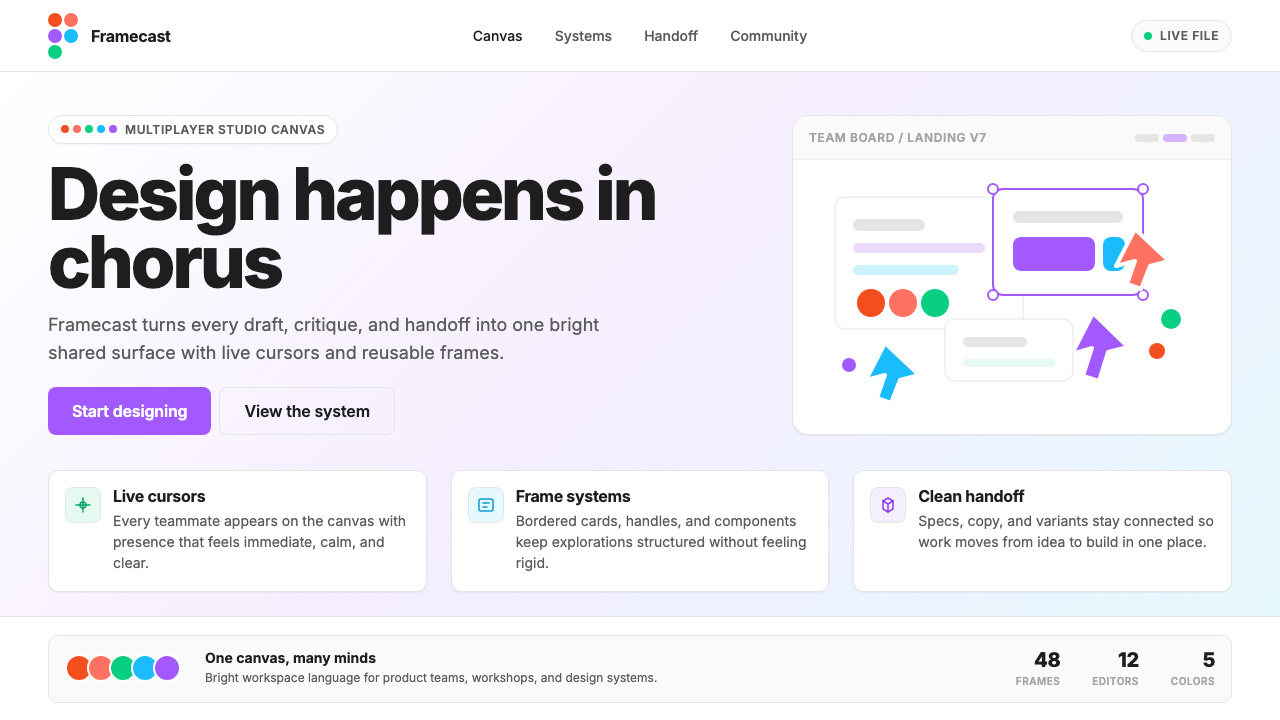 Figma 2024A brand that looks like its canvas. Five dots scatter like cursors, soft card…
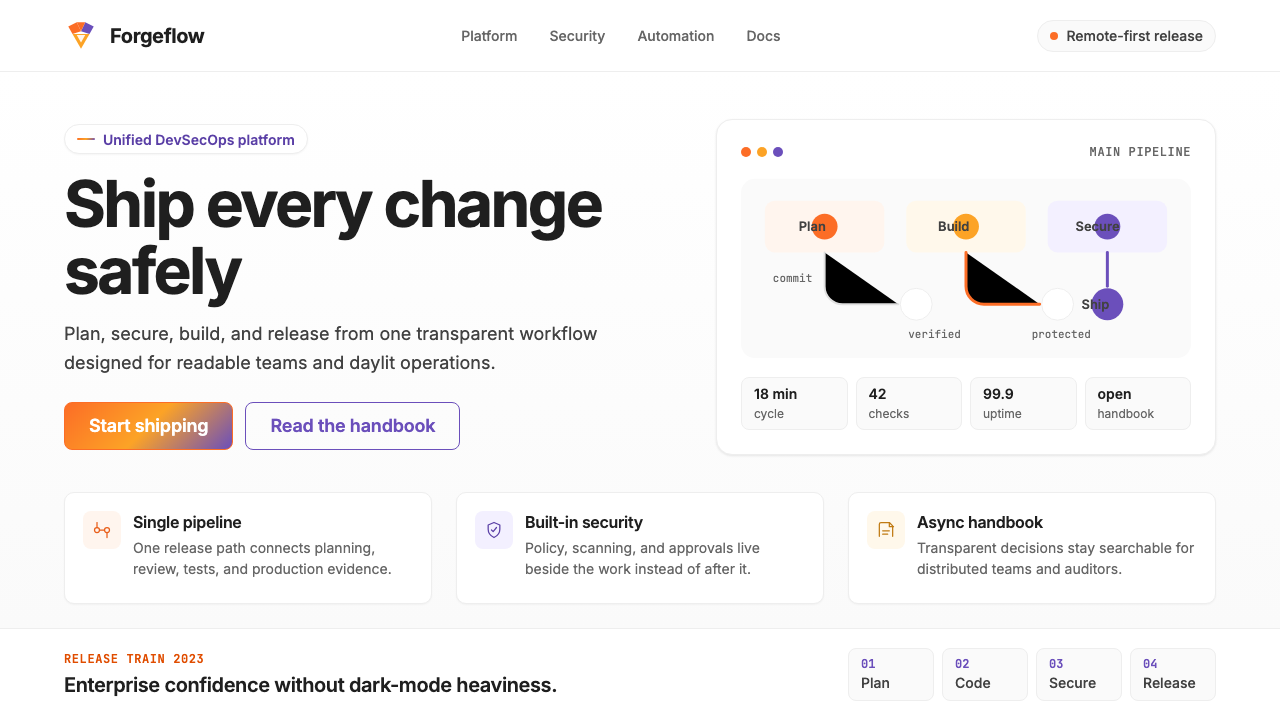 GitLab 2023DevOps in daylight. Tanuki orange-to-purple gradient, Inter, warm enough for…