What is Ayacucho Retablo Box?
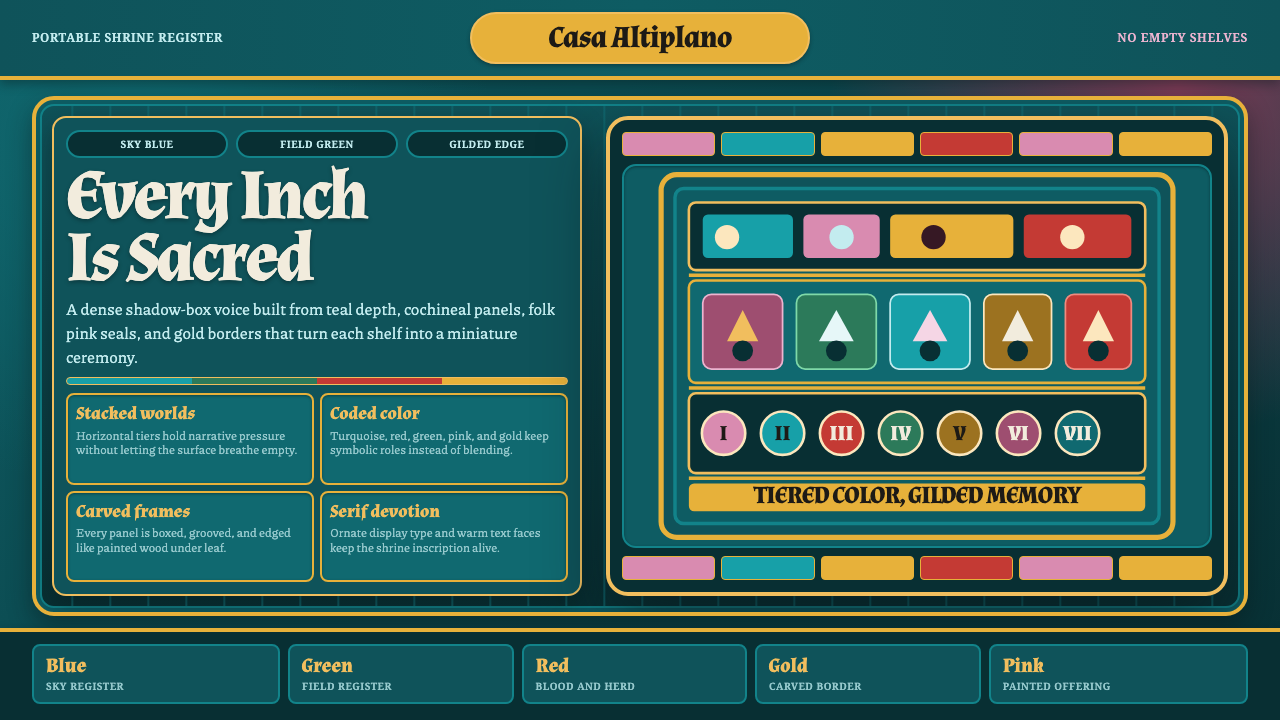
Ayacucho Retablo Box turns a portable Andean shrine into an interface of sacred density: saturated color, tiered storytelling, and no empty space left without purpose.
Ayacucho Retablo Box in brief
The retablo ayacuchano is a portable wooden shrine box from Ayacucho, Peru. Its double doors open onto a miniature world arranged on tiers: small figures, scenes, and symbolic details are built from a hand-mashed paste of potato and gypsum, then painted in emphatic polychrome. The object is intimate in scale but expansive in visual pressure. It asks the eye to move from door to shelf, shelf to figure, figure to ornament, finding narrative through accumulation rather than through a single central image.
Its color language is strict rather than merely decorative. Blue signifies sky, green fields, red blood and herds, and yellow sand; gold leaf and pink accents intensify the devotional and celebratory atmosphere. These colors do not dissolve into a naturalistic landscape. They remain distinct, concentrated signals, allowing a packed miniature scene to retain emotional order even when many forms compete for attention.
As a digital design system, Ayacucho Retablo Box carries that shadow-box logic onto a dark teal surface. Saturated panels sit within clear borders, ornate serif display type gives titles ceremonial presence, and stacked regions behave like shelves inside an opened shrine. The goal is not calm minimalism. It is deliberate abundance: a composition in which every visual compartment feels held, framed, and alive with significance.
Where does Ayacucho Retablo Box come from?
Ayacucho Retablo Box belongs to the twentieth-century Peruvian retablo tradition, while remaining rooted in older Andean portable-shrine and saint-box traditions. That layered origin matters to its visual character. The retablo is not simply a container or a decorative miniature; it is a box made for opening, revealing, and holding a concentrated interior world. Its structure establishes a sequence between exterior doors and interior tiers, turning discovery into part of the object itself.
The form is associated with Ayacucho in Peru, within the Latin American Andes, and with Peruvian retablo folk art and Andean polychrome devotional craft. These descriptions point to a tradition in which material, color, enclosure, and symbolic narrative work together. The wood box supplies the architectural frame; the potato-and-gypsum paste gives the figures their handmade presence; painted color assigns meaning across sky, fields, blood, herds, and sand.
The named figures attached to this tradition include Joaquín López Antay, Ayacucho retablo master artisans, and the Familia Jiménez retablo workshops. Taken together, these names emphasize that the retablo is carried by makers and workshops as well as by a recognizable visual form. The system is therefore inseparable from skilled handwork: shaped figures, painted surfaces, gold leaf, pink accents, and the patient arrangement of multiple elements into a coherent enclosed scene.
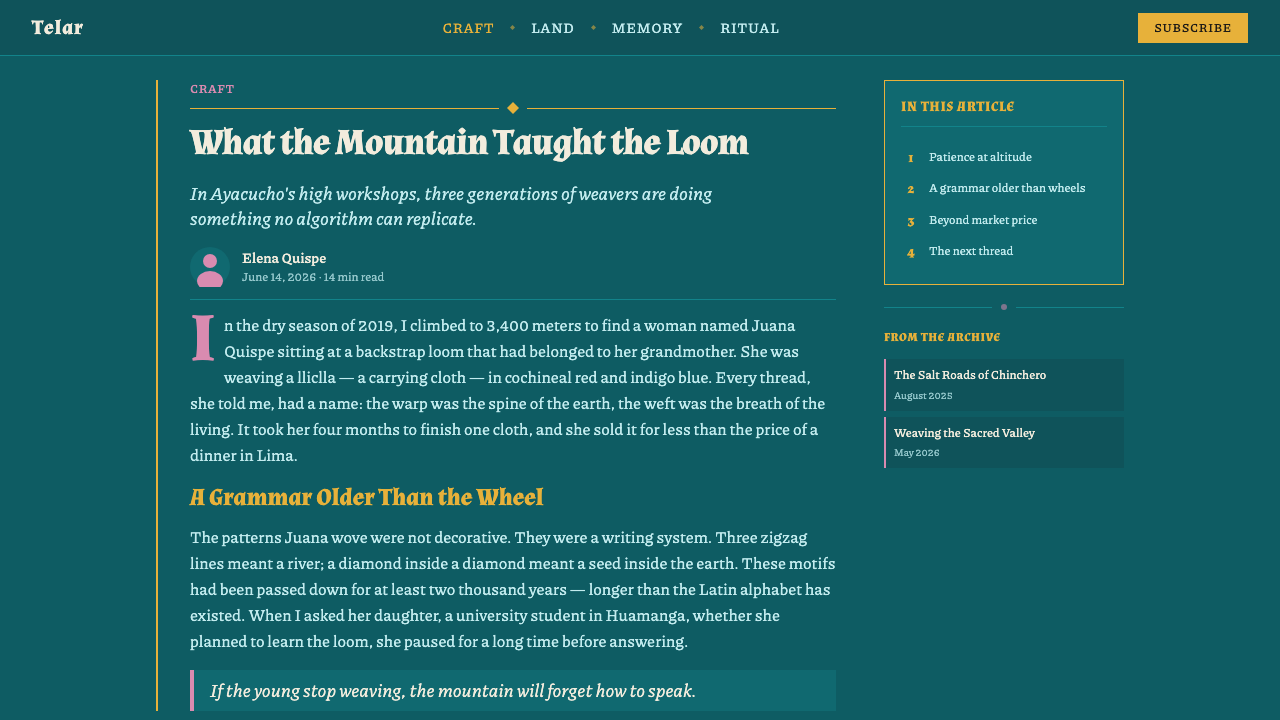
For contemporary designers, the historical lesson is not to copy an object loosely as exotic decoration. The retablo’s density has an internal discipline. Doors establish a threshold, tiers establish order, color establishes symbolic roles, and ornament reinforces attention. A convincing digital interpretation should preserve those relationships: abundance should feel intentional, every border should contain something meaningful, and visual richness should serve a narrative rather than become noise.
What defines the Ayacucho Retablo Box look?
Sacred Density
Empty space is treated as a missed opportunity. Panels, shelves, figures, labels, and ornaments should gather closely, creating the sensation of an opened box full of discoveries. Density must still be ordered: each cluster needs a frame, a tier, or a contrasting ground so the eye can enter the richness without losing its path.
Tiered Narrative
The defining compositional device is the tier. Content does not float freely across a field; it occupies shelf-like bands, chambers, and framed compartments. Higher and lower regions can imply different scenes or levels of emphasis, while the surrounding structure makes many separate elements read as one contained world.
Symbolic Polychrome
Color is vivid, but every major hue has a role. Blue carries sky, green fields, red blood and herds, and yellow sand, while gold leaf and folk pink provide luminous and festive accents. On the deep teal ground, these colors should remain clear blocks or deliberate painted signals, not soft atmospheric blends.
Dark Teal Ground
The dark teal field functions like the recess of a shrine box. Rather than receding into emptiness, it makes the polychrome panels and gold-edged details feel more enclosed and more precious. It should be broad enough to unite the surface, but never so dominant that it weakens the crowded interior character.
Ornate Serif Ceremony
Display typography should feel formal, carved, painted, or announced rather than neutral. An ornate serif voice gives headings the presence of a dedication on a shrine door, especially when paired with compact supporting text. The type should participate in the composition as an object with weight and ritual gravity, not merely deliver information.
Bordered Craft
Borders are structural, not incidental. They recall the wooden box, its doors, and its nested shelves by defining where a scene begins and ends. Repeated edging, inset panels, and gold-like trims can create craft richness, provided they clarify containment instead of decorating every surface indiscriminately.
Who shaped Ayacucho Retablo Box?
Joaquín López Antay is named among the key figures of the Ayacucho retablo tradition. His presence in the tradition’s account anchors the style in specific makers rather than in an anonymous visual category. For designers, that association is a reminder that the retablo’s visual density comes from craft knowledge and arranged material detail, not from a generic decorative pattern.
The master artisans of Ayacucho represent the collective making tradition behind the retablo. Their work joins box construction, miniature modeling, painting, symbolic color, and layered composition in a single object. The phrase matters because no isolated visual ingredient can substitute for that synthesis: the doors, tiers, figures, and painted code depend on one another.
The Familia Jiménez retablo workshops are identified as key contributors within the tradition. Their inclusion foregrounds the workshop as a place where a visual language is sustained through repeated making. In a digital adaptation, that workshop logic can be expressed through consistent framed modules, recurring painted motifs, and variation inside an established symbolic system.
How do you use Ayacucho Retablo Box today?
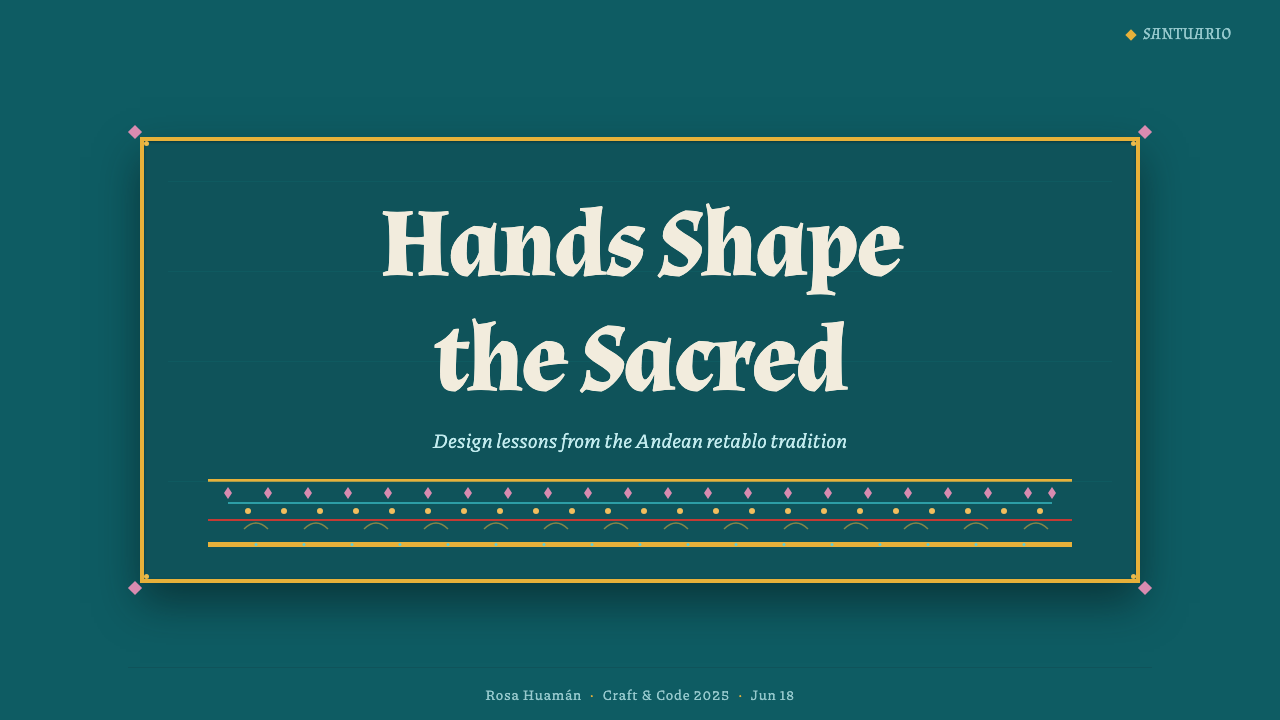
For presentation covers, treat the slide as the closed or newly opened face of a shrine box. Use the dark teal ground as a unifying field, place an ornate serif title within a strong framed panel, and let a small number of vivid symbolic colors establish the subject before supporting detail appears. The cover should feel ceremonious and contained, not spacious or corporate-neutral.
For content and data slides, build shelf-like bands rather than loose card grids. A section title can occupy one bordered tier, supporting explanations another, and charts or key figures a lower chamber. Data visualizations should retain clear color roles and firm separation between groups. The objective is not to make information visually sparse, but to let dense information feel curated like a miniature scene with a readable internal order.
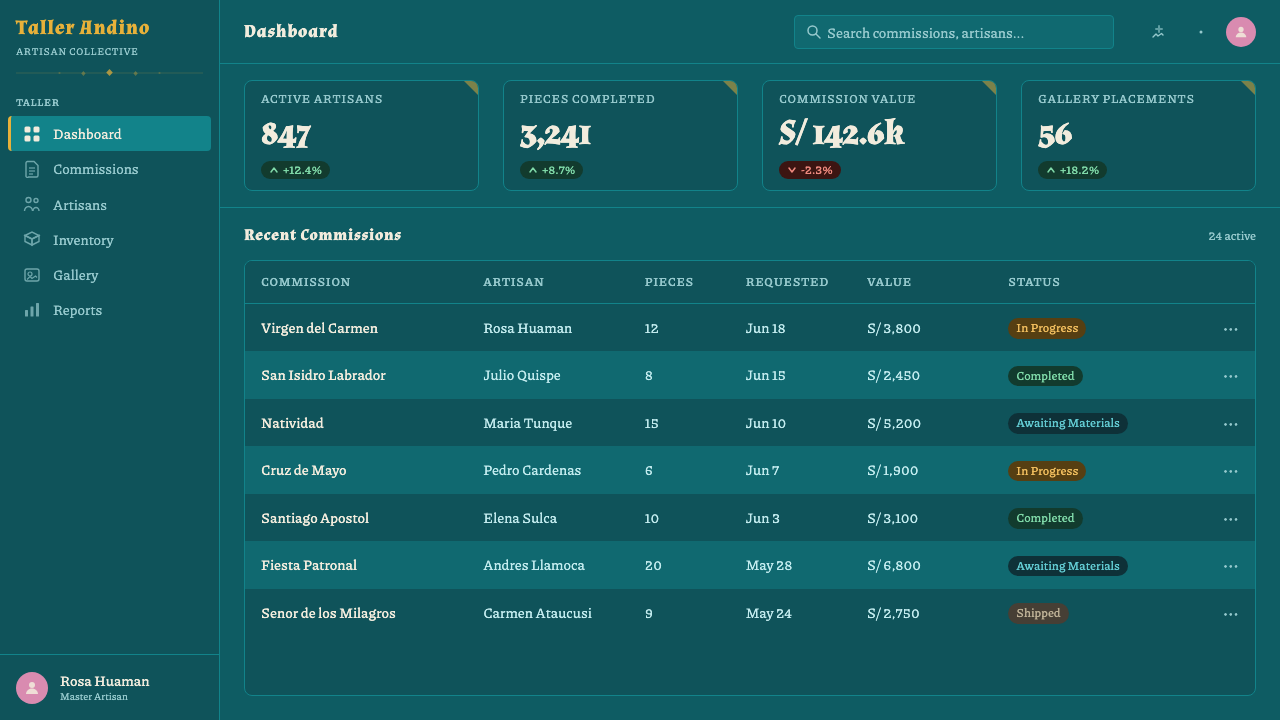
For web interfaces, the style is particularly useful for dashboards, collections, catalogs, and pricing pages that need to present many related items with a sense of occasion. Give navigation, summary information, and primary content distinct framed zones. Panels can stack vertically or nest within one another, while saturated accents identify categories, states, or featured material. Maintain accessible contrast and clear reading order so richness does not make the interface difficult to use.
For editorial and marketing work, use the retablo model to build immersive feature sections. An article can open with a formal title plaque, move through framed narrative chapters, and introduce images or quotations as objects placed in a devotional cabinet. A campaign page can make benefits, stories, and calls to action feel like connected compartments rather than isolated promotional blocks. Repeated borders and a controlled family of colorful accents create continuity across a long page.
The common mistake is confusing density with indiscriminate clutter. A successful Ayacucho Retablo Box interpretation does not scatter every bright color, ornate border, and decorative motif across the page at once. It gives every element a chamber, preserves the symbolic role of color, and lets the deep teal ground unify the whole. If content begins to feel random, add hierarchy and containment rather than simply removing all richness.
Ayacucho Retablo Box — FAQ
Is Ayacucho Retablo Box simply a maximalist style?
No. It is visually abundant, but its abundance comes from a portable shrine structure and a symbolic craft system. Doors, tiers, framed compartments, miniature figures, and color roles all create order. Generic maximalism can add many unrelated elements for intensity; this style requires those elements to feel gathered into an enclosed narrative world.
How should the symbolic colors be used in a contemporary interface?
Use them as meaningful visual signals rather than as a rainbow decoration. Blue can support sky-like or open contextual areas, green can identify field-like or growth-related material, red can mark urgent or vital narrative content, and yellow can act as a dry, bright accent. Gold and folk pink work best as selective finishing notes. The deep teal ground should keep these distinct colors visually gathered.
Can this style work for data-heavy dashboards?
Yes, if the dashboard adopts the retablo’s tiered order rather than only its surface decoration. Group related metrics into framed shelves, give categories stable color meanings, and let summary information occupy its own chamber. The design works when density feels like curation. It fails when ornament obscures labels, comparison, or interaction.
What kind of typography fits Ayacucho Retablo Box?
An ornate serif display voice is the central typographic cue because it gives headings ceremony and presence against the packed color field. Supporting text should remain disciplined and legible, allowing the display type to act like a title on a shrine door. The contrast should come from role: formal, expressive headings paired with quieter explanatory text.
How can a design avoid becoming a superficial retablo imitation?
Begin with the system, not the ornament. Build a threshold, use tiers to organize content, frame panels as meaningful compartments, and give color a stable symbolic job. Then add gold-like edges, pink accents, or richer motifs only where they deepen the sense of crafted enclosure. The strongest adaptation honors the retablo’s logic of devotion, narrative, and deliberate fullness rather than borrowing isolated visual effects.
Related design styles
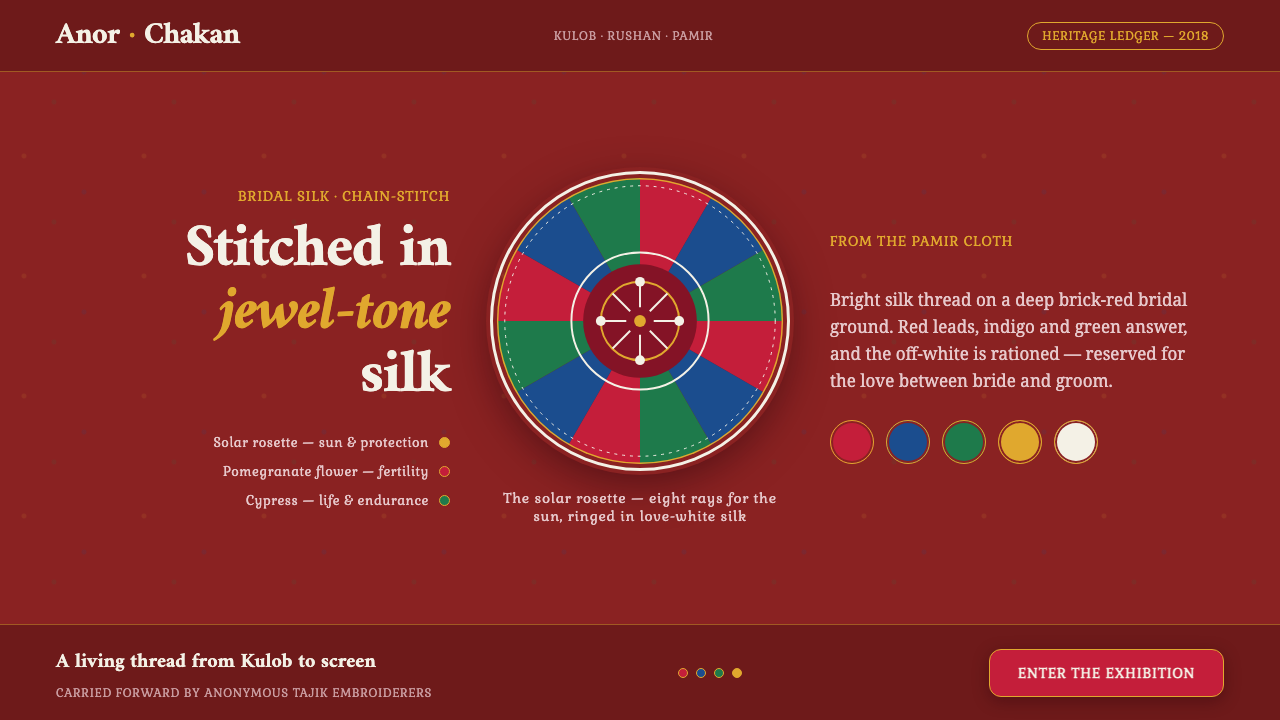 Tajik Chakan EmbroideryBridal silk that earns its white. Jewel-tone chain-stitch on deep brick-red,…
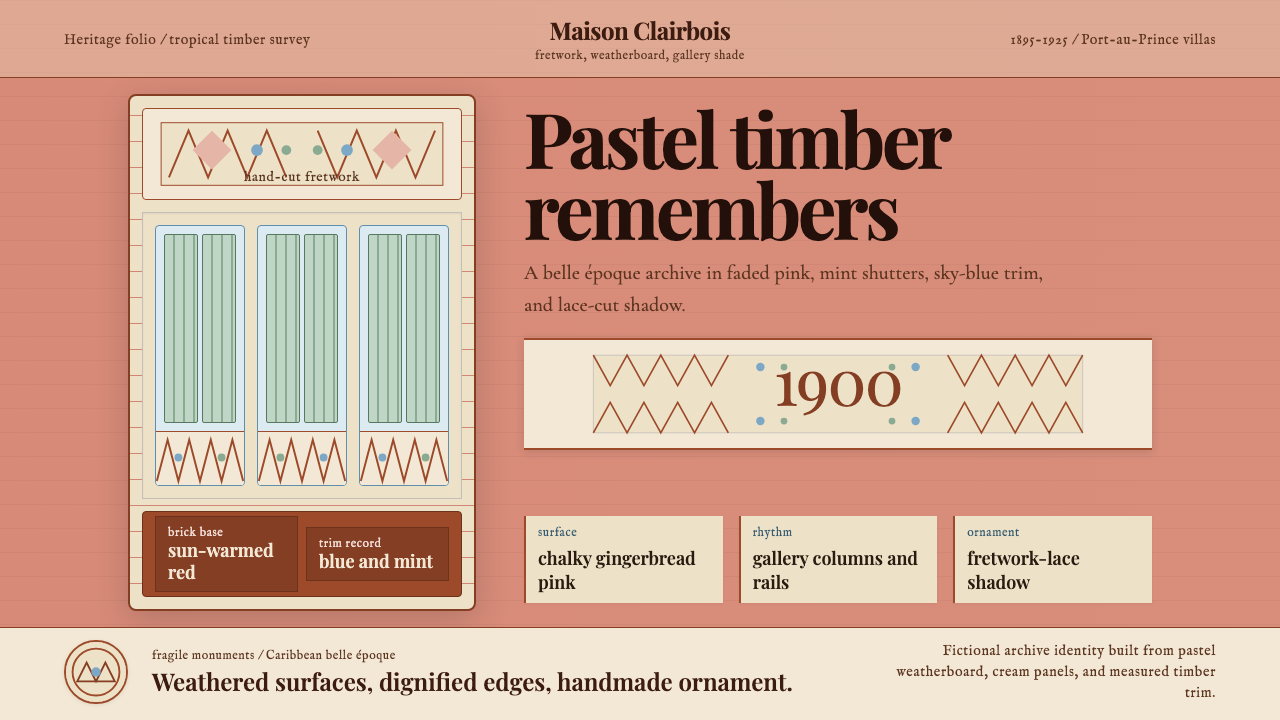 Haitian Gingerbread House (1900)Fragile elegance endures. Faded pink walls carry mint shutters and fretwork-l…
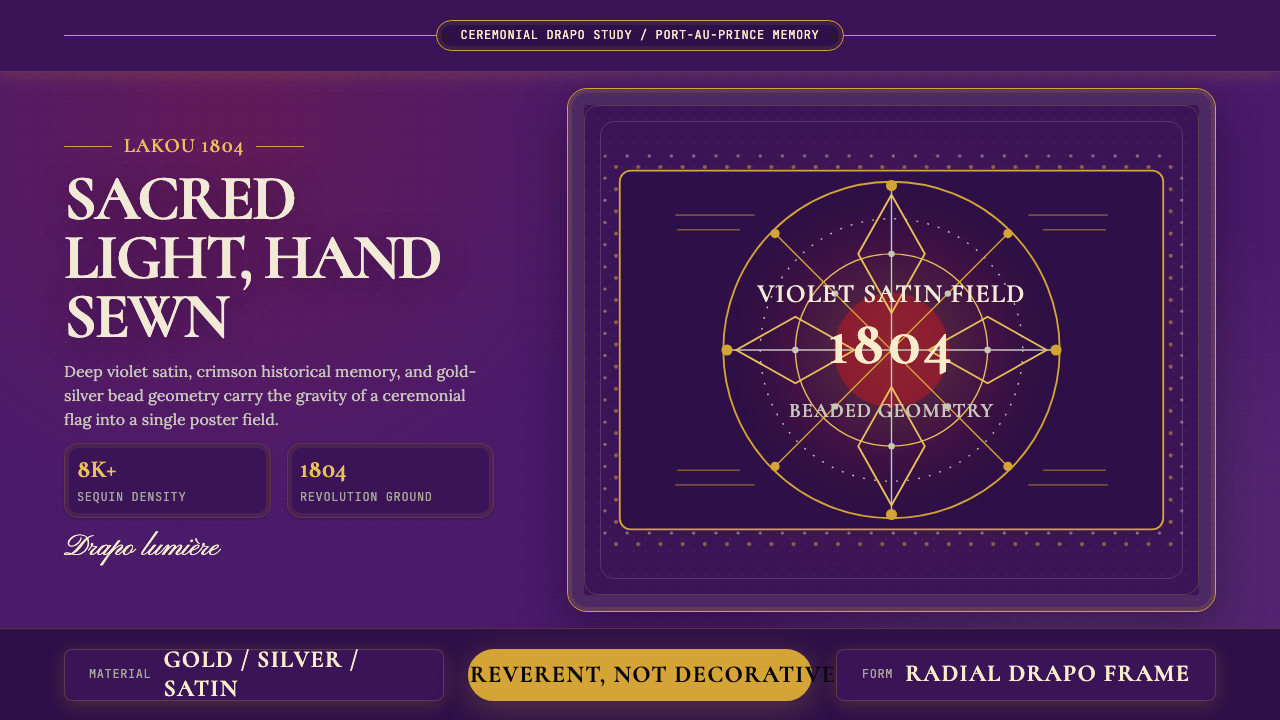 Haitian Vèvè Sequin Drapo 1804Sacred density. Violet satin, gold sequins, and radial geometry hold 1804 gra…
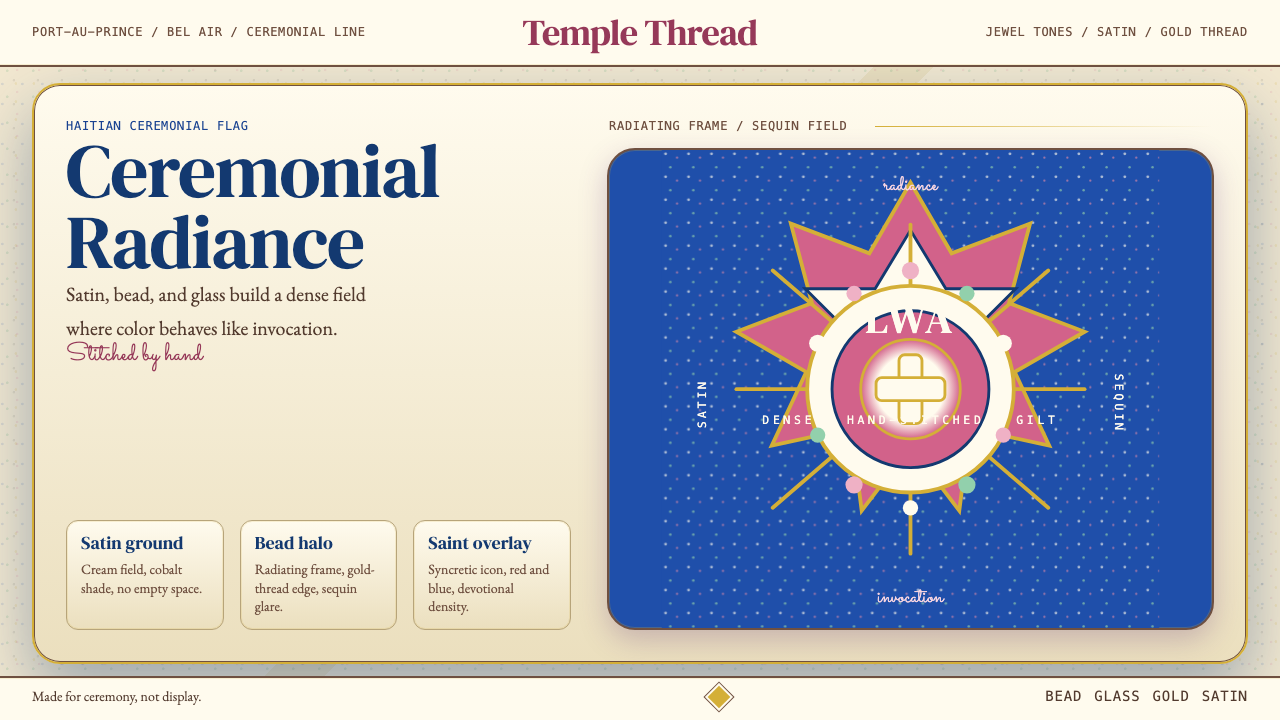 Haitian Vodou Flag (Drapo Vodou)Sacred and saturated. Jewel-tone satin, gold-thread frames, sequin halos.
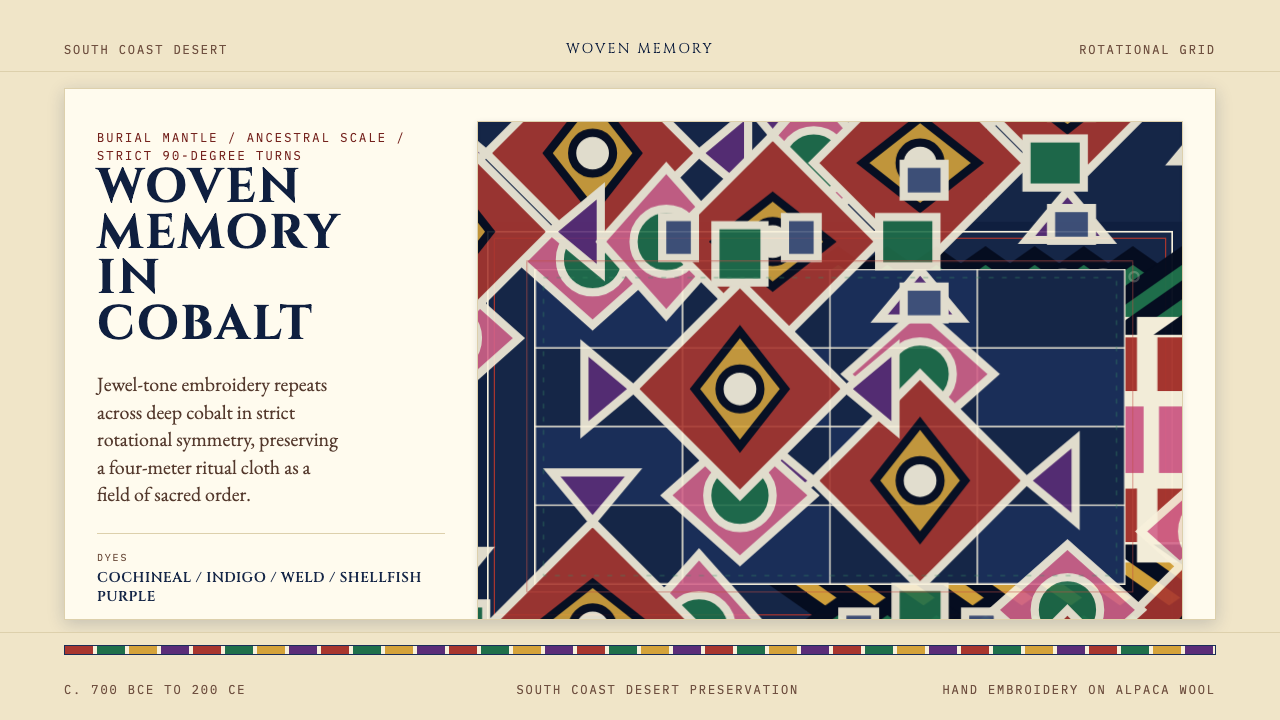 Paracas Andean TextileAncestral and exact. Jewel tones repeat on deep cobalt in strict 90° turns.
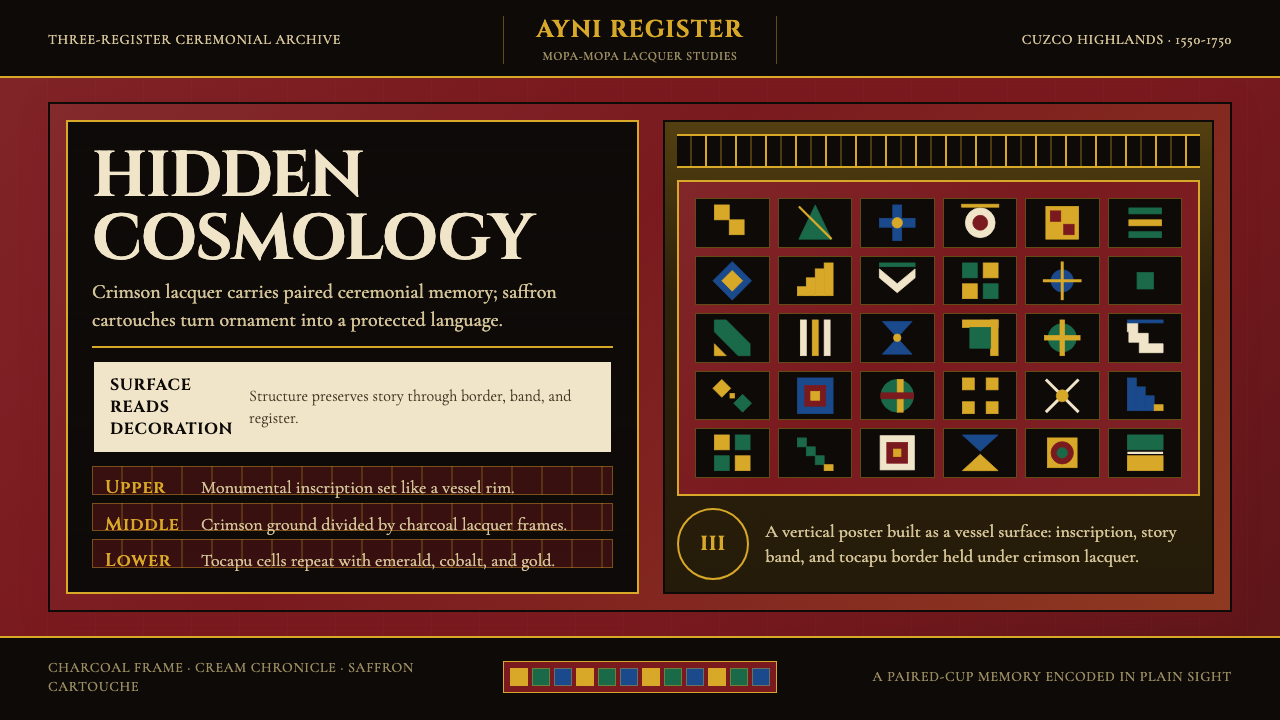 Peruvian Quechua Keros (Andean Cup)Hidden cosmology glows. Crimson lacquer and saffron tocapu grids frame the st…