What is Pazyryk Ice Maiden?
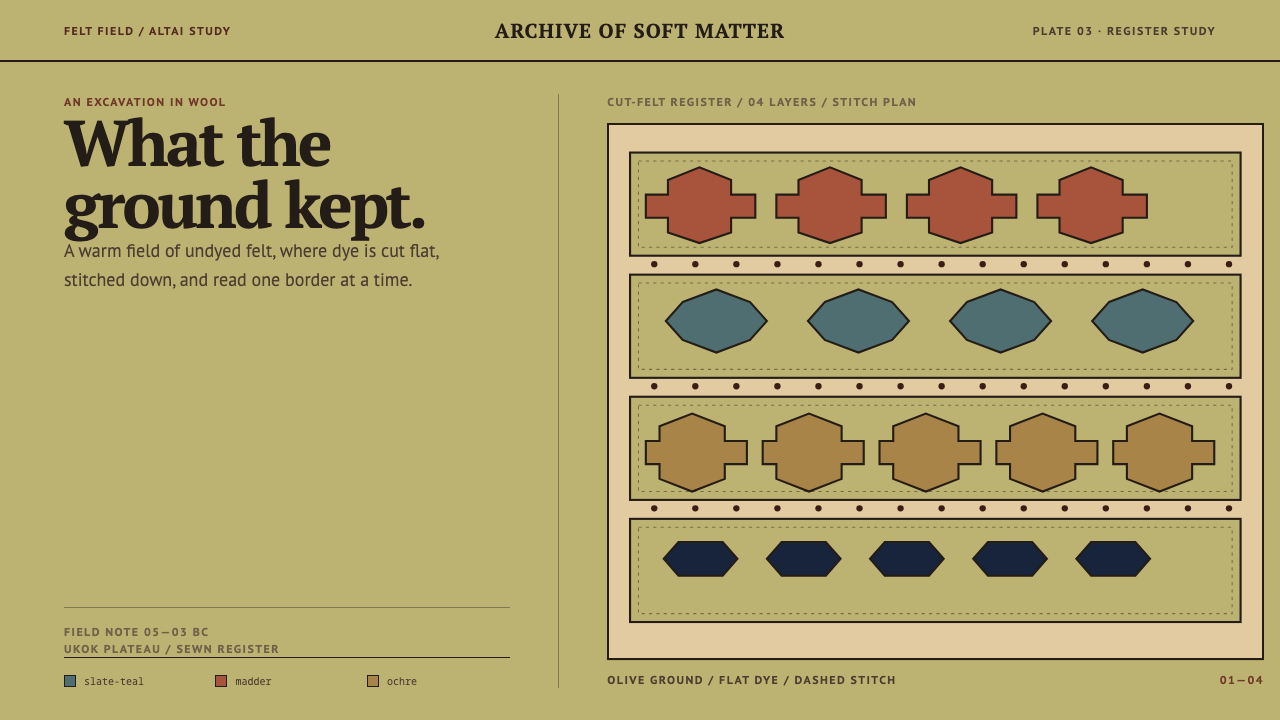
Pazyryk Ice Maiden takes its look from frozen Iron Age felt: an olive wool ground, flat figures cut with scissors and sewn into bordered registers, and nothing that shines.
Pazyryk Ice Maiden in brief
Pazyryk Ice Maiden is a design style based on the soft goods of the Iron Age nomads of the Altai: appliqué felt hangings, silk, leather, knotted pile carpet and tattooed skin. Its core image is a piece of undyed olive-khaki wool felt used as the page, with flat figures in madder red, cochineal red and ochre gold cut out and sewn on in bordered bands.
Unlike most historical revival styles, it is a matte, tactile, light-ground system. Surfaces are dull, edges are scissored, figures are flat silhouettes and nothing glitters. The page looks handmade and a little weathered, because its model was handmade and survived only because it froze.
The result suits designers who want warmth and weight without gloss. Its animal figures, deer above all, come from the animal style of the steppe, and its structure comes from the way appliqué felt is organised: a sequence of registers, each framed by a border, read one after another. It is a style in which the material is the message: felt that looks like felt, edges that look cut, colour that looks dyed, and a page that admits it was made by hand.
Where does Pazyryk Ice Maiden come from?
The Pazyryk barrows in the Altai Mountains of southern Siberia date from the fifth to the third century BC. Soon after burial they froze solid, and the cold preserved what almost never survives from the ancient world: the soft materials. Appliqué felt hangings, tussah silk, leather and wool came through, along with what is regarded as the oldest known knotted pile carpet and, on some of the buried, tattooed skin. The permafrost kept the half of steppe nomad culture that normally rots away. For later researchers that meant being able to study what usually vanishes: how a hanging was cut and sewn, how a colour sat on cloth, how a body was marked.
The finds came out in two phases. Excavations between 1929 and 1949 opened the principal barrows, and the names most closely attached to them are Mikhail Gryaznov and Sergei Rudenko. In 1993 Natalia Polosmak's excavation on the Ukok Plateau recovered the woman now called the Siberian Ice Maiden. Her shoulder, wrist and thumb carry tattooed deer in the animal style, the visual language that ties these objects to the wider world of the steppe.
These objects belong to the Scythian animal style and the wider art of the Eurasian steppe nomads, a visual culture in which stylised animals dominate decoration and in which portable, flexible materials mattered more than monuments. The Pazyryk kurgan culture is its local expression. For a design system the significance is material: here is an art of felt, silk, leather and skin rather than of stone or metal, and its aesthetics follow the way those materials are cut, sewn and worn.
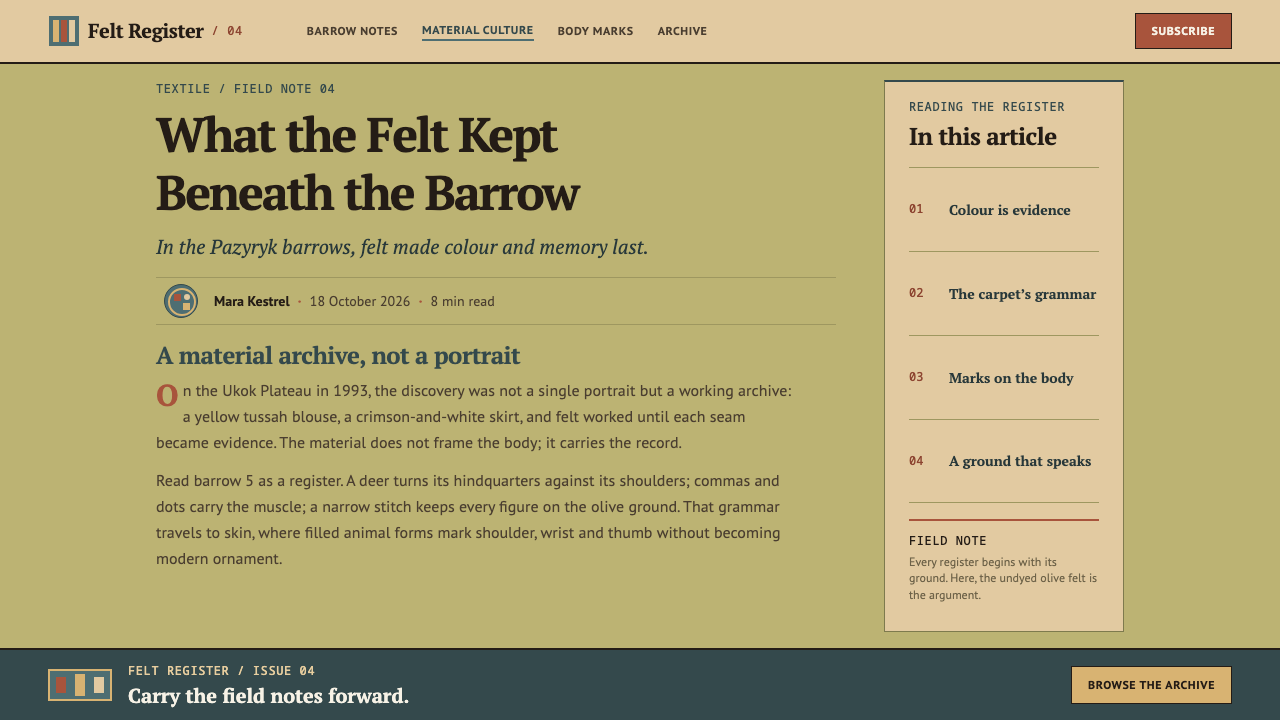
The style derives from the felt itself. Instead of starting from the famous tattoos or the carpet, the system takes felt as its referent: a dull, undyed olive wool as the ground; figures in madder, cochineal and ochre cut flat and sewn down; a cool teal-grey as counterpoint; and bordered registers organising the whole. Edges keep the character of scissors, slightly irregular and a little frayed, rather than the mathematical smoothness of vector paths.
What defines the Pazyryk Ice Maiden look?
The Felt Ground
The ground is undyed olive-khaki wool felt, mid in value and matte. It is the page, and it sets the temperature of everything on it: warm, fibrous, slightly dusty. Unlike most revival styles it is not dark, and unlike a modern white page it has body, so figures sit on it the way appliqué sits on cloth.
Natural-Dye Palette
The figures use madder red, cochineal red and ochre gold, with a cool teal-grey as counterpoint. These are the colours of plant and insect dyes: earthy, a little muted, never neon. The palette is warm-leaning and low in glare, and nothing in it shines.
Flat Cut Silhouettes
Figures are cut flat from coloured material and sewn down, so they have shape but no internal modelling. There is no shading, no highlight and no simulated depth. Detail comes from the outline and from a few cut or stitched marks, which keeps each figure legible at a glance and honest about being a piece of cloth.
Bordered Registers
The whole is organised into registers, bands of figures each framed by a border. They read one after another, like lines of a story or rows of a ledger. Structure comes from borders and bands rather than from boxes and shadows, and the system's order is the order of a sewn hanging.
Scissored Edges
Edges are cut, not drawn. They carry slight irregularity and a trace of fray, the signature of scissors on felt. A shape that is too perfect would be a vector pretending to be cloth, so the style treats small imperfection in the outline as evidence of the medium.
Matte Surfaces
Nothing here shines. There is no gloss, no glow, no metallic sheen and no soft glass effect. Felt, silk and leather in this tradition are absorbent, light-eating surfaces, and the style obeys that by keeping every area dull. The restraint is what lets its warm colours feel serious rather than decorative.
Animal Style
The motif vocabulary comes from the steppe animal style, with the deer inked on the Ice Maiden's shoulder, wrist and thumb as its best-known example. Animals appear as stylised silhouettes, used as figures within the registers rather than as pictures of scenes. In a layout this means a small, repeated vocabulary of creatures, not a free-for-all of decorative motifs.
Who shaped Pazyryk Ice Maiden?
Gryaznov is one of the two names most closely tied to the excavations of the Pazyryk barrows between 1929 and 1949. Those campaigns are why we know that appliqué felt, silk, leather and the oldest knotted pile carpet survived, and so why a felt-based design system is possible at all.
Rudenko is the other name the record attaches to the 1929 to 1949 excavations. His work establishes the material evidence for Iron Age steppe nomad culture that the style draws on: the soft goods that normally decay, preserved in frozen barrows.
Polosmak's name is tied to the 1993 excavation on the Ukok Plateau that recovered the Siberian Ice Maiden. That find added a human dimension to the felts and carpets, since the tattooed deer on shoulder, wrist and thumb showed the animal style worn on the body.
The woman recovered from the Ukok permafrost is the style's most famous figure and the source of its name. She is also a reminder of how to use the reference: the style borrows the felt-and-register logic of her world, while her remains and tattoos call for respect rather than casual decoration.
How do you use Pazyryk Ice Maiden today?
Pazyryk Ice Maiden is one of the few historical styles with a warm, matte, light-to-mid ground, which makes it useful when a design needs weight and craft without the drama of a dark theme. It rewards restraint: a small number of flat figures, a few natural-dye colours and a clear border system will do more than any ornament. A warm, matte page is also easy on the eye over many paragraphs, so the style works well for long reading where a dark theme would tire the reader.
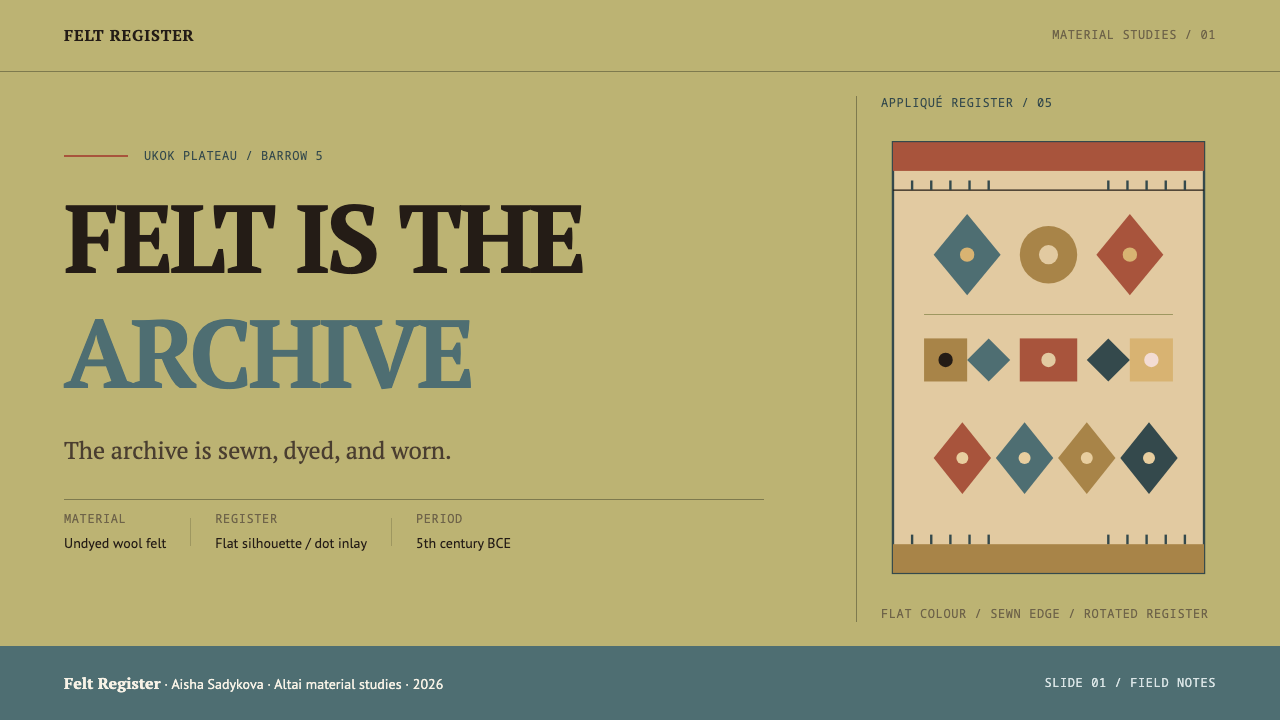
For presentation slides, a cover can be a single olive-khaki field with one band of cut silhouettes across it and a title set in plain type beneath. Content slides can adopt the register logic directly: each slide is one framed band, with text sitting in the felt ground. Data slides suit flat bars and simple blocks in madder and ochre, outlined by a border, with the teal-grey used for the comparison series. Keep the number of colours on any one slide small, so that the felt ground stays the dominant fact and the figures read as sewn pieces rather than as a palette demonstration.
For web interfaces, the style suits documentation, heritage and craft brands, outdoor and travel products, and editorial hubs. Use borders and dashed rules, which can echo stitching, instead of shadows; make buttons flat with a clear outline; and give cards a felt-coloured ground rather than white. Avoid gloss on controls, because the system is built on matte surfaces.
For editorial and marketing work, it supports archaeology, history, nomad and steppe subjects, natural-dye and textile brands, and any story about things made by hand and kept safe by cold or time. Section dividers can be bordered bands of repeated animal silhouettes, and photography of real felt or wool objects works as a companion. The tone can be unhurried and specific.
The most common mistake is polishing the style: adding gloss, soft shadows, neon accents or perfectly smooth vector shapes, which turns a felt page into a glass one. A second is mixing in unrelated tribal or ethnic patterns because they feel similar; the vocabulary is specific, the animal style of the steppe, and loose borrowing weakens it. A third is using more colours than the natural-dye palette allows.
Pazyryk Ice Maiden — FAQ
What are the Pazyryk barrows?
They are burial mounds of Iron Age nomads in the Altai Mountains of southern Siberia, dating from the fifth to the third century BC. The barrows froze solid soon after burial, which preserved soft materials that rarely survive: appliqué felt, tussah silk, leather, the oldest knotted pile carpet known, and tattooed skin.
Is this a tattoo style?
No. The tattooed Ice Maiden is the most famous find and gives the style its name, but the system takes felt as its referent. Animal figures like the tattooed deer can appear as motifs, yet the page logic comes from appliqué textile: a felt ground, flat cut silhouettes and bordered registers. If tattoo imagery is used at all, it should be treated as one motif among several, with the same respect owed to the remains it came from.
Why is the ground light when most ancient-art styles are dark?
Because the model is felt, an undyed olive-khaki wool, which is mid in value and warm. The style follows its material rather than a convention of antiquity as dark and heavy. The result is a matte, earthy page where figures in natural-dye colours stand out through hue, not through contrast with black.
How do I get scissored edges in a digital layout?
Think of it as a quality, not a recipe. Aim for outlines that are slightly irregular and not mathematically smooth, as if cut by hand from cloth. Hand-cut raster silhouettes or slightly roughened masks work better than perfect vector curves, and a small amount of unevenness is more convincing than a heavy texture overlay.
Where does the style struggle?
It struggles in contexts that want speed, gloss or futurism: high-tech products, fintech dashboards and anything meant to feel glassy or instant. Its values are slowness, handwork and weight, so it asks for subjects where those values are an advantage. A product whose promise is warmth, durability, provenance or craft will find it easy to carry; a product whose promise is speed will find it quietly contradicting the message.
Related design styles
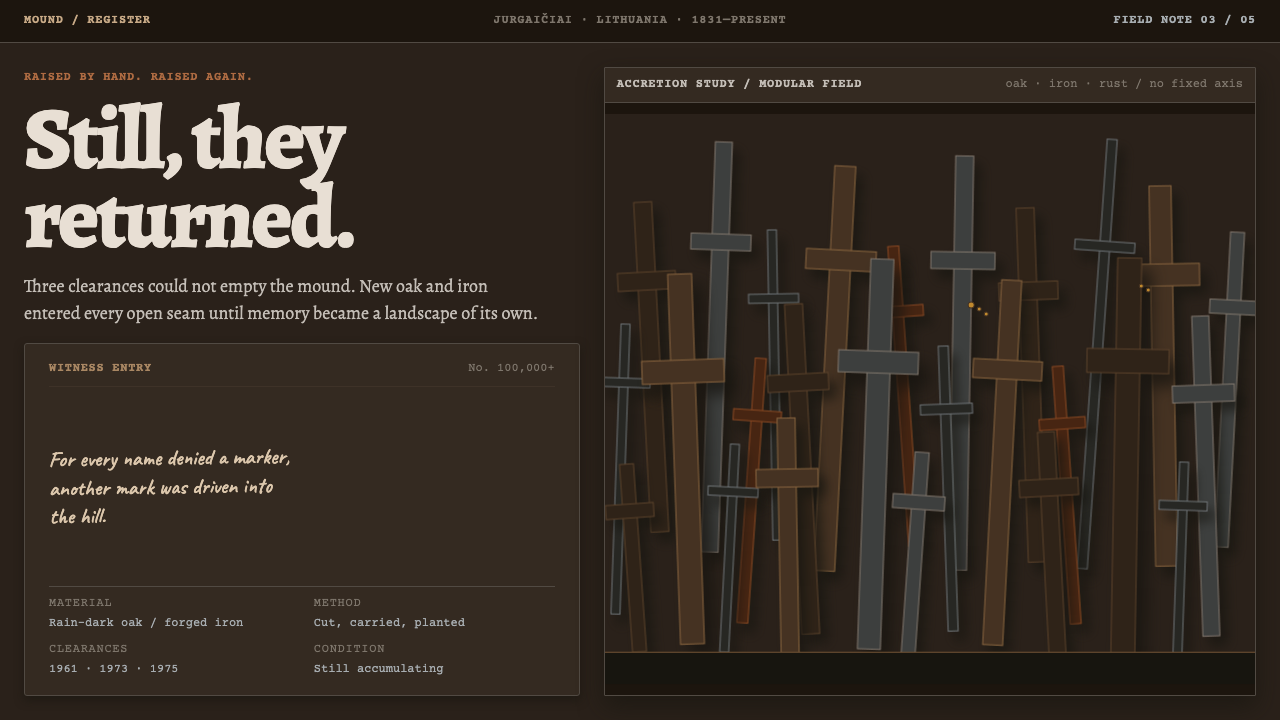 Hill of CrossesMemory returns by hand. Rain-black oak and rusted iron overlap until density…
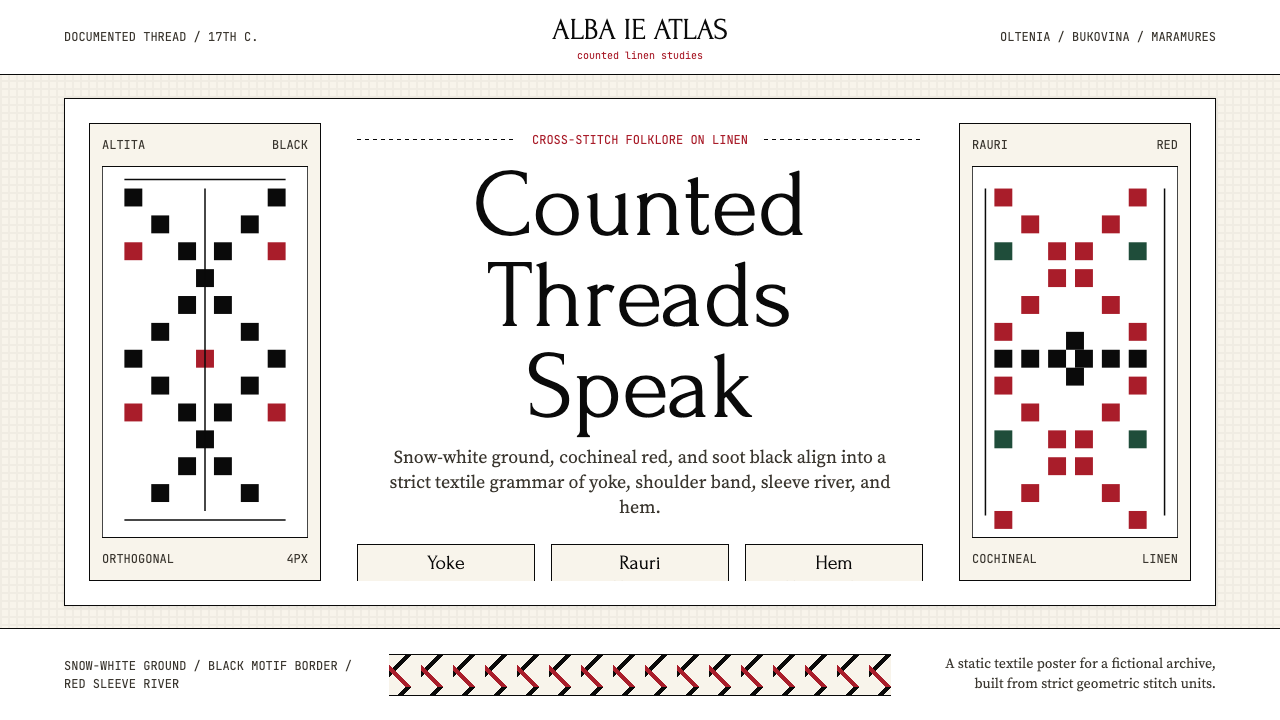 Romanian Ie (folk embroidered blouse)Folklore becomes grid. Cochineal red and soot black stitch strict bands on li…
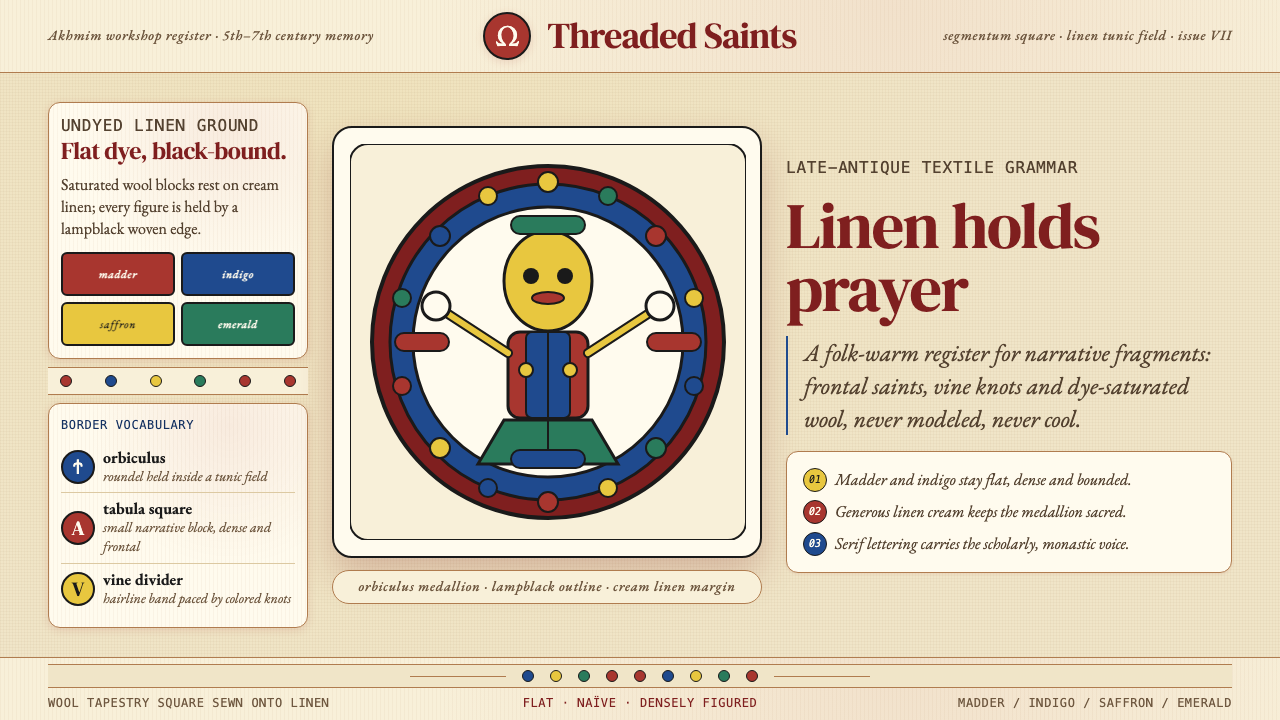 Egyptian Coptic TextileWarmth woven flat. Madder, indigo and saffron medallions sit on linen cream.
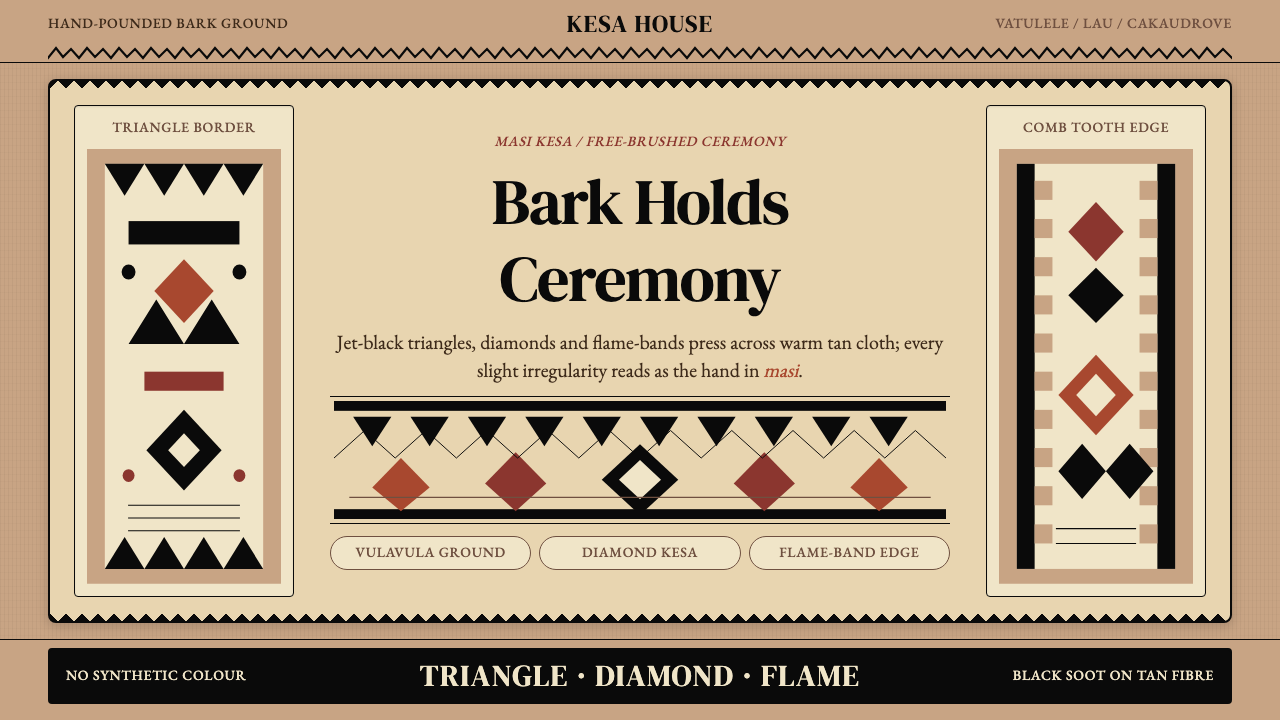 Fijian Masi (Tapa Cloth)Ceremony hits in black. Tan bark ground carries diamonds, zigzags and flame-b…
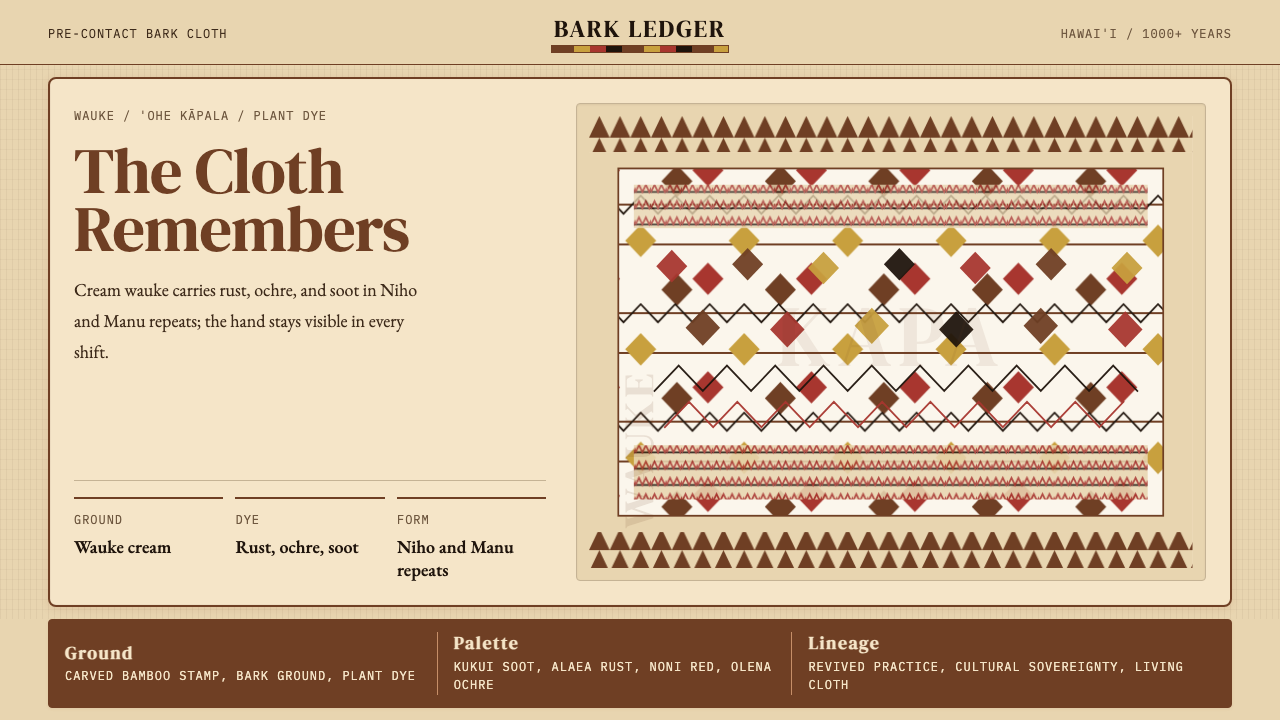 Hawaiian Kapa (Bark Cloth)Ceremonial geometry. Cream wauke, rust, ochre, and soot stamped in repeat.
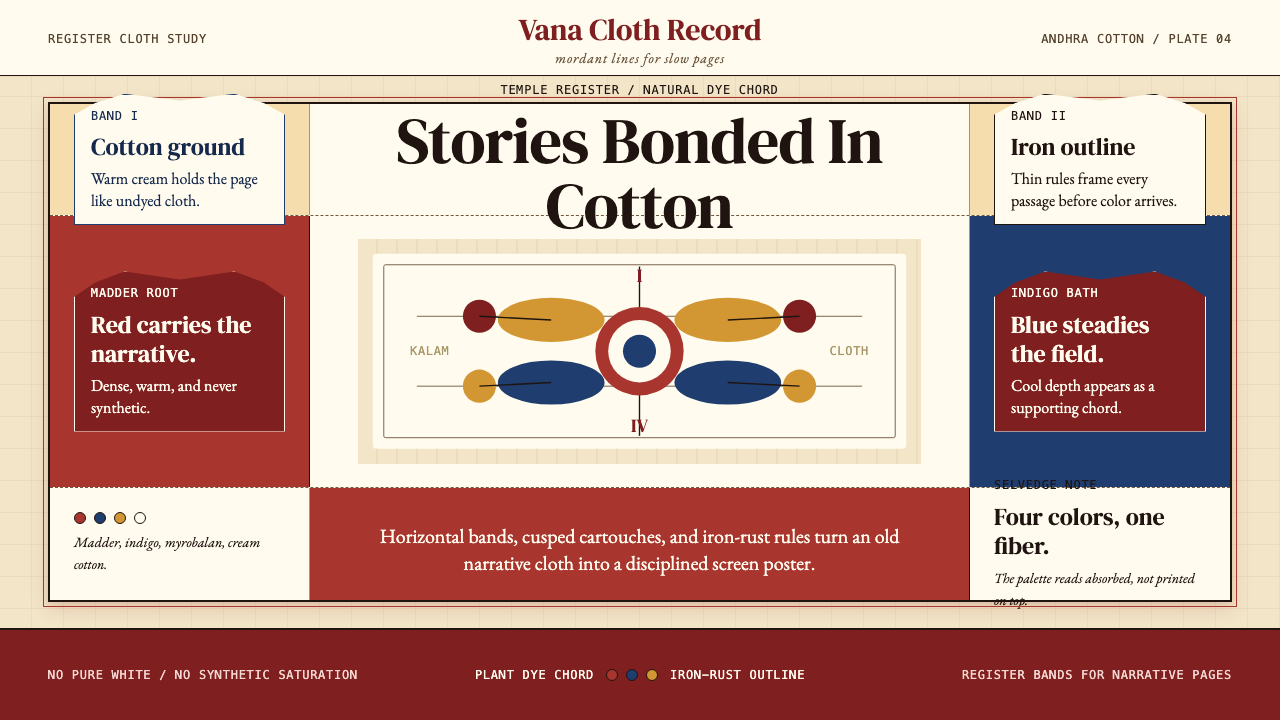 Kalamkari (Andhra Pradesh)Cloth becomes narrative. Madder bands, indigo panels, and iron rules stack li…