What is Hill of Crosses?
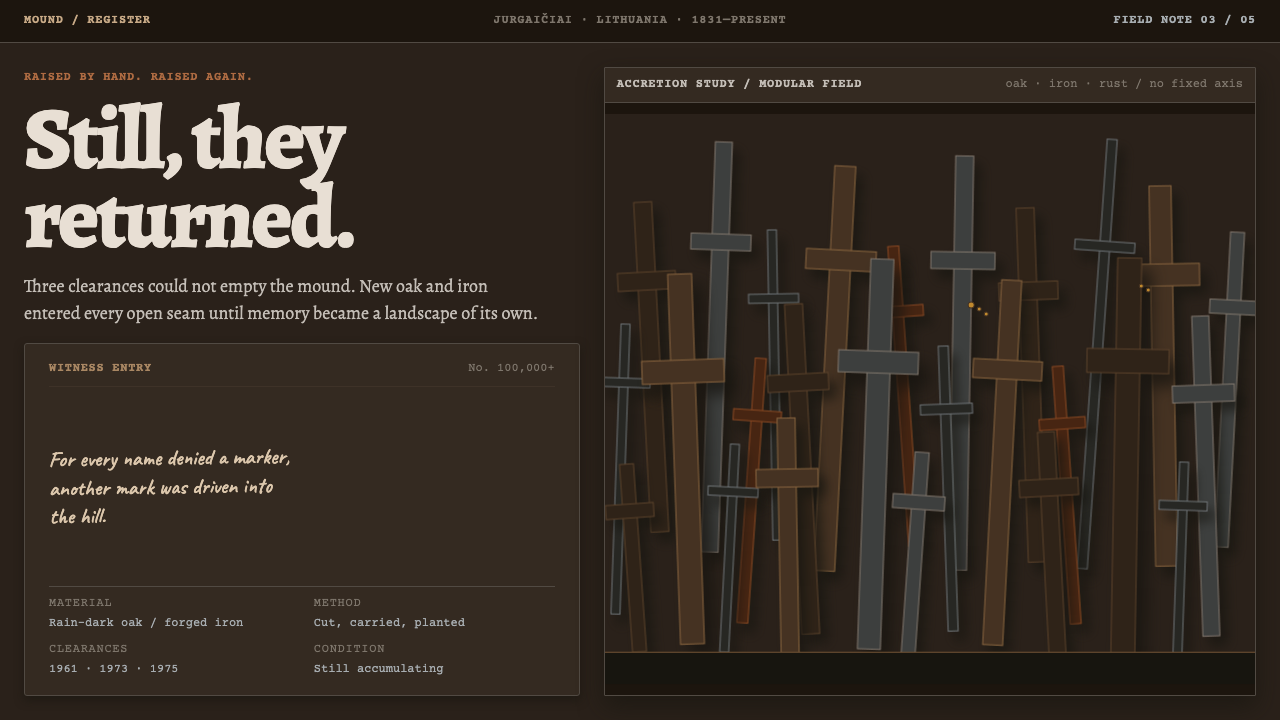
A single hillfort mound in Lithuania carries more than a hundred thousand hand-planted crosses, leveled by bulldozers three times and rebuilt within weeks each time — a design language where density itself is the act of defiance.
Hill of Crosses in brief
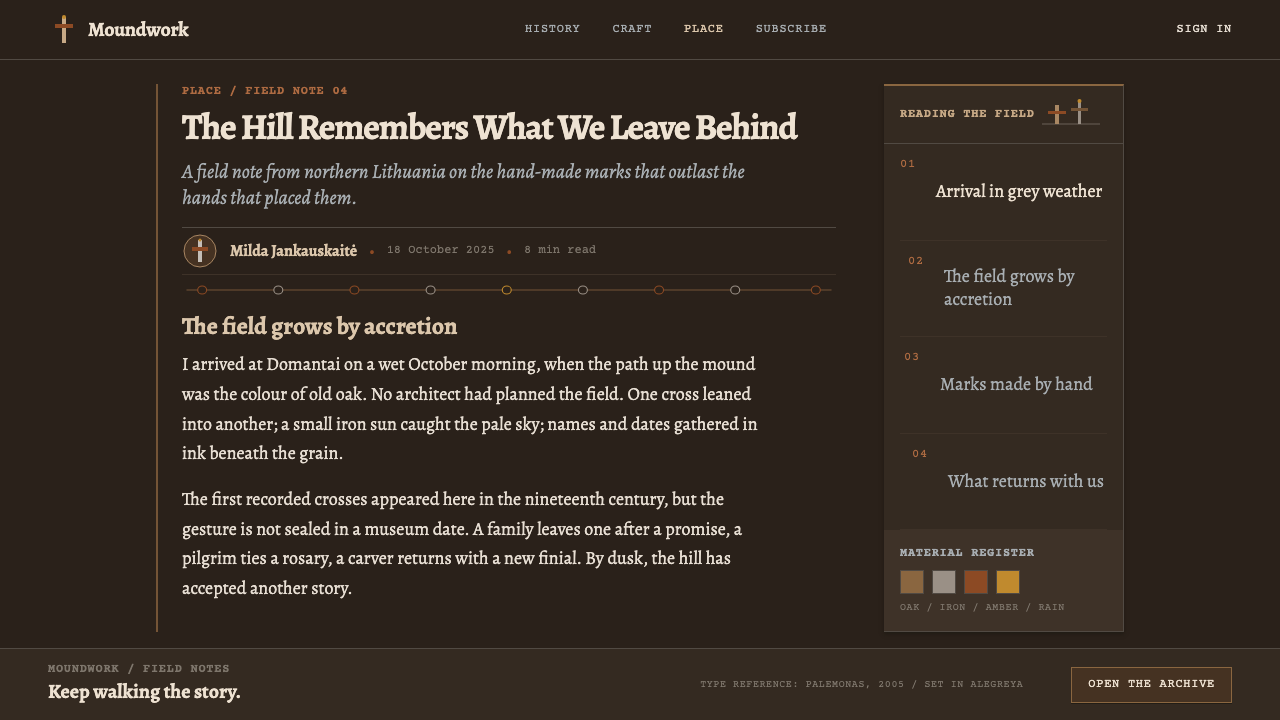
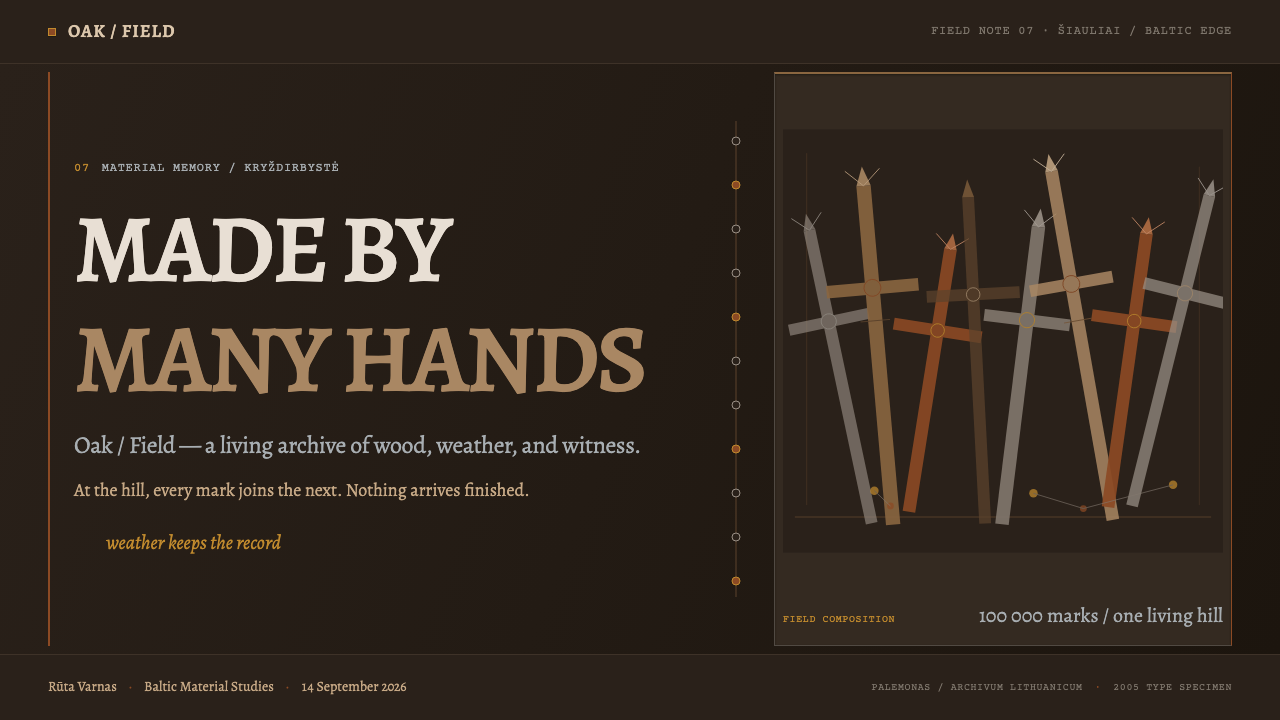
The Hill of Crosses is not a designed monument in the conventional sense; it is an accretion, built up cross by cross over nearly two centuries with no central authority, no master plan, and no single artist. What makes it a coherent visual system is the sheer accumulated density of tens of thousands of individual wooden and iron objects, leaning at different angles, overlapping in depth, and layered so thickly that no single cross is meant to be seen in isolation.
The material palette is narrow and entirely weathered. Oak crosses, ranging from about one to five meters tall, are chip-carved by self-taught itinerant makers and bolted to wrought-iron fittings, often hung with rosaries. Years of linseed oil finish and constant rain turn the wood from a warm brown toward silver-gray, while the iron elements oxidize to orange and rust. Nothing about this palette was chosen for visual effect; it is simply what happens to oak and iron left outdoors for decades in a wet climate.
The compositional principle that emerges from this material reality is one of near-total color suppression paired with maximum structural density. There is no dominant hue to speak of — the effect comes entirely from tightly packed, overlapping silhouettes, layered edges receding into the distance, and an almost complete absence of chroma. Color, where it appears at all, is a rare accent: a glint of brass or an amber rosary bead catching light against an overwhelmingly muted field.
Where does Hill of Crosses come from?
The first crosses on this hillfort mound, located about twelve kilometers north of the city of Šiauliai in northern Lithuania, were planted after the 1831 uprising against Russian imperial rule, when families unable to recover the bodies of executed or exiled relatives began placing crosses on the hill as a form of memorial. This origin already establishes the site's core logic: the crosses were never decorative, they were acts of memory and mourning carried out by ordinary people rather than commissioned artists.
Through the nineteenth and early twentieth centuries the practice continued and grew, driven by anonymous itinerant cross-makers known in Lithuanian as kryždirbiai — self-taught craftsmen who traveled between villages carving crosses on commission, developing a recognizable but unattributed folk style rooted in Lithuanian cross-crafting and blacksmithing traditions. Among the few names that survive from this tradition is Vladas Tumasonis, though the overwhelming majority of makers remain anonymous, consistent with a practice built on communal and devotional purpose rather than individual authorship.
The Soviet era transformed the hill from a site of quiet memorial into a direct site of political confrontation. Because the Soviet government treated the mound as an unacceptable expression of both Lithuanian nationalism and religious devotion, authorities bulldozed the site in 1961, again in 1973, and again in 1975, attempting each time to erase it permanently. Each demolition was followed, within weeks, by Lithuanians secretly returning under cover of night to plant new crosses — turning the site into one of the most visible acts of civil and religious resistance in Soviet-occupied Lithuania.
This cycle of destruction and immediate rebuilding is why the hill's aesthetic of dense, layered accumulation is inseparable from its political history: every added cross after 1961 carried the explicit weight of defiance, not simply devotion. Following Lithuanian independence, the site's significance was formally recognized internationally when UNESCO proclaimed it in 2001, cementing its status as a monument built entirely from below, by an unbroken chain of anonymous hands.
What defines the Hill of Crosses look?
Accumulated Density
The defining visual fact of the hill is sheer quantity: over a hundred thousand crosses packed into a single mound, overlapping in depth with no visible spacing logic other than physical necessity. A design drawing on this principle treats density itself as the message — many small, similar elements crowded together read as more powerful than any single large, isolated one.
Leaning, Non-Aligned Silhouettes
No two crosses stand at the same angle or on the same axis; the field is made of leaning silhouettes tilted by decades of ground settling and weather, overlapping one another in a way that creates depth without any formal perspective system. Applied to layout, this argues for deliberately irregular, slightly offset repetition rather than perfectly aligned grids when the goal is to evoke organic accumulation.
Weathered Wood Tones
Oak crosses finished in linseed oil begin warm brown and weather toward silver-gray under constant rain exposure. This is a material process, not a chosen palette, and it produces a narrow band of muted brown-to-gray tones rather than any saturated color. A system built on this should favor desaturated, warm-neutral browns and cool grays over any bright or synthetic-feeling hue.
Iron Oxidation
The wrought-iron fittings that bind and reinforce the crosses oxidize over time to shades of orange and rust, providing the only warm accent against the otherwise gray and brown field. This suggests using a single rust-orange accent sparingly against a predominantly neutral composition, rather than treating orange as a primary color choice.
Near-Absent Chroma
Across the entire hill, saturated color is almost entirely absent; the sky is typically an overcast, low gray, and the only glints of brighter color come from occasional brass fittings or amber rosary beads catching light. A composition drawing on this should keep chroma extremely low throughout, reserving any brighter accent for a single small, meaningful detail rather than a broad area.
Tight, Interlocking Spacing
The crosses are planted so closely together that their edges overlap and interlock, leaving almost no negative space between individual elements within the densest clusters. In interface or layout terms, this argues for tight spacing between repeated elements when the intent is to convey mass and accumulation rather than the generous breathing room typical of most contemporary design.

Who shaped Hill of Crosses?
The overwhelming majority of crosses on the hill were carved by self-taught, itinerant Lithuanian craftsmen known collectively as kryždirbiai, who traveled between villages making crosses on commission using traditional carving and blacksmithing methods. Their anonymity is itself part of the site's visual and cultural logic — this is a monument built by an unbroken chain of unnamed hands rather than the signature work of identified artists.
One of the few named cross-makers associated with the tradition, Vladas Tumasonis represents the rare case of an individual craftsman's name surviving within a practice otherwise defined by anonymity. His presence in the historical record helps confirm that the kryždirbiai tradition, though largely unattributed, was carried out by real, identifiable individuals working within a shared folk vocabulary.
UNESCO's 2001 proclamation of the Hill of Crosses formally recognized the site's cultural significance on an international level, following its history as a site repeatedly demolished by Soviet authorities and rebuilt by ordinary Lithuanians. The proclamation marks the point at which a monument built entirely from below — through anonymous, uncoordinated acts over nearly two centuries — received the kind of institutional recognition normally reserved for planned, authored works.
How do you use Hill of Crosses today?
This style transfers most naturally into contexts where the goal is to communicate weight, permanence, and accumulated meaning through quantity rather than through any single striking element. The essential move is to abandon the instinct toward generous, evenly spaced layouts and instead let many similar small units pack tightly together, overlapping at slightly different angles.
For presentation slides, a cover built from a dense field of small, repeated, slightly rotated icon-like marks — rendered in muted brown-gray tones with a single rust-orange accent — can evoke the hill's accumulation without literally depicting crosses. Content slides should avoid generous whitespace between bullet points or data groups; instead, cluster related elements tightly, using overlap or slight rotation to suggest organic buildup rather than engineered order.
For web interfaces, this logic suits archival, memorial, or community-contribution platforms where the point is that many small individual contributions accumulate into something larger — a wall of user submissions, a dense timeline, or a tightly packed tag cloud all draw on the same principle. Keep the color palette to desaturated browns and grays with one warm rust accent reserved for a single meaningful interactive element, such as a call-to-action.
For editorial and marketing layouts, this style supports long-form storytelling about resilience, memory, or collective effort. A tightly packed photo grid or a densely set list of names or contributions, rendered with almost no saturated color, communicates scale and persistence more effectively than a sparse, minimal layout would. Section breaks can use overlapping, irregularly angled dividers rather than clean straight rules to preserve the sense of organic accumulation.
A common mistake when applying this style is over-cleaning it — smoothing the deliberate irregularity into a neat, evenly spaced grid, or introducing bright saturated colors to make the composition feel more 'designed.' The entire visual power of this system comes from its refusal of tidiness and its near-total suppression of chroma; regularizing it or brightening it removes the exact qualities that make it recognizable.
Hill of Crosses — FAQ
Why does the Hill of Crosses have no single designer or unified plan?
The site grew organically from an act of individual memorial after the 1831 uprising, with subsequent generations of families and itinerant craftsmen adding crosses independently over nearly two centuries. There was never a central authority commissioning or coordinating the layout, which is precisely why the hill's visual identity comes from accumulated density and overlapping individual acts rather than from any planned composition.
Why did the Soviet government bulldoze the hill three separate times?
Soviet authorities viewed the hill as an unacceptable public expression of both Lithuanian nationalism and religious devotion, both of which the regime actively suppressed. Bulldozing it in 1961, 1973, and 1975 was an attempt to physically erase a symbol that resisted state control, but Lithuanians returned within weeks each time to secretly replant crosses, turning repeated demolition into a repeated act of visible defiance.
What gives the crosses their weathered brown-to-gray coloring?
The crosses are made of oak finished with linseed oil, which begins as a warm brown but weathers toward silver-gray after years of exposure to constant rain. This is a purely material and climatic process rather than a chosen aesthetic — the color is a byproduct of oak and iron aging outdoors in a wet northern European climate over decades.
Why is there so little color variation across the entire hill?
The narrow palette comes directly from the limited set of materials involved — weathered oak, oxidized iron, and an overcast northern sky — rather than from any deliberate color scheme being imposed on the site. The rare exceptions, such as a brass fitting or an amber rosary bead, stand out precisely because the surrounding field is so consistently muted, which is what gives them their signature-like quality.
How many crosses are on the hill today, and is the number still growing?
The hill carries more than a hundred thousand crosses, a figure built up through continuous, informal contributions since the first crosses were planted after the 1831 uprising. Because there is no central authority controlling who may add a cross, the accumulation has continued well past the site's 2001 UNESCO recognition, consistent with a monument that has always grown from the bottom up rather than through any managed process.
Related design styles
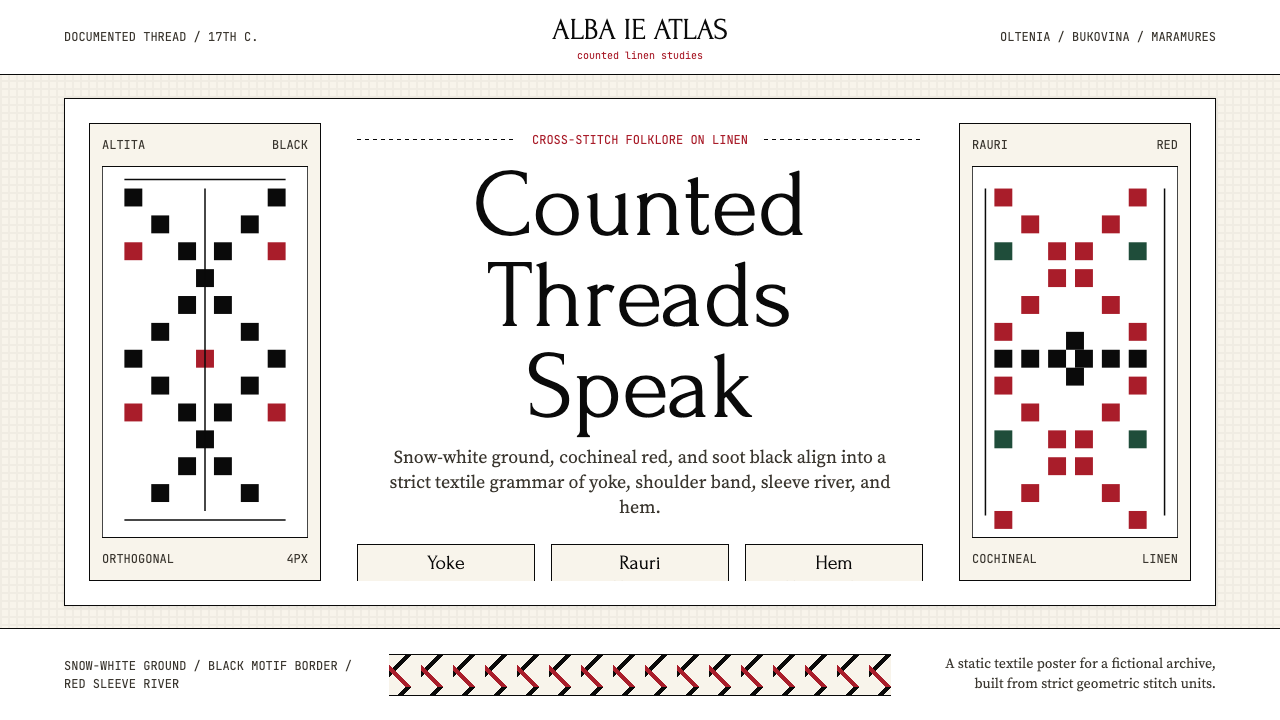 Romanian Ie (folk embroidered blouse)Folklore becomes grid. Cochineal red and soot black stitch strict bands on li…
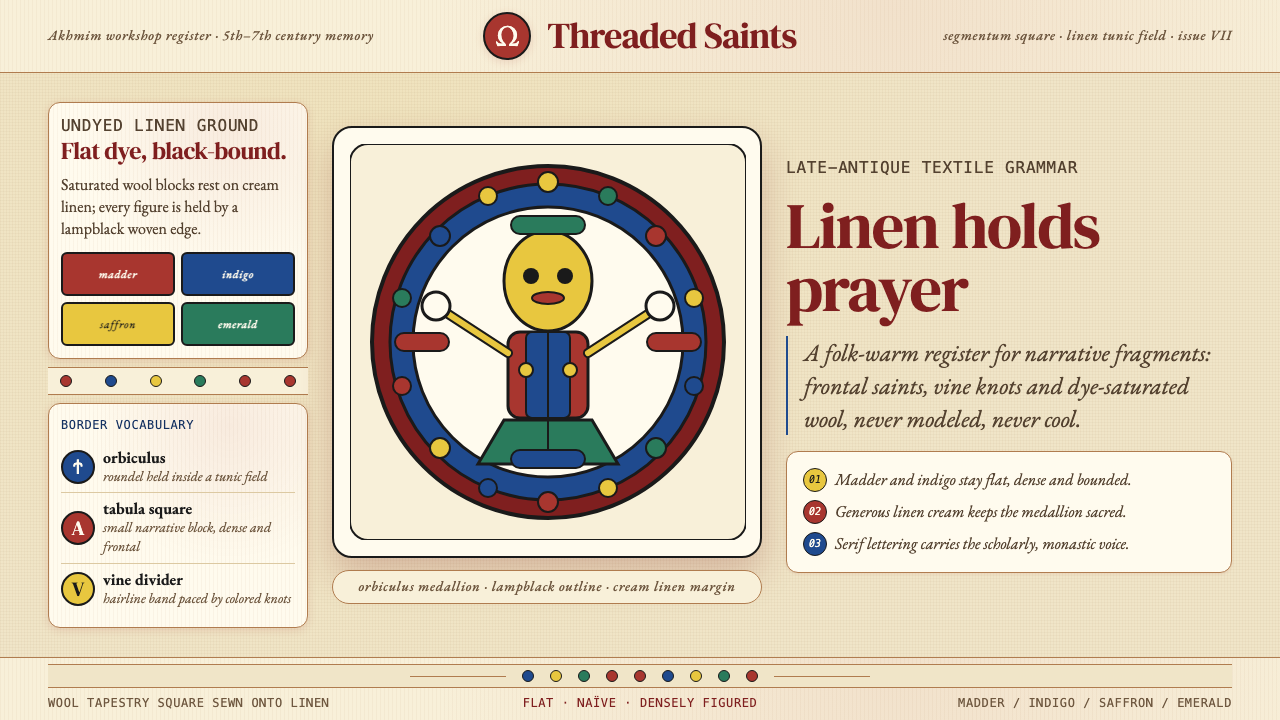 Egyptian Coptic TextileWarmth woven flat. Madder, indigo and saffron medallions sit on linen cream.
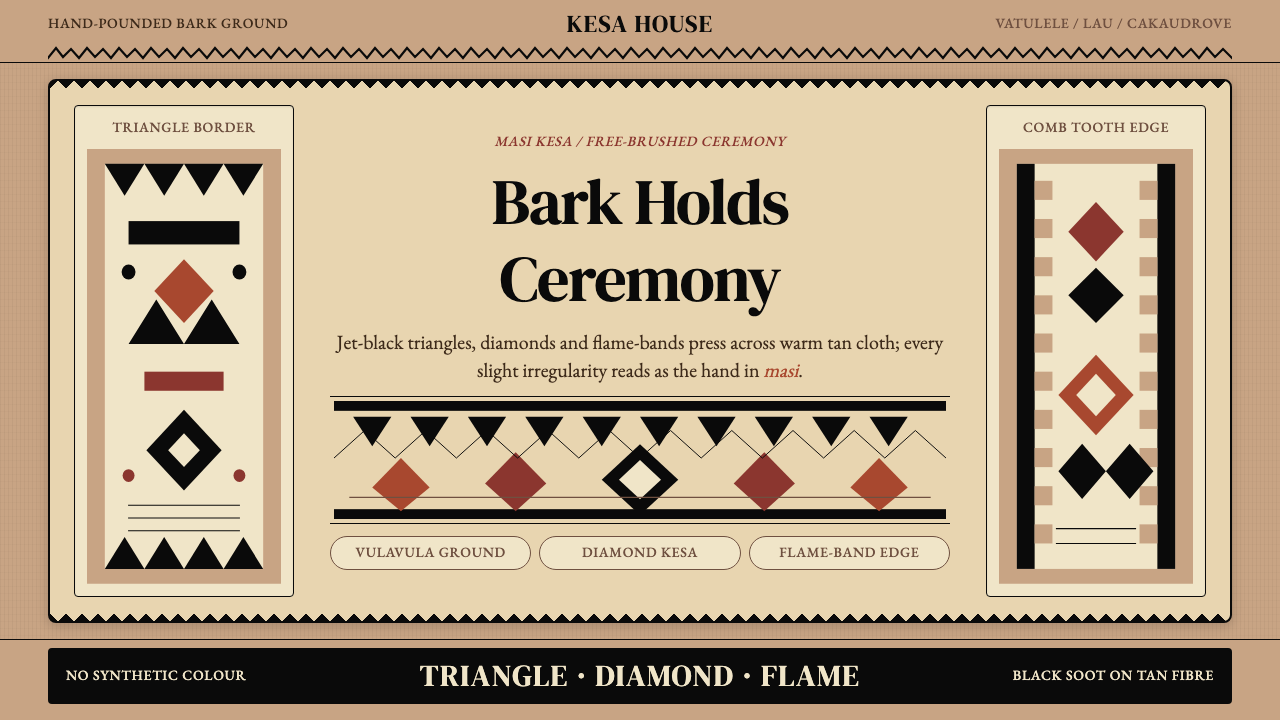 Fijian Masi (Tapa Cloth)Ceremony hits in black. Tan bark ground carries diamonds, zigzags and flame-b…
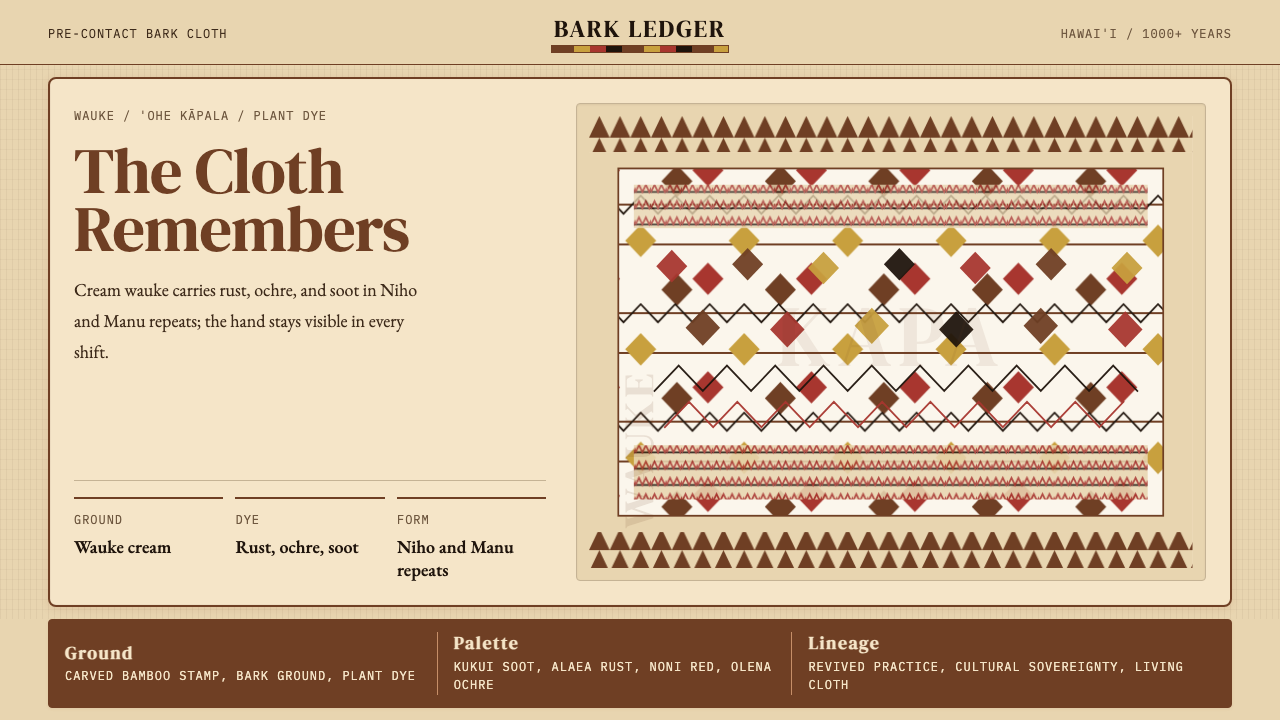 Hawaiian Kapa (Bark Cloth)Ceremonial geometry. Cream wauke, rust, ochre, and soot stamped in repeat.
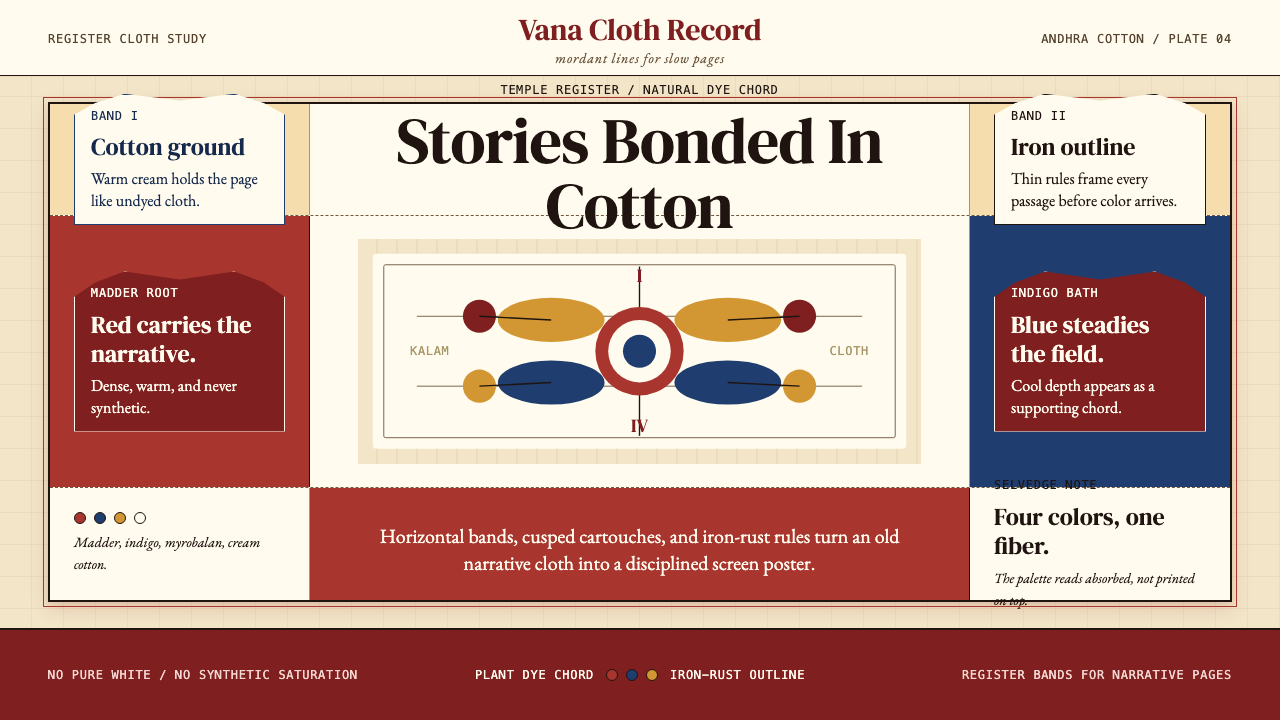 Kalamkari (Andhra Pradesh)Cloth becomes narrative. Madder bands, indigo panels, and iron rules stack li…
 Kuba Raffia Cloth (Congo)Deliberate asymmetry lives. Cream raffia, chocolate seams, and rust blocks.