What is Omani Khanjar Silver Dagger?
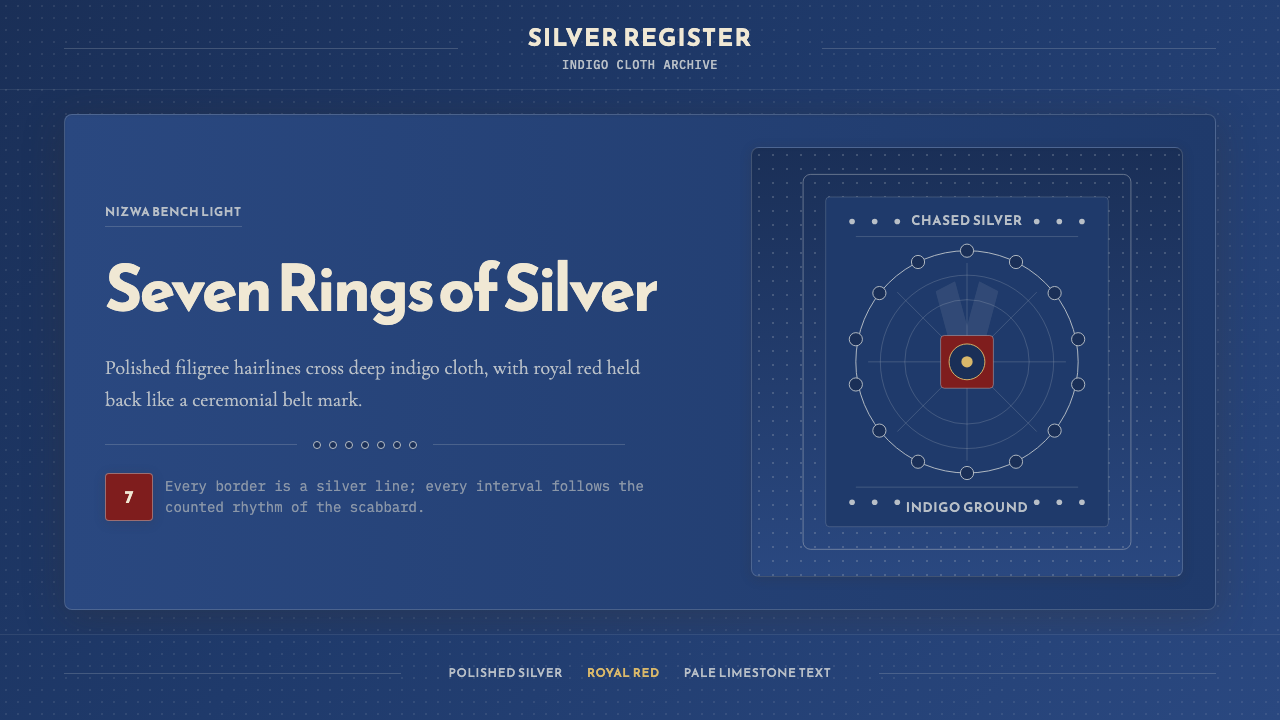
Oman's J-curved silver dagger — the khanjar — has graced flags, coins, and formal dress for centuries, and its silversmith's vocabulary of polished filigree on deep indigo cloth translates with surprising directness into a digital design language of luminous precision and ceremonial weight.
Omani Khanjar Silver Dagger in brief
The Omani Khanjar Silver Dagger design style takes its entire visual grammar from one of the world's most recognizable national symbols. The khanjar — a J-shaped curved dagger worn at the waist by Omani men on formal and ceremonial occasions — is so central to Omani identity that it appears on the national flag, national emblem, and currency. This design system translates the material culture of the Nizwa silversmith's workshop into interface and graphic language: polished-silver filigree hairlines over deep indigo display cloth, a royal-red accent color that echoes the silk Saidi belt, and inscriptive serif type recalling verses chased into a scabbard.
Every surface in this aesthetic is understood as the dark indigo cloth on which the dagger rests. Every border is a silver hairline. Every ornamental rhythm references the seven-ring count of the traditional khanjar scabbard. The result is unmistakably Omani in character — formal, lustrous, and grounded in the prestige of craft rather than the anonymity of corporate luxury. Where many heritage-derived design languages are decorative in spirit, this one is structural: the ornament is not applied to surfaces but emerges from the logic of the object itself.
The palette places polished silver and deep indigo at the center, with royal red as a purposeful accent and warm ivory as a secondary ground. Type is inscriptive and authoritative — reminiscent of the calligraphic traditions of the broader Arabian Peninsula — while remaining legible and hierarchically clear. The overall register is one of dignified restraint: everything present has a ceremonial justification, and nothing is included merely to fill space.
Where does Omani Khanjar Silver Dagger come from?
The khanjar's origins reach back at least to the seventeenth century, when the Ya'rubi dynasty unified Oman and expelled Portuguese colonial forces from the Gulf coast. The dagger was already a prestige object in the material culture of southeastern Arabia, but the Ya'rubi period — with its court culture, maritime trade wealth, and Ibadi Islamic traditions — elevated it from weapon to symbol. By the time the Al Bu Said dynasty took power in the mid-eighteenth century, the khanjar had become inseparable from the formal identity of an Omani man of standing.
The craft centers that defined the khanjar's visual character are concentrated in the interior of Oman, particularly in Nizwa — historically the country's most important inland city and the seat of the Ibadi imamate. Nizwa's silversmiths developed distinctive techniques for chasing, filigree, and niello inlay that set Omani daggers apart from those produced across the wider Gulf region. The Bahla and Salalah traditions added regional variations, while Muscat, as the commercial and diplomatic capital, became the market where finest pieces were traded and gifted to foreign dignitaries.
Sultan Qaboos bin Said, who ruled from 1970 until his death in 2020, played a decisive role in codifying the khanjar as the primary national symbol of modern Oman. His Renaissance project — a sweeping modernization that built schools, hospitals, roads, and institutions in a country that had almost none at his accession — was carried out under the explicit mandate of preserving Omani cultural identity alongside modernization. The khanjar appeared on the new national flag from 1970, on currency, and in the national emblem. Wearing it at formal occasions became not merely a tradition but a statement of national pride available to every citizen.
The silversmithing traditions behind the khanjar connect to a broader material culture of the frankincense trade, which for centuries made Dhofar in southern Oman one of the wealthiest regions of the ancient world. The material wealth generated by incense exports funded elaborate craft production — in silver, textiles, leather, and wood — and established Oman as a node in trade networks linking the Arabian Peninsula with East Africa, the Indian subcontinent, and maritime Southeast Asia. The visual culture of the khanjar carries traces of all these influences: the inlay techniques recall Indian craftsmanship, the filigree patterns echo both Arabian and East African traditions, and the indigo cloth on which the dagger is displayed derives from textile routes that spanned the entire Indian Ocean world.
What defines the Omani Khanjar Silver Dagger look?
The Indigo Ground
Deep indigo — the color of the cloth on which a displayed khanjar rests — forms the primary background of this design language. It is not the navy of corporate design or the midnight of luxury tech; it reads as saturated and specific, carrying the weight of ceremonial cloth rather than the sleekness of a digital convention. Against this ground, all other elements gain their distinction and their luminosity.
Silver Filigree Lines
Borders, dividers, and structural lines are rendered as silver hairlines — fine, bright, and precise, directly evoking the filigree wire work of the Nizwa silversmith. These lines are never thick or heavy; their authority comes from their precision and their contrast against the dark ground, not from mass. Decorative motifs, where they appear, echo the chain-link and rope-twist patterns of traditional khanjar fittings.
Royal Red Accent
A deep, saturated red — drawn from the crimson silk of the Saidi ceremonial belt worn with the khanjar — serves as the sole warm accent in an otherwise cool palette. It is used sparingly and purposefully: for primary calls to action, for tier or status indicators, for the single most important element on any given composition. Its rarity in the layout is what gives it authority; when it appears, the eye goes to it immediately.
Seven-Ring Ornamental Rhythm
The traditional khanjar scabbard is distinguished by its seven silver rings — a count so specific and consistent that it has become a marker of authentic craft. This numbered rhythm translates into interface design as structured repetition: groups of seven, spacing systems built on consistent multiples, ornamental bands that divide at seven intervals. The rhythm is never arbitrary; it references an object that every Omani can identify on sight.
Inscriptive Typography
Type in this system evokes the carved and chased inscriptions found on khanjar blades and scabbards — verses from poetry or the Quran rendered in precious metal against dark steel. A serif typeface with calligraphic roots and a strong vertical axis is preferred: it reads as authoritative without being archaic, inscriptive without being decorative. Arabic script, when present, is treated with the same weight and presence as Latin letterforms, never subordinated to the Roman grid.
Lustrous Contrast
The defining visual tension in this style is between the deep, absorbing darkness of the indigo ground and the sharp luminosity of silver elements. This is not the soft contrast of most dark-mode interfaces; it is the specific contrast of polished metal against ceremonial cloth — hard-edged, high-fidelity, almost tactile. Gradients and soft transitions undercut this quality; every edge should feel struck rather than faded.
Formal Restraint
Like the ceremony in which the khanjar is worn, this design language operates within strict formal conventions. Decoration is present but never exuberant; every ornamental element can be traced back to the physical object. Empty space is not avoided — the dark indigo ground reads as rich, not empty — but it is purposeful. The style resists the impulse to fill, to vary, to surprise; its power comes from consistency and the weight of established convention.
Who shaped Omani Khanjar Silver Dagger?
Al-Bahri represents the tradition of master silversmiths whose workshop practices defined the standards of Nizwa-school khanjar production. Within the Omani craft tradition, such figures serve as living embodiments of transmitted technique — the precise ratios of blade curvature, the count of scabbard rings, the weight distribution of the handle — knowledge that passed through apprenticeship rather than written documentation. His name is invoked in discussions of authentic craft lineage as a touchstone for discerning connoisseurs of Omani silverwork.
Ruler of Oman from 1804 to 1856, Sayyid Said bin Sultan presided over the height of Omani maritime power, when the Sultanate controlled a trade empire stretching from the Gulf coast to Zanzibar and the Swahili coast. His court in Muscat — and later his capital in Zanzibar — was a center of refined material culture in which the khanjar functioned as a key element of diplomatic and courtly display. The formal gift of a fine khanjar was an act of statecraft, and the objects produced during his reign set a benchmark for the most elaborate and prestigious examples of the tradition.
Sultan Qaboos (r. 1970–2020) did more than any other figure to fix the khanjar as the defining visual symbol of modern Oman. When he came to power, Oman was one of the most isolated countries in the world; his Renaissance project transformed it into a modern state while deliberately enshrining traditional symbols. His decision to place the khanjar on the national flag — where it remains today, crossed with a sword against a white vertical stripe — gave the object a global visibility it had never possessed, and made it the unavoidable reference point for any visual language claiming an Omani identity.
The Al Rashidi Saidi school designates one of the recognized lineages of Omani silversmithing craft, associated with the refinement of the khanjar's proportions and decorative vocabulary during the Al Bu Said period. Within the tradition of applied arts on the Arabian Peninsula, named schools of this kind preserve not only techniques but also aesthetic judgments — the particular curvature considered most elegant, the density of filigree work considered most accomplished, the specific alloy composition considered most lustrous. Their standards continue to inform the evaluation of contemporary Omani silverwork.
Nizwa's contribution to the visual identity of the khanjar is best understood not through individual names — most master craftsmen worked anonymously within guild-like workshop structures — but through the cumulative development of a regional style. Nizwa smiths are credited with standardizing the seven-ring scabbard, refining the signature J-curve of the blade, and developing the specific filigree patterns that distinguish Omani work from otherwise similar daggers produced in Yemen, Persia, or India. Their influence created the visual baseline that all subsequent discussions of the khanjar's design identity take for granted.
How do you use Omani Khanjar Silver Dagger today?
The Omani Khanjar Silver Dagger style is one of the more specific and demanding heritage aesthetics to apply in contemporary design — its authority depends on treating its visual elements as a coherent system derived from a real object, not as decorative motifs borrowed freely. Understanding what the style is actually doing — using the indigo-silver contrast to create a sense of precious display, using the seven-ring rhythm to impose measured structure, using the royal red sparingly to direct attention — is the prerequisite for applying it with integrity.
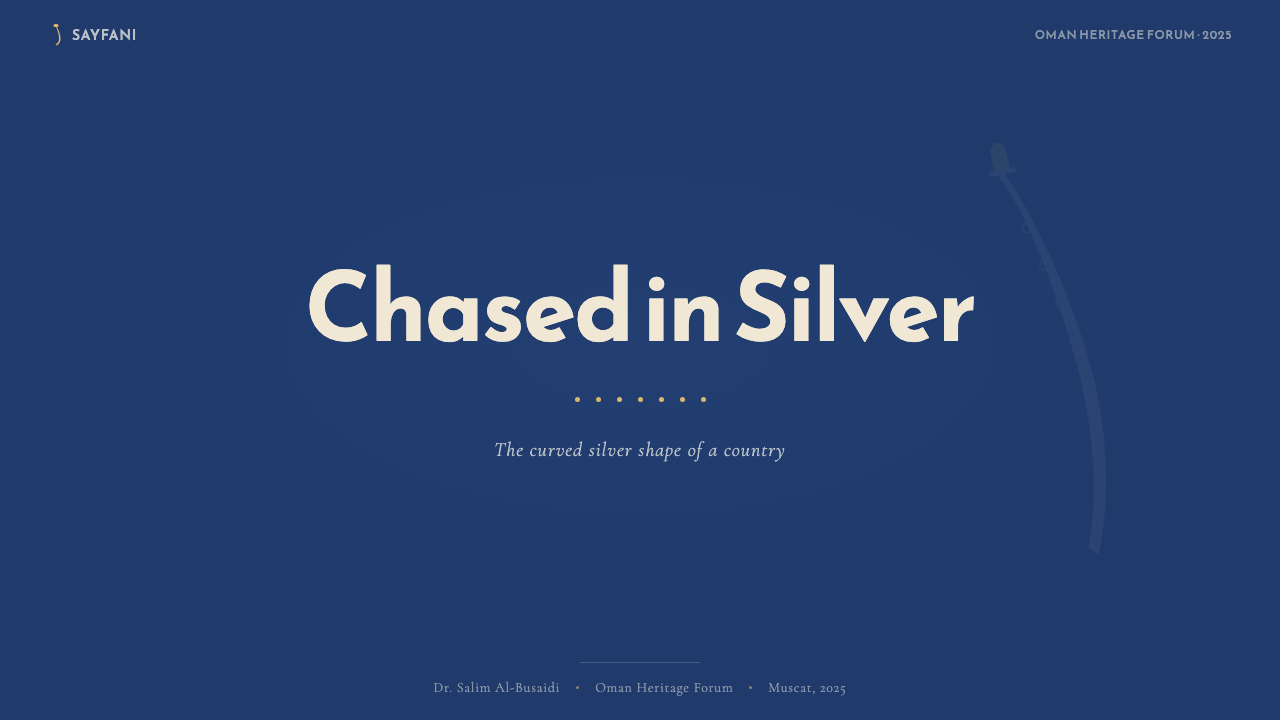
For presentation slides, this style is especially well-suited to formal or ceremonial contexts: keynote addresses, institutional reports, ministerial presentations, heritage brand launches. A cover slide should commit to the deep indigo ground across the full bleed, with the title set in a luminous near-white or silver-toned typeface at substantial scale. Supporting text drops to a lighter weight in the same family. Decorative silver hairlines — thin, precise, horizontal — can divide the composition without adding visual noise. Content slides should be treated as dark-ground layouts where the text itself carries the ornamental role; data visualizations use the royal red for highlighted values and silver tones for secondary data series.
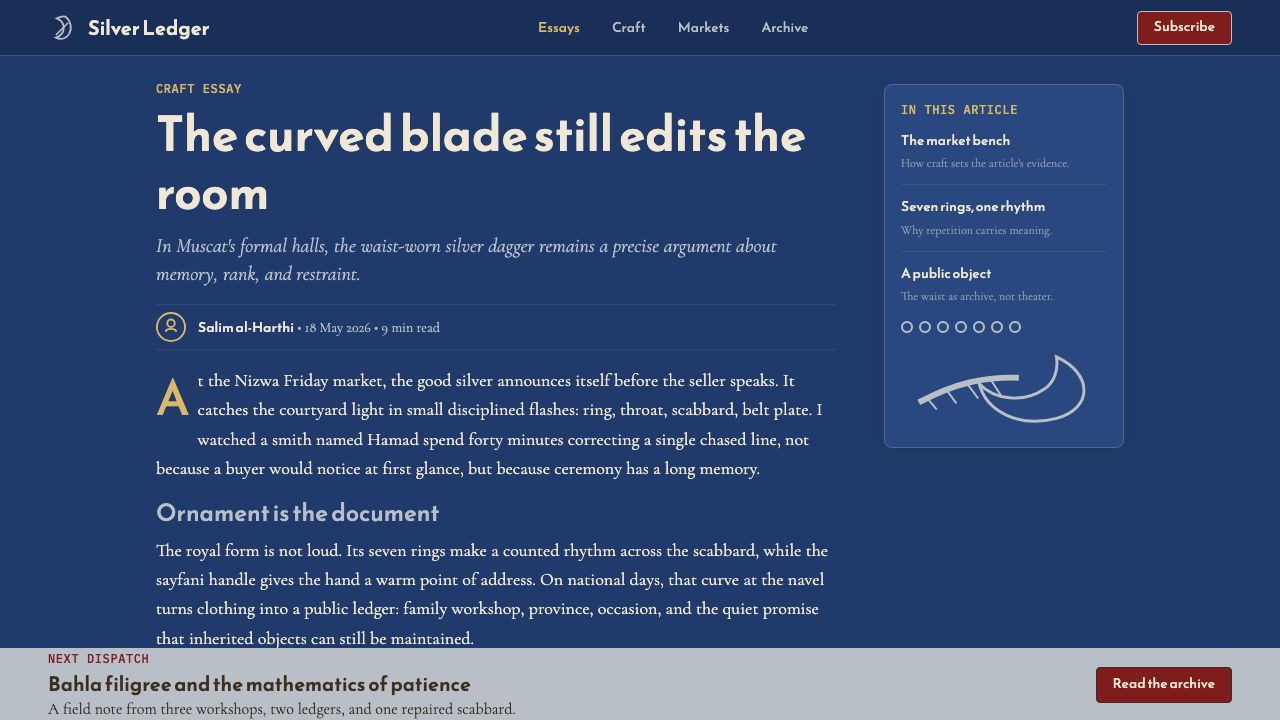
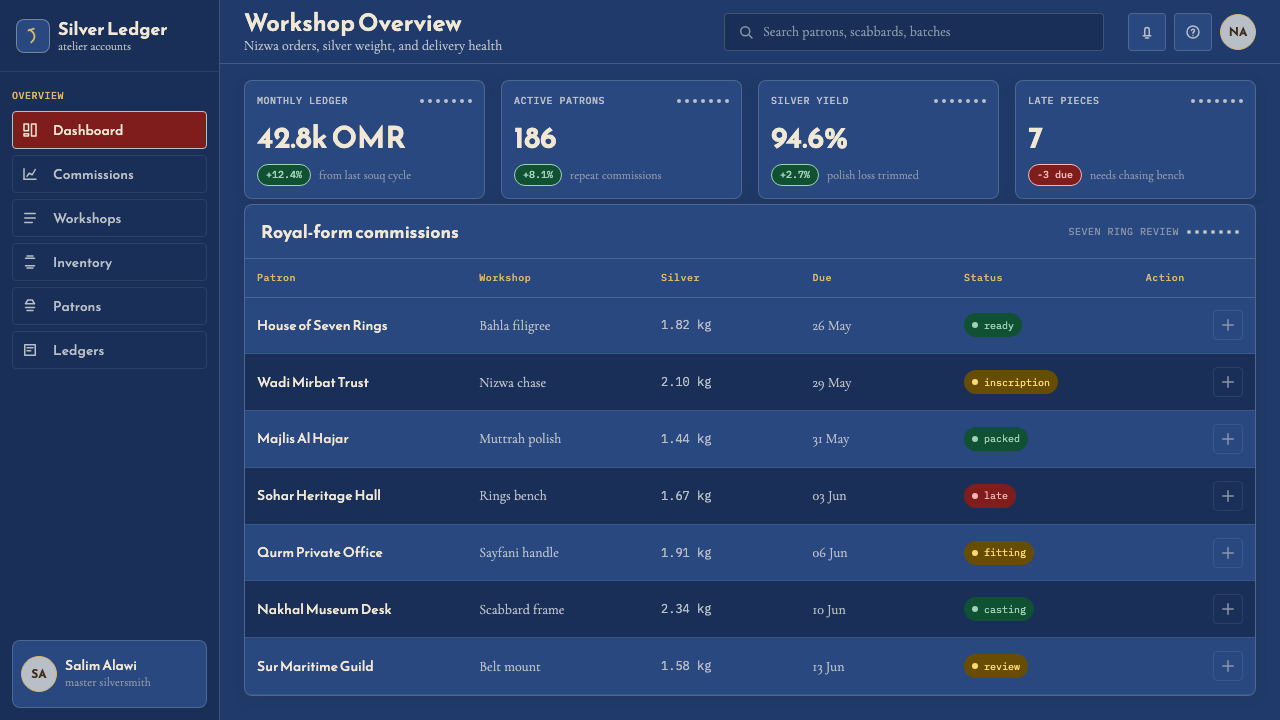
For web interfaces and dashboards, this style suits contexts where gravitas and trustworthiness are primary values: government portals, institutional websites, cultural heritage platforms, premium hospitality brands, and financial products targeting Gulf audiences. Navigation should be typographic and minimal against the dark ground — wordmarks and labels at full contrast, with the royal red held in reserve for the single most important interactive element on any given page. Card components take their character from the polished-silver-on-indigo contrast: a subtle silver border or elevated surface rather than a soft shadow. Pricing and tier pages benefit from the style's inherent sense of hierarchy; a premium tier can be distinguished simply by applying the royal red or a silver-filigree accent rather than by changing the layout paradigm entirely.
For editorial and marketing work, the style supports a specific kind of cultural authority — appropriate for publications covering Gulf affairs, heritage tourism, luxury goods with Omani provenance, and any context where the reader is expected to recognize the khanjar as a cultural referent. Article layouts should use the indigo ground for pull quotes and section breaks, with body text on a warm ivory field to reduce reading fatigue across long passages. Marketing materials work well with the style's poster-like directness: full-width feature blocks on deep indigo, title text in the silver register, a single royal-red call-to-action button positioned with the deliberateness of the strongest element in a ceremonial composition.
The most common mistake when applying this style is treating the indigo and silver as a color scheme rather than as a structural logic. This leads to using indigo as a background without committing to the corresponding precision of the silver filigree elements, or to adding silver as a decorative sparkle on an otherwise conventional layout. The style's power depends on the coherence of the system: every border must feel like a silversmith's wire, every ornamental band must echo the scabbard ring count, every surface must read as cloth rather than screen. A second common error is over-applying the royal red — using it on multiple elements simultaneously, or at high saturation across wide areas, destroys the accent economy that gives it authority. A third mistake is importing soft or warm elements — rounded corners, ambient glows, gradient fills — that carry the visual logic of other aesthetic systems and break the specifically hard-edged, lustrous quality that defines this one.
Omani Khanjar Silver Dagger — FAQ
Is this style appropriate for non-Omani or non-Gulf contexts?
The style is specific enough in its cultural references that it carries meaning — and responsibility — wherever it is applied. Used in a context with genuine connection to Omani culture, heritage, or Gulf regional identity, it is both appropriate and powerful. Used as a generic dark-luxe aesthetic with no cultural grounding, it risks reading as pastiche or appropriation. The practical test: if the audience would not recognize the khanjar as the source of the visual logic, the style should either be explained in context or replaced with a more neutral dark-ground aesthetic. The indigo-silver-red combination can be abstracted to the point where cultural specificity is lost; whether that abstraction is desirable depends on the project's purpose.
How does this style differ from other Gulf or Middle Eastern design aesthetics?
Several visual traditions from the broader Gulf and Middle Eastern region share surface elements — geometric patterns, calligraphic typography, rich dark grounds — but differ significantly in their underlying logic and cultural source. Omani Khanjar style is specifically grounded in the material culture of silversmithing and dagger-making, giving it a hard-edged, metallic precision that distinguishes it from the more textile-derived warmth of Moroccan or Persian aesthetics, the gold-dominant palatial language of Gulf luxury brands, or the geometric tile-work traditions of Andalusian-influenced design. The seven-ring structure, the specific indigo cloth reference, and the J-curve dagger form are Omani-specific; other regional traditions would substitute different objects and different craft vocabularies.
Can this style work in a light-ground version?
A light-ground inversion is possible but substantially changes the character of the style. On a warm ivory or cream ground, the indigo becomes an accent color rather than the primary field; silver elements shift to a dark tone for legibility; the royal red becomes more dominant by default. This inverted version can work well for print contexts — a publication on Omani crafts, a museum exhibition catalogue, a luxury print advertisement — where the full-bleed dark ground would be impractical or where reading comfort is paramount. However, the specific quality of polished metal against ceremonial cloth — the defining visual logic of the style — depends on the dark ground. A light-ground version is a related aesthetic, not the same system.
How should Arabic and English text be balanced in this style?
The khanjar's cultural context makes bilingual Arabic-English presentation both natural and expected for audiences in the Gulf. The style's inscriptive typography logic treats both scripts with equal formal weight — Arabic text should never be subordinated to the Roman grid or reduced to smaller sizes as a secondary translation. In practice, this means sizing Arabic and English text by optical equivalence rather than by matching a fixed unit, allowing the Arabic right-to-left flow to define the right edge of the composition on any line where it appears, and choosing typefaces in both scripts that share a similar vertical rhythm and stroke character. The two scripts read differently but should carry the same visual authority on the page.
What kinds of projects should avoid this style?
The style's formal, ceremonial character makes it a poor fit for contexts that require approachability, playfulness, or organic warmth. Consumer-facing products in categories like food and beverage, children's education, wellness, casual social platforms, or any application where the user experience depends on friendliness and lightness will be undermined by the style's severity. It also struggles when applied to dense data environments where the high contrast of the indigo-silver palette creates legibility problems at small scales. Finally, any project where the designer cannot commit to the full system — where budget, timeline, or platform constraints prevent proper typography, proper contrast ratios, and the precise line work that defines the filigree language — should choose a less demanding aesthetic. A half-applied version of this style reads as dark and generic rather than as ceremonially Omani.
Related design styles
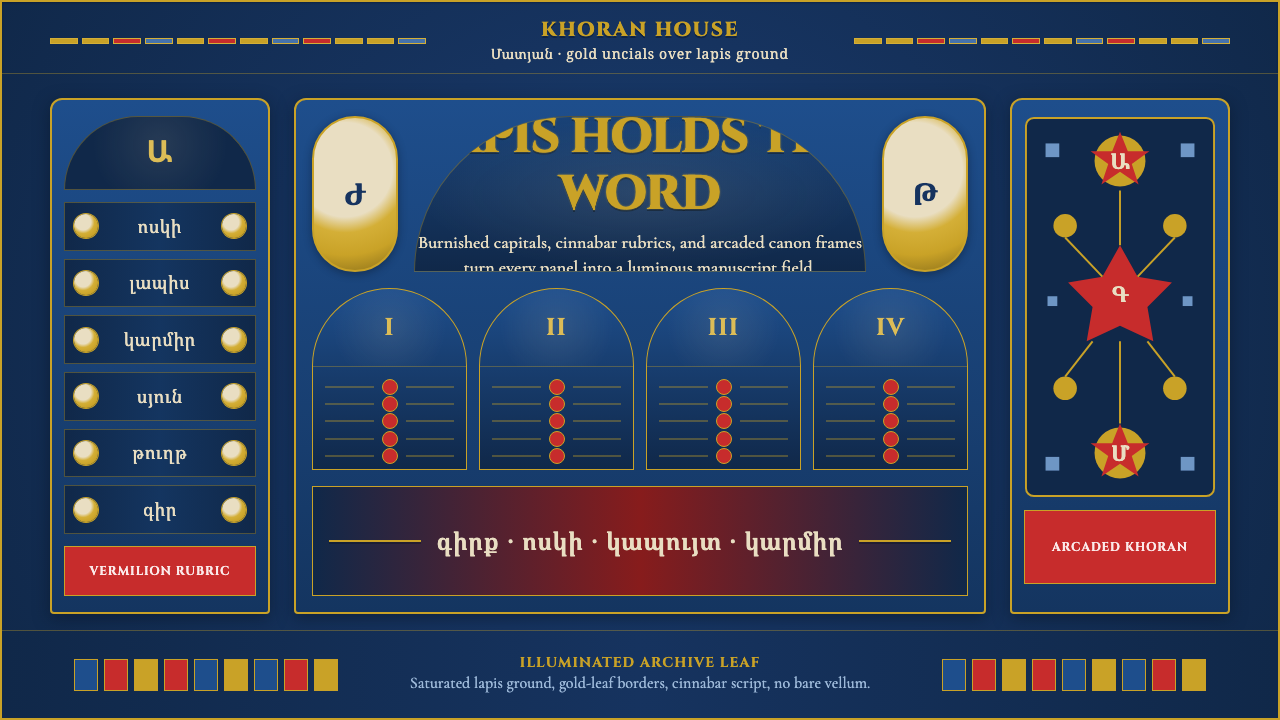 Armenian Manuscript FolkloreJewel-dense devotion. Lapis ground, gold uncials, and vermilion arcades fill…
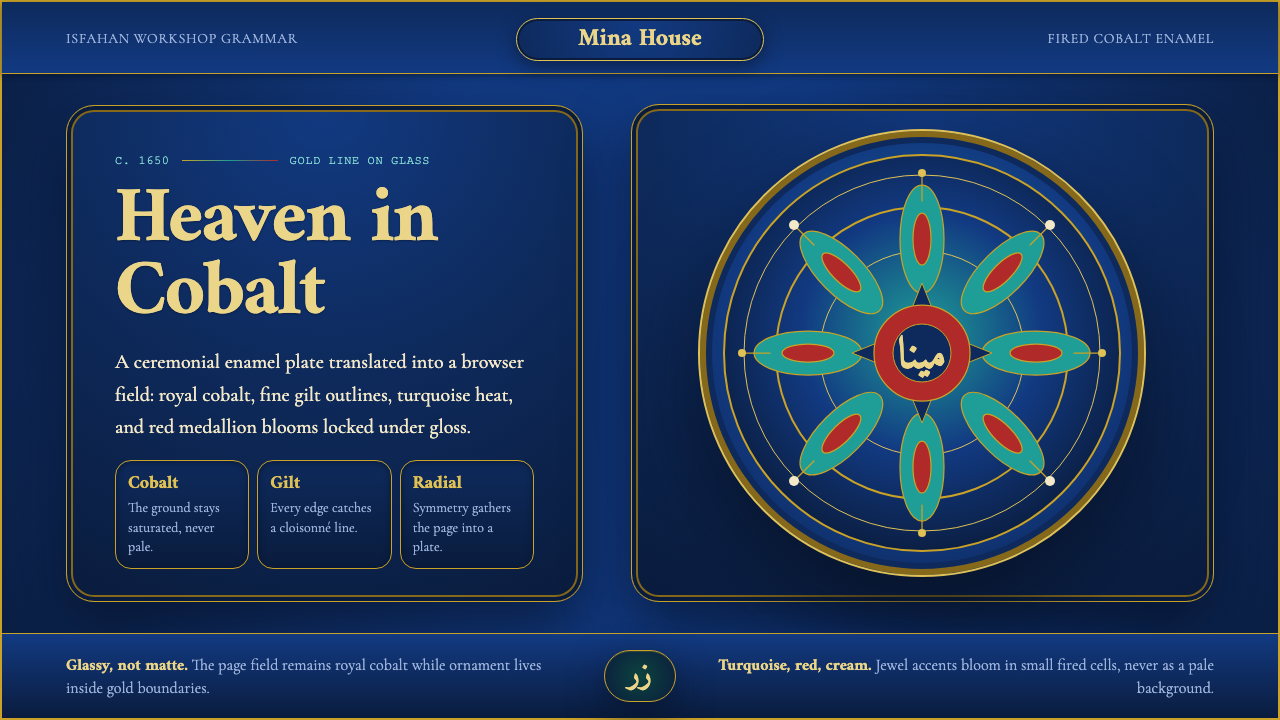 Isfahan Minakari EnamelJewel-bright ceremony. Cobalt enamel, gold cloisonné lines, and radial blooms…
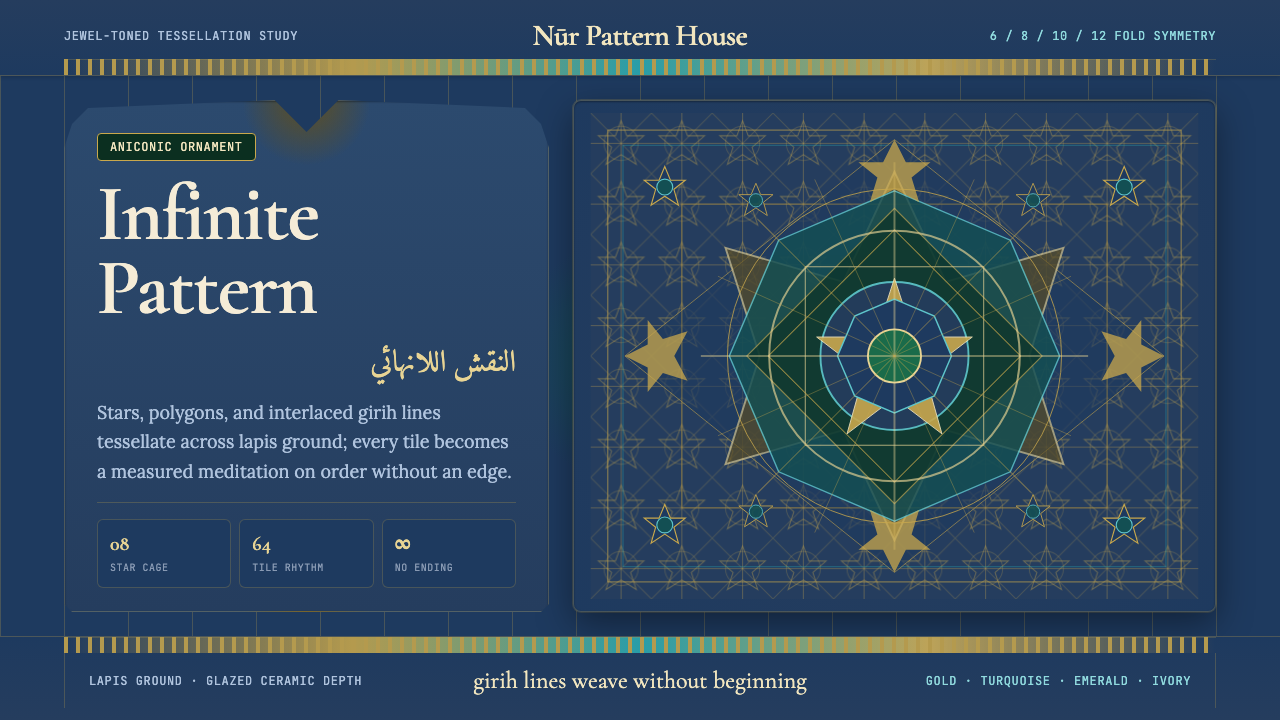 Islamic Geometric ArtInfinite order, fully tiled. Lapis ground with gold girih lines and turquoise…
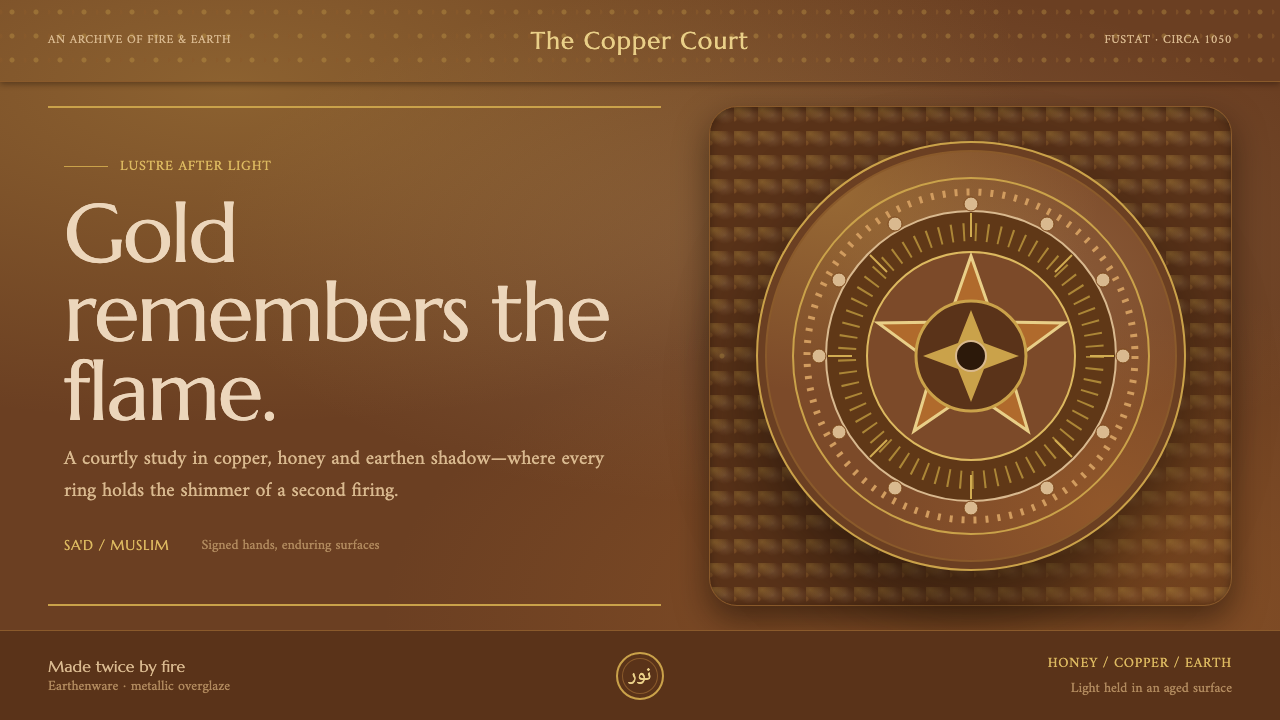 Fatimid LustrewareOpulence fired into earth. Copper-gold lustre glows through dense medallions…
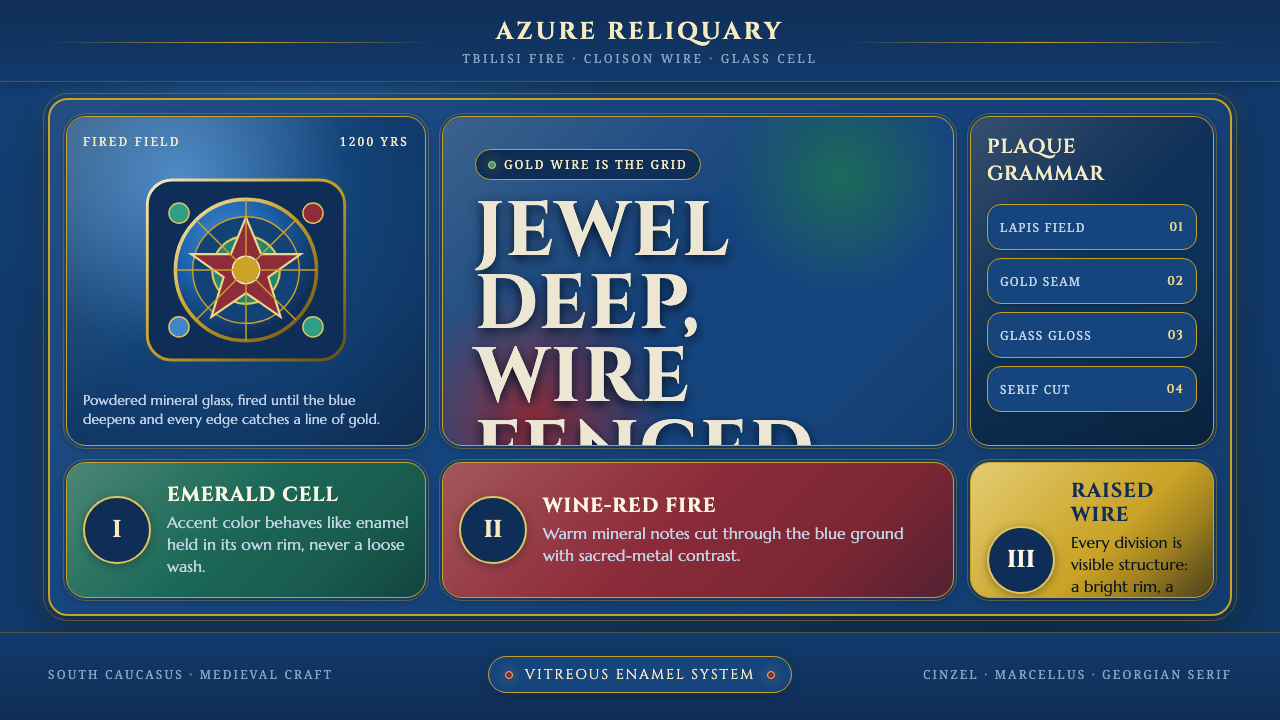 Georgian Minankari CloisonnéJewel-deep and wire-fenced. Lapis enamel, gold seams, emerald cells, glossy s…
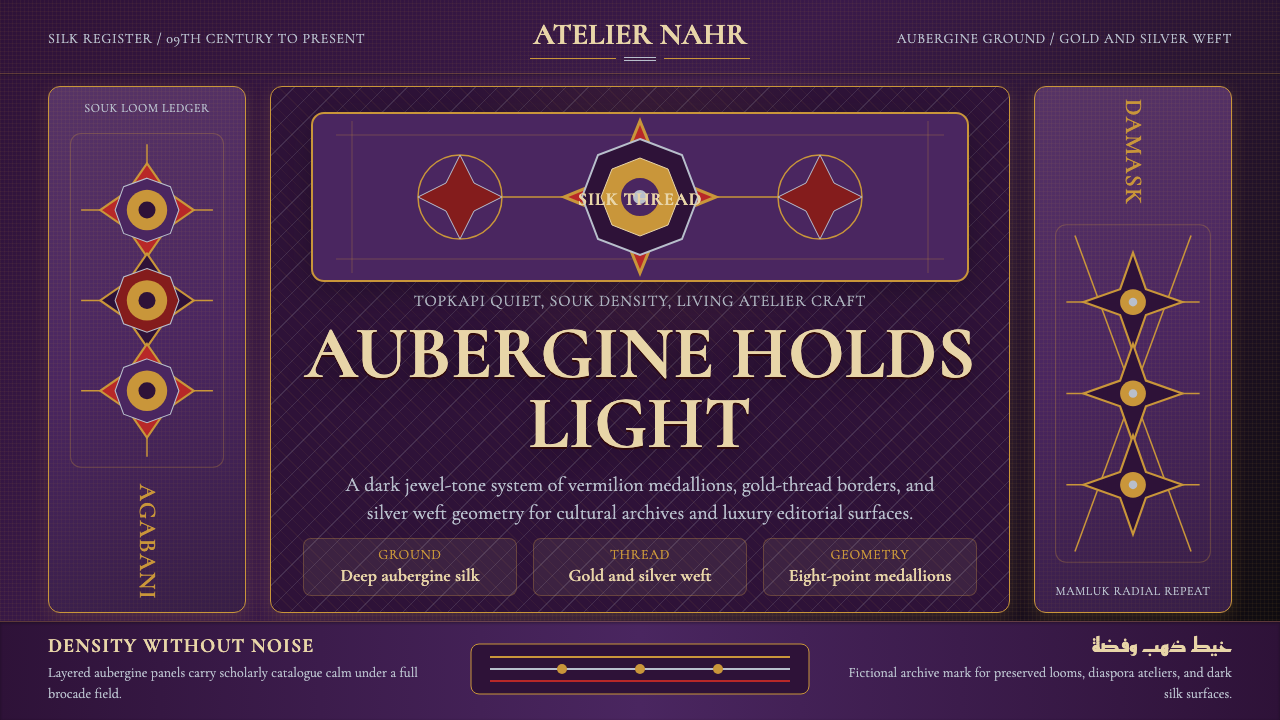 Syrian Damascene BrocadeDark silk shimmers. Aubergine ground, Cormorant SC, gold medallion grid.