What is Newari Ranjana-Script Mandala?
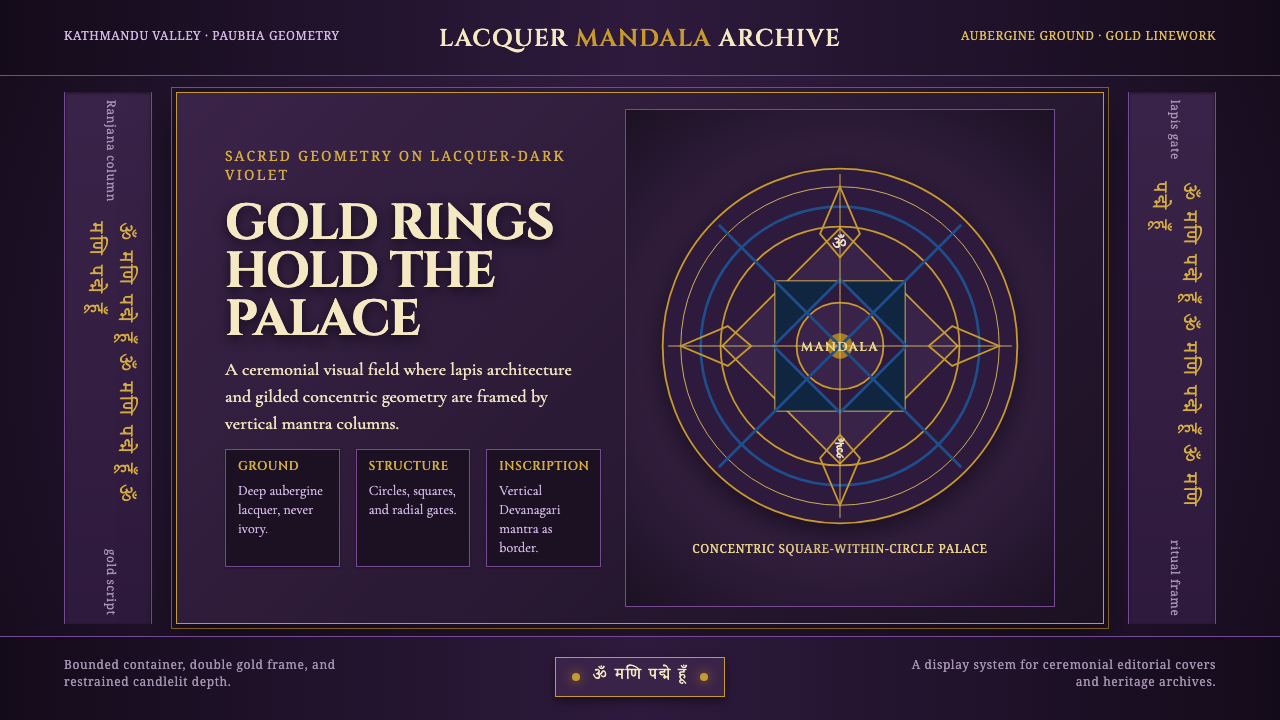
Ceremonial darkness turns the mandala into a field of attention: gold rings, lapis gates, and vertical sacred script emerge from aubergine lacquer.
Newari Ranjana-Script Mandala in brief
Newari Ranjana-Script Mandala reads the Newar Vajrayana Paubha tradition of the Kathmandu Valley through a dark, ceremonial visual system. Its central image is the mandala palace: concentric squares set within circles, rendered as sacred geometry rather than decorative pattern. Gold defines rings, boundaries, and radiant structure; lapis-blue architecture establishes gates and spatial thresholds; a deep aubergine field gives the composition gravity.
The style depends on contrast with ritual purpose. Light elements do not merely sit on a dark background: they appear to emerge from it, as if the painted surface were lacquer holding illumination beneath it. The mandala is therefore not treated as a loose ornamental motif. It is a disciplined center, organized by enclosure, repetition, and directional passage from outer frame toward inner sanctuary.
Vertical Ranjana, also called Lantsa, script completes the system. Columns of calligraphic mantra frame the geometry and create a boundary between sacred image and surrounding space. The script is not a generic exotic flourish or an interchangeable decorative alphabet. In this visual language, its dense vertical rhythm gives the composition ceremony, precision, and a sense that the image has been formally consecrated.
Where does Newari Ranjana-Script Mandala come from?
The source lineage begins in the Kathmandu Valley, Nepal, where Newar artists have painted Vajrayana Buddhist mandalas in the Paubha tradition since at least the 11th century. Within this tradition, the mandala palace is constructed through concentric circles and squares, making cosmology visible as ordered architecture. Gold and lapis are not incidental luxuries in this description; they establish the sacred geometry against a dark lacquer-like ground.
Paubha painting joins image, structure, and ritual use. Its mandala does not rely on naturalistic scenery to create meaning. Instead, enclosure, gates, rings, and carefully nested forms establish a visual world with a protected center. The result is an image that asks to be read spatially: the eye encounters a perimeter, crosses thresholds, and is repeatedly returned to the central order.
Ranjana or Lantsa script belongs to the same sacred environment. Vertical columns carry mantras such as “唵嘛呢叭咪吽” around the painted geometry, placing calligraphy in active conversation with the mandala rather than treating writing as a caption. The script tradition is described as being as old as the painting practice itself, and its framing role makes language part of the image’s ritual architecture.
This particular system makes a deliberate contemporary reading of that lineage. Rather than using the more familiar Paubha red, it adopts a deep aubergine-purple field. The change preserves the logic of luminous gold geometry and lapis-blue architecture while intensifying their tantric contrast against darkness. The aim is not to abandon the source tradition, but to make its ceremonial structure legible through a more nocturnal, lacquered atmosphere.
What defines the Newari Ranjana-Script Mandala look?
Aubergine Lacquer Field
The ground is deep aubergine-purple, dense enough to read as a ceremonial surface rather than empty backdrop. It replaces the more familiar Paubha red in this interpretation and gives every gold or lapis element a controlled, luminous presence. The darkness should feel polished, still, and intentional, not merely blackened or gloomy.
Concentric Sacred Geometry
Squares within circles form the central grammar. Each enclosure reinforces the next, so the composition gains force through nesting rather than visual clutter. Geometry should feel measured and palace-like: rings protect, squares organize, and repeated boundaries turn the center into a destination.
Gold as Radiant Structure
Gold is used to make structure visible: rings, outlines, boundaries, and sacred emphasis. Its role is architectural before it is ornamental. Against aubergine, gold should appear precise and concentrated, reserving brilliance for forms that establish hierarchy or mark the mandala’s ritual order.
Lapis Architectural Gates
Lapis-blue defines the architecture of passage. It reads as gates, framed entrances, and spatial intervals within the mandala palace, creating a cool counterpoint to gold. The blue should remain structurally placed, never dispersed as a casual accent, so that it continues to suggest threshold and inner depth.
Vertical Ranjana Frame
Ranjana or Lantsa script is arranged in precise vertical columns around the sacred geometry. The writing gives the outer field a disciplined rhythm and formally separates the mandala from its surroundings. Its calligraphic density is part of the composition’s meaning, not a substitute for texture or ornament.
Ceremonial Restraint
The style gains authority from limitation. A dark field, gold geometry, lapis architecture, and sacred script already provide a complete visual vocabulary. Additional unrelated motifs weaken the system because they compete with the mandala’s center and the formal boundary established by calligraphy.
Who shaped Newari Ranjana-Script Mandala?
Newar Paubha painters are the makers named in the source lineage. Since at least the 11th century, artists in the Kathmandu Valley have rendered Vajrayana mandalas as palace-like arrangements of concentric circles and squares. Their practice establishes the visual foundation for this system: sacred geometry, gold and lapis, and a dark lacquer-like ground.
Ranjana or Lantsa sacred scribes sustain the calligraphic tradition that frames the painted mandala. Their vertical mantra columns demonstrate that writing is structurally active within the composition. The script supplies border, rhythm, and sacred language at once, making it inseparable from the image’s ceremonial reading.
The Kathmandu Valley is the place of continuous ritual use identified by the source material. It situates Paubha painting, mandala cosmology, and Ranjana script within a living sacred context rather than a detached museum style. This continuity is why the system benefits from careful framing and from avoiding casual use of its script or geometry.
How do you use Newari Ranjana-Script Mandala today?
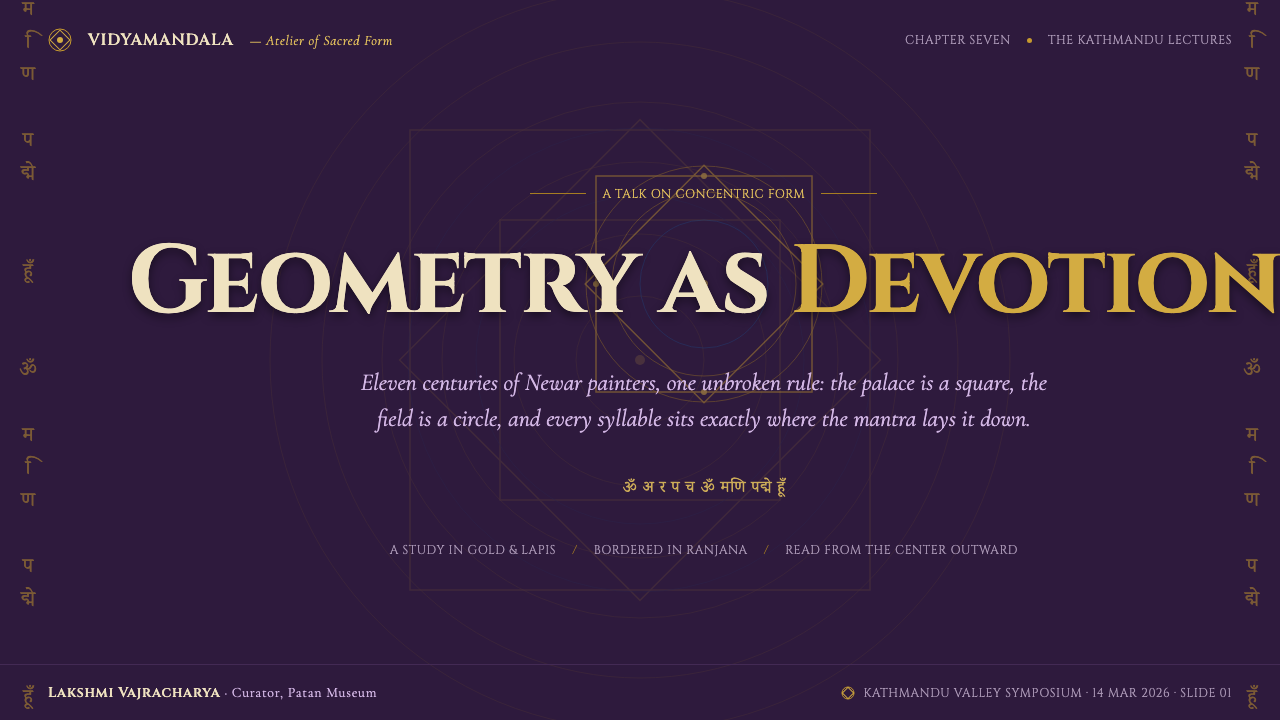
For presentation slides, use the mandala as an organizing center rather than a full-page decoration. A cover can place a restrained mandala segment or ring structure behind a concise title, with vertical script reserved for an edge or ceremonial frame. Content slides should keep the dark field open, using gold rules to establish reading order and lapis blocks to distinguish sections. Data slides work best when charts are treated as measured geometry, not when they imitate the mandala literally.
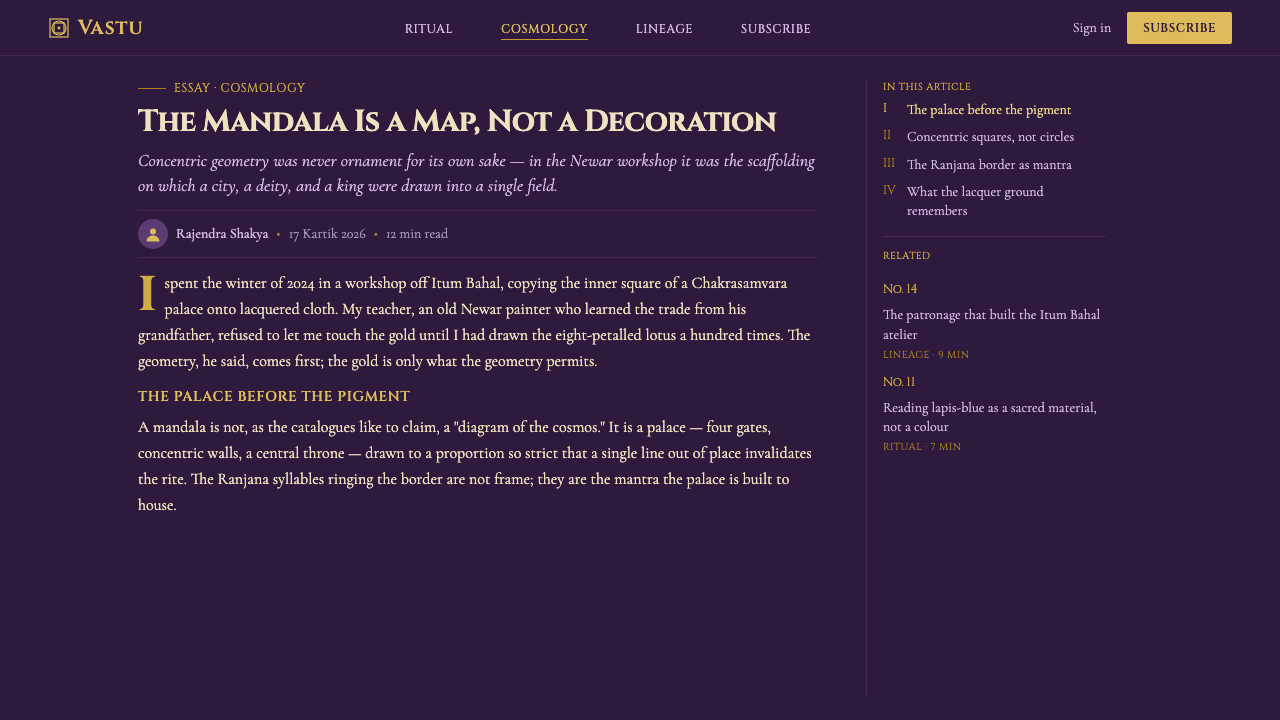
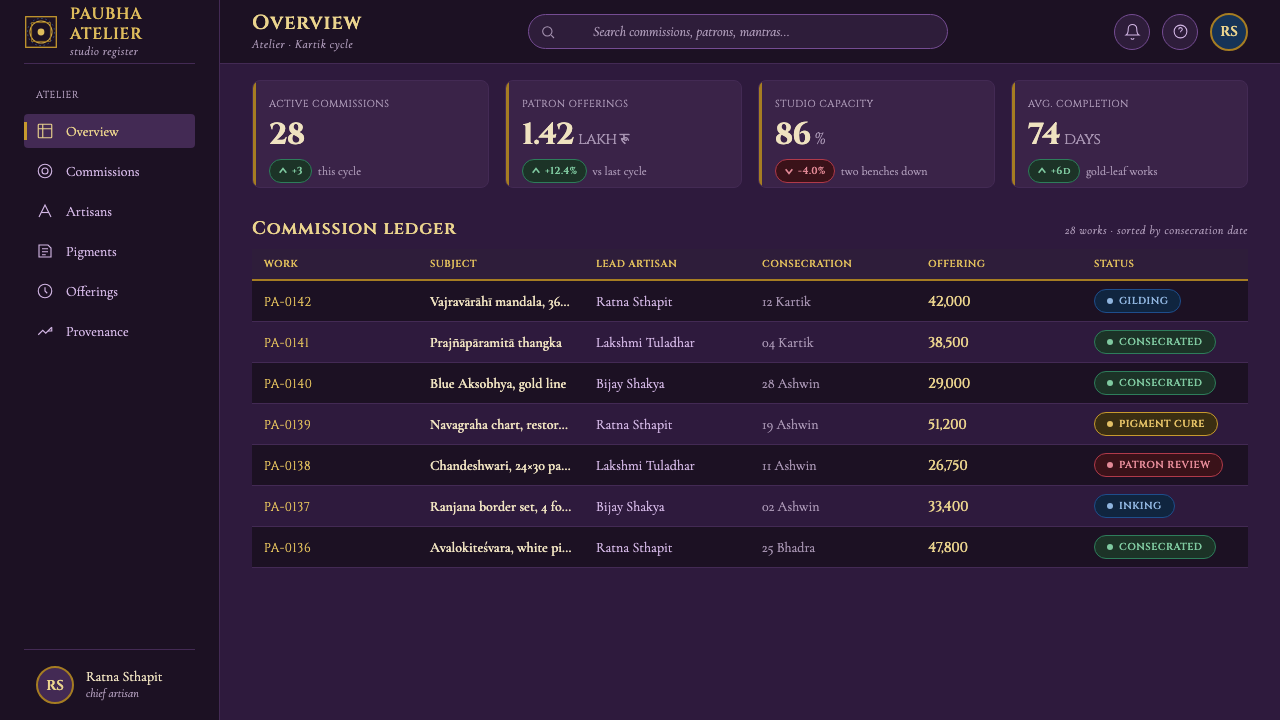
For web interfaces, this style is most effective where focus, hierarchy, and a sense of occasion matter. A dashboard can use aubergine as a calm field, gold for important structural states, and lapis for navigational thresholds or grouped views. A pricing page can frame tiers as clearly bounded chambers, but it should preserve ordinary readability and keep transactional information more prominent than atmospheric ornament.
For editorial and marketing work, the system supports launches, cultural programs, invitations, and long-form stories that need gravity. A feature page can alternate expansive dark breathing room with carefully bounded text panels. Gold may signal a section’s entrance or conclusion; lapis can hold images, metadata, or secondary passages. The central geometry should appear only where it can carry the composition, rather than being repeated as wallpaper.
The script requires particular care. Use verified Ranjana or Lantsa content only when its language, direction, and ritual context are understood and appropriate. If those conditions are unavailable, preserve the visual logic through empty vertical divisions, ruled frames, or clearly non-scriptural marks instead of fabricating mantra text. Sacred calligraphy should not become a decorative placeholder.
The most common mistake is treating the style as a generic dark luxury look. Gold plus purple alone does not produce the Newari Ranjana-Script Mandala system. Without concentric order, lapis gate-like structure, and disciplined vertical framing, the result loses the relationship between sacred geometry and calligraphy that gives the source material its ceremonial force.
Newari Ranjana-Script Mandala — FAQ
Is this simply a dark version of Paubha painting?
No. The system is a specific reading of the Paubha lineage. It retains the mandala palace, gold geometry, lapis-blue architecture, and Ranjana framing described in the source material, while choosing aubergine-purple instead of the more familiar Paubha red. The dark field changes the atmosphere, but the structural relationship between geometry, gates, and script remains essential.
Can Ranjana script be used as a decorative border?
It should be approached as sacred calligraphy, not as a generic decorative device. In the source tradition, vertical Ranjana or Lantsa columns carry mantras and frame sacred geometry. Use actual script only with verified content and appropriate context. When that is not possible, create a non-scriptural vertical frame instead of simulating sacred writing.
Why are gold and lapis paired against aubergine?
The pairing makes the system’s hierarchy immediately legible. Gold carries the radiant geometry, while lapis-blue describes the palace-like gates and spatial thresholds. The aubergine field gives both colors darkness against which to emerge. Together they turn contrast into structure: light marks order, blue marks passage, and the ground holds the composition in ceremonial stillness.
What should be avoided when adapting the style for digital work?
Avoid reducing it to unrelated dark luxury cues, scattering gold accents without hierarchy, or placing copied-looking script wherever space feels empty. The style needs a clear center, nested boundaries, deliberate lapis gate structures, and meaningful vertical framing. It also benefits from restraint: the geometry should organize attention, not compete with every interface element or message.
Related design styles
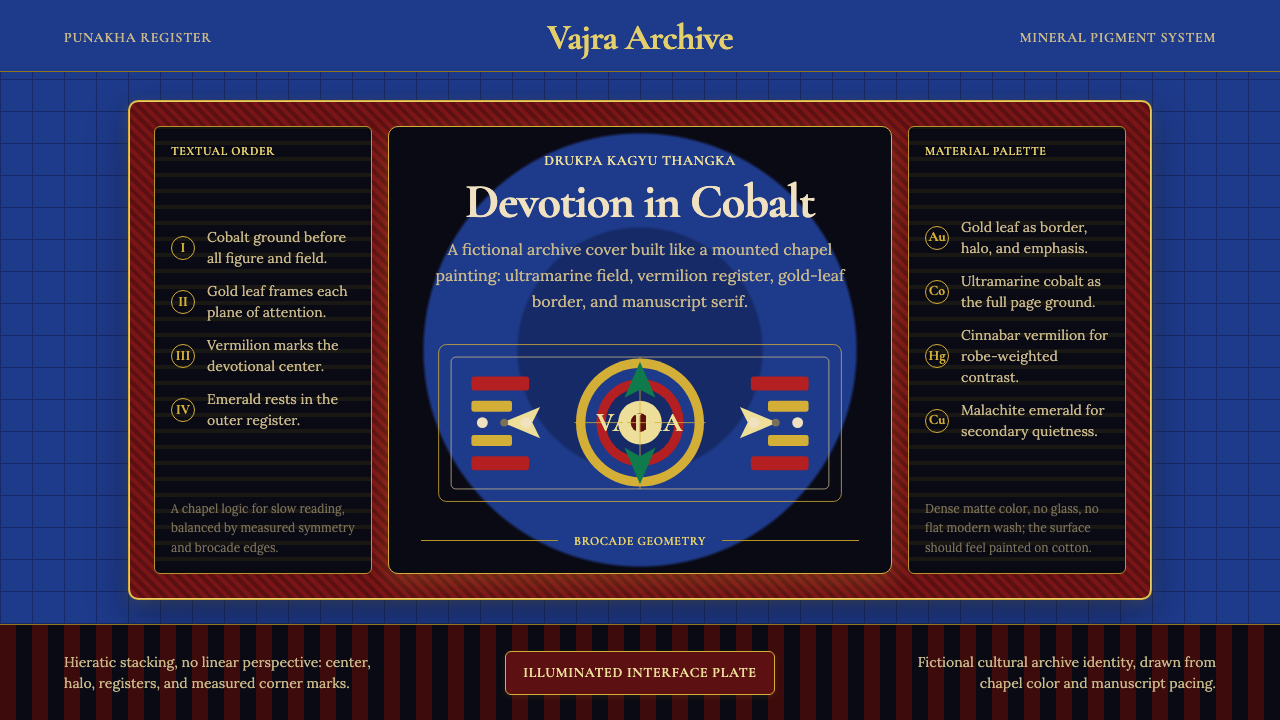 Bhutanese Drukpa Kagyu ThangkaDevotion made cobalt. Gold frames, Cormorant serif, and vermilion marks hold…
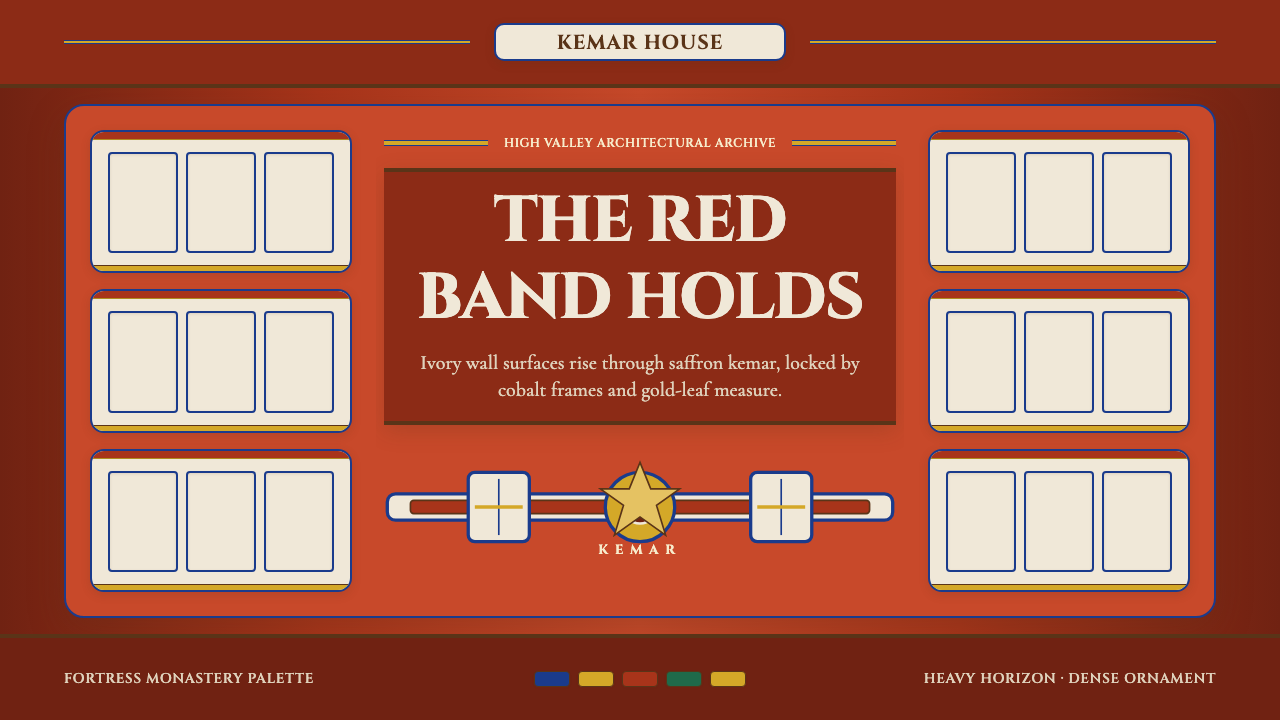 Bhutanese Dzong (Fortress Red)Monumental red holds the page. Cobalt frames and gold bands lock the fortress…
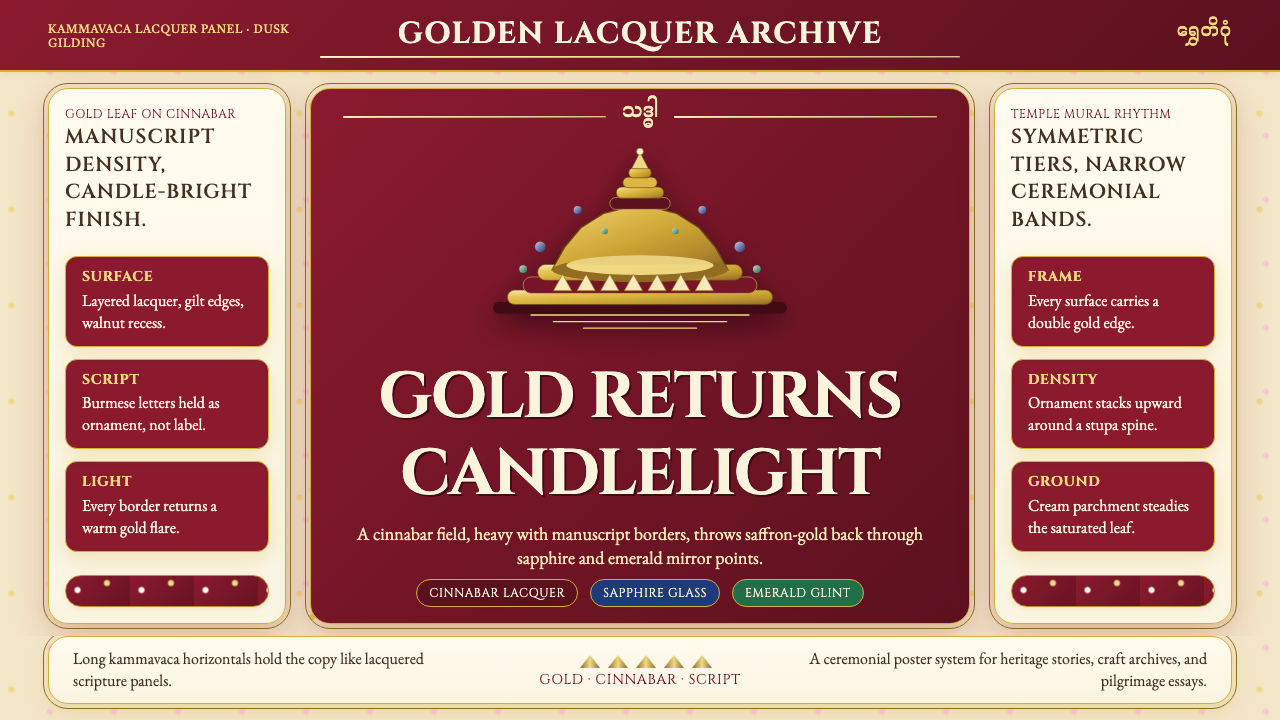 Burmese Shwedagon Gold-LacquerOpulence catches fire. Gold-leaf gradients on cinnabar panels frame a stupa s…
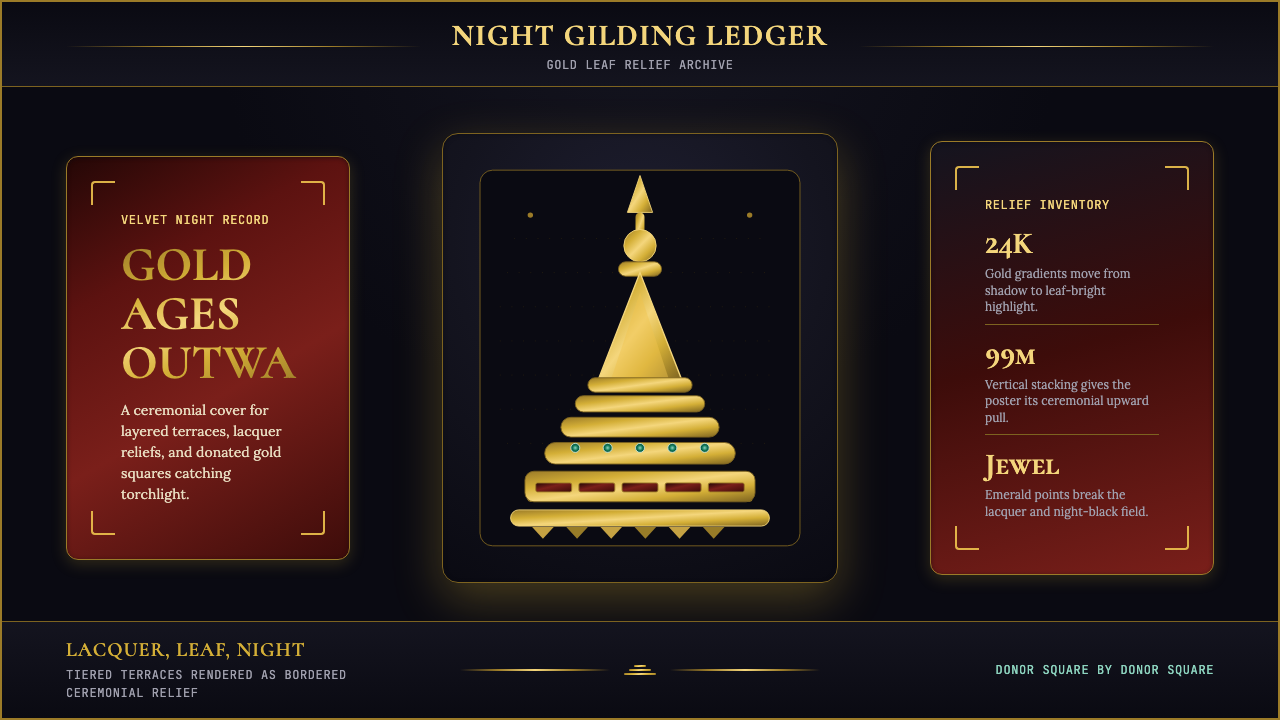 Burmese Shwedagon Stupa ReliefGold refuses restraint. Velvet black, teak-red lacquer, and tiered gradients…
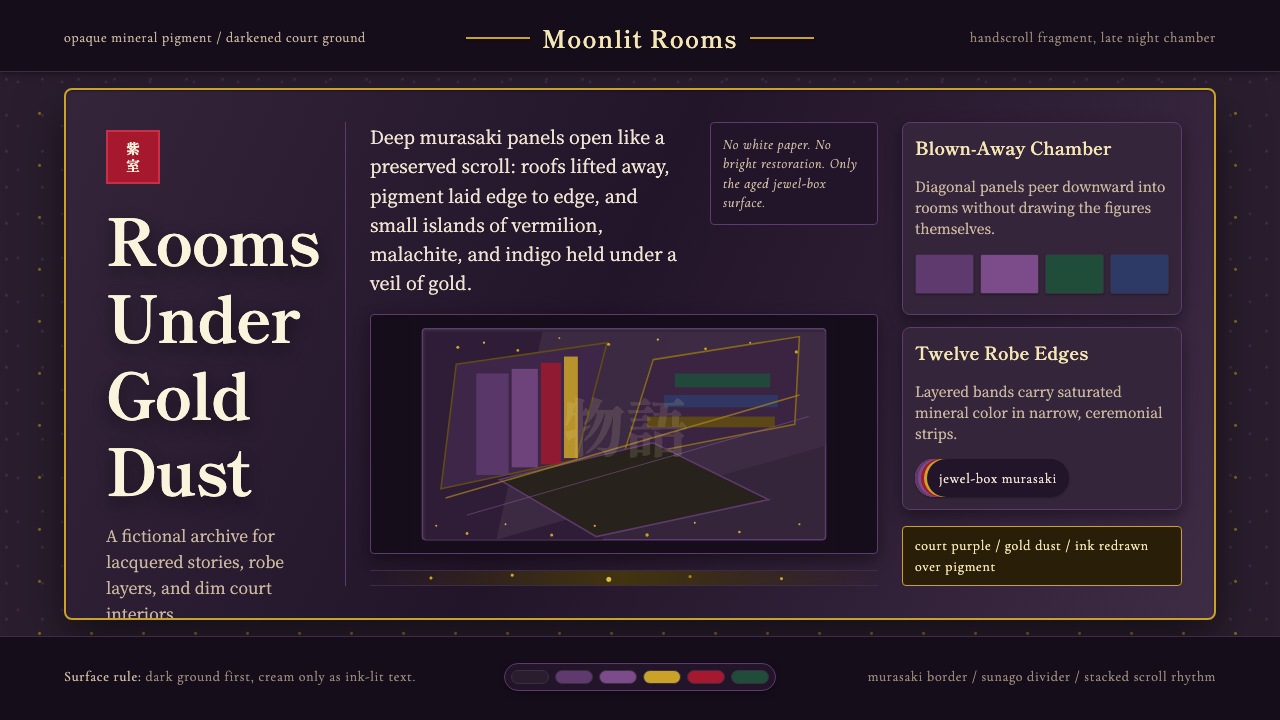 Heian Genji ScrollAged court opulence. Murasaki ground, gold dust, and stacked scroll panels.
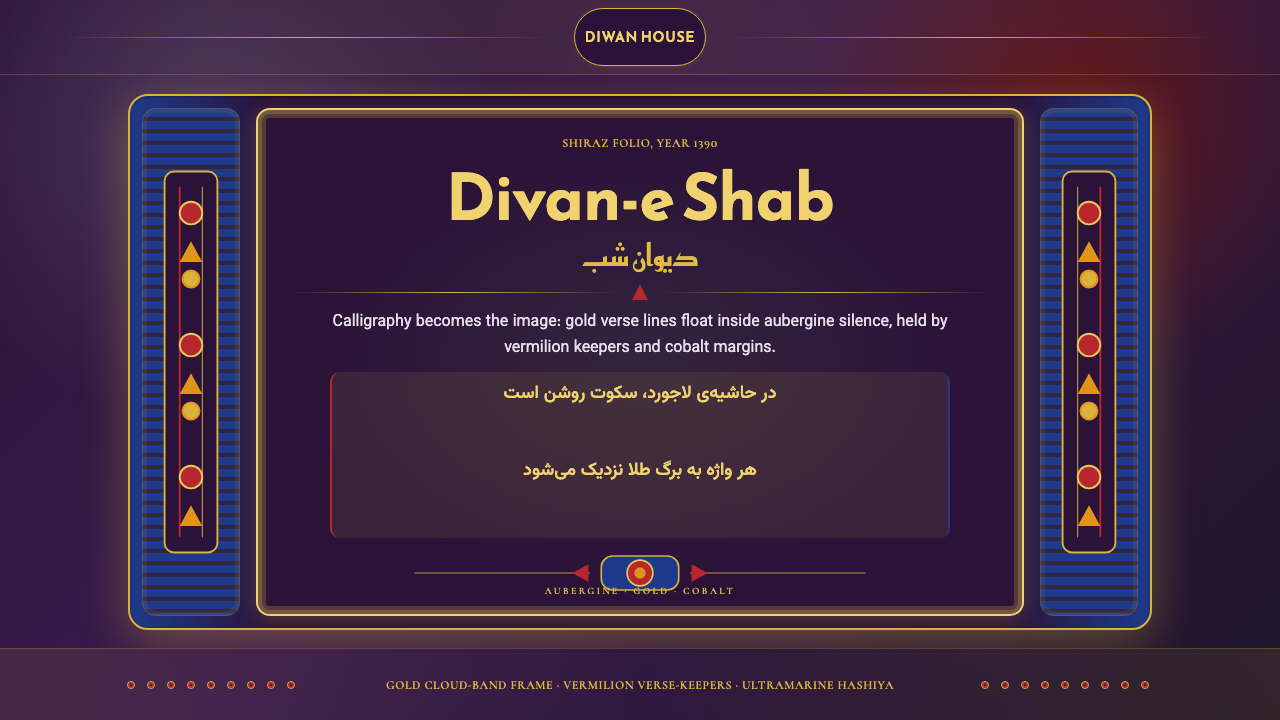 Iranian Shiraz Poetry Divan 1390Midnight manuscript glow. Aubergine fields, gold Kufi type, cobalt margins.