What is New Romantic Blitz (1980)?
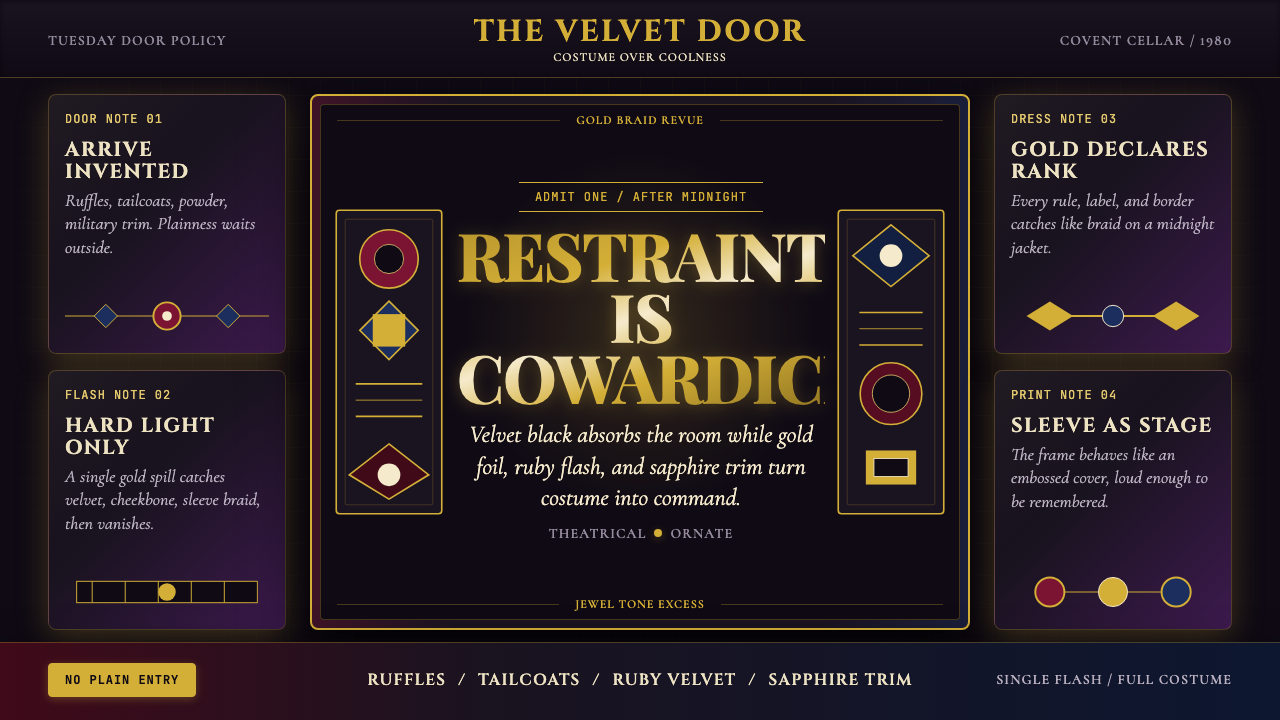
Born in a velvet-dark London basement where the door policy demanded costume over cool, New Romantic Blitz is maximalist theatre translated into design — jewel-toned excess, gold-braid type, and the conviction that restraint is just cowardice with better PR.
New Romantic Blitz (1980) in brief
New Romantic Blitz (1980) is a design aesthetic rooted in the early-1980s British New Romantic subculture, distilled specifically from the visual atmosphere of Steve Strange's Blitz Club in London's Covent Garden. Where punk had weaponized ugliness, New Romantic armed itself with glamour — theatrical costume, historical pastiche, and an almost defiant celebration of beauty for its own sake. The design system that emerged from this moment is dark, opulent, and unapologetically excessive.
Visually, the style is built on a foundation of velvet-deep backgrounds — near-black with a richness that reads as saturated rather than flat — lit by the hard, directional quality of stage lighting rather than the even diffusion of daylight. Against this darkness, gold-accented serif typography functions like embossed lettering on an album sleeve: formal, weighty, and charged with a sense of occasion. Jewel-tone accents in ruby red and sapphire blue punctuate the composition with controlled bursts of colour, each one suggesting precious stone rather than surface pigment.
The aesthetic is maximalist in conviction but not chaotic in execution. It operates with the logic of costume and theatre: every element is deliberately chosen, every excess is intentional. The contrast is extreme — deep grounds against luminous type, muted textures against hard jewel accents — and the overall effect is one of calculated theatricality, the visual equivalent of arriving at a nightclub in full Weimar-era evening dress.
Where does New Romantic Blitz (1980) come from?
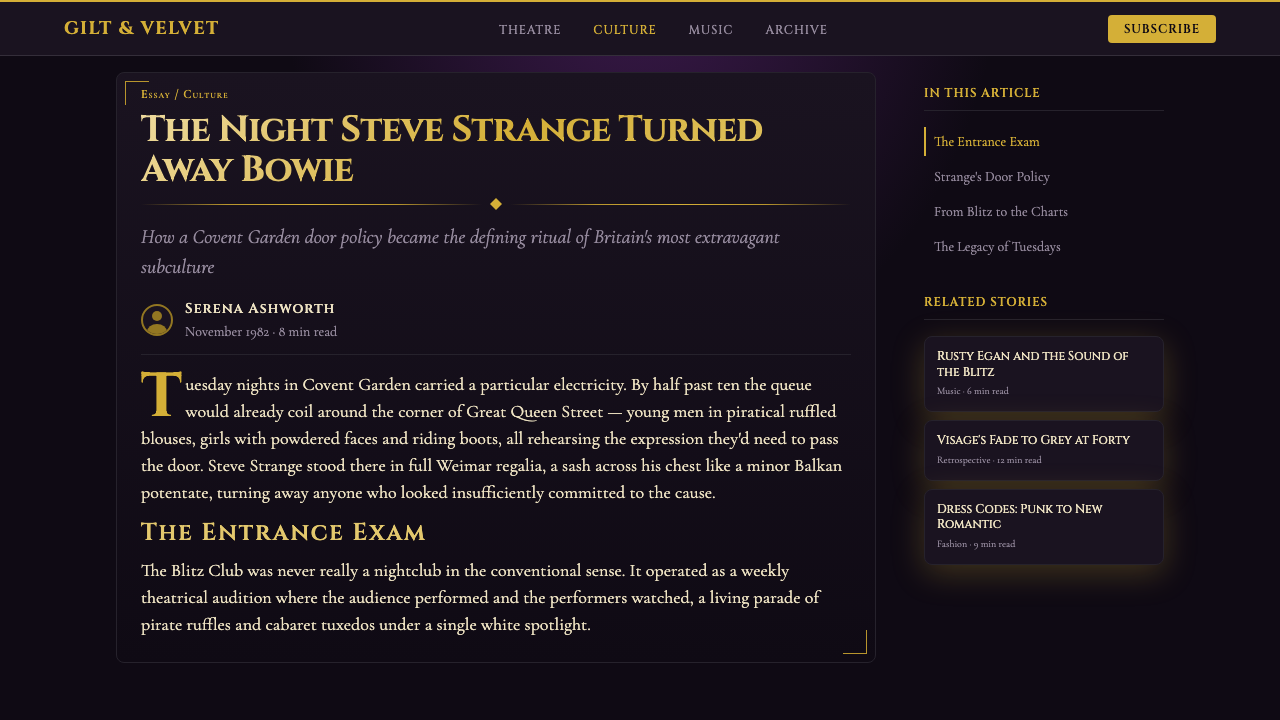
The story of New Romantic design begins on a Tuesday night in 1978, when Steve Strange and DJ Rusty Egan launched a club night at the Blitz wine bar on Great Queen Street in Covent Garden, London. Strange's door policy was unique and defining: admission required theatrical costume. Not fashionable clothing — costume. Patrons arrived in pirate ruffs, Weimar tuxedos, military frogging, and Bowie-Berlin makeup, and those deemed insufficiently theatrical were turned away, regardless of who they were. This selection mechanism meant that the Blitz's interior became a living gallery of competitive excess, a feedback loop of visual one-upmanship that set the aesthetic temperature for British pop culture well into the 1980s.
The musical backdrop Rusty Egan spun — Bowie, Kraftwerk, Giorgio Moroder — was cold, electronic, and cinematic. The fashion response was its theatrical opposite: warm fabrics, historical silhouettes, ornate surface detail. This productive tension between cold machine music and warm theatrical costume is encoded in the design DNA of the style. The backgrounds are dark and almost technological in their depth; the type and accents are warm, handcrafted-feeling, historically resonant. The two poles never fully reconcile, and the friction between them is where the visual energy lives.
From the Blitz sprang a constellation of acts that gave the aesthetic its commercial reach: Visage, featuring Steve Strange himself, whose single 'Fade to Grey' became an international hit in 1980 and 1981; Spandau Ballet, managed from within the Blitz scene by Gary Kemp, whose debut album 'Journeys to Glory' cemented the look on a global stage; and Adam and the Ants, whose 'Kings of the Wild Frontier' fused pirate, Native American, and military imagery into a visual language that saturated pop media from 1980 to 1982. Boy George, who had been a Blitz regular and a Steve Strange door-picker, emerged as the movement's most visible face with Culture Club from 1982.
The New Romantic moment was historically brief — the scene's commercial peak lasted roughly from 1980 to 1983 — but its influence on visual design, album sleeve art, music video aesthetics, and fashion photography proved durable. The album sleeves of this era, particularly the work commissioned by Spandau Ballet and Visage, developed a specific visual grammar: embossed gold lettering on dark velvet-weight stock, jewel-tone colour washes, dramatic chiaroscuro lighting. This grammar entered the design vocabulary of luxury branding, theatrical poster design, and editorial fashion work, where it has persisted as shorthand for a particular register of opulent, dramatically staged glamour.
What defines the New Romantic Blitz (1980) look?
Dark Ground
The base of every composition is a deep, near-black ground that carries richness rather than emptiness — the visual equivalent of velvet rather than matte board. This darkness is not neutral; it has weight and texture implied by the way light appears to barely break its surface. The dark ground creates the theatrical space into which all other elements emerge, functioning as the lighting rig of a stage rather than the blank canvas of a studio.
Gold-Accented Serif Typography
Type in this style has the ceremonial weight of embossed album sleeves or gilded book spines. Serif letterforms with pronounced contrast between thick and thin strokes carry the visual richness; gold or warm-metallic coloring elevates them further, giving text the quality of precious inlay rather than ink on surface. Headlines are set with generous weight and scale, so the type itself becomes the primary decorative object — not a carrier of information wearing costume, but costume itself.
Jewel-Tone Accents
Ruby red and sapphire blue function as accent colours that feel less like surface pigment and more like light passing through a cut gemstone — deep, saturated, and internally luminous against the dark ground. These accents are used selectively, not liberally: a jewel tone deployed sparingly retains its sense of preciousness; spread across an entire composition, it would flatten into mere decoration. The placement of jewel accents guides the eye in the same way a single lit candelabra guides attention in a dark room.
Dramatic Chiaroscuro Lighting
The visual logic of stage and nightclub lighting — a single hard source cutting through deep shadow — defines how elements are treated. Highlights are crisp and directional; shadows are deep and unceremonious. There is no even ambient illumination softening the composition. This approach gives the style its characteristic sense of theatricality: everything appears to be caught in a moment of deliberate revelation, pulled from darkness into light for a reason.
Theatrical Excess as Principle
Where many design systems treat restraint as a virtue, New Romantic Blitz treats it as a failure of imagination. Layering is encouraged: texture under type, type over accent, accent beside highlight. The goal is richness, not clutter — there is a difference between maximalism with internal logic and mere noise. The test is whether each element is doing something specific and deliberate, not whether there are few enough elements to look minimal. Reduction for its own sake would betray the movement's founding conviction.
Historical Pastiche and Costuming
The New Romantic movement drew freely from Weimar-era cabaret, Regency-period silhouettes, Victorian ornament, pirate romanticism, and Bowie's theatrical personas — mixing historical references without archaeological accuracy. In design terms, this translates to an approach that borrows from historical typography, decorative motifs, and formal registers without reproducing any single period faithfully. The result is a sense of deliberate anachronism: things that feel simultaneously from another era and entirely contemporary in their self-aware theatricality.
Hard-Flash Highlight
Borrowed directly from the nightclub photography aesthetic of the era — the stark, bleaching quality of a camera flash in a dark room — hard highlights appear as almost overexposed pockets of pure brightness against the deep ground. These are not soft glows or gradual luminosity; they are sudden, almost violent insertions of light that create immediate focal points and reinforce the sense that the composition is a staged, performative moment rather than a naturalistic scene.
Who shaped New Romantic Blitz (1980)?
Steve Strange was the co-founder and doorman of the Blitz Club, and frontman of Visage. His role as literal gatekeeper — enforcing the theatrical costume requirement and personally turning away those he deemed insufficiently spectacular — made him the aesthetic curator of the entire New Romantic movement. His own appearance, characterized by elaborate makeup and hybrid historical dress, set the visual standard. As vocalist on 'Fade to Grey' (1980), he brought the Blitz aesthetic to an international audience for the first time.
Rusty Egan was the DJ and co-founder of the Blitz Club night, responsible for the specific musical atmosphere — heavy on Bowie, Kraftwerk, and European electronic music — that defined the sonic side of the New Romantic aesthetic. His musical curation created the emotional temperature against which the theatrical costume competed and collaborated. As a producer, he shaped the recorded output of Visage and helped establish the cold, electronic-lush production style that characterizes the movement's music.
Gary Kemp was the guitarist and primary songwriter of Spandau Ballet, the act that most directly translated the Blitz Club aesthetic into mainstream commercial success. His management of the band's visual identity — working closely with designers and photographers to produce album artwork and promotional imagery that captured the movement's maximalist dark glamour — helped codify the New Romantic visual grammar for a global audience. The 'Journeys to Glory' sleeve and associated imagery became reference points for the style's mature form.
Boy George arrived in the Blitz scene as a teenage regular and occasional wardrobe assistant to Steve Strange before emerging as the lead singer of Culture Club from 1982. His visual persona — combining elements drawn from mime, Victorian portraiture, Hasidic dress, and Caribbean styling — exemplified the movement's commitment to historical pastiche and gender-ambiguous theatricality. His mainstream success brought the Blitz aesthetic's approach to costumed identity to the largest possible audience, including through the early years of MTV.
Adam Ant's visual identity during the 'Kings of the Wild Frontier' era (1980–1981) represented the movement's most extreme experiment in historical costuming: fusing highwayman, Native American warrior, and military uniform references into a distinctive visual language that proved enormously influential on music video aesthetics and fashion photography throughout the decade. His collaboration with Malcolm McLaren on developing the 'Antmusic' visual concept, and the subsequent massive commercial success of that concept, demonstrated how the Blitz aesthetic could scale from a Tuesday-night club scene to a global phenomenon.
How do you use New Romantic Blitz (1980) today?
New Romantic Blitz works best in contexts where drama, occasion, and a sense of premium theatricality are desired values — luxury product launches, entertainment industry materials, album art, theatrical event promotion, high-end editorial fashion, and any designed artifact where the intent is to make the audience feel they are in the presence of something exceptional. The style is not suited to everyday utility contexts; it signals rarity and occasion by its very nature, so applying it to workaday interfaces or functional documentation will produce tonal mismatch.
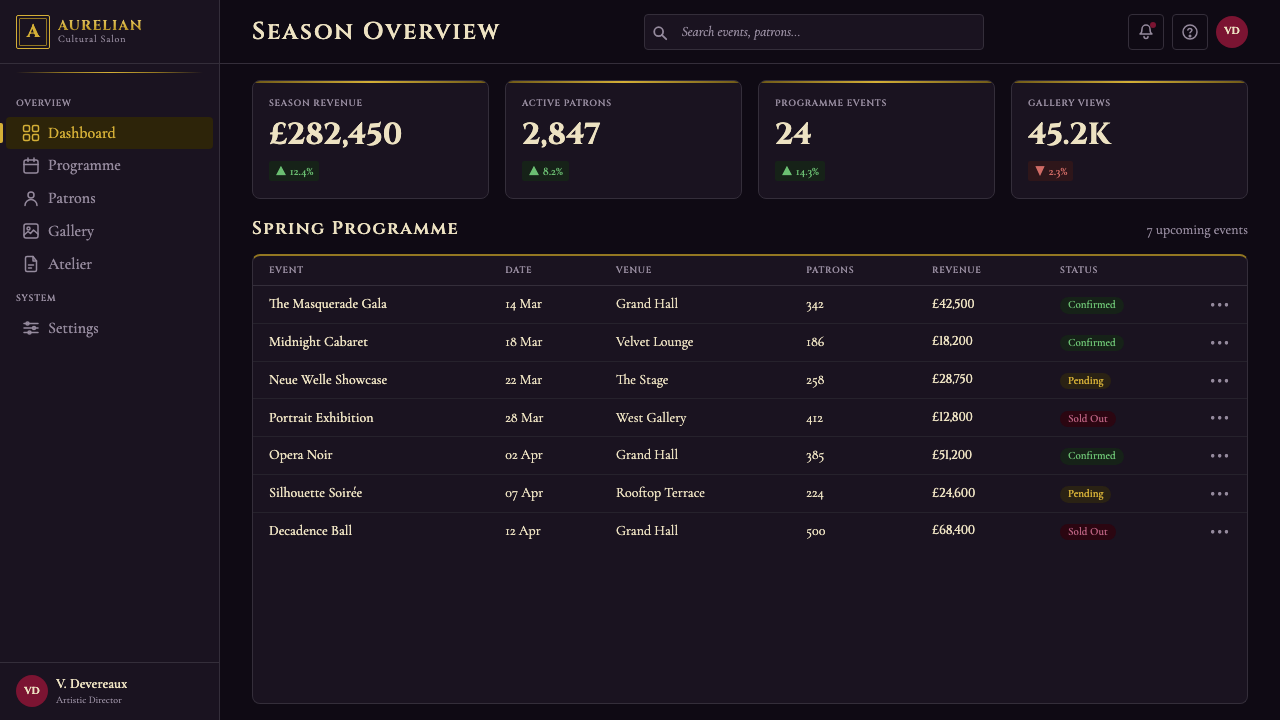
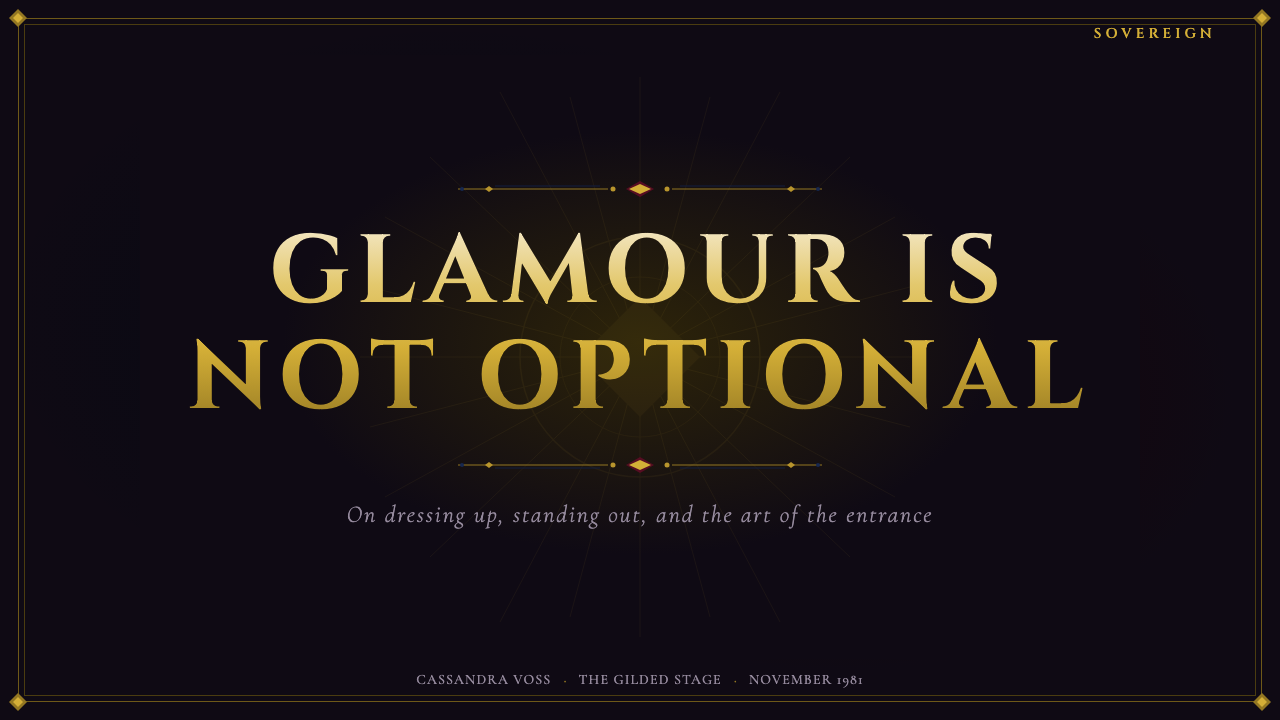
For presentation slides, the style rewards a specific approach: use a near-black ground consistently across the entire deck, not just the cover. Cover slides should feature the title in heavy gold-accented serif type at large scale, with a jewel-tone accent — a ruby horizontal rule, a sapphire geometric shape — providing compositional structure without competing with the title. Content slides should maintain the dark ground and reserve all typographic hierarchy for weight and scale differences within the same serif family. Data and chart slides work well when chart elements are coloured using the jewel palette — ruby bars, sapphire lines — against the dark background, which transforms functional data into something that reads as precious rather than merely informational.
For web interfaces, this style is most appropriate for landing pages, event sites, entertainment platforms, and premium product showcases where conversion depends on communicating exclusivity and atmosphere rather than functional clarity. Navigation should be typographic and minimal — the dark ground does the heavy atmospheric lifting; navigation elements that compete for visual attention will undermine it. Hero sections benefit from the hard-flash highlight treatment: a single area of near-overexposed brightness that draws the eye and implies stage lighting. Pricing pages can use jewel-tone tier differentiation effectively — a sapphire accent for one tier, ruby for another — giving each option a gemstone-like sense of deliberate value rather than a clinical comparison table.
For editorial and marketing work, New Romantic Blitz delivers its maximum impact in full-page or large-format compositions where the dark ground can breathe and the jewel accents have sufficient contrast space to register. Magazine spreads, event posters, and digital banners benefit from the style's theatrical poster logic: a single dominant image or typographic element, hard lighting, minimal copy, and the jewel accent doing the communicative work of colour. In marketing copy, the tone should match the visual register — formal without being stuffy, theatrical without being camp.
A common mistake is applying the jewel accent colours too liberally, which drains them of their preciousness. Ruby and sapphire work because they appear sparingly against a deep ground; used across large areas or as background fills, they lose their gemstone quality and become merely dark shades of red and blue. A related error is choosing a dark background that leans cool-grey or charcoal rather than near-black with warmth — the velvet quality of the original aesthetic requires depth, not just darkness. Finally, pairing the gold serif headline treatment with a sans-serif secondary typeface in a neutral weight will flatten the theatrical effect; if mixed type is necessary, the secondary face should maintain a sense of formality and weight to preserve the overall register.
New Romantic Blitz (1980) — FAQ
Is New Romantic Blitz the same as gothic or dark glamour aesthetics?
Related but distinct. Gothic aesthetics typically embrace death imagery, ecclesiastical references, and a tone of melancholy or foreboding. Dark glamour leans on noir conventions and cool detachment. New Romantic Blitz shares the dark ground with both but is fundamentally theatrical and celebratory rather than mournful or detached — it wants you to feel the thrill of a nightclub entrance, not the weight of mortality. The gold-braid type and jewel accents are specifically joyful in register, signalling precious occasion rather than darkness for its own sake. The movement's founding context — a nightclub where you had to perform to get in — is the essential key: this aesthetic is about display, not withdrawal.
Can this style work in a light-background application?
It is possible but requires significant adjustment. The style's visual logic depends on the contrast between deep dark ground and luminous accents — without the darkness, the jewel tones lose their preciousness and the gold typography loses its sense of emergence from shadow. A light-background version might work for accent elements (a gold-serif pull quote, a jewel-tone CTA button) within an otherwise conventional layout, but applying the full system to a cream or white background produces something that reads more as Art Nouveau or Edwardian revival than New Romantic. If a lighter treatment is needed, consider using a deep jewel tone — very dark ruby or sapphire — as the background rather than attempting a full inversion to light.
How do I prevent this style from feeling dated or costumey?
The risk of any historically-rooted aesthetic is that it collapses into pastiche — recognizable enough to read as period reference rather than deliberate design language. For New Romantic Blitz, the antidote is restraint in specific places: limit the number of historical typographic motifs to one per composition, keep the jewel accents to genuinely small areas, and ensure that the overall layout grid is contemporary and rational even if the surface treatment is ornate. The theatricality should feel like a deliberate choice, not a default setting. Pairing the style with clean, modern information architecture — clear hierarchy, functional navigation, unambiguous interactive states — signals that the designer is in control of the aesthetic rather than being consumed by it.
What types of photography or imagery work within this style?
Photography within this aesthetic should embrace the hard-flash and dramatic-lighting logic of the style itself: high-contrast images with deep shadows and crisp highlights, shot in ways that emphasize theatricality and deliberate staging rather than naturalistic candour. The nightclub photography of the era — particularly the work documenting the Blitz scene itself — provides the clearest reference. Portraits where makeup, costume, or expression carries performative weight work better than candid documentary images. In digital contexts, duotone treatments using one jewel tone and near-black are effective — they integrate photography into the composition rather than leaving it as a window into a different visual world.
Is this aesthetic appropriate for corporate or B2B contexts?
Generally, no — but with a narrow exception. The style signals personal expression, theatrical occasion, and artisanal luxury; these are values that corporate and B2B contexts typically avoid in favour of rationality, trustworthiness, and scalability. The exception is luxury B2B: high-end event agencies, bespoke design consultancies, entertainment industry service providers, and similar businesses where the client relationship is personal and the work is genuinely premium-positioned. In these contexts, the style can signal that the provider is a connoisseur rather than a commodity — that they operate at the level of taste and occasion rather than at the level of specification and deliverable. Outside this narrow band, prefer a system whose values more directly match the corporate procurement context.
Related design styles
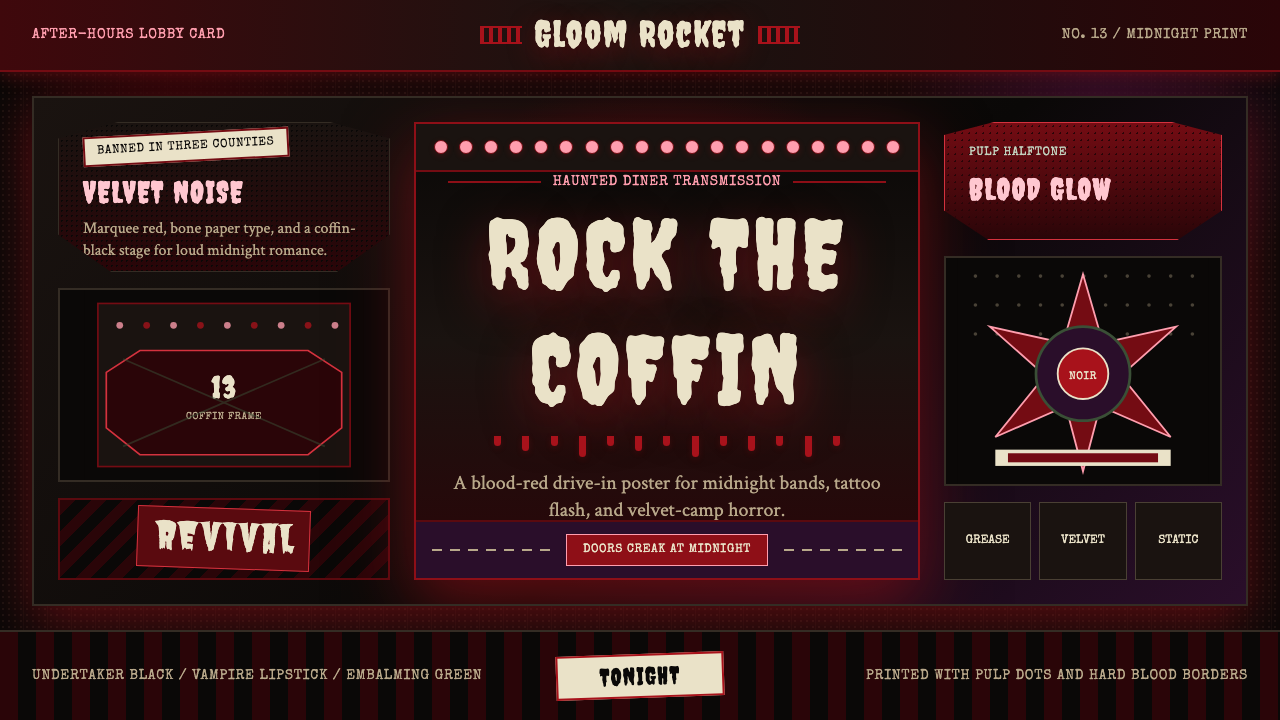 Gothabilly Horror RevivalHaunted swagger. Blood-red marquee type, coffin frames, and pulp halftone on…
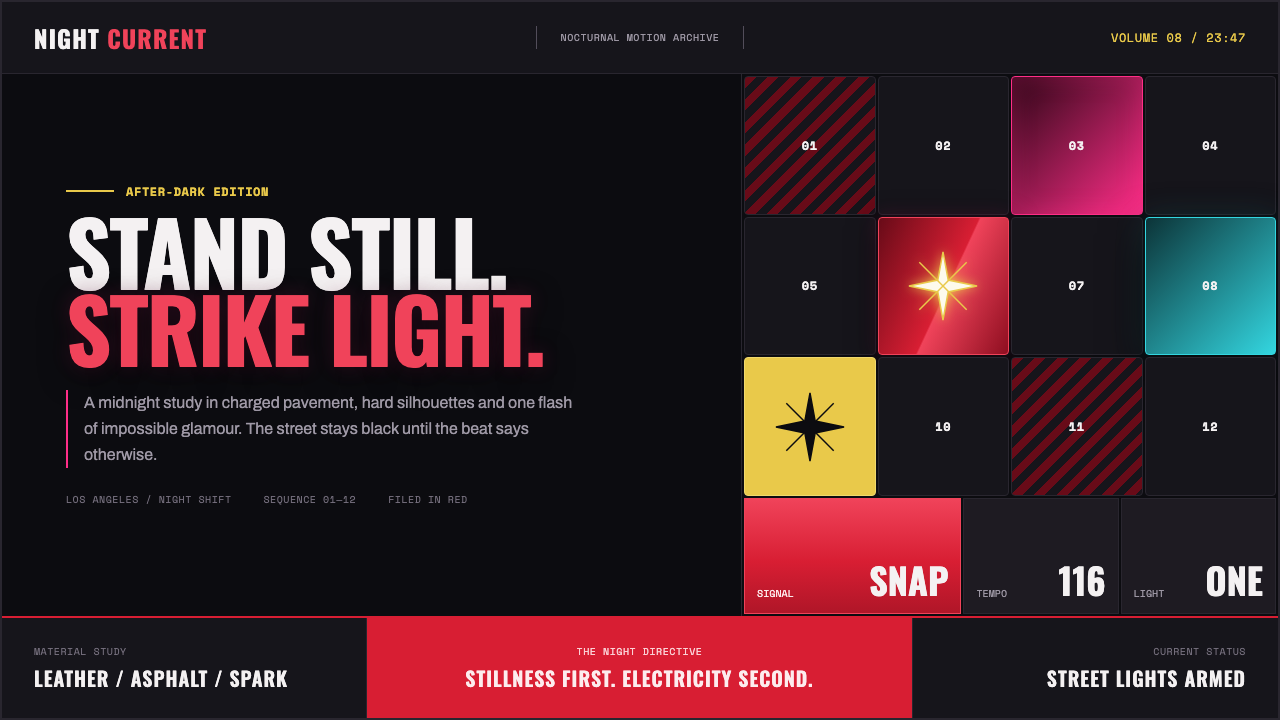 Thriller (1982)Stillness turns electric. Leather red and rhinestone gold ignite a neon pavem…
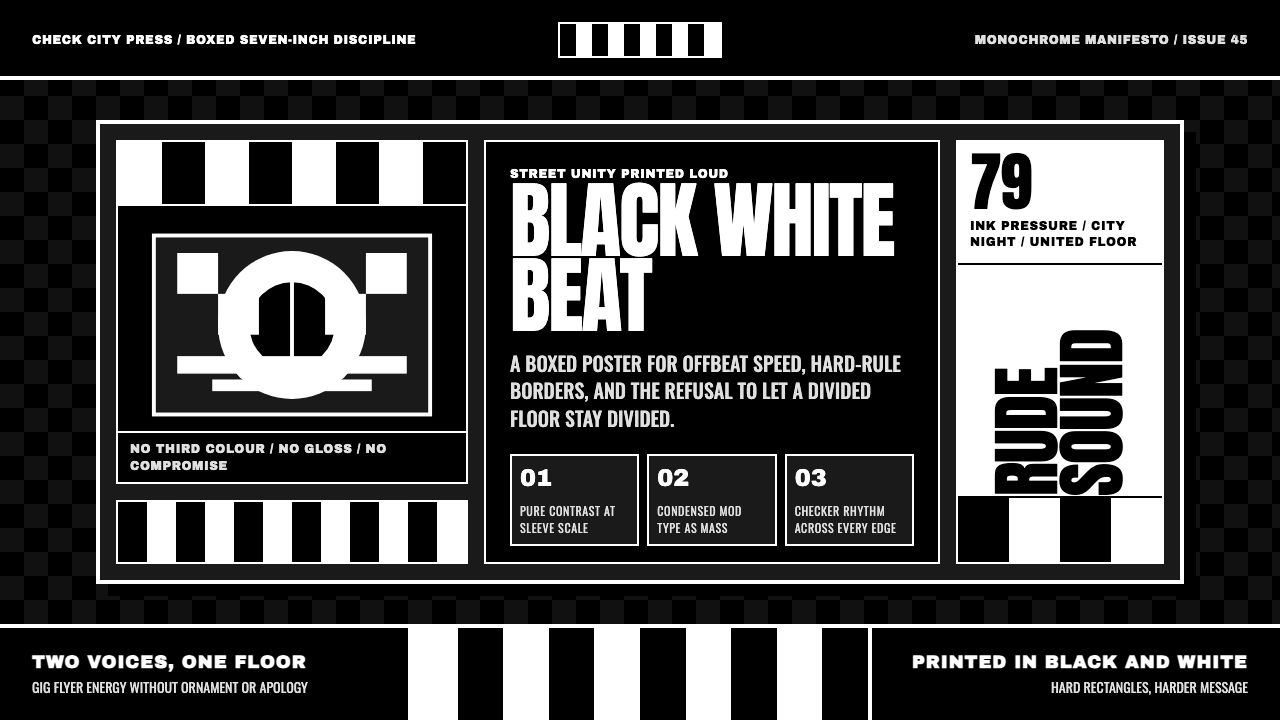 2 Tone SkaContrast as manifesto. White Anton type locks into a near-black checkerboard…
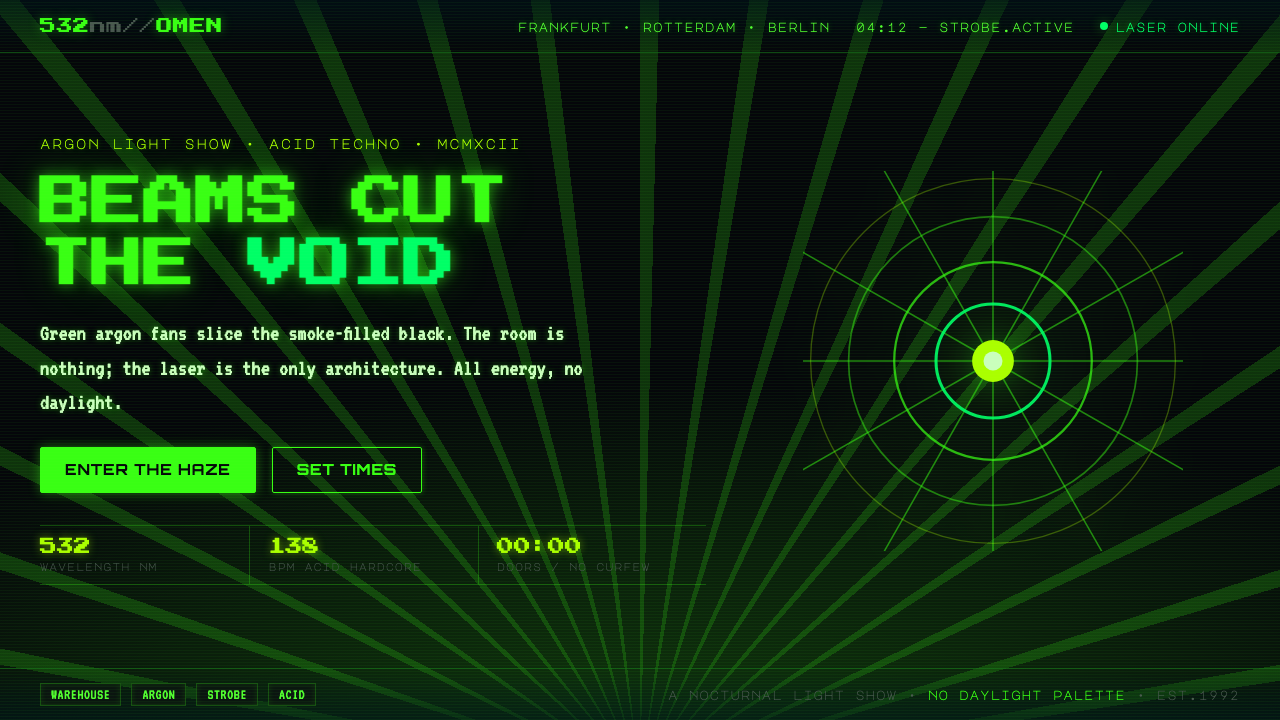 Acid Rave Laser Show 1992Beams cut the void. Argon green on pitch-black smoke, pixel marquee type, add…
 Beirut Golden-Age PosterFestival glamour after dark. Midnight blue carries foil-gold type and magenta…
 Jungle / Drum & BassRaw rave voltage. Neon green Anton, camo strips, and xerox grain hit black.