What is Newar Mandala?
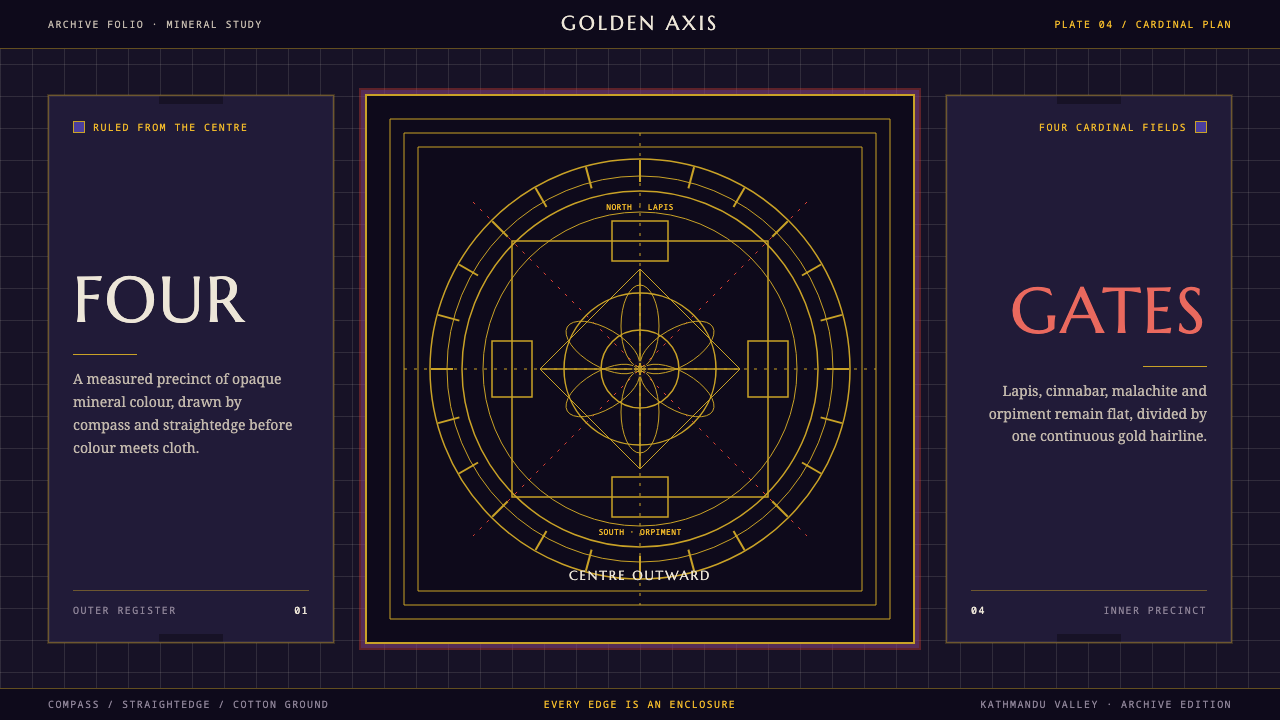
A Newar mandala isn't decorated — it's surveyed: a square palace measured out by compass and straightedge, its four gates opening onto rings of lapis and cinnabar.
Newar Mandala in brief
Newar painters in the Kathmandu Valley build a mandala the way a draftsman builds a plan rather than the way a painter builds a picture. A length of cotton cloth is sized with animal glue and kaolin to create a stable ground, the entire construction is ruled out with compass and straightedge before any color is applied, and the result is then filled in solid with ground mineral pigment — lapis, cinnabar, malachite, orpiment, and gold. A mandala, in this tradition, is not ornament applied to a surface. It is a plan: nested rings held inside a square palace with four cardinal gates.
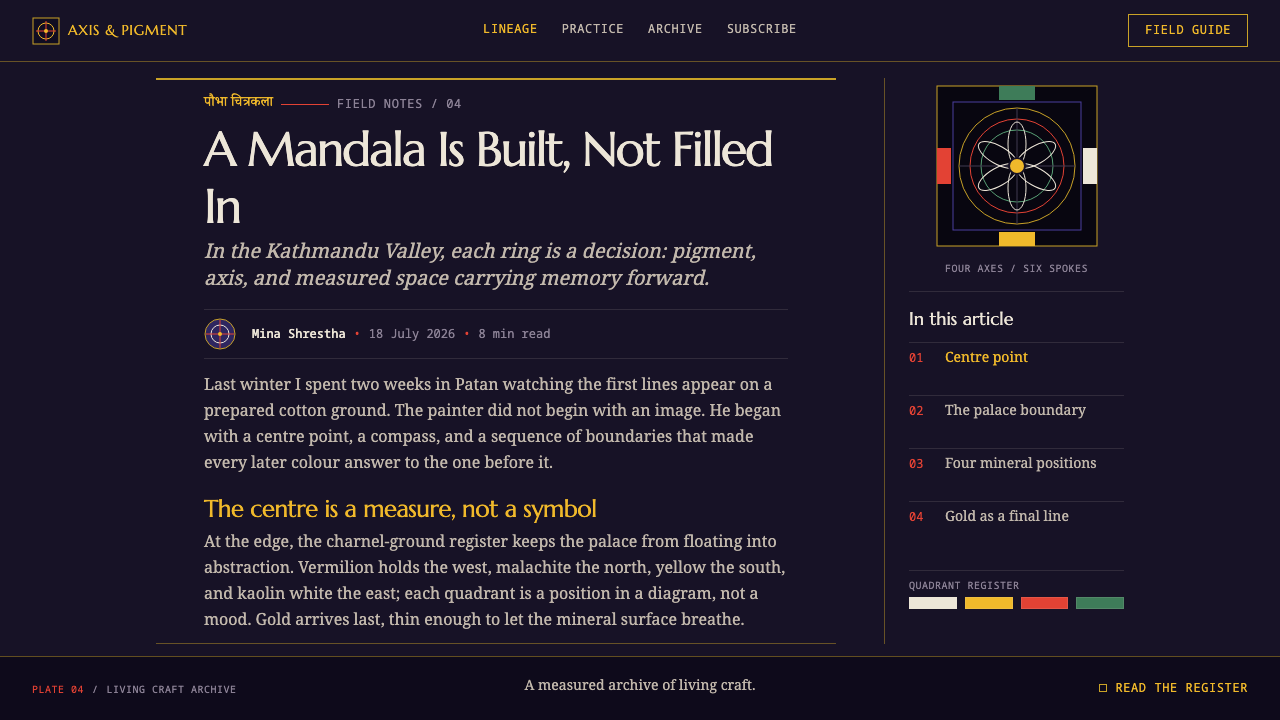
That plan has specific, named components. A ring of flames and a ring of vajras surround a six-petaled lotus platform; all of it sits inside a square palace pierced by a gate on each of its four sides; and an outer band represents the charnel ground ringing the entire composition. Every element occupies an exact, geometrically determined position — nothing in a properly constructed mandala is placed by eye or adjusted for visual balance the way a conventional composition might be.
This design system takes that plan at face value. The page itself functions as the charnel ground — a deep black with a cool blue cast, never a neutral gray or plain black. Every content-bearing surface is treated as a square precinct with gated axes on four sides, echoing the palace structure. Color stays mineral and fully opaque, with no gradients of any kind, and borders are rendered as a single fine gold line rather than a heavier frame. Layout grows outward from a center point rather than starting from a conventional left margin, mirroring the way the mandala itself is built ring by ring around its core.
Where does Newar Mandala come from?
This mandala tradition belongs to the Newar painters of the Kathmandu Valley, working out of the historic workshop towns of Patan, Bhaktapur, and Kathmandu itself. It sits within the broader Paubha painting tradition and within Vajrayana mandala iconography more specifically, and its practice in the valley extends from the thirteenth century onward — placing it among the longer continuously documented painting traditions associated with Vajrayana Buddhist visual culture.
The making of a Newar mandala is closer to technical drafting than to freehand painting. A painter first sizes a length of cotton cloth with animal glue mixed with kaolin, preparing a stable, evenly absorbent ground. The entire structure of the mandala is then measured out with compass and straightedge before a single figure is painted — every ring, gate, and platform positioned by geometric construction rather than sketched by eye. Only once that underlying geometry is fixed does the painter begin filling it in, layer by layer, with ground mineral pigment: lapis for blue, cinnabar for red, malachite for green, orpiment for yellow, and gold for the finest structural lines.
What that geometry describes is not a decorative pattern but a plan. A Newar mandala is built from nested rings — a ring of flames, a ring of vajras, a six-petaled lotus platform — all gathered inside a square palace pierced by gates on its four cardinal sides, with an outer band representing the charnel ground, or śmaśāna, ringing the whole composition. One well-documented type from this tradition, the Chakrasamvara mandala depicted with Newar donor portraits, is a fifteenth-century form, anchoring the broader tradition's long history to a specific, well-studied historical example.
The technique and its geometric discipline have been carried forward by named painters working within the Newar workshop tradition, including Jivarama, Tej Bahadur Chitrakar, Anandamuni Shakya, and Lok Chitrakar. Their work, across different periods of this long tradition, reflects the same underlying method: construct the geometry first, then fill it with opaque mineral color, treating the mandala as an exact structural plan rather than an illustrative composition.
What defines the Newar Mandala look?
Color
The palette is drawn from opaque ground minerals — lapis for blue, cinnabar for red, malachite for green, orpiment for yellow — finished with gold reserved for the finest lines. Every color sits as a flat, fully opaque field; nothing fades or blends from one hue into another.
Ground
The base surface reads as the charnel ground itself — a deep black with a cool blue cast, never a neutral gray or a flat, warm black. This darkness is treated as a meaningful structural element rather than incidental background.
Square Precinct
Every content-bearing surface is treated as a square precinct rather than a freeform panel, pierced by gated axes on its four sides in the way the mandala's own palace is. This gives even a simple card or container a strong sense of enclosed, four-directional structure.
Gold Hairline Border
Borders are rendered as a single fine gold line rather than a thick or heavily rendered frame. The line functions the way it does in the source paintings — marking a boundary precisely, without adding visual weight of its own.
Center-Outward Layout
Composition grows outward from a central point rather than beginning at a conventional left margin. The focal element sits at the literal center of the layout, with supporting rings or sections built concentrically around it.
Concentric Ring Structure
Content is organized into nested, concentric bands — echoing the flame ring, vajra ring, and lotus platform of the source structure — rather than a single flat field or a simple grid. Each ring functions as a distinct zone with its own content, ordered from center to edge.
Geometric Precision
Every element occupies an exact, compass-and-straightedge-determined position rather than one adjusted by eye for visual balance. This discipline gives the system a rigorous, axial symmetry that reads as deliberate and constructed rather than loosely composed.

Who shaped Newar Mandala?
Jivarama is among the named painters associated with the Newar workshop tradition of mandala and Paubha painting, working within the same geometric, mineral-pigment method described here — constructing the underlying structure with compass and straightedge before filling it in with opaque color. His work forms part of the long documented lineage that connects the tradition's earlier centuries to its later practitioners.
Tej Bahadur Chitrakar belongs to the Chitrakar lineage of painters traditionally associated with Newar Paubha and mandala production in the Kathmandu Valley. His work continues the workshop-based transmission of the tradition's precise geometric method and mineral-pigment technique from one generation of painters to the next.
Anandamuni Shakya is recognized within the Newar workshop tradition for sustained work in Paubha and mandala painting, maintaining the practice's exacting geometric construction method across a period when many traditional workshop crafts faced pressure to modernize or simplify. His work is part of what has kept the tradition's precise technical discipline intact into the present.
Lok Chitrakar is a contemporary painter working within the Newar Paubha and mandala tradition, continuing the same disciplined method of geometric construction followed by layered mineral pigment. His work represents the tradition's continuity into the present day, carried forward through the same workshop-based training that produced earlier generations of Newar painters.
How do you use Newar Mandala today?
This system transfers well to any context that benefits from a single, ceremonial focal point surrounded by clearly ordered supporting structure — a dashboard built around one dominant metric, a premium or ceremonial brand identity, or any composition that wants to feel deliberately constructed rather than loosely arranged.
On presentation slides, a cover works well as a centered composition: a title or key statement placed at the literal center of the frame, with concentric rings or bordered sections built outward around it rather than a conventional top-left headline. Content slides can adopt a nested-ring or quadrant structure where the material supports it, dividing information into concentric zones rather than a simple top-to-bottom list. Data is well suited to radial or ring-based charts — a set of concentric progress rings, for instance — echoing the mandala's own nested-ring structure directly.
For web interfaces, the style suits dashboards organized around one dominant, centered metric or focal element, surrounded by supporting panels arranged concentrically or symmetrically around it. Backgrounds should stay a genuine deep black with a cool cast rather than a warm or neutral dark gray, accent colors should stay flat and fully opaque rather than softened into gradients, and borders should use a single fine gold-toned line rather than a heavy frame to signal precision and value.
In editorial and marketing contexts, the system suits premium, ceremonial, or heritage-forward branding — luxury packaging, invitation design, or any campaign that wants to signal considered structure and gravity rather than casual friendliness. A centered, symmetrical composition framed with a thin gold line communicates permanence and intention more effectively than an asymmetric, off-center layout would.
The most common mistake is softening the mineral, fully opaque palette into gradients or pastel tints, which erases the exact quality that makes the system read as deliberate and structural. A second common mistake is building a loosely asymmetric layout instead of respecting the tradition's strict geometric symmetry — this system depends on exact, compass-and-straightedge precision, not organic or freehand composition.
Newar Mandala — FAQ
Is a Newar mandala purely decorative, or does its structure carry meaning?
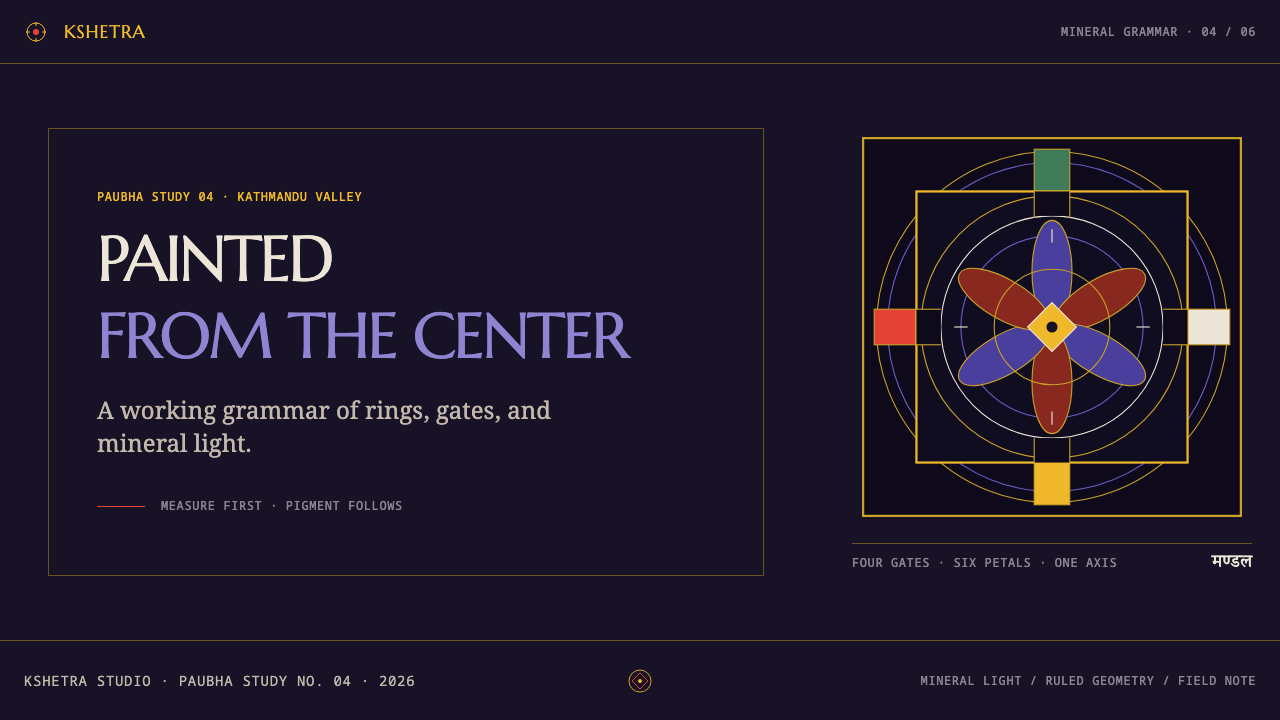
Its structure carries specific meaning; it is not decoration applied for visual effect. Each mandala is constructed as a plan — a square palace with four gates, nested rings representing flames and vajras, a central lotus platform, and an outer charnel-ground band — and every element occupies a fixed, deliberate position determined by geometric construction rather than aesthetic preference. Treating the mandala as pure ornament misreads what the object actually is.
Why does the layout build outward from a center instead of starting at a left margin?
Because that is how the source object is actually constructed. A Newar mandala is built ring by ring around a central point — the composition literally grows outward from its core rather than being read left to right like text. A design system that follows this logic keeps the same center-outward structure, placing the focal element at the true center of a layout rather than adapting the mandala's geometry into a conventional reading order that the original never had.
Can this style work with bright, non-mineral colors instead of the traditional palette?
It can, but the result should keep the palette's defining qualities — flat, fully opaque color with no gradients, and enough restraint that each hue reads as deliberate rather than decorative. What matters less is matching lapis, cinnabar, malachite, and orpiment exactly, and what matters more is preserving the opacity and structural discipline that mineral pigment naturally produces. A softened, blended, or gradient-heavy palette breaks the system regardless of which specific colors are used.
What is a useful historical anchor point for this tradition?
The Chakrasamvara mandala depicted with Newar donor portraits is a well-documented fifteenth-century example, and it offers a useful fixed point within a tradition that extends more broadly from the thirteenth century onward. It shows the same geometric, ring-and-gate structure and the same mineral-pigment technique that later painters — including Jivarama, Tej Bahadur Chitrakar, Anandamuni Shakya, and Lok Chitrakar — continued to work within across the centuries that followed.
Where does this style struggle?
It struggles in contexts that call for informality, asymmetry, or rapid, casual content changes — social feeds, playful consumer apps, or anything that wants to feel spontaneous rather than constructed. The system's entire value comes from exact geometric precision and a sense of deliberate, unhurried construction, which reads as authoritative and considered in the right setting but can feel rigid or overly formal wherever lightness and informality are the actual goal.
Related design styles
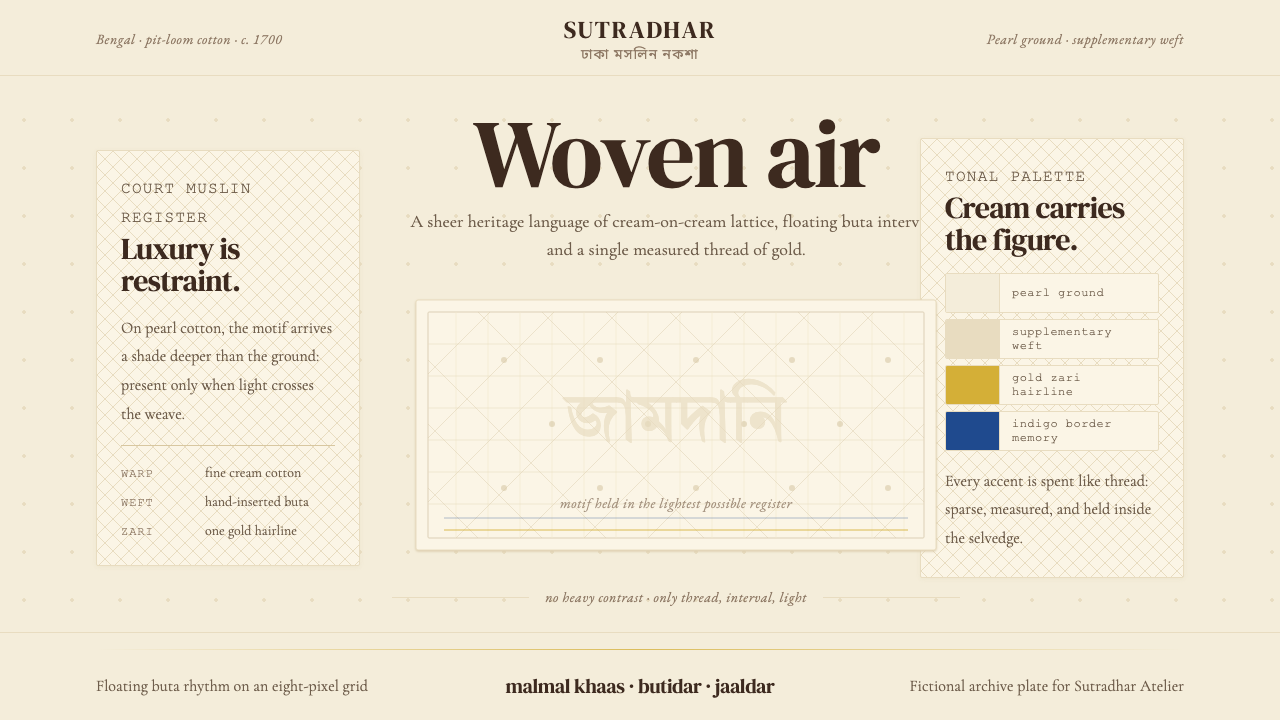 Bengali Jamdani WeavingLuxury whispers. Pearl cream, tonal buta, and one gold hairline make woven ai…
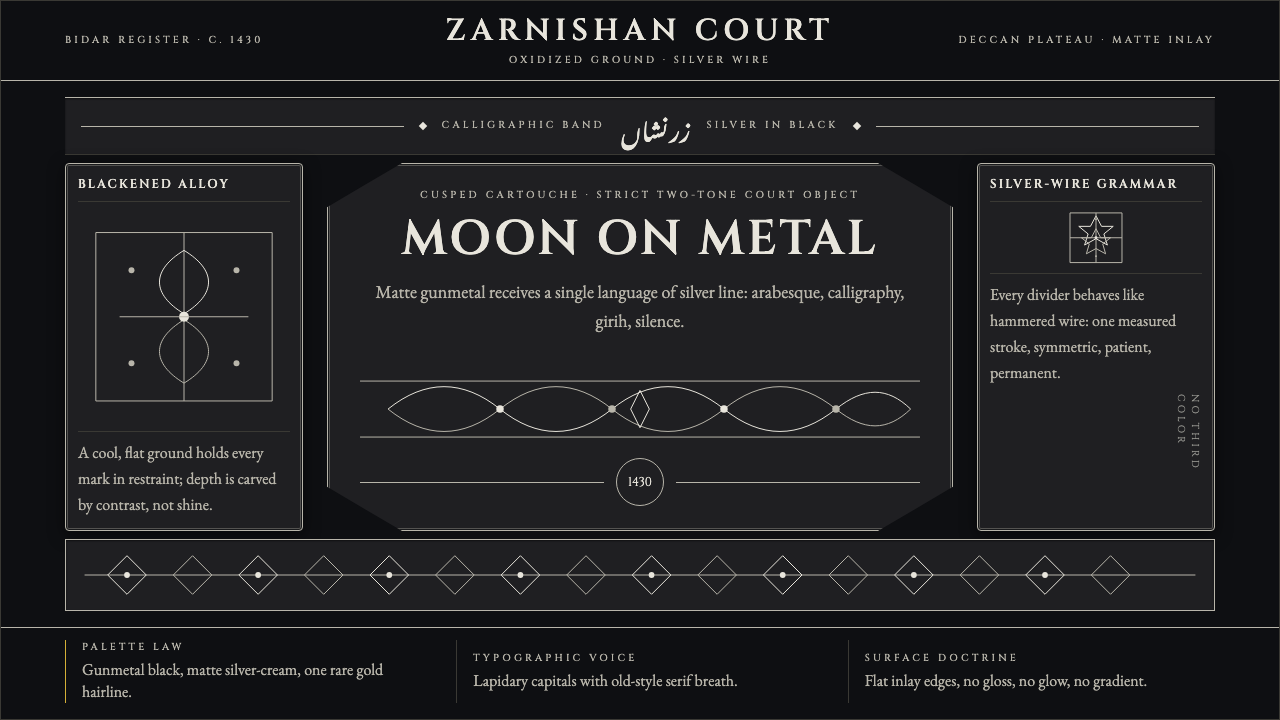 Bidri Deccan MetalworkCourtly darkness, tooled by silver. Cinzel caps and hairline arabesques cut g…
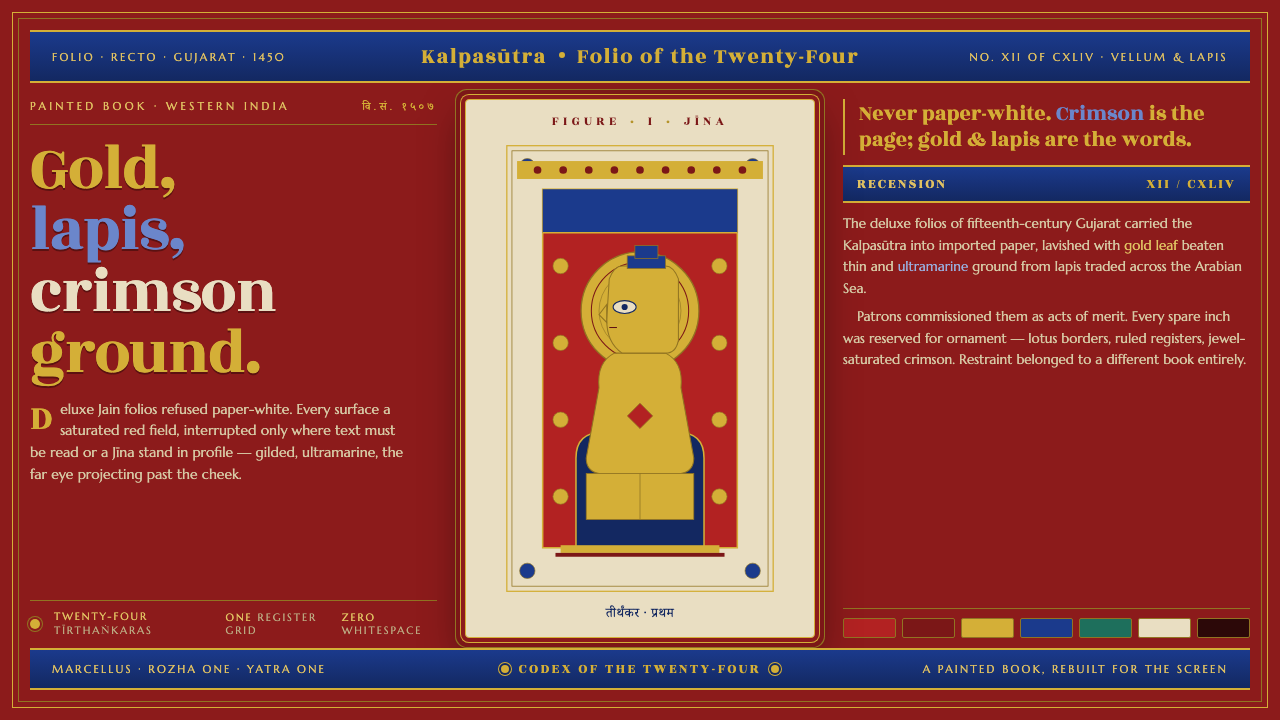 Jain Kalpasutra ManuscriptNever paper-white. Gold leaf and lapis figures on jewel-crimson, lotus-ruled…
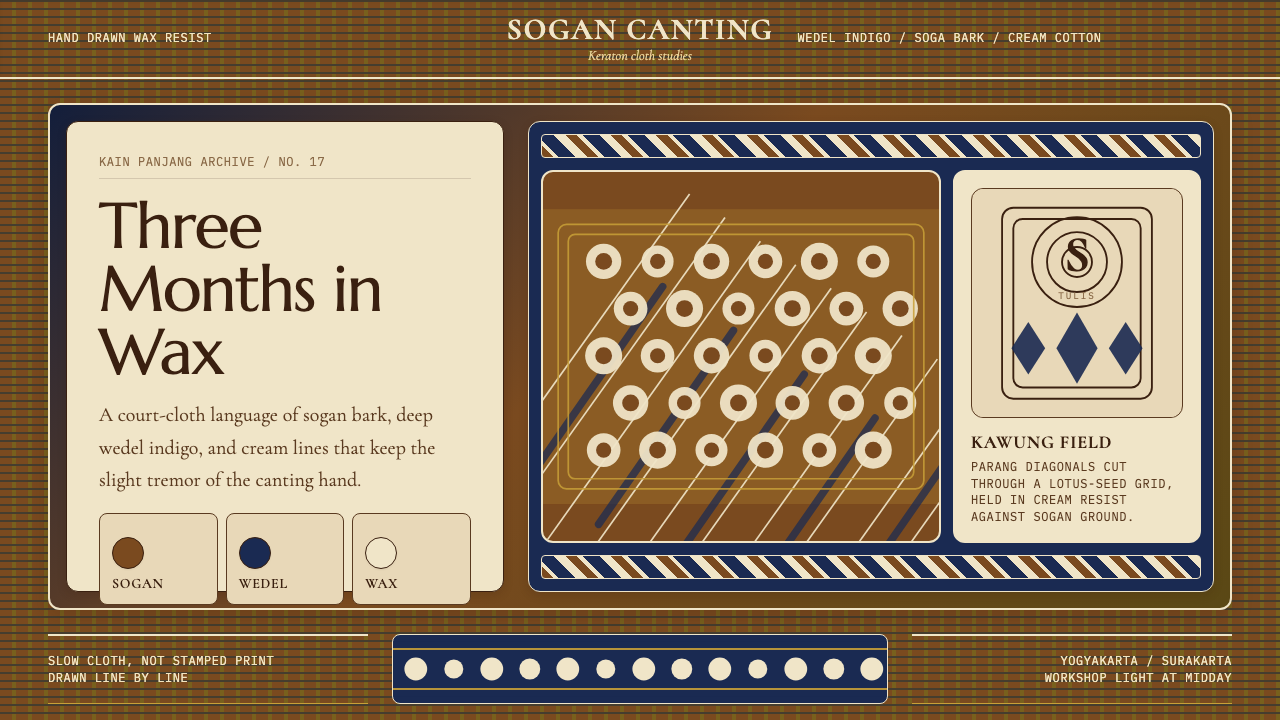 Javanese Batik Tulis (Keraton Sogan)Patience made visible. Sogan brown, indigo, and cream wax-lines form dense co…
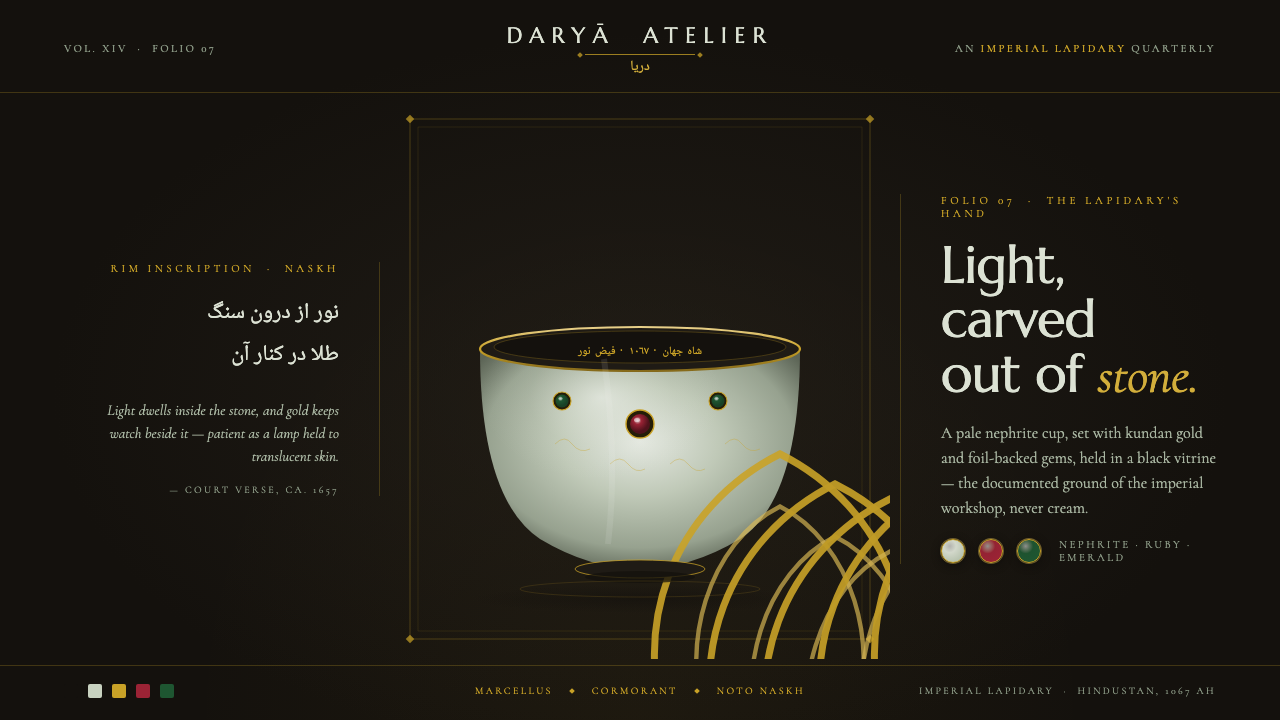 Mughal Jade CarvingImperial luxury, lit from inside. Pale nephrite glows on black, kundan gold f…
 Parsi Gara EmbroideryHeirloom needlework, made digital. Off-white silk vines glow over deep auberg…