What is Blacklight Mini-Golf?
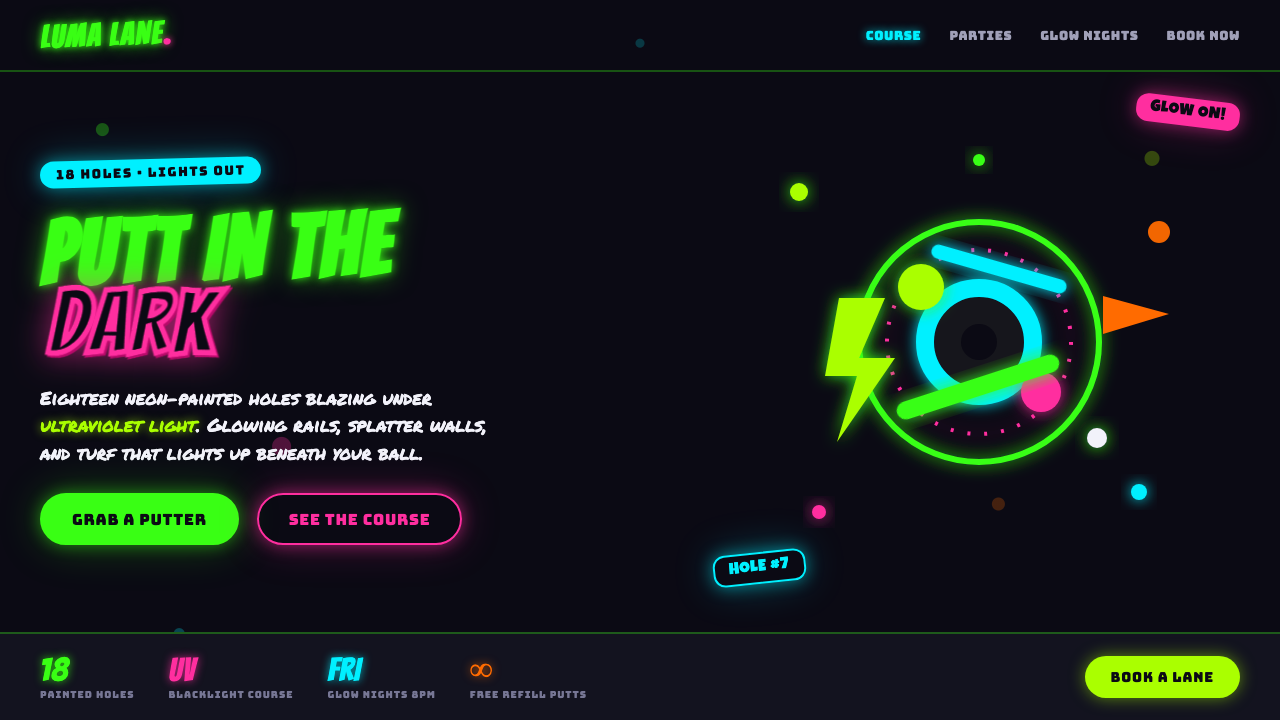
Blacklight Mini-Golf turns a blackout arcade wall into a fluorescent riot: brushy monsters, hand-lettered signs, and colors that seem to glow from inside the dark.
Blacklight Mini-Golf in brief
Blacklight Mini-Golf is the aesthetic of the indoor blacklight course: a deliberately darkened family-entertainment space in which ultraviolet illumination activates fluorescent paint. Black walls disappear into the room while painted monsters, splatters, arrows, holes, and signs leap forward in luminous color. The atmosphere is not refined nightclub futurism or polished digital neon. It is North American arcade kitsch: direct, comic, noisy, playful, and proud of being a little excessive.
Its visual vocabulary begins with contrast. A black-painted ground behaves like the unlit wall of a venue, creating the stage on which UV-fluorescent green can act as the hero glow. Hot pink, acid lime, electric cyan, and glow orange join it as competing bursts of energy rather than as a calm, coordinated palette. Bright marks are usually large, irregular, and visibly painted; they feel applied by a muralist or sign painter, not generated by a sterile interface system.
In digital work, the style translates the sensation of entering a blacklight course rather than literally reproducing one. Hand-lettered and cartoonish type, comic-monster imagery, paint splatters, thick outlines, and radiant halos create a screen that feels lit from within. The goal is controlled sensory overload: a dark field keeps the composition legible, while every fluorescent accent appears to be an event.
Where does Blacklight Mini-Golf come from?
The style belongs to contemporary blacklight mini-golf chains in North America, from 2010 to the present. Its setting is the indoor course rather than the daylight putting green: a blackout room designed as an immersive family attraction. Glowgolf and Monster Mini Golf venues provide the recognizable context named by the source material, where course decoration, mural painting, signage, and game atmosphere operate as one visual environment.
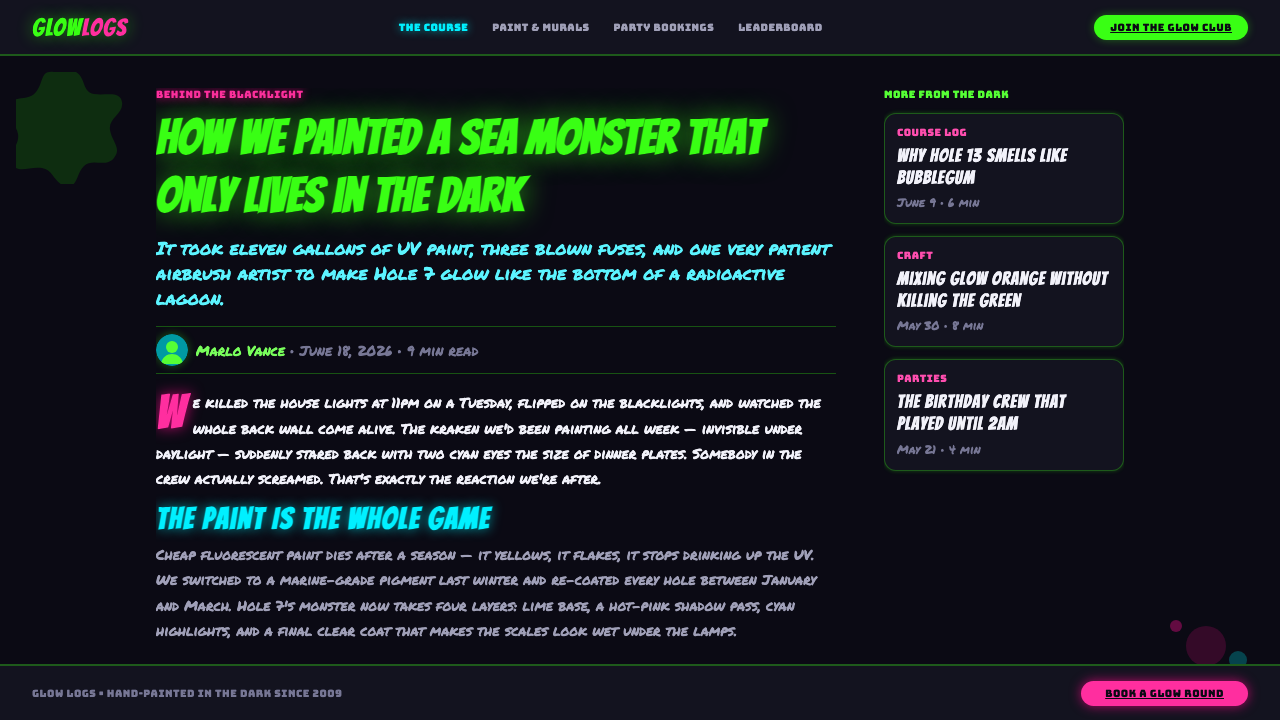
Its immediate roots are UV blacklight venue art and day-glo or fluorescent poster painting. Both depend on fluorescent pigment becoming visually active against darkness, but the mini-golf setting gives that effect a theatrical job. Paint does not simply decorate a wall; it identifies a playful world around the course. Monsters, splatters, directional gestures, and bold lettering make the room feel animated even before anyone plays.
Comic-monster signage supplies the style's personality. Rather than presenting information in a neutral corporate voice, it treats each label and graphic as part of the attraction. Hand-painted marks can look brushy, uneven, oversized, and gleefully theatrical. Contemporary digital versions should preserve that combination of venue art, fluorescent poster energy, and comic signage instead of converting it into generic cyberpunk neon.
What defines the Blacklight Mini-Golf look?
Blackout Ground
The ground is black and absorbent, like a painted wall outside the reach of the ultraviolet glow. It is not an empty background: it establishes the venue illusion by swallowing ordinary visual noise. Large dark areas are essential because they make fluorescent marks feel suspended, revealed, and electrically alive. Filling every corner with color weakens the blacklight effect.
Fluorescent Riot
UV-fluorescent green leads the palette as the dominant glow. Hot pink, acid lime, electric cyan, and glow orange arrive as vivid interruptions, creating a lively clash rather than a restrained harmony. The palette should read as paint responding to ultraviolet light: concentrated, theatrical, and impossible to mistake for ordinary pastel or daylight color.
Painted Glow
Every bright mark wears a blacklight halo. The glow should feel like pigment radiating from a painted surface, not like a perfectly smooth software effect. Uneven edges, brushy contours, and layered luminous strokes help preserve the mural quality. The light belongs to the mark itself, as though the monster, letter, or splatter is charged from within.
Hand-Lettered Type
Typography is hand-lettered and cartoonish, with the expressive role of venue signage rather than the restraint of an editorial system. Letterforms can wobble, swell, lean, or bounce, provided they remain easy to read from a distance. Thick dark outlines separate bright type from the glow behind it, making words feel painted onto the black wall.
Comic Monsters
Monsters are the central decorative voice: friendly, exaggerated, and built for instant recognition rather than realism. They can frame a title, point toward an action, guard a game area, or burst from behind a panel. Their role is to keep the environment from becoming an abstract neon pattern. The imagery makes the style family-entertainment kitsch rather than an anonymous glow treatment.
Splatter and Motion
Paint splatters, streaks, drips, arrows, and irregular bursts give the composition its velocity. These marks should behave as energetic gestures, not as delicate decoration. They can connect areas of the layout, push the eye toward a call to action, or make a quiet region feel as if a fluorescent paintball just struck it. Their roughness is part of the appeal.
Who shaped Blacklight Mini-Golf?
Monster Mini Golf operators represent the venue side of the aesthetic: the people maintaining an indoor entertainment environment in which miniature golf, blacklight murals, comic imagery, and signage are experienced together. Their importance is practical rather than auteur-driven. The visual language must work as part of a loud, immediate, family-facing attraction, not as isolated gallery decoration.
Glowgolf venue artists stand for the mural and atmosphere work that turns a dark course into a fluorescent setting. Their medium is the wall-scale relationship among glow, black space, painted characters, and playful directional graphics. In a digital adaptation, that perspective encourages designers to build an entire scene rather than scatter disconnected neon accents across a conventional layout.
UV mural painters are the craft source behind the style's most convincing qualities: visible brushwork, fluorescent pigment, large-scale silhouettes, and illustrations meant to transform under ultraviolet light. They demonstrate why polished vector perfection is not the primary goal. The image should retain the sense of an artist painting a playful world onto a black wall for people to enter.
How do you use Blacklight Mini-Golf today?
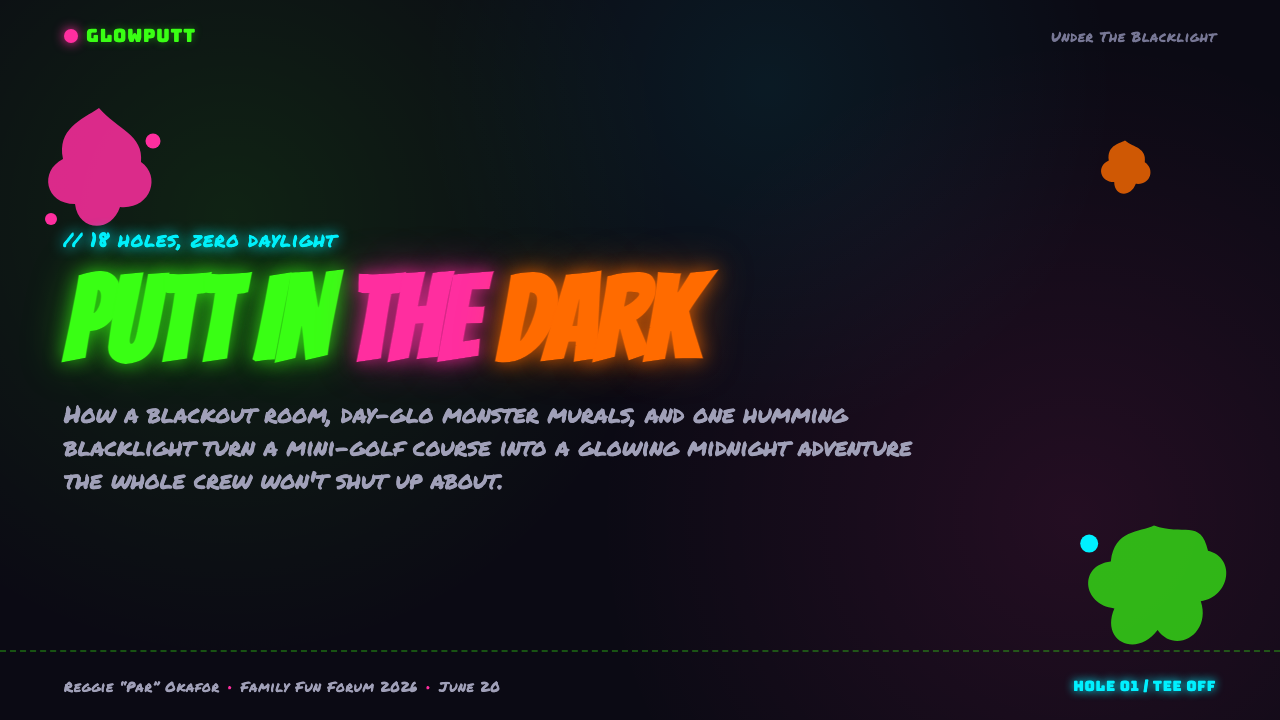
For presentation covers, treat the slide as a dark venue entrance. Let one hand-lettered title or comic monster establish the first read, then surround it with a limited burst of fluorescent green and supporting hot colors. On content slides, return to a calmer black field and use glowing headings, painted dividers, and small splatters to organize information. The spectacle should introduce the subject; the body content still needs generous dark space and clear reading order.
Data slides work best when charts behave like course signage rather than corporate reporting furniture. Use fluorescent color to distinguish the most important category or movement, and keep secondary information quieter against the blackout ground. Bars, paths, score-like markers, directional arrows, and playful labels can echo a mini-golf environment. Avoid turning every series into a competing glow source, because the viewer must still find the point of comparison immediately.
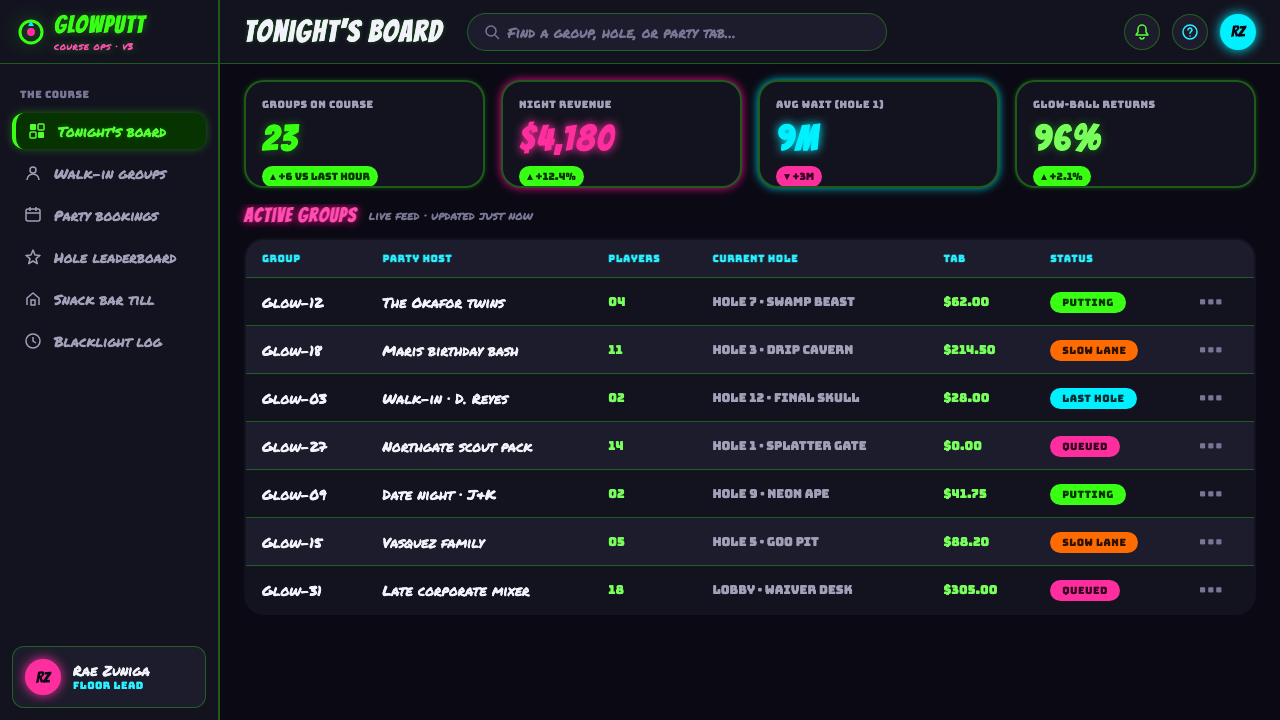
For web interfaces, the style is strongest in game hubs, event pages, youth-oriented promotions, arcade dashboards, and playful pricing or ticketing journeys. A dashboard can use glowing status markers, monster-led empty states, and luminous calls to action while retaining dark panels for focus. A pricing page can frame each choice as an attraction or course challenge, but the primary decision and its supporting information must remain more visible than decorative splatter.
For editorial and marketing, Blacklight Mini-Golf excels at announcements, seasonal campaigns, party invitations, attraction guides, and experiential landing pages. Use large comic imagery to create section breaks and let hand-painted lettering signal a change of mood. The common mistake is applying smooth neon gradients, minimal futuristic type, and generic nightclub imagery. That produces a sleek glow aesthetic, but loses the brushy, family-arcade, comic-monster character that makes this style specific.
Blacklight Mini-Golf — FAQ
Is Blacklight Mini-Golf simply a neon style?
No. Neon can describe many polished, urban, futuristic, or nightlife-oriented looks. Blacklight Mini-Golf is specifically rooted in a dark indoor family-entertainment venue, fluorescent paint, comic monsters, hand-lettered signage, and visible mural energy. Its brightness should feel painted and playful, not like clean tubing, luxury nightlife branding, or an abstract digital glow.
How should fluorescent green be used without overwhelming the page?
Treat it as the hero glow, not as a replacement for every surface. Place it where the eye should land first: a title, a key action, a score, a route, or a central monster detail. Let black space do much of the compositional work, then use hot pink, cyan, lime, and orange as smaller interruptions. The contrast between darkness and selective brightness is the source of the effect.
Can this style work for information-heavy screens?
Yes, if the fluorescent language is assigned to hierarchy rather than applied everywhere. Keep information areas calm and dark, use hand-painted or glowing elements to mark major sections and active states, and reserve monsters and splatters for moments that need attention or delight. The style becomes unusable only when every label, panel, and datum tries to glow with equal intensity.
What makes the hand-painted look important?
The hand-painted look connects the interface to UV mural painters and venue artists. Brushiness, irregular outlines, splatters, and animated lettering make the fluorescent color feel like physical pigment on a blackout wall. Removing those qualities leaves only a dark background plus bright color, which may be attractive but no longer carries the playful, comic, family-arcade identity of the source aesthetic.
Related design styles
 Among Us (crewmate space)Trust is ready to break. Loud capsule colors cut through a navy void with har…
 Champeta Picó SoundLoud after dark. Orange-green banners and fat Bungee type glow like a speaker…
 Hyperpop 100 gecs (2019)Cute chaos detonates. Blacklight candy, Bungee type, and pixel trash collide.
 Taylor Swift Eras (2023)Every chapter catches light. Hot pink, lavender, gold and beadwork glow on mi…
 Afrobeats LagosLoud after dark. Neon green type and yellow diagonals hit black like pasted s…
 Bad Bunny YHLQMDLGMaximal night-pop collides. Bubblegum pink and acid lime stickers glow on mid…