What is Nenets Chum?
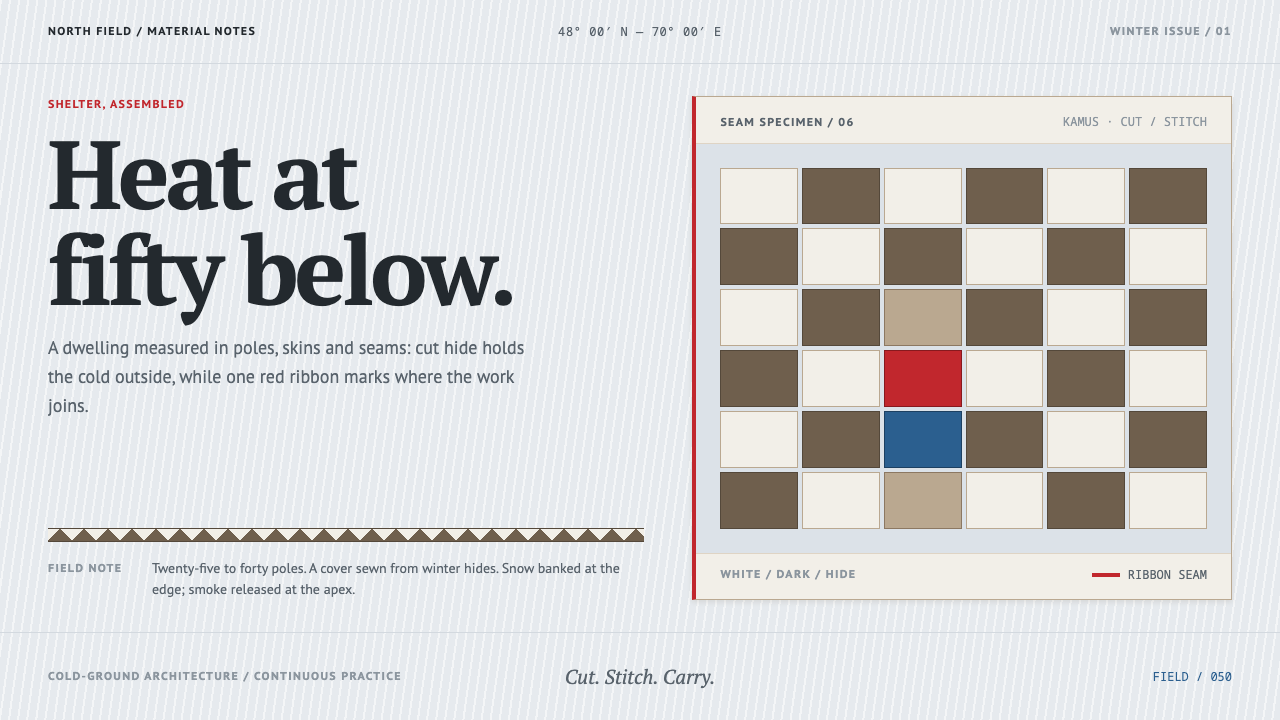
Nenets Chum borrows the logic of a tent made of reindeer hides — snow-grey panels, a cut-fur matrix of hard-edged blocks, and one red seam exactly where the colour belongs.
Nenets Chum in brief
Nenets Chum is a design style drawn from the chum, the conical tent that Nenets herders carry across the Yamal tundra of north-western Siberia with their reindeer herds. Its language is snow-grey hide panels, stepped rectilinear blocks of dark and white fur laid out like a mosaic, narrow ribbons of red, blue and green along the seams, and a single saturated red used sparingly.
The principle is warmth without excess. A chum is built to keep people alive at fifty below zero, and everything in it is made from what the herd provides. Ornament in this tradition is not applied to the surface; it grows out of the sewing, out of the seams, joins and cut edges that hold the shelter together. The style treats construction as the source of beauty.
On screen it becomes a light, quiet, tactile system: low-contrast neutrals, geometric patterning confined to seams and borders, and red used only in strips, squares and triangles. It suits products that want to feel warm, practical and handmade, yet precise.
Where does Nenets Chum come from?
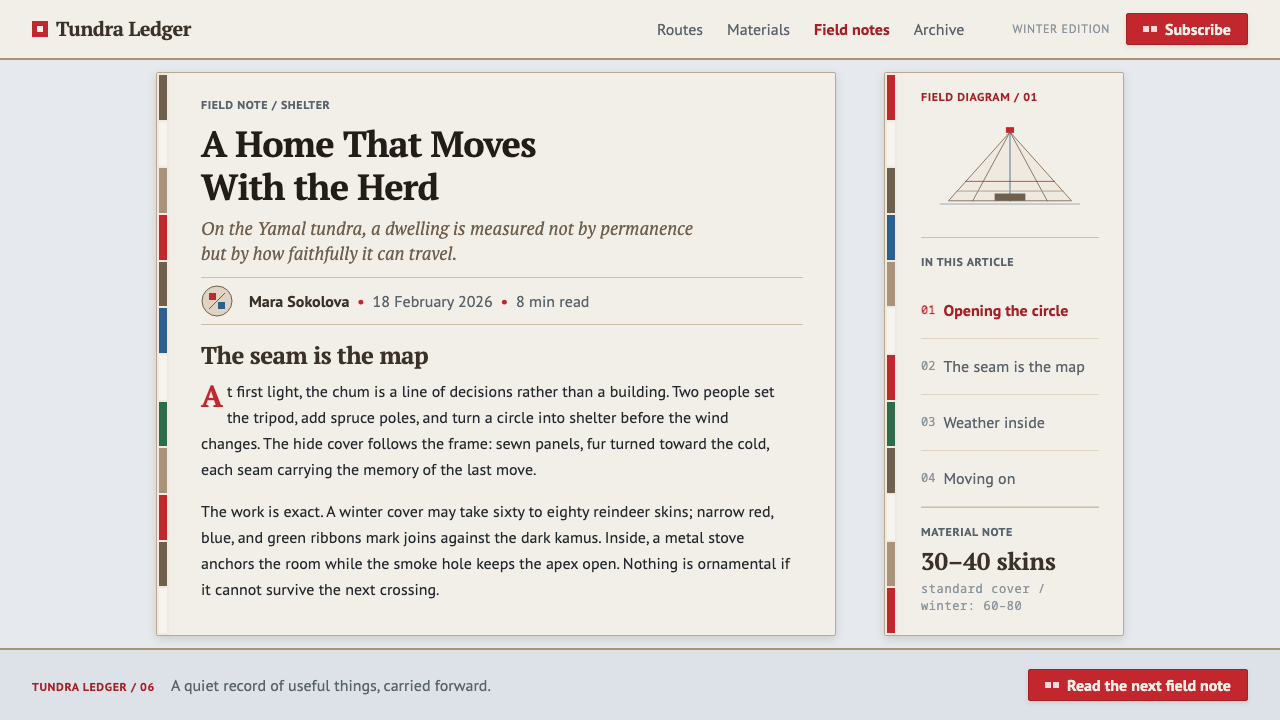
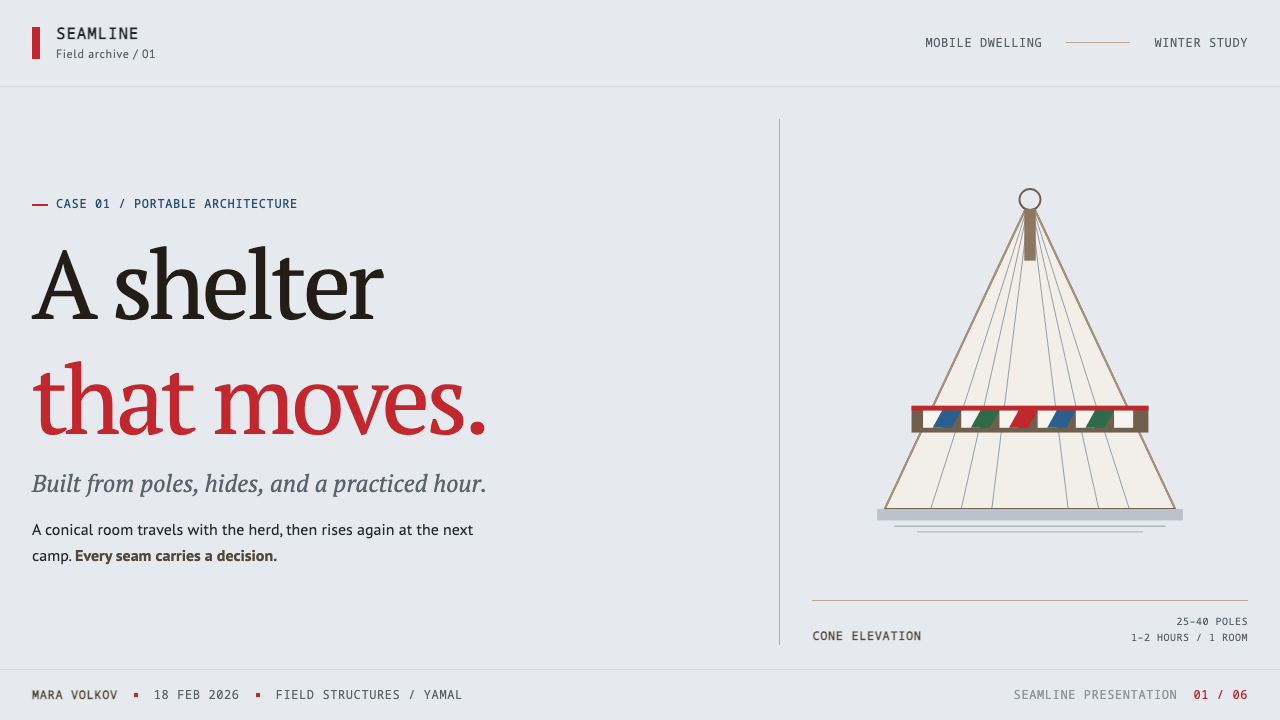
A chum goes up in about an hour. Between twenty-five and forty spruce poles are stood as a tripod, and over them is dropped the nyuk, the covering: reindeer hides sewn into a single piece, sixty to eighty skins for a winter chum. Snow is banked around the base. Inside there is a board floor with skins laid on top, a stove at the centre and a smoke hole at the apex. It holds at minus fifty, and two or three people can raise it in an hour or two. It is the working dwelling of migrating Nenets herders, and it still is.
The tradition belongs to Samoyedic nomadic material culture and to the wider circumpolar family of conical-tent building. It predates 1900 and is continuous, which means the object has never been a museum piece. It is a house in use. Its home is the Yamal Peninsula and the tundra of north-western Siberia, where Nenets herding families of the Yamalo-Nenets Autonomous Okrug still move with their reindeer.
The ornament follows the sewing. The covering is made from kamus, the leg skin of the reindeer, and the makers cut dark kamus and white kamus into squares, steps, saw-teeth and opposed triangles, then stitch them in mirrored arrangements along the seams. Everything is straight-edged. There is no curve and no shading, because a fur mosaic is made by cutting and sewing and a cut edge is hard. The craft belongs to the Arctic tradition of fur mosaic and appliqué.
Colour enters in the ribbons. Narrow cloth ribbons in red, blue and green run along the seams. In a material culture that is otherwise almost achromatic, a world of snow, hide and dark fur, red is the one saturated colour, and it is used the way the herders use it: in strips, squares and triangles, and sparingly. The covers themselves are cut and stitched by Nenets women. The system takes the same rule for its colour. Snow for the ground, hide for the surface, and red only on the seam where it belongs.
What defines the Nenets Chum look?
Snow-grey hide ground
The ground is a cool, low-contrast snow-grey, with hide-toned panels sitting on it. It is neither white nor dark but the soft neutral of a world made from snow and skins. Everything else relies on this calm base: because the ground is quiet, a seam, a block or a ribbon can be read at a glance, and the interface feels warm without a single warm accent.
The cut-fur matrix
Dark and white kamus are cut into squares, steps, saw-teeth and opposed triangles, and set out in a grid-like matrix of tight, rectilinear blocks. It reads as pattern, but it is really construction: each piece is a cut shape stitched to its neighbour. In design, this suggests strict modular patterning in a limited neutral range, with every unit a hard-edged cell on a visible grid.
The red seam
Red is the one saturated colour in an otherwise achromatic material culture, and it is used the way the herders use it, in strips, squares and triangles, sparingly. In a layout, red should be rare and exact: a thin line at a join, a small square marking a state, a single triangle for direction. A viewer should be able to count the reds on a page, and each should sit on a seam.
Ribbons along the seams
Narrow cloth ribbons in red, blue and green are laid over the seams, hiding the join and marking it at once. They are the system's dividers: thin coloured bands that sit exactly where one panel meets another. Blue and green stay quiet beside red. The rule is that colour belongs to a join, never to a field, so seams do the structural work and fills stay neutral.
Hard edges, no curves
Every shape is straight-edged: squares, steps, saw-teeth, triangles. There is no curve and no shading, because the fur mosaic is cut and stitched and the cut edge is hard. Corners are sharp, shadows are absent, and tone does not fade into tone. The effect is warm precisely because it is exact; the eye reads care in a clean cut, not softness in a blur.
Mirroring along the seam
Blocks are arranged in mirrored sequence along the seams, so a pattern on one side of a join answers the pattern on the other. This produces a calm, balanced rhythm without any need for decoration. In layouts, mirrored arrangement and repeated modules around a central line give stability, and a seam can serve as a vertical or horizontal axis for the whole composition.
Warmth without excess
The chum keeps people alive at fifty below zero with board, skins, a stove and a smoke hole, and it adds nothing it cannot use. The interface equivalent is a layout of necessary parts, each placed for a reason, with modest padding and almost no ornament. Warmth comes from material honesty, from a surface that clearly looks like what it is made of.

Who shaped Nenets Chum?
The families who still migrate with their reindeer across the Yamal Peninsula and the tundra of north-western Siberia, and for whom the chum is a working house. They are the living source of every rule in the system, and the reason it keeps its warmth tied to use rather than to display.
The makers of the nyuk, who cut the dark and white kamus into blocks and sew them into the mirrored matrix along the seams. Their cut-and-stitch method is the origin of the system's hard edges, its modular pattern and the strict economy with which red is used.
The wider tradition of nomadic material culture within which the chum belongs, part of a circumpolar family of conical-tent building. It places the system in a long practical lineage of shelter, in which beauty is a by-product of making something that works in extreme cold.
How do you use Nenets Chum today?
Nenets Chum works for products that want to feel warm, practical and honest without being rustic. It rewards restraint and modular thinking, and suits outdoor, craft, travel, food and wellbeing brands, and tools for people who work in difficult conditions. Apply the logic of the tent: a calm ground, hard-edged modules, and colour only on the seam. Because the pattern is made of cut shapes, it also scales well: a single block can be a bullet, a row of blocks can be a border, and a field of blocks can be a texture, all from the same small vocabulary.
For presentation slides, a cover can be a snow-grey field with a band of stepped fur-block pattern along one edge, a single red ribbon at its seam and a clear title in a neutral hide tone. Content slides use panels divided by thin seam lines, with colour limited to those lines. Data slides put charts on the neutral ground, show categories as hard-edged blocks, and reserve the red for the one value or threshold that matters.
For web interfaces, cards and panels become hide-toned rectangles joined by visible seams, and navigation reads as a row of stitched panels. Pricing pages can set plans as adjacent panels with a red seam marking the recommended one. Buttons are plain rectangles, borders are sharp and shadows are absent. Alerts and selected states take the red in the form of a strip, a small square or a triangle.
For editorial and marketing work, the style gives outdoor gear, regional food, craft products and cultural storytelling a trustworthy, hand-made-but-exact voice. A fur-block border can frame a story page, and a thin ribbon can divide sections. Photography of snow, hide and hands suits it well. Keep copy practical and short, and let the pattern prove care.
The common mistake is to treat the style as an excuse for ethnic ornament, scattering decorative motifs or curved folk patterns across a page. The source pattern is cut, stitched and rectilinear, and it sits at the seams. The second mistake is overusing red until it stops being the rare colour. If red covers the page, the seam logic is gone, and the warmth turns into noise.
Nenets Chum — FAQ
What exactly is a chum?
A chum is the conical tent of the Nenets herders of the Yamal tundra. Spruce poles form a tripod, and the nyuk, a cover sewn from reindeer hides, is dropped over them, with snow banked at the base. Inside are a board floor, skins, a stove and a smoke hole at the apex. It stays livable at minus fifty and can be raised in an hour or two, which is why it is still the working home of migrating herders.
Why is red used so sparingly?
Because in the source material red is the one saturated colour in an otherwise achromatic world of snow, hide and dark fur, and herders use it in small strips, squares and triangles. Its force comes from rarity. If a layout uses red everywhere, it loses that force and also loses the logic that places colour on seams. Count your reds, and put each one on a join.
How do I get a fur-mosaic pattern without it looking like folk decoration?
Keep it constructional. The source pattern is cut and stitched, so every shape is a hard-edged square, step, saw-tooth or triangle, arranged in mirrored sequence along a seam. Use two neutral tones, keep it to borders and dividers instead of whole backgrounds, and avoid curves, gradients or scattered motifs. The pattern should look like it holds the layout together.
Does this style work in dark mode?
It is built on a light, snow-grey ground, so the canonical form is light. A dark version is possible by treating the dark kamus as the field and keeping the white fur and the red seam as the only lights. But you lose the snow-and-hide softness that gives the system its warmth, so treat it as an adaptation and keep the cut-edge discipline intact.
Related design styles
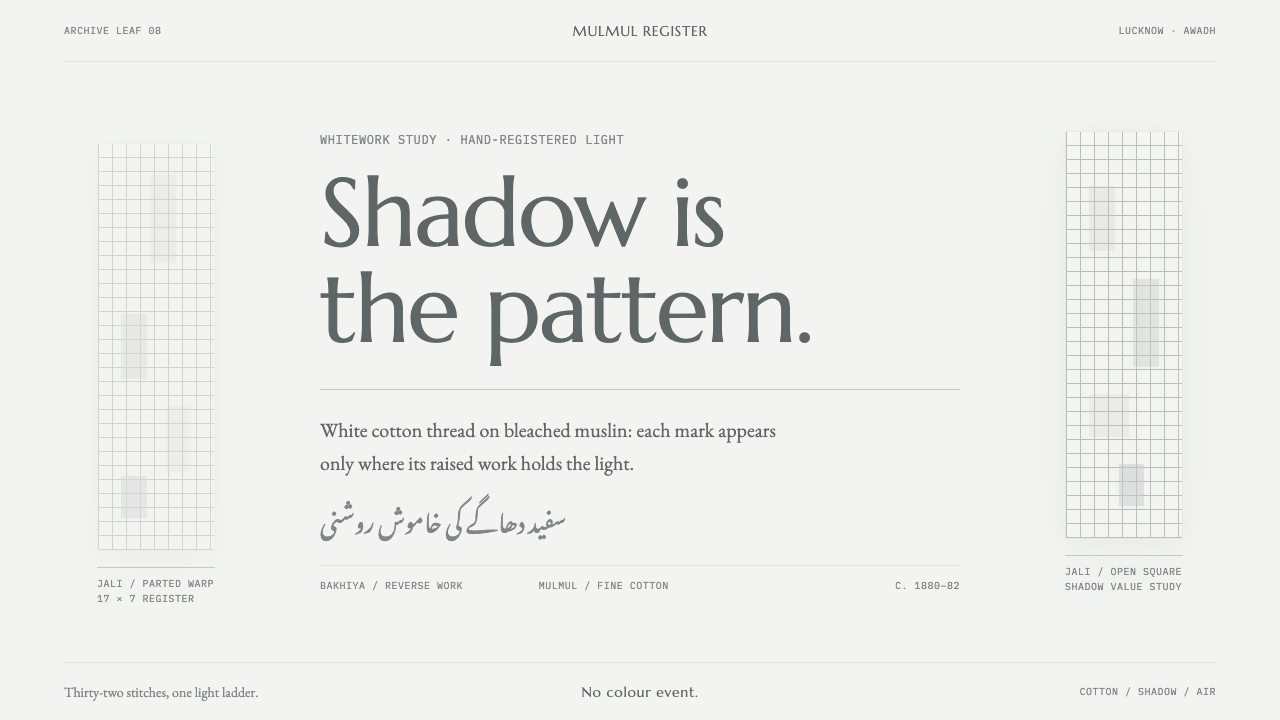 Lucknow ChikankariShadow becomes ornament. White thread and jali grids emerge through a muslin…
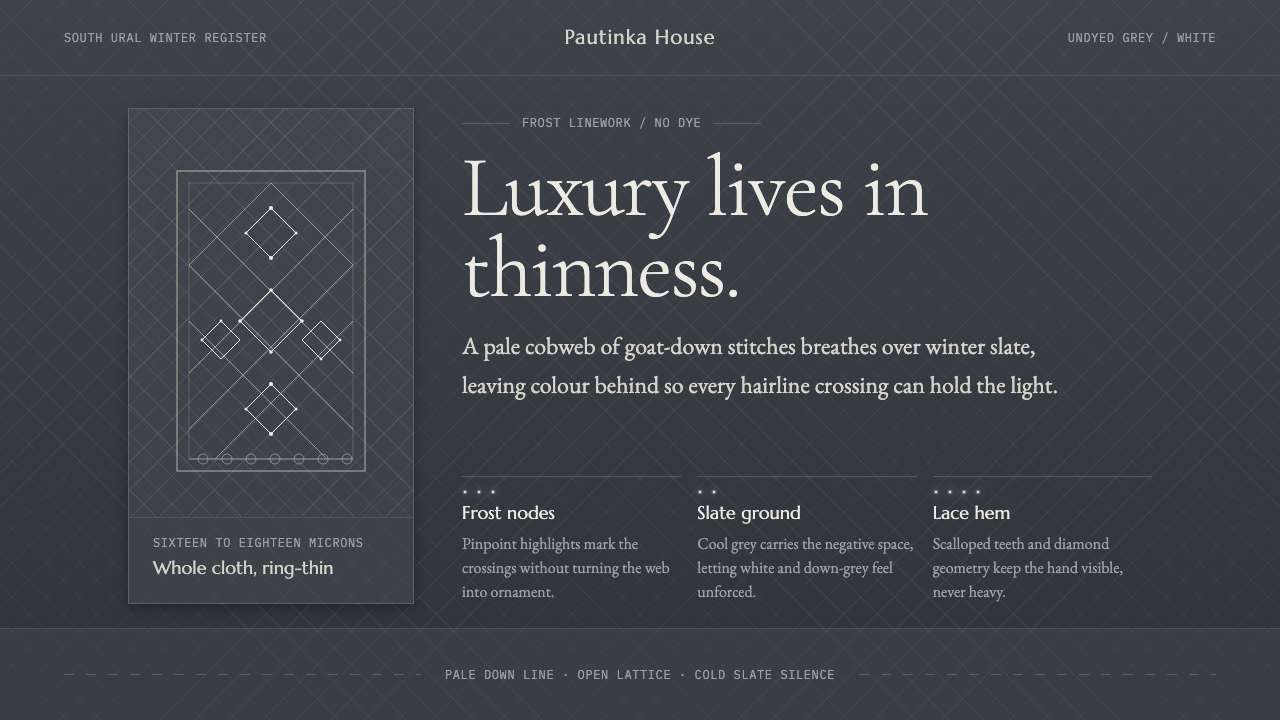 Orenburg Goat-Down Gossamer ShawlLuxury in thinness. Pale Cormorant type and down-lace lines breathe on Ural s…
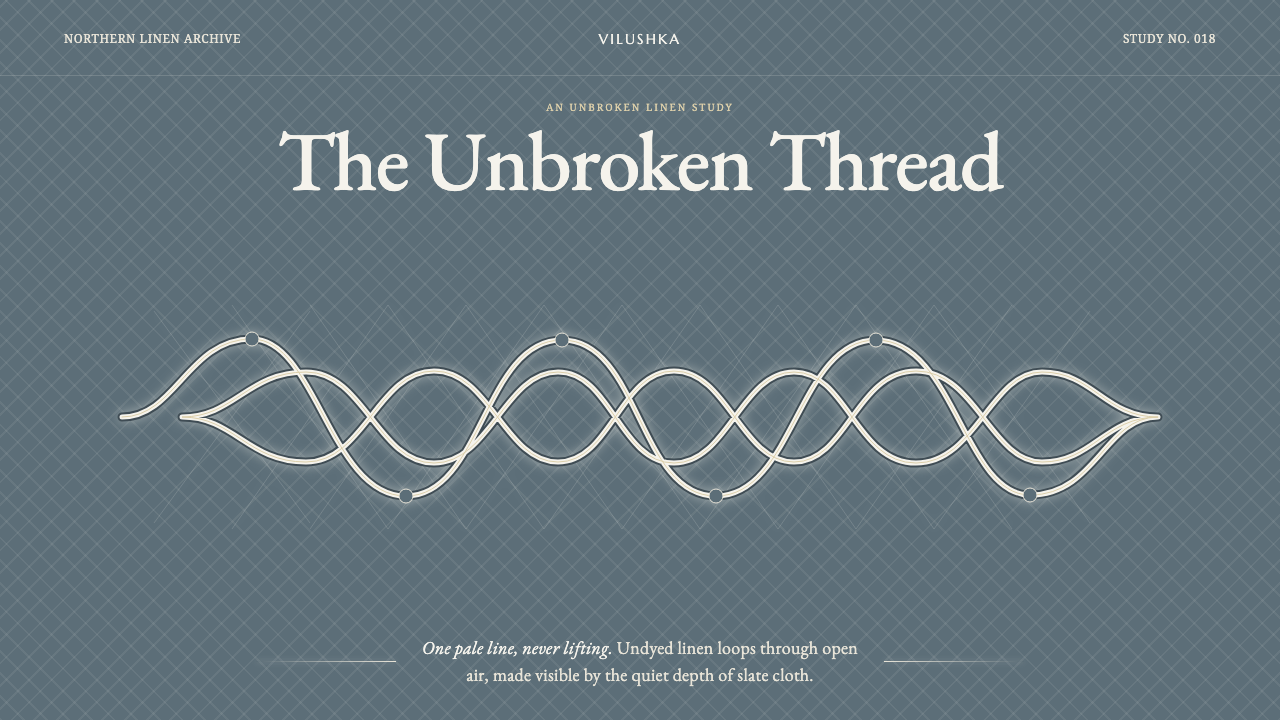 Vologda Bobbin LaceOne thread never lifts. Warm white linen loops glow across a quiet slate-blue…
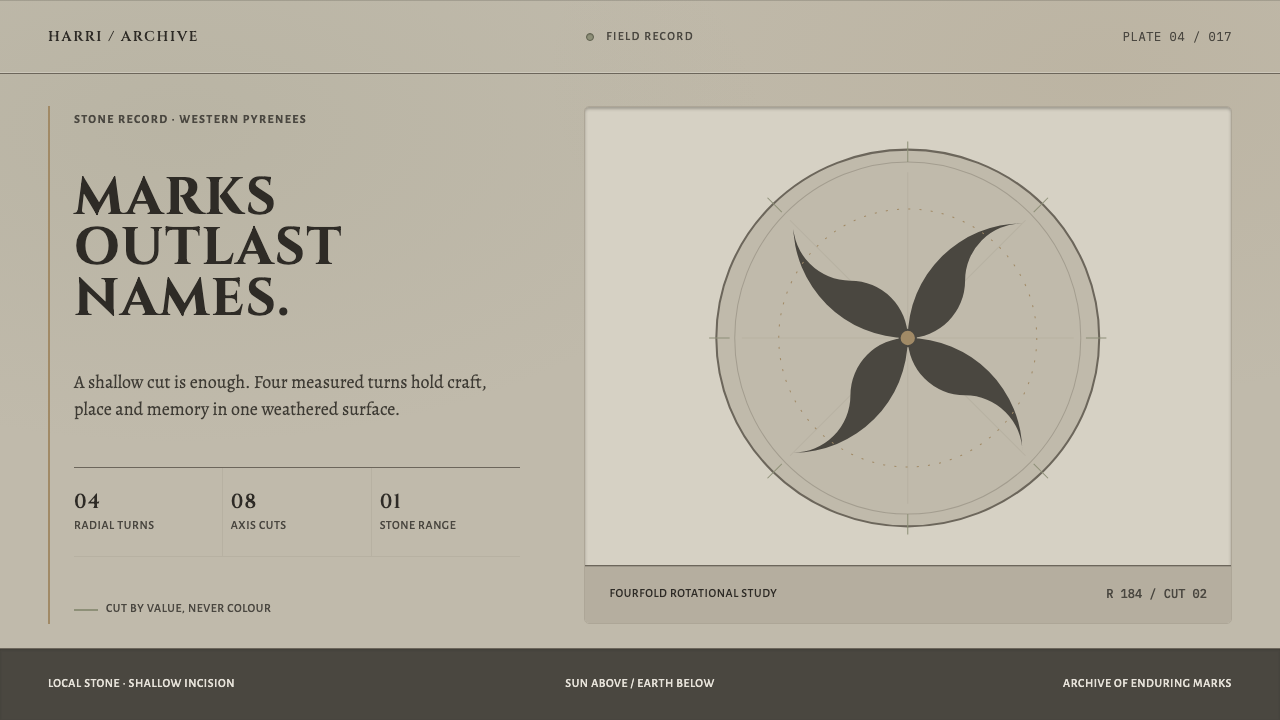 Basque LauburuMemory cut into stone. Warm grey planes and four measured turns build depth f…
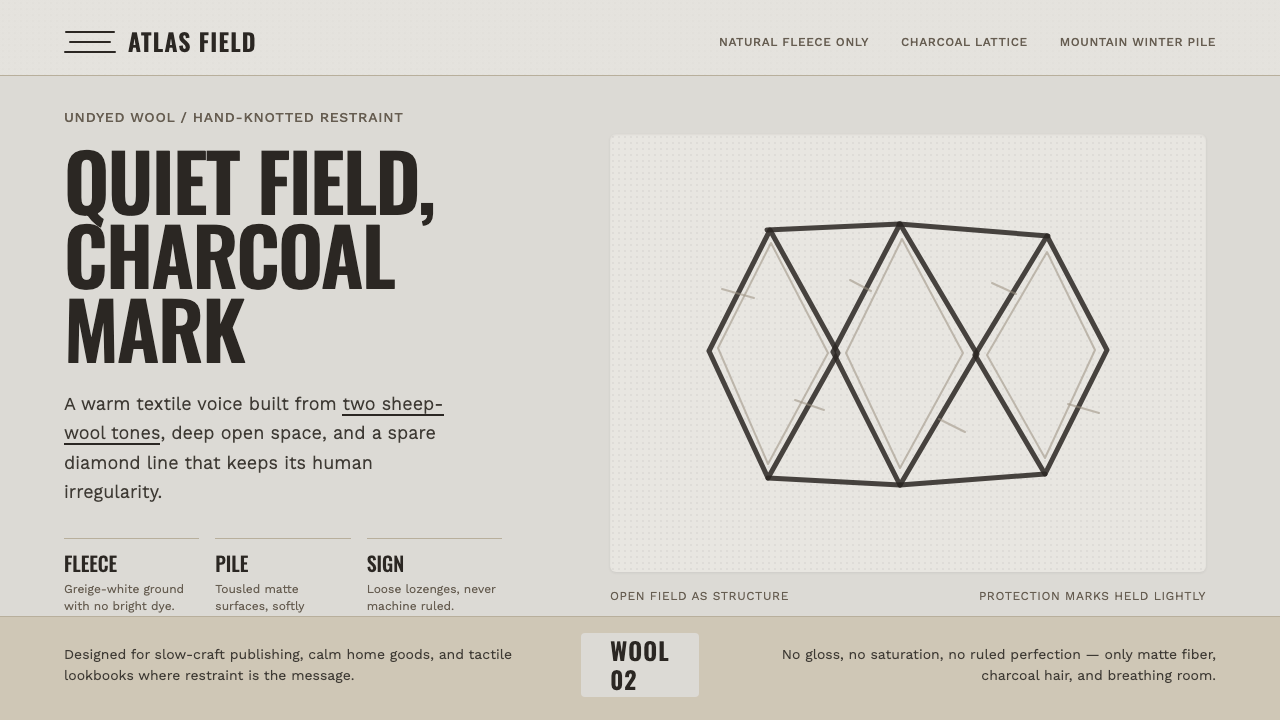 Beni Ourain Berber CarpetRestraint feels tactile. Greige wool field, Oswald type, and a loose charcoal…
 Bonsai CultivationQuiet asymmetry. Pine green rests on dark tray earth, sealed by one vermilion…