What is Nanotech Assembler?
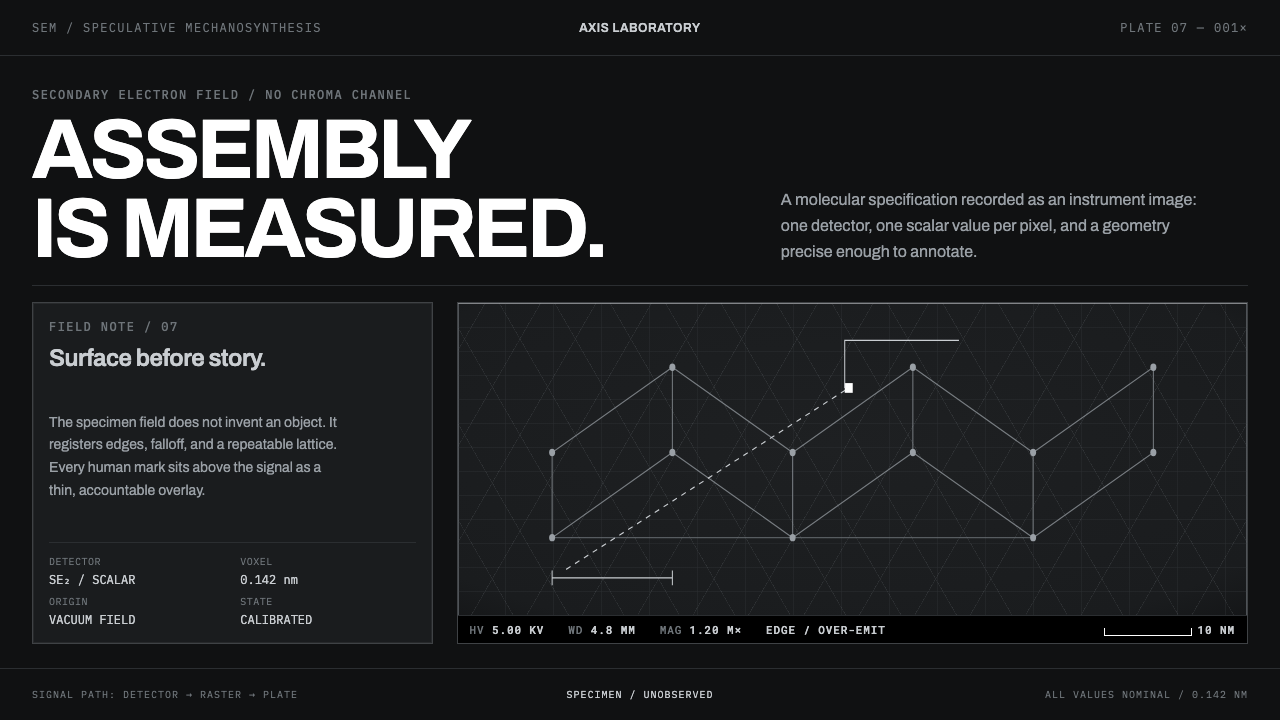
Nanotech Assembler is a style built on one discipline — nothing is illustrated, everything is measured: grey micrograph fields with hairline overlays that make speculation accountable.
Nanotech Assembler in brief
Nanotech Assembler is a design style that borrows the look of the scanning electron microscope to give an unseen technology a visual form it can be held to. Its language is a greyscale image field with a mid-tone specimen surface against a near-black vacuum, edges that over-emit and blow out to white, and crisp thin-line vector annotation — labels, scale bars, lattice geometry, accelerating voltage — laid over the top.
The reason is a paradox. A molecular assembler has never been photographed. It exists as specification, in the theoretical literature of molecular nanotechnology and mechanosynthesis, and the only honest way to picture it is in the convention of the instrument that would one day record it. So the style refuses to illustrate. It does not draw glowing robots or neon molecules. It presents a surface the way a microscope would, and then measures it.
The result is dark, restrained and credible. Speculation is made accountable by dressing it as evidence: every human mark on the image is a measurement, and anything that cannot be a measurement is left out.
Where does Nanotech Assembler come from?
The lineage begins with Richard Feynman in 1959, whose vision of working at the molecular scale is the usual starting point for nanotechnology. Between 1986 and 1992 K. Eric Drexler turned that vision into specification, and his book Nanosystems remains a reference text for what a molecular assembler would have to be. From 2000 to the present the Nanofactory Collaboration has pursued the practical side, publishing papers on diamond mechanosynthesis, the idea of building diamond structures one precise step at a time. Robert A. Freitas Jr. and Ralph C. Merkle are among the key names in that literature.
None of this literature contains a photograph of a working assembler, because none exists. What it contains is models, diagrams and calculations. That gap is what the style is built on. The system asks what convention would have to be used if such a machine were ever imaged, and the answer is the scientific electron-micrograph convention. That convention has its own lineage, represented here by Manfred von Ardenne, a name from the early history of electron imaging.
The convention is physical, and its physics explain the look. A scanning electron microscope records secondary electrons with a single detector and assigns each pixel a single scalar value, which is a measure of how many electrons came back. There is no colour channel at any point in the signal path, so the image is grey because the instrument is grey. The specimen surface returns a middling signal and sits at mid-grey. The vacuum around it returns almost nothing and goes near black. Edges emit more strongly than flat surfaces, so they over-emit and blow out to white.
Everything that is not signal is added by people afterwards. Labels, scale bars, lattice geometry drawn as thin lines and the accelerating voltage are vector marks burned in over a softly imaged surface, sharp where the image is soft. That division is the whole style. The image is what the instrument saw, the overlay is what the observer measured, and the two never pretend to be each other.
What defines the Nanotech Assembler look?
Greyscale only
There is no colour in the signal path of a scanning electron microscope, so there is none in the style. Every tone is a step between near-black and white, and variety comes from tone, texture and line, not hue. This is the system's honesty rule: any colour would be added after the fact and would therefore be a claim rather than a measurement.
Mid-tone specimen, near-black vacuum
The specimen surface sits at mid-grey, and the vacuum around it returns almost nothing, so the field falls to near black. The result is a dark composition in which the subject emerges from the dark rather than sitting on a lit ground. Layouts should keep the same relation: a soft grey subject, a deep surround, and large areas of quiet dark.
Edges that blow to white
Edges over-emit and clip to white. This is a property of the instrument, not a glow effect, and it gives forms a bright, hard outline against the dark. In design, it means contours and highlights are the brightest things on the page, and that brightness is concentrated at edges and corners, never spread across surfaces as a halo or bloom.
Hairline vector overlays
Everything human arrives as crisp thin-line vector: outlines, brackets, crosshairs, grid and lattice geometry. The lines are as sharp as the image is soft, which is exactly what separates the observer's layer from the instrument's. They are thin, even and unornamented, and they never carry colour or shadow.
Measurement furniture
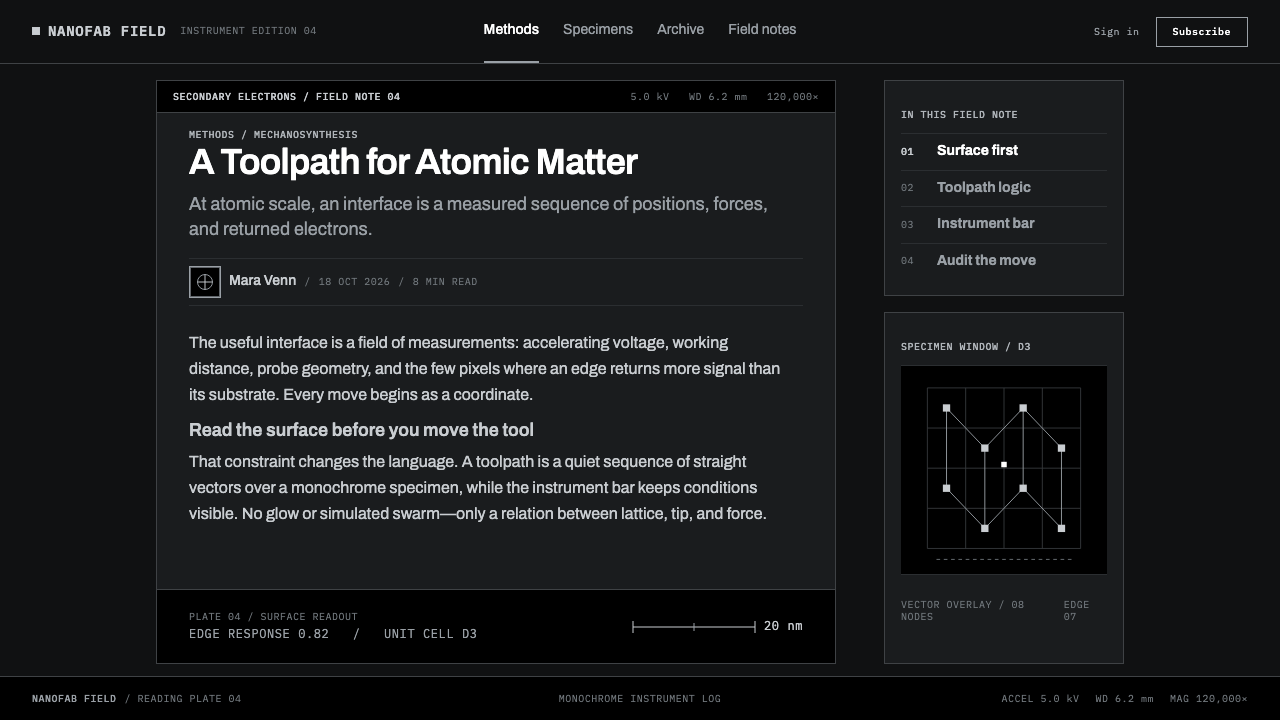
Scale bars, accelerating voltage, labels and callouts are not decoration; they are the content that makes an image credible. A scale bar answers how big, a voltage reading answers how it was taken, and a label answers what is being looked at. Data strips and captions belong in the layout as functional components, set small, regular and precise.
Soft image, sharp annotation
The system works in two layers with different textures. The micrograph is a softly imaged surface with grain and gentle tonal change. The annotation is clean vector with hard ends. Keeping those two textures distinct is the style's core craft: blur the annotation or sharpen the image and the separation between what was seen and what was measured collapses.
Nothing illustrated
A molecular assembler has never been photographed, so any picture of one would be invention. The style declines to draw. There are no cartoon machines, no glowing particles and no stylised molecules; there are only surfaces, measurements and the instrument's own conventions. Where something is synthetic, the honest course is to say so on the image itself.
Who shaped Nanotech Assembler?
The 1959 starting point of the lineage, associated with the idea of working at the molecular scale. He stands at the speculative root of the field, years before anyone could specify, let alone image, a molecular machine.
The figure of the 1986–1992 period, who turned the speculation into specification. His Nanosystems is the text behind the idea of a molecular assembler, and his work is why the system treats the assembler as a thing described precisely rather than imagined loosely.
A key name in the mechanosynthesis literature and the work associated with the Nanofactory Collaboration. He represents the engineering side of the lineage: papers, designs and calculations for how diamond structures might be built by machine.
Another key figure of the molecular nanotechnology and mechanosynthesis literature. Alongside Freitas he stands for the shared, ongoing effort, running from 2000 to the present, to turn a specification into something that could eventually be built and checked.
A name from the early history of electron imaging, standing here for the instrument side of the lineage. Where Drexler and the Nanofactory Collaboration supply what would be seen, von Ardenne's field supplies the convention in which it would be recorded.
How do you use Nanotech Assembler today?
Nanotech Assembler works wherever credibility is the product. It suits advanced hardware, materials, semiconductors, laboratory tools, research reports and any content that has to survive scrutiny. Applied well, it makes claims look like evidence; applied badly, it becomes a dark tech wallpaper.
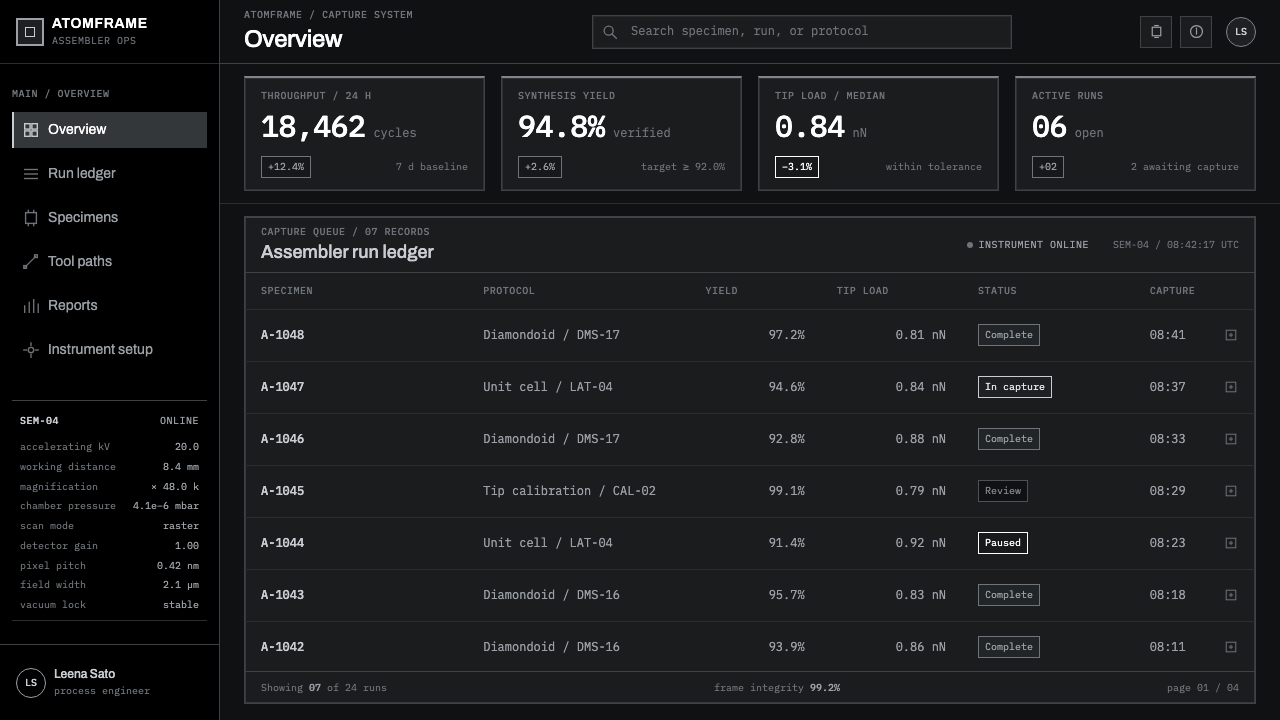
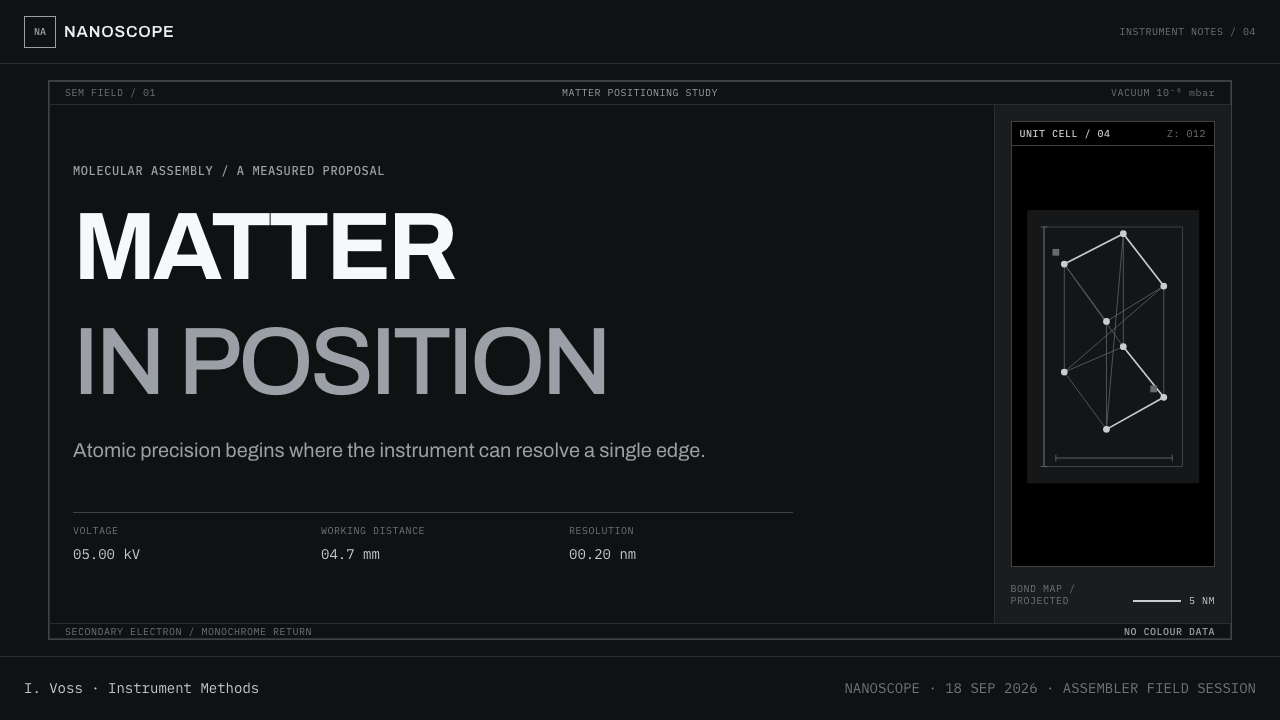
For presentation slides, a cover can be a full-bleed grey micrograph field with a single hairline scale bar, a short title in a plain technical face and a data strip along one edge. Content slides use a restrained grey layout with thin overlay lines to connect labels to the things they describe. Data slides are the style's home ground: charts in greyscale, thin axes, direct labels and a small, quiet readout of the conditions under which the data was gathered.
For web interfaces, the style suits dashboards, monitoring tools, technical documentation, research portals and pricing tables presented as specification sheets. Surfaces are dark and low-contrast, components are thin-lined and square, and status is carried by weight, inversion and annotation rather than by colour. Readouts sit in a small, even, technical type, and measurement-style captions replace marketing copy.
For editorial and marketing work, it fits white papers, product announcements for deep-tech companies and investigative features. Use real or honestly labelled synthetic imagery as the field and let the annotations carry the story: what is shown, at what scale, under what conditions. Short captions written like measurement notes are more persuasive here than adjectives.
The common mistake is to add what the instrument would never produce: neon blue glows, gradient halos, particle effects or tidy illustrations of tiny machines. Each of these tells the viewer that the image is imagined, which is exactly what the system exists to avoid. Keep colour out, keep annotations thin and sharp, and if an image is synthetic, say so in the annotation.
Nanotech Assembler — FAQ
Has a molecular assembler ever actually been imaged?
No. A molecular assembler has never been photographed. It exists as specification in the molecular nanotechnology literature, and the system pictures it in the only way that stays honest: through the imaging convention of the scanning electron microscope that would have to record it. The micrograph look is therefore a statement of method, not a claim that such an image exists.
Why is the style grey and never coloured?
Because the instrument is grey. A scanning electron microscope records one scalar value per pixel through a single detector, so there is no colour channel anywhere in the signal path. Colour would have to be added afterwards, which makes it an assertion rather than a measurement. If you need to separate things, use tone, line weight, inversion or a label, not hue.
Can I use this for topics that have nothing to do with nanotechnology?
Yes, whenever the content depends on credibility. Hardware, materials, laboratory data, security research and scientific tools can all borrow the grammar: grey fields, thin overlays and readouts. What does not carry over is the pretence of a microscope for subjects with no instrument behind them. Use the style where something really is measured, so the overlays mean what they say.
What should I do if my image is generated or simulated?
Say so on the image. The system is built on the difference between what an instrument recorded and what a person annotated, and a synthetic surface blurs that line unless it is labelled. A short note in the data strip, in the same small precise type as the other readouts, keeps the style honest and keeps the viewer's trust.
Does it work on a light background?
It is a dark style by nature, because the specimen emerges from a vacuum that returns almost nothing. A light version is possible if you keep the greyscale and the hairline overlays, but you lose the dark surround that makes the edges bloom to white and the subject feel recorded. Treat any light version as an adaptation, not the canonical form.
Related design styles
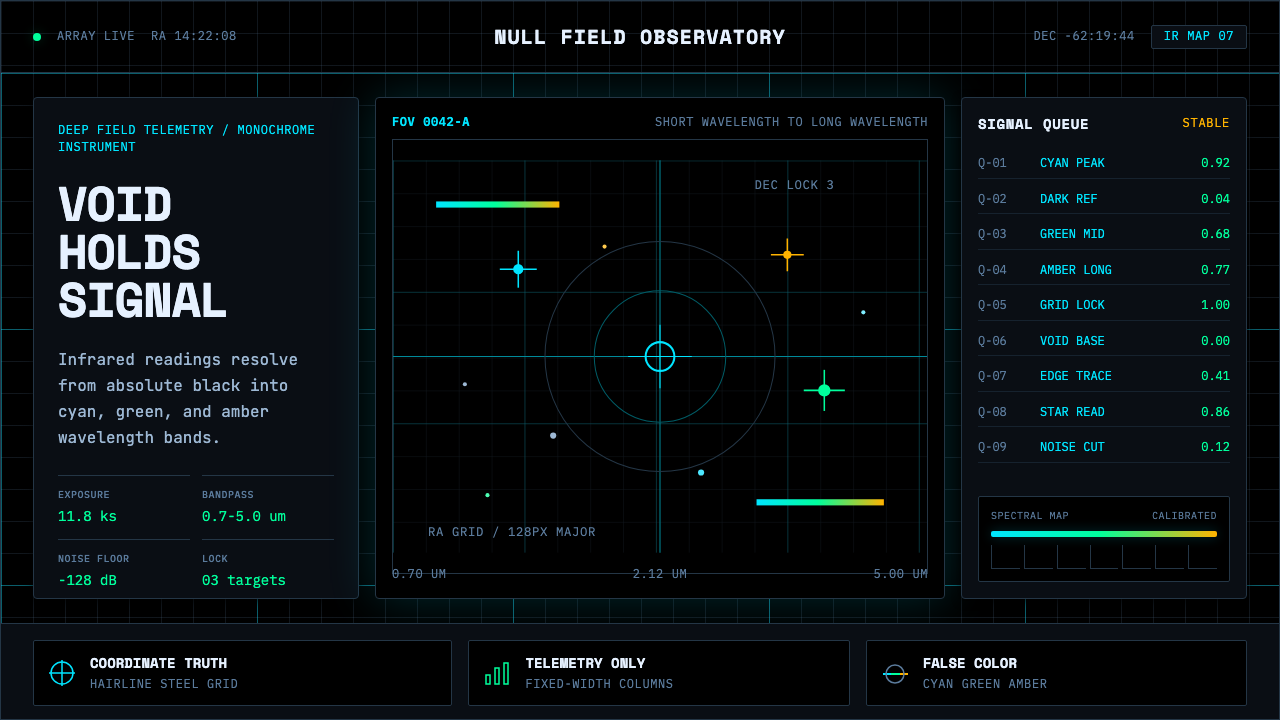 Deep Space ObservatoryTrust the void. Cyan telemetry and amber wavelength bars lock to a steel grid.
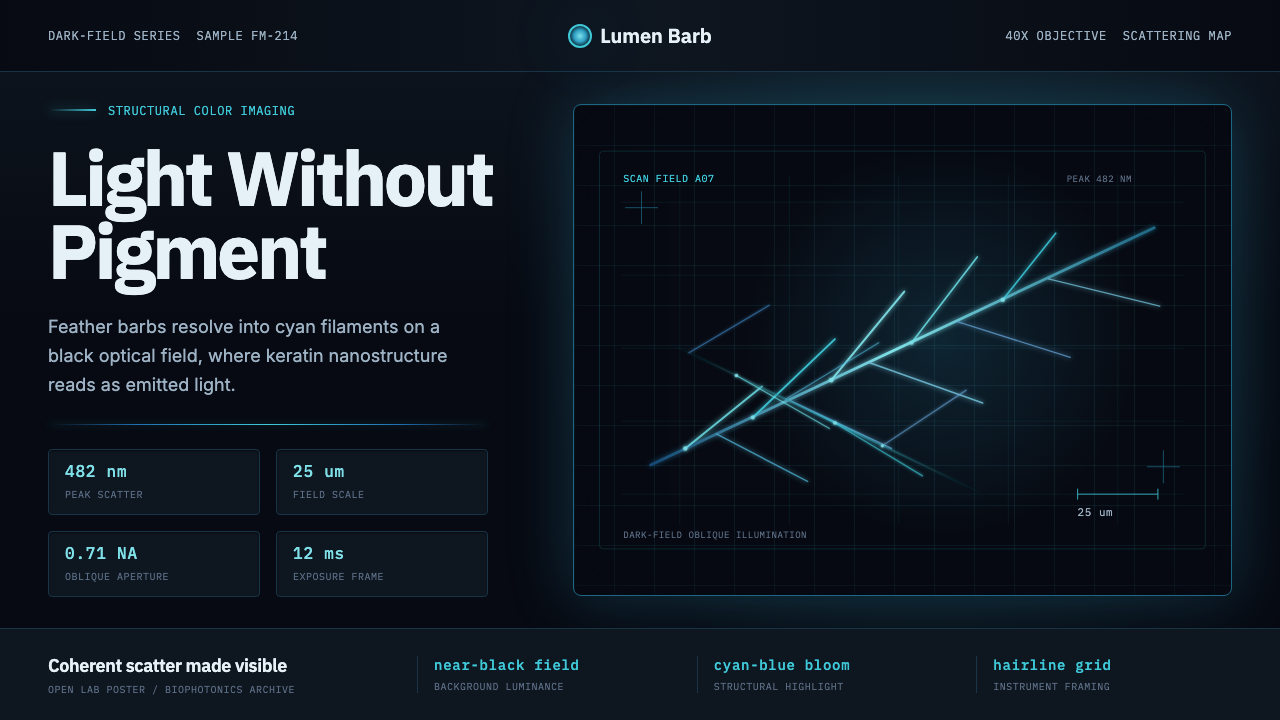 Feather MicroscopyPhysics glows in the dark. Cyan filaments and mono scale bars cut a black ima…
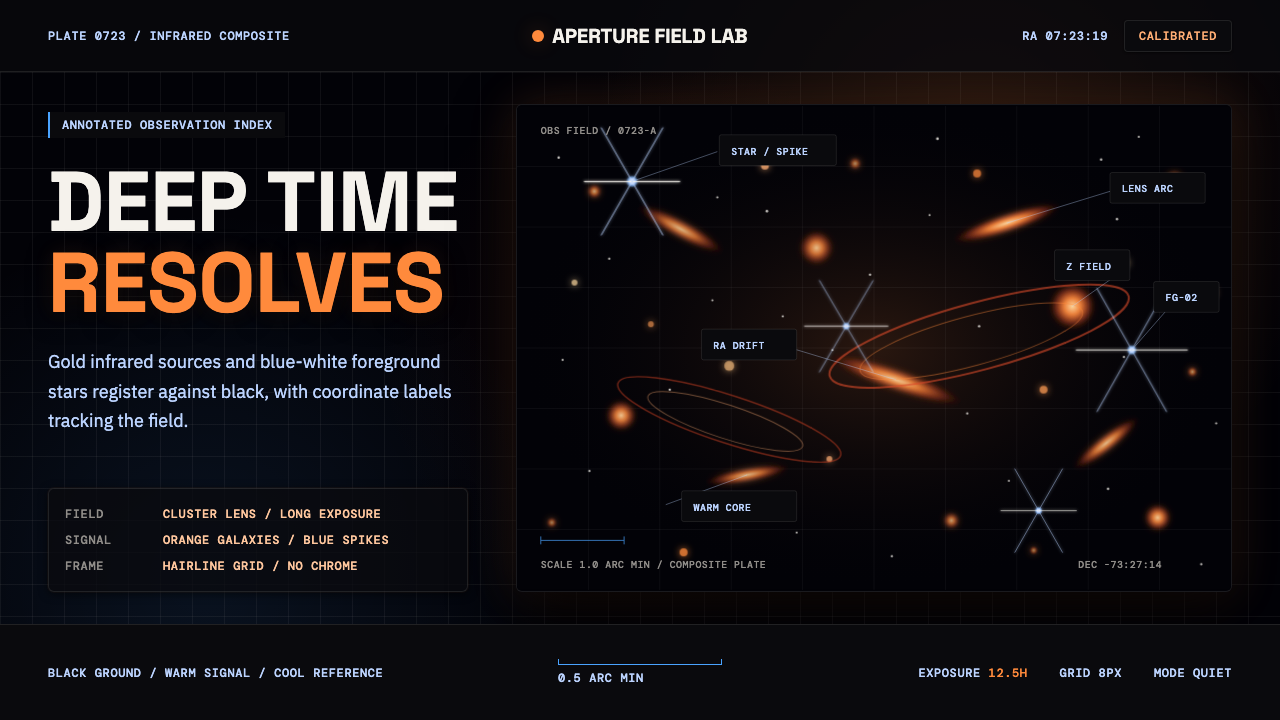 JWST Deep FieldPrecision in deep black. Orange galaxies, blue spikes, and DM Mono callouts m…
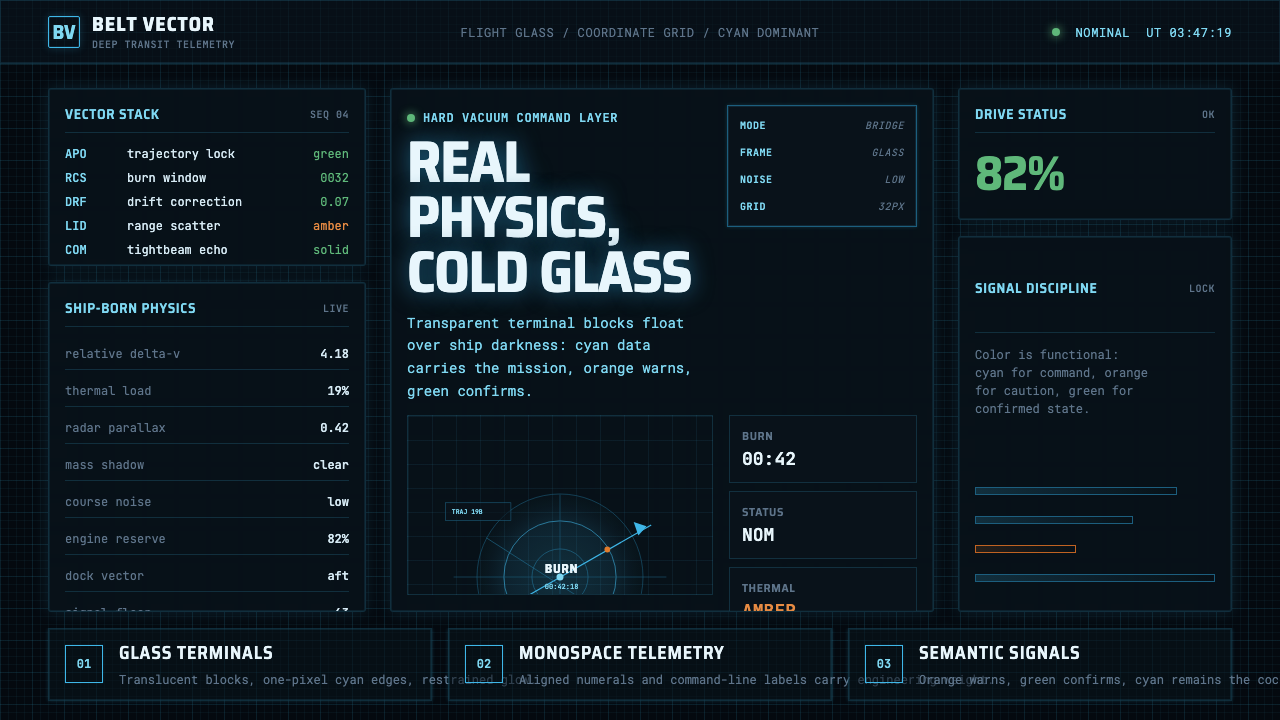 The Expanse Belter UIEngineering, not neon. Cyan glass panels, mono data, orange warnings on ship-…
 Fencing PisteTurns darkness into signal. Rajdhani HUD type frames a white piste and red-gr…
 FUI Sci-Fi HUDBlack until it glows. Cyan wireframes, ring gauges, and radar grids sell live…