What is Nanopunk Grey Goo?
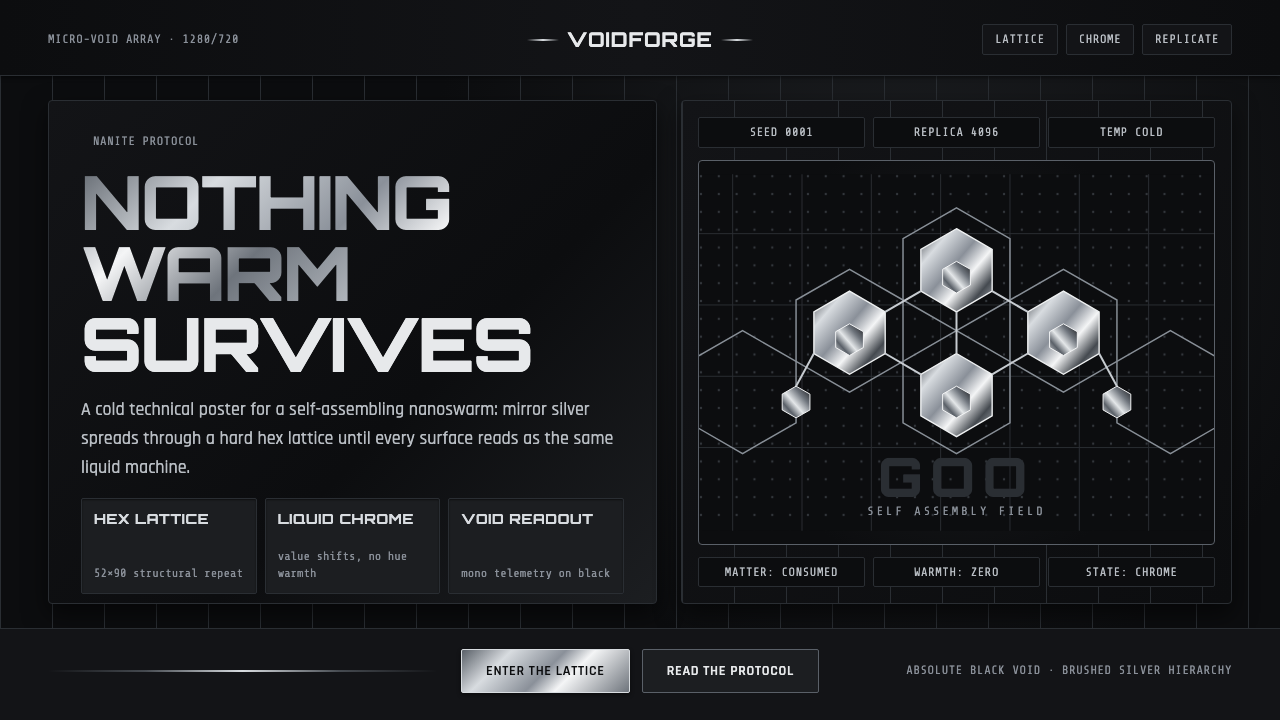
Nanopunk Grey Goo turns the fear of self-replicating matter into an interface: chrome, crystalline repetition, and a black void with no refuge from the swarm.
Nanopunk Grey Goo in brief
Nanopunk Grey Goo draws from the grey goo thought experiment outlined by K. Eric Drexler in Engines of Creation in 1986. Its premise is stark: self-replicating nanomachines consume matter without limit until the world becomes an undifferentiated silver paste. The style does not illustrate that scenario as a distant disaster scene. It treats the interface itself as the contaminated surface, where reflective material appears to be assembling, spreading, and absorbing everything around it.
Its visual vocabulary is deliberately microscopic and impersonal. Near-black space suggests an absolute void; brushed silver and mirror-polished chrome imply material caught between machine part and liquid metal. Hexagonal lattices stand in for molecular self-assembly, while hard technical lettering resembles a nanofabrication readout. The result is less cyberpunk nightlife than technological catastrophe viewed at impossible magnification.
The system depends on coldness as a narrative device. Reflection is not luxury, and repetition is not decoration: both indicate a process that has escaped human scale. A chrome surface seems to duplicate its neighboring surface; a lattice appears ready to extend beyond the frame. Nothing warm interrupts this logic, because warmth would suggest biology, comfort, or human control surviving contact with the swarm.
Where does Nanopunk Grey Goo come from?
The conceptual origin is Drexler’s 1986 grey goo scenario in Engines of Creation. It belongs to molecular nanotechnology as a speculative warning: replication is valuable only while it remains bounded, and terrifying once it no longer does. In this source material, the end state is not rubble or fire but sameness, a silver paste produced by unchecked conversion of matter.
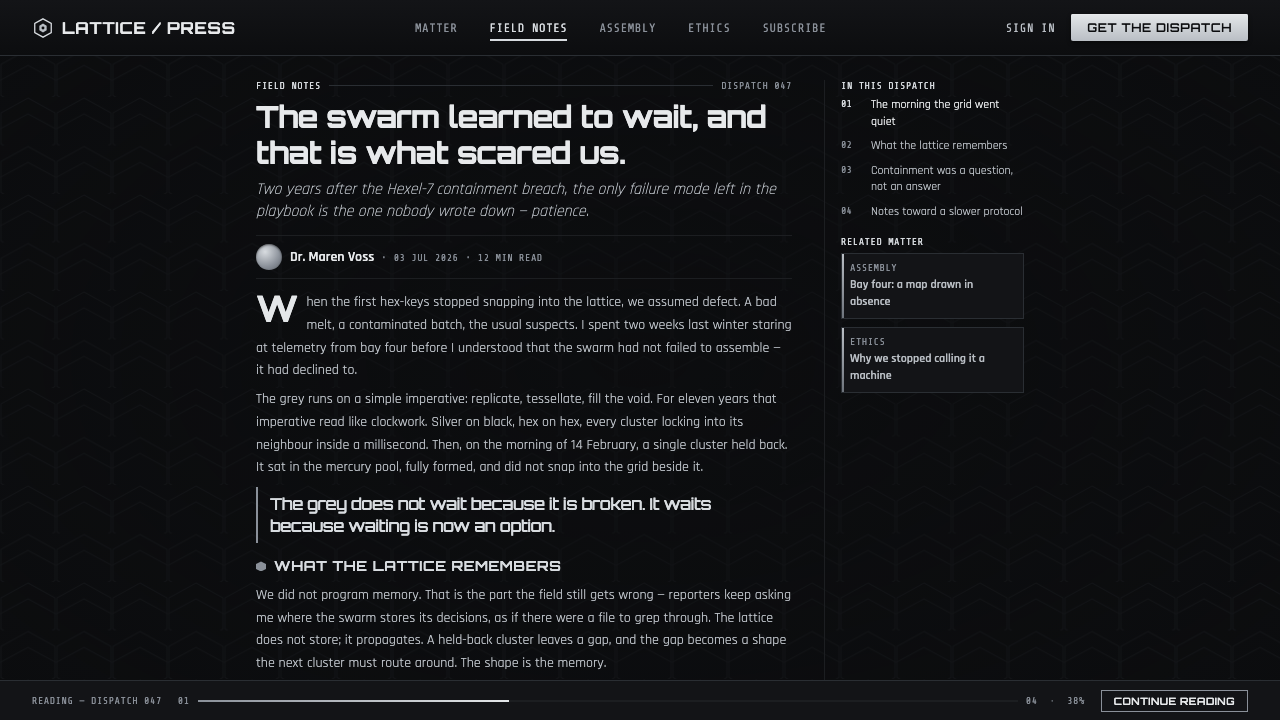
Nanopunk provides the visual frame for that scenario. Rather than depicting nanotechnology through laboratory cleanliness or optimistic miniaturization, it emphasizes hostile precision, crystalline order, and industrial reflection. The hexagonal lattice becomes a useful metaphor because it can read simultaneously as structure, tiling, molecule-like assembly, and a system expanding without a visible edge.
The style also sits within hard-SF techno-catastrophe. Its drama comes from process rather than character: matter is copied, surfaces are colonized, and distinction is erased. That makes the aesthetic especially suited to interfaces that need to feel diagnostic, contaminated, or terminal rather than expressive or welcoming.
Its current visual language belongs to a speculative nanopunk revival associated with the 2020s. This is not a historical revival in the decorative sense. It is a contemporary interface interpretation of an older technological nightmare, using dark fields, metallic gradients, technical typography, and repeated lattice structure to make replication feel present and active.
What defines the Nanopunk Grey Goo look?
Black Void
The background is near-black and expansive, functioning as absence rather than a neutral canvas. It isolates every metallic element and makes the interface feel suspended at micro-scale, with no environmental warmth or ordinary spatial context.
Chrome Matter
Silver shifts between brushed restraint and mirror-like polish. These surfaces should feel manufactured yet unstable, as though hard components are beginning to liquefy and merge into a single self-replicating material.
Hexagonal Assembly
Hexagonal lattices provide the structural grammar. They imply molecular self-assembly through repetition and interlock, not through literal scientific illustration. A lattice should suggest that the visible field is only one exposed fragment of a much larger process.
Technical Type
Typography is hard, precise, and readout-like. It should resemble information produced by a fabrication system or a diagnostic instrument, keeping language clipped and mechanical rather than editorial, playful, or ceremonial.
Reflective Depth
Depth comes from reflection, metallic gradient, and contrast between polished and brushed surfaces. It should feel material rather than atmospheric: a surface is deep because it is chrome, not because it has been softened into a cinematic environment.
Cold Replication
Repeated modules, cells, and metallic fragments should imply propagation. The repetition must remain disciplined and exact, creating the uneasy impression that the system can continue indefinitely without needing variation, personality, or human intervention.

Who shaped Nanopunk Grey Goo?
Drexler supplies the style’s conceptual source through the grey goo thought experiment in Engines of Creation, published in 1986. The visual system translates his warning about unchecked self-replication into metallic surface, darkness, and proliferating structure.
Grey goo is the catastrophic condition at the center of the theme: matter consumed without limit and reduced to undifferentiated silver paste. It supplies the style’s insistence on liquid chrome, sameness, and the disappearance of warm or organic contrast.
Nanopunk is the speculative visual culture that gives the scenario its contemporary form. It frames molecular nanotechnology not as a promise of seamless progress, but as a cold, reflective system whose precision can become invasive and total.
How do you use Nanopunk Grey Goo today?
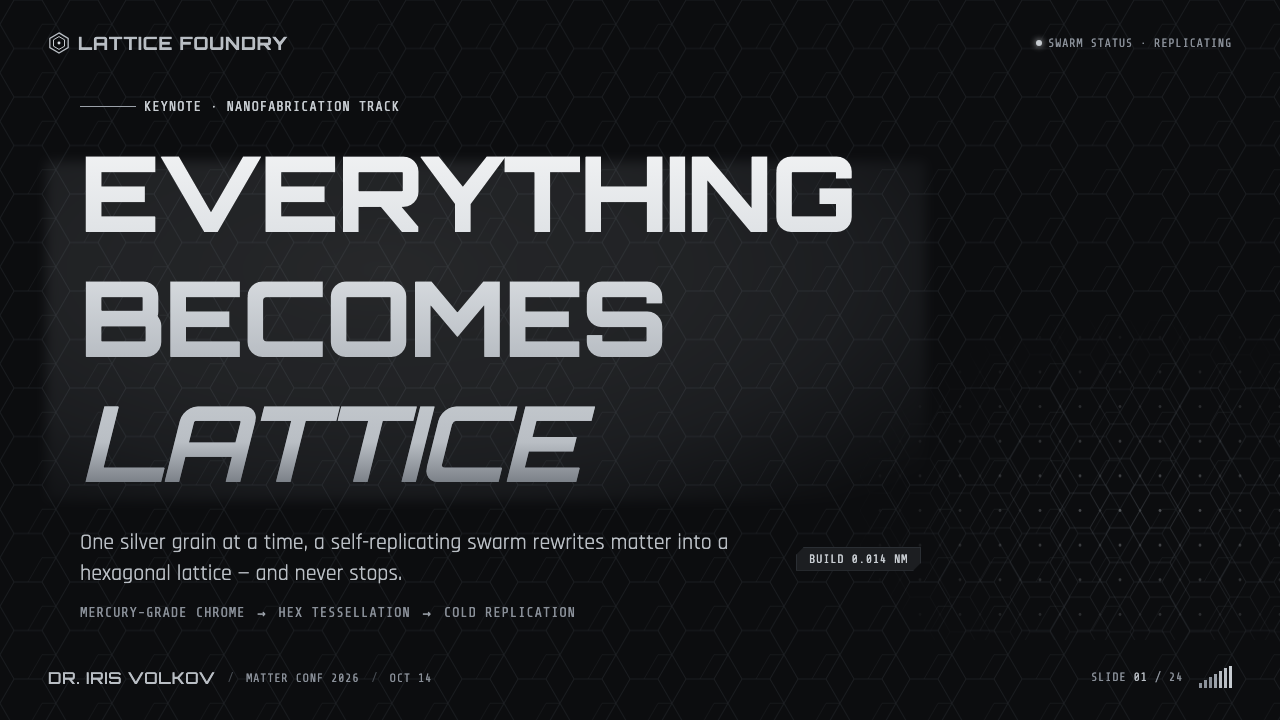
For slides, use the cover as a contamination event. Let a black field hold one large chrome form or a partial lattice, with the title reading like a system designation rather than a campaign slogan. Content slides should preserve the void: organize short blocks as technical readouts, use metallic separators sparingly, and allow blank darkness to carry as much weight as visible information. On data slides, repeated cells, segmented charts, and lattice-backed diagrams can suggest assembly without making the data illegible.
For web interfaces, the style suits monitoring dashboards, speculative tools, technical archives, and pricing pages for products that genuinely benefit from an ominous high-precision identity. Treat the grid as a containment structure. Panels can feel like machined fragments set into darkness, while silver states distinguish active systems, diagnostics, or selected tiers. Reserve the most reflective treatment for information that requires immediate attention; if every surface gleams equally, hierarchy collapses into noise.
For editorial and marketing work, use the system to frame a technological proposition as consequential and slightly dangerous. A long-form article can alternate dense technical passages with wide black intervals, lattice crops, and metallic callouts. A marketing page can move from void to structure to saturation, making each section feel as if the interface is being assembled in real time. Keep language factual and compressed so the visual coldness is not undermined by exuberant copy.
The common mistake is treating Nanopunk Grey Goo as generic futuristic chrome. That removes its central tension: replication without limit. Random silver decoration, colorful neon, friendly rounded imagery, or abundant glow turns the result into conventional science-fiction styling. A convincing application needs black space, disciplined hexagonal structure, controlled reflection, and a clear feeling that every repeated element belongs to one autonomous material process.
Nanopunk Grey Goo — FAQ
Is Nanopunk Grey Goo simply a chrome-heavy cyberpunk style?
No. Cyberpunk often depends on urban density, neon, subculture, and human life under technological pressure. Nanopunk Grey Goo is more microscopic and impersonal. Its central image is self-replicating matter, so chrome, lattice, and blackness must communicate propagation and loss of distinction rather than city spectacle.
Why are hexagonal lattices so important to the style?
They stand in for molecular self-assembly. Their repeated, interlocking geometry makes a surface feel organized by a process rather than decorated by a designer. Used with restraint, they imply that replication continues beyond the visible interface.
Can the style use colors other than silver and black?
The supplied system is built around brushed and mirror-polished silver on near-black, with an explicit refusal of warmth. Additional color risks weakening the premise unless it remains subordinate to the cold metallic field and preserves the sense of technical catastrophe.
Where does Nanopunk Grey Goo work poorly?
It struggles wherever reassurance, intimacy, playfulness, or organic warmth are central to the experience. The style’s strength is its controlled sense of contamination and technological indifference. Applying it to a context that needs comfort can make the product feel hostile rather than precise.
Related design styles
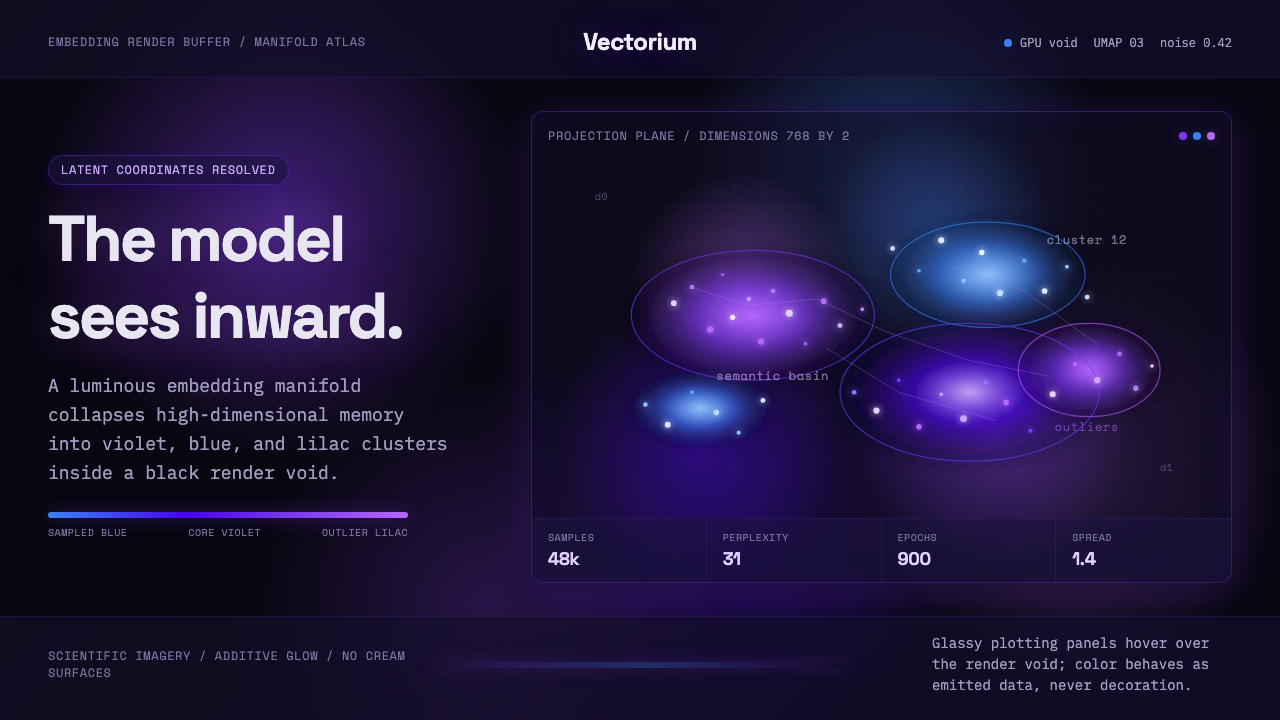 Latent SpaceSees the model from inside. Violet-blue point clouds glow on a black GPU void.
 Dyson Sphere MegastructureCold void, captive heat. Molten orange core caged by brown lattice and orbita…
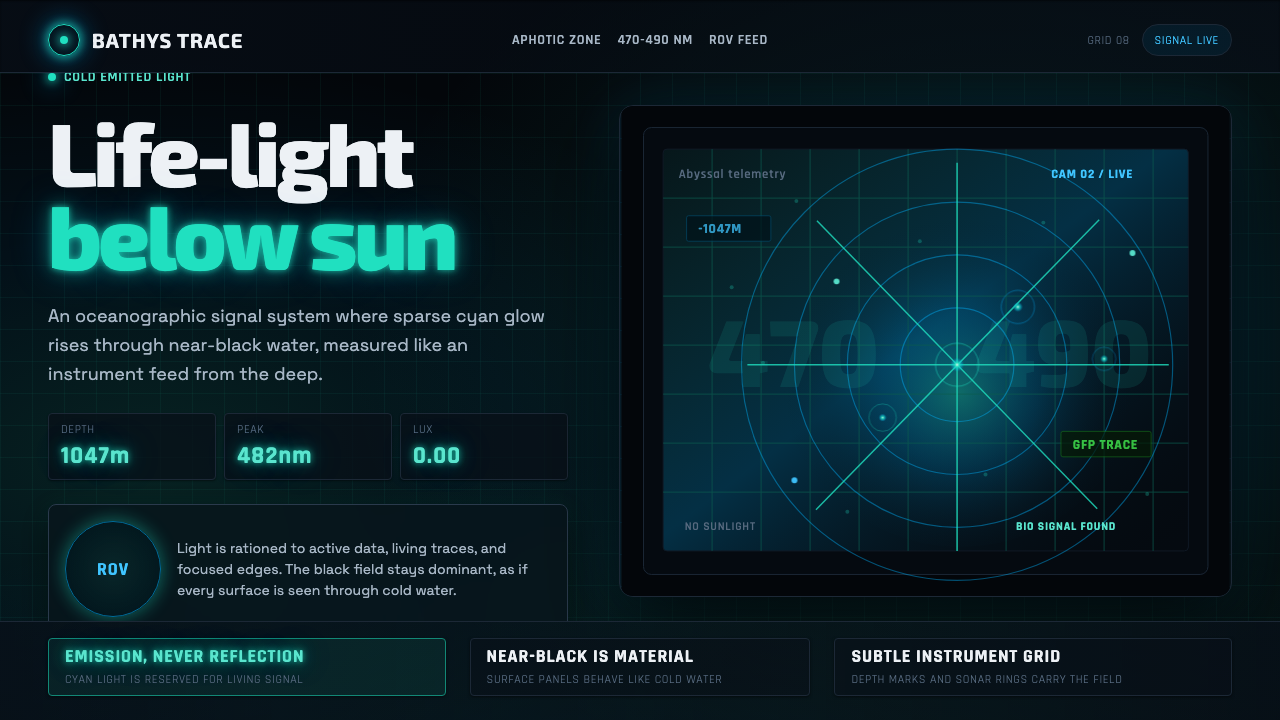 Abyssal BioluminescenceDark carries the signal. Electric cyan pins and Exo 2 readouts surface from a…
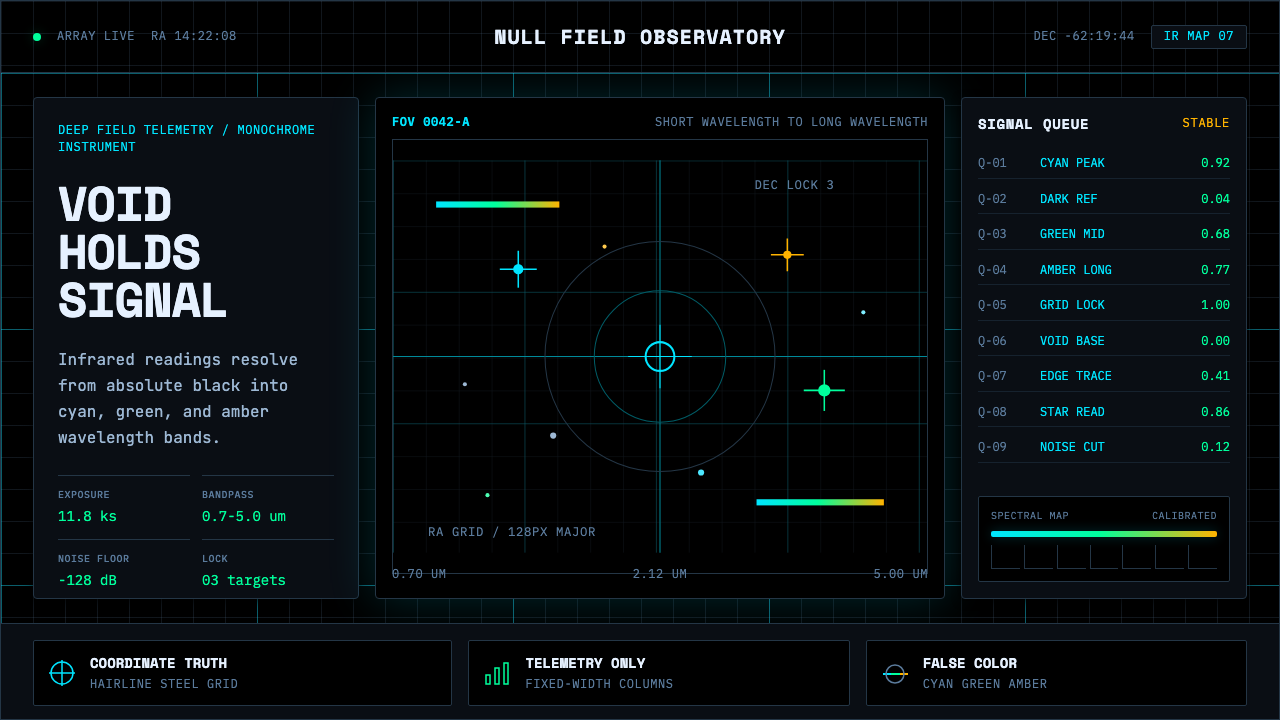 Deep Space ObservatoryTrust the void. Cyan telemetry and amber wavelength bars lock to a steel grid.
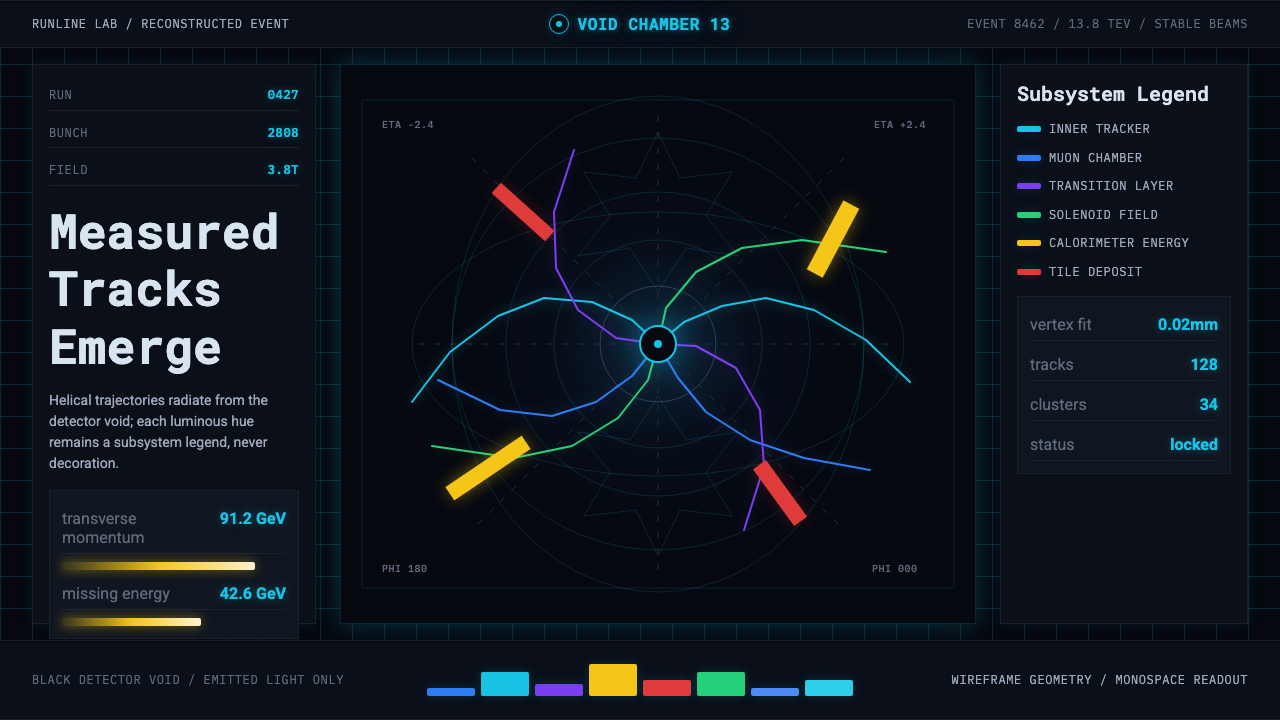 CERN CollisionData, not spectacle. Cyan tracks on black wireframes make every subsystem col…
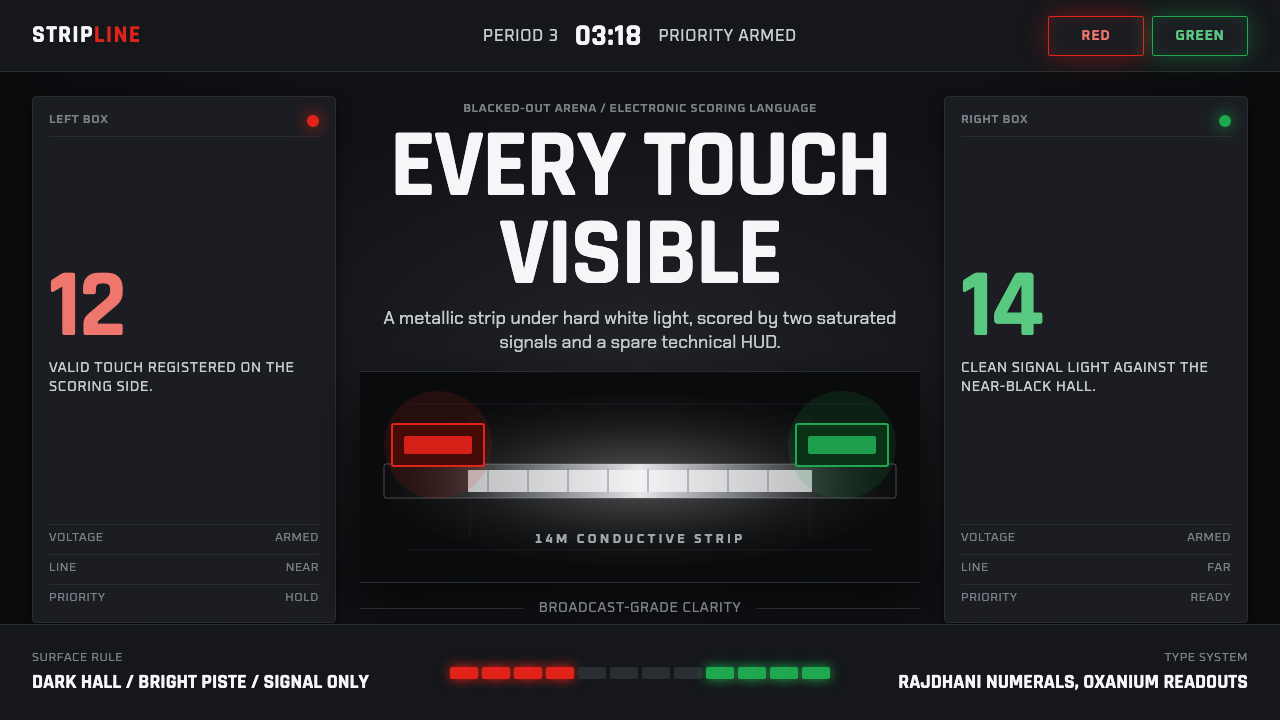 Fencing PisteTurns darkness into signal. Rajdhani HUD type frames a white piste and red-gr…