What is Dyson Sphere Megastructure?
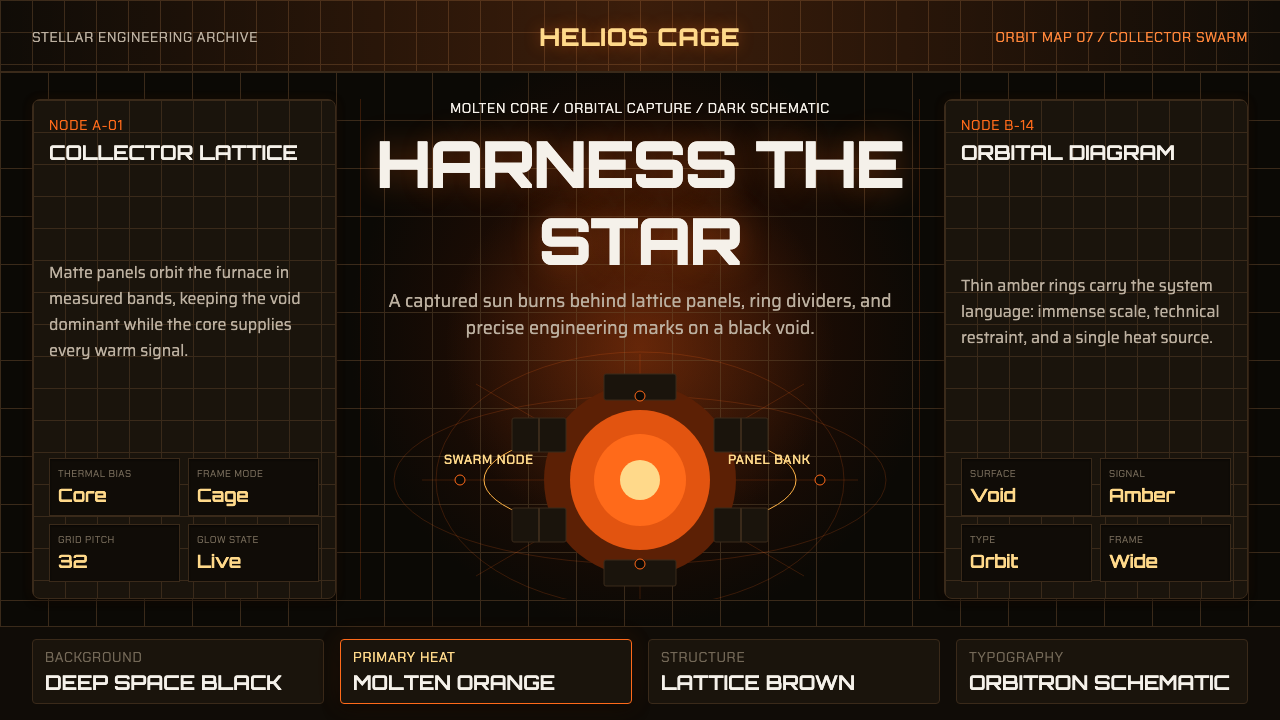
The Dyson Sphere Megastructure turns an impossible act of stellar engineering into a stark visual drama: cold void outside, captive heat within.
Dyson Sphere Megastructure in brief
Dyson Sphere Megastructure is a futuristic visual style built around the image of a star enclosed by an immense energy-harvesting system. A molten-orange stellar core occupies the center, while dark lattice collectors, orbital rings, and thin schematic lines surround it like the components of a machine whose scale exceeds ordinary comprehension. The result combines speculative megastructure futurism, stellar-engineering concept art, and the disciplined visual language of hard science fiction.
Its defining tension is thermal as much as geometric. The surrounding space is almost entirely black, carrying only a faint suggestion of warmth, while the central star supplies the composition’s light, color, and emotional pressure. Brown and near-black structures cross the glow as silhouettes, making the star appear both contained and dangerously powerful. Darkness does not function as empty background; it establishes the scale of the void and allows every illuminated edge to register as captured energy.
The style presents speculation with the confidence of technical documentation. Orbital paths, sectional rings, collector grids, and engineering annotations imply that the unimaginable structure has been measured and planned. Yet the central radiance prevents the image from becoming clinically neutral. Every diagram remains organized around a blazing object that cannot be reduced to linework, producing an aesthetic that is simultaneously analytical, monumental, and sublime.
Where does Dyson Sphere Megastructure come from?
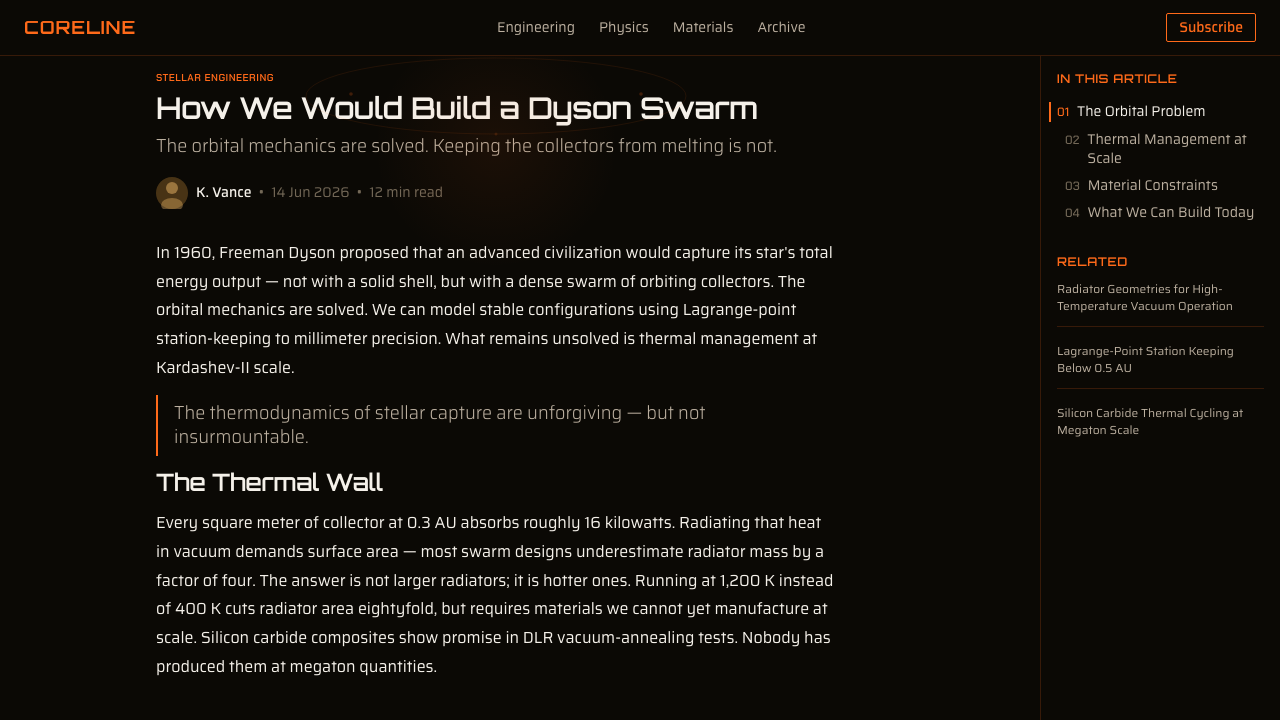
The concept behind the style was proposed by Freeman Dyson in 1960. Its premise belongs to speculative stellar engineering: instead of treating a star merely as a distant natural object, an advanced civilization might surround it with energy-collecting structures. The visual idea therefore begins with a reversal of scale. Architecture no longer sits beneath sunlight; architecture is expanded until it can organize itself around the source of sunlight.
A literary precursor appeared in Olaf Stapledon’s work in 1937. That earlier imaginative context helped establish the broader possibility of civilizations operating on astronomical scales. The lineage is important because the Dyson Sphere was never only a mechanical diagram. From the beginning, it also belonged to speculative storytelling, where technological ambition becomes a way to picture intelligence, power, and survival beyond the dimensions of a planet.
As the idea circulated globally and through internet culture, it became a recurring subject of megastructure futurism and hard science-fiction rendering. Artists translated an abstract stellar-engineering concept into recognizable visual components: a bright star, surrounding collector lattices, repeated orbital bands, and diagrammatic paths crossing deep black space. These conventions make the structure readable without requiring a complete physical shell. A swarm of panels and rings can communicate enclosure, collection, and immense construction through implication.
The contemporary style inherits both sides of that history. From speculative engineering it takes systems, grids, orbital logic, and the appearance of technical credibility. From concept art it takes drama, scale, and a central source of overwhelming illumination. Its visual identity emerges where those impulses meet: the star is presented as a natural furnace, while everything surrounding it appears designed, calculated, and constructed.
What defines the Dyson Sphere Megastructure look?
Color and Heat
The palette is organized by temperature rather than variety. Space-black and deep brown establish the cold enclosure; molten orange identifies the star and every surface touched by its energy. Lighter accents should appear as concentrated heat along inner edges, apertures, or collector faces. Additional hues weaken the premise because the composition depends on one unmistakable relationship: darkness surrounds, while orange burns.
Central Radiance
The star is the visual and conceptual center of gravity. It may be fully visible or partly obscured by infrastructure, but its light must appear to drive the entire image. Surrounding elements gain hierarchy according to their distance from the core and their exposure to its glow. This radial logic makes the interface or composition feel powered from within rather than illuminated by an external source.
Orbital Geometry
Concentric rings, partial ellipses, radial spokes, and intersecting paths define the structural vocabulary. The rings should not read as casual decoration; they imply movement, collection zones, sectional boundaries, or construction layers. Cropping some arcs at the frame edge expands the perceived system beyond the visible field, while overlapping paths suggest several coordinated orbital planes.
Collector Lattice
Dark panels and repeated lattice cells give the megastructure material presence. Seen against the core, they become crisp silhouettes; farther from it, they nearly disappear into space. Repetition communicates industrial scale more effectively than intricate ornament. The grid should feel modular and purposeful, as if every segment belongs to a larger energy-harvesting network.
Engineering Linework
Fine schematic lines make the scene resemble a technical rendering rather than unstructured cosmic spectacle. Leader lines, sectional marks, orbital traces, and restrained annotations can identify relationships without explaining every component. The linework should remain subordinate to the star: precise enough to imply planning, but quiet enough that the central heat retains authority.
Monumental Scale
Scale is conveyed through nested systems rather than familiar human references. A tiny inner ring against a vast outer lattice, repeated collectors receding into darkness, or an arc continuing beyond the frame all imply dimensions larger than the viewer can survey. Empty space is essential here. Broad black regions allow the engineered forms to feel isolated, remote, and astronomically large.
Controlled Luminosity
Glow is concentrated and directional, not spread evenly across the scene. The hottest light belongs near the core, while distant structures receive only narrow rims or faint reflections. This hierarchy preserves the difference between the energy source and the machinery that captures it. If every component glows equally, the star loses its power and the engineered enclosure becomes visually incoherent.

Who shaped Dyson Sphere Megastructure?
Dyson proposed the concept in 1960, providing the intellectual foundation for the style’s central image: stellar energy surrounded and collected by structures built on an astronomical scale. His role is conceptual rather than decorative. The visual system repeatedly returns to the engineering consequence of that proposal — a star no longer seen in isolation, but understood as the core of an immense constructed network.
Stapledon supplied the literary precursor in 1937, helping establish an imaginative horizon in which civilization could be pictured at cosmic scale. Within the style’s genealogy, he represents the narrative dimension of the megastructure: the rings and collectors are not merely hardware, but evidence of a civilization capable of reorganizing its relationship with a star.
Hard science-fiction rendering is the visual tradition that gives the concept its technical authority. It translates speculation into lattices, orbital diagrams, sectional rings, and controlled light, allowing an impossible scale to appear engineered rather than magical. Its importance lies in disciplined plausibility: every visible form seems to perform a task, even when the complete system remains beyond explanation.
How do you use Dyson Sphere Megastructure today?
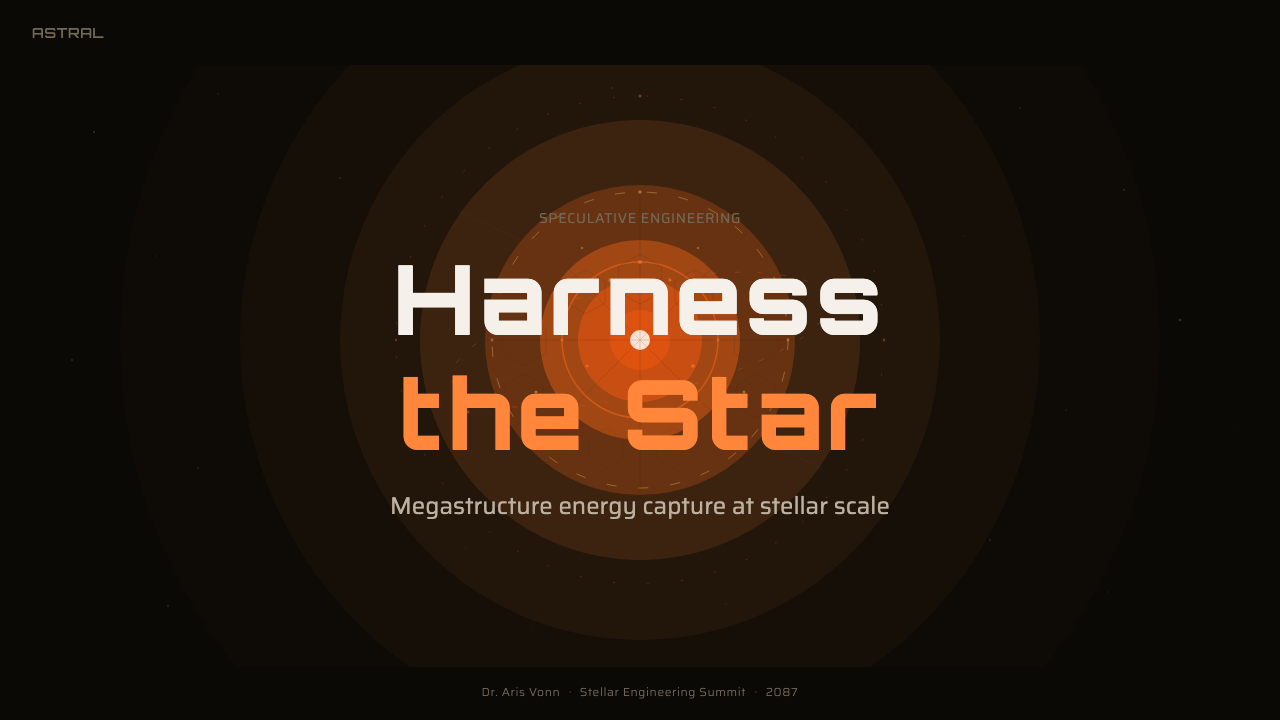
For presentation slides, the style is strongest when the central idea is treated as a system rather than a decorative space theme. A cover can place a glowing stellar core near the center, partly crossed by a collector lattice or orbital arc, with the title aligned like an engineering designation. Content slides should reduce the spectacle: use dark panels, thin orbital dividers, compact annotations, and one restrained warm focal area. The star may become a small recurring marker that keeps each page connected to the larger energy system.
Data slides can turn quantities into orbital or collector relationships. Circular charts may behave like nested harvesting rings, while linear comparisons can resemble arrays of repeated panels moving from darkness toward heat. The visual metaphor should remain legible: brighter or more exposed regions indicate proximity to the central source, while muted brown structures indicate containment and infrastructure. Avoid forcing every dataset into a circle; conventional charts can still sit inside the larger schematic framework.
For web interfaces, Dyson Sphere Megastructure suits dashboards, monitoring systems, infrastructure products, and pricing pages that benefit from a sense of technical scale. A dashboard can organize its primary status around a luminous central module, with secondary metrics distributed in surrounding bands. Pricing tiers may be presented as expanding collection capacity rather than unrelated cards. Deep panels establish the void, warm highlights mark active or high-energy states, and orbital linework connects controls without becoming ornamental clutter.
Editorial and marketing layouts benefit from the contrast between documentary precision and cosmic drama. Long-form articles can use wide dark fields, inset diagrams, sectional labels, and cropped arcs that pass behind headings. Marketing pages can open with a monumental stellar image, then transition into quieter engineering sections where each feature is treated as part of the enclosing system. The style is especially effective when the subject concerns energy, infrastructure, advanced technology, global systems, or ambitious future scenarios.
The common mistake is to equate futuristic scale with constant glow and visual density. Filling every panel with orange light, covering every gap with orbital lines, or adding unexplained technical marks destroys the distinction between void, structure, and energy. A convincing application preserves large regions of darkness, keeps most machinery subdued, and allows a single central heat source to organize the hierarchy. The design should feel like a vast machine observed in operation, not a collection of generic science-fiction effects.
Dyson Sphere Megastructure — FAQ
Is the Dyson Sphere Megastructure style simply a space-themed dark interface?
No. A generic space interface may use stars, darkness, and glowing controls without a governing structure. Dyson Sphere Megastructure is organized around a specific relationship: a central star supplies energy, surrounding machinery captures it, and orbital geometry explains how the system is arranged. Remove that hierarchy and the result becomes ordinary science-fiction styling. The theme depends less on decorative imagery than on making every major element appear connected to stellar containment or collection.
Does the style require a complete spherical shell around the star?
No. The source language explicitly supports dark lattice collectors and Dyson-swarm rings, so enclosure can be communicated through partial structures. Repeated panels, intersecting orbital bands, and silhouetted arcs often create a stronger composition because they leave the star visible and preserve the contrast between natural furnace and constructed cage. The viewer only needs enough coordinated geometry to understand that the separate components belong to one stellar-scale system.
How should typography behave within this visual system?
Typography should support the engineering-rendering character: direct, controlled, and clearly hierarchical. Titles can feel like system names or project designations, while smaller text behaves like annotations attached to a diagram. Labels should align with panels, rings, or leader lines rather than floating arbitrarily. The central image remains dominant, so type should clarify scale and function without competing with the star’s luminosity.
Can the design work without a large hero image of a star?
Yes, provided the interface preserves the system’s radial hierarchy and thermal contrast. The star can become a compact luminous node, a recurring core symbol, or an implied source just outside the visible frame. Surrounding rings, collector grids, and illuminated inner edges can still point toward it. What cannot disappear is the sense that all structures are oriented around one concentrated source of energy.
Where does the Dyson Sphere Megastructure style struggle?
It struggles where intimacy, softness, casual friendliness, or organic warmth are the primary goals. Its dark void, engineered enclosure, and monumental scale naturally communicate power, distance, and technical seriousness. Those qualities suit advanced systems and ambitious speculative narratives, but they can overwhelm ordinary personal tasks or emotionally gentle content. The style is most convincing when the product’s subject already involves energy, infrastructure, complex systems, or a future-facing sense of scale.
Related design styles
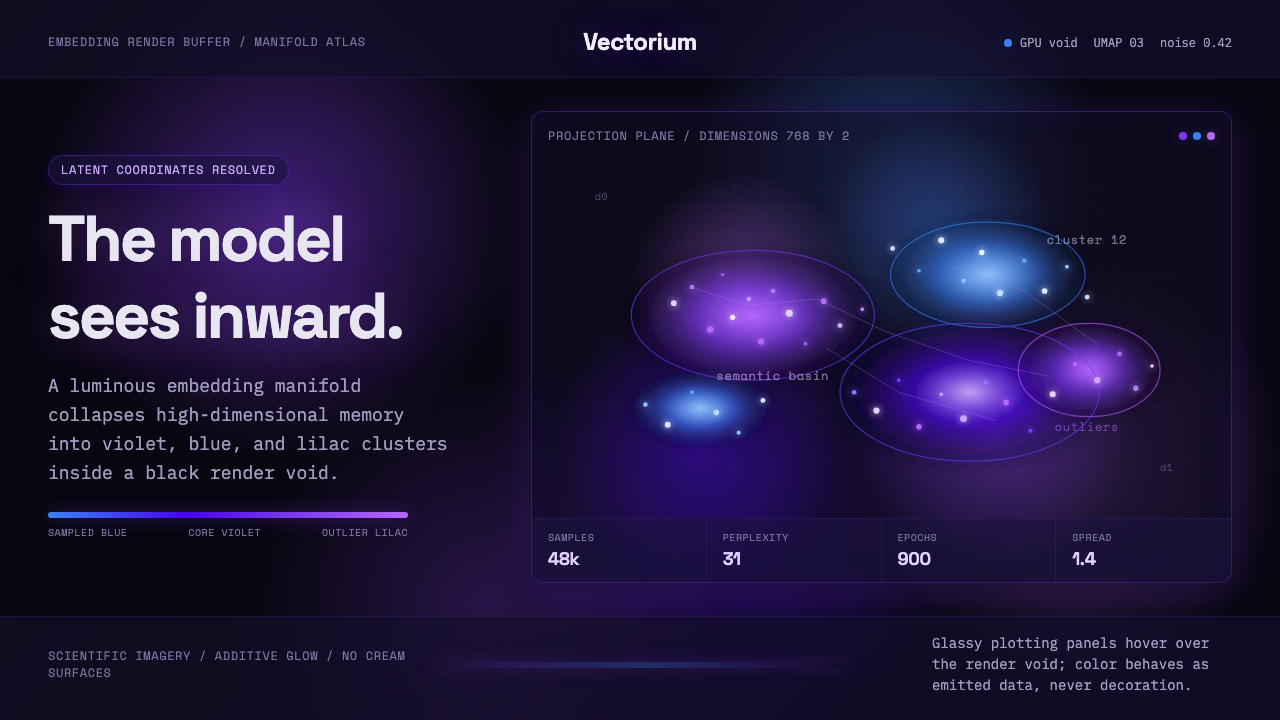 Latent SpaceSees the model from inside. Violet-blue point clouds glow on a black GPU void.
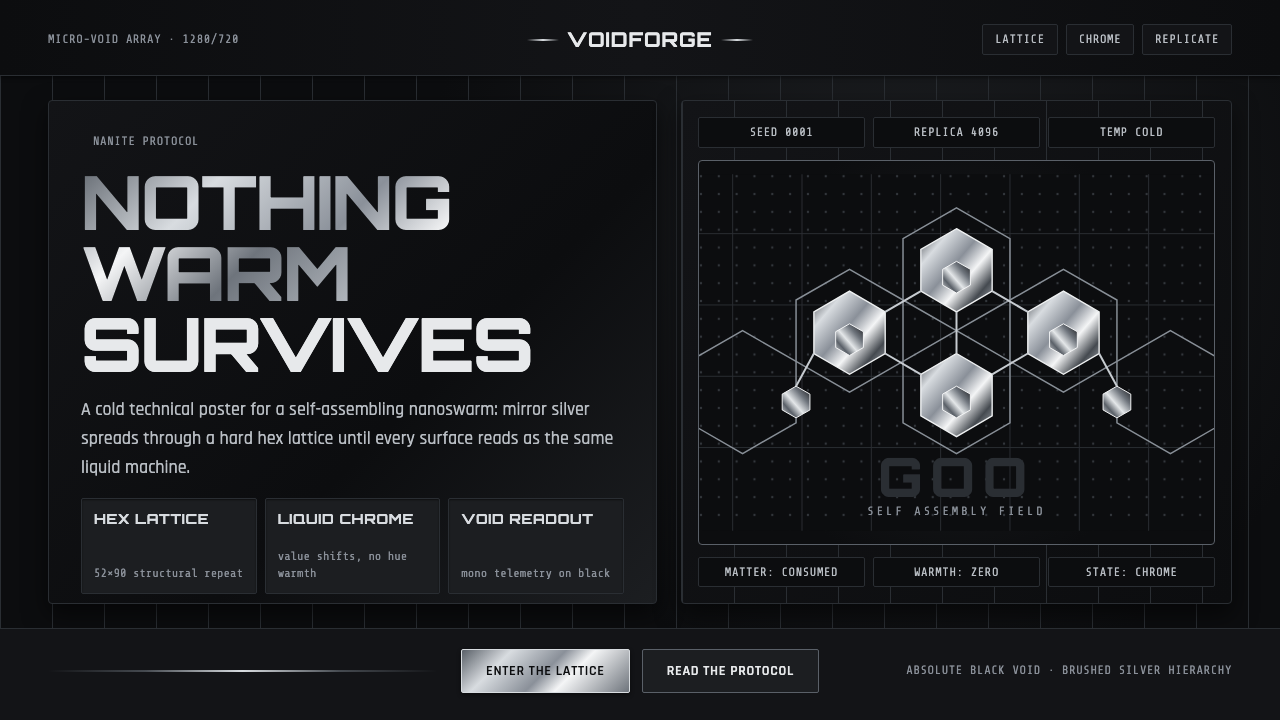 Nanopunk Grey GooColdness self-replicates. Chrome gradients and hex lattices spread across a b…
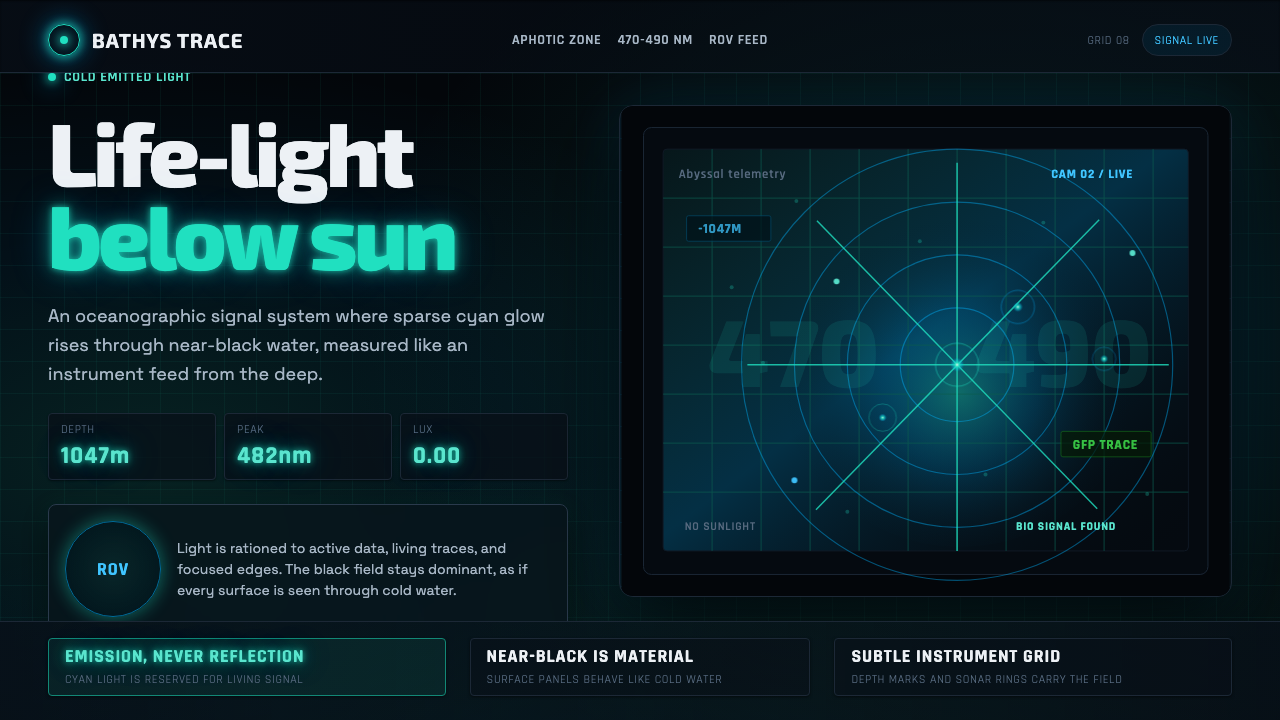 Abyssal BioluminescenceDark carries the signal. Electric cyan pins and Exo 2 readouts surface from a…
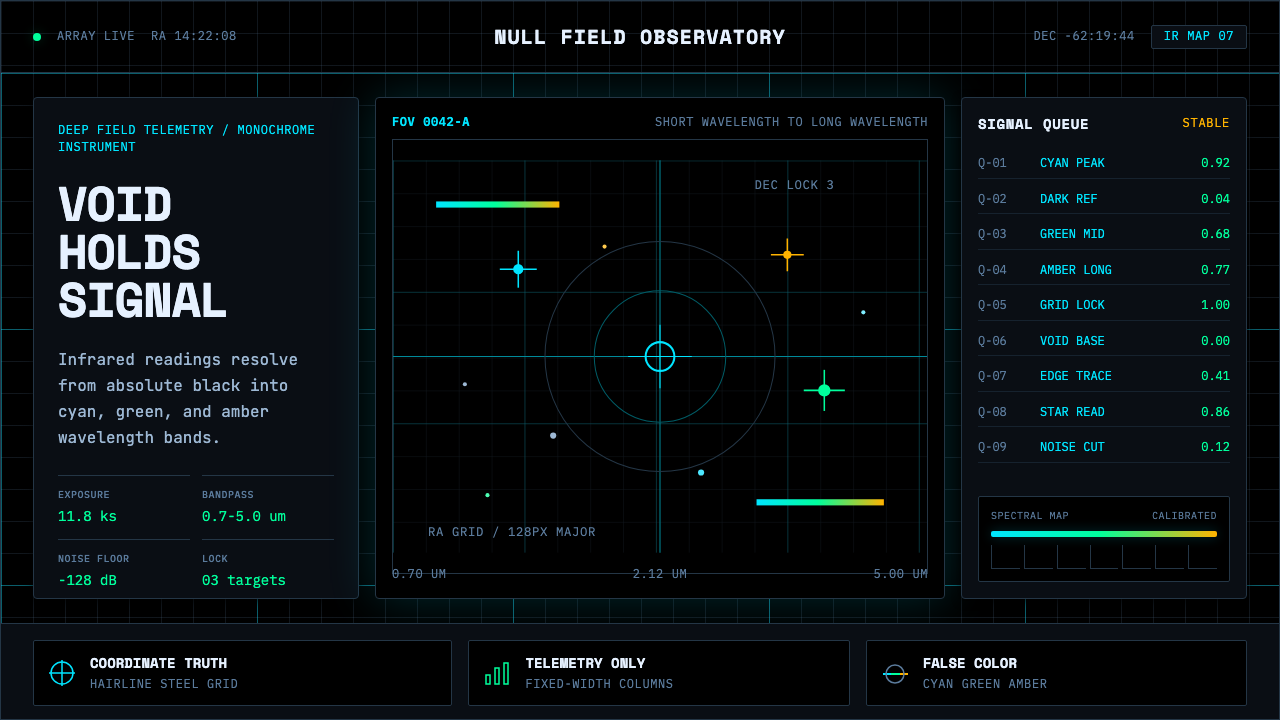 Deep Space ObservatoryTrust the void. Cyan telemetry and amber wavelength bars lock to a steel grid.
 Holographic IridescentLight as material. Cyan-pink-violet foil sweeps anchored against near-black,…
 Holographic UI 2040Information made of light. Deep-space black, ultra-light Inter and prismatic…