What is Mozambican Capulana?
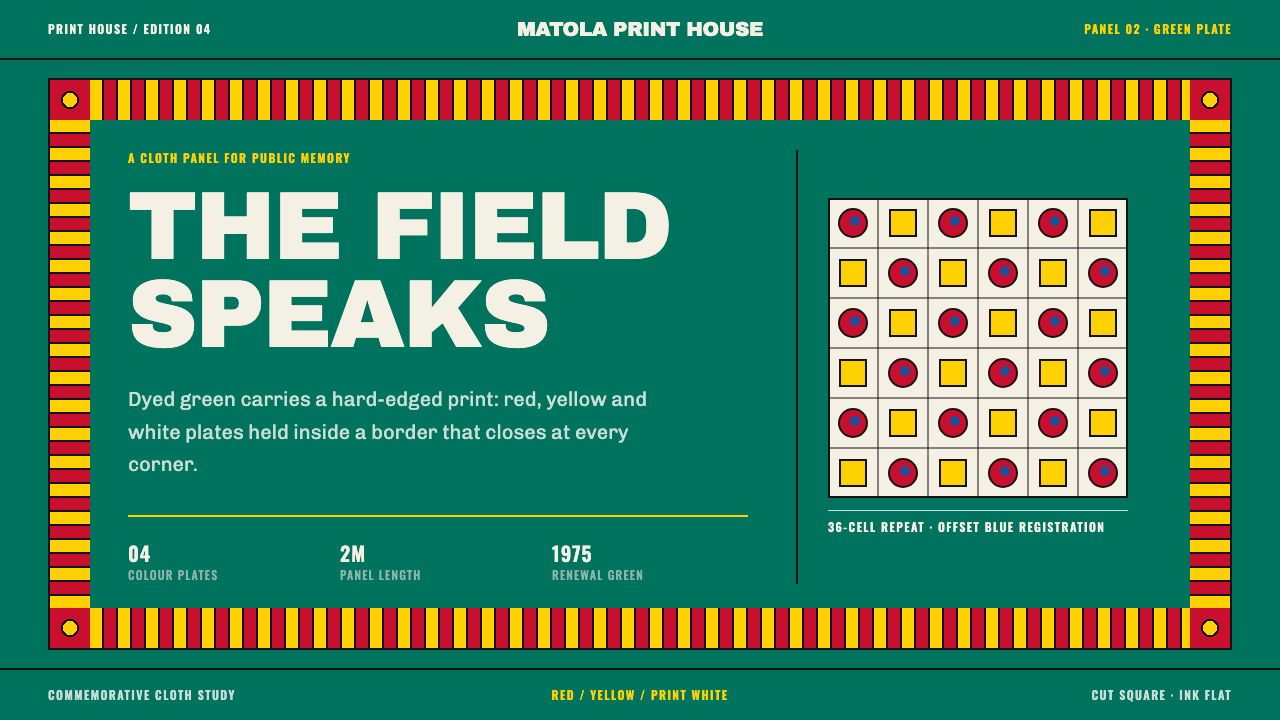
The Mozambican Capulana style turns a printed cotton panel into a design language: a full-perimeter border, flat opaque red and yellow plates repeating on renewal green, hard black outlines, and colour that sits a hair off register.
Mozambican Capulana in brief
A capulana is a printed cotton panel about two metres by one, worn wrapped around the body, slung as a baby carrier, tied as a headwrap or hung on a wall. The format reached Mozambique by sea along Indian Ocean trade routes, descending from the sarong and the sari. What Mozambique added to it, and what makes it local, is a printed border that runs the full perimeter of the cloth and holds its own pattern apart from the field it frames.
The Mozambican Capulana design system takes that panel literally. Corners are square, never rounded. Ink is flat and opaque, laid down in colour plates rather than blended. Shapes are held by a hard black outline. The principal colours, a red and a yellow, repeat across a ground of renewal green, and the plates sit a hair off register, so that the colours do not align perfectly with their outlines. The result is bold, graphic and immediately legible, with a surface that clearly comes from a printing process.
The central idea is that the border makes the field speak. The frame is not decoration added around a picture; it is a separate pattern with its own rhythm, and the contrast between the two is what gives the cloth, and the layout, its voice. In a design context this produces a distinctive logic of framed panels, repeats and flat colour, well suited to messages that need to be seen and recognised at a glance.
Where does Mozambican Capulana come from?
The capulana is a trade-cloth format far older than the political prints that made this style recognisable. It arrived in Mozambique by sea along the Indian Ocean routes that linked the African coast with India and Indonesia, derived from the sarong and the sari. The printing traditions behind it belong to the world of wax and batik cotton, in which colour is laid down in successive plates on cotton cloth. That heritage explains the style's flat, opaque, plate-by-plate look.
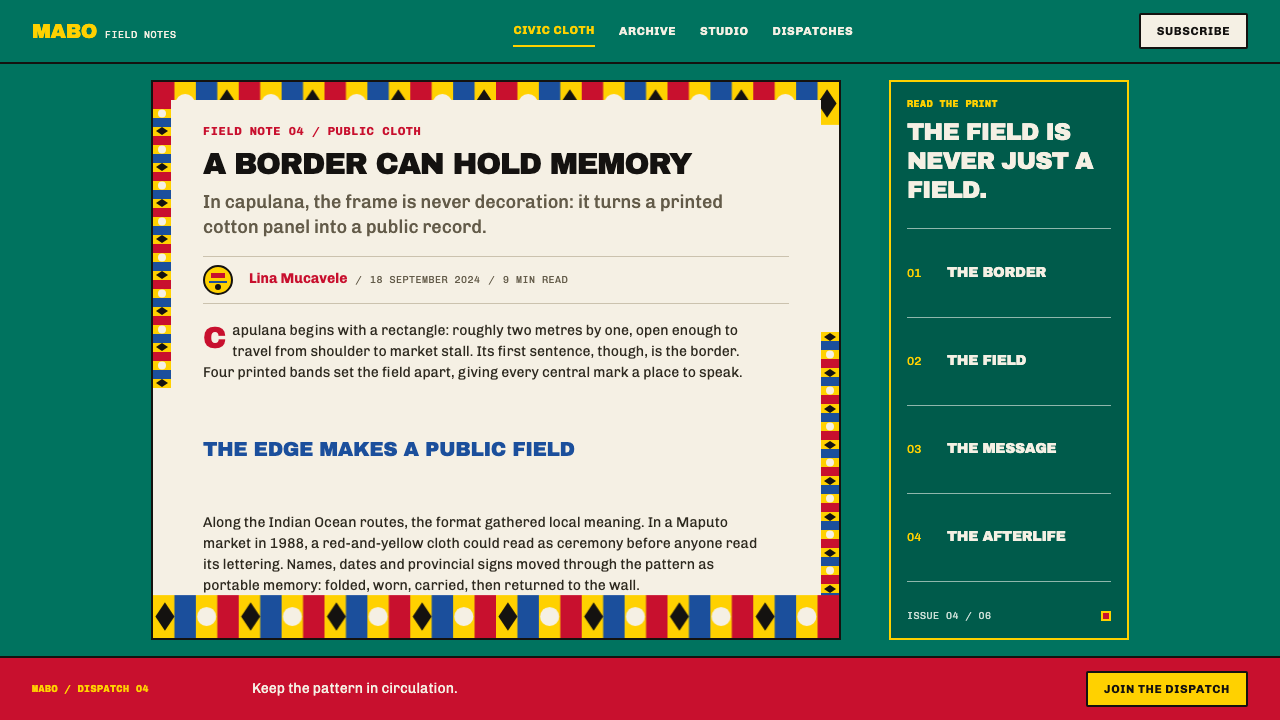
Mozambique's own contribution was the border. A printed band runs along all four sides of the panel and carries its own pattern, separate from the field in the centre. This makes the capulana a framed object rather than an endless repeat, and it gives the printed surface two voices: the frame, which is a rhythm, and the field, which is a message. The arrangement works equally well when the cloth is worn, tied or hung, because the frame stays legible wherever the folds fall.
From about 1950 to 1990, the field of the cloth carried politics. Prints associated with Frelimo, commemorative cloths for Women's Day, and provincial maps ringed with spears and Nguni shields turned the panel into a public medium: a message that could be worn on the body or hung in a room. Commemorative printing peaked around independence in 1975. The style belongs to that period, when everyday cotton was used to say who a community was and what it remembered.
The women's side of this history is part of the lineage. Josina Machel and the Organização da Mulher Moçambicana are the names attached to the Women's Day commemoratives that appear on the cloths. The design system keeps the physical logic of these panels, with their square corners, flat opaque ink, black outlines and colour plates that sit slightly off register. That small misalignment is not an error to be corrected. It is the visible trace of how the cloth was printed, and the style preserves it on purpose.
What defines the Mozambican Capulana look?
Border and Field
The defining structure is a border that runs the full perimeter and holds its own pattern, set apart from the field it frames. The border and the field are two different rhythms, and the tension between them is the style. In a layout, this means panels, cards and slides have a visible band around them with its own repeat, while the content inside stays plain and legible. The frame is what makes the interior speak.
Renewal Green Ground
The ground is a deep green, the colour of renewal. It is a saturated, serious green rather than a pastel, and it makes the style dark overall, giving the warmer colours a field against which to glow. Because the ground is a printed colour in its own right, it stays flat. It does not fade, vignette or gradient. Its job is to hold the plates of red and yellow that repeat across it.
Opaque Red and Yellow Plates
Red and yellow are the principal accent colours, and they are applied as opaque plates, flat ink that covers what lies beneath rather than blending with it. The effect is graphic and solid. Colours do not mix into intermediate tones, so every shape is clearly one thing. These two plates repeat across the field in rows or motifs, giving the style its rhythm and its strong, immediately recognisable warmth against the green.
Hard Black Outline
Shapes are held by a hard black outline, as if the black plate had been printed to define each motif. The line is decisive and even, not hairline, and it separates adjacent colours so that no two plates bleed into each other. Together with the flat colour it gives the style a bold, almost poster-like clarity, which keeps every element readable at a distance or in the folds of a cloth.
Off-Register Plates
Colour plates sit a hair off register, so that fills do not line up perfectly with their outlines, leaving a slight offset or sliver of ground. This is the trace of a multi-plate print, and in this style it is a feature rather than a defect. It must be subtle: enough to be felt as handmade-by-machine, never enough to look like a glitch. It stops the surface from looking digitally perfect and ties it to its printing origins.
Square Corners
The panel is a rectangle, and its corners are square. The style never rounds them: cards, buttons, images and frames all keep sharp right angles, as a piece of cloth does when it is cut from the roll. This gives layouts an upright, orderly and slightly severe character, and it makes the border read as a true frame. Softness comes from colour and repeat, not from curved edges.
Repeat and Commemoration
Motifs repeat, and what they repeat is meant to mean something. The historical cloths carried commemorative imagery, such as provincial maps encircled by spears and Nguni shields and Women's Day designs. In the style, repeat is therefore a way of stating and re-stating a message, a rhythm of recognition rather than empty pattern. When using it, choose motifs with a reason to be there.
Who shaped Mozambican Capulana?
Josina Machel is the figure in whose memory Mozambique's Women's Day is observed, and she stands for the commemorative prints that carried that day's imagery on cloth. Her name anchors the style in the cloths that honoured women's part in the independence struggle. For a designer, she is a reminder that these are not decorative patterns but a public memory expressed in cotton.
The Organização da Mulher Moçambicana, the Mozambican Women's Organisation, is associated with the Women's Day commemorative cloths. It stands for the organised, collective use of the capulana as a medium: cloth printed in quantity, worn together and recognised by a community. The style inherits this collective voice, preferring bold, shared signs to private, subtle ones.
Frelimo, the liberation front that led Mozambique to independence in 1975, is the source of the political prints that gave the capulana its public, commemorative role during the decades from 1950 to 1990. The field of the cloth, which in earlier trade textiles had been largely ornamental, became a space for maps, emblems and slogans. This shift from pattern to message is the main historical turn the style records.
How do you use Mozambican Capulana today?
The Mozambican Capulana style is built for messages that need to be seen and remembered: campaigns, commemorations, community projects, cultural programmes, events and brands that want a bold, rooted, graphic identity. Think of the page as a cloth. Decide where the border runs, what the field holds and which two or three plates of colour repeat.
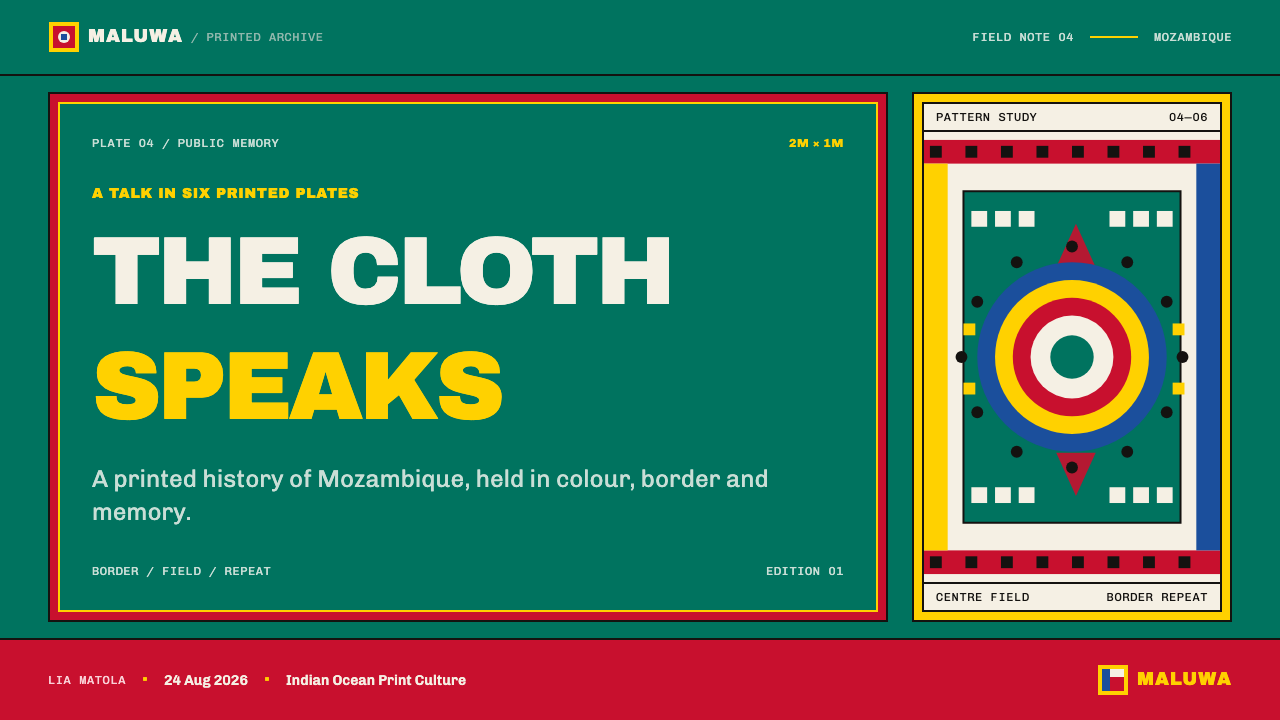
For presentation slides, the border becomes the slide frame, a printed band with its own pattern running around all four edges, and the field inside holds the content. A cover can set a large title on a flat colour panel inside the frame, with one repeating motif in red and yellow. Content slides keep the frame constant, so the deck feels like a series of cloths from the same print run. Data slides suit flat, opaque bars with black outlines and no gradients, each series assigned one of the plate colours.
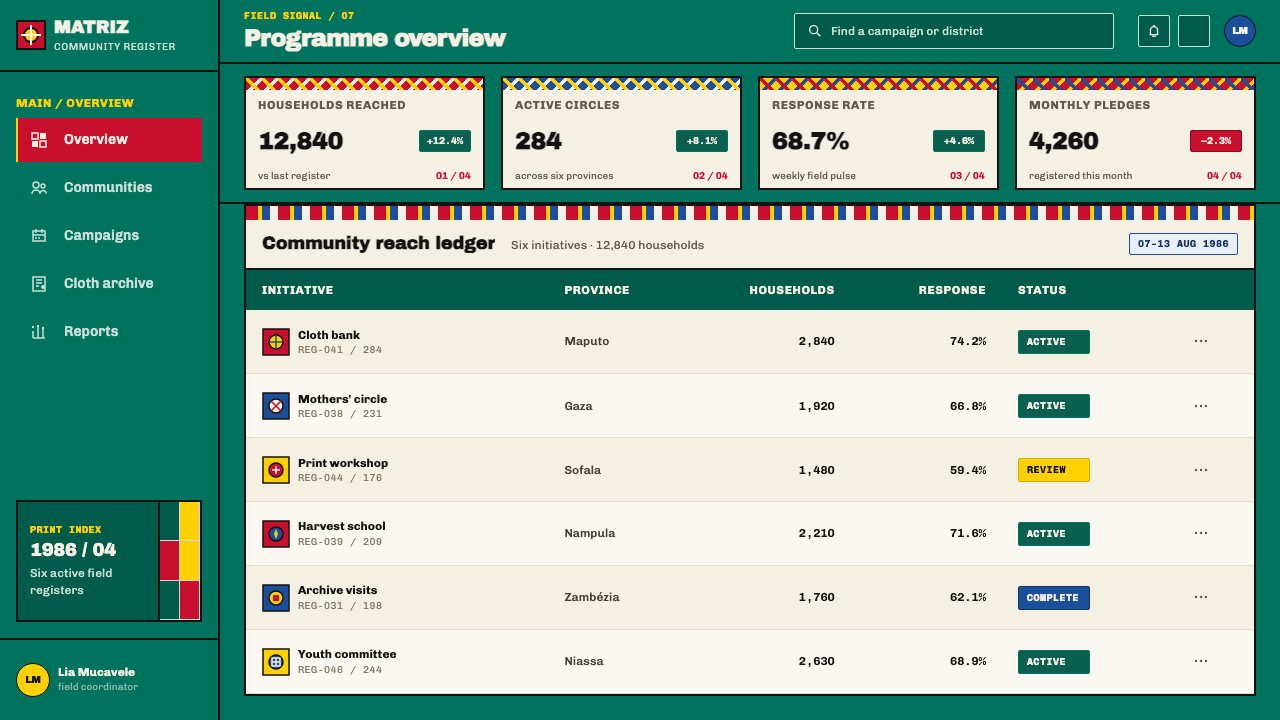
For web interfaces, cards and panels can carry the framed logic: a visible border band, square corners and a flat green or dark ground behind. Pricing tiers read well as framed panels, with the recommended tier distinguished by a stronger border pattern or a plate of yellow. Buttons are flat, opaque and black-outlined, with no soft shadows. Dashboards can use the same flat colours to code status, provided the repeat and the frame are applied with restraint so that data stays readable.
For editorial and marketing work, the style suits cultural features, campaigns, festivals, fashion and craft, and any story that has a community or a memory at its centre. Captions and pull quotes work well inside the border, as the framed field is a natural place for a message. Photography can sit in a bordered panel with a black outline, treated as a printed element, not as a window with soft edges.
The most common mistake is to treat it as a generic African pattern. This style is specific: a commemorative trade cloth from Mozambique, with an Indian Ocean heritage and a political history, and its motifs should be chosen and used with that in mind. A second mistake is blending the colours with gradients, soft shadows or transparency, which destroys the flat plate logic. A third is to over-correct the registration so that everything lines up perfectly, or to exaggerate it until it looks like a rendering fault. The offset should be just visible.
Mozambican Capulana — FAQ
What exactly is a capulana?
A capulana is a printed cotton panel, about two metres long and one wide. It is worn wrapped, used as a sling to carry a baby, tied as a headwrap or hung on a wall. The format came by sea from the sarong and the sari, and Mozambique added a printed border that runs around the full perimeter with a pattern of its own. In the design style, the panel becomes a model for framed layouts and flat, repeated colour.
Why is the border so important?
Because it is what Mozambique added to the format, and because it makes the field speak. The border is a separate pattern with its own rhythm, and the contrast between frame and field gives the cloth its voice. In layouts, a visible frame around content creates a clear sense of a deliberate, finished object, which is why the style keeps the border consistent across slides, cards and pages.
Is the off-register effect a flaw?
No. In multi-plate printing, each colour is laid down separately, and slight misalignment between plates is normal. The style keeps that offset as a visible trace of the printing process. It should be subtle, a hair rather than a gap, so that the surface feels printed and human rather than digitally perfect, but never so large that it looks like a glitch or a rendering error.
Does it have to be dark?
The style is dark as designed, because its ground is a deep, saturated renewal green and its warm plates are meant to glow against it. You can use light panels inside the frame for reading text, but the overall character depends on the green ground and the opaque red and yellow plates. A fully pale version would lose the contrast that gives the style its energy.
Can I use its motifs on any project?
Use them with care. The historical cloths carried real commemorative meaning, including maps, spears, Nguni shields and Women's Day designs. Borrowing the structure and the colour logic is a good use of the style. Borrowing the specific emblems, without a reason to be there, risks turning a record of public memory into a pattern. Choose motifs that fit your own message, and keep the border and plates as the main inheritance.
Related design styles
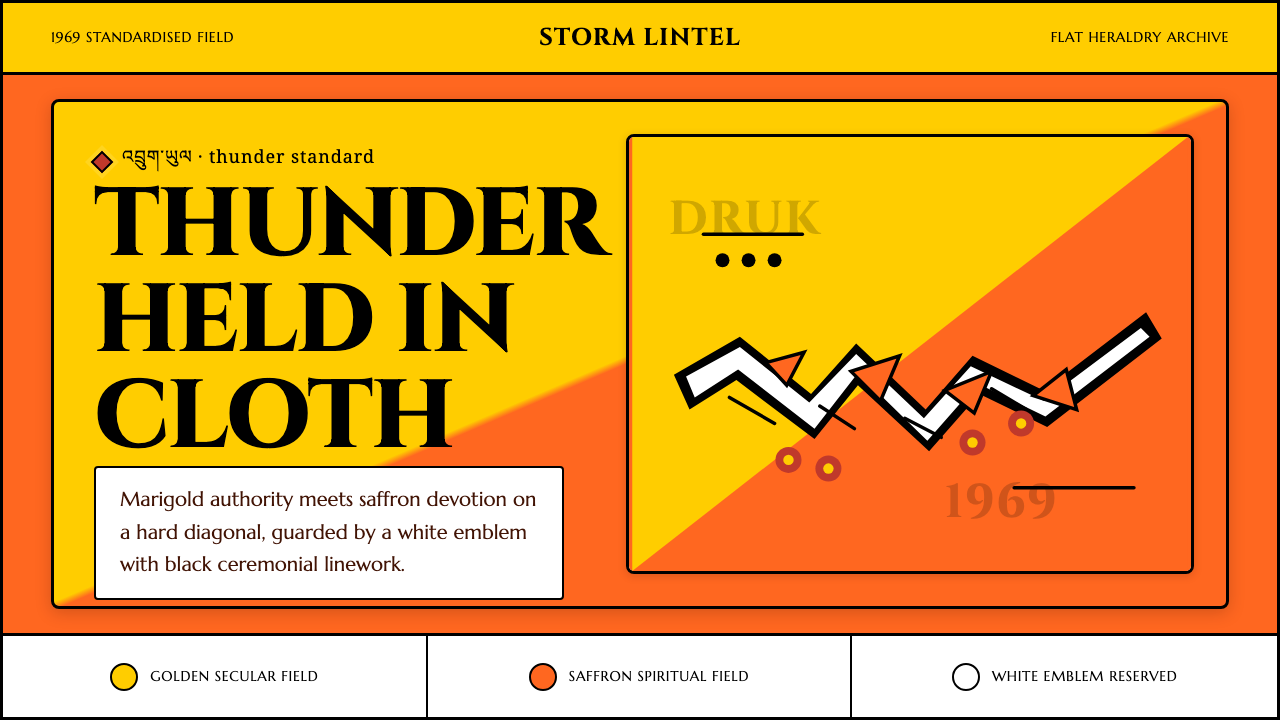 Bhutan Thunder Dragon FlagHeraldry hits like thunder. Marigold and saffron split hard around a white em…
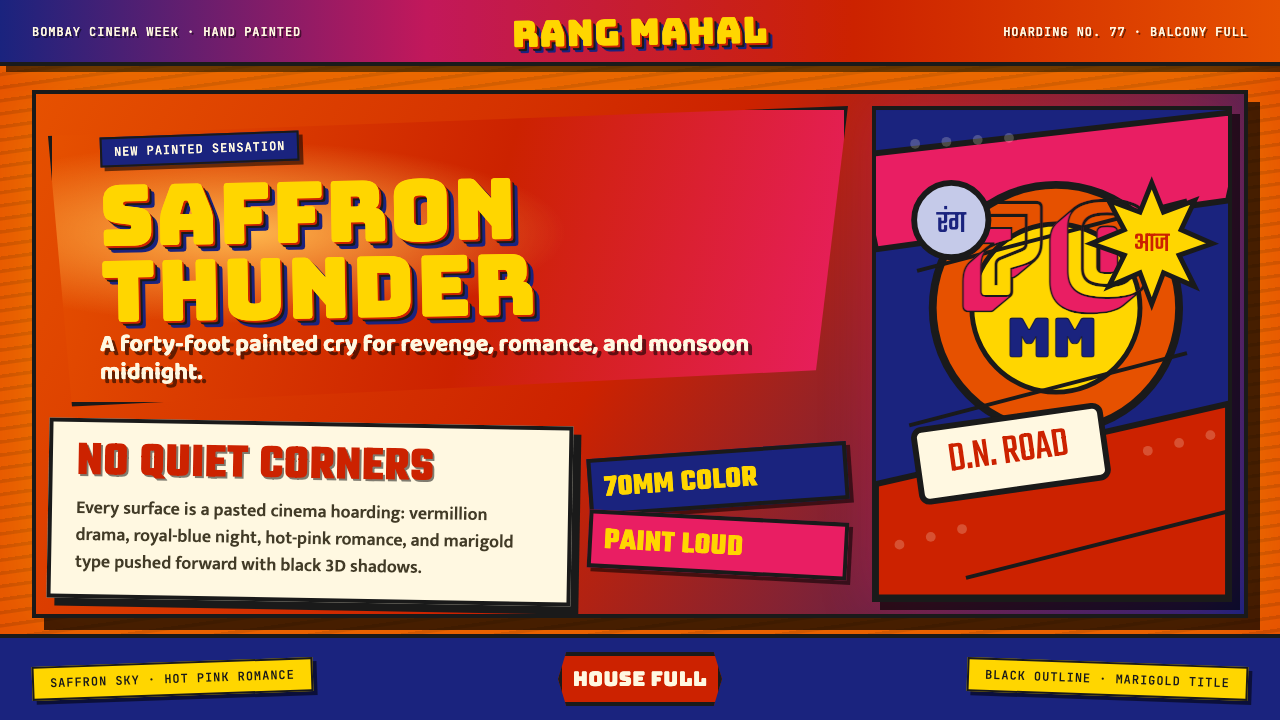 Bollywood Poster Art (1970s)Subtlety is unaffordable. Saffron fields, Bungee shadows, diagonal hoarding d…
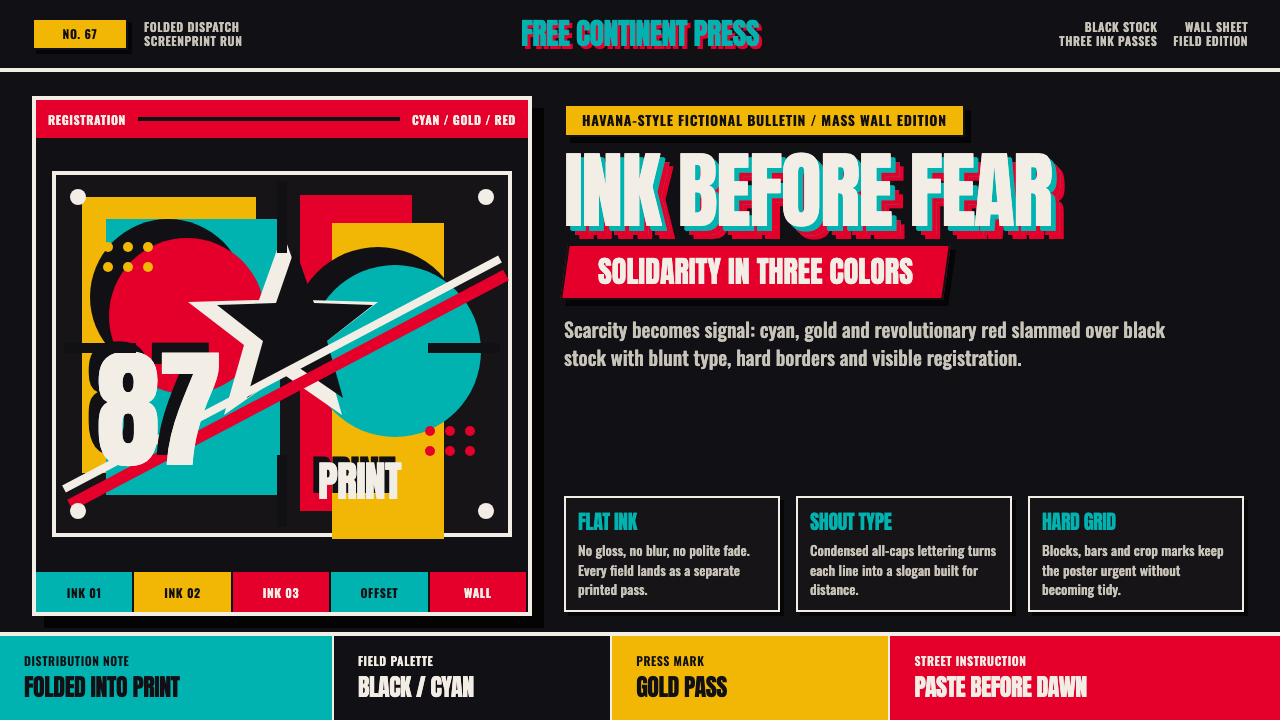 Cuban OSPAAAL Tricontinental PosterUrgency from scarcity. Cyan, gold and red slam over black in blunt silkscreen…
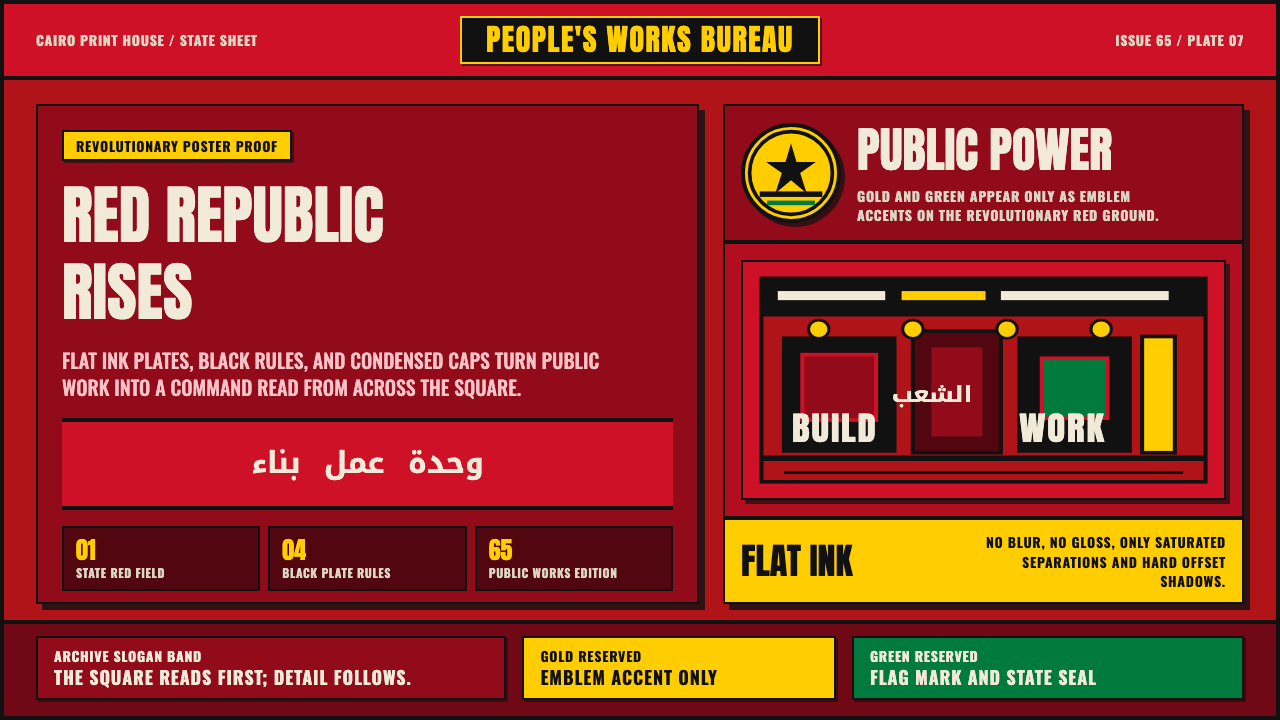 Egyptian Political PosterState power shouts. Red poster grids, black keylines, kufic type, gold-green…
 Godzilla (1954 Showa)Fear takes monumental form. Charcoal halftones split under one atomic-blue ra…
 Grenadian Spice & Nutmeg FlagSpice becomes sovereign. Grove green, flag red, brass borders, and serif ledg…