What is Morin Khuur?
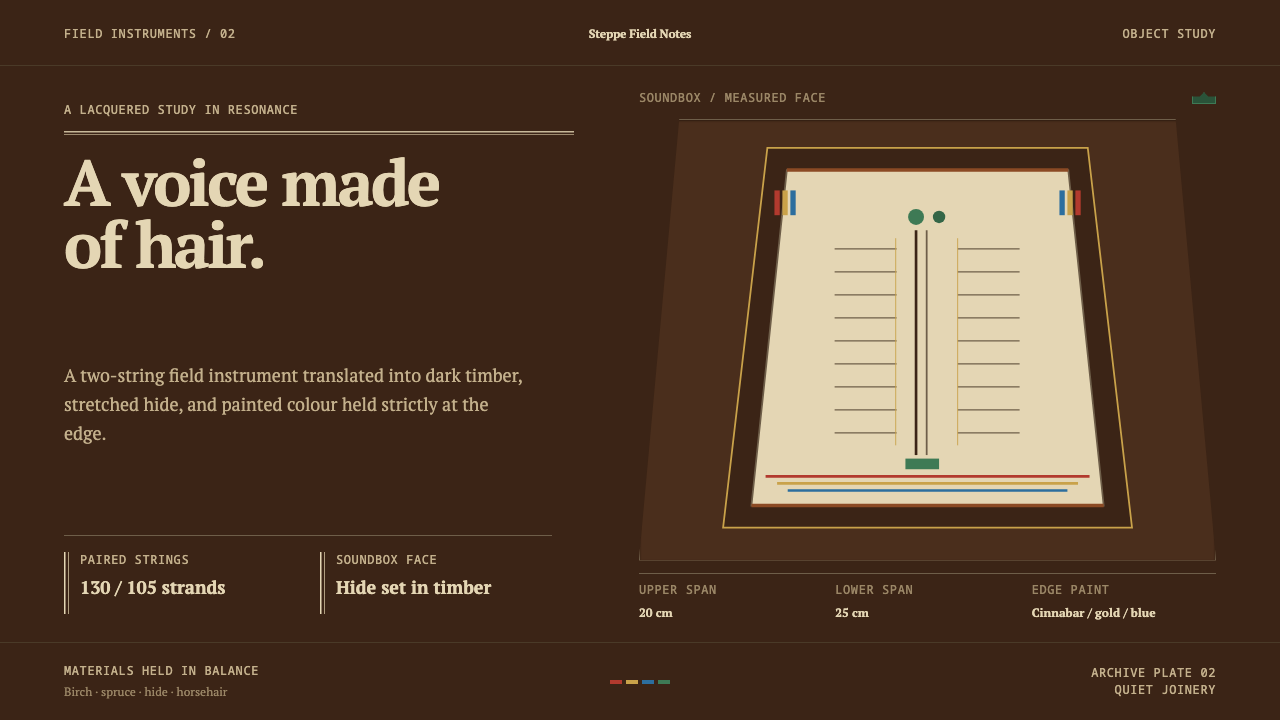
The morin khuur builds resonance out of material, with dark timber framing pale hide and colour running only along the edges like painted ornament.
Morin Khuur in brief
The morin khuur is the horsehead fiddle of Mongolia and the Central Asian steppe, a two-string bowed instrument whose scroll is carved as a horse's head and often painted green. It stands about a metre and a little more in height. Its soundbox is a trapezoid faced with camel, goat or sheep skin, and its two strings are bundles of horsehair rather than metal or gut.
As a visual style, the morin khuur turns the instrument's own anatomy into a layout system. Dark stained birch and spruce form the ground, a pale hide-and-horsehair palette carries everything that is meant to be read, and the colours of ritual ornament, cinnabar, gold and the blue of the ceremonial khadag scarf, run only along the edges. The trapezoid shapes the containers, paired hairlines mark divisions, and a carved terminal finishes each vertical run.
The overall impression is of a dark, warm, material-driven design in which nothing is merely decorative. The wood grain is left open and the lacquer is smooth, with no artificial ageing or distressing. Wear, where it appears at all, belongs on the hide, where a bow and a hand would actually touch it. It is a style about resonance that has been built from parts, not polished into existence.

Where does Morin Khuur come from?
The instrument belongs to the steppe, where herding societies built their musical life from what the animals around them provided. The reference record dates the instrument tradition to before 1900 and places it across Mongolia and the wider Central Asian steppe. Almost everything about the morin khuur comes from the horse and the herd: hide for the face of the soundbox, hair for both the strings and the bow, and a carved horse's head at the top. In Mongolian culture green is associated with peace and abundance, which is part of why the scroll is so often painted that colour.
Its construction is as distinctive as its look. The soundbox is a shallow trapezoid, roughly twenty centimetres across the top and twenty-five at the base, and only eight or nine centimetres deep. The neck is fretless, so the player shapes pitch by pressing the strings with the fingers alone. The two strings are made differently: one hundred and thirty stallion-tail hairs make the male string, and one hundred and five mare-tail hairs make the female string. The sound that results runs close to the long song and the throat singing of Mongolian vocal tradition, low, breathy and voice-like rather than bright.
The tradition has not stood still. In the late 1960s an all-wood soundbox with f-holes was introduced, a construction that echoes the violin family and departs from the older skin-faced box. The visual system described here takes its logic from the instrument as a whole, with hide and horsehair as the pale reading surfaces, but the existence of the wooden-faced version is a reminder that the instrument has been adapted for new settings while remaining recognisably itself.
Along the edges of the instrument runs a tradition of painted and carved ornament. The reference record names the dolgion khee, a wave-and-fire ornament, among the visual idioms of the instrument-making tradition, and the colours that go with it are cinnabar, gold and the blue associated with the khadag, the ceremonial scarf offered as a mark of respect. In 2008 the morin khuur tradition was inscribed on UNESCO's list of intangible cultural heritage. That recognition places the instrument within a living practice of making and playing, and for designers it is a reminder that the style stands for a real musical culture, not just a decorative theme.
What defines the Morin Khuur look?
Trapezoid Container
The soundbox is a trapezoid, wider at the base than at the top, and the shape governs how containers are drawn. Panels, cards and frames take this slightly tapering outline, which gives them a grounded, stable look, as though they rest on their wider edge. It is a quiet departure from the plain rectangle and a constant reminder of the object behind the style.
Dark Timber Ground
The ground is stained birch and spruce, deep and warm rather than black. The wood grain stays open and visible, while the lacquer finish is smooth and clean. There is no simulated wear, no scratches and no fake ageing. The dark field is not mood lighting but material, a tone that carries weight and lets lighter surfaces sit on top of it.
Pale Hide Surfaces
Everything meant to be read sits on a pale, warm surface that recalls hide and horsehair. This is the reading layer: text blocks, tables and forms are placed on it so that contrast is comfortable and sustained. Any wear in the design belongs here, where a bow or a hand would touch it, and nowhere else.
Edge-Run Colour
Cinnabar, gold and khadag blue appear only along edges, as painted ornament and never as fill. They trace borders, run along the top of a container, or underline a heading, and they are thin enough to feel brushed rather than printed. Keeping colour at the edge is the most characteristic rule of the style, and it is what stops the dark ground from becoming heavy.
Wave and Fire Ornament
The dolgion khee, a wave-and-fire ornament, is the decorative idiom that belongs on the edges. Its rolling curves and flame-like points give a restrained rhythm to borders and dividers, offering movement without turning the surface into a pattern. Used sparingly, it connects the design to the painted decoration of the instrument-making tradition.
Paired Hairlines
Divisions are marked with two thin parallel lines, reminiscent of the pairing of the instrument's two strings. The double line is lighter than a rule and more deliberate than a single hairline, and it gives sections a rhythm of twos. It acts as a quiet structural signature that repeats throughout the layout.
Carved Terminal
Each vertical run ends with a carved terminal, a scroll-like knot that echoes the horse's head at the top of the neck. It finishes a column the way the scroll finishes the instrument, giving long vertical elements a sense of conclusion. The effect is small but distinctive, and it is one of the details that tells the eye this is a shaped object rather than a flat layout.

Who shaped Morin Khuur?
Denis Yaravoi is the one individual named in the reference record for this style. The record gives his name without detail, so this article does not attribute any particular innovation or instrument to him. His presence in the lineage is a reminder that, alongside an old and largely anonymous making tradition, individual makers and players are part of how the morin khuur has been carried forward and adapted.
The anonymous makers of the Mongolian steppe built the instrument from hide, hair and local timber, and their choices shaped every element of its form. Their tradition is the source of the trapezoid soundbox, the horsehair strings and the carved horse's head. A design system based on the morin khuur borrows their way of letting materials and function decide the shape, and it owes them its sense of honesty.
The players of the morin khuur, known as khuurchi, are the people for whom the instrument is finally made. They hold it upright, bow the horsehair strings and shape the pitch with their fingers on a fretless neck, producing a sound close to the human voice. Their relationship with the instrument explains why the design keeps wear to the hide and treats the instrument as something handled and loved, not displayed.
UNESCO inscribed the morin khuur tradition on its intangible cultural heritage list in 2008. The inscription recognises the instrument as part of a living cultural practice that includes making, playing and passing on the music. It stands for the principle that the style should be applied with respect for a tradition that is still alive, and that the most faithful references acknowledge Mongolia as its home.
How do you use Morin Khuur today?
The morin khuur style suits designs that want warmth, material honesty and cultural depth in a dark setting. Its structure is easy to adapt, with a dark wood ground, a pale reading layer and colour confined to edges, and it rewards designers who think of every container as an object with a shape. The challenge is restraint: the style loses its character the moment colour spills over from the edges into the fill.
For presentation slides, a cover can use a deep brown ground with a pale panel of trapezoid shape holding the title, and a thin cinnabar or gold line tracing its upper edge. Content slides place the text on pale surfaces framed by the dark ground, with paired hairlines separating sections. Data slides keep the chart area pale, with series marked by thin lines and markers in the edge colours rather than by large coloured blocks, so the data stays legible and the ornament stays at the margin.
For web interfaces, the style fits music stores, audio and podcast apps, festival and ticketing sites, heritage organisations and artisan makers. Use the dark timber tone for navigation and page chrome, and place all reading content on pale panels. Cinnabar, gold and blue become borders, focus rings, active-tab underlines and small markers, never button fills. Paired hairlines work well as dividers, and a carved terminal can finish long sidebars or columns.
For editorial and marketing work, the style supports long features on music, travel, craft and cultural heritage. A dark page with a pale central reading column feels like text laid on a hide surface, and pull quotes can be framed with a painted edge. Photography of instruments, landscapes and makers sits naturally within the dark frame. Name Mongolia and the tradition specifically, and avoid treating the style as a generic steppe or Asian motif.
A common mistake is to fill large areas with cinnabar, gold or blue, when these colours are meant to be edge ornaments. Another is to add distressed textures, artificial scratches or glossy wood-grain gradients, which contradict the principle that the wood is left open and the lacquer smooth. Placing long text directly on the dark ground without a pale panel makes reading tiring, and sprinkling in horses, yurts and other steppe clichés turns a structural system into a theme park.

Morin Khuur — FAQ
Why is the scroll carved as a horse's head?
The horse is central to the herding culture of the steppe, and the instrument draws on it throughout: the strings and the bow are made from horsehair, and the scroll is carved into a horse's head. The name itself, morin khuur, can be read as horse fiddle. For the design, the horse-head idea is translated into the carved terminal that finishes each vertical run, rather than into any literal drawing of a horse.
Why are the accent colours only used on edges?
Because on the instrument, cinnabar, gold and blue appear as painted ornament along edges and never as large filled areas. Applying the same rule in design keeps the dark timber and pale hide in charge, and it prevents the colours from competing with the content. It also gives the style its recognisable look: a quiet field with fine lines of colour tracing its borders.
Is this a dark mode for any application?
Not exactly. It is a dark design, but it is built around a specific object and culture, and its structure of trapezoid containers, paired hairlines and edge ornament carries a particular meaning. It works best for music, heritage, craft and culture projects. For a general product you can borrow its logic, a warm dark ground with pale reading panels, without the full ornamental vocabulary.
Why does the style avoid distressed or aged textures?
Because the principle behind it is that resonance is built, not polished or faked. The wood grain is left open, the lacquer is smooth and the structure is plain. If wear appears, it belongs on the hide, where a bow and hand would actually touch it. Adding scratches or an aged look would suggest a nostalgic antique rather than a working instrument that is still played.
What does the 2008 UNESCO inscription mean for designers?
It recognises the morin khuur tradition as living intangible heritage, which means making and playing the instrument are ongoing practices with communities behind them. It does not restrict how designers draw inspiration, but it is a good reason to cite Mongolia and the tradition by name, to avoid caricature, and to treat the visual system as a way of honouring the instrument rather than exploiting it.
Related design styles
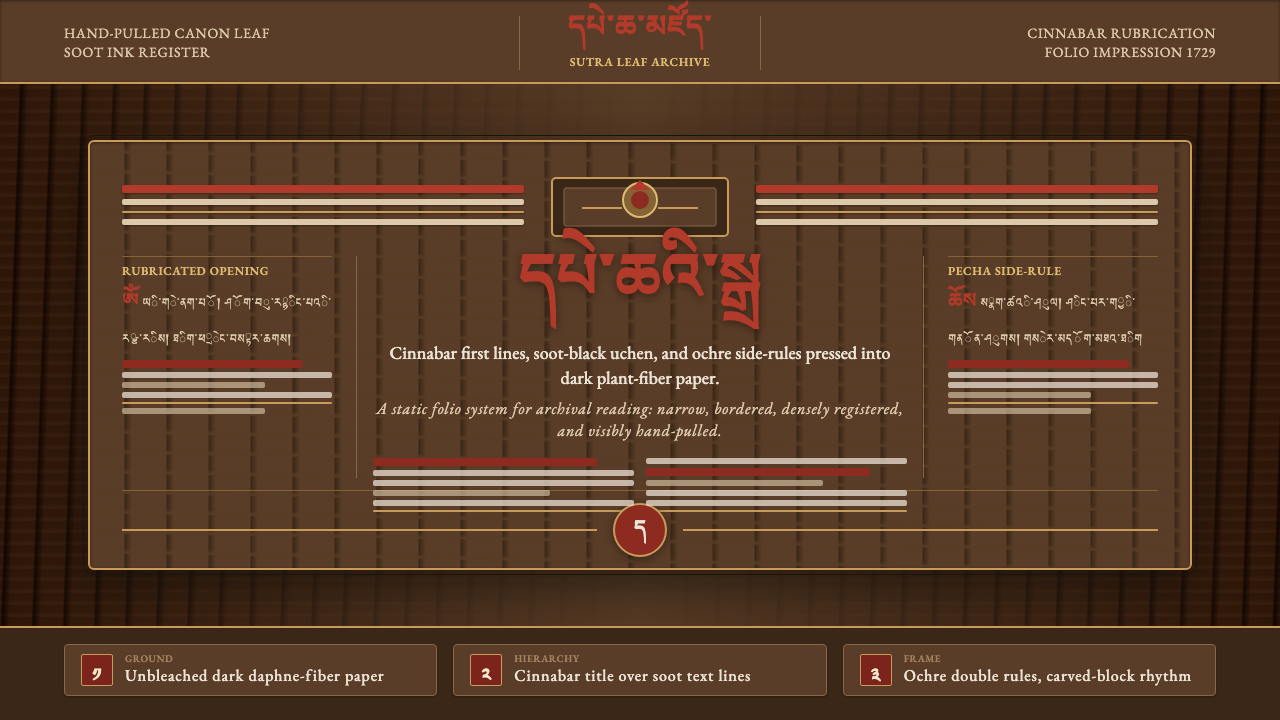 Derge Woodblock Sutra PrintHand-pulled scripture gravity. Cinnabar uchen and ochre rules press into dark…
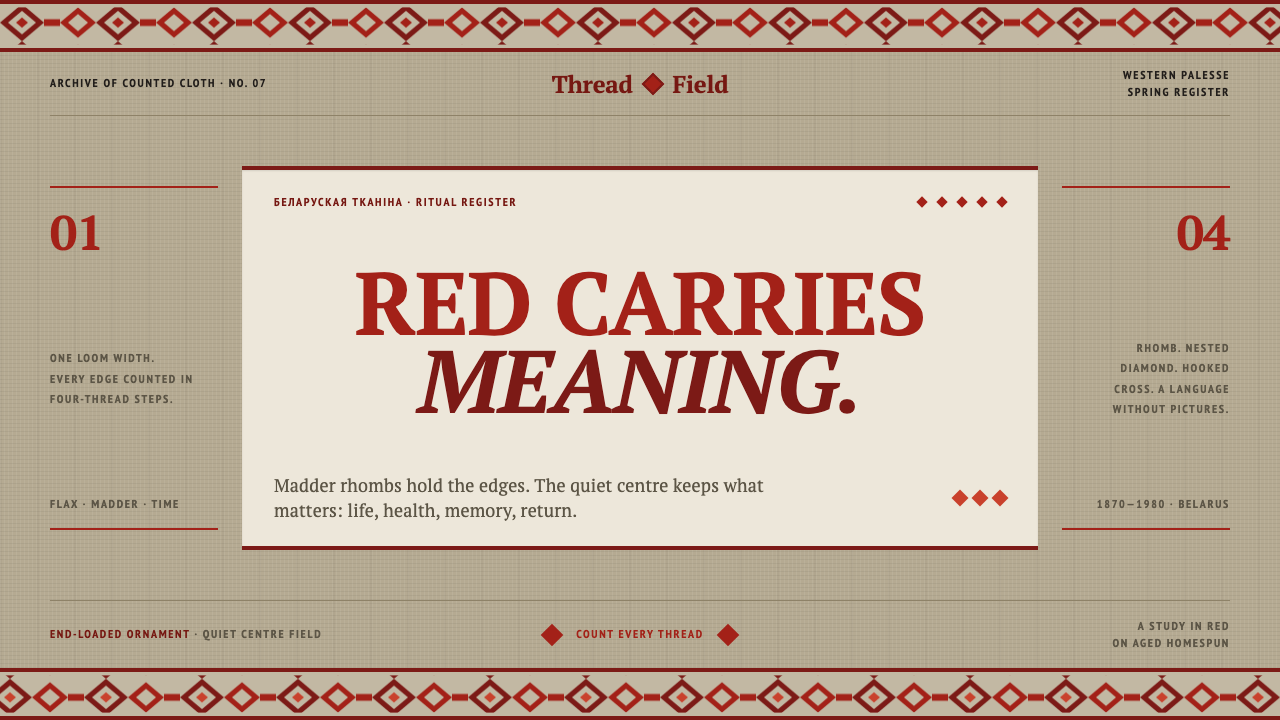 Belarusian RushnykRed carries meaning. Madder rhombs crowd aged flax edges while the woven cent…
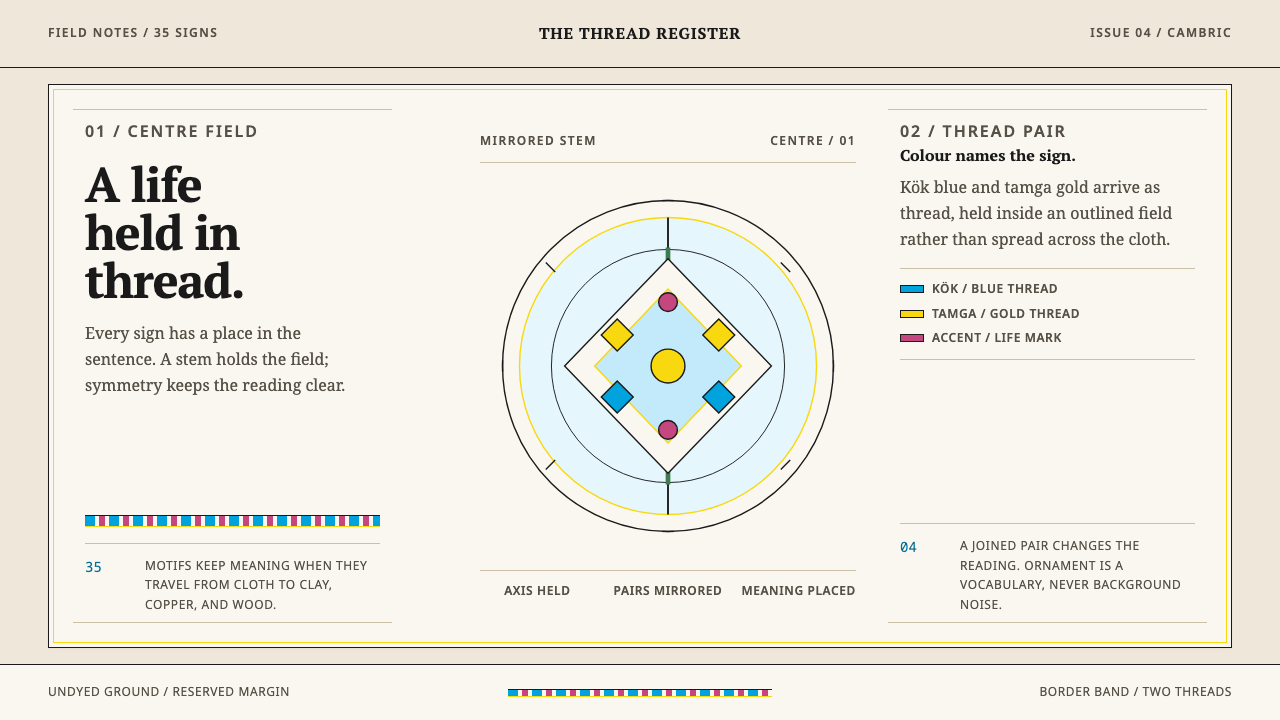 Crimean Tatar OrnekOrnament that can be read. Kök blue and tamga gold hold a mirrored stem on un…
 Georgian MkhedruliA manuscript breathes slowly. Tanned vellum, round Mkhedruli ink, ochre and u…
 Hebrew STaM ScrollExactness over ornament. Jet ink, ruled Hebrew columns, and amber-tan parchme…
 Isfahan Qalamkar PrintEvery impression keeps a hand. Indigo and madder repeats shift softly across…