What is Moken Kabang?
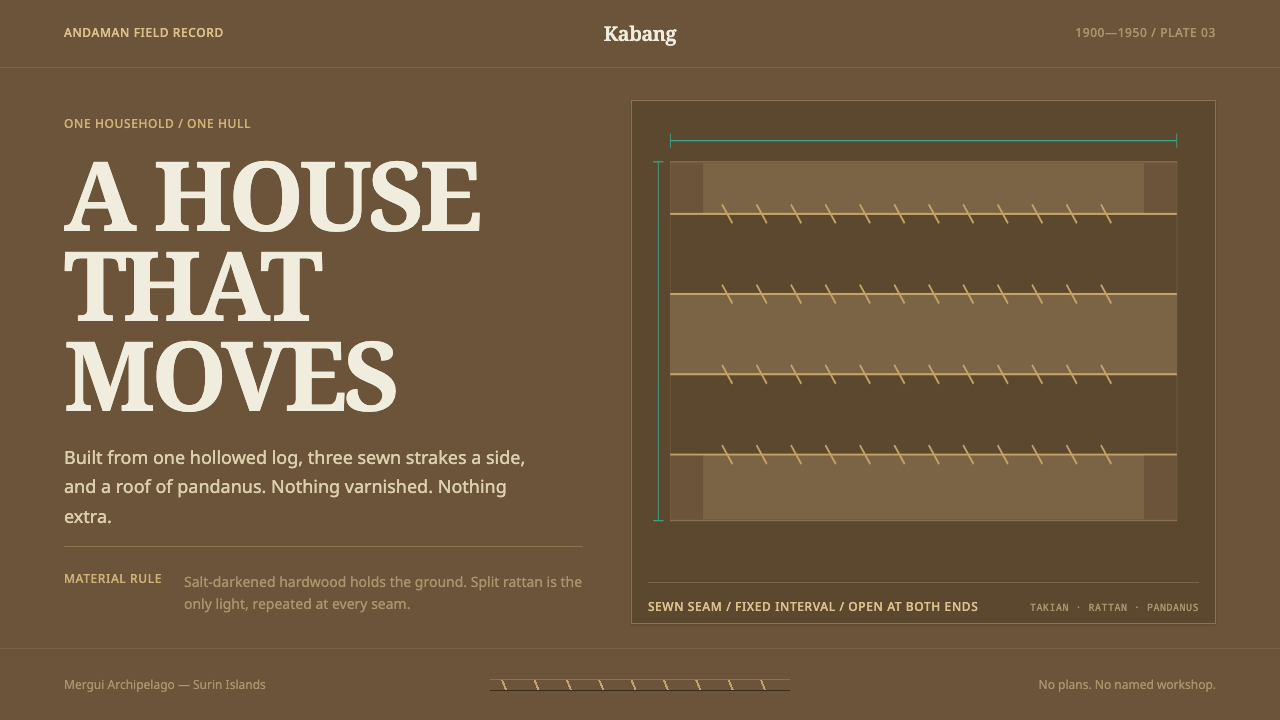
The kabang is a house that floats — a hollowed hardwood log, sewn planks and a roof of pandanus leaf — and the design logic that follows from it is blunt: nothing extra survives at sea.
Moken Kabang in brief
Moken Kabang is a design style drawn from the house-boat of the Moken, the sea nomads of the Andaman Sea. The kabang is vessel and dwelling at once: a family lived and travelled on it, and the Moken built it themselves from a small number of local materials. As a visual reference it is defined by subtraction. Nothing on the boat is painted or varnished, nothing is added for show, and what the eye meets is salt-darkened hardwood, split rattan and pandanus straw — each present because the boat needs it.
The design system built on this idea is a dark one. The ground is the deep, weathered brown-black of a hull that has lived in salt water and sun. The only light is a single warm tone, the colour of freshly split rattan and dried pandanus, spent sparingly against that darkness. Layouts run in long, low horizontals, like the strakes along a hull or the ridge line of a thatched roof, and they are left open at both ends rather than boxed in, echoing the openings cut into the bow and stern of the real boat.
What this adds to a designer's palette is a working, workshop-honest dark mode. It is not the glossy dark of nightlife branding or the cold blue-black of developer tooling. It is a dark that smells of wood and rope: matte, warm at the edges, assembled from seams and lashings rather than produced by effects.
Where does Moken Kabang come from?
The Moken are a sea-nomadic people of the Andaman Sea. Their traditional waters span the Mergui Archipelago, off the coast of Myanmar, and the Surin Islands, which belong to Thailand — a stretch of sea that modern borders now divide. The period this style draws on runs from roughly 1900 to 1950, the fully nomadic decades before permanent settlement on shore. Moken culture belongs to the broad Austronesian family of sea-nomad societies, maritime peoples whose lives were organised around boats, tides and shorelines rather than fields and villages. That context explains the visual restraint: when a home must float, carry its owners and be rebuilt by hand, every material has to earn its place.
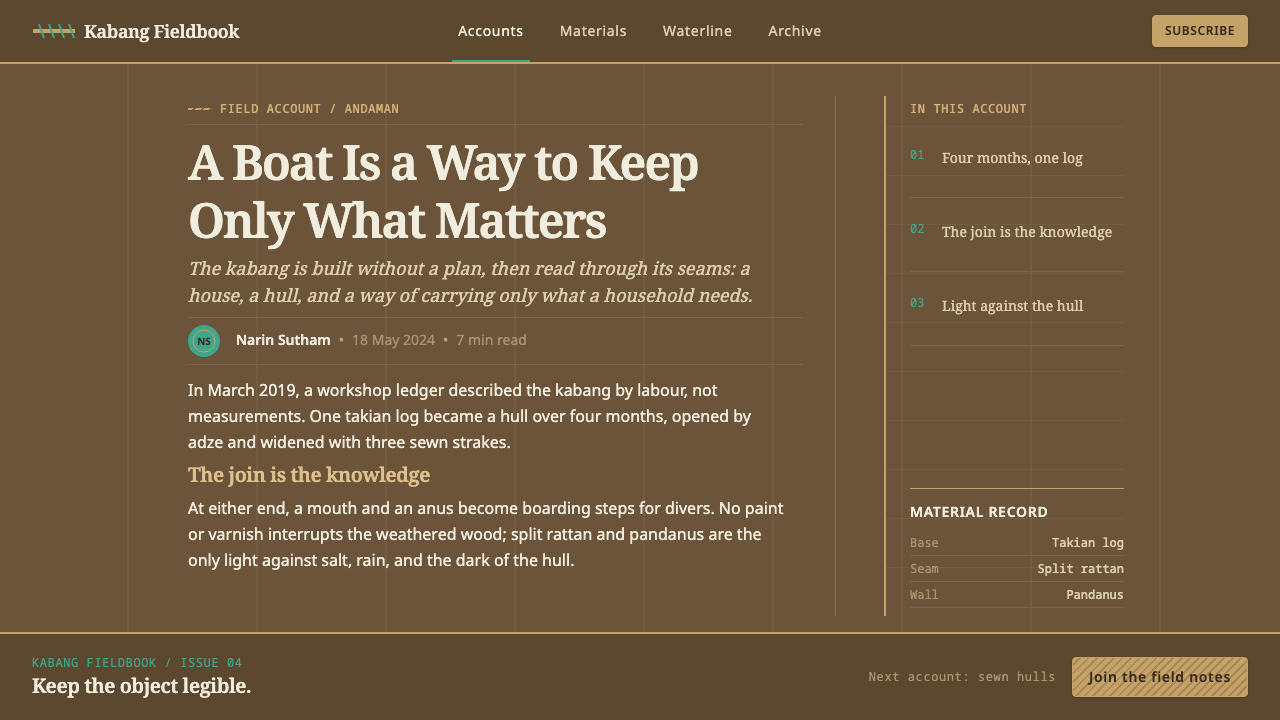
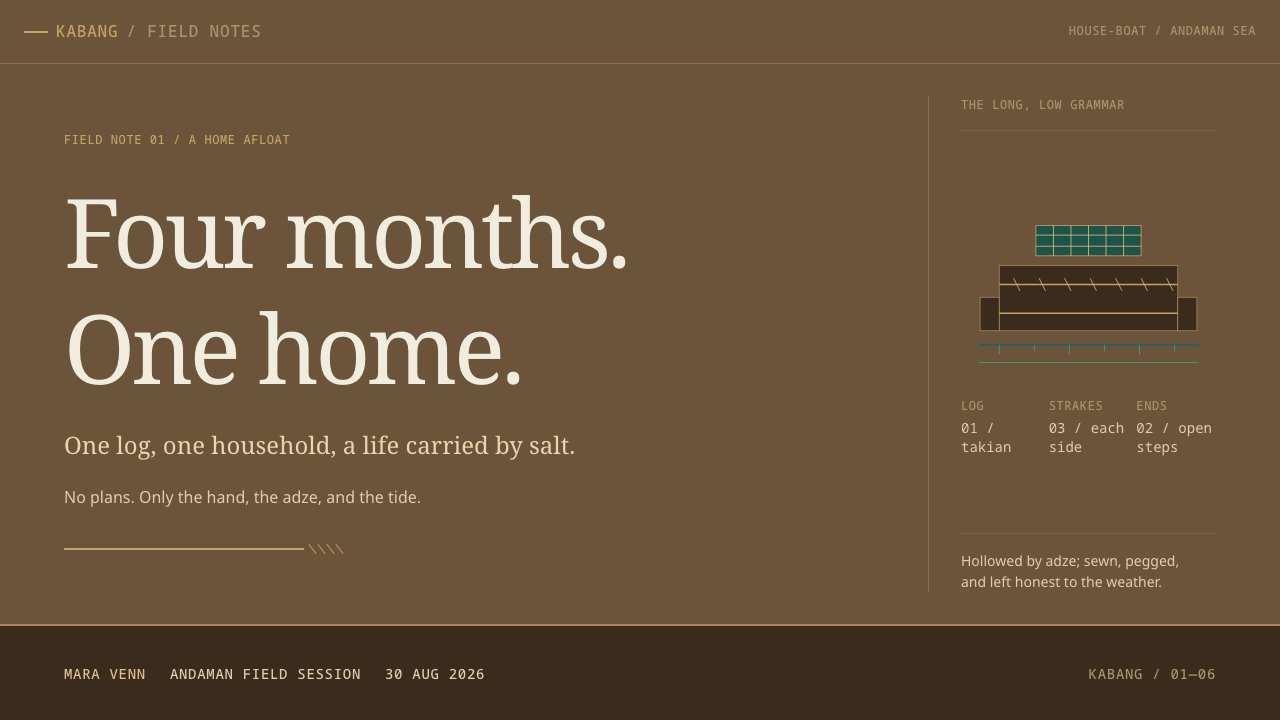
The kabang begins as a single log of takian, a dense tropical hardwood. The log is hollowed out and then expanded, spread open so that the hull becomes wider than the log it came from; boatbuilders call the technique an expanded dugout. Three strakes — the long planks that form the sides — are added on each flank. They are sewn to the base with rattan passed through holes and pegged in place, not nailed or glued. Above the hull, a house of pandanus leaves forms both the walls and the roof. The record describes the whole undertaking as about four months of work, carried out without drawn plans and without any named workshop. Whoever's boat it was, that family had built it.
Both ends of the hull carry an opening, a deliberate gap in the line of the boat. The Moken speak of these as the boat's mouth and its anus, and divers use them to climb in and out of the water. The detail matters for design because it shows the boat being treated as a body: a thing with an inside and an outside, whose functions are named plainly rather than disguised. It is also the origin of the most useful layout rule in the system, which is to keep horizontal bands open at their ends instead of closing them with frames, caps and borders.
Accounts of Moken life reach outsiders through several channels. Jacques Ivanoff is the anthropologist most closely associated with sustained research on the Moken; Survival International, an advocacy organisation for tribal peoples, has campaigned on behalf of the sea nomads of the region; and Andaman Discoveries, a Thailand-based community-travel organisation, is among the contemporary channels through which outsiders meet Moken communities. A responsible use of this style keeps that ecosystem in view. The source material records how the boat is built and what it is made of; it does not assign symbolic meanings to its forms, and neither does this article. Those meanings, if there are any to give, belong to the Moken to state.
What defines the Moken Kabang look?
The Hull Ground
The ground is dark, matte and warm: the brown-black of hardwood that has been darkened by salt and sun for years. It is deliberately not a neutral screen black. Grain and age show through as faint warmth near the edges of things, and there is no gloss, no varnish and no glassy sheen anywhere on the surface. Because nothing on the real boat is painted, nothing in the system is allowed to look coated.
One Warm Light
Against the dark hull the system allows a single light: the pale gold of split rattan and pandanus straw. It is used once per view, for the thing that matters most — a primary action, an active state, a headline figure. Because there is only one source of warmth, wherever it appears the eye goes there at once. A second competing accent would turn the discipline into decoration.
Long Low Horizontals
A hull is read left to right along its strakes, and a thatched house is a low ridge over a long body. The layout language follows: wide, shallow bands, stacked rows, generous width and modest height, with text lines that run long rather than being folded into tall narrow columns. Vertical emphasis is rare and always short.
Open Ends
The bow and stern of the kabang are open, and the system honours that. Rules and bands stop short of the frame; panels are not enclosed in full borders; sequences begin and end in space rather than inside caps. The result is a composition that feels like a view along a vessel rather than a sealed box.
Seams and Lashings
Joinery is shown, not hidden. Planks are sewn with rattan and pegged, so the joints are the ornament: dividers behave like rows of stitches, table rules like lashing, small repeated ticks mark rhythm. Texture comes from fibre and seam — split, slightly irregular, hand-made in feel — and never from simulated materials or soft photographic effects.
Anonymous Making
No plans were drawn and no workshop is named; the boat belongs to the family that made it. In design terms this means very little brand display. Marks are small, ornament is absent, and the interface presents the work itself — the content, the figures, the object — instead of the maker. The identity is carried by the discipline, not by a logo.
Who shaped Moken Kabang?
Ivanoff is an anthropologist whose name is closely tied to research on the Moken and their sea-going way of life. His writing is a common scholarly starting point for anyone who wants to understand how Moken communities relate to boats, the sea and the shore, and it helps in seeing the kabang as a made object with a technique rather than only as a picturesque sight. Anyone borrowing from the style should read beyond the visual summary given here.
Survival International is a long-established advocacy organisation for tribal and Indigenous peoples. It has publicly campaigned for the Moken and the sea nomads of the Andaman region, and its materials are one reference point for how the Moken are described to the wider world. It also serves as a reminder that this is a living people with rights and a changing present, not a vanished era. The style draws on the period before permanent settlement; the people did not stop at 1950.
Andaman Discoveries is a Thailand-based community-travel organisation, and in this style's sources it stands for a contemporary channel through which visitors meet and learn about Moken communities. It represents the other half of the picture: the kabang is not only an object in an archive but something that people today still talk about, show and explain to outsiders.
How do you use Moken Kabang today?
Moken Kabang suits work that wants to feel honest, practical and quiet — a dark theme with the warmth of wood rather than the glow of neon. Applying it well means copying the discipline of the boat rather than its decoration: a dark ground, one warm light, long low horizontals, open ends. It does not call for rope borders, palm silhouettes or anything that looks like a nautical souvenir.
For presentation slides, the cover should be almost empty. Fill the frame with the dark hull ground, set the title low and to the left along a single long horizontal band, and let one warm line or block carry the only light. Content slides work best as stacked horizontal rows, each row a single idea, with generous width and little height; dividers can imitate a seam of stitches instead of solid rules. For data slides, horizontal bars read naturally as strakes: draw them in the dark, near-tonal range and give the one number that matters the warm light. Resist legends in several colours — direct labels on the bars do the job.
On the web, the style is a strong fit for dashboards that are read for long stretches, such as monitoring tools, logs, field data and maritime or logistics products. The page ground is dark and matte, panels differ from the ground by a slight shift in warmth rather than by shadow, and the warm light is reserved for the active tab, the primary metric or the single action to take. Pricing pages should lay plans out as long low rows rather than tall cards, with the recommended plan lit by the warm tone and every other row left in the hull's brown-black; features are plain lines joined by faint seam-like dividers. Navigation stays spare: text labels and one underline.
In editorial and marketing work it suits slow, material, craft-minded subjects: boatbuilding, sustainable travel, wooden objects, field journalism, long reads about the sea, outdoor equipment that is meant to last. Photography should be dark, close and tactile — grain, rope, woven leaf, water at dusk — and cropped into wide, shallow frames to match the horizontal rhythm. Headlines stay modest and left-aligned. A single warm-lit call to action per page is enough; the style's persuasiveness comes from restraint.
The most common mistake is translating 'sea nomad' into 'tropical holiday'. Turquoise gradients, sunset oranges, palm silhouettes and wood-grain texture backgrounds all add exactly what the kabang refuses: surface that is not structure. A second mistake is giving the page several warm accents because the light looks pleasant; once there are three lights, none of them is the light. Finally, avoid presenting the style as a stand-in for a living culture's identity. Use it as a design discipline derived from a made object, credit the source, and let the Moken describe the meanings they themselves give these things.
Moken Kabang — FAQ
What exactly is a kabang?
A kabang is the house-boat of the Moken, the sea nomads of the Andaman Sea. It is built from one hollowed and expanded takian log, with three sewn-and-pegged strakes added on each side and a house of pandanus leaves forming the walls and roof. A family builds one in about four months, without drawn plans.
Why is this style dark by default?
Because its ground is the salt-darkened hardwood of the hull itself, and its single warm light only means something against that dark. A light version is possible in principle, but it must keep the other rules — one warm light, long low horizontals, open ends — or it becomes a generic beige craft theme. Treat the dark ground as the style's baseline rather than a toggle.
How do I apply the 'one warm light' rule in a real interface?
Pick the one element per view that deserves attention — a primary button, a headline figure, a selected state — and give only that the warm tone. Everything else sits in the dark range of the hull or in muted, low-contrast tints. If a second element needs emphasis, achieve it with position, size or weight, not with a second light.
Is it appropriate to use a living people's boat as a design reference?
It can be, if the reference is handled with care. This style borrows a construction logic and a material discipline, not sacred motifs or personal imagery, and the source material does not assign symbolic meanings to the boat's forms. Credit the Moken as the origin, avoid inventing myths or captions, and avoid exoticising language. The period it draws on is roughly 1900 to 1950; Moken life has changed since, so do not write about it as though it were frozen.
How is this different from generic nautical or tropical design?
Nautical design usually borrows symbols — anchors, ropes, stripes, brass — and tropical design borrows colour. Kabang borrows a method: subtraction, a dark salt-worn ground and a single natural light. It would not use a rope border or a palm-leaf motif; it would show seams and rhythm instead. The visual result is quieter, darker and more structural than either genre.
Related design styles
 Hindu Widow White SariRestraint carries the weight. Ash-toned khadi, quiet serif type, and vertical…
 Bonsai CultivationQuiet asymmetry. Pine green rests on dark tray earth, sealed by one vermilion…
 Chancay Gauze TextileQuiet woven dignity. Tan silhouettes float through a dark open cotton mesh.
 Karen Woven TunicOne field, then bands. Warm cotton white gives way to morinda registers and r…
 Konso WagaWeather makes the monument. Silver-grey timber, hard planes, and ochre held i…
 Moriori Rakau MomoriPressure, not incision. Literata shadows sink softly into pale, lichened bark.