What is Miʼkmaq Quillwork?
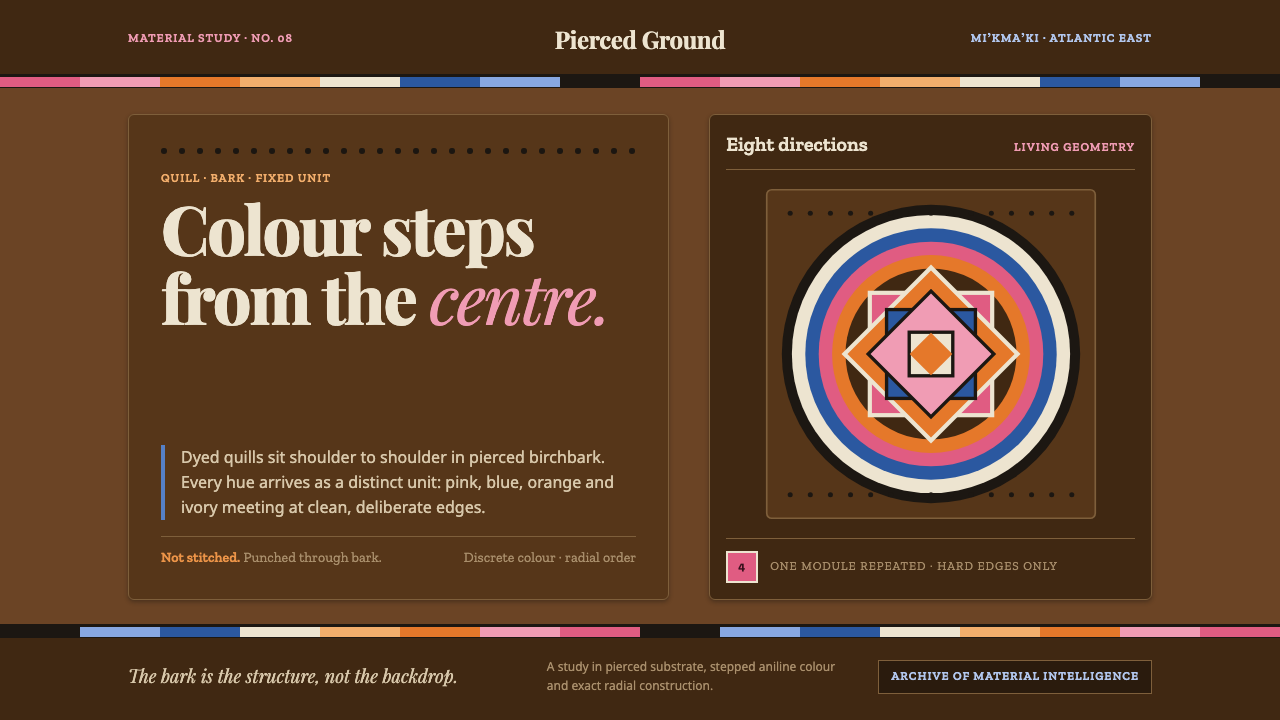
Miʼkmaq quillwork never blends a color — it steps, quill by quill, from a dark birchbark ground into a radiant eight-point star.
Miʼkmaq Quillwork in brief
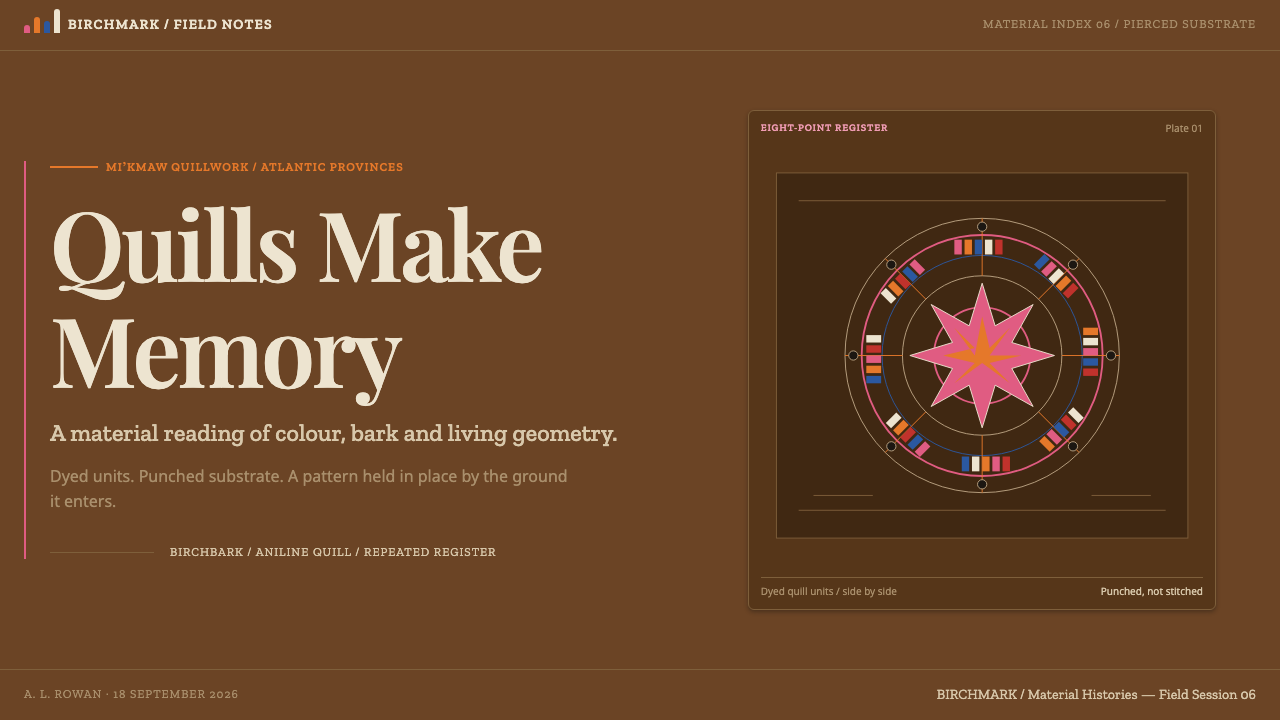
Miʼkmaq quillwork is a mosaic technique, not an embroidery technique — a distinction that shapes everything else about how it looks. Dyed porcupine quills are flattened and set edge to edge directly into a sheet of birchbark, with each quill's ends pushed through a small hole punched through the bark itself. The birchbark functions as a pierced substrate that the quills pass through, rather than a soft hide that the quills are stitched onto — a structural difference that separates this Eastern Woodlands practice from the sewn quillwork traditions of the Great Plains.
Because every quill is a discrete unit of a fixed, unstretchable length, color in this system can never fade gradually from one hue into another. It can only step — one solid band of color giving way abruptly to the next. Designs are built from that constraint rather than in spite of it: fields of color radiate outward from a central point, or ring the surface in concentric bands, each ring a single flat hue with a hard edge against its neighbor. At the center of the tradition sits the eight-pointed star, a motif that has remained a living, actively used element of Miʼkmaq quillwork rather than a decorative borrowing from elsewhere.
The color vocabulary itself has a specific historical hinge. Before roughly 1865, available dyes were more limited; after that point, aniline dyes brought saturated pink, blue, and lavender into the range, and quillwork's palette has stayed bold and assertive ever since — bright, stepped color against a dark ground, never a muted 'natural' earth-tone scheme. A system built on this logic reads the birchbark itself as a deep, near-black brown field; every panel or card is treated like a piece of that bark, bordered by a stepped band of color the way a real quilled edge would be; and any motion in the interface — a loading state, a reveal — advances the way the medium does, lighting up one radiating spoke at a time rather than fading or sliding smoothly. Wherever a conventional interface would use a gradient or a transition, this system cuts it into discrete steps instead.
Where does Miʼkmaq Quillwork come from?
This quillwork tradition belongs to the Miʼkmaq, whose homeland — Miʼkmaʼki — spans what is now Nova Scotia, New Brunswick, Prince Edward Island, the Gaspé Peninsula, and the surrounding stretch of eastern Canada. It is part of a wider family of practices sometimes grouped as Eastern Woodlands quillwork, distinct from the beadwork and quillwork traditions of the Great Plains further west, and it was already an established, mature practice well before 1900.
The defining technical fact of the tradition is the pierced substrate. Rather than sewing dyed porcupine quills onto a soft hide backing — the more familiar method associated with Plains quillwork — Miʼkmaq artists set quills directly into sheets of birchbark, pushing each quill's ends through small holes punched through the bark. That method locks every quill into a fixed position and a fixed length, which is why color in the finished object can only step from one flat band to the next rather than blend. Out of that constraint came the tradition's most enduring visual signature: fields of color built as radiating spokes or concentric rings, organized around the eight-pointed star that sits at the center of the vocabulary as a living, continuously used motif rather than an antique curiosity.
The historical record includes a useful fixed point: a quillwork chair held in the Winterthur Museum's collection has been dated to the period of roughly 1850 to 1900, placing surviving physical examples of the tradition squarely within the nineteenth century. That same century brought a shift in the available palette — aniline dyes, which became available from around 1865 onward, introduced saturated pink, blue, and lavender into a color vocabulary that had previously been more limited, and quillwork's characteristic boldness dates from that point forward. The same period also saw quilled birchbark objects made and sold into a growing nineteenth-century curio and trade market, as travelers and collectors created demand for portable, decorative Miʼkmaq work alongside its continued use within Miʼkmaq communities themselves.
The tradition did not end with the nineteenth century. It has been carried forward through generations of Miʼkmaw women quill artists working in family workshops across the Atlantic provinces, and it continues today through contemporary Miʼkmaw quill artists who maintain the same pierced-birchbark technique and the same stepped, radiating color logic. That continuity matters for how the style should be understood: this is a living practice with active makers today, not a closed historical style known only through museum holdings.
What defines the Miʼkmaq Quillwork look?
Color
Color arrives in flat, saturated steps rather than gradients — one hue against another against a dark ground, each with a hard edge against its neighbor. The palette leans on the bright pink, blue, and lavender that entered the tradition after aniline dyes became available, set against a dark, near-black brown ground rather than a light or neutral one. No hue fades into another; every color change is a decision made at a visible boundary.
Radial Composition
Designs are organized around a center rather than read left to right. Color fields radiate outward like spokes, or ring the surface in concentric bands, with the eight-pointed star sitting at the structural heart of the vocabulary. A layout built on this logic treats its focal point as the literal center of the composition, with supporting elements arranged around it rather than stacked above or beside it.
Ground and Surface
The base surface reads as dark birchbark — a deep, near-black brown, not a neutral gray or a light backdrop. Every panel or card in the system is treated as a piece of that bark: a dark field that color steps across rather than a blank canvas that color merely sits on top of.
Stepped Border
Edges are finished with a banded, stepped border rather than a single smooth line — echoing the quilled edge of a real piece of birchbark work. A card or container bordered this way reads as built from discrete colored units laid side by side, not wrapped in a continuous outline.
Stepped Motion
Where the interface needs to show progress or reveal content, motion advances in discrete steps rather than a smooth fade or slide — a radiating pattern lighting up one spoke at a time, in the same sequence a quiller's hand would fill a field. Anywhere a conventional system would use a gradient transition, this one cuts it into visible stages instead.
Fixed-Unit Module
Every visual element behaves like a discrete unit of fixed size laid alongside its neighbors, mirroring the quill itself — a component of set length that cannot stretch or compress. Grids and spacing in this system favor a repeated, countable module over a fluid, continuously scalable layout.
Restraint on Secondary Color
Green and blue, when they appear at all, show up rarely enough to register as an event rather than routine decoration — following the same rationing logic that governs the historical palette. The system leans hardest on its two or three primary colors and treats everything else as an occasional accent.
Who shaped Miʼkmaq Quillwork?
Quillwork has been passed down primarily through Miʼkmaw women working within family workshops across the Atlantic provinces, where technique and motif — including the eight-pointed star and the stepped, radiating color logic built from the pierced-birchbark method — were taught directly from one generation to the next rather than standardized in written form. This family-workshop model is the primary reason the tradition's core vocabulary has stayed consistent across a wide geographic area for so long.
Today's Miʼkmaw quill artists continue the same pierced-birchbark technique used by earlier generations, keeping the tradition active as a living craft practice rather than a style preserved only in museum collections. Their continued work is the reason this system can be described in the present tense — the eight-pointed star and the stepped color logic remain in active use, not archival reference.
A quillwork chair held in the Winterthur Museum's collection, dated to roughly 1850 to 1900, provides one of the clearer fixed reference points for dating this tradition's surviving nineteenth-century objects. Its presence in a major decorative-arts collection also reflects how quilled birchbark work moved, during that period, from purely community use into the broader nineteenth-century market for North American curios and collected craft.
How do you use Miʼkmaq Quillwork today?
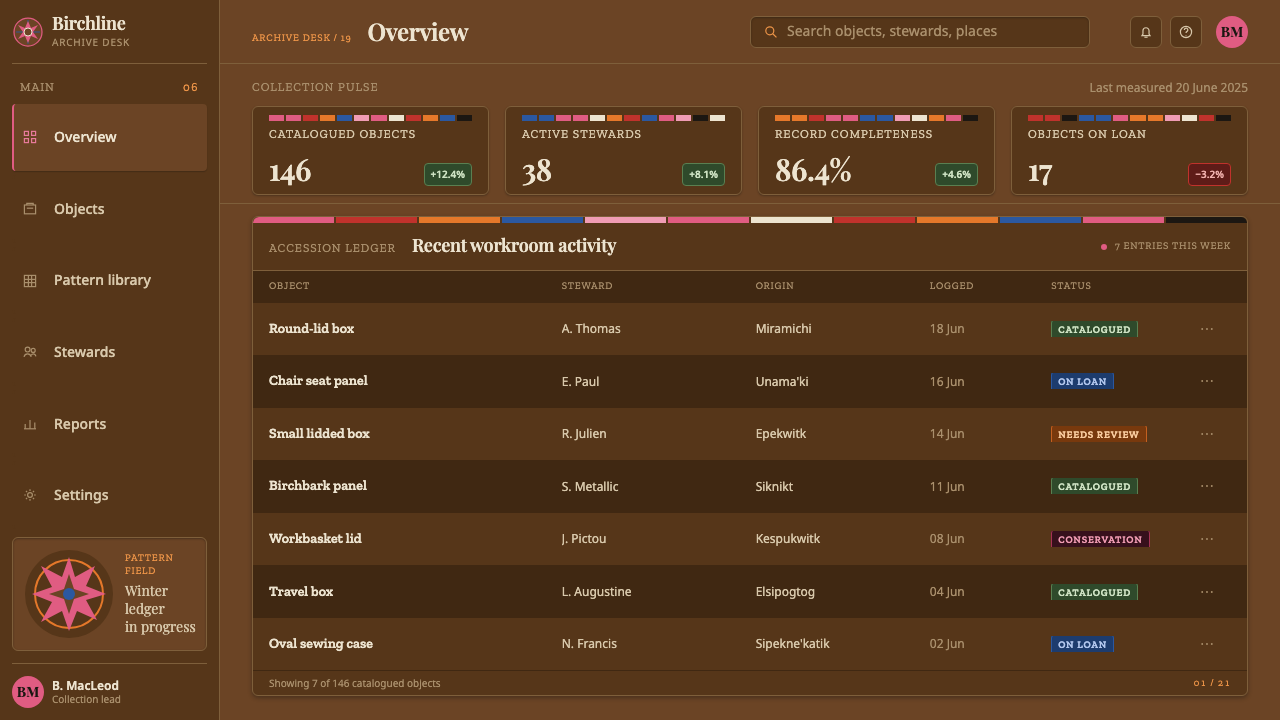
Because the entire system is organized around discrete steps rather than continuous blends, it transfers well to any interface that already thinks in states rather than gradients — progress indicators, tier badges, achievement systems, or any dark-mode product that wants a bold, culturally distinctive alternative to a soft neon glow.
On presentation slides, the style suits a cover built around a centered, radiating motif — a star or burst pattern in stepped color bands, with the title placed at or near that visual center rather than in a conventional upper-left position. Content slides should organize information radially or in concentric groupings where the structure supports it, rather than as a plain top-to-bottom bulleted list, and data works best as ring-based or radial charts — a concentric progress ring or a spoke chart — echoing the same structural logic as the decorative motif itself.
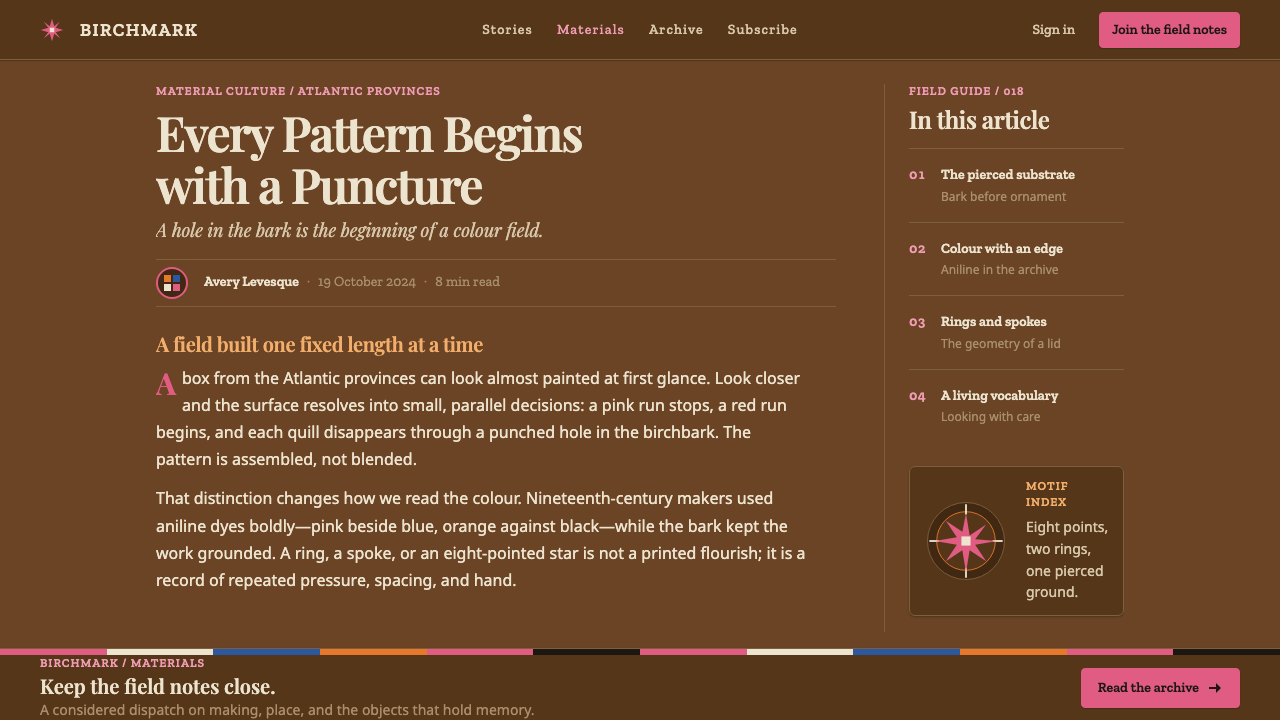
For web interfaces, the palette and structure suit dark-mode dashboards, loyalty or tier systems, and any product surface that wants strong saturated accent color against a genuinely dark ground rather than a mid-gray one. Progress bars and status indicators should advance in visible discrete steps rather than smooth fills, borders should use a banded, stepped treatment instead of a single-color outline, and badges or markers can draw directly on the eight-pointed star as a distinctive focal shape.
In editorial and marketing contexts, the style supports heritage-forward storytelling — campaign pages, packaging, or event branding that want to signal boldness and craft distinctiveness rather than softness. Section breaks work well as full-bleed dark panels punctuated by a single radiating motif, and color should be used the way it is in the source material: assertive, high-saturation, and never blended.
The most common mistake is smoothing the system's stepped color logic into gradients, which erases the exact quality that makes it recognizable and authentic. A close second is using every bright secondary color at once instead of rationing green and blue as rare accents; the system depends on a small set of dominant colors doing most of the work, with everything else appearing only occasionally enough to register as a deliberate event.
Miʼkmaq Quillwork — FAQ
How is Miʼkmaq quillwork different from Plains quillwork or beadwork?
The core difference is structural. Plains quillwork and beadwork are generally sewn onto a soft hide backing, with thread holding each quill or bead in place. Miʼkmaq quillwork instead uses birchbark as a pierced substrate — each quill's ends are pushed directly through small holes punched in the bark, with no hide and no stitching involved. That single technical choice is what forces the tradition's signature stepped, non-blending color logic, since a quill locked into a punched hole cannot be eased into a gradual color transition the way a sewn bead sequence sometimes can.
Can this style work in a light, bright-background product?
It is possible but it works against the grain of the original. The historical palette gets its punch from bright, stepped color set against a dark, near-black birchbark ground — the darkness is doing real work, making each color step register as a distinct, high-contrast event. Moved onto a light background, that contrast logic collapses and the stepped colors read as merely cheerful rather than structurally bold. If a lighter variant is genuinely needed, it works best when at least the focal motif — the star, the radiating bands — keeps a dark surround immediately behind it.
Why does the layout favor radial and concentric structures over a standard left-to-right grid?
Because the physical technique itself builds outward from a center. A quiller working in this tradition typically establishes a focal point — often the eight-pointed star — and fills the surrounding field in rings or radiating spokes around it, rather than working row by row across a rectangular frame the way a woven or printed textile might. A design system drawn from this tradition inherits that same center-outward logic, which is why it reads naturally as radial composition rather than a conventional column grid.
Is this a historical style, or is it still actively practiced?
It is actively practiced today. While surviving nineteenth-century objects — including a dated example in the Winterthur Museum's collection — establish the tradition's long history, quillwork has never stopped being made. Contemporary Miʼkmaw quill artists, working in the same family-workshop tradition that carried the craft through the twentieth century, continue to produce pieces using the same pierced-birchbark technique and the same stepped, radiating color logic described here.
Where does this style struggle?
It struggles in contexts that call for soft, continuous transitions or a minimal, monochrome restraint — meditation apps, quiet luxury branding, or any product where the goal is calm rather than bold declaration. The system's entire visual logic is built on hard steps and saturated color doing assertive work against darkness, which reads as vivid and confident in the right context but can feel visually loud or mismatched wherever subtlety is the actual design goal.
Related design styles
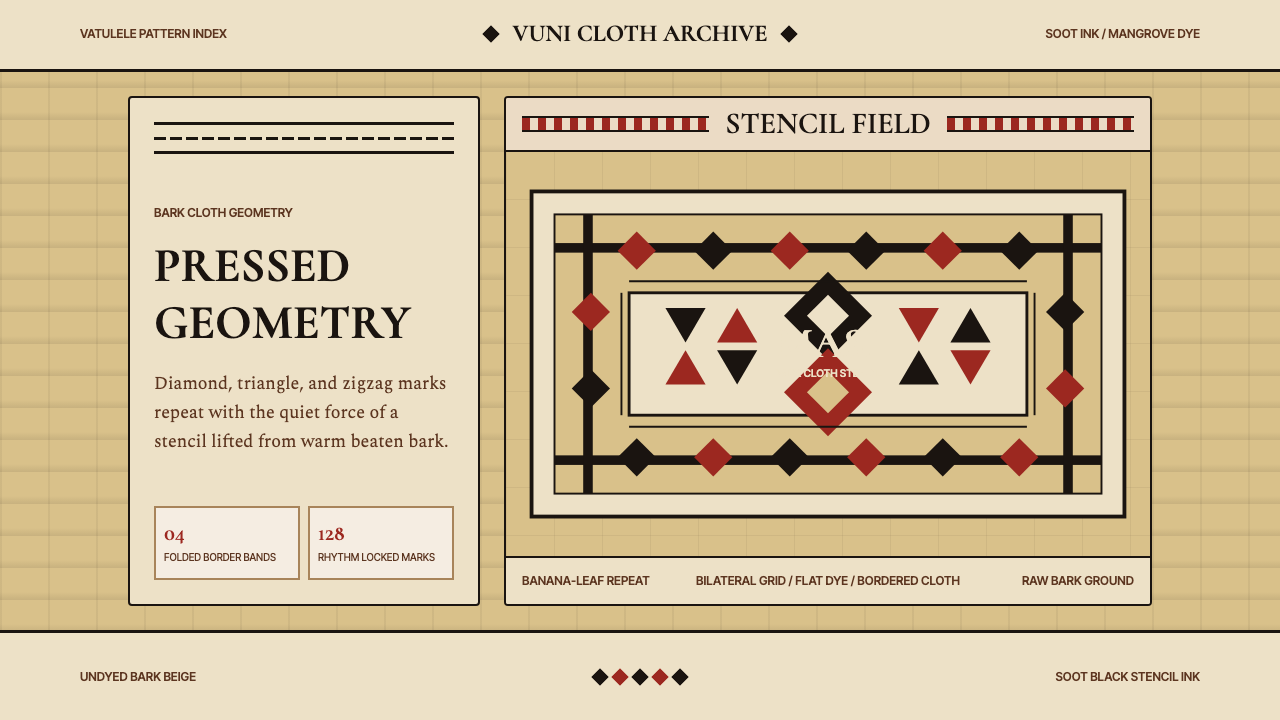 Fijian Masi Tapa StencilGeometry keeps ceremony. Soot-black diamonds repeat on bark beige with rust-r…
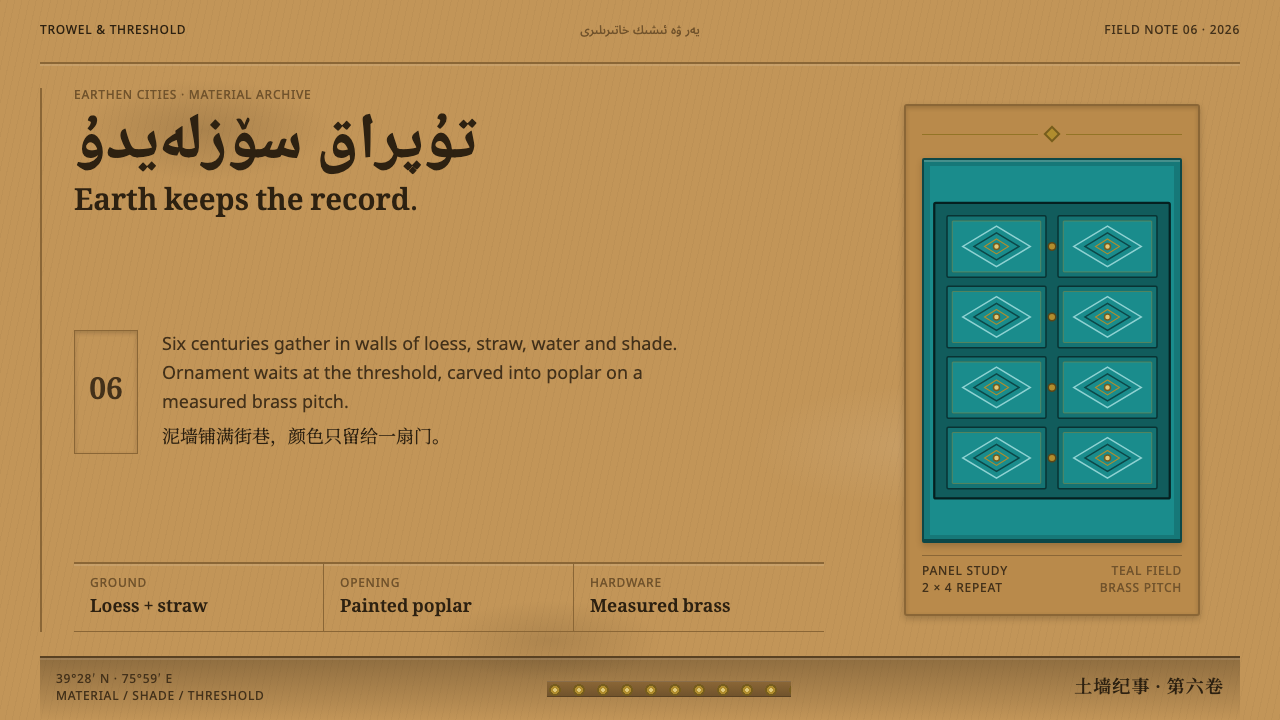 Kashgar Old TownEarth holds the field; ornament waits at one teal door, cut in a strict brass…
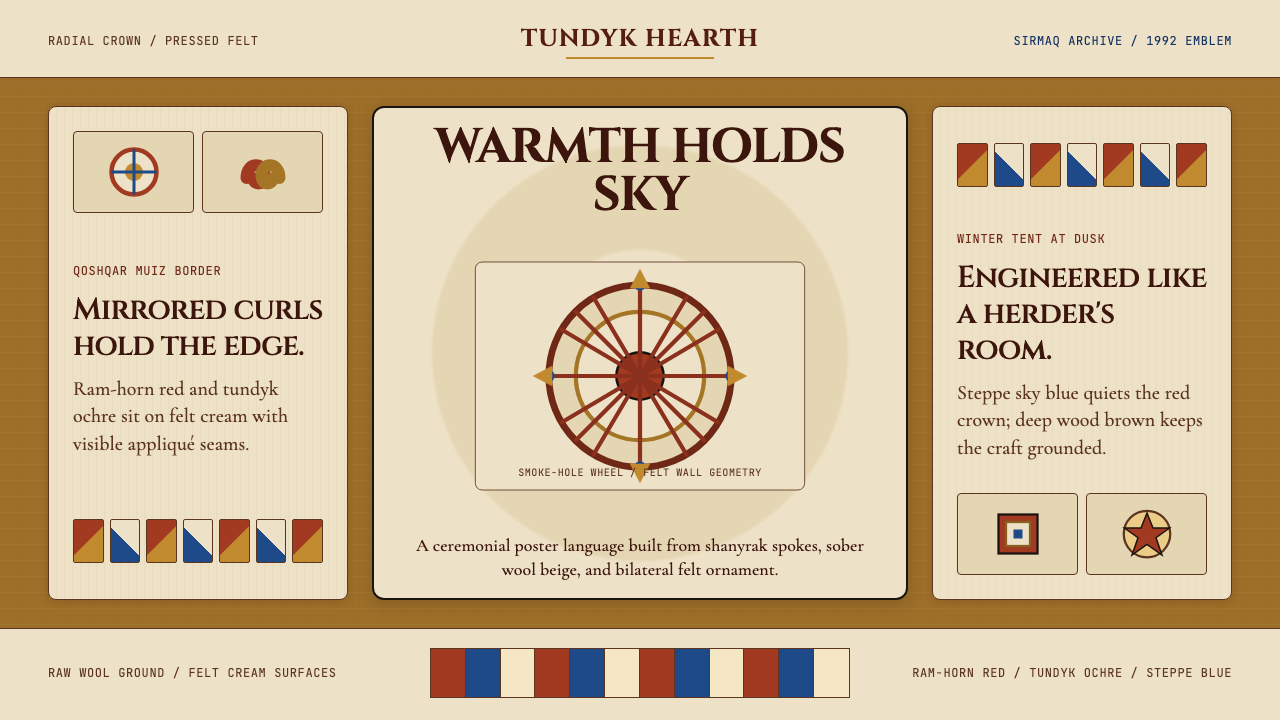 Kazakh Shanyrak Yurt FeltDomestic warmth, engineered. Ram-horn red felt curls around a radial shanyrak…
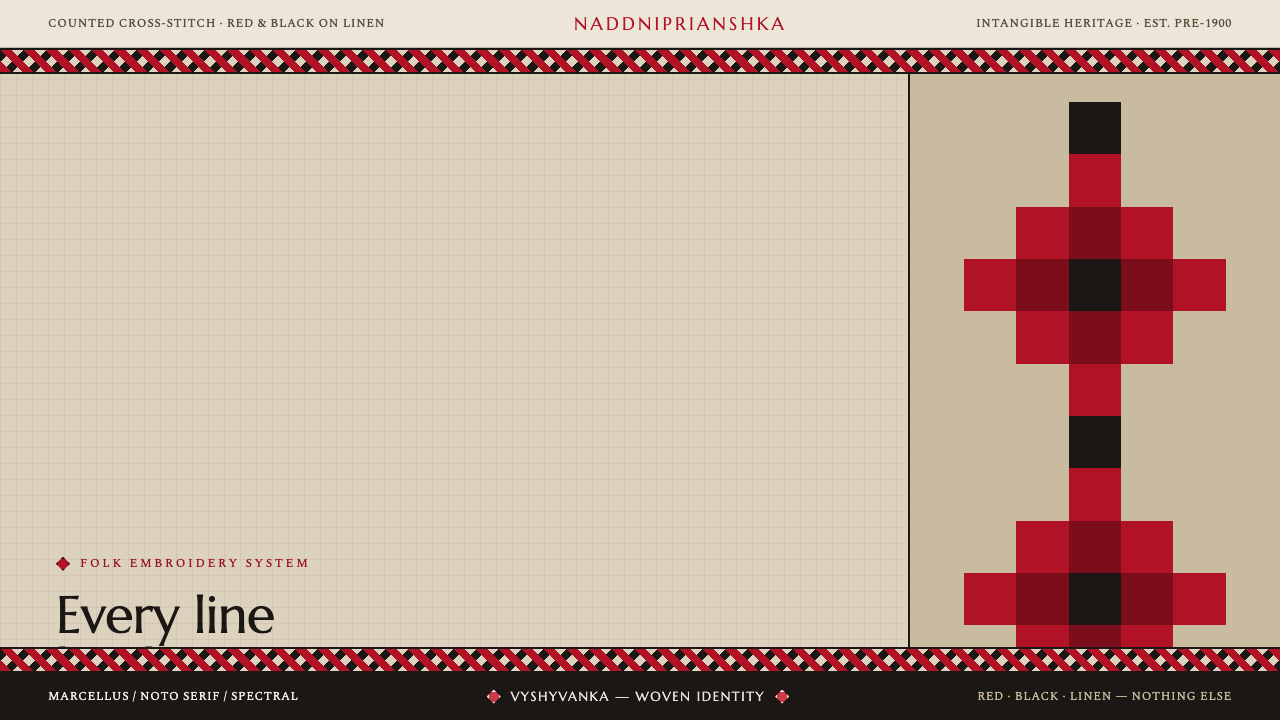 Ukrainian Vyshyvanka EmbroideryRed is life, black is protection. Stepped rhombus motifs counted thread by th…
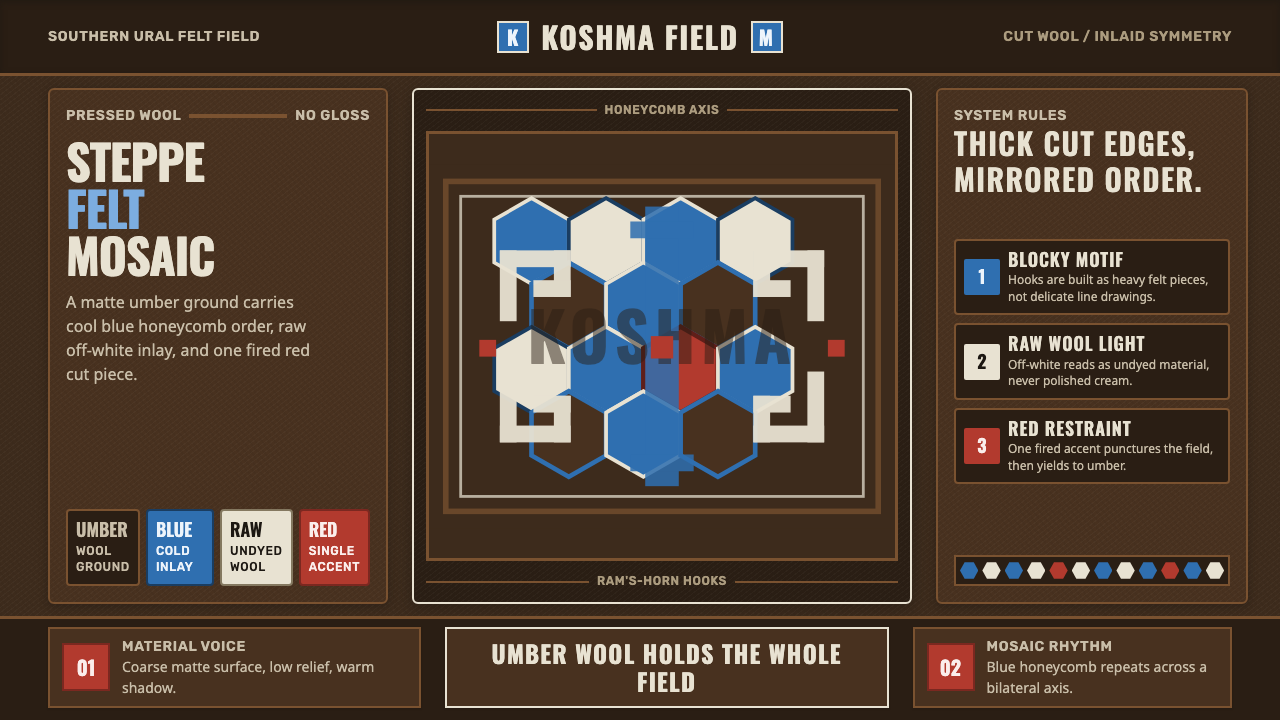 Bashkir Honeycomb Felt OrnamentSteppe craft feels weighty. Umber felt holds blue honeycomb and raw-wool hook…
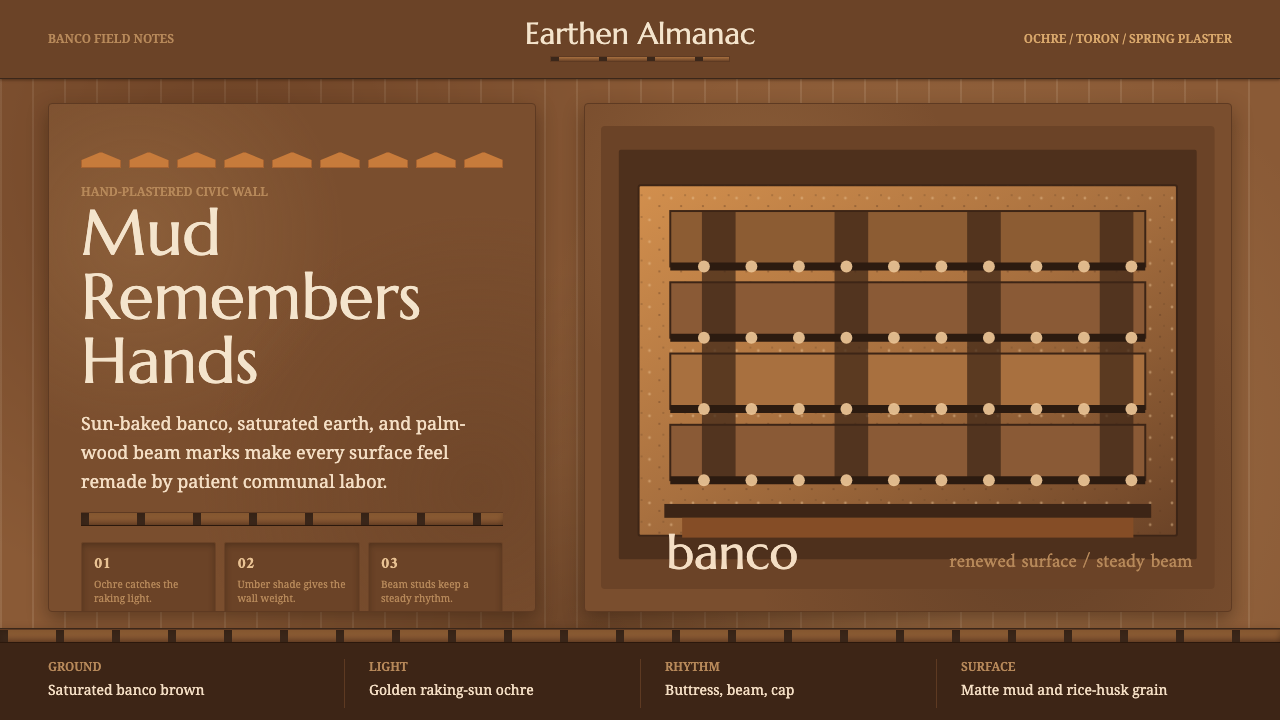 Djenné Mud MosqueBuilt from renewal. Banco brown, ochre caps, and toron grids feel hand-plaste…