What is Mexican Lotería Folk Card?
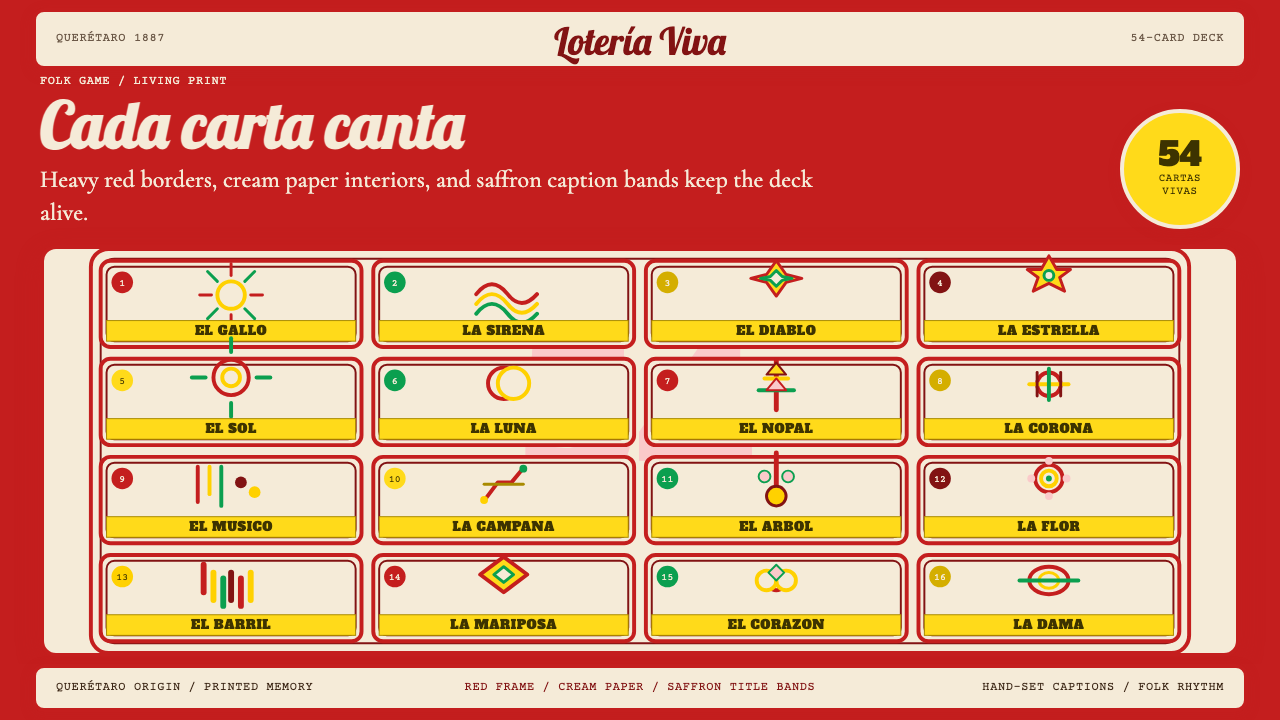
Fifty-four hand-called picture cards turned a folk bingo game into Mexico's most beloved visual ritual — and one of the richest folk-art design systems ever codified.
Mexican Lotería Folk Card in brief
Mexican Lotería is a folk game played with a deck of 54 picture cards — La Luna, El Corazón, El Borracho, La Sirena — each depicting an archetype from Mexican daily life, mythology, and natural world. A caller known as the cantor draws cards at random and improvises rhymed couplets or riddles that describe each figure without naming it outright, while players mark their tablas (bingo boards) with beans or coins. The game is not merely entertainment; it is a living transmission of folk proverbs, regional humor, and collective memory.
The design language of Lotería is instantly recognizable and tightly codified. Each card presents a single central figure rendered in flat, lithographed color against a cream ground, framed by a heavy ornamental border in deep red. A caption band — traditionally rendered in ochre or saffron — carries the card's name in bold serif lettering at the foot of the image. There is no gradation, no shadow that simulates depth, no naturalistic background: the figure exists as pure archetype, isolated and iconic, like a folk saint on a tile.
The Lotería deck functions as a complete visual vocabulary. Its palette — cream, vermilion border, saffron caption band, and the flat, expressive colors of the figures themselves — is not decorative in the casual sense but liturgical: these colors were chosen to evoke the hand-painted devotional objects, retablo ex-votos, and papel picado banners that surround the game in the festival context where it is most often played. Applying this design system means inhabiting that ritual atmosphere — warmth, clarity, and a kind of cheerful solemnity at once.

Where does Mexican Lotería Folk Card come from?
The word lotería derives from the Italian lotteria, itself from the Old Germanic hlut (lot, fate), reflecting the game's European origin. Lottery-style games arrived in New Spain during the colonial era, likely in the late eighteenth century, introduced by Spanish administrators who brought the practice from the Italian and Spanish royal courts. Early colonial lotería used playing-card suits and was associated with gambling among the urban elite — a far cry from the democratic folk game it would become.
The pivotal transformation came in 1887, when Don Clemente Jacques, a Franco-Mexican entrepreneur based in Querétaro, commissioned a standardized deck for the game that would become the definitive popular edition. The Jacques deck codified the 54-card structure, the flat-color lithographic figures, the vermilion ornamental border, and the saffron caption band that remain canonical to this day. Continuous production from 1887 through the present — with the Pasatiempos Gallo company eventually acquiring the brand in the twentieth century — meant that the Jacques aesthetic became the shared visual memory of generations of Mexican families.
The post-revolutionary period (roughly 1920 to 1940) was decisive for Lotería's cultural status. As Mexico's government promoted folk art as a vehicle for national identity — a project championed by muralists, the Ministry of Education under José Vasconcelos, and a generation of intellectuals — the Lotería deck was reframed not as a gambling novelty but as an encyclopedia of Mexican popular archetypes. El Charro, La Calavera, El Nopal: these images were read as distillations of lo mexicano, the essence of Mexican life. The game moved from market stalls and cantinas into schools and family homes.
In the latter half of the twentieth century, Lotería iconography crossed the border with Mexican diaspora communities and became a central visual language of Chicano-American identity and art. Artists such as Carmen Lomas Garza and Yolanda M. López reinterpreted the traditional cards — replacing archetypes with Chicana women, barrio scenes, and political subjects — demonstrating the deck's adaptability as a critique and reclamation tool. Today the Lotería card format is used by artists, educators, activists, and designers worldwide, far beyond its original game context, as a frame for any content that benefits from the combination of iconic clarity, folk warmth, and ritual seriousness the format naturally conveys.
What defines the Mexican Lotería Folk Card look?
Color Palette
The Lotería palette is warm, limited, and purposeful. Cream or aged-ivory serves as the card ground, evoking the uncoated printing stock of the original lithographic editions. The border is rendered in a deep, assertive red — closer to vermilion than crimson — that frames each card as a stage. The caption band reads in ochre or saffron, a warm golden yellow that sits between the red border and the figure without competing. The figures themselves use a small set of flat, fully saturated colors — cobalt blues, earthy greens, warm flesh tones, terracotta — never blended, always distinct. Black is used only for outlines and lettering. The overall effect is festive without being garish: each color carries folk-devotional weight rather than purely decorative intent.
Flat Figure Rendering
Every Lotería figure is rendered in flat color without shading, modeling, or cast shadows. This is not a technical limitation but an aesthetic inheritance from the devotional image tradition — retablos, ex-votos, and painted saints — where flatness signals sacred rather than secular representation. The figure occupies the card plane as an emblem rather than as an illusion of a three-dimensional object. Outlines are drawn boldly, contours are decisive, and interior color areas are cleanly separated. The resulting images have the visual authority of stamps or seals: immediately legible at a small scale, impossible to mistake.
Ornamental Border
The heavy red border is not merely decorative — it is structural, functioning as the architectural frame that distinguishes the Lotería card from all other card formats. The border typically features a repeated foliate or geometric motif drawn from the vocabulary of nineteenth-century commercial lithography: scrollwork, small rosettes, geometric interlocking patterns. The border weight is substantial enough to be read as a frame rather than a line, giving each card the formal gravity of a framed print or a votive panel. This border convention is the single element most consistently reproduced in contemporary Lotería-inspired design.
Caption Band and Serif Lettering
The ochre or saffron caption band at the foot of each card serves a dual function: it separates figure from border and it presents the card's name in bold, hand-set or lithographically rendered serif type. The letterforms are broad, sturdy, and legible at the small scale of the printed card. They carry the quality of proclamation — not the quiet annotation of a museum label but the confident declaration of a street-market crier. The caption and figure together are designed to be read as a unit: the name completes the image, and the image illustrates the name. Neither is subordinate.
Archetype as Subject
Each of the 54 Lotería cards depicts not a specific individual but a cultural archetype — the drunkard, the mermaid, the soldier, the ladder, the sun, the moon, the world. The design convention demands that each figure be rendered with maximum iconicity: readable not only as a picture of a particular object but as the idea of that category. This commitment to the general over the specific is what gives Lotería imagery its staying power. The designs do not date because they do not reference a particular moment; they reference a permanent type. Contemporary use of this system inherits this principle: content should be iconic and categorical rather than illustrative and particular.
Folk-Devotional Warmth
Perhaps the most difficult quality to articulate but the most important to preserve: the Lotería aesthetic carries a particular emotional register that can be described as cheerful solemnity. The warm ground, the ritual colors, the bold but human-scaled figures — together they produce a feeling akin to looking at an altar decorated for a village fiesta rather than at a fine-art print. This warmth is not sentimentality; it is structural. It comes from the folk-art tradition of making serious things beautiful and accessible, of treating everyday objects as worthy of sacred framing. Any application of this style that loses this warmth in favor of pure graphic slickness will feel like a copy of the surface without the soul.
Compositional Centering
Unlike Bauhaus or Swiss-style work, Lotería composition is strictly centered and symmetrical within the card frame. The figure sits at the visual center, the border distributes evenly on all four sides, the caption band anchors the base. This centering is not a failure of compositional sophistication but a deliberate strategy: the card is an icon, and icons benefit from the visual stability of symmetrical placement. The centered composition also ensures legibility when the card is displayed in any orientation context — table game, wall decoration, print layout, or digital grid.

Who shaped Mexican Lotería Folk Card?
A Franco-Mexican entrepreneur based in Querétaro, Don Clemente Jacques commissioned and standardized the 54-card Lotería deck in 1887 that became the definitive popular edition of the game. His deck established the flat-color lithographic figures, the vermilion ornamental border, the saffron caption band, and the card subjects that remain canonical to this day. By maintaining continuous production from 1887 onward, the Jacques deck transformed what had been a fluid folk tradition into a fixed and shared visual system — effectively becoming the style guide for an entire cultural aesthetic.
A foundational figure in Chicano art, Carmen Lomas Garza used the Lotería card format as a vehicle for depicting Chicana domestic life, family rituals, and barrio community scenes throughout the latter decades of the twentieth century. Her reinterpretations — which retained the bordered card structure and flat-color figure convention while replacing the traditional Mexican archetypes with scenes from South Texas Chicana experience — demonstrated that the Lotería format was not a fixed artifact but a living frame adaptable to new cultural subjects. Her work established a precedent for activist and community-oriented reuse of the design system.
A Chicana artist and activist based in San Francisco, Yolanda M. López produced influential reinterpretations of iconic Mexican imagery — including Lotería-derived formats — that centered Chicana women as subjects of their own visual culture rather than as objects of traditional folk iconography. Her practice of reclaiming and transforming inherited visual systems demonstrated how a design tradition with deep roots in one cultural moment could be appropriated and redirected to serve entirely different political and artistic purposes, without losing the visual legibility that made the original format effective.
The company that acquired the Don Clemente Jacques Lotería brand in the twentieth century and maintained its continuous mass production through the present day. Pasatiempos Gallo is responsible for the ubiquity of the Jacques deck's aesthetic across Mexico and the Mexican diaspora: by producing affordable, widely distributed editions of the standardized deck over multiple generations, the company ensured that the 1887 visual system became the shared visual memory of millions of families. Its stewardship made the Lotería aesthetic into something closer to a public visual commons than a proprietary design.
The 54 subjects of the canonical Lotería deck — El Gallo (the rooster), La Calavera (the skull), La Sirena (the mermaid), El Diablo (the devil), La Luna (the moon), El Nopal (the cactus), and their companions — constitute a collectively authored visual canon. No single artist is credited with the original drawings; they emerged from the interaction between commercial lithography conventions and the folk visual traditions of nineteenth-century Mexico. These 54 archetypes are the most important structural feature of the Lotería design system: they define the principle that each card must be both immediately recognizable and culturally resonant, legible to a child and meaningful to an elder.
How do you use Mexican Lotería Folk Card today?
The Lotería folk-card aesthetic is one of the most warmth-generating design systems available to contemporary work, and its transferability depends on understanding what the format is actually doing: presenting a single, iconic subject within a ritual frame that signals importance, legibility, and folk belonging simultaneously. Applying it correctly is less about copying the exact palette and more about inhabiting the structural logic — centering a clear subject, framing it with authority, labeling it with proclamation-grade type, and deploying the warm color field that gives each element its emotional weight.
For presentation slides, the Lotería frame works powerfully as a cover device or section divider. A cover slide built on this system places a single bold illustration or icon at center, surrounded by the red border treatment, on a cream ground, with the deck or section title reading in the saffron or ochre band at the base — treating the entire slide as a single card. Content slides should carry the aesthetic through warm backgrounds and bordered text regions rather than trying to reproduce the card format literally on every page. Data visualizations in this style benefit from the flat-color, high-contrast approach: each data category receives a distinct folk-palette color, bars and segments rendered cleanly without gradients or drop shadows.
For web interfaces — dashboards, landing pages, pricing tiers, and feature grids — the Lotería system provides a warm and culturally grounded alternative to both cold minimalism and generic illustration styles. Key moves: use a cream or warm off-white as the base surface, not pure white; apply the red border treatment to cards and featured content blocks rather than neutral borders; use the saffron or ochre color as a system accent for calls to action and highlights. Navigation and headings should use sturdy, confident serif type rather than geometric sans-serifs — the folk-card tradition is a lettered one, not a modernist one. Icon elements should be flat and boldly outlined rather than thin-line or gradient-filled.
For editorial layouts and marketing materials — posters, social cards, cultural event promotions, and brand identity work for food, music, or festival contexts — the Lotería system performs at its highest. A poster built on this vocabulary centers its subject boldly, frames it with the border convention, and uses the caption band as its headline treatment, creating an immediate folk-print authority that is almost impossible to achieve with any other design system. The warm palette reads across print and screen without adjustment, and the centering convention works at every scale from a small social card to a large-format banner.
A common mistake when applying this system is flattening it into generic retro illustration: choosing any flat-color style, adding a decorative border, and calling it Lotería. The authentic system is more specific. The border must be ornamental, not geometric or minimal. The ground must be warm, not white or cool-toned. The type must carry weight and proclamatory confidence, not delicacy. The figure must be a type, not a portrait. And the overall palette must evoke the particular warmth of hand-printed devotional objects, not the cheerful brightness of a contemporary graphic poster. Lose any one of these qualities and the result will read as folk-inspired rather than genuinely folk-rooted.
A second common mistake is treating the Lotería format as appropriate for any content regardless of emotional register. This system carries an inherent warmth, festivity, and human scale that makes it well-suited for cultural, communal, and celebratory contexts but potentially awkward for contexts that call for clinical authority, technological precision, or corporate neutrality. A healthcare dashboard or a financial analytics tool built in this style risks feeling whimsical when seriousness is required. The design system is not universally flattering — knowing when its warmth serves the content and when it competes with the content's required register is as important as any execution detail.

Mexican Lotería Folk Card — FAQ
Is Lotería the same as general Mexican folk art, or is it a specific visual system?
It is a specific visual system with a documented origin point — the 1887 Don Clemente Jacques standardized deck — that draws on but is distinct from the broader tradition of Mexican folk art. Not all Mexican folk art uses the Lotería card's particular combination of cream ground, vermilion border, saffron caption band, flat-color centered figure, and bold serif lettering. Other Mexican folk traditions — papel picado, Oaxacan wood carving, Talavera pottery, Huichol yarn painting — are visually distinct and should not be conflated with Lotería aesthetics. Applying this system well means referencing the specific Lotería vocabulary rather than a generalized notion of Mexican folk color.
Can this style work for a dark or night-mode interface?
With significant care, yes — but dark inversion is not native to the Lotería system. The canonical palette is light-ground, and the warmth of the system depends substantially on the cream or ivory base. A dark version must replace the cream ground with a very deep warm brown or near-black with warm undertones — not a cool, technology-blue or neutral grey — to preserve the folk-devotional temperature. The vermilion border reads well on dark grounds. The saffron caption color holds at high contrast against dark backgrounds and becomes the warmth carrier in the absence of the light ground. The most effective dark-mode Lotería variant uses warm-black and terracotta as its structural colors, with saffron as the primary accent.
How do I handle photography or realistic imagery within this design system?
Photography sits uneasily within the Lotería system because the system's power derives from flat, iconic figuration rather than naturalistic representation. When photography is necessary, the most successful approach is to treat it as a flat element: high-contrast silhouettes on a warm ground, aggressive crops that isolate a single iconic gesture or form, or duotone treatments that reduce the image to two of the folk palette's colors. Full-color naturalistic photography placed inside a Lotería-style border without treatment will undermine the system — the photographic depth conflicts with the flat-color field convention. In general, illustration or iconography created in the flat-color Lotería tradition will integrate more successfully than any photographic element.
Is it appropriate for brands outside of Mexican or Latin American cultural contexts to use this system?
This is a genuine question of cultural sensitivity rather than purely aesthetic judgment. The Lotería system is not simply a visual style; it is a living cultural tradition with specific community ownership. Thoughtful use outside its originating culture is possible and has precedent — designers worldwide engage with folk traditions that are not native to their own backgrounds — but it requires awareness of the difference between homage and appropriation. Using the visual system to celebrate or amplify Mexican or Chicano cultural content is clearly appropriate. Using it as an exotic ornamental treatment for content that has no cultural connection risks reducing a living tradition to decorative wallpaper. The more specific and informed the engagement with the system's actual history and meaning, the more likely the result is to be respectful rather than reductive.
What distinguishes a well-executed Lotería-inspired design from a surface-level imitation?
Five markers distinguish authentic engagement from superficial borrowing. First, the ground color: genuine Lotería warmth comes from cream or aged ivory, not white or off-white with cool undertones. Second, the border: it must be ornamental with repeated decorative motifs, not a simple geometric rule or minimalist frame. Third, the figure: it must be a bold, flat, self-contained icon with strong outlines, not a loosely rendered illustration. Fourth, the type: it must be sturdy and proclamatory, not delicate or fashionably thin. Fifth, and most importantly, the figure-caption relationship: the name and image must work together as a unit, each completing the other, as in the original cards. Designs that apply the palette and border while neglecting the iconic figure tradition and the figure-caption pairing will read as decoration rather than as a genuine invocation of the system.
Related design styles
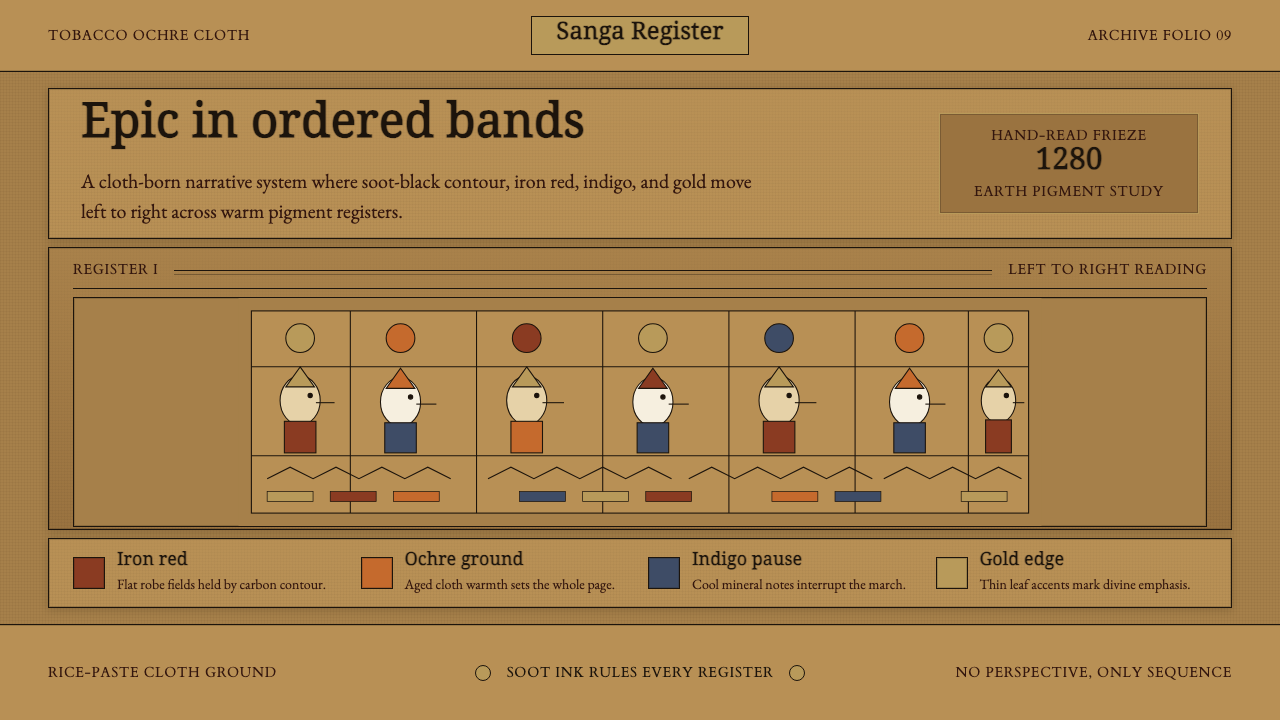 Balinese Kamasan PaintingAncient cloth, ordered as story. Ochre bands, soot outlines, indigo and gold…
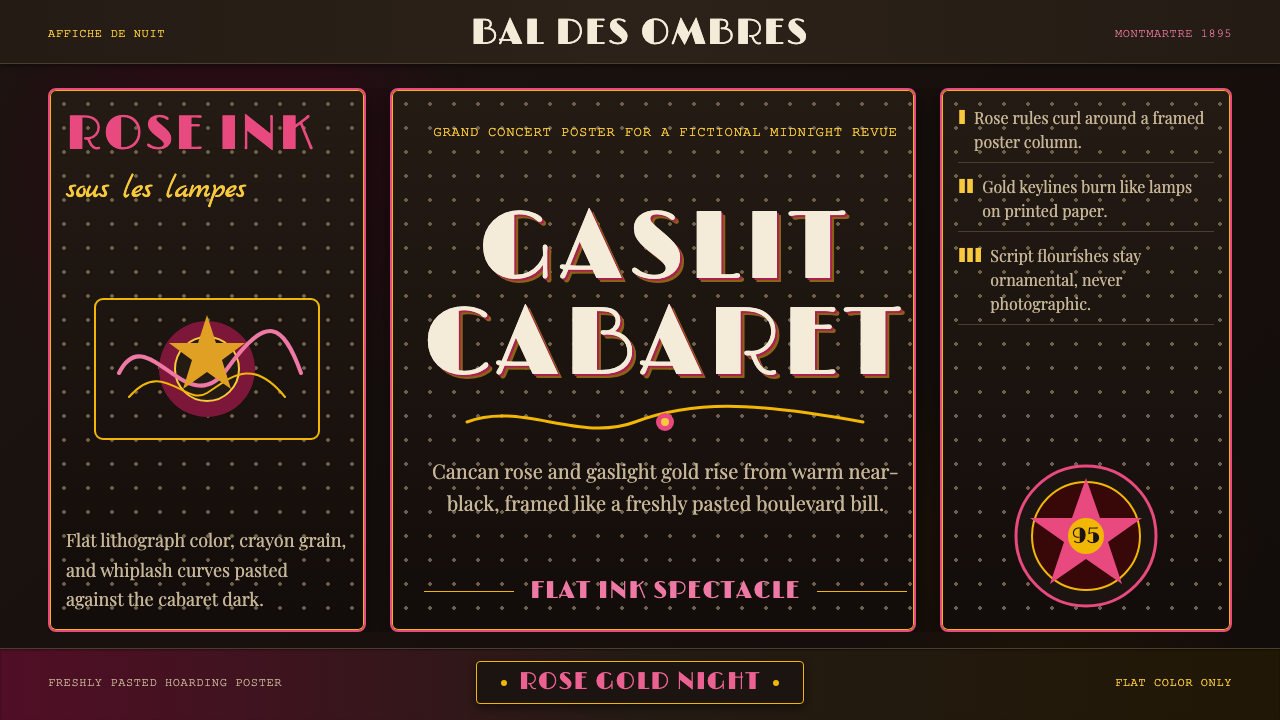 Belle Époque ParisCabaret night glows. Rose ink and gaslight gold curl across warm near-black p…
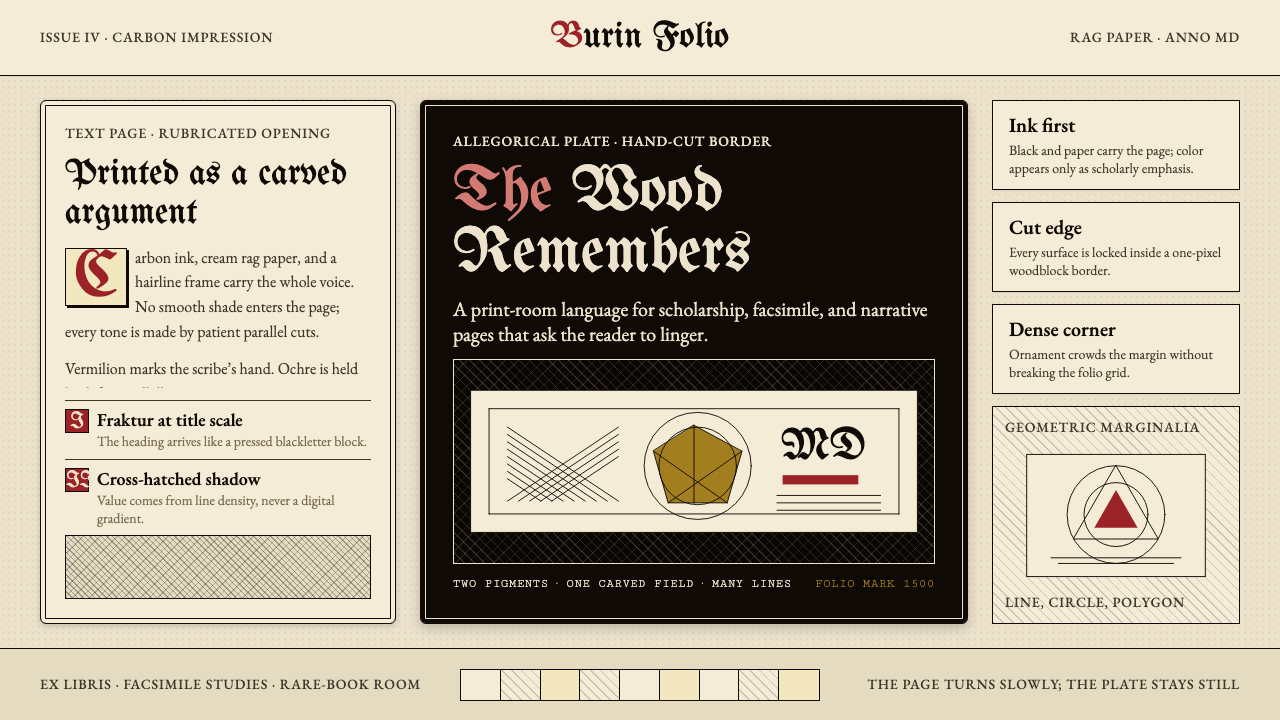 Dürer WoodcutInk remembers everything. Fraktur titles, rag-paper cream, and cross-hatched…
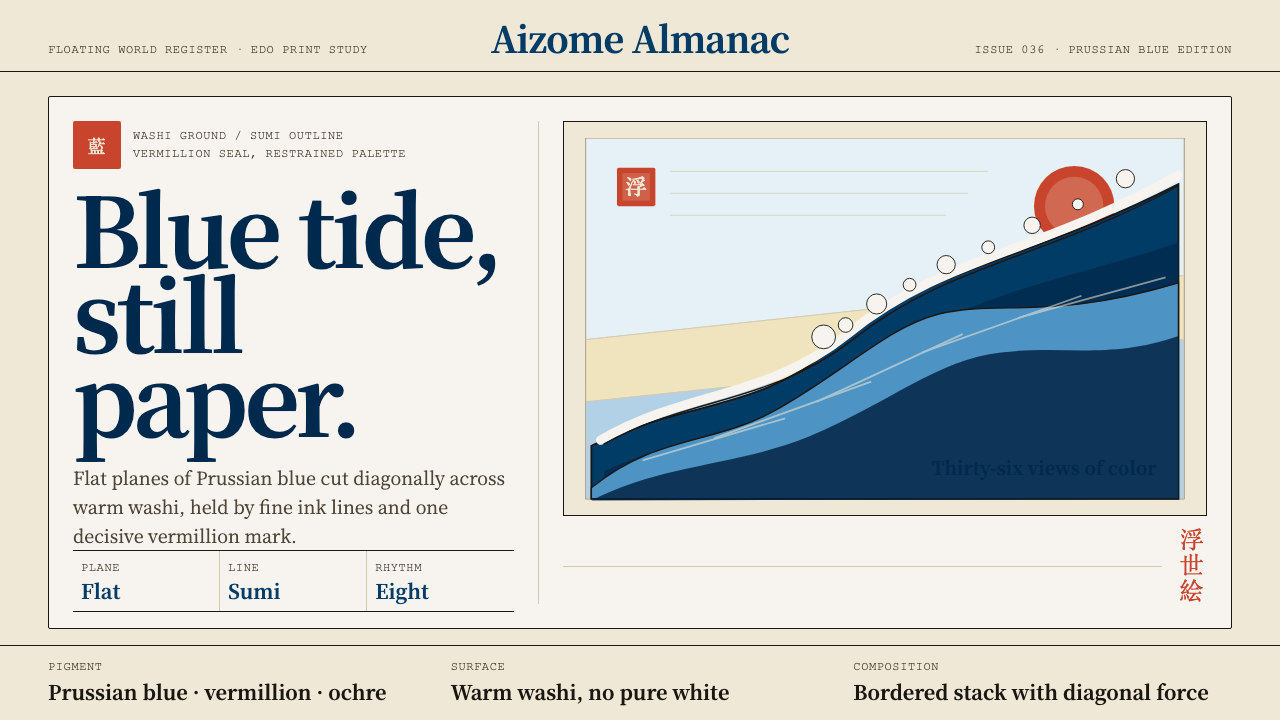 Edo Ukiyo-e (Hokusai)Flat power on paper. Prussian blue diagonals and vermillion seals cut across…
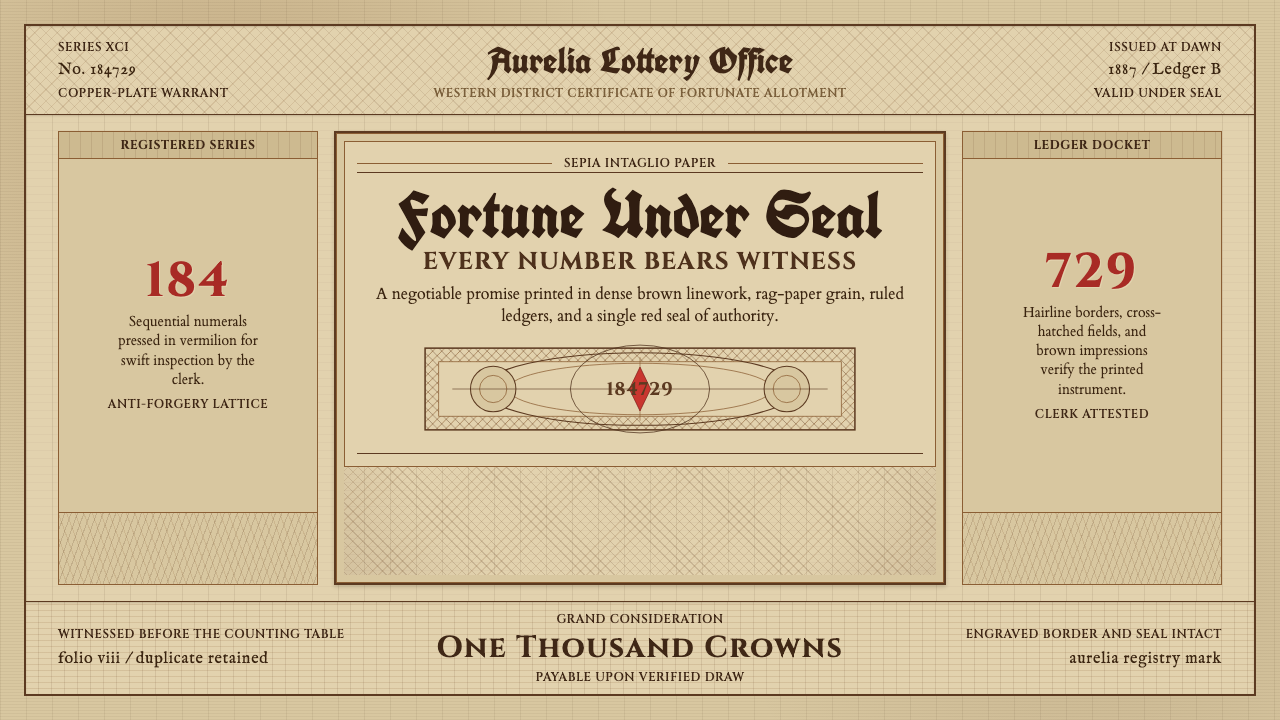 Engraved Lottery TicketLegal gravity in sepia. Guilloche borders, blackletter type, and a vermilion…
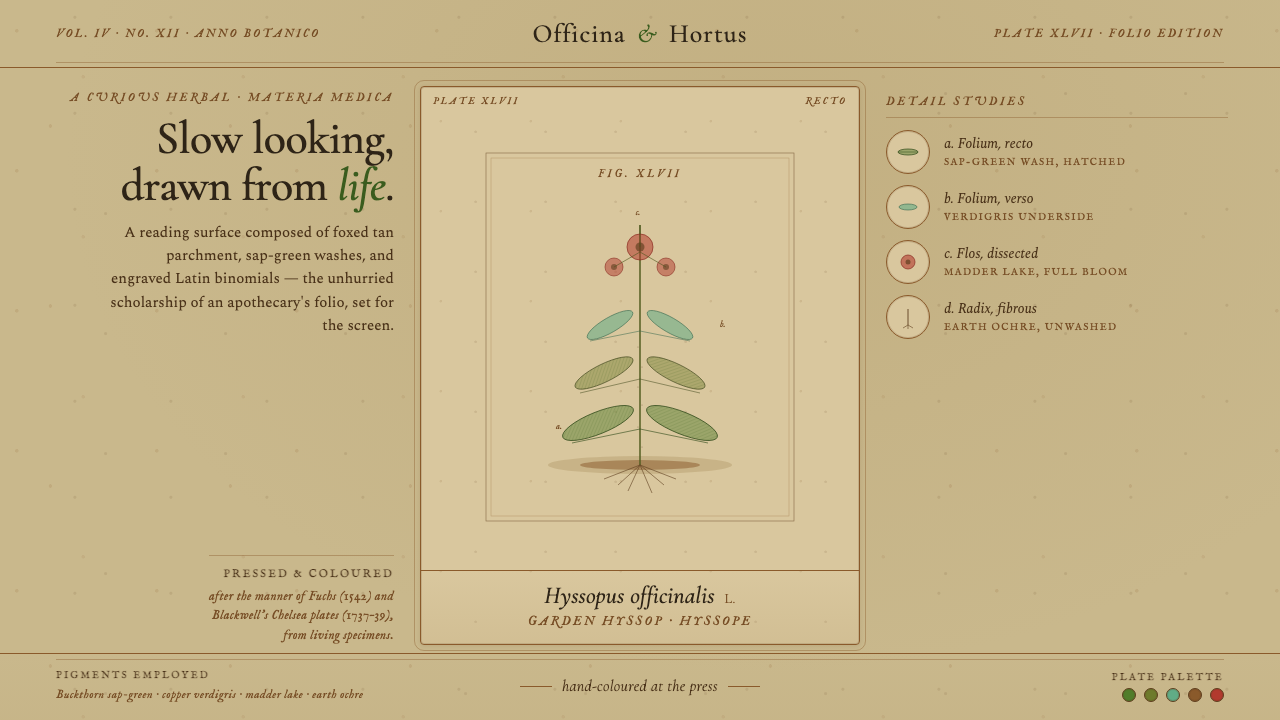 Herbal PharmacopoeiaSlow scholarship of the apothecary folio. Foxed tan parchment, sap-green wash…