What is Masuleh Stepped Village?
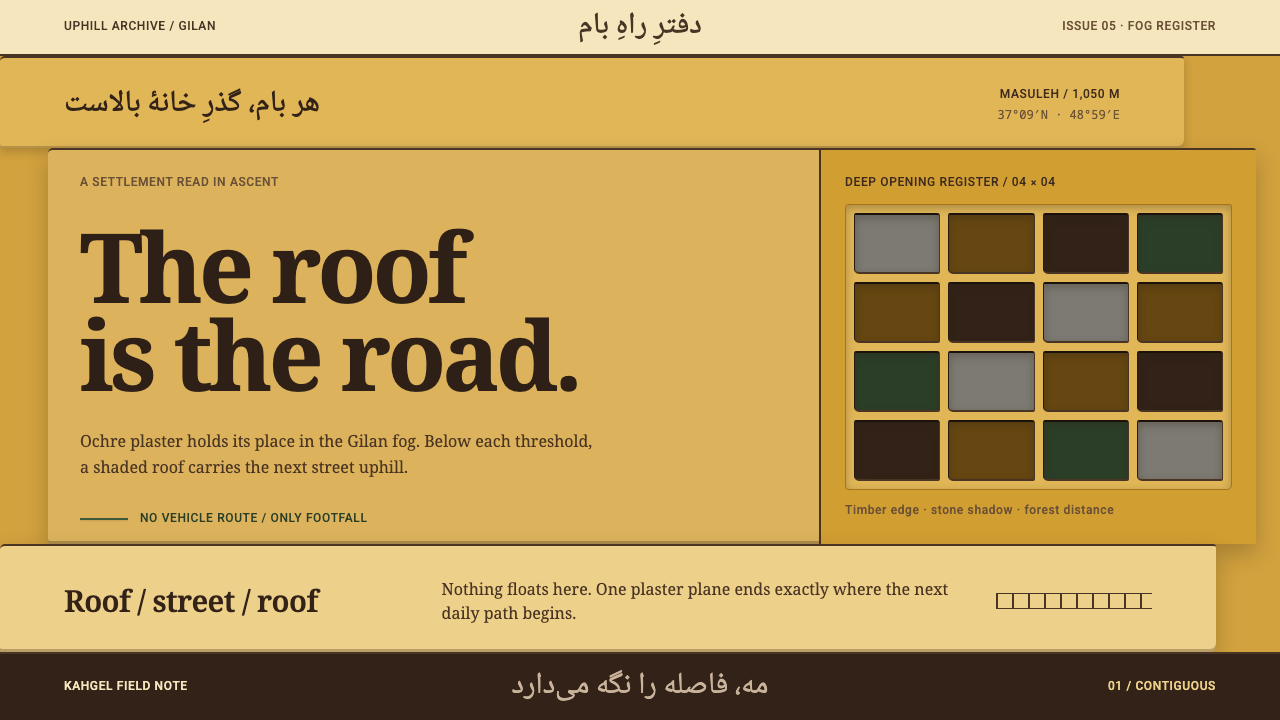
Masuleh is built so tightly into its slope that every roof is the street above — ochre against fog, dark timber against clay, a village made to stay readable inside the mist.
Masuleh Stepped Village in brief
Masuleh Stepped Village is the visual language of a mountain settlement in Gilan province, in north-west Iran, in the western Alborz above the Caspian littoral. The houses are stacked up the slope so closely that the roof of one is the street of the level above. The village is known as the one place in Iran where motor vehicles are banned outright, and the reason is simple geometry: there is no road, only terraces and the steps between them. It is architecture as terrain.
The style turns that way of building into rules. Horizontal bands are stacked and offset, contiguous rather than floating, and edged with dark stained timber. Openings are small and deeply recessed. Walls read as thick, light enters sparingly, and shadow seems to grow out of the wall rather than fall onto it. Nothing is machine-straight, corners are blunt and rounded as though plastered by hand, and the distance always fades into mist.
Colour is a working decision, not a decorative one. Mud brick and local stone are coated in kahgel, an ochre clay plaster, and the yellow keeps the village readable inside near-permanent Gilan fog. The resulting tonal family is warm and earthy: ochre and clay for the walls, dark brown timber for the edges, and a soft grey-green haze for everything that lies further away. The mood is quiet, dense and sheltering, a style that holds a lot in a small space without raising its voice.

Where does Masuleh Stepped Village come from?
Masuleh has roughly a thousand years of continuous settlement behind it, and the style is therefore dated simply as pre-1900. The village sits on a steep slope of the western Alborz above the Caspian littoral. On ground like that, flat land is scarce, so building goes up in steps. Each level borrows from the one beneath it, and the roof of a lower house is the walkway of the house above. The settlement pattern is not a plan imposed on the hill; it is what the hill allows.
The materials are the hillside itself. Walls are mud brick and local stone, and they are coated in kahgel, an ochre clay plaster. Because the plaster is clay, it shares its substance with the wall rather than sitting on it like paint, and the surface shows the slight irregularity of work done by hand. Dark stained timber appears where wood meets weather: edging, porches and lattice windows, darkened by rain over time. Openings are small and recessed deep in the thickness of the wall, which keeps interiors sheltered and gives the exteriors their characteristic shadow, a shadow that comes from depth rather than from a light source.
Climate set the colour. Gilan lies under near-permanent fog, and in fog a pale or grey village disappears. The ochre of the kahgel plaster is a working decision: it keeps the buildings legible against mist, so a visitor or a resident can still find the shape of the slope. That is why the system treats colour as a way of staying visible, not as a mood board. It is also why distant layers in the style are allowed to fade while nearby ones stay clear, since this is how the village is actually seen.
No single architect is credited, and that is part of the point. The record points to the builders of the Masuleh terraces and to the Sar-Aqa-Seyyed stepped-village tradition, a body of shared practice in which a village is made from the same few moves repeated with local variation. Three overlapping currents run through it: Iranian vernacular mountain architecture, kahgel clay-plaster building, and a settlement logic in which the rooftop is also the street. Together they explain why the style has a strong structure and almost no signature.
What defines the Masuleh Stepped Village look?
Stepped Bands
The basic unit is a horizontal band, and bands are stacked upward with each one offset from the one below, like terraces climbing a slope. The offset is what creates the village's silhouette: no two levels align exactly, and the stack leans and steps instead of rising in a clean column. In layout terms, this means content lives in wide horizontal strips whose left and right edges shift from level to level.
Contiguity, Not Floating
Every band touches its neighbours. Nothing hovers above the surface as a separate card with a soft halo; each piece rests on the piece below it, the way each house rests on the roof of the one beneath. The effect is of a continuous mass cut into levels, and it makes the page feel built rather than assembled. Gaps, where they exist, are lanes between volumes, not air around objects.
Kahgel Ochre
The dominant colour is the ochre of clay plaster: warm, earthy, slightly dusty, and varied in tone from wall to wall as hand-applied coats always are. It is not a bright signal yellow. It reads as a mineral colour that has taken on the light of the hills, and its job is to hold the village together against fog. Surrounding it, clay browns and muted greys keep the palette in one family.
Dark Timber Edge
Where the clay stops, dark stained timber begins. Edges, lintels, porches and lattice windows carry a deep brown that has been darkened by weather. This dark edge is the style's linework, the only strong contrast in an otherwise soft field. It outlines levels, frames openings and gives the stack a skeleton, so it should be used with intention and not sprinkled across the page.
Small, Deep Openings
Windows and doors are small and set deep in thick walls. The interior is sheltered, little light gets in, and the shadow inside each opening is dense and soft-edged. In interface terms, this favours compact controls and inset treatments over wide, airy apertures, and it argues for letting darkness collect inside a recess rather than casting a shadow outwards.
Hand-Plastered Softness
Nothing is machine-straight. Corners are rounded and blunt, as they are when clay is smoothed by hand, and edges wander slightly. The line of a wall may drift a little off true. The softness is not a rounded-button trend; it is the physical record of plaster being trowelled over uneven stone and brick, and the system should show that unevenness as fact, not as a filter.
Mist Depth
Depth is handled by haze. Layers close to the viewer are clear, saturated and crisp in their dark edges; layers further away lose contrast and colour and dissolve into grey-green mist. This is the mountain village's way of seeing and is quite unlike the sharp, flat horizon of a city skyline. It gives the style a quiet atmospheric depth without needing shadows, glows or glossy effects.

Who shaped Masuleh Stepped Village?
The record gives no individual architect for Masuleh, only its builders, the people who stacked brick and stone up the slope and plastered it in clay. Their decisions are visible everywhere: where a roof becomes a street, how deep a window sits, how far one level steps back from the next. Treating them as the authors of the style keeps the system honest about its source, a body of collective craft knowledge and not a single signature.
This is the tradition of stepped-village building that Masuleh belongs to. It is less a person than a way of settling a slope: levels that share walls and roofs, a rooftop that doubles as a street, materials taken from the hill itself. The name marks a lineage of practice rather than a biography, and it is the closest thing the style has to a school.
Masuleh sits within a wider tradition of Iranian building in mountain terrain, in which settlements are shaped by slope, weather and local material. The style inherits its respect for thick walls, small openings and responsive siting from this tradition. When a design uses the Masuleh system, it is quoting a regional approach to climate and ground, and it should do so with the same practical seriousness.
Kahgel is the craft behind the village's colour: an ochre clay plaster applied to mud brick and local stone. It is both a technique and a palette, and the two cannot be separated, because the yellow of Masuleh exists only as the colour of a particular clay. Whenever the style needs a warm, matte, hand-applied surface, this is the reference to return to.
How do you use Masuleh Stepped Village today?
Masuleh Stepped Village is a good fit for work that wants to feel grounded, sheltered and made by hand. Its principles are structural: stack, offset, touch, recess and fade. Applying it well means thinking of the page as terrain, with levels that rise and rest on one another, rather than as a set of free-floating components.
For presentation slides, a cover can be built from three or four offset ochre bands rising from the lower edge, edged with a dark timber line, with the title set in the open space above them as if against a misty sky. Content slides work well with a stepped layout in which each key point sits on its own band and the bands shift slightly from row to row. Data slides can use stepped or terraced charts, area graphs with a clear dark edge, and a haze treatment for background series so the highlighted series stays clear.
For web interfaces, the style suits hospitality, travel, architecture, cultural heritage, outdoor and slow-living products, and any service that wants to feel local and trustworthy. Build sections as contiguous bands with no floating cards, let the dark timber edge act as the divider and the focus outline, and keep controls compact and inset. Pricing tiers can climb like terraces, each higher tier rising one step from the last. Navigation can be typographic and low-key, since the style does not need ornamental icons.
For editorial and marketing work, Masuleh supports long-form photography essays, regional guides and brand stories about craft and place. A layout can step its text blocks in the same way the village steps its houses, with pull quotes inset like recessed windows. Photographs should be warm and slightly hazy, and captions can sit on a dark timber strip. The style's quiet density holds a lot of material without feeling crowded, as long as each level has its own clear purpose.
The most common mistake is to treat the style as an excuse for a pretty yellow-and-brown palette while keeping floating cards, soft shadows and perfectly straight lines. That loses everything that makes Masuleh itself. Another error is to use a bright, saturated signal yellow instead of a clay ochre, which turns a mineral village into a warning sign. A third is to bury the page in fog: haze belongs to distant layers and backgrounds, and the text in front must always stay crisp and readable.

Masuleh Stepped Village — FAQ
Why is the Masuleh palette so yellow?
Because the village is coated in kahgel, an ochre clay plaster, and that colour is a working decision. The Gilan fog is near-permanent, and a yellow wall stays readable inside it where a pale or grey one would vanish. The yellow is therefore functional first and aesthetic second. In design terms, it is a reminder to choose a dominant colour for its legibility in the real viewing conditions, and to keep it earthy and matte rather than turning it into a loud signal colour.
What is kahgel?
Kahgel is an ochre clay plaster used in the Masuleh area to coat mud brick and local stone. In spirit it is a coat that belongs to the wall rather than a paint laid over it, and it carries the slight irregularity of hand application. In the design system, kahgel stands for a matte, warm, earthy surface with variable tone and no gloss. It is the reason the style feels material rather than synthetic.
Why does the style avoid floating cards and soft shadows?
Because in Masuleh nothing floats. Every house rests on the roof of the house below, and every wall touches its neighbour. Floating cards with halo shadows invent a gap and a light source that the village never had. The style asks for contiguous bands that rest on one another, with shadow coming from depth inside a recess rather than from a light cast outwards. This makes pages feel built and grounded, which is the whole emotional point of the system.
Can the style work with a dark background?
The system is built on light, matte, ochre-and-clay surfaces seen through mist, so its natural mode is light. A night variation is possible if you treat the village after dusk: dark timber brown becomes the ground, ochre appears as lit wall faces, and the haze turns into a deep grey-green. The key is to keep the stepped, contiguous structure and the matte surface. If a dark version starts to rely on glows and bright accents, it has stopped being Masuleh.
Where does the Masuleh style struggle?
It struggles in contexts that demand sharp precision, high-energy brightness or a futuristic feel: trading screens, gaming, neon-driven entertainment and anything that depends on razor-straight geometry. It can also be too soft for tiny, dense control panels where every pixel of contrast matters. It is strongest for products about place, craft, hospitality, shelter and slow attention, where a sense of being grounded is a feature rather than a limitation.
Related design styles
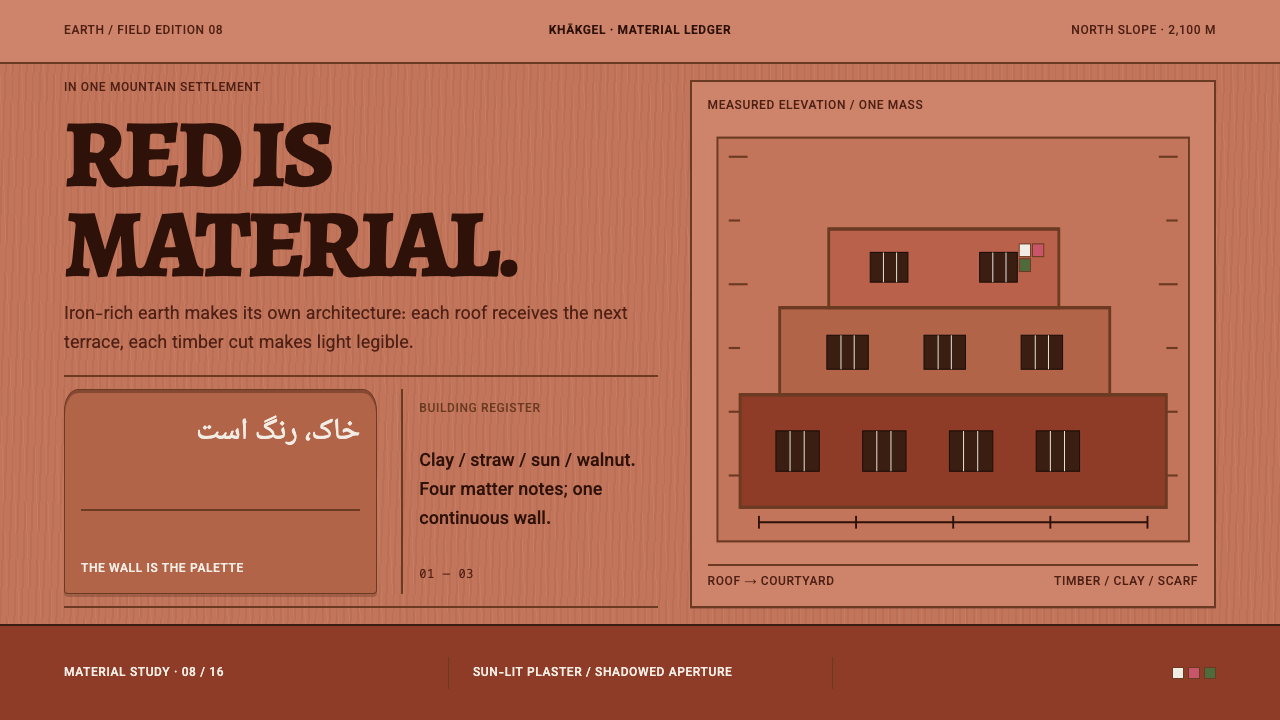 Abyaneh Red VillageRed is material, not decoration. Stepped clay bands and dark timber apertures…
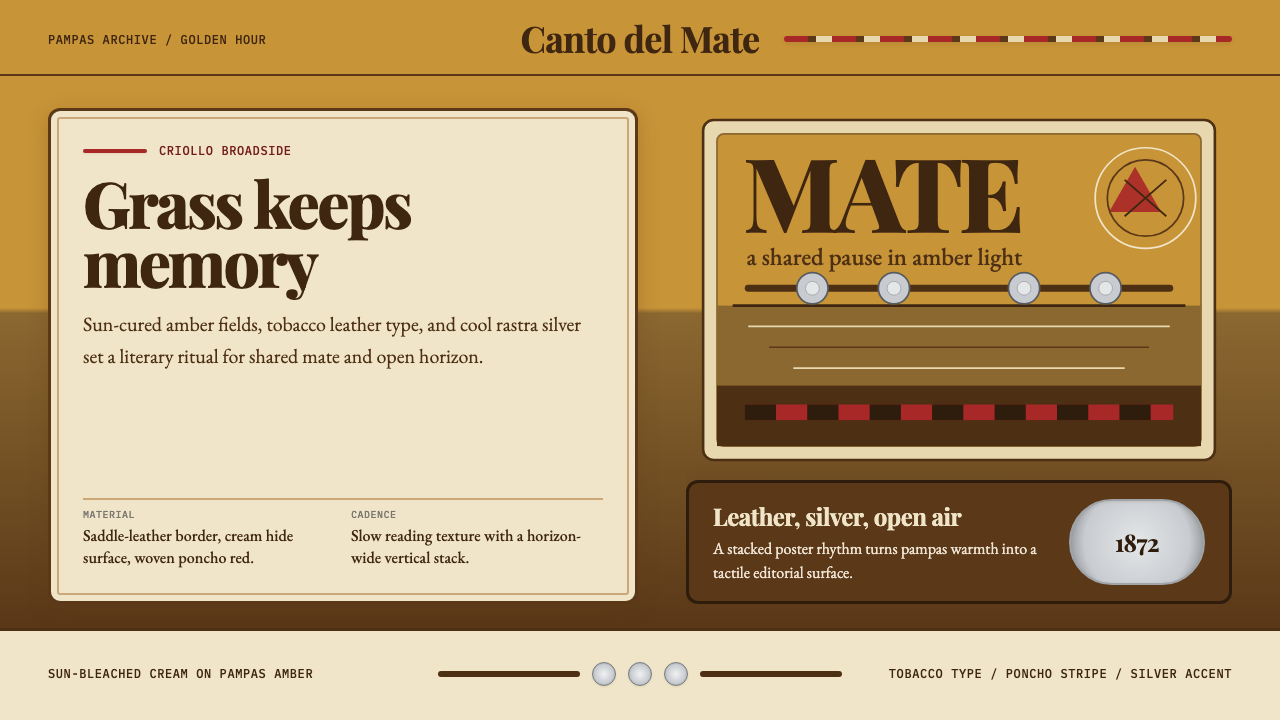 Argentine Gaucho (Pampas Mate Culture)Open grassland, printed warm. Amber fields, Playfair serif, and silver rastra…
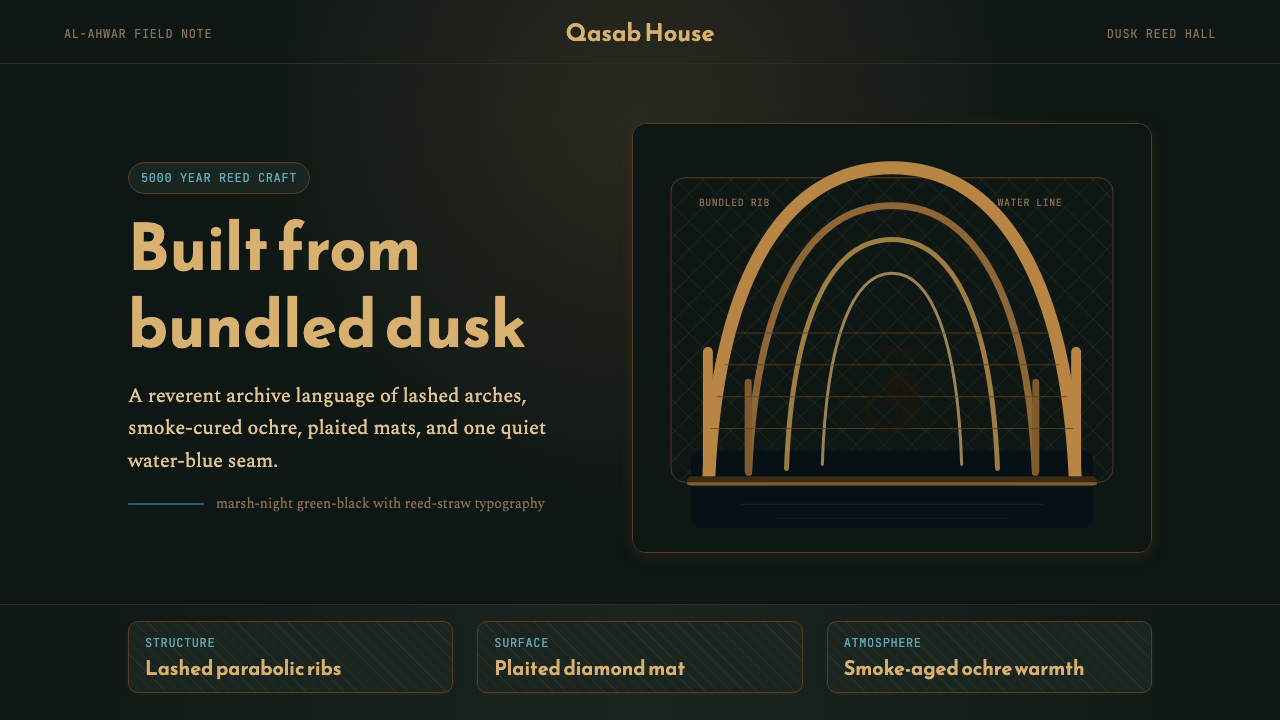 Iraqi Marsh Arab Mudhif ReedReverent reed darkness. Kufi arches, ochre lattice, and one water-blue line h…
 Kazakh DombraA story without words. Apricot varnish, bone hairlines, and two-string fret r…
 Safranbolu HousesBuilt, not decorated. Lime panels and oiled-timber frames carry a single saff…
 Adobe Pueblo SouthwestFeels made by hand. Earthen tan, turquoise trim, and viga rhythm shape the fr…