What is Makonde Ujamaa Blackwood?
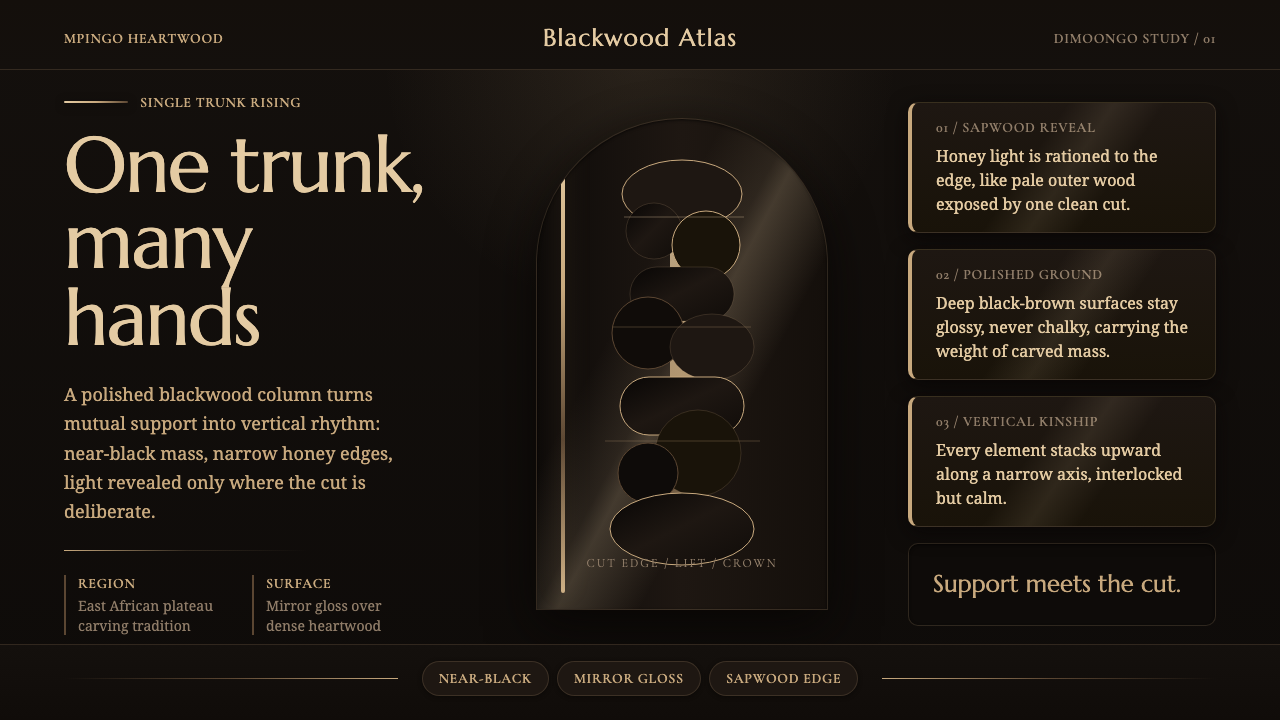
Makonde Ujamaa turns a single blackwood trunk into a rising community: near-black gloss, exposed honey sapwood, and human forms locked together as they climb.
Makonde Ujamaa Blackwood in brief
Makonde Ujamaa, also called Dimoongo or the tree of life, is a tall sculptural column carved in the round from a single trunk of mpingo, the African blackwood Dalbergia melanoxylon. Human figures are stacked, interlocked, and drawn upward toward the crown. The form is not simply an image of a tree or a group of people. Its structure makes kinship visible: each figure belongs to a larger rising body.
This design system translates that carved column into a dark interface language. The ground is polished near-black heartwood, while surfaces remain deep, dense, and almost lightless until a cut edge exposes pale honey-to-ivory sapwood. The contrast is material rather than decorative. It suggests a sculpture whose interior becomes visible only where the form has been opened.
The defining movement is vertical. Wet, mirror-like highlights trace a strong upward axis, echoing figures that climb through one another instead of standing alone. The result is an interface with weight, darkness, and direction: a system about mutual support, collective ascent, and the tension between a solid trunk and the many lives carried inside it.

Where does Makonde Ujamaa Blackwood come from?
The Ujamaa tree-of-life tradition belongs to Makonde blackwood sculpture of the Makonde plateau, a region spanning southeast Tanzania and northern Mozambique in East Africa. Its stated era runs from the post-independence period through the later twentieth century, from 1950 to 1990. The source tradition is identified alongside Shetani carving, placing Ujamaa within a broader Makonde sculptural culture rather than treating it as an isolated decorative motif.
The name Dimoongo means tree of life, and the form expresses that title through its construction. A single trunk becomes a continuous column rather than a collection of separate pieces. Figures are carved in the round, layered through the vertical body, and interlocked as they move toward the crown. The sculptural logic is therefore structural: the community is not placed beside the tree; it becomes the tree's living body.
Roberto Yakobo Sangwani introduced the form in the 1950s among Makonde carvers working across southeast Tanzania and northern Mozambique. Its emergence gave visual shape to Julius Nyerere's post-independence ideal of ujamaa, understood here as familyhood, mutual support, and social solidarity. The historical connection matters because the design language does not derive its meaning from darkness or luxury alone. Its central metaphor is collective life made visible through joined forms.
The interface translation preserves this origin through material hierarchy. Near-black heartwood establishes the continuous trunk, while honey and ivory sapwood appear only at exposed edges, as if the surface has been cut or worn open. Gloss follows a single vertical path instead of scattering across every component. Darkness supplies mass; edge light supplies evidence of inner life; upward alignment supplies the social and sculptural direction.
What defines the Makonde Ujamaa Blackwood look?
Blackwood Ground
The foundation is a polished near-black heartwood field, dense enough to feel like carved material rather than a neutral screen. Black is not used as empty absence; it carries the weight of the trunk and gives every illuminated edge consequence. Surfaces should feel continuous, deep, and quietly reflective, with darkness doing the work of structure.
Sapwood Edge Light
Pale honey-to-ivory sapwood appears where the imagined blackwood has been cut, opened, or exposed. It is a narrow revelation of the material's interior, not a general accent color. The light edge should clarify boundaries, thresholds, and points of contact, creating the sense that the interface is carved from a living substance with a visible inner grain.
Vertical Ascent
Composition rises through a strong vertical axis. Titles, navigation, panels, and highlights should feel related to that upward movement, even when the layout contains horizontal reading zones. The eye should sense a column beneath the interface: a stable central body with activity climbing through it rather than a flat field of unrelated modules.
Interlocked Structure
The system takes its social form from figures stacked and interlocked within the tree. Components should support one another visually: cards may nest, sections may overlap at the edge, and related information can appear as a climbing sequence. The effect is connective rather than modular in the usual product-design sense. Every part should seem to belong to a larger carved body.
Mirror Gloss
Gloss is wet, narrow, and directional. It traces the principal vertical movement like light sliding across a freshly polished sculpture. Broad, evenly distributed shine would turn the system into generic luxury styling. The preferred effect is selective: darkness dominates, while a few precise reflections reveal curvature, polish, and ascent.
Carved Depth
Depth should be sensed through material contrast and overlap, not through busy visual effects. Near-black surfaces recede into the trunk, while sapwood edges and gloss bring selected forms forward. The interface can feel dimensional without becoming glossy everywhere or turning every panel into a separate floating object. Depth belongs to the column first and to individual components second.
Collective Restraint
The style is dramatic, but its drama comes from disciplined repetition: one dark material, one exposed edge language, one climbing direction, and a limited set of luminous interruptions. Decorative variety weakens the metaphor. The system becomes strongest when each visual decision reinforces the same idea of many forms held together inside a single body.

Who shaped Makonde Ujamaa Blackwood?
Sangwani introduced the Ujamaa tree-of-life form in the 1950s among Makonde carvers of southeast Tanzania and northern Mozambique. His role is central to the design system's historical grounding: the rising column is not an anonymous fantasy of carved figures, but a form associated with a specific Makonde sculptural tradition and its post-independence context.
The form developed among Makonde master carvers working across the Makonde plateau. Their sculptural language turns a single mpingo trunk into a continuous field of joined human figures, making collective structure inseparable from material structure. In the interface, their influence appears through carved continuity, layered bodies, exposed edges, and the refusal to treat each element as visually independent.
Nyerere's post-independence ideal of ujamaa gave the tree-of-life form its social and political meaning within the approved source material. Ujamaa is described here as familyhood and mutual support. The design system therefore treats upward movement as a collective action: progress is represented by figures carrying, joining, and rising through one another.
How do you use Makonde Ujamaa Blackwood today?
For presentation slides, let the cover behave like a carved column. A dark, uninterrupted field can carry a tall title while a pale sapwood-like edge or narrow reflective path establishes the upward axis. Content slides should organize information as connected layers rather than isolated cards: a section can rise from the previous one, with exposed edges marking transitions and relationships. Data slides can treat columns, sequences, and comparisons as sculptural growth, using the lightest material accents only where a finding needs to emerge from the dark field.
For web dashboards and pricing pages, Makonde Ujamaa is suited to products that want to communicate depth, continuity, and collective value. Keep the dashboard grounded in near-black surfaces, then reserve honey-to-ivory accents for active states, important boundaries, and the current path through information. Pricing tiers can read as stacked forms within one trunk rather than unrelated promotional boxes. Gloss should guide attention along the main journey, while secondary controls remain quiet and materially subordinate.
For editorial and marketing work, the system supports a strong vertical narrative. An article can move downward through a dark body while a luminous edge marks chapter changes, quotations, or evidence. Campaign pages can frame a product or idea as something carried by a larger community, using interlocking blocks and rising image crops instead of scattered decoration. The name Makonde Ujamaa and its relationship to the tree-of-life tradition should remain visible when the historical reference is central, so the visual language is not detached from its source.
The common mistake is to reduce the style to a black background with gold accents and a few ornamental figures. That combination may look polished, but it loses the single-trunk structure, the exposed-material logic, and the idea of mutual support. Another failure is to distribute gloss equally across every surface, which destroys direction. Use darkness for mass, pale edge light for revelation, and vertical movement for meaning; let every component appear connected to the same carved body.

Makonde Ujamaa Blackwood — FAQ
Is Makonde Ujamaa simply a dark luxury style?
No. Its surface may appear polished and precious, but its organizing idea is collective ascent. The near-black heartwood, exposed sapwood, and mirror gloss are material translations of a single carved trunk. The stacked and interlocked figures connect the visual system to ujamaa as familyhood and mutual support. Removing that relational structure leaves only a generic dark interface.
What does ujamaa mean in this design context?
The approved source describes ujamaa as familyhood and mutual support, and connects the tree-of-life form to Julius Nyerere's post-independence ideal. In the interface, that meaning appears through interlocking components, shared vertical direction, and a sense that separate figures belong to one body. It should shape composition and hierarchy, not be added as a label after the visual decisions are complete.
How much gloss should the interface use?
Use it selectively and directionally. The source image is a wet, mirror-like highlight tracing a single strong vertical axis, not a field of shine applied to every surface. Let most of the interface remain deep and near-black. A few carefully placed reflections can reveal the principal path, the curvature of a surface, or the edge of an important transition. Excess gloss turns carved material into generic decoration.
Can the system work on a light background?
A light variation is possible, but it would move away from the approved translation. The defining ground is polished near-black heartwood, and the pale sapwood has meaning because it appears as an exposed edge against that darkness. If the entire field becomes light, the contrast between outer trunk and revealed interior disappears. A light adaptation should therefore preserve strong dark masses and the sense of material being opened.
How should the cultural reference be handled in public-facing work?
Keep the reference specific. Name Makonde Ujamaa or Dimoongo when the work draws directly on the tree-of-life form, and retain its setting in southeast Tanzania and northern Mozambique, its blackwood material, and its relationship to familyhood and mutual support. Avoid presenting the style as an anonymous tribal look. The more directly the work borrows the form, the more clearly its source and meaning should remain attached.
Related design styles
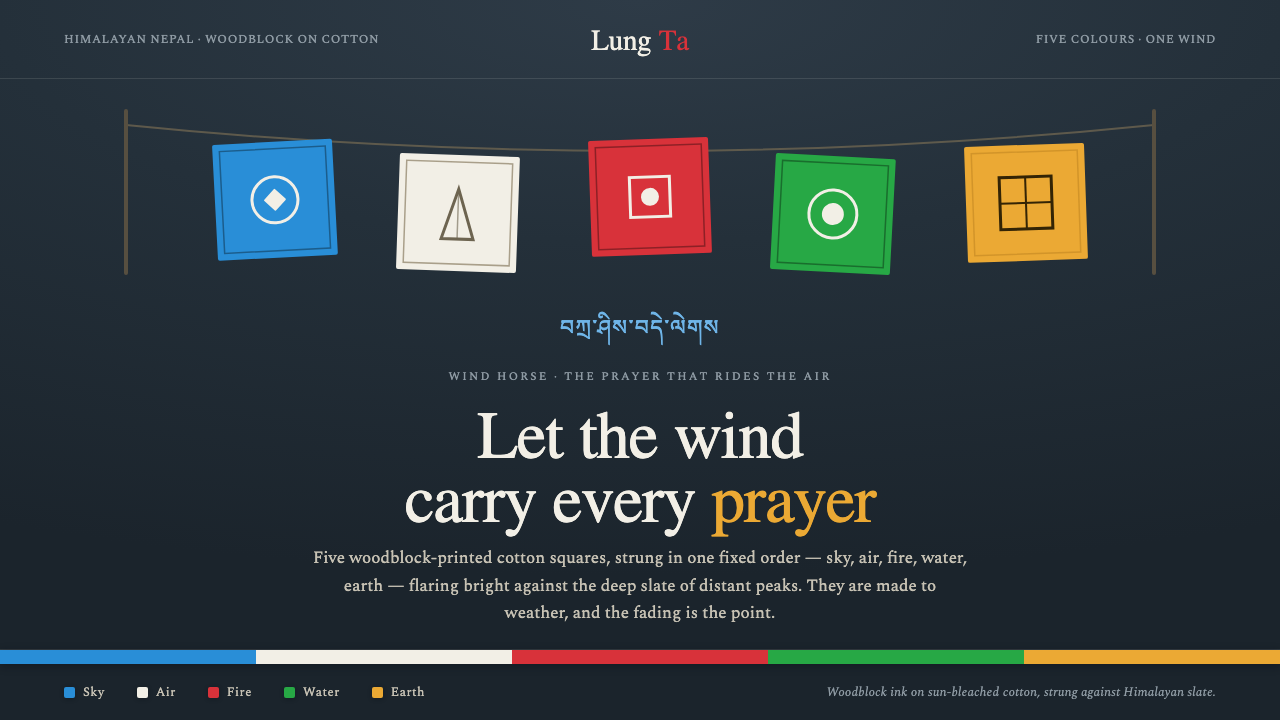 Nepali Lungta Prayer FlagsLet the wind carry the prayer. Five woodblock flags flare in fixed order agai…
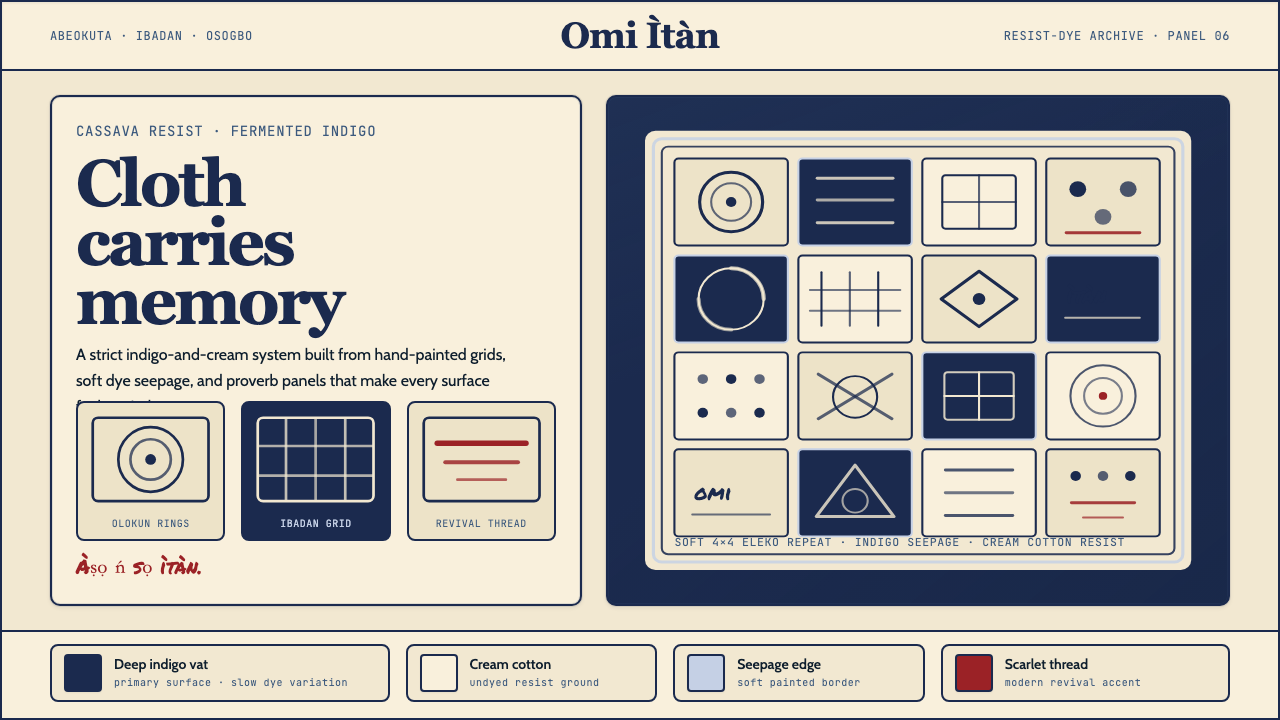 Yoruba Adire IndigoMemory lives in cloth. Deep indigo grids on cream cotton carry hand-painted p…
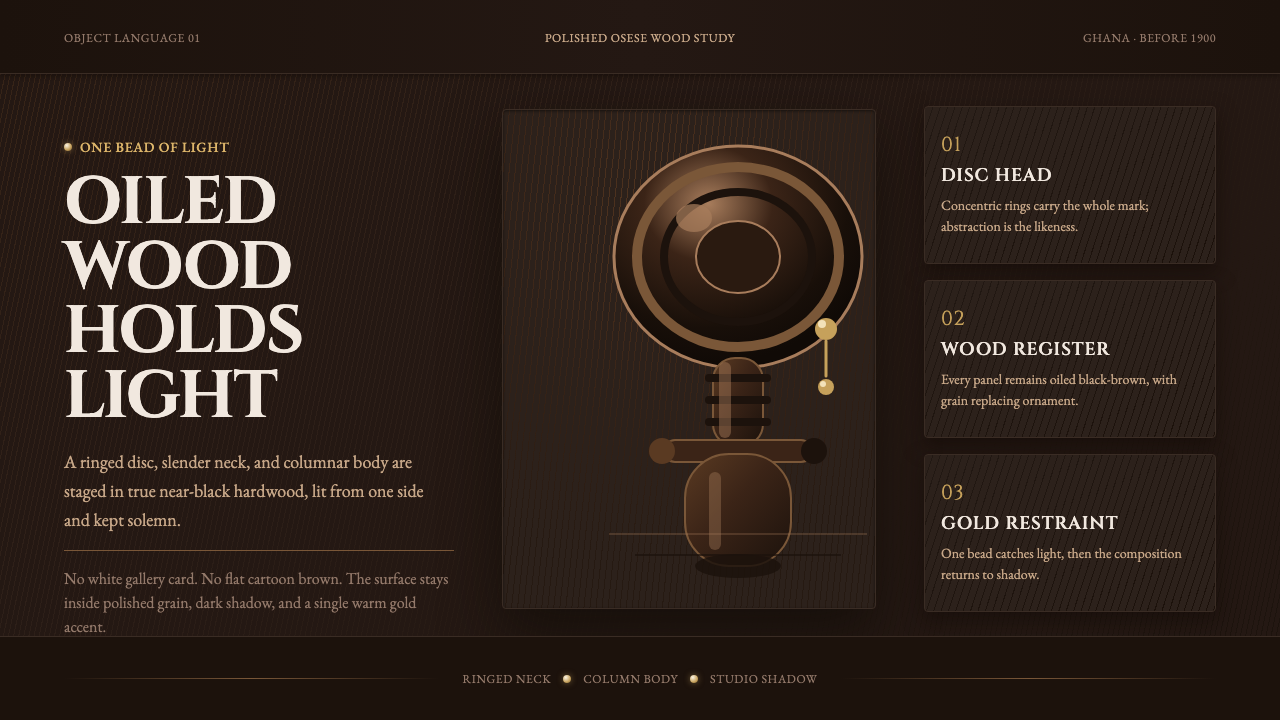 Akuaba Akan Fertility DollDarkness becomes sculpture. Near-black wood, ringed geometry, and one gold be…
 Baule GoldweightWear is the ornament. Burnished brass and olive recesses make every small wei…
 Dogon Bandiagara Cliff MaskHand-hewn gravity. Charred wood, kaolin type, and sandstone geometry stack li…
 Dogon Toguna Shelter MaliGravity made visible. Deep umber ground, low roof band, chestnut posts in sha…