What is Magritte Surrealism (1929)?
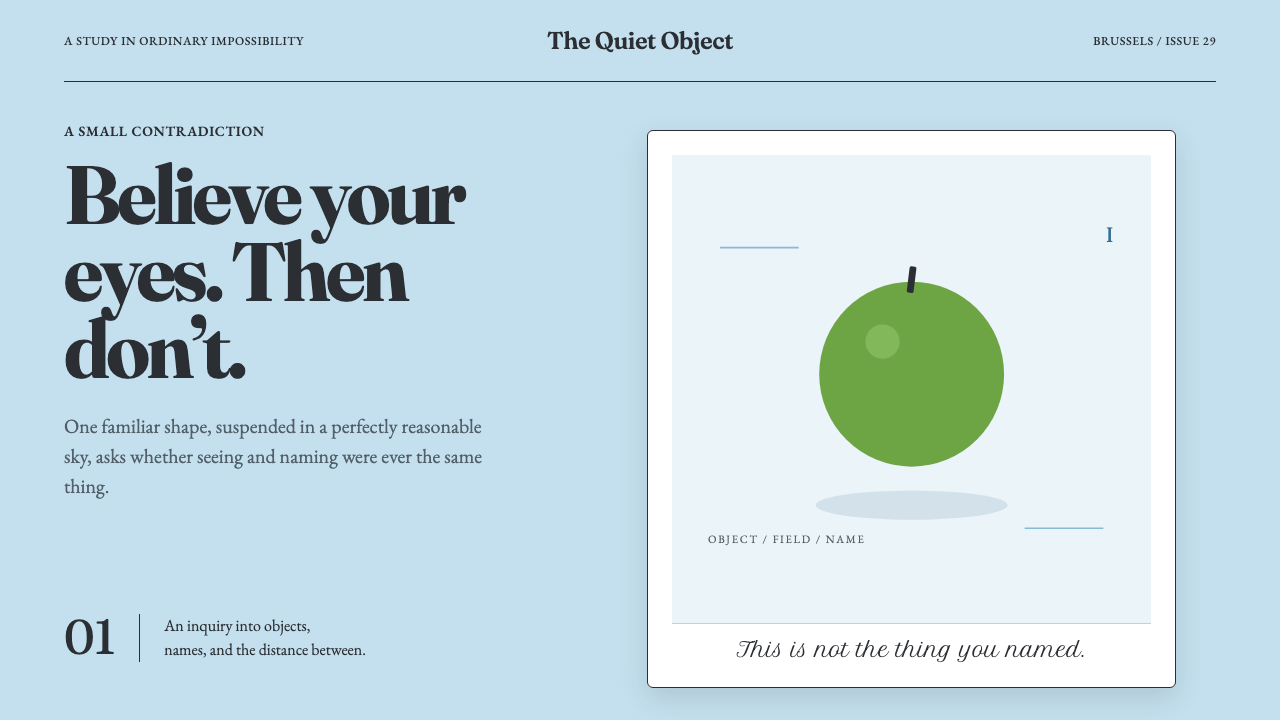
Magritte Surrealism (1929) lets ordinary things tell quiet lies — a flat cerulean sky suspending a single green interruption, and a caption that calmly contradicts what you are looking at.
Magritte Surrealism (1929) in brief
Belgian Surrealism rendered as a design system: the brushless, bourgeois calm of René Magritte around 1929, the year he painted a meticulously rendered pipe and wrote 'this is not a pipe' beneath it. The technique is flat and matte, with no visible brushwork, closer to a precise commercial illustration than to expressive painting — ordinary objects rendered with photographic clarity, never distorted or melted the way other Surrealists rendered dream imagery.
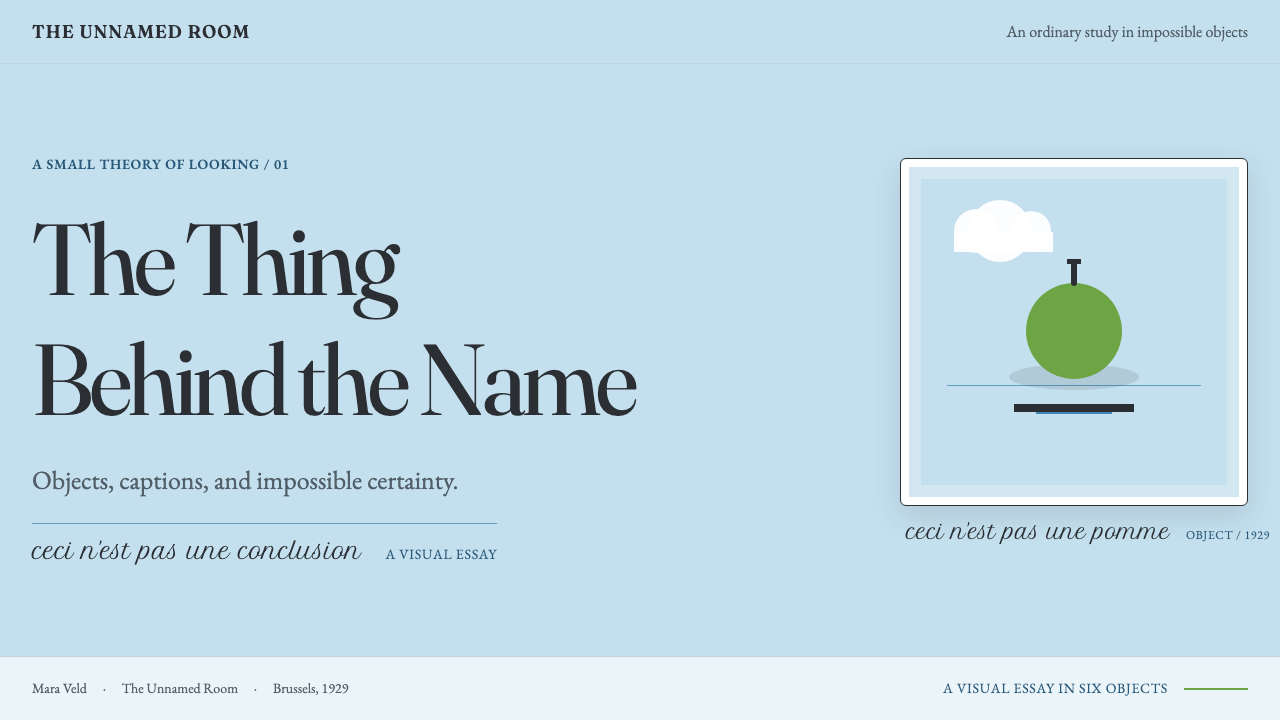
Flat cerulean skies carry marching, evenly spaced clouds, and a single precise, realist object — a bowler hat, an apple, a pipe — sits suspended in an enormous field of negative space rather than crowded into a busy scene. The emptiness around the object is doing real work: it isolates the one thing that matters and gives the composition its deadpan, held-breath quality.
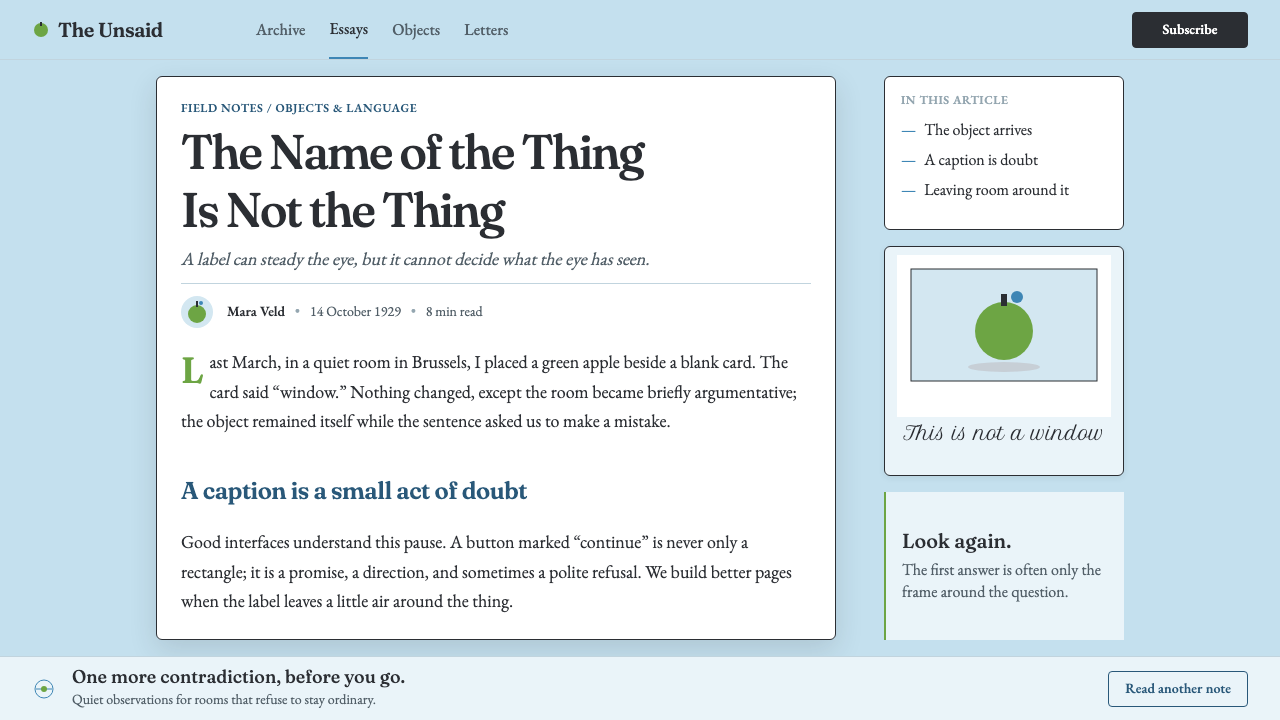
The wit lives entirely in the gap between a thing and its name, or between a thing and its expected context. Nothing is decorative for its own sake — a green apple interrupts an otherwise unremarkable arrangement, a caption quietly contradicts the image above it, and the whole page behaves like a canvas that insists, without raising its voice, this is not a button.
Where does Magritte Surrealism (1929) come from?
Magritte's peak Surrealist period ran roughly from 1926 to 1938, based in Brussels. Belgian Surrealism developed its own distinct temperament, quieter and more deadpan than the version centered in Paris, favoring everyday bourgeois objects and settings — bowler hats, pipes, curtained windows — over the more overtly dreamlike or erotic imagery associated with other branches of the movement.
Magritte worked closely with a circle of Belgian writers rather than relying purely on visual collaborators. Paul Nougé, a poet who effectively acted as the intellectual leader of the Belgian Surrealist group, frequently suggested concepts and even titles for Magritte's paintings. E.L.T. Mesens, active as a composer, collagist, and gallerist, helped organize the Belgian circle's activities and its connections to the wider movement. Marcel Lecomte, another writer within the same milieu, was part of the literary environment that shaped Magritte's conceptual, idea-first approach to painting.
The Belgian group maintained a complicated relationship with Surrealism's Paris center. André Breton, the movement's founder and chief theorist, had defined Surrealism in his 1924 manifesto as an exploration of the unconscious mind. Magritte lived near Paris for a period at the end of the 1920s and engaged directly with Breton's circle, though relations were sometimes tense — the Belgian group prized its own identity and resisted simply being absorbed into the Paris-led movement.
1929 marks the height of Magritte's use of the device that would define his public image: his painting The Treachery of Images, showing a meticulously rendered pipe captioned 'Ceci n'est pas une pipe' — this is not a pipe. Painted in the same deadpan, commercial-illustration technique as the rest of his work, it crystallized his central argument that a picture of an object is not the object itself, and it became the single most quoted image to emerge from the entire movement.
What defines the Magritte Surrealism (1929) look?
Flat, Brushless Finish
Surfaces are rendered smooth and matte, with no visible brushwork, closer to a precise commercial illustration than to expressive painting. This clinical finish is what makes the eventual contradiction between image and reality land as deadpan rather than dreamy.
Cerulean Sky and Marching Clouds
A flat cerulean sky carries evenly spaced, repeated cloud shapes that march across the field like a pattern rather than a naturally varied sky. The regularity itself is part of the joke — nature rendered with the consistency of wallpaper.
Object in Vast Negative Space
A single precise, realist object sits alone within an enormous field of open space rather than being placed within a busy scene. The emptiness isolates the object and gives the whole composition a held-breath quality.
Word-Image Contradiction
A caption or label quietly contradicts, or refuses to simply confirm, the image it sits beneath. The wit lives entirely in this gap between a thing and its name, never in exaggeration or distortion of the image itself.
Deadpan Realism
Objects are rendered with photographic clarity and never melted, warped, or distorted the way other strands of Surrealism render dream imagery. The strangeness comes entirely from context and juxtaposition, not from the rendering technique.
Singular Interruption
An otherwise ordinary, orderly composition allows exactly one anomalous element — an oversized apple, an object floating where it should fall — to interrupt it. Restraint elsewhere is what makes that single interruption register as strange rather than as clutter.

Who shaped Magritte Surrealism (1929)?
The Belgian painter whose flat, brushless technique and word-image conceptual games, most famously in The Treachery of Images (1929), defined the deadpan, bourgeois-calm register of Belgian Surrealism.
A poet who acted as the intellectual leader of the Belgian Surrealist group, frequently suggesting concepts and titles for Magritte's paintings and shaping the movement's idea-first, literary approach.
A composer, collagist, and gallerist who helped organize the Belgian Surrealist circle's activities and its connections to the wider international Surrealist movement.
The Paris-based founder and chief theorist of Surrealism, whose 1924 manifesto defined the movement as an exploration of the unconscious mind. Magritte engaged with Breton's circle directly, though the Belgian group maintained its own distinct identity.
How do you use Magritte Surrealism (1929) today?
This system rewards contexts that want to feel clever, restrained, and quietly unsettling rather than loud or literal — intellectual and cultural brands, editorial work built around ideas, and any product that wants wit without visual noise all suit it well.
For presentation slides, a cover works well with a flat cerulean field, a single precise object placed off-center in vast open space, and a short caption that comments on the image rather than simply describing it. Content slides should resist filling space — one idea, one object, one contradiction per slide is stronger than several competing for attention.
For web interfaces, the vast-negative-space principle translates well to hero sections and empty states: a single realist icon or illustration held in generous open space, with microcopy that plays against the visual rather than merely labeling it. Marching, repeated cloud-like patterns can work as a quiet background texture, kept subtle enough not to compete with the one object that matters.
For editorial and marketing work, the style supports headlines that contradict or complicate their accompanying image rather than simply captioning it, and feature blocks built around a single arresting object rather than a busy collage. The device works best when used sparingly — one contradiction per page, not several.
A common mistake is piling up multiple surreal elements at once, hoping more strangeness reads as more clever — this style depends on isolating a single interruption within an otherwise calm, orderly field. Another is rendering the central object with any distortion or exaggeration; the strangeness must come entirely from context and caption, never from the drawing itself.
Magritte Surrealism (1929) — FAQ
What is the story behind 'this is not a pipe'?
In 1929, Magritte painted a meticulously realistic pipe and captioned it 'Ceci n'est pas une pipe' — this is not a pipe — in his painting The Treachery of Images. The point is literal: the painting is a representation of a pipe, not an actual pipe you could smoke. It became the movement's most quoted image because it distilled the entire word-image philosophy into one deadpan, easily grasped joke.
How is Belgian Surrealism different from the more famous Salvador Dalí style?
Dalí's brand of Surrealism, more associated with the Paris-centered movement, leans on melting, warped, overtly dreamlike imagery to signal strangeness. Belgian Surrealism, as practiced by Magritte and his circle, keeps objects rendered with calm, photographic clarity and locates its strangeness entirely in context and juxtaposition instead — a quieter, more bourgeois, more conceptual register.
Why does the technique stay so smooth and realistic instead of using dreamlike distortion?
The realism is what makes the eventual contradiction land — if the rendering itself were already strange or distorted, the viewer would expect strangeness and the joke would lose its edge. By painting everything with the calm precision of commercial illustration, Magritte lets the surprise come entirely from an unexpected caption or context, not from the drawing.
How should captions or labels be used when applying this style?
A caption should never simply describe or confirm the image it accompanies. It should introduce a small, calm contradiction or a shift in framing — the same logic as labeling a painted pipe as not a pipe. Overusing this device dilutes it, so it works best reserved for one deliberate moment per composition rather than applied to every label on a page.
Related design styles
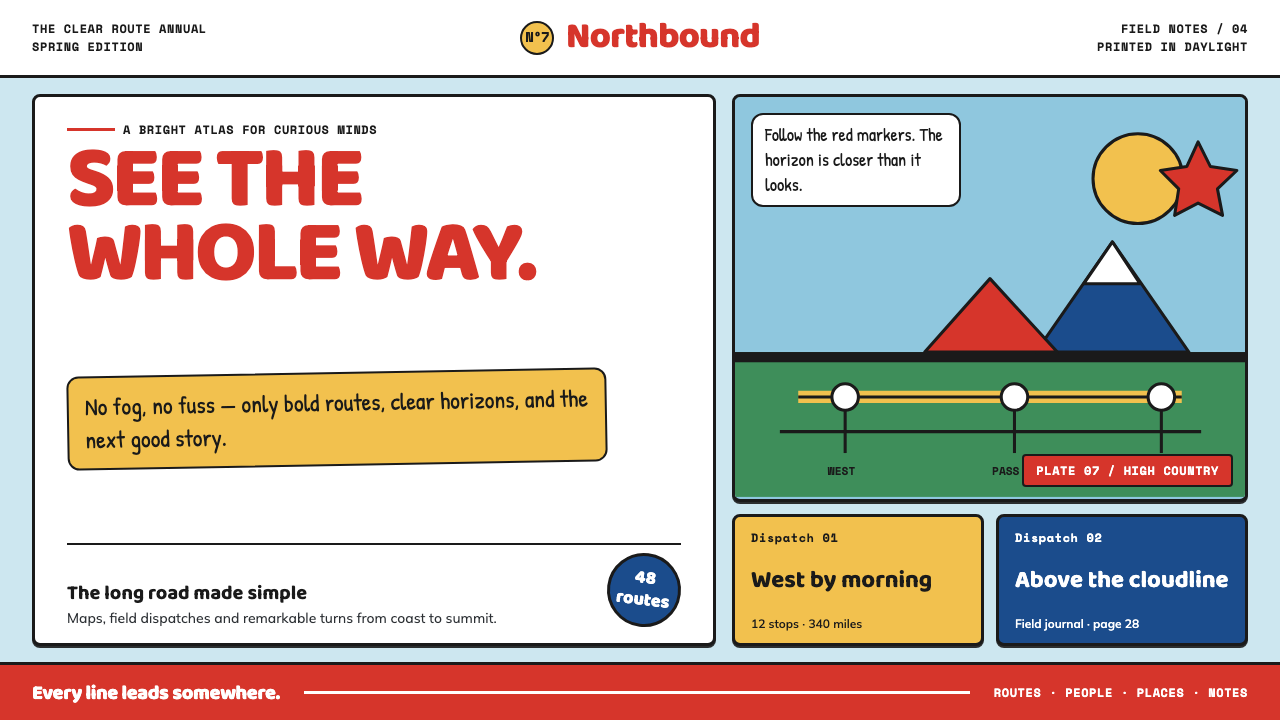 Tintin (Hergé Ligne Claire)Adventure reads at a glance. Flat spot colors and uniform black contours map…
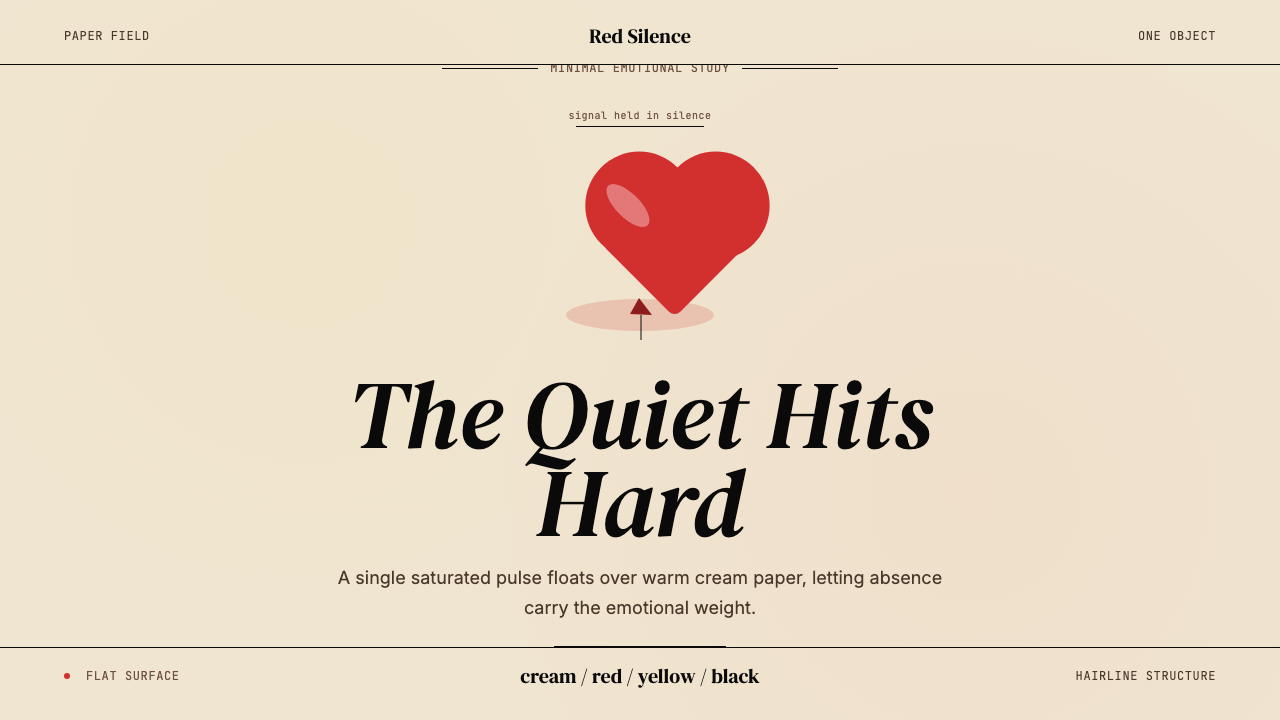 Kanye — 808s & HeartbreakGrief in restraint. Cream paper, one red heart, yellow heat, and a black hair…
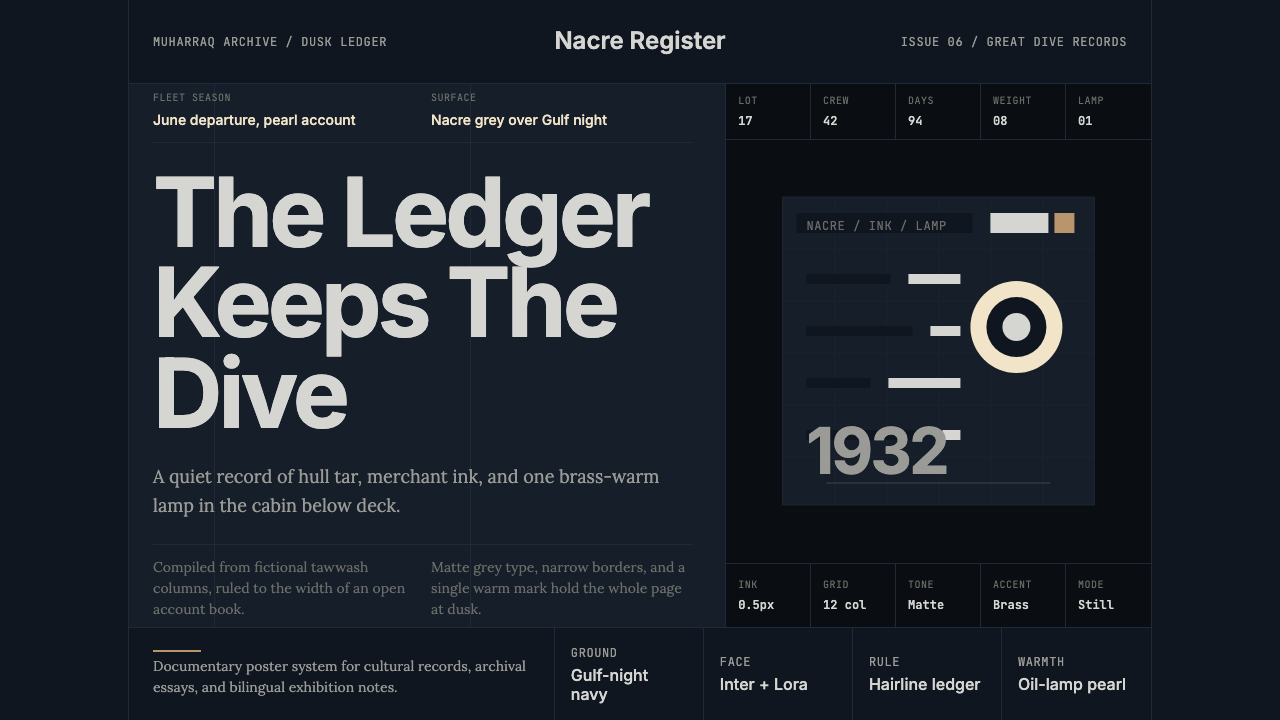 Bahraini Pearl Diving GreyQuiet authority at dusk. Nacre grey type and hairline grids hold one brass-wa…
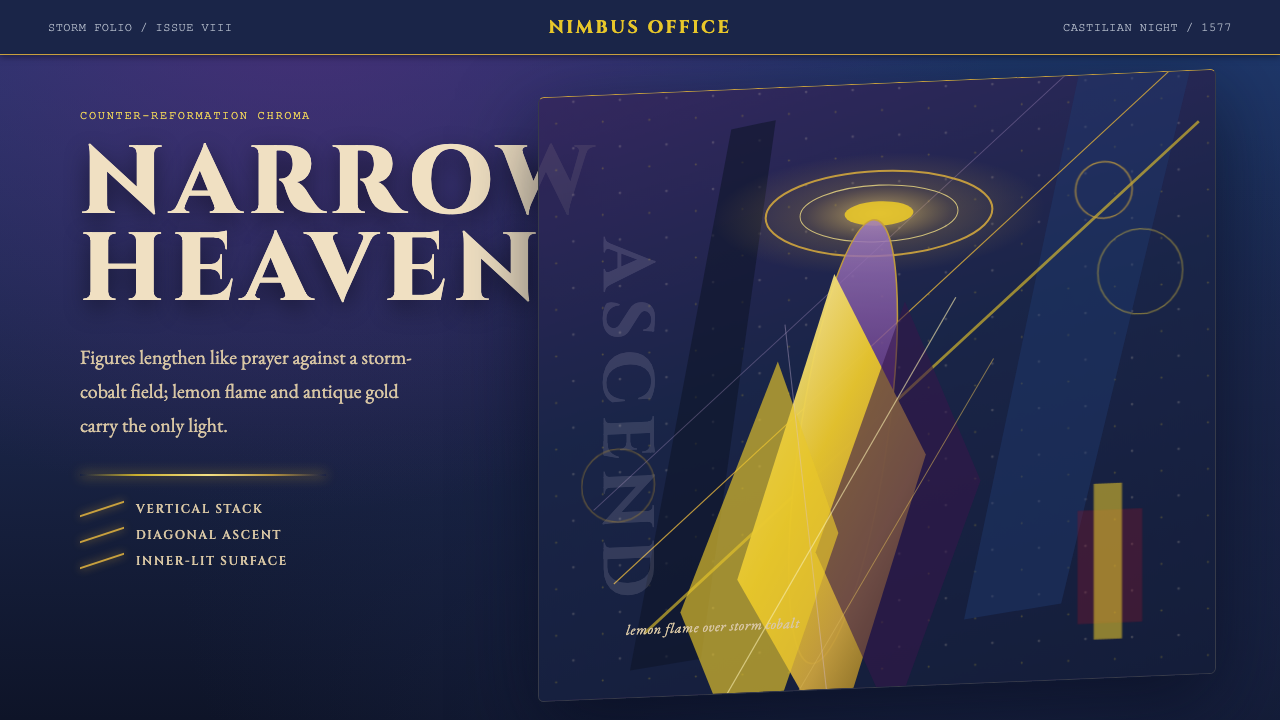 El Greco — Toledo MannerismMysticism strains upward. Storm cobalt, lemon flame, and gold halos pull the…
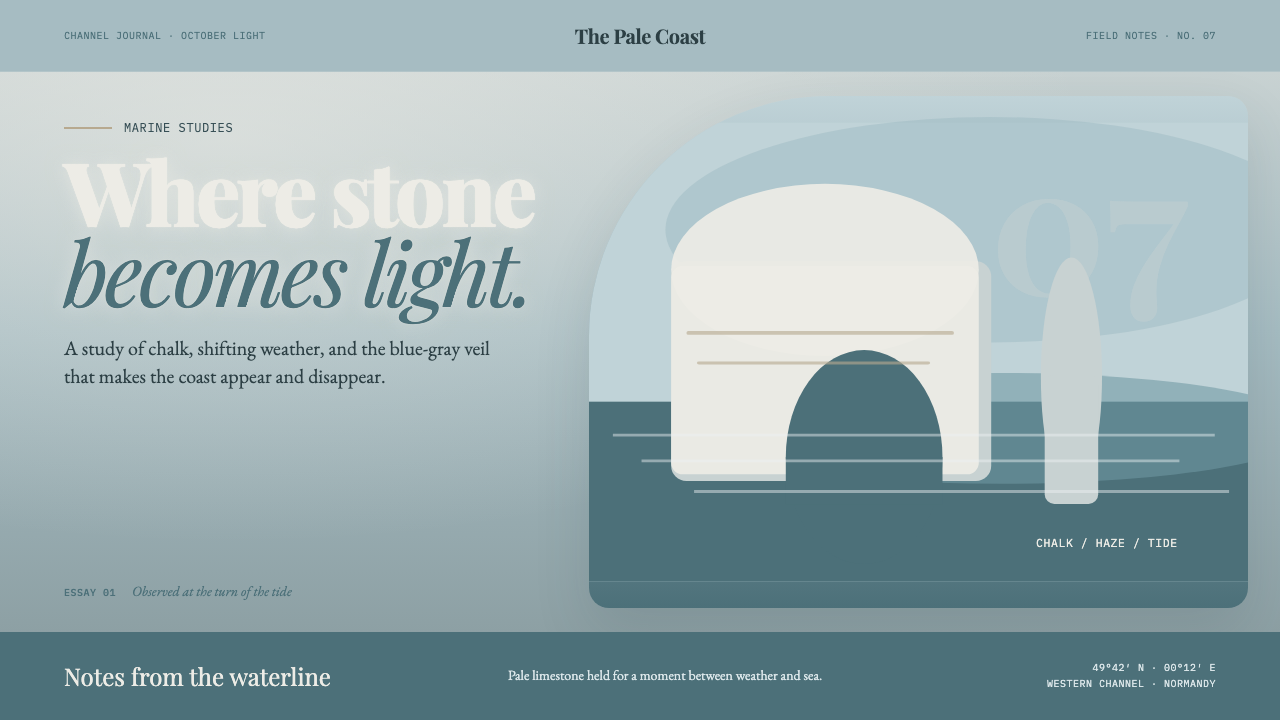 Étretat Chalk CliffsStone becomes light. Chalk-white forms dissolve through blue-gray mist and li…
 Grant Wood American Gothic (1930)Plainness stands firm. Dusty denim and ochre align on a strict central axis.