What is Madhubani Mithila (Bharni & Kachni)?
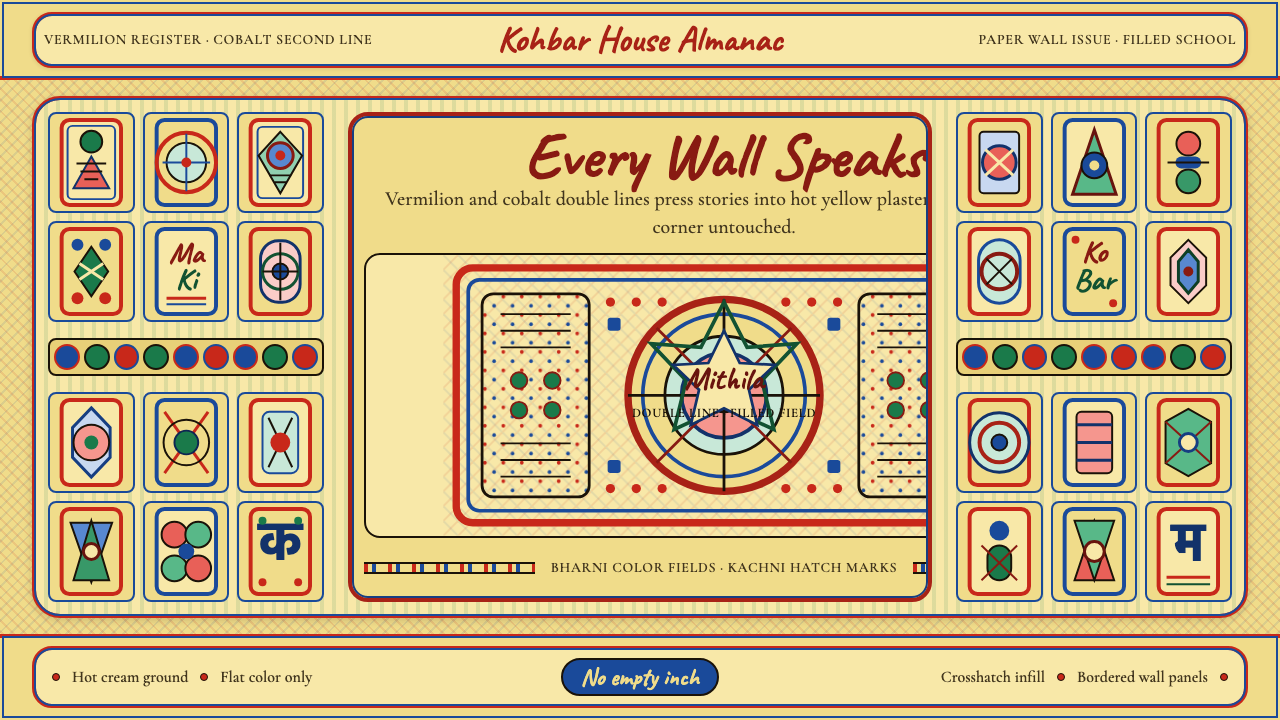
Madhubani Mithila painting refuses empty space — every surface erupts with double-outlined deities, peacocks, and lotuses packed so tightly that the ground itself disappears.
Madhubani Mithila (Bharni & Kachni) in brief
Madhubani Mithila painting is South Asia's most maximalist folk tradition — a visual system built on the absolute rejection of negative space. Practiced for centuries by village women in the Mithila region of Bihar, India, and across the border in Nepal's Janakpur, the art form covers every available surface with interlocking figures, geometric infill, and pattern fields so dense that the eye finds no resting point and no silence.
The tradition divides into distinct sub-schools with different visual registers. The bharni (filling) school, practiced by Maithil Brahmin and Kayastha artists, fills outlined figures with flat, saturated color — bold vermilion, hot cobalt, deep turmeric yellow — until the composition becomes a solid field of competing hues. The kachni (line) school, associated with Kayastha artists, relies instead on obsessive crosshatching and fine parallel lines to build up tone within figures, creating a texture that reads as almost woven. Godna and gobar variants, practiced by Dalit artists, have their own traditions rooted in tattoo patterns and natural pigments respectively.
What unites all sub-schools is the double outline — every figure, from a fish to a goddess to a vine tendril, is traced with two concentric contour lines in contrasting colors, typically one vermilion and one cobalt. This double edge gives the style its characteristic thrumming quality, as if every form is vibrating slightly against its neighbor. Between and around the figures, no surface is left bare: crosshatch, dot grids, geometric patterning, and subsidiary motifs fill every gap until the composition reaches a state of total saturation.
Where does Madhubani Mithila (Bharni & Kachni) come from?
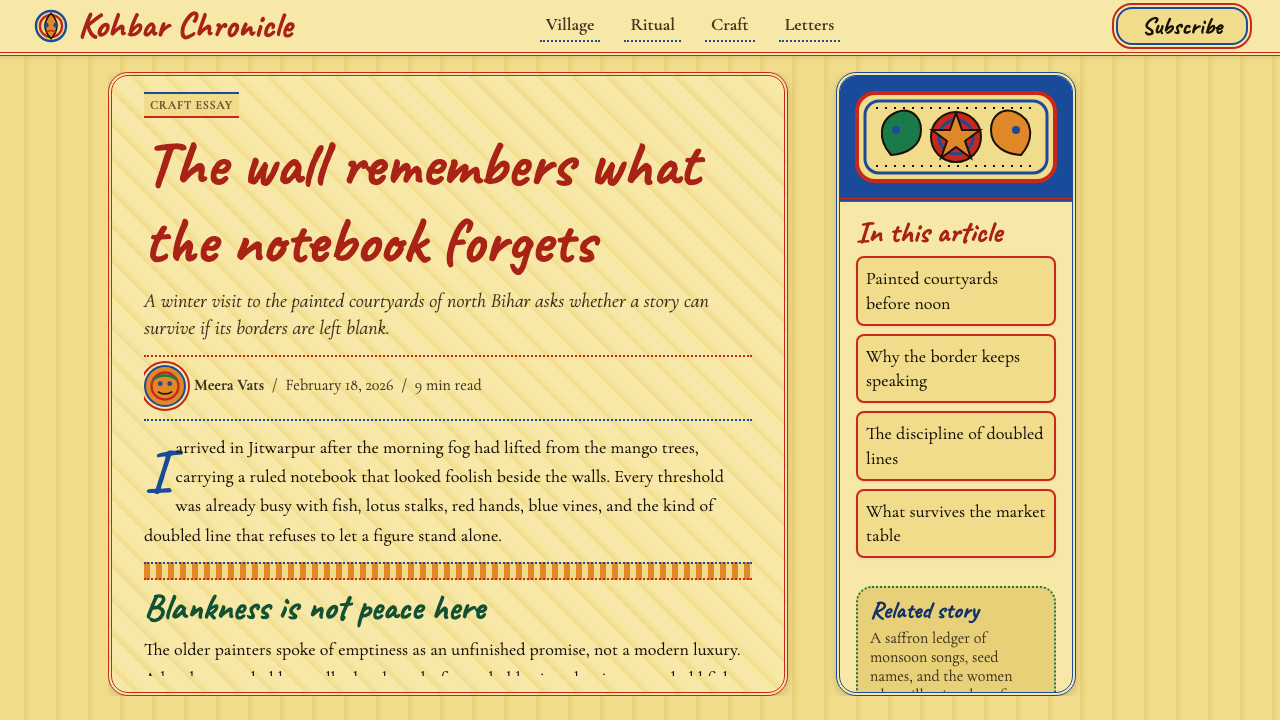
Madhubani painting's origins are inseparable from ritual. The tradition grew out of the practice of decorating the walls of the kohbar ghar — the wedding chamber — in which newly married couples spent their first days. The imagery was not decorative in any secular sense: fish signified fertility, bamboo represented procreation, lotuses evoked purity and the cosmos, and the full repertoire of Hindu deities — Krishna, Sita, Ram, Durga, Ganesha — populated the walls as protective presences. The act of painting was itself a religious observance performed by women, encoding knowledge passed from mother to daughter across generations. Some scholars trace mural traditions in the Mithila region back to the pre-seventh century, though continuous documentation is difficult.
The transformation from private ritual to public art form came abruptly in 1934, when the British civil servant and art historian William Archer, stationed in Bihar, documented surviving examples following a devastating earthquake that had stripped plaster from house walls across the region, exposing the painted surfaces beneath. Archer was struck by the work's formal sophistication and published accounts that brought it to wider scholarly attention, though commercialization did not follow immediately. The paintings remained a living household practice for another three decades.
The 1965 Bihar drought was the decisive turning point. The All India Handicrafts Board, responding to economic crisis in the region, encouraged artists — most of whom were women who had never been paid for their work — to transfer their compositions from mud walls and floors onto paper and cloth. The craft became an income source, and within years, Madhubani paintings were appearing in urban galleries and being exported internationally. Artists such as Sita Devi, Ganga Devi, and Bhua Devi became nationally celebrated figures, their names attached to a tradition that had previously been communal and anonymous.
Recognition brought complexity. Government certification, craft board classification, and the pressure of the export market all exerted influence on what was painted and how. Some artists expanded their subject matter beyond the traditional Hindu iconography to address contemporary themes — Ganga Devi's late work depicted her own cancer treatment in the Madhubani idiom. The tradition also spread geographically, with Janakpur in Nepal developing its own school, and urban Indian artists adopting the style in non-ritual contexts. Today the tradition is practiced by thousands of artists across Bihar and beyond, ranging from rural practitioners maintaining ritual contexts to internationally exhibited figures who have moved the form into conceptual and political territory.
What defines the Madhubani Mithila (Bharni & Kachni) look?
Total Surface Coverage
The governing principle of Madhubani composition is horror vacui — fear of emptiness. No ground is left visible. Primary figures in the center are surrounded by secondary figures, which are surrounded by subsidiary motifs, which are surrounded by infill patterns until the entire surface is occupied. This is not merely decorative habit but a cosmological statement: the world is full, alive, and interconnected, and a blank surface is an absence of meaning.
Double Outline
Every form in Madhubani painting — human, animal, botanical, geometric — is traced with two parallel contour lines in contrasting hues, almost always one warm and one cool. The double edge creates a visual vibration at every boundary, making figures appear to pulse against their backgrounds and against each other. This technique has no counterpart in Western folk traditions and is the single most recognizable feature of the style.
Hot Flat Color
The bharni school fills outlined figures with flat, unmodulated color at maximum saturation — no shading, no gradation, no highlight. The dominant tones are a hot cream-yellow ground, vermilion, cobalt, turmeric, and black, drawn originally from natural sources including lampblack, indigo, turmeric, and red clay. Color is applied symbolically rather than naturalistically: a figure's skin may be vermilion, its garments cobalt, its jewelry turmeric, without any attempt at realistic rendering.
Sacred Iconographic Vocabulary
Madhubani painting draws on a fixed repertoire of motifs with precise symbolic meanings. Peacocks represent beauty and the divine. Fish — always depicted in pairs — signify fertility and prosperity and appear in virtually every composition. Lotus flowers connect the earthly and cosmic realms. The sun and moon appear as protective presences flanking central figures. Bamboo, parrots, elephants, and the tulsi plant each carry specific ritual significance. Mastery of the tradition means mastering this vocabulary and its combinatorial logic, not inventing new symbols.
Crosshatch and Dot Infill
Any surface not occupied by a primary or secondary figure is filled with pattern. The kachni school builds this infill from fine parallel lines and crosshatching that creates a halftone-like texture visible even at small scales. Both bharni and kachni compositions scatter precise dot grids across backgrounds and within figures. These infill patterns are not random but follow conventions: certain motifs belong in certain contexts, and their arrangement carries meaning legible to those who know the tradition.
Frontal and Profile Flatness
Madhubani figures exist entirely in two dimensions. Human faces appear almost universally in profile with a frontal eye — the same visual convention used in ancient Egyptian painting, arrived at independently. Bodies are shown frontally or in three-quarter view, never with foreshortening or perspective. There is no attempt to simulate three-dimensional space: the picture plane is frankly flat, and depth is indicated by vertical layering rather than recession.
Rhythmic Repetition
Madhubani compositions achieve their density not through variety alone but through repetition with slight variation. A border of fish may run around the entire periphery of a piece, each fish nearly identical to the last, with minute differences in the crosshatch angle or the position of the eye. This rhythmic iteration creates a meditative quality — the visual equivalent of a repeated mantra — that gives the most densely packed compositions a sense of coherence and breathing.

Who shaped Madhubani Mithila (Bharni & Kachni)?
Sita Devi of Jitwarpur village was among the first artists to transfer Madhubani compositions from mud walls to paper and cloth when the All India Handicrafts Board initiated its commercialization effort after the 1965 drought. She received India's Padma Shri award in 1981 and became one of the most prominent faces of the tradition internationally, her work helping to establish Madhubani painting's legitimacy as a fine art form rather than merely a craft category.
Ganga Devi was celebrated for the lyrical quality of her line work and her expansion of subject matter beyond traditional Hindu iconography. Her late series depicting her own cancer treatment — rendering chemotherapy sessions and hospital stays in the full Madhubani visual vocabulary — demonstrated the tradition's capacity to absorb and process contemporary experience. The series, begun in the 1980s, became some of the most discussed works in Indian folk art scholarship and was acquired by major international collections.
Bhua Devi was a master practitioner of the kachni (line) school, known for the extraordinary fineness of her parallel hatching and the density of her infill patterns. Her work demonstrates the full technical demands of the kachni approach, in which tone and texture must be built entirely through line rather than flat color fill. She was instrumental in establishing the kachni school's reputation as a distinct and technically demanding stream within the broader Madhubani tradition.
William Archer was a British civil servant and art historian stationed in Bihar who, in 1934, documented surviving Madhubani murals exposed by a major earthquake. His writings introduced the tradition to the broader scholarly and art world beyond its home region. Without his documentation, the commercialization effort of the 1960s would have lacked the scholarly foundation that helped position Madhubani painting as a tradition of historical depth rather than a craft novelty, and the international recognition that followed might have been significantly delayed.
How do you use Madhubani Mithila (Bharni & Kachni) today?
Madhubani Mithila is one of the most distinctive and least generic historical styles available for contemporary design work. Its core visual logic — total coverage, hot saturated palette, double outlines, and rhythmic infill — produces work that is instantly recognizable and unlike any Western design tradition. Applying it well requires genuine engagement with the system's underlying principles rather than surface borrowing of a few decorative motifs.
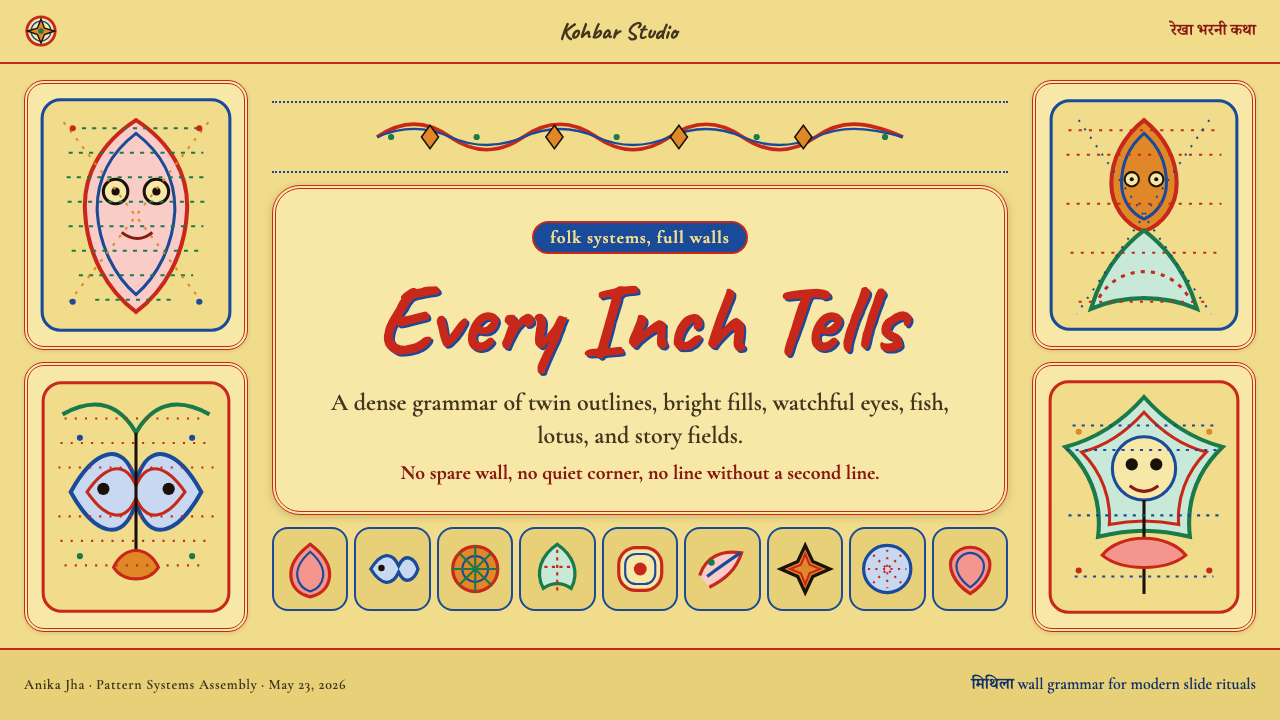
For presentation slides, the style works most powerfully as a full-bleed cover treatment. A Madhubani-derived cover uses the hot cream-yellow as the ground, fills the entire space with an interlocking figure composition — peacocks, fish, lotuses — framed by a double vermilion-cobalt border, and places the title in a clear zone within or beneath the central figure. The density of the imagery signals abundance and care. Content slides should be handled more sparingly: a narrow Madhubani border strip along the left or bottom edge, using the same double-outline motif at reduced scale, anchors the page to the style without competing with the information. Data slides can use the style's saturated palette for chart elements — each data series assigned one of the tradition's primary hues — while keeping backgrounds clean.
For web interfaces and dashboards, the style suits brand-heavy contexts where cultural richness and craft authenticity are part of the product identity — arts platforms, cultural institutions, premium handcraft marketplaces, and luxury consumer brands with an artisanal positioning. The approach: use the cream-yellow ground for hero sections and feature panels, deploy double-outline decorative borders at section breaks, and reserve the full compositional density for hero imagery and illustration. Navigation and body text should remain clean and highly legible; the maximalism works as punctuation rather than as the default state.
For editorial and marketing work, Madhubani's poster-like saturation makes it exceptionally effective for full-page spreads, packaging, and event identity. A festival brand, a cultural publication, or a handcraft marketplace can build an entire visual identity around a simplified Madhubani vocabulary — double-outline motifs, flat saturated color blocks, dot-grid textures — without requiring full compositional density in every application. Marketing materials benefit from isolating one or two signature motifs (a single peacock, a pair of fish) and deploying them at large scale against the cream ground, with the infill pattern serving as a unifying texture across collateral.
A common and significant mistake when applying this style is treating it as a pattern library — lifting individual motifs (a lotus here, a fish there) and scattering them across an otherwise neutral design. This misses the fundamental logic of the tradition: Madhubani is a system of density and total coverage, and isolated motifs stripped of their context read as superficial decoration rather than as a coherent visual language. A second common error is substituting the hot, slightly orange-tinged cream ground with a pure white, which drains the warmth that makes the saturated colors vibrate. The ground color is not neutral — it is part of the palette, and its removal fundamentally changes the character of the work.
Madhubani Mithila (Bharni & Kachni) — FAQ
What is the difference between bharni and kachni?
Bharni and kachni are the two primary technical schools within the Madhubani tradition. Bharni, historically associated with Maithil Brahmin and Kayastha artists, fills outlined figures with flat, saturated color — the visual result is bold, hot, and richly chromatic. Kachni, associated with Kayastha artists, builds tone and texture through fine parallel lines and crosshatching rather than flat fill — the visual result is more tonal, almost monochromatic in its densest passages, and has a woven or engraved quality. Both schools share the same iconographic vocabulary, double-outline convention, and horror-vacui compositional logic; the difference is purely technical in how color and tone are rendered.
Is Madhubani only appropriate for South Asian or Indian-themed content?
The style's association with a specific cultural tradition means that context matters significantly, but the style is not limited to culturally specific content. The visual logic of total coverage, double outlines, flat hot color, and rhythmic infill can be applied to any subject matter — just as Art Nouveau's organic forms were applied to department stores and railway stations far from its Belgian origins. The critical question is intent and execution: using the style superficially as exotic decoration risks cultural reduction, whereas engaging seriously with its formal logic and subject matter conventions produces work that reads as genuinely informed rather than appropriative.
How can this style work in a digital product without feeling decorative or costume-like?
The key is applying the style's structural principles rather than its surface motifs. The double-outline convention translates to UI component borders with an inner and outer stroke. The hot cream-yellow ground translates to the base background color. The rhythm of dot-grid infill translates to texture patterns on loading states or section dividers. The flat saturated color with zero gradation translates to solid-fill UI elements with no soft shadows. When the structural principles drive the design rather than the figurative iconography being applied literally, the result is a digital UI that carries the visual character of the tradition without reading as costume.
What motifs are central to the tradition and what do they mean?
The most central motifs carry specific ritual and cosmological meanings. Fish appear in pairs and represent fertility, prosperity, and good fortune — they are arguably the most universal symbol in Madhubani work. Peacocks represent beauty, divine grace, and the monsoon. Lotuses connect the earthly and divine realms and represent purity arising from muddy origins. Bamboo represents the cycle of life and procreation. The sun and moon appear as protective cosmic presences. Among deities, Krishna and Radha (divine love), Sita and Ram (duty and devotion), and Durga (protective power) recur most frequently. These motifs are not interchangeable — their placement, pairing, and context within a composition carry meaning that practitioners of the tradition read fluently.
Does the style work in monochrome or is full color essential?
The kachni school demonstrates that Madhubani can function in a near-monochromatic register — its compositions built entirely from fine line work read as highly tonal even without flat color fill. A monochrome or two-color interpretation that retains the double-outline convention, the total surface coverage, and the rhythmic infill logic will preserve the style's essential character. What is lost in a reduced palette is the symbolic color system — the distinction between the hot assertive tones of vermilion and cobalt that carries meaning in the tradition. For contemporary applications, a reduced palette version works well as a texture or structural device, but the full saturated palette is necessary when color itself needs to carry the communicative weight of the style.
Related design styles
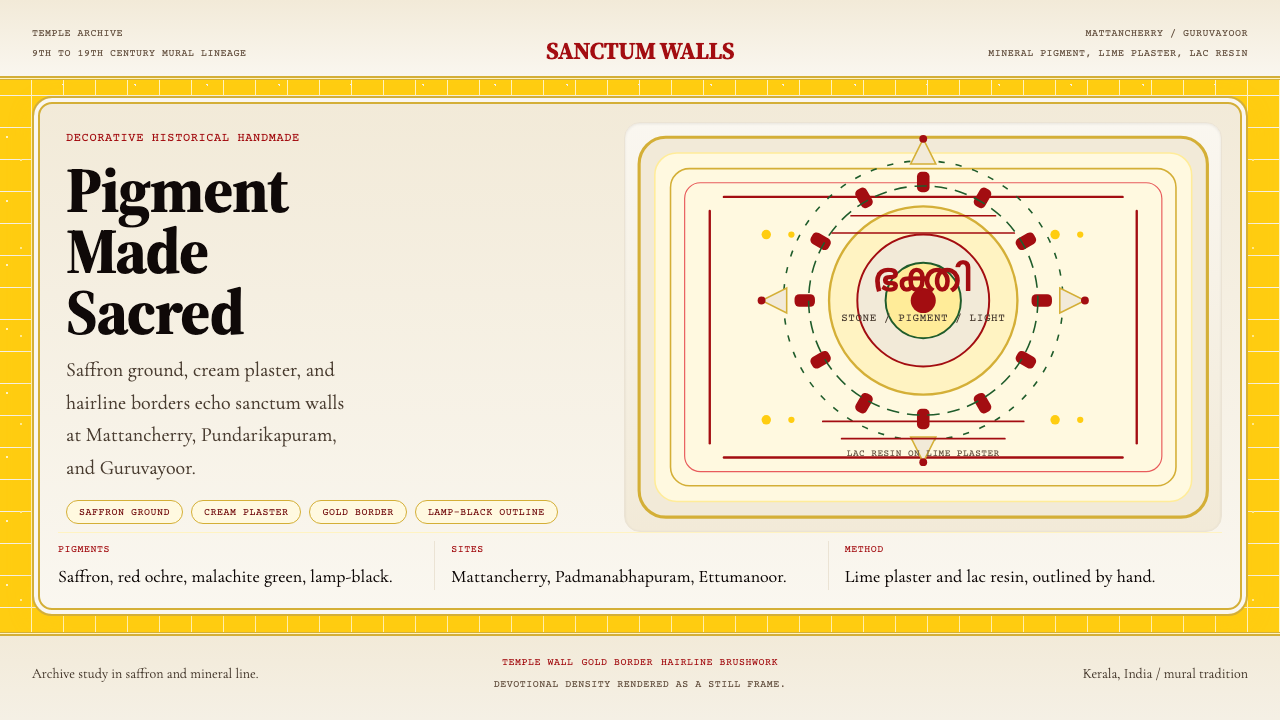 Kerala Mural TempleDevotional density over space. Saffron ground and cream panels, edged in gold.
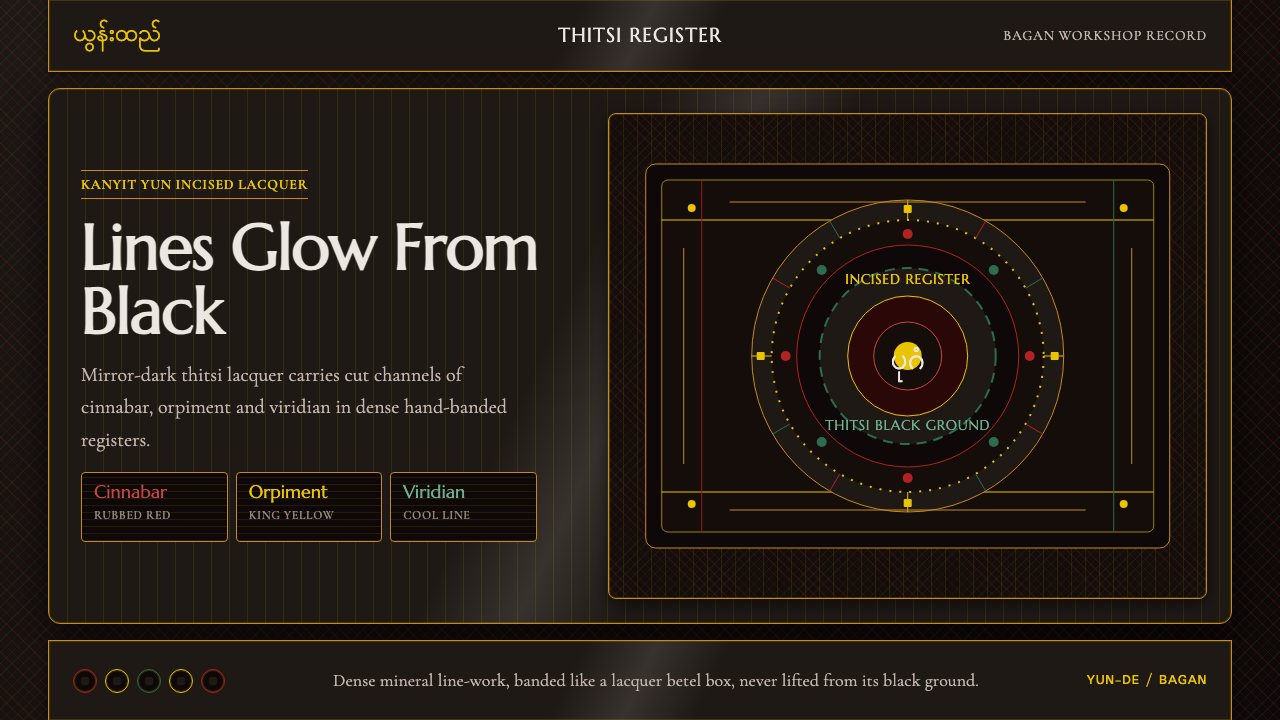 Burmese Yun LacquerwareLacquer glows in cut lines. Cinnabar, orpiment and viridian band a mirror-bla…
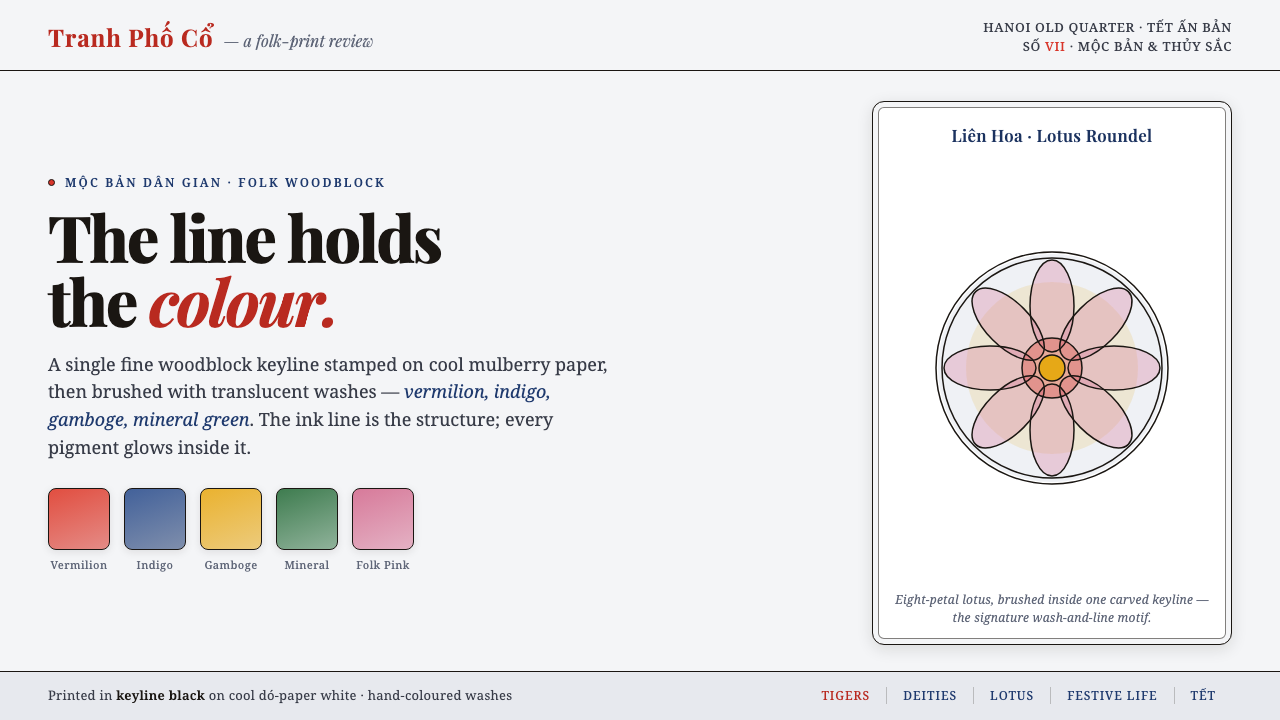 Hàng Trống Folk PrintBright folk colour, never loud. Translucent vermilion-indigo washes held insi…
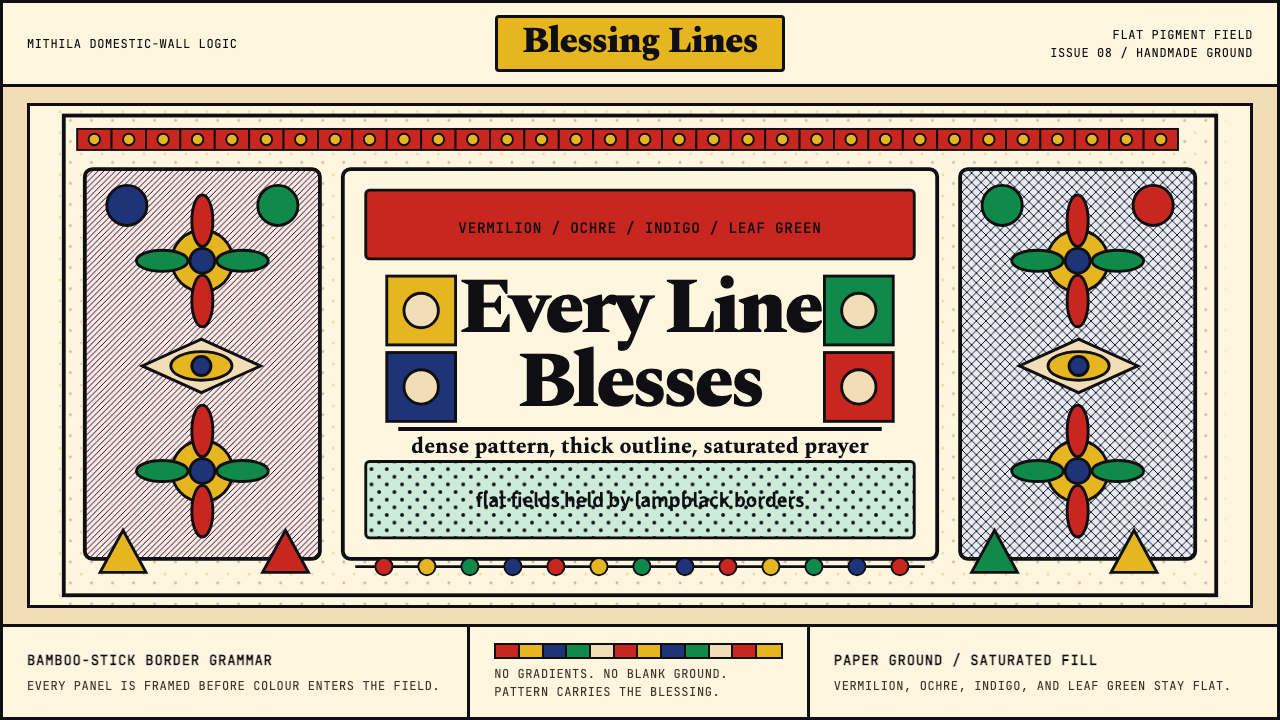 Mithila (Madhubani) PaintingEvery inch is blessed. Lampblack borders lock vermilion, ochre, indigo, and l…
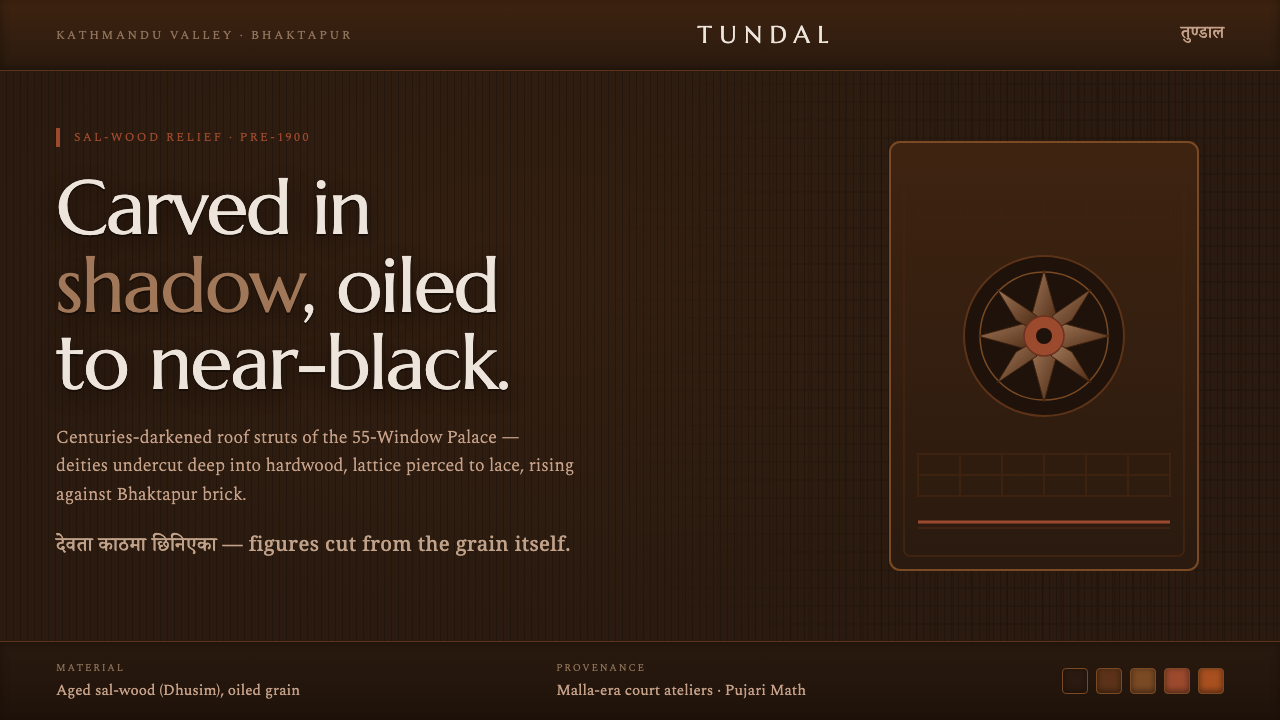 Newar Tundal Strut CarvingCenturies-darkened sal-wood. Carved deities and pierced lattice in mid-brown…
 Odisha Palm-Leaf EtchingSacred narrative goes microscopic. Lampblack hairlines cut tobacco-brown leaf…