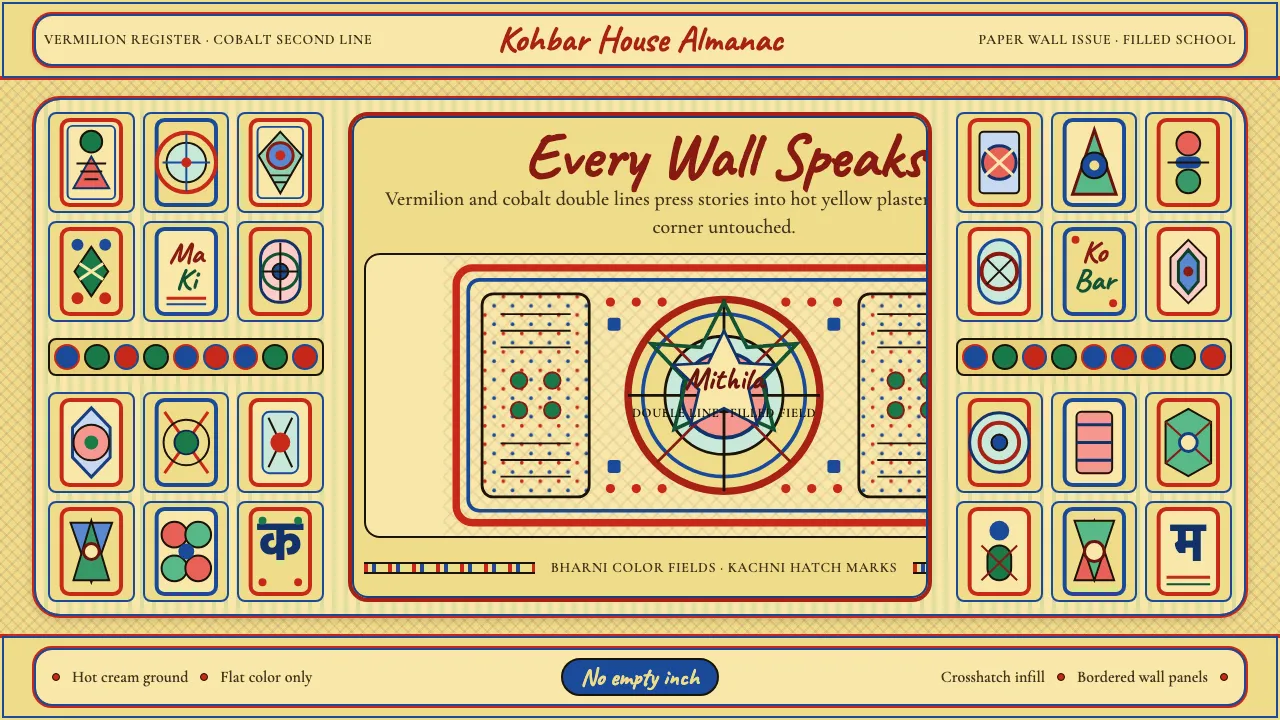
About Madhubani Mithila (Bharni & Kachni)
Madhubani painting is the most maximalist folk tradition in South Asia. Bihar village women — Maithil Brahmin and Kayastha artists for the bharni (filled) school, Dalit artists for godna and gobar variants — cover entire mud walls and paper sheets with double-outlined figures of deities, peacocks, fish, and lotuses, filling every spare millimeter with crosshatch, dots, and pattern fields.
Documented by William Archer in 1934 and commercialized after the 1965 Bihar drought, Madhubani found its way from wedding-chamber walls to international galleries. This design system captures that relentless density: hot cream-yellow ground, vermilion and cobalt double outlines, flat color with zero negative space.
Learn more about the Madhubani Mithila (Bharni & Kachni) style
- Origin
- India (Bihar, Mithila region — Madhubani, Darbhanga, Sitamarhi); Nepal (Janakpur)
- Era
- pre-7th century mural origins; documented 1934; paper-revival 1965
- Key figures
- Sita Devi · Ganga Devi · Bhua Devi · William Archer
- Movements
- bharni · kachni · godna · gobar
Madhubani Mithila (Bharni & Kachni) design spec
Colors
Typography
The other 11 sections — buttons, cards, spacing, motion, techniques and more — open once you unlock. Download the DESIGN.md or send it to your AI in one click. Unlock once, yours forever.
Sign up nowStyles similar to Madhubani Mithila (Bharni & Kachni)
Also inspired by crafts & folk art, with a close feel.
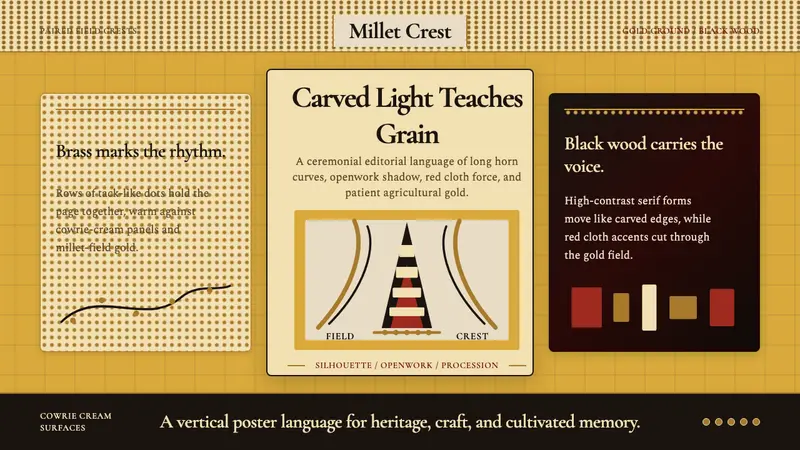 Bambara Chi Wara AntelopeCarved memory in gold. Black serif silhouettes and brass-dot borders carry the field ritual.
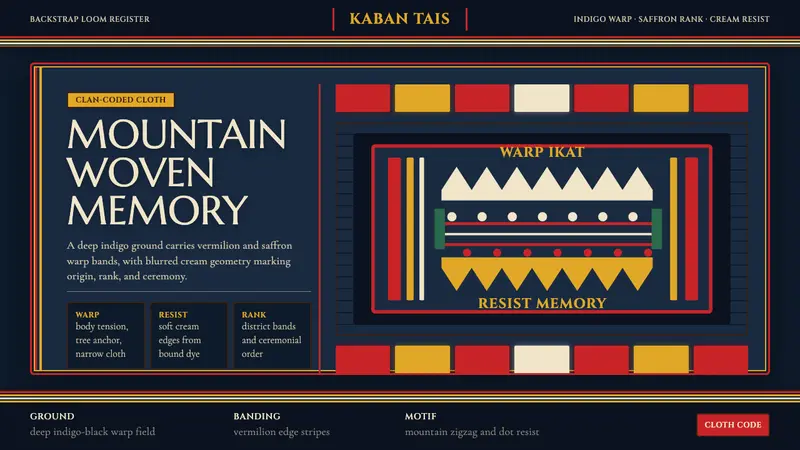 Timorese Tais (Backstrap Loom)Identity woven in darkness. Indigo ground, vermilion bands, saffron stripes, blurred cream resist.
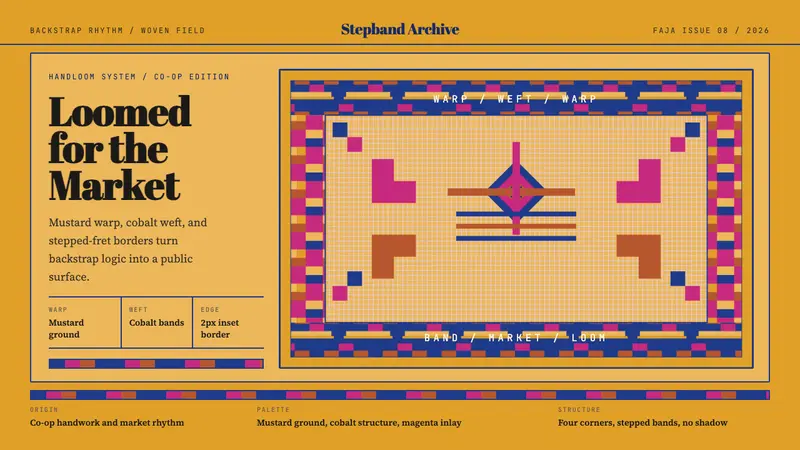 Otavalo Andean TextileThe loom stays vivid. Mustard ground, cobalt bands, stepped-fret borders.
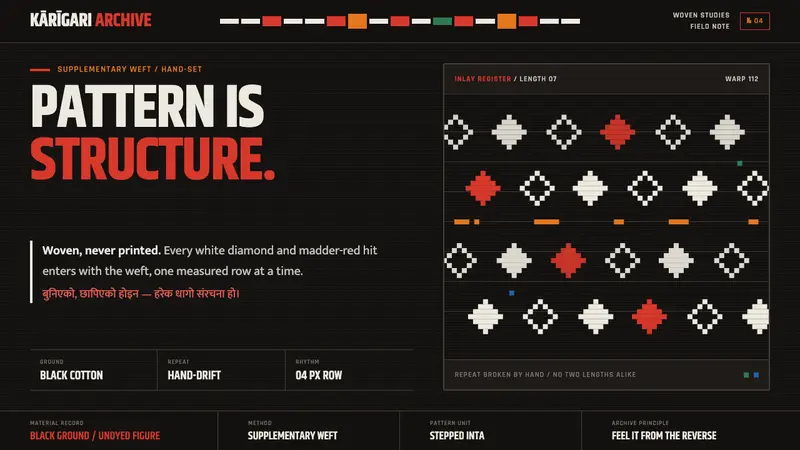 Nepali Dhaka TopiPattern becomes structure. White diamonds and madder-red hits advance row by woven row on black.