What is Lichtenberg Figure?
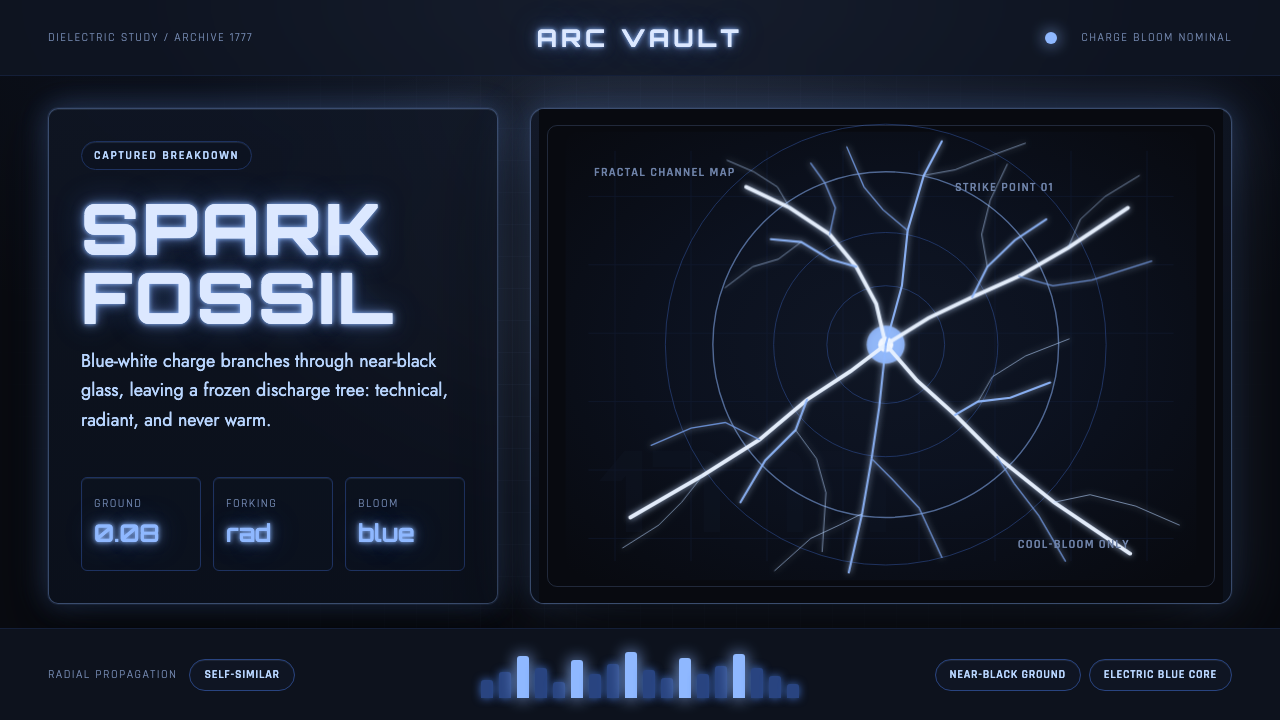
A spark fossil made visible: blue-white fractals branch through near-black dielectric glass, preserving the instant when electricity breaks free.
Lichtenberg Figure in brief
Lichtenberg Figure is the visual record of an electrical breakdown. When enough charge enters a dielectric such as clear acrylic or a coated plate, the excess surges outward in a brilliant blue-white flash, carving branching channels through the dark interior. The resulting image resembles a tree, a root system, or a frozen burst of lightning: filaments radiate from a central strike point, fork repeatedly, and taper as they approach the edges.
The aesthetic treats that physical event as its complete design vocabulary. The ground is near-black and dielectric, as though the viewer were looking into a transparent block containing a trapped discharge. Against it, electric-cornflower filaments carry the composition. Their brightest cores receive a restrained soft bloom, while the surrounding field remains quiet and matte. The palette never leaves the cool blue-white register, so luminosity comes from concentration and branching rather than from added color.
Lichtenberg Figure is therefore neither a generic neon style nor an abstract lightning effect. Its identity depends on dendritic structure, radial movement, and the sense that every branch came from the same electrical event. The composition should feel generated by energy moving outward from a point, not arranged by decoration. Glow is permitted because it belongs to the phenomenon itself, but it must remain controlled enough for the underlying fossil-like pattern to stay legible.

Where does Lichtenberg Figure come from?
The historical origin of Lichtenberg Figure belongs to early electrostatics and dates to Georg Christoph Lichtenberg’s first figures in 1777. The name therefore points to an experimental record rather than an invented decorative motif. Its essential image is an electrical event made permanent: a discharge that normally exists as a flash becomes a branching trace held inside a material.
The source tradition is rooted in eighteenth-century German experimental physics, but its geographic reach is global. The contemporary revival is associated with captured-acrylic and electron-beam work emerging around the 2010s, extending the figure from an early electrostatic observation into a material and laboratory practice. Modern high-voltage and beam labs provide the setting in which the fossil-like quality becomes especially legible: the discharge is not merely seen in motion but preserved as structure.
Across these periods, the defining continuity is fractal branching physics. The channels do not behave like a single clean line or a symmetrical emblem. They radiate, fork, and diminish toward the boundary, creating a record of energy finding routes through a dielectric interior. That behavior explains why the style feels simultaneously scientific and organic: its tree-like appearance is not borrowed from nature as ornament but emerges from the logic of electrical breakdown.
The contemporary design language translates this history into a strict visual system. Near-black dielectric darkness establishes the interior field, blue-white filaments preserve the electrical identity, and restrained bloom marks the most intense parts of the discharge. High-voltage art becomes the bridge between laboratory evidence and public visual culture, allowing the figure to function as an image system while retaining the character of a physical trace.
What defines the Lichtenberg Figure look?
Dielectric Ground
The ground is near-black, dense, and visually quiet. It should suggest clear acrylic, coated material, or a dark interior rather than an ordinary black page. This darkness is not simply a background color; it is the apparent body through which the discharge has traveled. Keeping it restrained gives the filaments a sense of depth without introducing decorative texture.
Blue-White Filaments
The active mark is a cool blue-white filament with a sharp electrical identity. Branches begin with visible intensity near the strike point and become thinner as they travel outward. The color should remain within a cold register, allowing brightness and density to carry hierarchy. Warm accents would break the material and atmospheric logic.
Dendritic Branching
The defining structure is dendritic: a channel radiates, forks, and forks again. Branches should not form ornamental patterns or evenly repeated motifs. Their irregular distribution is what makes the image feel like a fossilized event. The eye should be able to follow energy from a central origin into increasingly delicate peripheral paths.
Radial Composition
Composition is organized around outward movement from a point. The center acts as the energetic origin, while the edges receive the remainder of the branching system. This creates direction without arrows or interface ornament. Cropping can heighten the sense that the figure continues beyond the visible field, but the central strike point must remain perceptible whenever the composition depends on origin and release.
Restrained Bloom
Glow is an essential exception to the otherwise dark and matte field. It belongs at the brightest filament cores and should soften their edges without erasing their branching shape. The bloom is a sign of electrical intensity, not a general atmosphere applied to every object. When every element glows equally, the discharge loses its hierarchy and becomes generic neon.
Cool Continuity
The palette remains consistently blue-white against near-black. Variation comes from concentration, opacity, branching density, and the relationship between sharp cores and softer bloom, not from introducing unrelated hues. This continuity makes the system feel like a single captured discharge, preserving the impression that every mark belongs to one material event.

Who shaped Lichtenberg Figure?
Lichtenberg is the historical figure named by the style and is associated with the first figures made in 1777. His place in the system is foundational: the visual language begins with the act of recording electrical breakdown as a branching trace. The name preserves the connection between early electrostatics and the later image of the spark fossil.
Bert Hickman is listed among the key figures of the modern captured-acrylic and high-voltage revival. Within this article’s visual history, his name marks the contemporary return of Lichtenberg Figure as a material phenomenon rather than a solely historical record. The association connects laboratory discharge, preserved acrylic structure, and high-voltage art.
The spark fossil is the central conceptual figure of the style: a flash transformed into a permanent dendritic record. It explains why the system feels both energetic and archaeological. The filaments suggest motion, yet the captured interior suggests that motion has ended and left behind a visible history.
How do you use Lichtenberg Figure today?
For presentation covers, Lichtenberg Figure works best when the title is placed against a largely undisturbed near-black field and the branching system enters from a visible strike point or from beyond the edge. The cover should feel like an exposure of hidden energy, with blue-white filaments carrying the visual event. Content slides can use smaller fragments of the same figure as structural dividers, background traces, or directional paths, while text remains sharply separated from the brightest cores.
Data slides should treat the branching pattern as a diagrammatic metaphor rather than a decorative wallpaper. A central metric, origin, or decision can sit near the strike point, with related values or stages radiating outward through restrained lines and branches. The visual hierarchy should come from brightness, density, and proximity to the origin. If charts are introduced, their marks should stay cool and luminous, with the darkest field providing contrast and the strongest glow reserved for the most important finding.
For web interfaces, the style suits dashboards, monitoring surfaces, analytical tools, and pricing pages that want to communicate energy moving through a system. Near-black panels can hold blue-white states, active paths, or highlighted thresholds, while inactive content remains quiet and matte. On pricing pages, a branching motif can suggest progression from a central plan or capability, but the interface should remain readable: controls, labels, and values need clear separation from the glowing artwork.
Editorial and marketing work can use Lichtenberg Figure as an image of discovery, stored energy, or a hidden system becoming visible. A feature article may open with a large fossil-like figure, then use cropped branches to lead readers through sections. Marketing pages can pair a dark field with a single intense discharge around a product statement or call to action. The strongest applications preserve the tension between scientific evidence and visual wonder instead of turning the motif into generic cyberpunk atmosphere.
The common mistake is treating the style as permission to add neon color, indiscriminate glow, or random lightning lines. Warm gradients, rainbow accents, evenly glowing objects, and decorative branching weaken the concept because they sever the connection to one captured electrical event. Another mistake is hiding the origin entirely: without a central strike point or a convincing sense of radial release, the composition becomes a texture. Keep the palette cool, the branching irregular, and the bloom subordinate to structure.

Lichtenberg Figure — FAQ
What is a Lichtenberg Figure?
It is the frozen record of an electrical breakdown in a dielectric. A charge surges through material, creating branching channels that radiate from a strike point. The resulting figure preserves the appearance of a spark after the flash has ended.
Why is the palette limited to blue-white and near-black?
The palette keeps the image tied to a single cool electrical event. Near-black suggests the dielectric interior, while blue-white identifies the discharge. Brightness, branch density, and restrained bloom create variation without introducing unrelated color.
Is glow essential to the style?
A restrained glow is important because it indicates the brightest electrical cores. It should soften selected edges while preserving the branching structure. Glow applied equally to every element turns the figure into generic neon and removes its energetic hierarchy.
Can the style work in a web dashboard or pricing page?
Yes. It works especially well where a product needs to show flow, activation, monitoring, or progression. Use the dark field for quiet structure, blue-white marks for active states, and the strongest brightness only for the most important path, value, or decision.
What should be avoided when applying Lichtenberg Figure?
Avoid warm or rainbow accents, random lightning decoration, uniform glow, and perfectly repeated branches. Those choices make the result ornamental and detach it from the source idea of one discharge fossilized inside a dielectric. The origin, irregular branching, and cool continuity must remain visible.
Related design styles
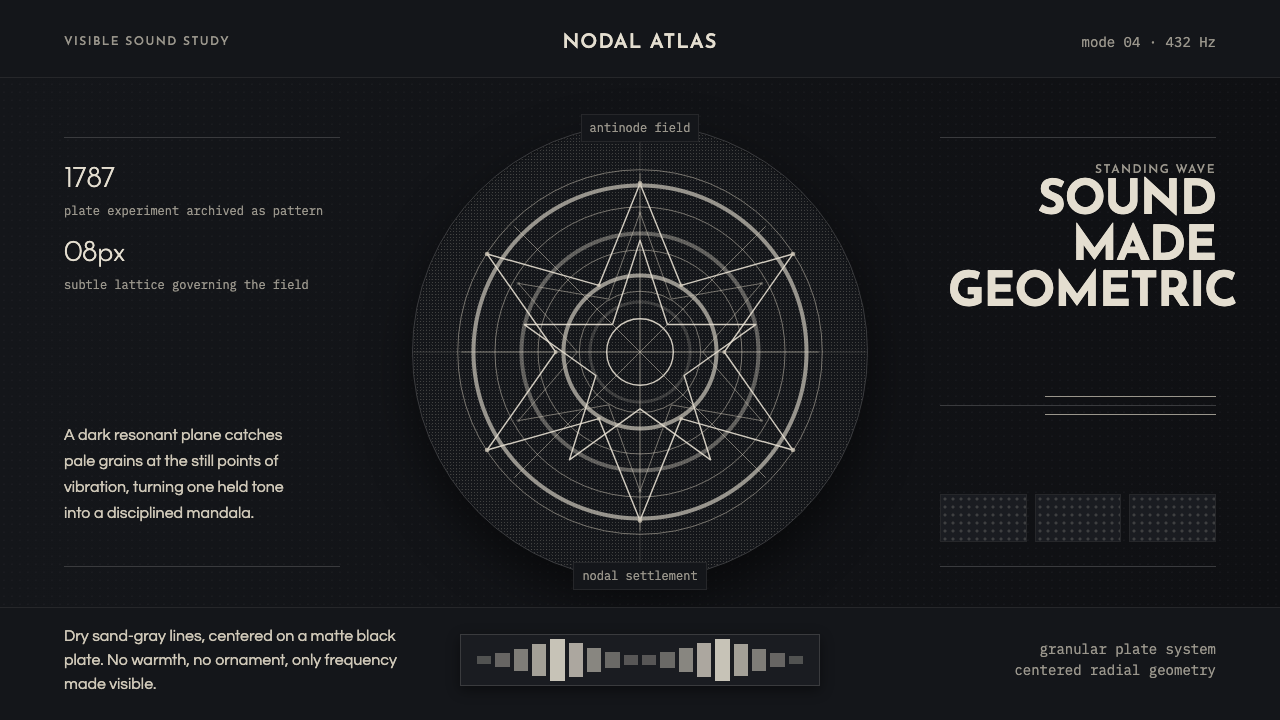 Cymatics Standing WaveSound becomes geometry. Sand-gray nodal rings settle on a dark resonant plate.
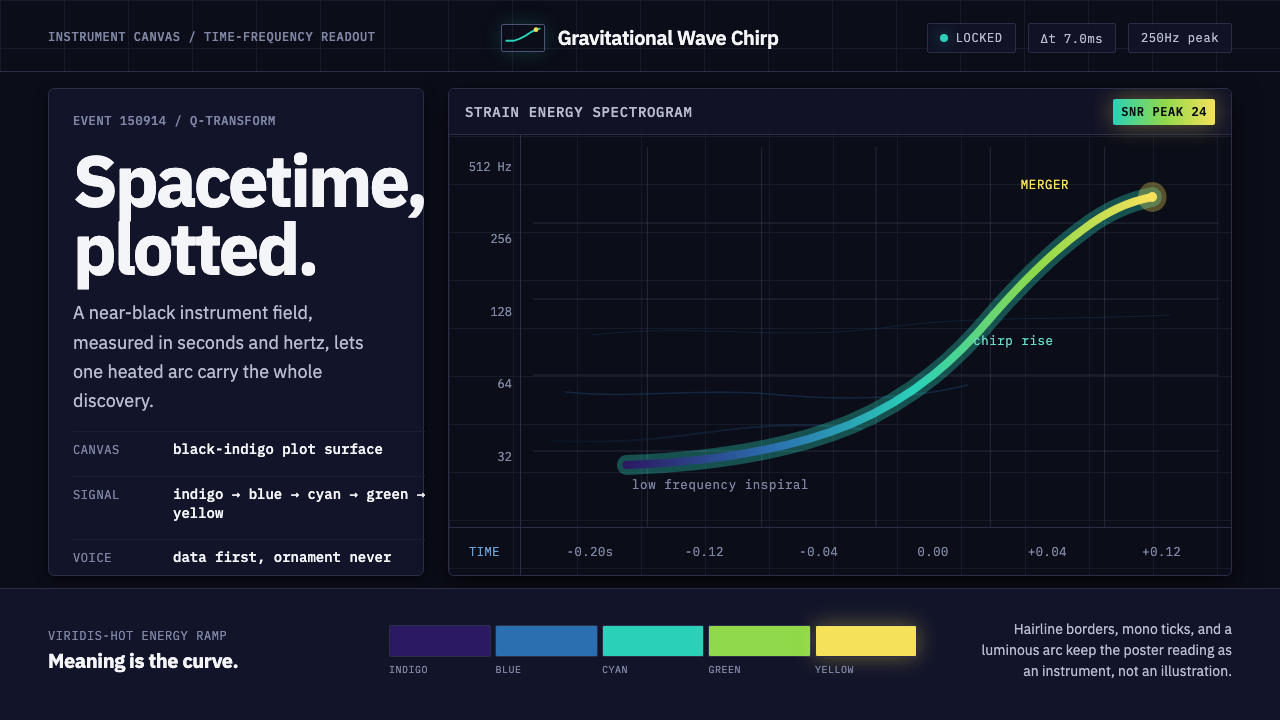 Gravitational Wave ChirpData makes the drama. Near-black grid, mono Hz ticks, and a viridis-hot chirp…
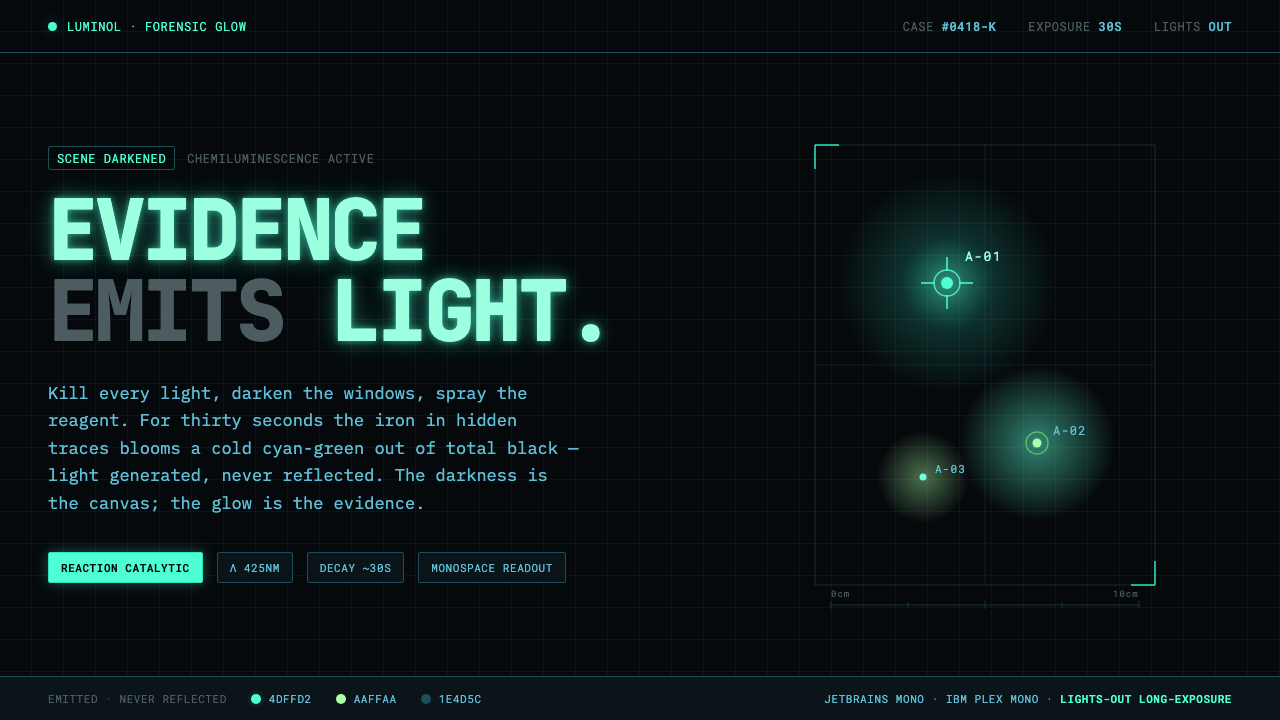 Luminol CSI GlowEvidence emits its own light. Cold cyan-green glow bloomed from pitch-black,…
 Minority Report Gestural UIPredictive computing, conducted on glass. Luminous cyan panels floating in pu…
 Cell MicroscopySignal on total dark. DAPI blue-violet and FITC green bloom as soft point-emi…
 CERN CollisionData, not spectacle. Cyan tracks on black wireframes make every subsystem col…