What is Cymatics Standing Wave?
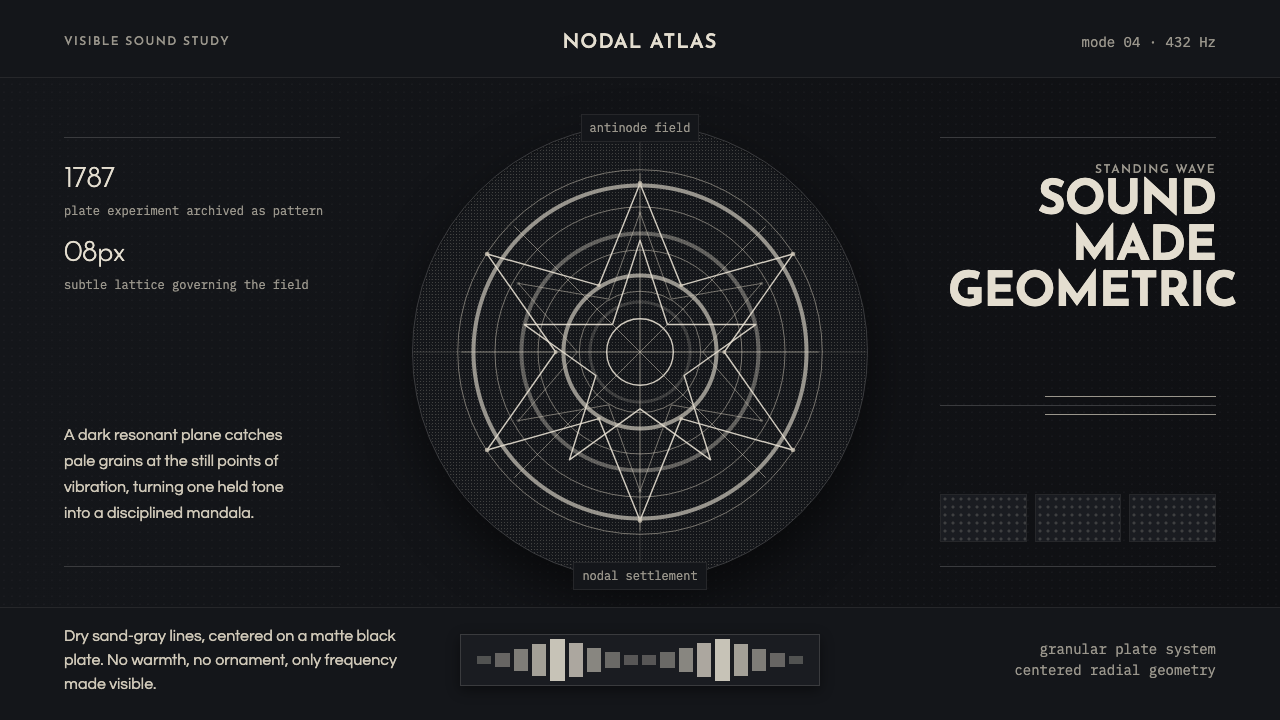
Cymatics turns sound into a quiet geometry: sand-gray nodal figures settle on a dark resonant plate, where every ring and lattice is the visible trace of a wave.
Cymatics Standing Wave in brief
Cymatics is the study of visible sound. On a Chladni plate — a blackened metal disc dusted with fine pale sand — resonance drives the grains away from the violently moving antinodes until they collect along the still nodal lines. A pure tone becomes a visible pattern: rings, stars, lattices, and mandala-like structures crystallised from vibration.
Cymatics Standing Wave takes that physical demonstration as its complete visual world. The ground is dark, granular, and absorptive, like a resonant plate held under controlled light. Against it, dry sand-gray figures stand in sharp relief. The palette is deliberately desaturated, allowing structure rather than color to carry the image. Nothing feels painted onto the surface; the geometry appears to have precipitated out of it.
The system is centered, radial, and mathematically calm. Its visual drama comes from the contradiction between stillness and energy: the pattern is static, yet it records movement; the composition is symmetrical, yet it is born from oscillation; the surface feels physical, yet the result is almost diagrammatic. Cymatics is therefore less an illustration of music than a way to make invisible order perceptible.

Where does Cymatics Standing Wave come from?
The historical starting point is 1787, when Chladni figures established the basic phenomenon that gives this style its name and visual authority. Fine grains on a vibrating plate do not distribute themselves evenly. They retreat from regions of strong motion and settle on the lines where the plate remains comparatively still. The resulting figures make the spatial structure of a tone visible without requiring an image of an instrument, performer, or sound source.
The term cymatics was coined by Hans Jenny in the 1960s. That naming widened the subject from a single demonstration into a broader way of thinking about sound, matter, and form. In the visual language derived here, the word suggests a bridge between observation and abstraction: the pattern is scientific evidence, but it is also an image with symmetry, rhythm, density, and visual presence.
Its cultural geography is global, but its historical foundation is specific: eighteenth-century German acoustics, later carried into modern physics education and sound art. The system therefore avoids theatrical musical symbolism. It does not rely on notes, instruments, equalizers, or expressive color. Its subject is wave physics made legible through material behavior.
Around circa 2010, cymatics experienced a science-demonstration revival. That renewed visibility reinforced the style's central appeal: an invisible force can be observed through a simple physical setup, and a technical principle can produce imagery that feels ceremonial. Cymatics Standing Wave preserves that balance, keeping the surface grounded in demonstration while allowing the resulting forms to function as a refined design vocabulary.
What defines the Cymatics Standing Wave look?
Dark Resonant Ground
The background is not an empty black field but a dark resonant plate. It should feel dense, matte, and faintly granular, providing the physical impression of a surface that can receive vibration. Near-black tones create the necessary depth while avoiding the polished gloss of a screen or the theatrical darkness of a stage.
Sand-Gray Figure
The foreground uses a dry, desaturated sand-gray rather than bright white or metallic silver. This color recalls the fine pale grains on a Chladni plate and keeps the image tied to material evidence. It is light enough to stand clearly against the ground, but muted enough to feel deposited, mineral, and physical.
Radial Geometry
The primary forms grow from a center outward. Rings, stars, and lattice structures should read as consequences of resonance rather than arbitrary decoration. Radial repetition creates a sense of order, while small changes in density and contour keep the figure from becoming a generic ornament. Every curve should imply a wave meeting a surface.
Centered Symmetry
Composition is organized around a visible center. Symmetry is not used to create ceremonial luxury but to express mathematical calm and physical regularity. The surrounding space should protect the figure's circular logic, giving it room to read as a complete field rather than a cropped fragment. Centering is structural, not merely decorative.
Dry Material Contrast
The visual tension comes from the contrast between granular darkness and settled mineral lightness. Surfaces should suggest dust, plate, and fine particulate matter without becoming photorealistic texture studies. The material story is restrained: a dark plate, pale grains, and the evidence of vibration connecting them.
Wave-Born Stillness
The style should feel energetic in origin but still in presentation. Avoid effects that make the figure appear to ripple, glow, or dissolve. The standing wave is powerful precisely because its result has settled. Motion is encoded in the pattern's logic, not simulated through spectacle. The image is a frozen event with an active cause.

Who shaped Cymatics Standing Wave?
Ernst Chladni is the historical anchor of the visual system. The source places the first Chladni figures in 1787, connecting his name to the demonstration in which sand on a vibrating plate gathers along nodal lines. In design terms, Chladni represents the moment when sound becomes spatial evidence: a tone leaves behind a figure that can be examined as both experiment and composition.
Hans Jenny coined the term cymatics in the 1960s. His place in this lineage gives the style its broader conceptual frame, shifting attention from one plate and one pattern toward the visible behavior of sound and matter. The design system inherits that expanded view by treating every radial figure as part of a larger relationship between frequency, surface, and form.
Robert Hooke appears in the approved historical lineage of cymatics. Here, his role is treated as a reminder that the subject belongs to a longer culture of making hidden physical behavior observable. The reference should remain restrained and scientific, supporting the connection between acoustic inquiry, wave physics, and demonstration rather than introducing unrelated portraiture or historical ornament.
How do you use Cymatics Standing Wave today?
For presentation slides, use the standing-wave figure as the central organizing device. Cover slides can place one large radial pattern against the dark plate, leaving generous quiet space for a short title. Content slides should keep the same centered logic while introducing text as a calm counterforce: clear hierarchy, restrained color, and no competing musical imagery. Data slides can treat diagrams as wave fields, using rings, nodes, or lattice structures to suggest relationships without making the science look decorative.
For web interfaces, the system suits dashboards and pricing pages that need a sense of technical authority and visual focus. Keep the interface dark and let sand-gray carry the main information, reserving stronger contrast for active states, selected plans, or important thresholds. Cards should feel like plates or panels, with firm edges and controlled depth. Radial marks can identify status or category, but they should remain legible symbols rather than ornamental backgrounds.
For editorial and marketing work, Cymatics Standing Wave offers a distinctive way to frame science, sound, education, and experimental technology. Use a broad dark field for opening spreads, feature statements, or campaign moments, then return to quieter plate-like surfaces for explanatory sections. A single figure can act as a visual chapter marker. Copy should explain the phenomenon with confidence and clarity, allowing the image to carry atmosphere while the writing carries evidence.
The common mistake is to confuse cymatics with generic music visualization. Equalizer bars, neon glows, colorful spectrums, animated ripples, and decorative notes weaken the system because they replace material observation with spectacle. Another mistake is making every pattern perfectly ornate. The figure should feel generated by resonance, with density, symmetry, and stillness doing the work. If the surface looks like a nightclub screen rather than a dark plate holding settled grains, the visual logic has been lost.

Cymatics Standing Wave — FAQ
What is Cymatics Standing Wave?
It is a design system based on cymatics, the study of visible sound. Its central image is a Chladni plate: fine pale sand settles along the still nodal lines of a vibrating dark metal plate, turning a tone into a symmetrical figure. The system translates that phenomenon into a dark, granular ground with centered sand-gray rings, stars, and lattices.
Does this style need to show actual sound or music imagery?
No. The system is about sound becoming geometry, not about depicting instruments or performance. Its strongest expression is often an abstract nodal figure that implies frequency through symmetry and density. Musical symbols may be appropriate in explanatory material, but they should not replace the physical logic of the plate and the settled grains.
Can the system work on a light background?
It can be adapted, but the dark resonant plate is the defining ground and should remain the default. A light inversion may preserve the radial geometry, yet it loses some of the material contrast between dark plate and pale sand. If a light version is necessary, keep the figure dry and desaturated, maintain strong structural contrast, and avoid turning the result into a generic scientific diagram.
Should a cymatic pattern be animated?
Not necessarily. The standing wave is compelling because the vibration has resolved into stillness. Static artwork often communicates the concept more precisely than constant motion. If movement is introduced in a digital interface, it should clarify the relationship between vibration and nodal form, then allow the pattern to settle. Continuous spectacle, glowing trails, or dissolving particles work against the system's quiet mathematical character.
Related design styles
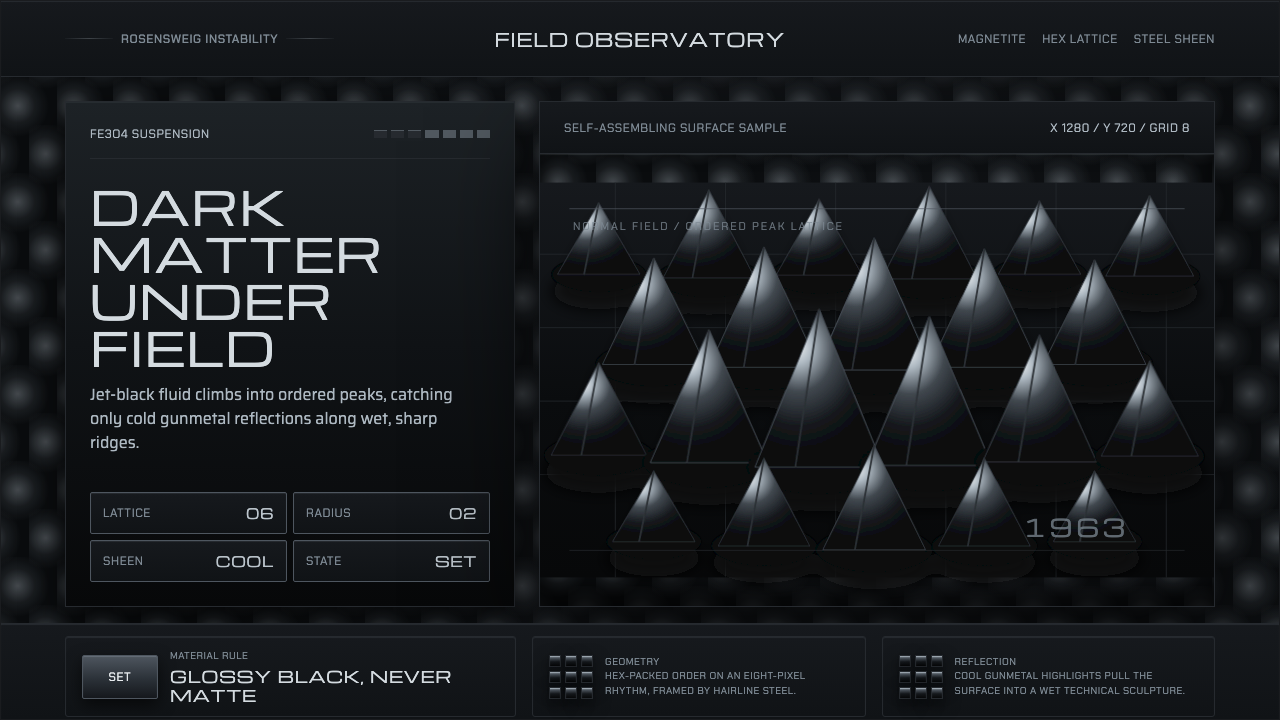 Ferrofluid Spike FieldPhysics turns sculptural. Jet black peaks, steel sheen, hex order.
 High Life (2018)Institutional dark, one living light. Matte-black hull, hydroponic green, one…
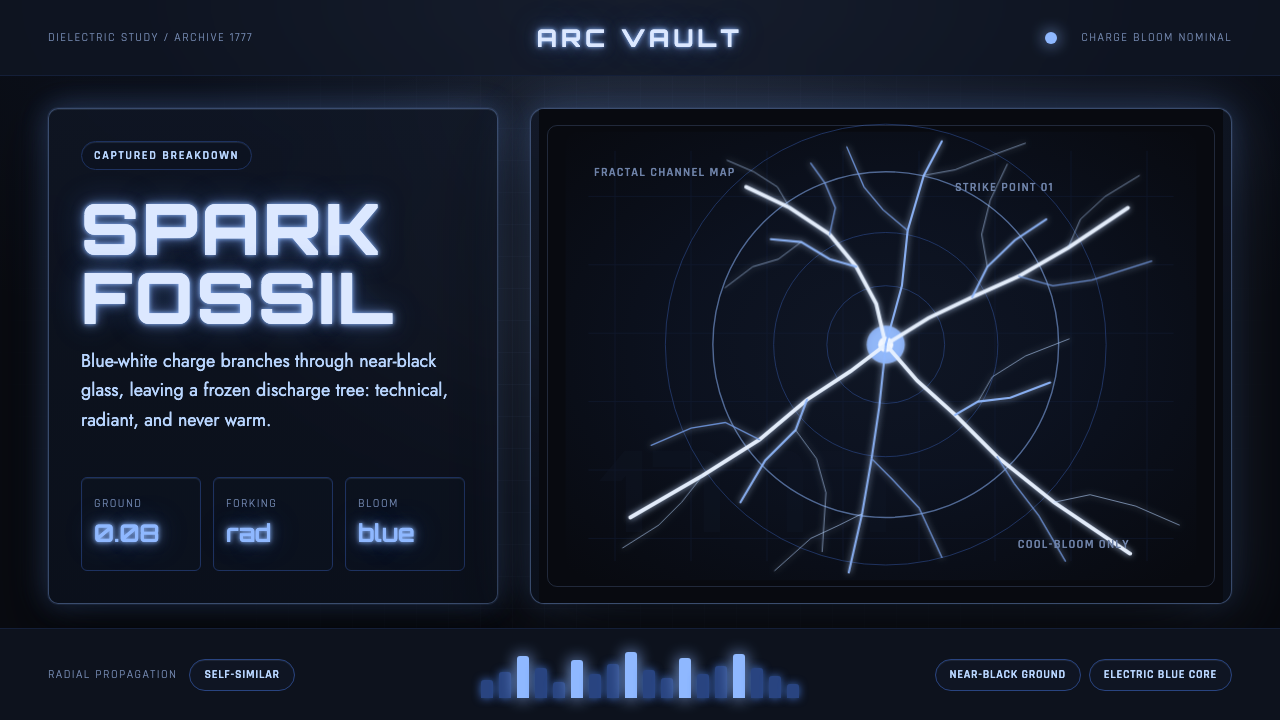 Lichtenberg FigureA spark fossil. Blue-white fractals bloom across near-black dielectric glass.
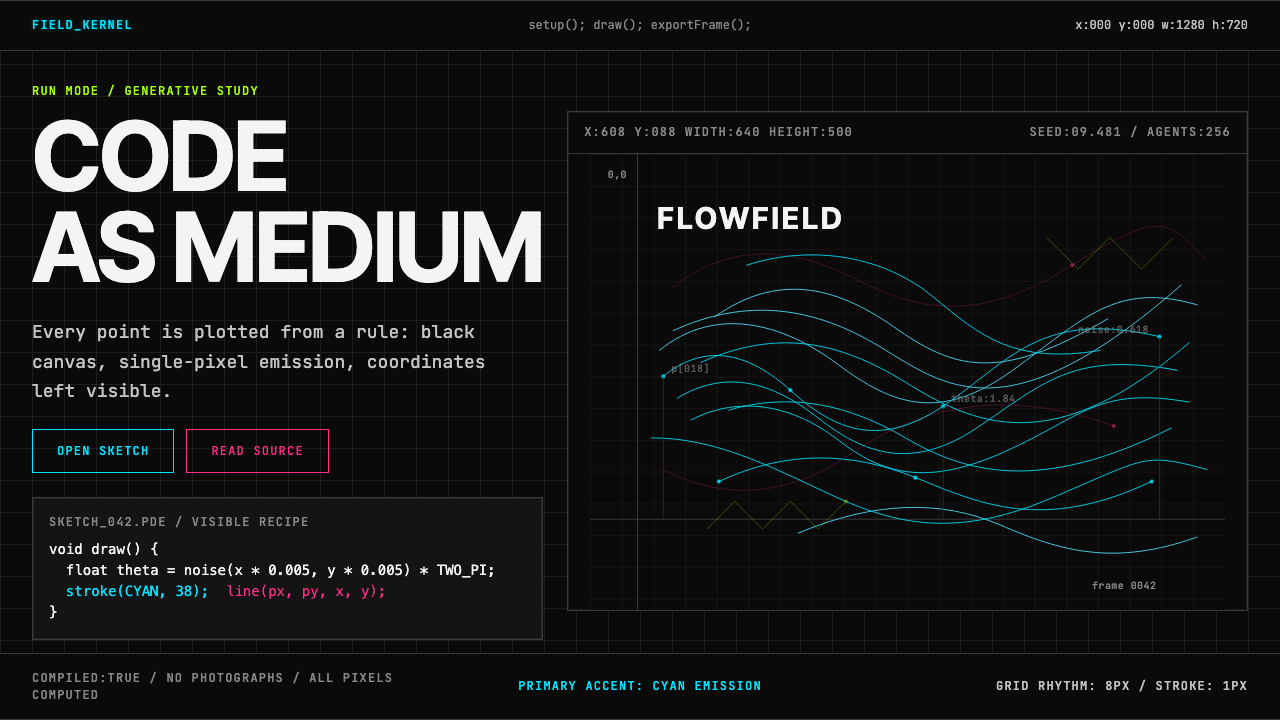 Processing / GenerativeCode becomes image. Cyan hairlines trace black-grid flowfields with mono coor…
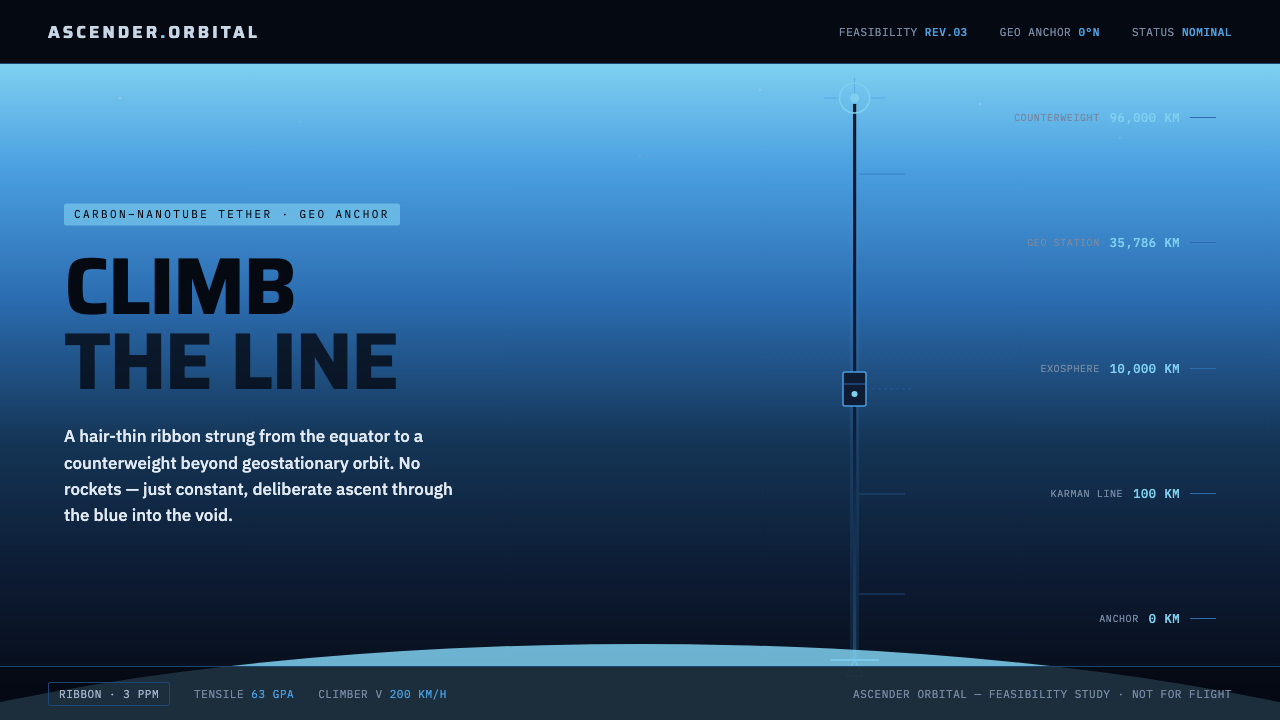 Space ElevatorClimb the line, no rockets. Carbon ribbon rises through atmosphere blue into…
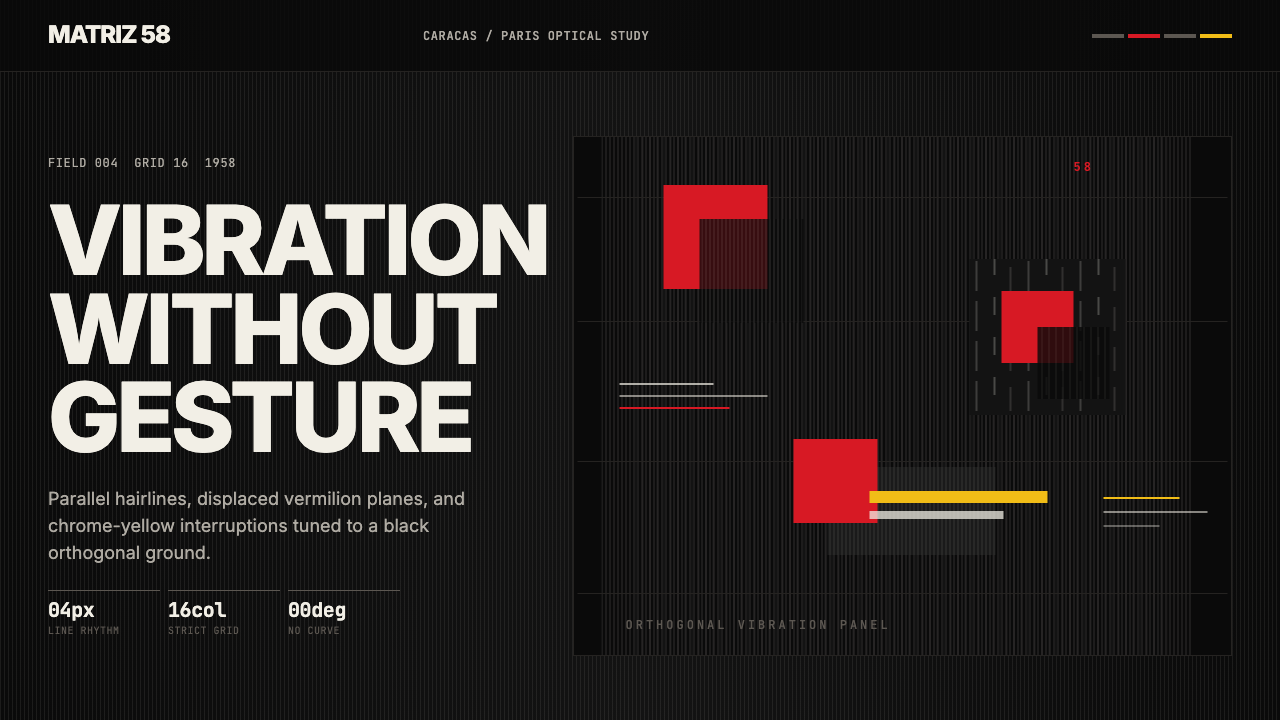 Venezuelan Cinético Soto 1958Optical tension holds still. Matte black, Inter, hairlines, and vermilion off…