What is Lao Naga Textile?
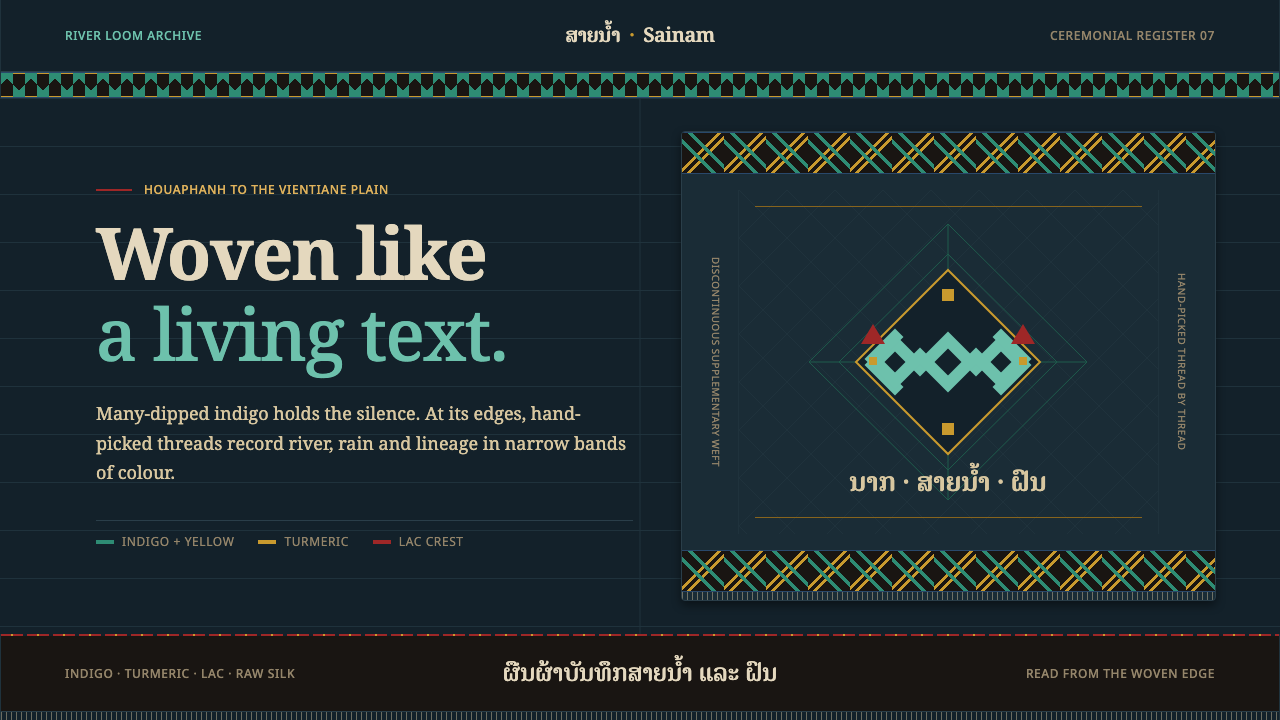
Lao-Tai ceremonial cloth turns a near-black indigo field into a text — read at the ends, in narrow bands of turquoise and turmeric, where the river serpent coils.
Lao Naga Textile in brief
Lao-Tai textile design is a woven vocabulary built almost entirely from restraint. The ground is silk dyed indigo so many times it approaches black, and across that dark field almost nothing happens — no field-wide pattern, no gradient of color, no filled surface. Pattern is rationed to the ends of the cloth, where a discontinuous supplementary-weft technique called chok is hand-picked thread by thread to lay narrow horizontal bands of color: turquoise, turmeric gold, and a red derived from lac insects.
The dominant motif is the naga, a crested serpent associated with rivers, rain, and the boundary between the human and water worlds. It appears coiled, mirrored, and set inside diamond lattices, repeated with the regularity of a written character rather than drawn as a single illustrative image. Because the naga recurs at fixed intervals inside a strict lattice, the visual effect resembles a repeating glyph more than a picture — something meant to be read in sequence rather than looked at all at once.
What distinguishes this system from other indigo textile traditions is its discipline about where color is allowed to exist. The dark field is not a background waiting to be filled; it is the dominant fact of the cloth, and every colored band is an interruption that must justify itself. Lac red in particular is treated as a signature rather than a surface — it appears along the crest of the serpent motif and rarely anywhere else, functioning like a mark of authorship rather than a fill color.
Where does Lao Naga Textile come from?
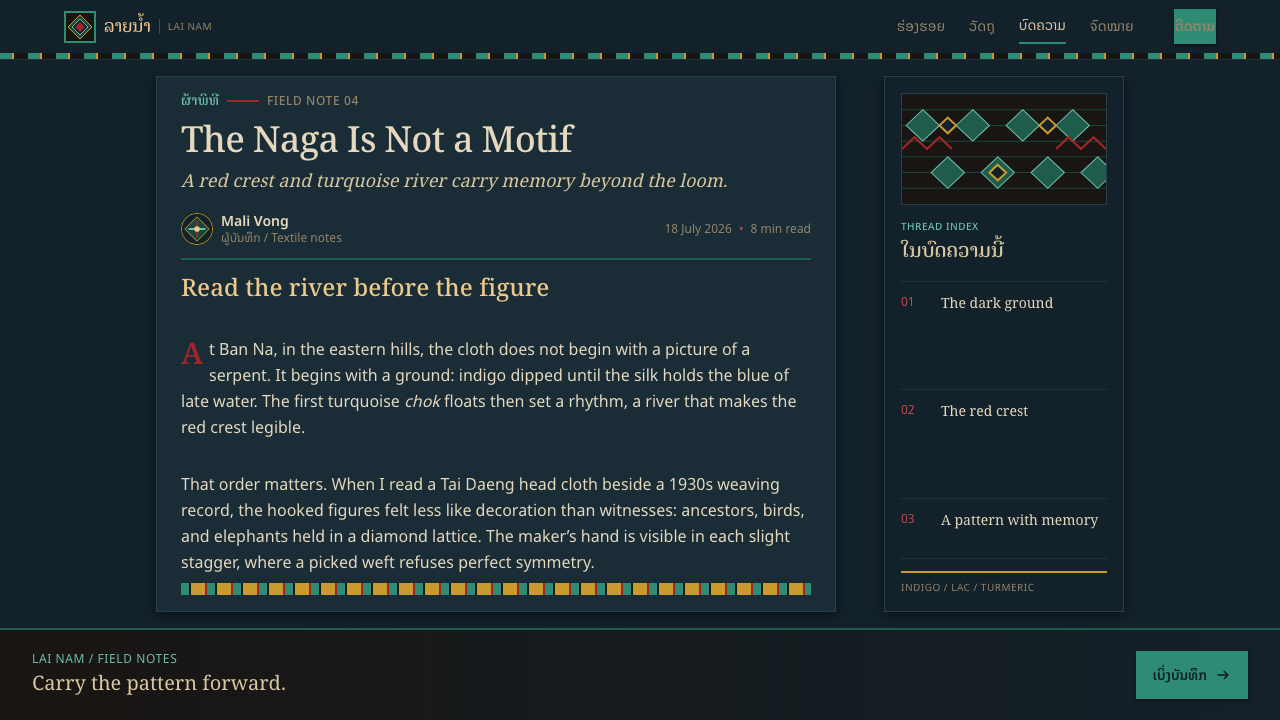
This visual language belongs to Tai-speaking weaving communities across Laos, documented most thoroughly among Tai Daeng villages in the upland provinces of Houaphanh and Sam Neua, with related traditions continuing around Luang Prabang and the Vientiane plain. As a village craft, it predates the twentieth century and has no single founder or founding date; it is a pre-1900 tradition passed down through households and lineages of weavers, primarily women, who learned the chok technique and the naga cosmology it encodes as part of ordinary domestic life.
The twentieth century brought disruption and, eventually, deliberate revival. Decades of conflict and displacement in Laos scattered weaving communities and interrupted the transmission of technique in many villages. From the 1990s onward, institutions took on an active role in documenting and sustaining the practice. The Traditional Arts and Ethnology Centre in Luang Prabang became a central point for recording weaving methods, working directly with village weavers to preserve chok and khit supplementary-weft techniques that might otherwise have faded as older weavers passed away without apprentices.
International museums played a parallel role in establishing the historical record. The Fine Arts Museums of San Francisco, among other institutions, built collections and scholarship around Southeast Asian textiles that gave Lao-Tai ceremonial cloth a documented place within the broader history of natural-dye weaving traditions. This combination of village-level revival and institutional documentation is why the tradition can be dated with some precision even though it has no single inventor: the cloth itself long predates any written account of it, but the record we have was substantially built from the 1990s forward.
Underlying the entire practice is naga cosmology, a belief system shared across much of mainland Southeast Asia in which the serpent-spirit governs water, fertility, and the threshold between visible and unseen worlds. The naga motif on Lao-Tai textiles is not decorative in the way a repeating floral pattern might be decorative elsewhere; it is a cosmological statement woven into cloth that was worn or displayed at ceremonies marking exactly the kinds of transitions the naga is understood to preside over — birth, marriage, and other rites of passage.
What defines the Lao Naga Textile look?
Ground and Field
The dominant surface of the cloth is silk dyed indigo through repeated dipping until it reads as nearly black rather than blue. This is not a neutral backdrop; it is the visual anchor of the entire system, occupying the overwhelming majority of the surface while pattern is confined to narrow zones at the ends. A design built on this logic treats large areas of near-black or deep dark tone as the default state, with color understood as a rationed exception rather than a fill.
Band Placement
Color never appears as a wash or a filled region; it arrives strictly as narrow horizontal bands positioned at the ends of the cloth, produced by the discontinuous supplementary-weft chok technique. Applied to a screen or page, this translates into treating color as a bounded strip — a header band, a footer band, a divider — rather than a background fill, with the vast majority of the composition left in the dominant dark ground.
The Naga Motif
The crested serpent is rendered coiled and mirrored inside diamond lattices, repeated at regular intervals rather than drawn once as a centerpiece illustration. Its regularity and repetition give it the character of a written symbol rather than a picture. In application, motif elements should repeat on a strict lattice or grid rather than appear as one-off decorative illustrations, reinforcing a sense of pattern-as-language.
Restrained Palette
The working colors are turquoise, turmeric gold, and lac red — each traceable to a specific natural source: a mineral or plant-derived blue-green, a plant-derived yellow, and a red from lac insects. No hue is arbitrary or purely decorative; each is understood to come from a specific material origin, and this grounding is part of what gives the palette its disciplined, non-arbitrary feel.
Red as Signature
Lac red is deliberately rationed to a single signature line — typically the crest of the naga motif — rather than spread across a surface. This treats a single accent color as a mark of identity or authorship, used sparingly and consistently in one specific location, rather than as a general-purpose accent color to be applied wherever emphasis is needed.
Material Traceability
Every color in the system traces back to a specific plant, insect, or ash-lye process, and the visual result reads that way: slightly variable, warm rather than synthetic, and consistent with a dye process rather than a manufactured pigment. This principle argues against perfectly uniform, flat digital color in favor of tones that feel sourced rather than generated.

Who shaped Lao Naga Textile?
The Tai Daeng weaving communities of Houaphanh and Sam Neua provinces are the primary living carriers of this tradition, practicing the chok supplementary-weft technique as part of household craft passed between generations of women. Their continued work — through periods of conflict, displacement, and eventual revival — is the reason the precise techniques of hand-picked banding and naga-lattice motif construction survive today rather than existing only as museum description.
Founded to document and sustain Lao textile and craft traditions, this Luang Prabang institution has played a central role since the 1990s in recording village weaving methods and working directly with weavers to keep techniques like chok and khit alive. Its work bridges the gap between informal household transmission and the kind of systematic documentation that allows a tradition to be studied, taught, and referenced with historical precision.
Among the international institutions that built collections and scholarship around Southeast Asian textiles, the Fine Arts Museums of San Francisco helped situate Lao-Tai ceremonial cloth within a documented global history of natural-dye weaving. Museum collection and study give the tradition a form of institutional permanence that complements the living, ongoing practice in Lao villages.
How do you use Lao Naga Textile today?
This style transfers well to any interface or document that needs to feel deliberate and text-like rather than decorative. The core move is to commit to a dominant near-black or very deep-toned ground across the majority of the surface, and to treat color as something that appears only in specific, bounded zones — never as a general background wash.
For presentation slides, this suggests a cover built almost entirely from the dark ground, with a single narrow band of color — turquoise or turmeric — running near the top or bottom edge, carrying the title or a key phrase the way the chok band carries the naga. Content slides should keep body text and diagrams on the dark field, reserving the accent band for section headers or key callouts only, so the eye understands the band as a signal, not a decoration.
For web interfaces, the dark ground works naturally as a primary background for dashboards or portfolio sites aiming for a serious, considered tone. Navigation bars or footer strips are natural places for the narrow accent band, since they already occupy a bounded horizontal zone at the edge of the layout. Avoid spreading turquoise, turmeric, and red across multiple UI elements simultaneously; instead let one band do the work in one location, consistent with the source material's insistence that pattern lives only at the ends.
For editorial and marketing layouts, a repeating motif — used the way the naga repeats inside its lattice — can mark section dividers or pull-quote borders, provided it appears as a regular, repeated small unit rather than a single decorative illustration. Pull the lac-red equivalent accent into a single recurring signature element, such as a consistent underline on links or a single icon color, rather than distributing it as a general highlight color throughout the page.
A common mistake when applying this style is treating the dark ground as merely a 'dark mode' backdrop and then adding conventional UI color liberally on top of it. The source discipline is the opposite: darkness is the default and the overwhelming majority state, and every appearance of color must be narrow, bounded, and justified — closer to a rationed signature than a palette to be used freely.
Lao Naga Textile — FAQ
Why is the cloth dyed nearly black instead of a visible blue?
The near-black tone is the result of many repeated dips in indigo dye, a process that deepens the color with each pass. This is a deliberate outcome, not an accident of dyeing — the deep, nearly black ground is what allows the narrow bands of turquoise, turmeric, and lac red at the ends to read with such clarity and weight. If the ground were a lighter, more visible blue, the accent bands would compete with it rather than stand apart from it.
What does the naga symbolize, and why does it appear in a repeating lattice?
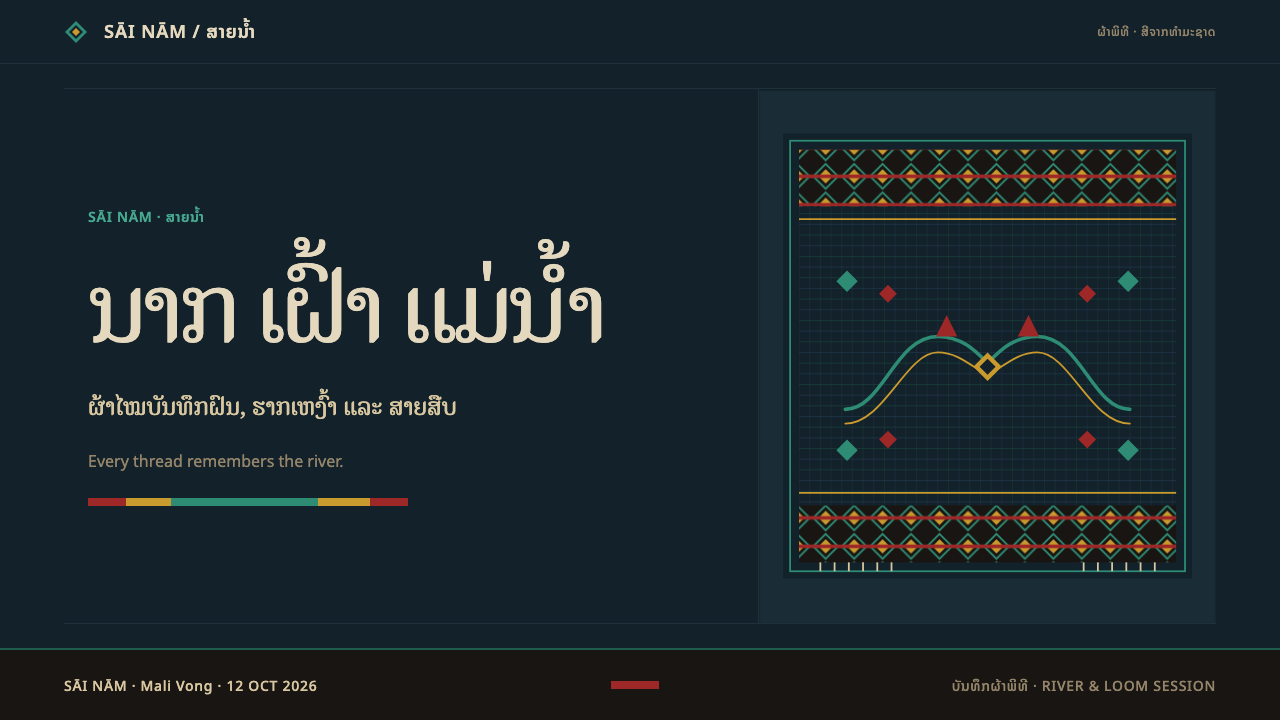
The naga is a crested serpent associated with rivers, rain, and the threshold between the human and water worlds within a cosmology shared across mainland Southeast Asia. It appears coiled and mirrored inside diamond lattices, repeated at regular intervals rather than as a single illustration, which gives it the character of a symbol meant to be read in sequence — closer to a repeated written character than a one-off decorative image.
Is chok the same as ordinary weaving?
No. Chok is a discontinuous supplementary-weft technique, meaning the colored pattern threads are hand-picked and added into the weave only where the motif requires them, rather than woven continuously across the full width of the cloth the way the base structure is. This is what allows the pattern to be confined precisely to narrow bands at the ends of the cloth while the rest of the weave remains the plain indigo ground.
Why is lac red used so sparingly compared to turquoise and turmeric?
Lac red functions as a signature element within the system, typically confined to the crest line of the naga motif rather than distributed across the cloth the way turquoise and turmeric bands are. Treating a single strong color as a rare, specific mark rather than a general accent is part of what keeps the overall composition disciplined — it prevents the palette from feeling evenly saturated across the board and preserves a clear visual hierarchy.
How did this tradition survive periods of conflict in Laos?
The tradition survived primarily through continued village-level transmission among Tai Daeng weaving communities, who kept the chok technique alive as part of household craft even through periods of displacement. From the 1990s, institutions such as the Traditional Arts and Ethnology Centre in Luang Prabang began actively documenting and supporting village weavers, helping to formalize and safeguard a practice that had previously depended entirely on informal transmission between generations.
Related design styles
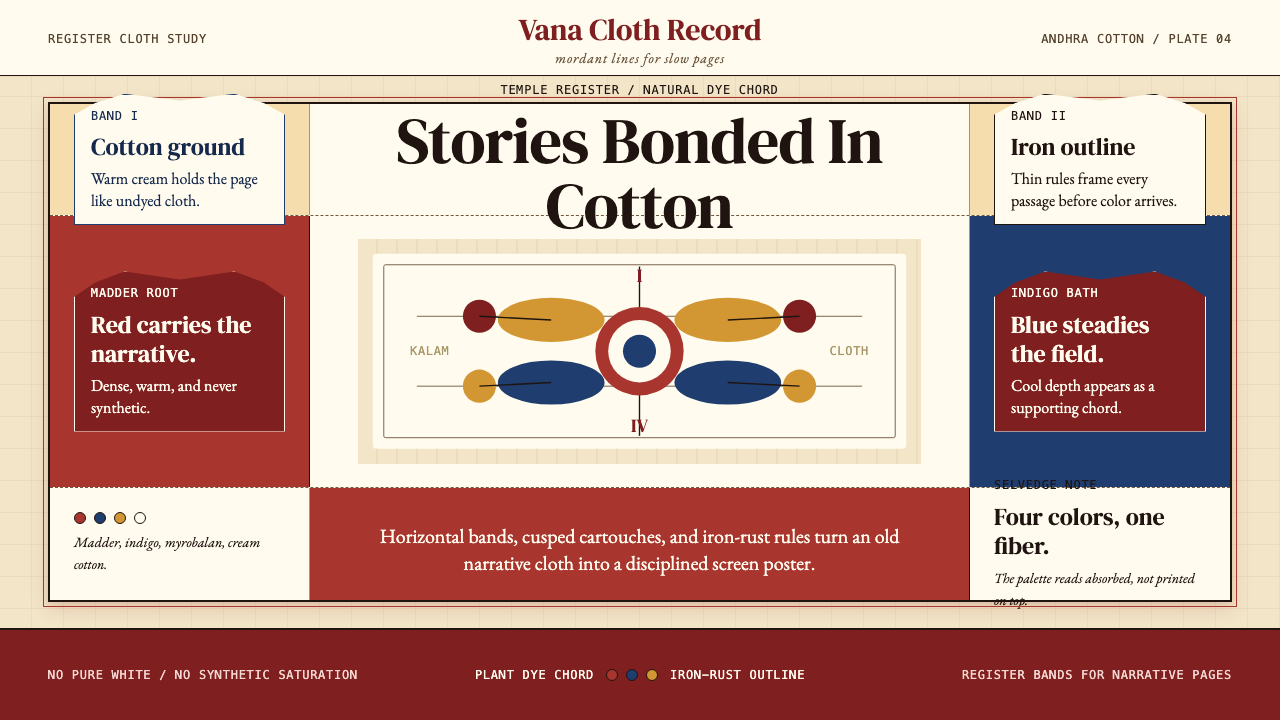 Kalamkari (Andhra Pradesh)Cloth becomes narrative. Madder bands, indigo panels, and iron rules stack li…
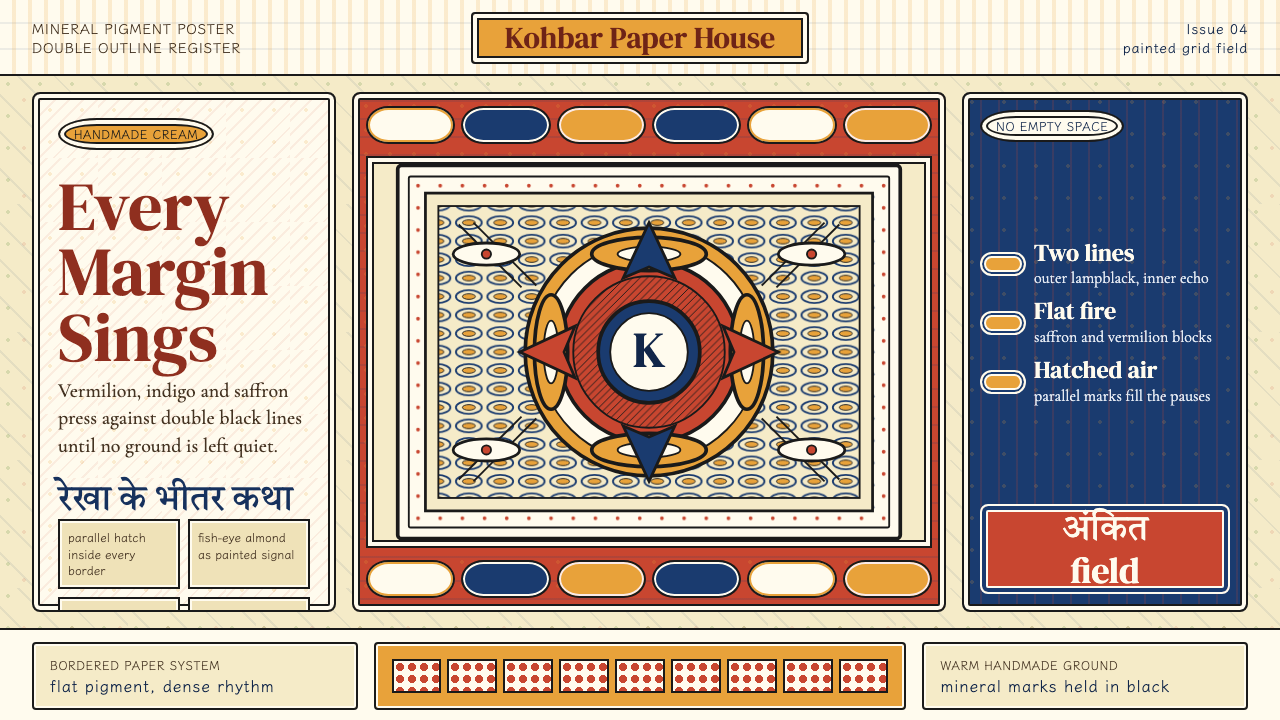 Madhubani (Mithila Folk Painting)No empty ground. Vermilion, indigo and saffron pack double-outlined panels wi…
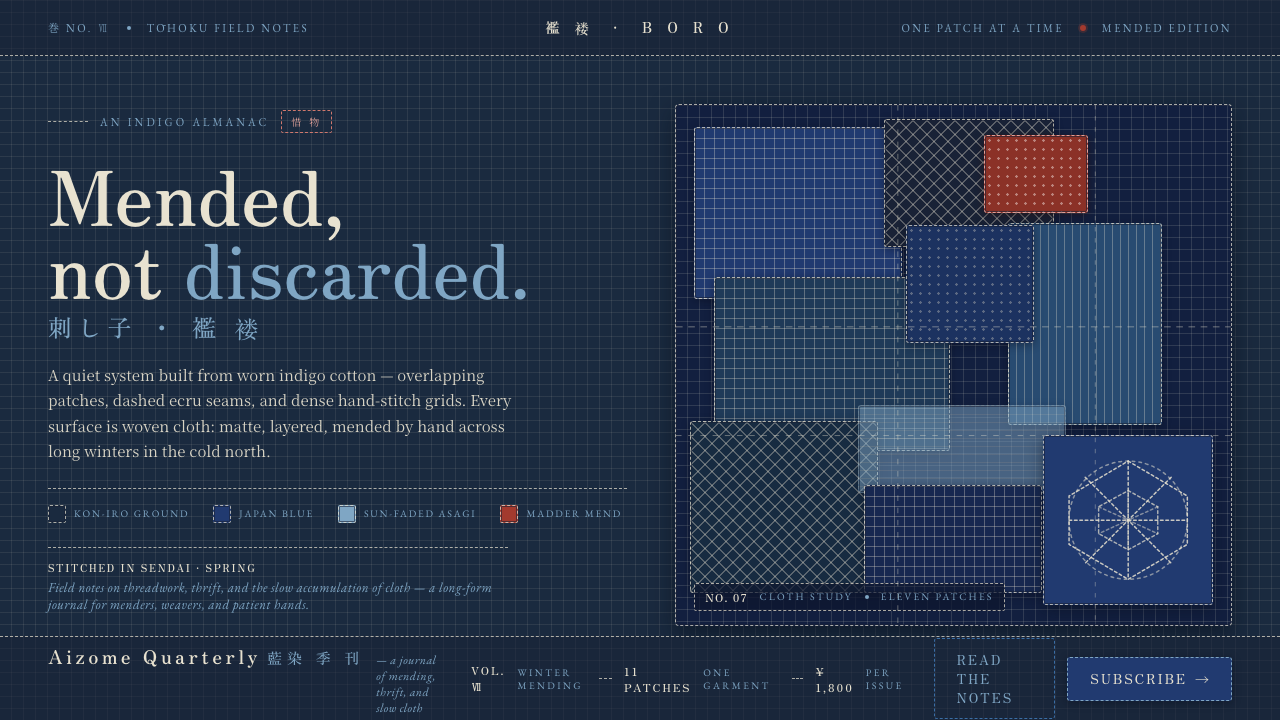 Sashiko BoroMended, not discarded. Deep kon-iro grounds, overlapping patches, dashed ecru…
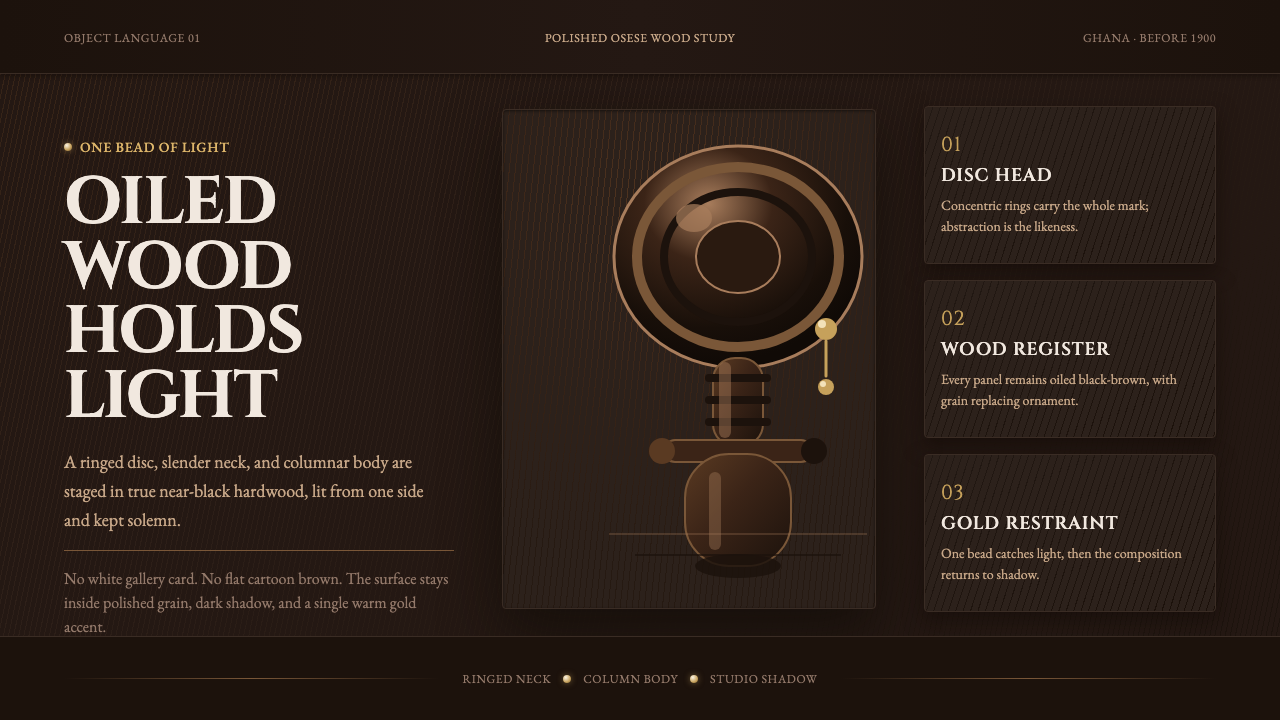 Akuaba Akan Fertility DollDarkness becomes sculpture. Near-black wood, ringed geometry, and one gold be…
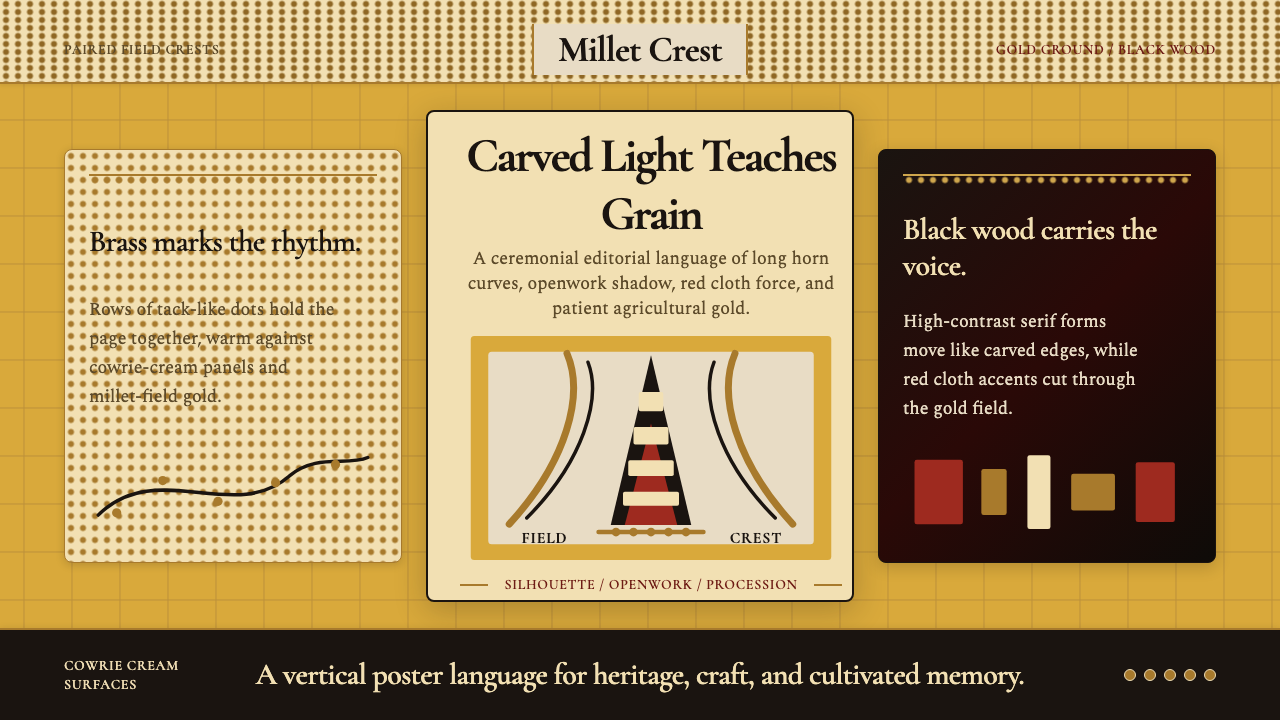 Bambara Chi Wara AntelopeCarved memory in gold. Black serif silhouettes and brass-dot borders carry th…
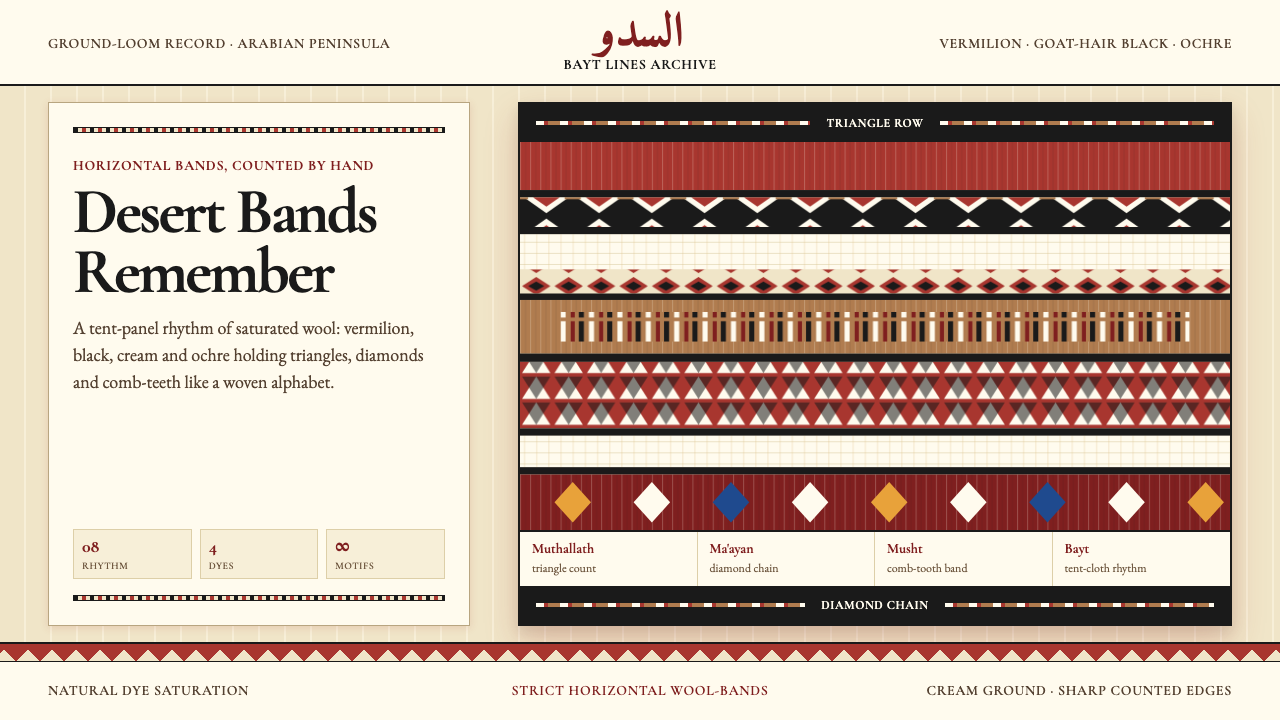 Bedouin Desert Textile (Sadu)Woven memory, not ornament. Vermilion-black bands count triangles and diamond…