What is Kufic Square Arabic?
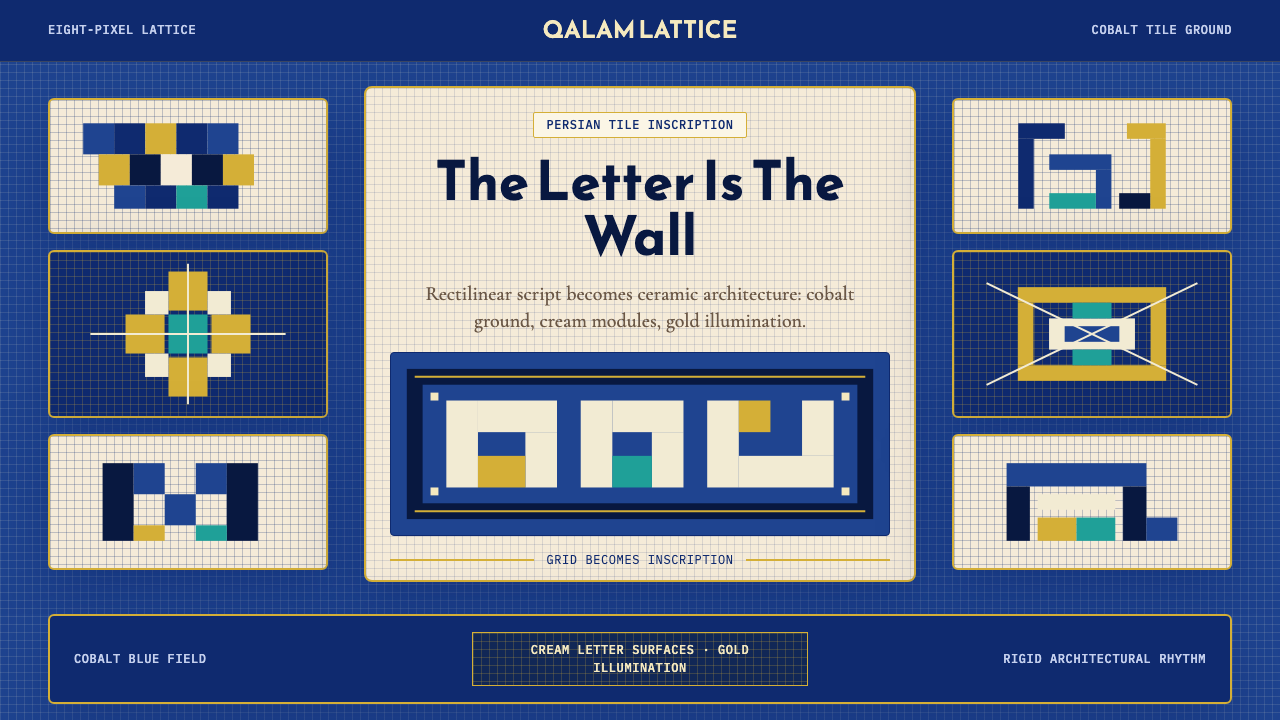
Square Kufic turns Arabic script into pure right-angle geometry — every letter a Tetris-like module locked to a rigid grid, born from centuries of Persian tile craft.
Kufic Square Arabic in brief
Square Kufic, known in Persian as Kufic-e Banna'i or 'bricklayer's Kufic', is a branch of the ancient Kufic script tradition in which every letterform is reconstructed as a right-angle assembly of square modules. Unlike the fluid cursive of everyday Arabic writing, Square Kufic admits no curves, no diagonal strokes, and no decorative flourishes — only horizontal and vertical lines meeting at perfect ninety-degree corners, building characters the way a mason builds a wall: unit by unit, course by course.
The visual result is unlike any other script tradition in the world. Words and phrases dissolve into dense, interlocking geometric lattices that must be read slowly and deliberately, often requiring the eye to trace the negative space between filled modules as much as the filled modules themselves. This ambiguity between figure and ground — where tile and gap are equally active — gives Square Kufic compositions an architectural presence that feels closer to a floor plan or a woven kilim than to a page of text.
As a contemporary design system, Square Kufic offers a powerful visual vocabulary rooted in Islamic geometric tradition: a cobalt ground that references Persian mosque tilework, cream letterform surfaces that recall unglazed terracotta, gold accent lines that echo the illuminated borders of Timurid manuscripts, and an unwavering grid logic that turns every layout decision into a structural statement. It is a style that does not ornament — it constructs.

Where does Kufic Square Arabic come from?
Kufic script takes its name from the Iraqi city of Kufa, one of the earliest centers of Arabic literacy, where the first angular, horizontal-heavy form of written Arabic emerged in the seventh century. Early Kufic was not a single script but a family of regional hands unified by their rectilinear bias — a sharp contrast to the rounder Naskh script that would eventually dominate book production. By the ninth and tenth centuries, Kufic letterforms were being carved into stone, cast in bronze, and painted onto ceramic surfaces across the Islamic world, functioning as the prestige script for Quranic manuscripts and royal inscriptions.
Square Kufic as a distinct geometric practice crystallized in eleventh-century Persia, driven by the demands of large-scale architectural inscription. The challenge facing mosque builders was this: how do you inscribe a Quranic phrase around the exterior of a dome, across a portal arch, or over an entire wall surface, when the letters must be legible from a distance, durable in tile, and visually consistent with the surrounding geometric ornament? The answer was to abandon the calligraphic model entirely and rebuild each letterform from the same square tile unit used for the surrounding mosaic. The letter and the tile field became one system.
The tradition reached its peak of ambition and refinement during the Timurid period of the thirteenth through fifteenth centuries, when the great mosque complexes of Yazd, Isfahan, Shiraz, and Samarkand were constructed and decorated. In these buildings, Square Kufic inscriptions wrap entire iwans and minarets in continuous textual bands, their cobalt-blue tile letters reading simultaneously as scripture, as architectural ornament, and as geometric pattern. The Alhambra in Granada, built under the Nasrid dynasty in the thirteenth and fourteenth centuries, brought the tradition to Andalusia, where it fused with local Moorish ornamental vocabularies.
After centuries of relative dormancy as a living practice — surviving mainly in architectural preservation and scholarly documentation — Square Kufic underwent a significant revival in the twentieth and twenty-first centuries. Calligraphers and graphic designers working across Iran, the Arab world, and the diaspora began exploring the script's grid-based logic as a framework for contemporary typography. Figures such as Hassan Massoudy, Bahram Shabahang, and Reza Abedini engaged with the geometric tradition not as a nostalgic exercise but as a genuinely structural design system compatible with digital grids and screen-based composition. In this form, Square Kufic entered the vocabulary of contemporary Islamic modernism — a bridge between a millennium of tile craft and the pixel grid of the present.
What defines the Kufic Square Arabic look?
Grid Architecture
Every element in Square Kufic — letterform, border, background fill, and negative space — snaps to the same square-module grid. Nothing exists between grid units; nothing spans a fractional increment. This absolute modularity means that the grid itself is the design system: change the module size and the entire composition scales proportionally. The discipline echoes the kashi-kari tilework tradition from which the script emerged, where individual glazed squares were the indivisible atoms of the whole.
Color Field
The canonical palette is structured around three roles rather than three hues. A deep cobalt blue — saturated and cool, referencing Persian mosque tile — occupies the ground field. A warm cream or unglazed-terracotta tone fills the letterform surfaces, providing luminous contrast without the harshness of pure white against the cobalt. Gold — a thin, linear accent rather than a fill — appears at borders, tile seams, and decorative bands, functioning as the illumination tradition of manuscript culture translated into architectural line.
Right-Angle Letterforms
In Square Kufic, curves are structurally forbidden. Every letter that would ordinarily contain a circular or diagonal element — the rounded belly of ba, the curved sweep of sad, the descending loop of qaf — must be reinterpreted as a staircase of square modules or an L-shaped right-angle construction. The scribal challenge is to maintain legibility while imposing this constraint: skilled Square Kufic composition preserves enough of the letter's topological identity that a trained eye can decode the text, even when any one letterform might be mistaken for a purely abstract geometric fragment.
Figure-Ground Ambiguity
One of the most distinctive perceptual qualities of Square Kufic is the active role of the negative space. Because letters are built from the same module type as the surrounding field, the eye constantly oscillates between reading the filled modules as letters and reading the empty modules as letters. Many compositions are deliberately reversible: the cobalt ground resolves into text when read one way, and the cream letterforms resolve into an independent geometric pattern when the reading logic is reversed. This figure-ground oscillation is not a byproduct but a feature, celebrated in tile compositions where dual readings were understood as an emblem of divine complexity.
Compositional Density
Square Kufic compositions are dense by nature: the grid must be packed tightly enough that letters remain identifiable and the overall panel reads as inscription rather than decoration. Unlike open-field calligraphy where generous spacing is a mark of refinement, Square Kufic rewards compression. Skilled compositions fill eighty to ninety percent of the panel surface with active module, leaving the minimum negative space required to distinguish letterforms. This density gives the style its monumental, wall-like quality — a visual weight that anchors rather than floats.
Symmetry and Rotation
Large-format Square Kufic panels — particularly those designed for square architectural fields such as tile dados and portal spandrels — often employ four-fold rotational symmetry, with the inscription arranged so that the same phrase reads correctly from all four orientations of the panel. This is not merely decorative; it reflects a theological principle that divine text has no privileged direction. In contemporary applications, this rotational logic translates to layouts that can be viewed in multiple orientations without losing structural coherence — a property well-suited to flexible digital formats.
Border and Frame Logic
Square Kufic compositions are almost never borderless. The tradition calls for one or more framing bands — typically rendered in the gold accent color — that separate the inscription field from its architectural surround. These borders are themselves part of the grid system, occupying a fixed number of module widths and establishing the outer boundary within which all letterforms must resolve. In digital applications, this border logic translates to contained cards and panels with explicit rule lines rather than floating elements with soft shadows. The frame is structural, not decorative.

Who shaped Kufic Square Arabic?
A leading contemporary Iranian calligrapher who has worked extensively with Square Kufic as a living compositional practice rather than an archaeological subject. Abdolali's panels demonstrate how the strict grid constraint of the script can generate compositions that feel simultaneously ancient and rigorously modern — the same modularity that governed eleventh-century tilework governs his ink-on-paper studies. His work has been central to establishing Square Kufic as a serious framework for contemporary Arabic typography beyond architectural restoration.
An Iraqi-born calligrapher based in Paris whose career spans traditional Arabic scripts including Kufic and their reinterpretation through contemporary expressive and geometric approaches. Massoudy is notable for engaging with the structural logic of early Kufic forms and translating them into large-format compositions that operate as both text and visual art. His published books on Arabic calligraphy have been foundational texts for designers approaching the Kufic tradition from outside the classical training lineage.
An Iranian designer and researcher who has worked systematically on the computational and grid-based underpinnings of Square Kufic, documenting the modular rules that govern authentic historical compositions and developing frameworks for applying those rules to contemporary type design and digital layout. Shabahang's contribution is methodological as much as aesthetic: he has made the internal logic of the script legible to designers without classical calligraphy backgrounds, enabling more rigorous and structurally coherent contemporary applications.
One of the most internationally prominent Iranian graphic designers, whose poster work and book design has brought Islamic geometric typography — including Kufic-derived letterforms — to global design audiences through exhibition and publication. Abedini does not work exclusively in Square Kufic but has engaged with the script's structural logic as part of a broader investigation of how Persian visual culture can generate authentic contemporary design languages without resorting to decorative pastiche. His practice is a model for how historical scripts can be used as structural systems rather than stylistic quotations.
The anonymous master builders and tile artisans of the Nasrid dynasty who constructed and decorated the Alhambra complex in Granada between the thirteenth and fourteenth centuries are collectively among the most significant figures in the Square Kufic tradition. The Alhambra's muqarnas ceilings, stucco panels, and tile dados contain some of the most complex and sophisticated Square Kufic compositions ever produced, integrating inscription, geometric ornament, and architectural structure into a single unified surface system. Their work remains the most frequently cited historical reference for contemporary designers working with the style.
How do you use Kufic Square Arabic today?
Square Kufic is a structurally demanding style to apply well, because its authority comes entirely from grid discipline. The temptation — particularly for designers unfamiliar with the script — is to treat the cobalt-and-gold palette and the geometric motifs as decorative elements that can be layered over an otherwise conventional layout. This produces pastiche. Authentic application requires that the grid governs everything: margins, column widths, spacing between elements, and the proportions of any geometric ornament must all resolve to the same underlying modular unit.
For presentation slides, Square Kufic works with particular force on cover pages where a single dominant composition — an inscription panel, a geometric border frame, or an abstract grid of interlocking modules — anchors the visual hierarchy. The cobalt ground with cream text creates immediate high contrast that reads well at distance across a conference room. Content slides benefit from the style's border logic: enclose each text block or data panel in a rule-line frame, use the gold accent sparingly at section headers or divider lines, and treat each slide as a contained tile within a larger structural sequence. Data visualizations — bar charts, comparison matrices, flow diagrams — take on a diagrammatic solidity when their containers are drawn in the same ruled-line vocabulary as the surrounding layout.
For web interfaces, the style is particularly well-suited to dashboards, pricing pages, and feature comparison tables where the primary task is hierarchy and scannability. Define a strict grid system where every column, gutter, and row height is a multiple of the same base unit. Use the cobalt ground for the navigation bar or sidebar, cream or near-white for content areas, and gold rule lines for horizontal dividers and card borders. Interactive states — hover, active, selected — can be marked by shifting the ground color from cobalt to a slightly lighter or darker variant rather than introducing a new hue. Avoid soft drop shadows entirely; when elevation is required to indicate layering, use a hard-offset shadow in the accent color or the dark cobalt tone.
For editorial and marketing work, Square Kufic's density and monumentality make it effective for covers, chapter openers, and section dividers where the goal is visual authority rather than narrative flow. A marketing landing page can use the style's tile logic to organize feature blocks: each block sits in a ruled-line container, cobalt and cream alternate as background colors across blocks, and the gold accent appears only at calls to action and key data points. For longer-form editorial layouts, the border-frame logic translates naturally to pull-quote treatments and sidebar callouts — a small ruled rectangle with a gold rule at top and bottom distinguishes editorial asides from main body text without requiring color shifts.
A common and serious mistake when applying Square Kufic is treating the gold accent as a fill color rather than a line color. In the historical tradition, gold appears as a thin illuminating line — a seam between tiles, a border around a panel, a ruled frame — not as large solid areas. When gold is used at area scale, it competes with the cobalt ground for dominance and the three-tone hierarchy collapses. A related mistake is abandoning the grid when dealing with non-geometric content like photography or freeform text: Square Kufic requires that even images be cropped and placed on the grid. A photograph that bleeds to a non-modular edge undermines the entire structural logic of the system.

Kufic Square Arabic — FAQ
Do I need to use actual Arabic letterforms to apply Square Kufic, or can I use just the geometric aesthetic?
This is the most important question to answer before starting any project in this style. Square Kufic, at its core, is a writing system — the geometric patterns are legible text, not decorative abstraction. Using the grid, color palette, and border logic without actual Arabic script produces a geometric style that references Islamic architecture, but it is not Square Kufic. This distinction matters both aesthetically and ethically: aesthetically, because the figure-ground ambiguity and the density that give the style its power emerge specifically from the letter-tile relationship; ethically, because treating religious Quranic inscriptions as decorative surface risks cultural disrespect. Designers working without Arabic literacy should collaborate with a calligrapher or typographer trained in the tradition, and should be explicit with clients about whether a project uses authentic inscription or geometric reference.
How does Square Kufic handle legibility when the letterforms are so geometrically abstract?
Legibility in Square Kufic operates differently from conventional typography. In standard scripts, legibility is a function of letterform distinctiveness — each character is identifiable in isolation. In Square Kufic, legibility is contextual and trained: a reader familiar with the script learns to recognize whole words or phrases from their overall grid silhouette rather than parsing individual letters sequentially. For this reason, shorter texts — a divine name, a Quranic phrase of two to five words, a building dedication — are the traditional domain of the script. Very long passages become illegible even to trained readers without extensive spatial context. In contemporary applications, this means Square Kufic is most effective as a headline or identity element rather than as body text, and the content should be kept brief enough that the overall compositional silhouette encodes the meaning.
Can Square Kufic be used in a light or white background context, or does it require the dark cobalt ground?
The cobalt ground is historically canonical but not structurally mandatory. Inversions — cream or white ground with cobalt letterforms — are documented in historical tilework where the surrounding architectural field was light-toned, and they appear in contemporary applications where digital context favors light interfaces. The inversion works well provided the three-role structure is maintained: a dominant ground tone, a contrasting letterform tone, and a third accent tone for borders and seams. What does not work is reducing the system to two tones without the accent, or using the cobalt as an area accent rather than a ground — this undermines the compositional depth that the three-tone hierarchy creates. A light-ground variant can also use deep navy or charcoal instead of cobalt as the letterform color, particularly in contexts where full-saturation cobalt feels too intense for extended reading.
What is the difference between Square Kufic and other geometric Islamic patterns like Girih or Arabesque?
Square Kufic, Girih, and Arabesque are three distinct traditions within the broader field of Islamic geometric art, and conflating them is a common error in Western design writing. Square Kufic is specifically a writing system — its geometric patterns encode Arabic text, and their meaning is semantic and linguistic. Girih is a non-representational geometric tiling tradition, most famously documented in the Darb-i Imam shrine in Isfahan, which generates complex star and polygon patterns from a small set of five tile shapes; it encodes no text and has no linguistic meaning. Arabesque is a curvilinear vegetal ornament tradition — spiral vine scrolls and interlacing foliage — that is antithetical in its formal character to the right-angle rigidity of Square Kufic. In architectural settings, all three traditions often appear together on the same building, occupying different surfaces and performing different roles. In design applications, mixing their visual vocabularies tends to produce incoherence unless the project is explicitly about the coexistence of multiple Islamic ornamental traditions.
Is Square Kufic appropriate for non-Islamic brands and contexts, or does its religious origin make it culturally specific?
The answer depends on how the style is used and with what content. Square Kufic as a geometric-grid visual system — the cobalt-cream-gold palette, the strict modularity, the border-frame logic — draws on an architectural and aesthetic tradition that has influenced design across cultures for centuries and can be applied in secular contexts with care and transparency. However, using actual Quranic inscriptions as decorative elements for commercial brands outside Islamic religious contexts is a different matter and risks genuine cultural offense. The practical guideline: the visual system is transferable; the specific sacred texts are not. Designers working with brands outside the Islamic tradition who want to reference Square Kufic should work either with abstract geometric compositions that reference the grid logic without using specific inscriptions, or with secular Arabic texts appropriate to the context — and in either case should engage a cultural consultant or calligrapher who can advise on the boundaries of respectful application.
Related design styles
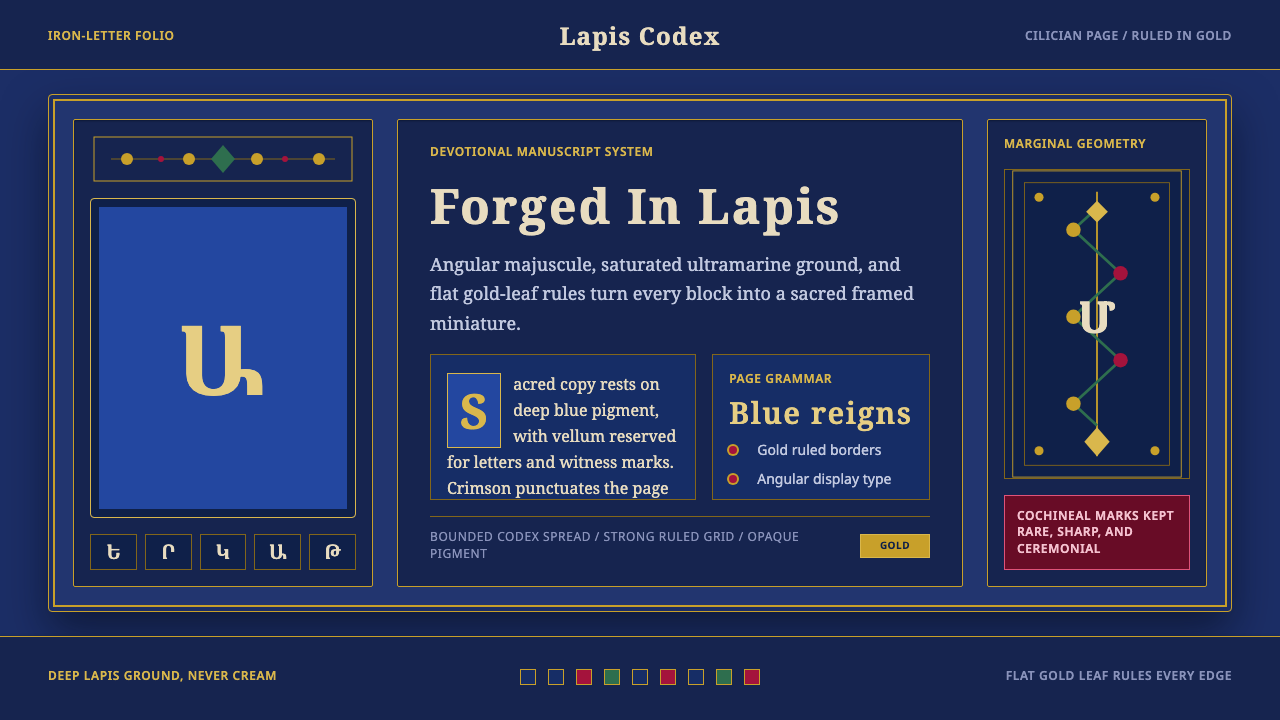 Armenian ErkatʿagirDevotional lapis reigns. Gold rules and angular serif glyphs frame a sacred g…
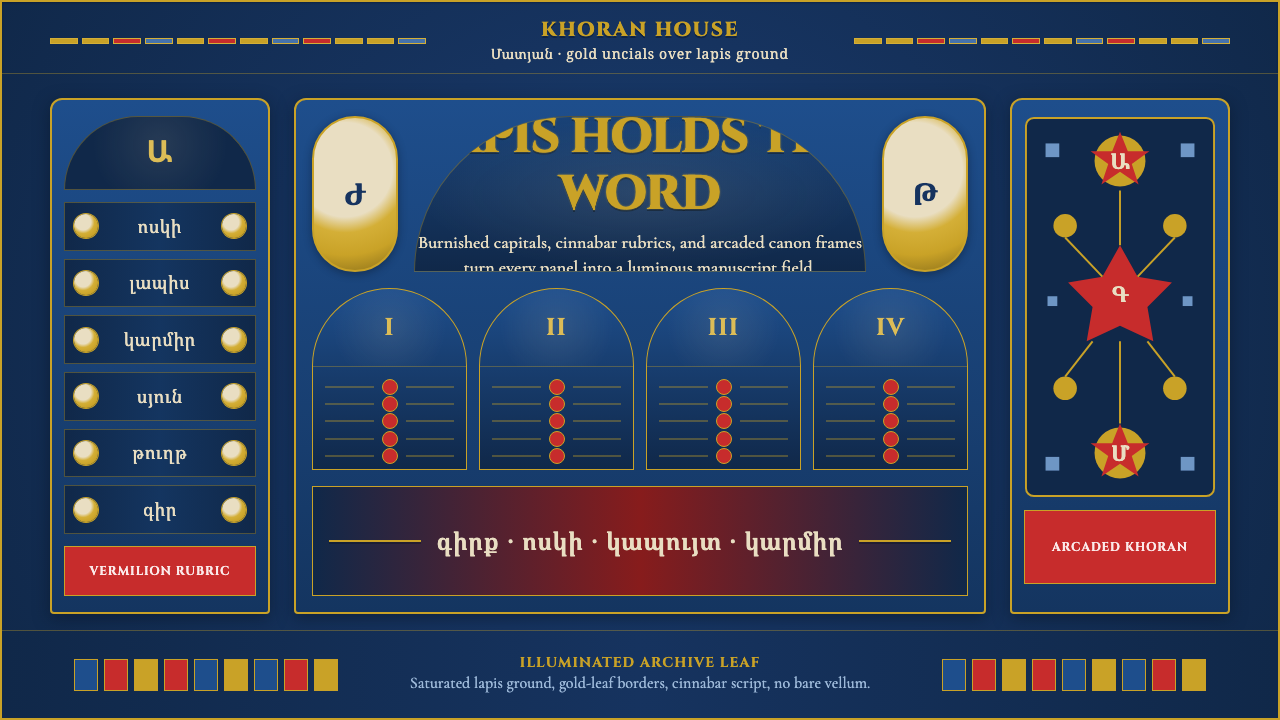 Armenian Manuscript FolkloreJewel-dense devotion. Lapis ground, gold uncials, and vermilion arcades fill…
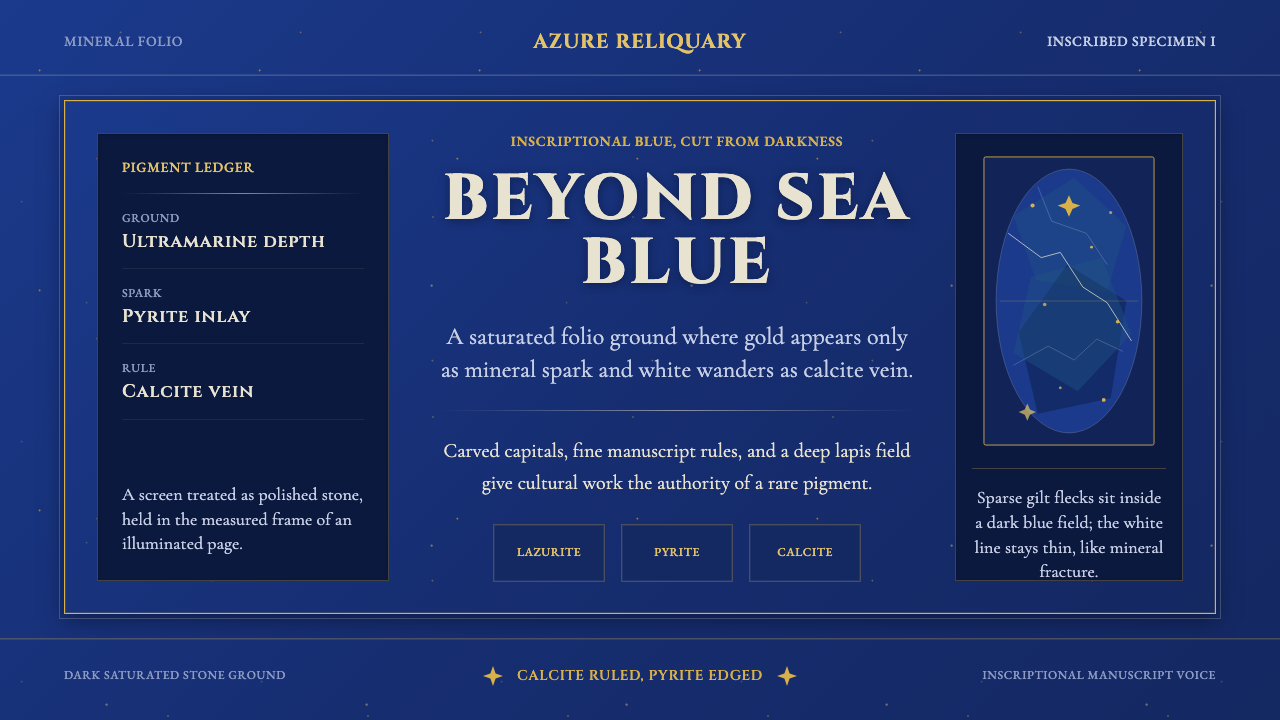 Badakhshan Lapis LazuliStone as manuscript. Ultramarine field, pyrite flecks, calcite veins, carved…
 Herat Friday Mosque TileHistory is built to be repaired. Cobalt fields lock turquoise stars into tile…
 Islamic Geometric ArtInfinite order, fully tiled. Lapis ground with gold girih lines and turquoise…
 Islamic Girih TilesSacred geometry glows. Cobalt tile, turquoise stars, and gold strapwork repea…