What is Komi-Permyak Ornament?
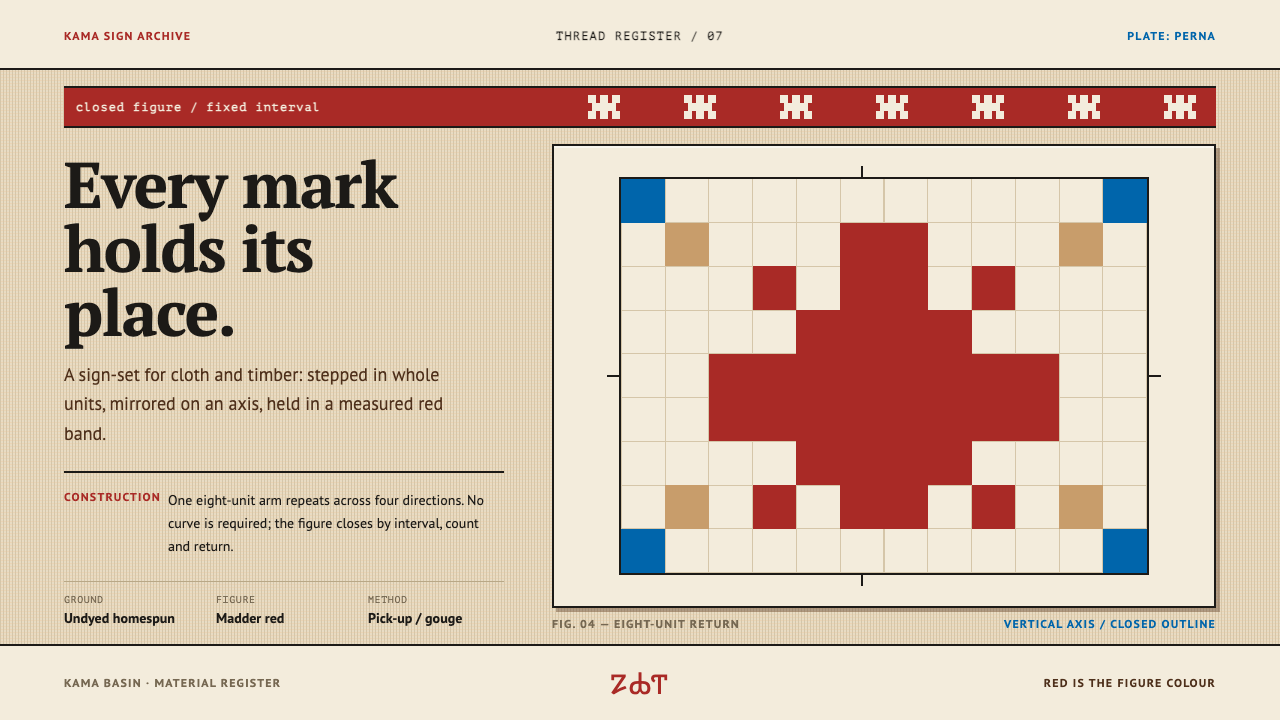
Komi-Permyak ornament is a vocabulary of stepped signs on which loom and chisel agree: nothing curves, everything counts in whole units, and a madder-red cross repeats across undyed cloth.
Komi-Permyak Ornament in brief
Komi-Permyak ornament is a closed set of signs that the loom and the chisel agree on. Its central figure is the perna, written перна in Cyrillic, a stepped solar cross that repeats in madder red across bands of undyed homespun cloth. The same figure is gouged into spruce porch boards and window surrounds along the Kama river. The result is a visual system that is at once textile and carpentry, and it is unlike anything built on curves.
Nothing curves. A pick-up float in weaving and a V-gouge in woodcarving both work in whole units, so every arm of every figure steps orthogonally or on the diagonal, and the figure mirrors around a vertical axis. The designs line up in bands, sit inside margins and repeat at fixed intervals. A homespun grid underlies it all: the cloth is the grid, and the pattern is what the grid allows.
Behind these signs lies an older layer. The Perm animal style produced bronzes and bone objects showing moose, birds and elk-headed men, and over the centuries those animal figures were flattened into the same stepped line. The palette is restrained: undyed cloth, madder-red figures, the sky blue and white of the regional emblem, the dark brown of weathered spruce and the green of bronze patina. This is Finno-Ugric ornament, not Russian folk souvenir.
Where does Komi-Permyak Ornament come from?
The ornament belongs to the Kama basin in Perm Krai, in the north-east of European Russia. It is a continuous sign-set that stretches back before 1900 and sits on top of a far older tradition, the Perm animal style, usually dated between the 7th century BCE and the 12th century CE. The region's peoples speak Finno-Ugric languages, and the ornament belongs to that family of cultures rather than to the Russian folk tradition that it is often loosely lumped with.
The Perm animal style gave the region its first visual language. Its bronzes and bone objects show moose, birds and elk-headed men, subjects drawn from the forest and the sky. Over the centuries these figures were simplified and flattened until they could be carried by the same line as everything else: straight, stepped and symmetrical. The older animals did not vanish so much as pass into the grammar of the stepped sign, which is why the ornament feels both archaic and abstract.
The key technical fact is that the loom and the chisel share a logic. Komi-Permyak браное weaving, a pick-up technique, raises threads in whole counted units. A woodcarver's V-gouge cuts in whole, readable steps. Neither tool can draw a smooth curve, and both find a stepped diagonal natural. The signs are therefore not a style imposed on the materials but what the materials produce when worked by hand. That agreement between tool, medium and pattern is the heart of the tradition.
The only named historical figure in this lineage is Stephen of Perm, the medieval missionary associated with the Christianisation of the Perm lands and with the writing of the Komi language. His presence reminds us that the region sat at a crossing of belief systems, between older forest religion and the new faith, and that the ornament survived as a sign language that crossed that boundary. Its makers, the weavers and carvers of the Kama, remain unnamed.
What defines the Komi-Permyak Ornament look?
Whole-Unit Logic
Loom and chisel both work in whole units, so every stroke follows the grid: orthogonal or at a diagonal, one step at a time. There are no curves, no fractional positions and no soft transitions. The grid is not applied from outside; it comes from the way the material is made, which is why the ornament feels so certain of itself.
The Stepped Solar Cross
The perna is the central sign: a cross whose arms climb in steps, read as a sun. It repeats in madder red across undyed cloth and appears gouged into spruce boards. Variations are made by adding or removing steps, never by bending a line. A single sign, repeated, carries the whole system's identity.
Mirror Symmetry
Figures are mirrored around a vertical axis, so left and right match exactly. The symmetry gives the ornament its stability and makes it easy to read at a glance, and it also makes the pattern easy to weave, since half the figure is simply reversed. Balance comes from mirroring, not from the weighted asymmetry of modernist layout.
Bands and Fixed Intervals
Signs run in bands, with margins at either side and repeats at fixed intervals. A band behaves like a line of text: it has a beginning, a rhythm and an end. Ornament is therefore a structural device that organises the cloth or board, not wallpaper that fills it. White space around the band matters as much as the band itself.
Restrained Palette
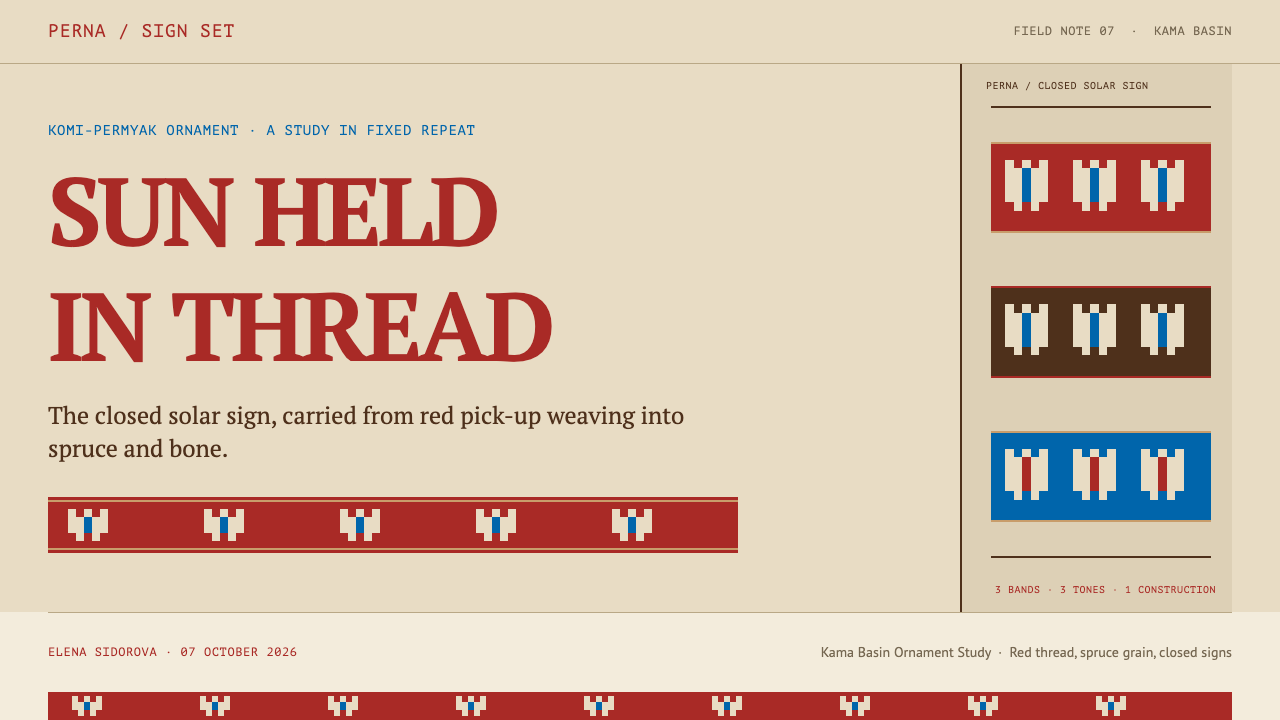
The ground is undyed homespun, an off-white that is the colour of the cloth itself, and the figures are madder red. Secondary colours come from the region's emblem, sky blue and white, and from its materials: the dark brown of weathered spruce and the green of bronze patina. Colours are few, each tied to a material or a place, and none is used decoratively.
Flattened Animals
The Perm animal style stands behind the ornament: moose, birds and elk-headed men, preserved in older bronzes and bone, were flattened over the centuries into the same stepped line. The animals are still there if you look, reduced to silhouette and rhythm. This gives the style a depth of reference that pure geometry would not have.
Who shaped Komi-Permyak Ornament?
The only named historical figure in this lineage, a medieval missionary associated with the Christianisation of the Perm lands and with the writing of the Komi language. He stands for the moment at which the region's older forest world met a new faith and a new written culture. The ornament, a sign language older than his mission, is one of the things that carried across that threshold.
The women and men who worked the браное pick-up technique on homespun cloth, lifting threads in whole counted units to build stepped figures in madder red. They are the principal makers of the textile side of the tradition. Their craft is the origin of the style's grid logic, since a weaver cannot place a mark between two threads.
The carvers of spruce porch boards and window surrounds along the Kama river, who cut the same stepped figures with a V-gouge. Their work shows that the ornament was an architectural language as well as a textile one. The weathered brown of old spruce is part of the style's palette, a reminder that the material ages in public.
The bronze and bone workers, active between the 7th century BCE and the 12th century CE, who made objects with moose, birds and elk-headed men. They are the deep background to the ornament: the animals they showed were gradually flattened into the stepped line. They matter because they show the abstraction was a long process of reduction, not a modern invention.
How do you use Komi-Permyak Ornament today?
Komi-Permyak Ornament is a style of structure, repetition and restraint. It suits work that wants to feel rooted, precise and calm, and it gives interface designers a ready-made reason to avoid rounded corners and soft effects. To apply it correctly, start from the grid and the repeat, not from the sign, and let ornament follow structure.
For presentation slides, a cover can run a single band of the stepped cross in madder red along one edge, on an undyed off-white ground, with the title set plainly beside it. Content slides should use a strict grid, with ornament bands as section dividers or footers rather than as decoration in the middle of the page. Data slides suit step charts and bar charts, since the stepped line is the style's native form, and curved lines or pie charts would be foreign to it.
For web interfaces, remove curves. Corners are square, borders are straight, charts use stepped lines, and icons are built on the diagonal. Dashboards and tables fit naturally, because the style is already a grid. Use madder red for key states and the off-white ground for surfaces, with the regional blue and white for occasional accents. Repeating patterns work best as a thin header or footer band, with generous margins, not as a background texture.
For editorial and marketing work, the style suits textile, craft, regional food and heritage brands, and any product that wants a quiet, handmade authority. Introduce the cultural context honestly: name the Komi-Permyak and Kama origins and avoid describing the ornament as generic Slavic folk art. A repeated band across the top of a page is often enough; the sign does its best work in small doses.
The most common mistake is to bring in curves. A floral flourish, a rounded button or a swirl immediately breaks the logic and turns the style into a souvenir. Another mistake is to fill the page with ornament as wallpaper; in the tradition, signs sit in bands with margins, and leaving space is part of the design. A third is to use the red everywhere; the cloth is mostly undyed, and the red is strong because it is rationed.
Komi-Permyak Ornament — FAQ
What is the perna?
The perna is the central sign of Komi-Permyak ornament: a stepped solar cross whose arms climb in whole steps. It is woven in madder red across bands of undyed homespun cloth and gouged into spruce porch boards and window surrounds along the Kama river. Because it is built from steps, it can be woven and carved with the same logic, which is why it appears across both media.
Why does nothing curve?
Because the tools cannot make one. A pick-up float in weaving and a V-gouge in woodcarving both work in whole units, so strokes run orthogonally or on the diagonal, one step at a time. The straight, stepped line is what these materials produce naturally, which makes the ornament feel inevitable rather than chosen. For a digital design, the lesson is to drop rounded corners and curved chart lines altogether.
Is this Russian folk art?
Not in the usual sense. It comes from the Kama basin in Perm Krai, and belongs to the Finno-Ugric family of cultures, with deep roots in the Perm animal style, rather than to the Russian folk-souvenir tradition it is often confused with. It is best described as Komi-Permyak ornament, and the specific name matters when you present it.
Which colours does the style use?
A restrained set. The ground is undyed homespun, an off-white, and the figures are madder red. Secondary colours include the sky blue and white of the regional emblem, the dark brown of weathered spruce and the green of bronze patina. Use red sparingly: the cloth is mostly undyed, and the red carries weight because it is limited. Avoid bright secondary hues that have no source in the materials.
Can a modern product use this ornament respectfully?
Yes, if it is done with understanding. Take the structural principles, whole-unit geometry, mirrored figures, bands with margins and a rationed palette, and apply them to products whose values fit, such as craft, textiles, heritage and quiet tools. Name the Komi-Permyak and Kama origins, and avoid pasting the perna as decoration on unrelated material, or mixing it with curved folk motifs from other traditions.
Related design styles
 Kyrgyz Shyrdak Felt RugCut felt becomes structure. Vermilion-indigo mirror blocks stitch positive to…
 Bulgarian Shevitsa Folk EmbroideryVillage-bright code. Deep indigo carries shevitsa red crosses and gold-cord b…
 Estonian Kihnu Island SkirtJoy is woven vertical. Madder red ground, Oswald stripes, black and green pin…
 Gorodets Folk Panel PaintingFolk color moves at a gallop. Blue forms, red roses and white dots spark on i…
 Māori Tā Moko (Facial Tattoo)Ancestry feels carved. Blue-black spirals on tan ground carry a restrained Ga…
 Marquesan PatutikiSoot meets skin without compromise. Solid black zones collide with comb-struc…